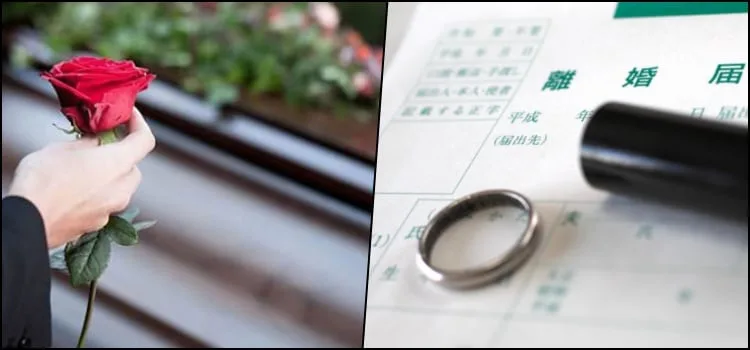
To file for divorce in Japan, both parties, husband and wife, must agree to the process. However, if one party passes away, the widow (er) can initiate a process known as shigo rikon (死後離婚 lit.: “divorce after death”).
This process is becoming increasingly common in Japan, especially among women who, in most cases, no longer want to have any relationship with the parents of the deceased spouse, as it is known that the widow (er) has a legal obligation to care for their aging in-laws.
How does posthumous divorce work?
If you want to sever ties with your in-laws, you only need to fill out an official form. The form asks for your personal information and the personal information of the deceased spouse.
The in-laws cannot interfere in this matter, nor do they receive an official notification of the divorce after the fact. A widow (er) can file this termination report at any time after the death of a spouse. There is no waiting period or deadline for its submission.
Although this process is not new, only today are Japanese people opting for Shigo Rikon because, due to social pressures, it was not customary to choose this type of procedure.
According to statistics compiled by the Ministry of Justice, the number of posthumous divorces grew only very gradually until 2013 (April 2013 to March 2014), when 2,167 forms were submitted.
The number of forms modestly increased to 2,202 in the fiscal year of 2014, but jumped more than 550 to 2,783 the following year, and by the end of 2016 reached 4,032, an increase of almost 50%.
Shigo Rikon and the traditional view
Since Japan was an agricultural country for much of its history, these traditional views come from villages where agricultural culture had a collectivist tendency.
Until the second half of the 20th century, most of the Japanese population were farmers and agricultural workers. When a woman married, she practically ceased to be part of her family and became part of her husband’s family and vice versa.
When a spouse passed away, the surviving party had the legal obligation to take care of their in-laws after the death of the husband/wife.
This legal obligation was even included in the Civil Code of Japan in the late 19th century, after the Meiji Restoration. However, this system was revoked after World War II, under the New Constitution.
It was after World War II that it became possible to sever marital ties even with the death of the spouse.
Shigo Rikon and the present day
These legal provisions included in pre-war Japan were abolished after World War II. However, the thinking behind them remains ingrained in the minds of today’s older Japanese.
However, industrialization caused the youth of the time to migrate to more urban areas. As a consequence, a different lifestyle was adopted, directly affecting this traditional view.
It has now become common for women to hold jobs outside the home. Many wives continue to work after marriage, just like their husbands. Thus, they help support the family financially while also managing the household and raising children.
This family style where both parents work demands a lot. Therefore, there are not many financial and emotional conditions to support the in-laws of the deceased spouse.
The Jigokudani park is a famous hot spring area near Nagano. The name Jigokudani (地獄谷 lit.: “Hell Valley”) is due to the steam and boiling water bubbling up from the frozen ground.
It is famous for its large population of wild snow monkeys that come to the valley during winter when the snow covers the park. The monkeys descend from the steep cliffs and the forest to sit in the warm hot springs and return to the safety of the forests at night.
Attractions of Jigokudani Park
Jigokudani park offers visitors the unique experience of seeing wild monkeys bathing in a natural hot spring.
The park is inhabited by a species of Nihonzaru (日本猿 lit.: “Japanese monkeys”), which are known as Snow Monkeys.
It is located in the natural habitat of this species, in the forests of the Jigokudani valley in Yamanouchi, not far from the towns of Shibu and Yudanaka.
The park has an artificial pool where the monkeys gather, just a few minutes from the park entrance.
The park has an information center in Japanese. However, there is an explanation about the alpha male system of the monkeys in English, as well as portraits of the alpha males.
The monkeys of Jigokudani Park
Although the park is open year-round, the monkeys are particularly photogenic when the area is covered in snow.
Generally, there is snow from December to March, and the best time to visit is between January and February.
The monkeys usually enter the bath, but they need some encouragement from the park staff throwing food into the pool.
Accustomed to humans, the monkeys can be observed up close and usually ignore their human guests. It is prohibited to touch or feed the monkeys.
Visitors will likely encounter monkeys along the way to the pool. The monkeys live in large social groups, and it can be quite fun to observe their interactions.
Access to Jigokudani Park
There are two paths to the park. One requires a 25 to 40-minute walk through the forest, while the other requires a 10 to 15-minute walk from the nearest parking lot.
The first approach involves taking a bus to Kanbayashi Onsen from Yudanaka Station (10 to 15 minutes), Shibu Onsen (5 to 10 minutes), or Nagano Station (40 minutes).
Buses on the Yudanaka-Kanbayashi line stop at the Kanbayashi-Onsen bus stop. Meanwhile, other buses stop at the Snow Monkey Park.
From Kanbayashi-Onsen, it is a 30 to 40-minute walk to the monkey park. The walking trail is accessible year-round, but sturdy footwear is recommended, especially in winter.
The alternative route involves a 10 to 15-minute walk from a paid parking lot just west of the monkey park. However, the narrow road from Shibu Onsen to the parking lot is not open to public transport and is closed in the winter.
Although time-consuming, it is possible to walk to the parking lot of Shibu Onsen in about 45 to 60 minutes.
Many know the flag Hinomaru, which has been Japan’s current flag since 1870. However, before this flag came into use, there were other flags or symbols used to represent the country, some separate territory, or some specific period in Japanese history.
Check out the timeline of Japanese flags below:
Note: Japan only began using a national flag during the period of the Tokugawa Shogunate. Before that, Japan, having been governed by different clans, had emblems known as Mon (紋 lit.: “crest”) that represented the clans that ruled during their respective periods, but it is not known if they were considered a national symbol.
1. Kamakura Shogunate (1185 – 1333)
Initially, this was the emblem used to represent the Minamoto clan that governed Japan between the 12th and 14th centuries.
Later, due to the fall of the Minamoto clan caused by a coup by the Ashikaga clan in 1333, Japan was left without a symbol to represent it as there was no government between 1333 and 1336.
Then, in 1336, Takauji Ashikaga took power and established a new shogunate, and a new emblem was imposed to represent the new government.
2. Ashikaga Shogunate (1336 – 1573)
This was the emblem that represented the government of the Ashikaga clan between the 14th and 16th centuries. However, the emblem stopped being used after Yoshiaki Ashikaga was deposed, thus beginning the Azuchi-Momoyama period.
3. Azuchi-Momoyama Period (1573 – 1600)
On the left: Mon of the Oda Clan (1573 – 1583) and on the right: Mon of the Toyotomi Clan (1583 – 1600)
The Oda clan and the Toyotomi clan were responsible for the end of the Ashikaga Shogunate and thus governed Japan for 27 years. Subsequently, Japan had two emblems to represent the government of the two clans.
In 1600, the Azuchi-Momoyama period came to an end, and the Tokugawa clan established a new shogunate.
4. Tokugawa Shogunate (1600 – 1868)
On the left: Flag of the Tokugawa Shogunate and on the right: Mon of the Tokugawa Clan
For the first time, Japan had a flag to represent its state. The flag of the Tokugawa Shogunate is white with a black stripe in the middle.
However, despite having a flag to represent this period, generally the Mon of the Tokugawa Clan is used to represent the period in the historical context.
Subsequently, the flag and emblem were replaced by the Hinomaru after the Meiji Restoration in 1868, which is used to this day.
5. Empire of Japan (1868 – 1947)
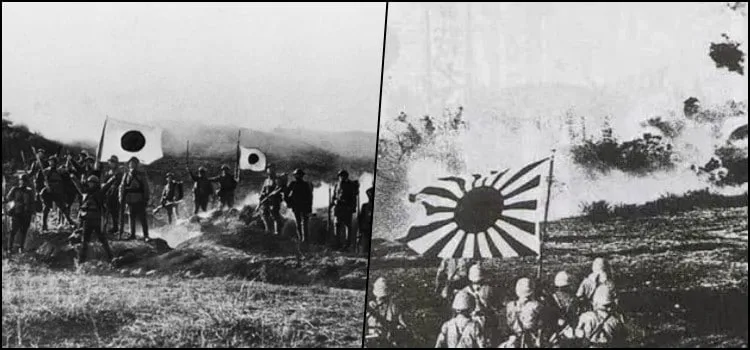
On the left: Hinomaru used to this day and on the right: Kyokujitsuki used in wars and now used by the Japan Maritime Self-Defense Force
The Hinomaru is white with a red disc that represents the Rising Sun. The flag was first used in 1870, after the end of feudal Japan and the Meiji Restoration. Officially, it was named Nisshōki (日章旗 lit.: “Flag of the Sun’s Mark”), however, it was only considered official in 1999, many years after the dissolution of the Imperial Japan.
In the image above on the right is the kyokujitsuki (Rising Sun Flag). It is officially used by the Japan Maritime Self-Defense Force.
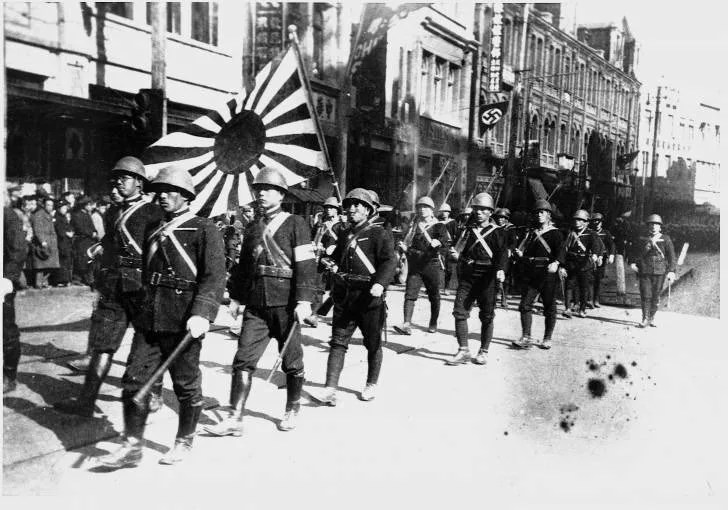
However, the Kyokujitsuki also carries the nationalist and imperialist sentiment of Japan, especially in World War I and II as it was used by the Japanese army during those times.
Thus, the liberal use of the Kyokujitsuki in Japan today has become controversial in China and Korea due to historical conflicts.
6. Hinomaru Flag (1947 – present)
This is the (slightly) modified version of the Hinomaru. The change occurred in the color of the circle, changed to a darker shade.
The current flag is a modified version of the Hinomaru and was officially adopted only in 1999. Its origin goes back a long time before, it was in 1870 that Hinomaru was first officially recognized as a merchant flag. It took more than 100 years to become the official symbol of Japan.
If you want to know more about the Japanese flag, we have an article that talks about the curiosities of the flag of Japan. If you liked the article, share it and leave your comments.
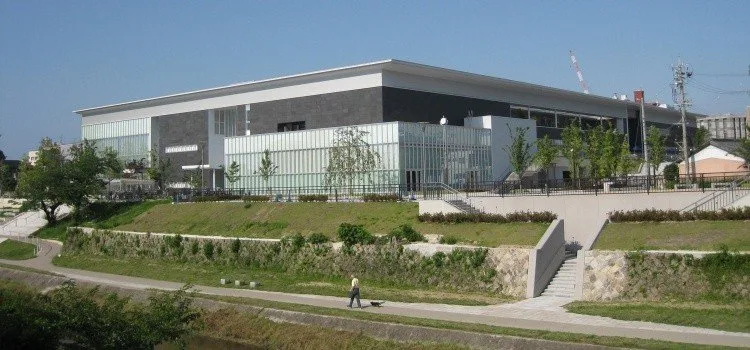
We know that the Japanese enjoy reading, so much so that there are thousands of mangas, light novels, and books released weekly. Even in bathhouses, you can find a library or a shelf of books to read. In this article, we will show what a municipal library in Japan (市立図書館 – Shiritsu toshokan) is like.
Why are we going to talk specifically about municipal libraries in Japan? To show that the Japanese government truly cares about the education of the population and invests heavily in knowledge and culture instead of leaving the population ignorant to manipulate them… And of course, a library in Japan is something amazing to see!
Municipal libraries in Japan are public places maintained by the taxes of the population that allow any local citizen to borrow books or research and read on-site. Of course, each city has its library that may vary, but many look gigantic like an airport and go far beyond books.
A municipal library in Japan
Japanese municipal libraries can go far beyond a place that offers books. They can host shows, presentations, and offer courses and other interesting opportunities. Some have several floors and support other languages, showing how well public money is spent in Japan.
You can even find studios and museums in a library in Japan.
Some libraries even offer books in Portuguese. You can read on-site and notice that the libraries are full of people and not a desert as it usually is in our dear Brazil. To borrow any book, just register at a municipal library in Japan.
We will leave a video below that shows in detail what a library in Japan is like:
Some characteristics of libraries in Japan
Some municipal libraries in Japan even dispense with contact with staff. There are libraries where you simply enter and take the book without presenting documents or filling out forms. After reading, you don’t even need to put it back in place; just leave it in a designated area, and the staff will put it back on the shelves.
There are screens that can help you find the exact location of a book on a specific floor or section. The first time you want to take a book home, you will need to register and receive a magnetic card that will be used to borrow and return books.
In addition to books, you will find huge areas to rest and relax while you read. Moreover, in these libraries in Japan, you find copiers, internet, tables, children’s areas, and parking lots like those in shopping malls. All of this is free! And you will also find convenience stores and restaurants on-site or nearby.
Some libraries have over 500,000 books and can be open every day. Japanese libraries are a great source of envy and one of the reasons Japan is an organized, peaceful, and prosperous country. What do you think of Japanese libraries? What do you think about sharing so that people know the importance of knowledge?
Nanjing was where one of the greatest catastrophes occurred in the war against Japan. The Nanjing Massacre was an episode of murder and mass rape committed by Japanese troops against the residents of Nanjing, then the capital of China, during the Second Sino-Japanese War (1937 – 1945). The massacre took place between December 1937 and January 1938, after the capture of the city.
During this period, soldiers of the Imperial Japanese Army murdered Chinese civilians and disarmed combatants, totaling around 40,000 to over 300,000. The troops also committed rapes and looting in the city.
As most of the Japanese military records regarding the murders were kept secret or destroyed shortly after Japan’s surrender in 1945, historians were unable to accurately estimate the death toll of the massacre.
Japan’s Invasion of Chinese Territory
In August 1937, the Japanese army invaded Shanghai, where they encountered strong resistance, suffering casualties. The battle was bloody as both sides had friction in close combat. By mid-November, the Japanese captured Shanghai with the help of naval bombardments.
The General Staff Headquarters in Tokyo initially decided not to expand the war due to heavy casualties and low troop morale.
However, on December 1, the headquarters ordered the troops to capture Nanjing. After losing the battle of Shanghai, Chiang Kai-shek, the general of the Chinese army, knew that the fall of Nanjing was a matter of time.
Chiang Kai-shek’s Plan
Chiang Kai-shek
He and his team realized that they could not risk the annihilation of their elite troops in a symbolic, but hopeless, defense of the capital. To preserve the army for future battles, most were withdrawn. Chiang’s strategy was to follow the suggestion of his advisors. The strategy involved luring the Japanese army to the capital and using the territory as a defensive force.
Chiang planned to wage a prolonged war of attrition to wear down the Japanese in the interior of China. In a statement, Commander Tang Shengzhi announced that the city would not surrender and would fight to the death.
Tang gathered about 100,000 soldiers, mostly inexperienced, including Chinese troops who participated in the Battle of Shanghai. To prevent civilians from fleeing the city, he ordered the troops to guard the port, as instructed by Chiang Kai-shek.
Kai-shek speaking
The defensive force blocked roads, destroyed boats, and burned nearby villages, preventing evacuation. This rejection of Kai-shek’s ceasefire plan sealed the city’s fate.
Nanjing had been constantly bombarded for days. The Chinese troops that remained there were demoralized and began to drink before the inevitable fall of the city. The Japanese military continued to advance, breaking through the last lines of Chinese resistance and reaching the gates of Nanjing on December 9.
At noon on December 9, the Japanese military dropped pamphlets in the city, demanding its surrender within 24 hours. Meanwhile, members of the Committee contacted Tang and proposed a three-day ceasefire plan. The Chinese troops could withdraw without fighting while the Japanese troops would remain in their current position.
The Capture of the City of Nanjing
The Japanese waited for a response to their surrender request. However, no response was received by the deadline of December 10. General Iwane Matsui waited another hour before issuing the command to take Nanjing by force.
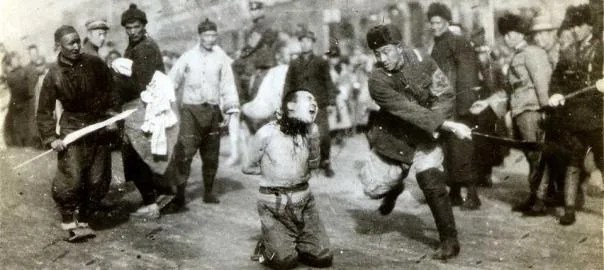
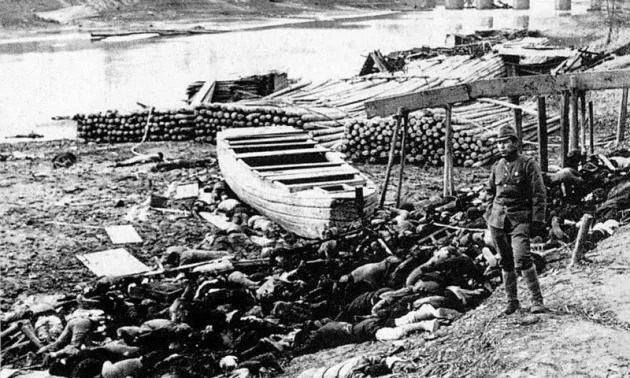
Prisoner about to be decapitated by Japanese soldier (left photo) and Japanese soldiers using prisoners to train bayonet attacks (right photo)
The Japanese army mounted its attack on the walls of Nanjing from multiple directions: The 16th Division attacked three gates in the east, the 6th Division launched its offensive in the west, and the 9th Division advanced into the intermediate area.
On December 12, under heavy artillery fire and aerial bombardment, General Tang Sheng-chi ordered his men to retreat. From then on, it was nothing less than chaos. Some Chinese soldiers stole civilian clothes in a desperate attempt to blend in. Others were shot by the supervising unit while trying to flee.
The Massacre Committed by Japanese Troops
Eyewitness accounts from foreigners and Chinese present in the city reported Japanese troops committing murder, theft, arson, and other war crimes. Some of the accounts came from foreigners who chose to stay behind to protect Chinese civilians.
Other accounts include first-person testimonies from survivors of the Nanjing Massacre, eyewitness accounts from journalists, as well as field diaries from military personnel. In 1937, the Osaka Mainichi Shimbun newspaper covered a “dispute” between the officers, Toshiaki Mukai and Tsuyoshi Noda.
Newspaper citing Mukai and Noda | Toshiaki Mukai (left) and Tsuyoshi Noda (right)
The two men competed to be the first to kill 100 people with a sword before the capture of Nanjing. Both surpassed their goal during the battle, making it impossible to determine which officer had actually “won” the competition. Therefore, they decided to start another competition to kill 150 people.
Subsequently, after Japan’s surrender in 1945, both Mukai and Noda were arrested and tried as war criminals. Both were found guilty and executed by firing squad.
Rape of Women and Children
During the occupation of the city, Chinese women were abducted and used as sex slaves. These women became known as “comfort women.” In the photo: A Japanese soldier with two comfort women.
It is estimated that around 20,000 Chinese women were raped during the occupation. A large number of rapes were committed by Japanese soldiers. They went door to door, looking for women to be captured and raped.
Initially, the women were killed immediately after being raped. They were often killed through explicit mutilations. Young children were not exempt from these atrocities and were also captured so that Japanese soldiers could rape them.
Withdrawal of Troops, End of Occupation, and Trial
At the end of January 1938, the Japanese army forced all refugees from the Safety Zone to return home, claiming to have “restored order.” After the establishment of the collaborating government in 1938, order was gradually restored in Nanjing and the atrocities of the Japanese troops decreased considerably.
On February 18, 1938, the International Committee of the Nanking Safety Zone was renamed to the “International Rescue Committee of Nanking,” and the Safety Zone effectively ceased to function. The last refugee camps were closed in May 1938.
In February 1938, both Prince Asaka and General Matsui were called back to Japan. Matsui retired, but Prince Asaka remained on the Supreme War Council until the end of World War II. He was promoted to the rank of general in August 1939, although he had no further military command.
Shortly after Japan’s surrender in 1945, those in charge of the Japanese troops in Nanjing were put on trial. As mentioned earlier, officers Toshiaki Mukai and Tsuyoshi Noda were tried by the Nanjing War Crimes Tribunal and sentenced to death.
Iwane Matsui was indicted for crimes against humanity by the Tokyo Tribunal and sentenced to death. Hisao Tani, one of those responsible for the massacre, was tried by the Nanjing War Crimes Tribunal for crimes against humanity and sentenced to death.
Immunity for Prince Asaka
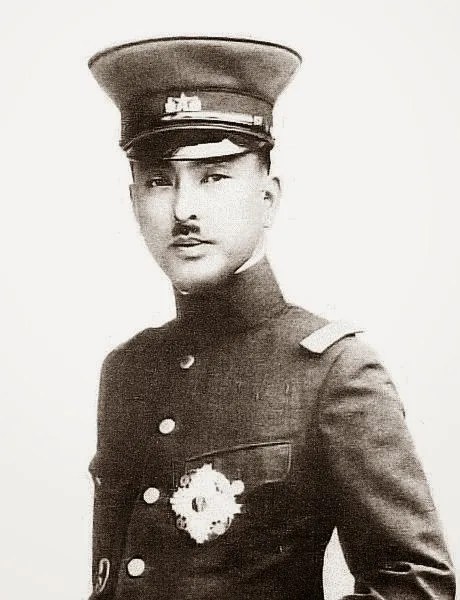
Prince Asaka Yasuhiko
Prince Asaka Yasuhiko was the one who authorized the troops to execute and rape civilians and plunder the city. In 1946, Prince Asaka was interrogated about his involvement in the Nanjing Massacre, and the testimony was submitted to the International Prosecution Section of the Tokyo tribunal.
Asaka denied the existence of any massacre and claimed to have never received complaints about the conduct of his troops. Subsequently, after the end of World War II, Asaka, like the entire imperial family, was granted immunity by American General Douglas MacArthur.
Who Were the True Responsible Parties?
After the end of World War II in September 1945, Japanese war criminals were put on trial in the Tokyo Tribunal and the Nanjing War Crimes Tribunal.
From left to right: Iwane Matsui, Hisao Tani, Prince Kan’in, Prince Asaka, Isamu Chō, and Kōki Hirota.
The responsible parties were:
General Iwane Matsui – Matsui was aware of what the troops were doing in Nanjing but did not take any action, claiming to be ill at the time of the capture. The Tokyo Tribunal found that, despite his illness, Matsui had sufficient capacity to control his troops. He was sentenced to death and executed on December 23, 1948;
Lieutenant General Hisao Tani – Tani was tried in the Nanjing War Crimes Tribunal. Tani denied the charges against him, blaming Korean soldiers for the massacre. He was found guilty of instigating the massacre and rape of civilians and was sentenced to death and executed on April 26, 1947;
Prince Kan’in – Considered responsible for authorizing the use of bacteriological weapons used in China, especially in Shanghai and Nanjing. However, Kan’in died before the end of the war in May 1945 and therefore was not tried;
Prince Asaka – As mentioned before, immunity was granted to Asaka. The prince was the one who authorized the massacre in Nanjing, in the absence of Matsui’s command, who was ill;
Lieutenant General Isamu Chō – Assistant to Asaka, was considered an accomplice in the massacre. However, Chō committed suicide in the Battle of Okinawa in June 1945 and therefore was not tried;
Prime Minister Kōki Hirota – Also considered one of the responsible parties, was tried in the Tokyo Tribunal. Hirota was found guilty of neglecting his role as Prime Minister and allowing the massacre to occur. He was sentenced to death and executed on December 23, 1948;
Controversies and Denial of the Massacre
Japanese nationalist groups engage in historical revisionism and deny that a massacre occurred. However, the Japanese government itself acknowledged the Nanjing Massacre after World War II.
However, the attitude of the Japanese government convinces the Chinese little, as there is a controversy involving the Yasukuni Shrine. The shrine has the names of registered war criminals, and Japanese political figures visit the shrine and pay tribute to the men responsible for the tragedy in Nanjing.
This has weakened the relationship between China and Japan, as it gives the impression that the Japanese do not regret the past despite the government’s statements.
No emperor of Japan has visited Yasukuni since 1975, although the Emperor and Empress still continue to attend the National War Dead Memorial Service annually.
The lucky bamboo or lucky bamboo is very common in Japan. Unlike what the name suggests, the plant is not actually a bamboo. It is a member of the lily family, typical of tropical forests in Southeast Asia and Africa. Its more accurate name is Dracaena Sanderiana. These plants are widely used in businesses, offices, homes, and commercial establishments.
This plant is one of the pieces of feng shui, and is believed to bring luck, prosperity, happiness, and fortune. Especially if given to a person as a gift. It can also be a decorative indoor plant and can be planted in soil, rocks, or water. It is an easy and practical care plant that can survive in various types of light. All the characteristics of this plant, such as small roots, branches, and leaves make it an ideal plant for home.
Lucky bamboo tends to be straight and with branched stems. Others can be long and only curl at the top. Some also grow lucky bamboo in aquariums and others prefer to buy an artificial one. Prices can vary from 20 to 1000 reais depending on the size and store.
Meanings of lucky bamboo
Much of the luck associated with bamboo comes from the number of stalks it has. The number of stalks demonstrates the type of energy that the plant attracts to the home or establishment. It is said that the more stems in the arrangement, the greater the blessings and good luck. Below is the explanation of each quantity of stalks.
Some tie the bamboo with a red ribbon that represents fire, resilience, and good health in feng shui. Receiving a lucky bamboo as a gift is more powerful than buying or making one.
1 long stalk (Lucky Log): This promises to bring prosperity and longevity. It is the most chosen and sought after as gifts for new businesses or commercial ventures;
2 stalks: Bring a lot of love and double the luck factor. Generally, people offer these as gifts to demonstrate and express love and affection;
3 stalks: The set of 3 stalks is said to bring much happiness, success in professional career, and a long life. This is the most popular among people as a gift;
4 stalks: No one wants this, as it symbolizes bad luck;
5 stalks: Attract a lot of positive and healthy energy in five areas of life, such as mental, physical, intuitive, emotional, and spiritual;
6 stalks: Increase your opportunities to increase your wealth;
7 stalks: Promises to bring positive energy to enable good overall health for a person;
8 stalks: Should bring positive energy increasing prosperity and fertility;
9 stalks: This is a symbol of great fortune and luck;
10 stalks: Represents all the good in life. Shows that the person wishes to have a happy and perfect life. That everything happens according to what they imagine and desire;
21 stalks: Divine blessings, wishing that the person and their family be covered with great wealth and lasting health;
Tower: Represents the climb, for ascension in work;
Lucky bamboo can represent the 5 natural elements where the stem of the plant represents wood; the stones mean earth; the pot and a coin inside mean metal; the ribbon means fire, and we don’t even need to mention water.
Tips for caring for lucky bamboo
Lucky bamboo can be grown in water or even soil as long as the moisture is maintained. Some usually choose glass jars, sturdy and decorate with stones, crystals, and sand. When choosing the plant, make sure that the stem is white and new, without spots and with green leaves. It is better to buy the already prepared straight model because the growth process of a straight lucky bamboo is complicated.
Some complain that the bamboo stalk turns yellow; unfortunately, the plant has already been compromised, so we recommend using filtered and chlorine-free water to prevent the bamboo from turning yellow. Change the plant’s water every week for fresh and clean water. The bamboo should not be placed directly in the sun, but it can receive indirect sunlight. Let the water rest for 24 hours to remove the chlorine.
If your bamboo dies, it means you are having bad luck! What do you think of this ingenious decoration that can bring luck? I hope you enjoyed the article and share it with friends.
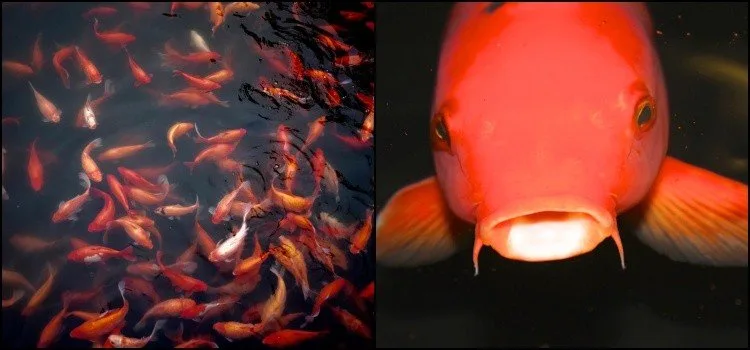
The Koi fish are colorful ornamental carp originating from Japan. These fish are a common symbol of Japanese and Chinese culture. Often depicted in works of art, tattoos, clothing, and even used for landscaping. They are considered intelligent animals, and can even be trained.
Some legends and meanings surround these carp. They can be recognized as symbols of courage and perseverance. In Japan, large koi fish events are even held. Every year, for example, breeders of these carp come together and promise exhibitions, contests, and even auctions. Now let’s learn more about the history of this beautiful animal.
Besides koi (鯉), Japanese carp are called nishikigoi (錦鯉) mainly because they are colorful and used as decorations in ponds and water gardens. Japanese carp are symbols of love and friendship, as the word love or passion is also pronounced koi (恋).
History and Curiosities of the Koi Fish
Koi fish are a mutation of the common carp, usually brown in color. Their breeding was predominant in China. However, when the Chinese invaded Japan, these fish were primarily bred for food. They were very adaptable to Japanese conditions. It was then that the Japanese noticed the ornamental potential of the fish. They began to breed them to bring varied colors, something the Chinese did not do.
They noticed that depending on the circumstances, common carp changed color. This mutation is something spontaneous in the animal. At some point between 1820 and 1830, the Japanese already noticed small variations in colors among some carp and then created “mutants”. From these mutations, the famous koi fish emerged.
Quickly, the popularity of the Japanese Koi fish grew. Even if their beauty was not noticed in other countries, in Japan it became the most desired fish. More than a hundred types of Koi fish have been recorded since their creation, grouped into thirteen general classes.
The carp grow according to the size of the place they are raised. If raised in a small place, they will not exceed 7cm.
Classes and Varieties of Koi
Asagi – body with blue and gray scales with red parts on the abdomen, the head should be light blue;
Bekko – koi with black color patterns on the back with a red, white, or yellow background;
Goshiki – literally means five colors, white, black, red, blue, and dark blue;
Hariwake – silver body with orange or yellow patterns;
Kawairmono – this is a term to define those that do not fit into any of the recognized patterns;
Kohaku – white body with red parts;
Koromo – white body with bluish or black scales, over reddish patterns;
Kumonryu – white body with black patterns and details;
Matsuba – net-like pattern across the body, usually metallic base color;
Ogon – solid color and pattern throughout the body;
Sanke – white body with red and black details, with no black on the head;
Showa – black body with patterns in white and red;
Shusui – white body with blue scales on the dorsal and reddish lower part;
Tancho – white body with a red circle on the head;
These fish should only be raised in large ponds or farms. To remain healthy, good water quality is necessary. Filtration systems should be used to maintain this water. A well-cared-for koi has a life expectancy of around 50 to 70 years. However, there are reports of Koi fish over 200 years old.
The Legends and References of Carp
According to legend, the kois had to reach the source of the Huang Ho River, which was at the top of a mountain. The kois needed to swim through valleys filled with currents, waterfalls, and cascades. The legend continues that the carp that could overcome all difficulties and reach the top would transform into a dragon.
Because of such a legend, the ascending kois generally represent strength, courage, and determination in achieving goals and overcoming difficulties. Meanwhile, the descending carp signify goals that have been achieved or realized. Such symbols and meanings are often depicted in the form of tattoos.
If you have ever watched pokemon or played any game from this franchise, you might know the pokemon called Magikarp. This pokemon is inspired by a carp and its legend. Initially, it is quite weak, but upon evolving, it becomes a large and strong dragon called Gyarados. This is a clear reference to the legend of the Koi fish.
Did you already know the origin story or the legend of the Koi fish? Let us know in the comments and share with your friends.
Kanchō (カンチョー) is a prank performed by joining hands in the shape of an imaginary weapon and trying to poke the victim’s anus, often while exclaiming “Kan-CHO!“.
It is a common prank among children in East Asian countries, such as Japan, Korea, and Taiwan. In Korea, it is called ttongchim (똥침) and in Taiwan, it is popularly called Qiānnián shā (千年殺), derived from the full name of the skill “Secret Finger Jutsu of the Leaf Village: A Thousand Years of Death” (木の葉隠れ秘伝体術奥義: 千年殺し; Konohakagure hiden taijutsu ōgi: Sennen Goroshi).
This term derives from the popular Naruto franchise, where Kakashi Hatake uses a version of the prank on the titular protagonist during his ninja training.
The word is an adoption of slang from the Japanese word for enema (浣腸; kanchō). According to common practice, the word is usually written in katakana when used in its slang sense and in kanji when used in the medical sense.
What is the purpose of Kanchō, after all?
Kancho should not be considered vulgar; in fact, it is rarely used antagonistically, but rather as a kind of affection, similar to athletes who slap each other on the butt. Men and women, children and adults perform and receive kancho.
Some brave and shameless men perform kancho on women and even lift their skirts for this act. Foreign teachers in Japan are often targets of Kancho. This is partly due to their celebrity status in schools, as many children want to be the one who did Kancho to the teacher.
Why on earth do the Japanese do this? The short answer: because it’s funny. When asked why they do Kancho, Japanese people often give answers such as: communication, kinship, they’ve always done it, and their butt was a good target. Messed up? You got it.
If you want to avoid getting a kancho, especially if you study in a Japanese school full of children, we recommend wearing loose clothing and always staying alert with your back to the wall to avoid contact with those funny kids.
Below is a compilation of our channel with some examples of Kancho:
Where did Kanchō come from?
Kanchō likely came from something called 三年殺し [san nen goroshi] (lit: three-year murder). Some say the meaning is that this super secret move will kill the opponent in three years, or the pain inflicted by this technique will last three years.
Similar to kancho, you use your extended fingers, but you also use your middle fingers as well. Instead of focusing on the anus, the point of the move is to attack the area between your genitals and your anus, temporarily incapacitating your opponent.
Kanchō is growing not only in Asia but around the world. It’s not just children; research reveals that about 50% of Japanese adults do kancho from time to time. There are even TV shows and games that address kancho.
There is even an official website that talks about Kancho that can be accessed here: https://www.kancho.org/
If you liked the article, we recommend sharing it with friends and reading other articles below:
Did you know that in Japan you can set up your own individual business similar to MEI in Brazil (Micro Entrepreneur Individual)? Creating an individual company in Japan is called Kojin Jigyo (個人 事業) which literally means (事業) project, enterprise, business, industry (個人) individual.
Just like the MEI, the “kojin jigyo” does not require initial capital, has no expensive courses and taxes, and no bureaucracies. Professionals who earn a lot of money working as freelancers need to have this registration. It is not necessary to have a commercial point, and you can have your small business even while being employed elsewhere (check your contract).
Photographers, designers, hairdressers, private teachers, accountants, consultants, and both foreign and Japanese freelancers often resort to “kojin jigyo”. Before starting a large company, the individual business is the gateway that offers many benefits for foreigners, descendants, and Japanese.
Benefits and Requirements of Kojin Jigyo
Having an Individual Business in Japan allows for some requirements such as:
You can use a trade name;
You won’t spend on an accountant (expenses exceed 200,000 per year);
Bank loan with only 2% interest per year;
Professional credibility (to close large contracts);
Tax discounts if you stay up to date with your declaration;
Support and information about individual businesses;
Although it is an individual business, you can hire employees;
Some requirements and information you need to know about setting up your microbusiness in Japan:
You need a long-term visa or one that allows paid activities;
Some use the Kojin Jigyo to obtain the visa, this is possible when you have contracts or partnerships with other companies;
You need a specific authorization for certain types of businesses;
Opening an Individual Business in Japan
To declare yourself as a kojin jigyo, just fill out a form and send it to the nearest tax office. You must choose the correct form for your province and follow the indicated address or call to clarify your last doubts. Remember that all procedures are done in Japanese.
Once that is done, just make sure to keep all your payments recorded, on the blue sheet (detailed) or white. Declare your income tax annually as usual. Fortunately, one of the advantages is that you can deduct business expenses to pay less tax, just like in MEI.
If you work as a photographer, you won’t need to pay tax on the expensive camera and other equipment you buy. If you use a computer or even a phone for work, buy it for work and enjoy it for fun. Even food and transportation can be included in your individual business expenses.
Of course, not everything is perfect; we recommend you check all the details and not fill out any paperwork without being aware of becoming a Kojin Jigyo. Unfortunately, some end up declaring bankruptcy due to not knowing how to manage their individual business well, and we don’t want that to happen to you!
Starting your own business can be a great opportunity to get out of factories and maintain your visa to live in Japan. You can still keep your job and create your business, but remember to talk to your employer, immigration, city hall, and all responsible agencies to clarify your doubts.
I hope you liked the article! Share it with that friend who wants to change their life! We also recommend reading:
Emperor Jimmu (神武天皇 Jinmu-tennō) was the first emperor of Japan. According to historical records, his reign lasted from 660 B.C. to 585 B.C.
According to Japanese mythology, Jimmu was a descendant of the sun goddess Amaterasu and a descendant of the thunder god, Susanoo.
He is recorded as the first ruler of Japan in two early chronicles, Kojiki and Nihon Shoki.
Nihon Shoki gives the dates of his reign as 660 B.C. to 585 B.C.
He was born as Kamuyamato Iwarebiko on February 13, 711 B.C., in the territory that would be present-day Kyushu.
The Japanese chronicles record his expedition to the east of Hyuga in 607 B.C. along the Inland Sea of Japan, subjugating tribes and arriving in Yamato, where he established his power.
Despite Jimmu’s importance as a link between the ruling family of Japan and the divine ancestors, he never had many cults in Japan.
A Shintō shrine was erected by the Japanese government in 1890 at what is believed to be his burial site in Unebi.
Supposed Influences of Buddhism
Buddhism entered Japan through Korea in 520 A.D. Although it was not sponsored by the government until 1638, it always had an appeal to emperors, whose authority could be challenged by the local daimyo claiming to be kami.
By identifying as kami, which in Buddhist terminology was considered a bodhisattva more powerful than other kami, the Emperor increased his mystique and asserted his uniqueness.
After 1867, it became illegal for anyone to identify kami as a bodhisattva.
The word Shintō, translated as “the way,” or “the essence,” was not used until Buddhism entered Japan.
Legacy of Emperor Jimmu
Above all, whether myth or based on a ruler of Japan, Jimmu holds a place of honor in Japanese tradition.
Therefore, the idea of a special bond between ruler, land, and people helped make governance more stable.
During the shogunate periods, the Emperor was still revered and remained, at least theoretically, the sovereign.
After all, such was the respect for the institution that began with Jimmu, revoking it was unthinkable.
In Japan, it is easy to survive and face everyday situations using few words and basic phrases. This is one of the main reasons why most Brazilians living in Japan do not speak fluent or even intermediate Japanese. With that in mind, we created this article to help you disguise and pretend to be fluent in Japanese.
The purpose of this article is not to deceive anyone, just to disguise your years of study and procrastination that did not teach you to maintain a conversation with people. This happens to many Japanese learners and other language students. They study day and night, learn thousands of words, verbs, and grammatical expressions, but when it comes time to converse, they simply fail.
Reaching fluency in Japanese requires time, a lot of dedication, and immersion with Japanese people to practice your conversation skills. Some are somewhat afraid to talk to Japanese people due to the fear of making mistakes and not speaking correctly. The tips here will help you disguise and pretend to understand what is happening around you.
Others need to quickly learn some words to make speeches or introduce themselves in Japan. Many celebrities learn at least a phrase in the native language to speak to their fans. Things like accent and informal words are important for these and other occasions.
And don’t be fooled just because a Japanese person said nihongo jouzu to you. This expression is commonly heard by anyone who speaks a word in Japanese.
Remember not to try to pretend to speak Japanese without knowing anything about the language; you need at least a basic Japanese course to pretend to be fluent.
Expressions to pretend to understand Japanese
The first step to show that you know Japanese is to learn expressions that serve various occasions. Besides yes and no, you should learn various words to make your Japanese sound more natural and informal. See below some alternatives for confirmation and negation:
ない – nai – a negation used at the end of verbs;
違う – chigau – wrong, different;
無理 – muri – impossible;
だめ – dame – not good;
出来ない – dekinai – I can’t;
ん – un – equivalent to yes, you are agreeing;
そう – sou – a confirmation, that’s right (used with desu);
ええ… – ee… – being a confirmation will depend on the tone, it’s like our eee;
ちょっと – chotto – wait, a little, a minute;
大丈夫 – daijoubu – it’s okay, don’t worry;
It is worth remembering that Japanese people avoid denying things to someone as much as possible. They always use excuses or some alternatives to avoid saying no. If you need to deny or reject something, try to postpone it to tomorrow, say sumimasen and make up an excuse.
If you feel isolated or need to say something – あの – Ano can be used like an “ei,” to get the person’s attention;
Tips to disguise your Japanese
Avoid using a simple arigatou to thank, you can try using more informal words like a simple domo. During informal conversations, it is also common to swallow particles like wo that come before verbs.
Another tip is to study the endings of Japanese sentences well; try not to stick only to desu and masu. You should learn some regional slang to make your conversation more informal and interesting. Our article on gender language offers various options for informal endings to use in your sentences.
Use anata (you) only if you are speaking to a stranger. You can use omae or kimi depending on your relationship. Sometimes it is unnecessary to use the word anata in every sentence you make to the same person.
Try to use the names of things instead of saying kore wa (this);
Learn expressions from the local dialect;
How to have a good accent in the Japanese language
Some have difficulty speaking Japanese because of their Portuguese accent. Fortunately, Brazilians have a much easier time than native English speakers. Most Japanese phonemes are similar to the syllables in Portuguese. Some tips below can help you have a good accent in Japanese:
Although Japanese people do not place emphasis and accents on words like Portuguese, they use a tonal accent, making homophones like hashi (bridge) and hashi (chopsticks) sound a little different. You might want to listen to these words and try to catch the different tones within them.
Remember to pronounce the phonemes correctly to have a good accent. Some have a lot of difficulty with this, but it is a lack of practice and preparation. The video below will help you:
Becoming fluent in the Japanese Language
Of course, if you want to speak Japanese, you must truly learn it! Pretending to speak Japanese will not work in the long or short term. Being fluent is a difficult challenge that takes a lot of time. When pretending to know Japanese, you should keep the following goals in mind:
Master all the necessary phrases;
Learn to construct a sentence in Japanese;
Master basic Japanese grammar;
If you can fulfill the above points, you will succeed in a Japanese conversation. We hope these tips help you to strive and face the shame of speaking Japanese or socializing with Japanese people. So don’t be afraid to make mistakes!
I hope you enjoyed the tips in this article! If you liked it, share it with friends and leave your comments!
The Japanese are famous for being polite, humble, and respectful. But this is not a concept of universal and unquestionable acceptance as seen by some more observant foreigners and even some slightly indecorous Japanese. A Korean even said: While Koreans are not rude and genuine, the Japanese are polite and false.
It is known that we cannot take the image as a rule. The fact is that, since the Japanese use an indirect approach in their relationships, masking themselves through the appearances of social occasions, it is common for poor Westerners not to catch this dialectical game. But the calm nature of the Easterners from distant Japan values polite treatment to avoid problems.
In general, the Japanese are indeed polite. The culture shapes them this way, and they act so naturally that they do not even realize they are. For better understanding, see our article Honne and Tatemae, which is an attempt to explain this typical Japanese quirk.
Japan is a country with a population of over 125 million. And in the small territory of islands, there are people with very different traditions, history, and customs. Therefore, for the reader, it is useful to understand the disparity of behavior that can be found in that people. Some are closed, indifferent to others, repressing their own feelings; while others are the opposite, even resembling what is considered the image of our own people, the Brazilians.
Is Japanese politeness false?
Who has never tried to be polite to get a job or impress someone? The truth is that the whole world is dominated by people without education or who appear to be polite only at convenient moments. Even with dear friends, sometimes we need to pretend to be polite, even though we wish otherwise.
The same thing happens in Japan! The big difference is that the Japanese need to be polite almost all the time if they want to be accepted in society. Saying a simple good morning, asking how someone is, or thanking for anything are universal customs that have been decreasing more and more worldwide.
The truth is that not everyone wants to be polite all the time. I do not wish to offer something, but I do it out of politeness… Many go through this same situation. So in a way, we cannot say that there is false politeness. Politeness is exactly doing more for others even when we do not wish to.
We can say that false politeness only happens when there is a strong lack of empathy, narcissism, manipulation, racism, or selfishness. These people pretend to be polite, but in reality, they can ruin anyone to get what they want.
Being polite is being nice to another person even when you don’t want to!
Is Japanese politeness something genuine?
Some children tend to be messy until they reach school age and learn the rules and good manners that are taught. Some elderly people do what they want and are generally rude because they believe they have the right. The truth is that there will always be egotistical people or those who do not follow the standards established by society.
Most Japanese are polite mainly because of a sense of duty. In Japan, there is incredible social pressure to behave well, respect, follow rules, and do things in groups. Despite all this, we can affirm that Japanese politeness is something real, ingrained, and consistent, not something false.
Culture and society exert a great power over how the Japanese are. It is not just out of obligation; most Japanese feel joy in acting politely. The mentality of doing good for others is what keeps Japan safe and progressing! If everything were driven by falsities, Japan would never achieve its reputation for being polite!
They do not just learn protocols of politeness, but they learn to have respect and mutual consideration. How many examples of honesty and help do we need to remember to show that Japanese politeness is something genuine? Even members of the Yakuza show respect and politeness within society; why would others not do the same?
Another thing we can mention is that many feel shame and shyness! I myself have refrained from saying good morning or even thanking because of my shyness and embarrassment. Now imagine the Japanese, who are famous for their extreme shyness? You can observe in Japanese society that most people exchange greetings with a smile on their faces.
What can we learn from Japanese politeness?
The Japanese are taught to always be aware of how to act, yes always, so as not to stand out. These “polite” gestures are just something they do in their daily lives, and when they do this, it means nothing. They just do what they are taught to do.
While some may find this false, keep in mind that if you do not do the same, they will think you are a rude person. Many Brazilians in Japan complain about certain attitudes of the Japanese, but many who complain do not make an effort to say a simple good morning and make friends with a Japanese.
Have you ever tried to befriend a Japanese? You will see how they value friendship; you will see what true friendship is! A friendship without interests, a friendship without intruding in each other’s lives when not asked. Even when they do not want to, the Japanese consider others before themselves.
What did you think of this subject? Do you agree with the words of the article? We are happy to hear your opinion in the comments and your sharing on social media!
Generally, the Japanese do not assert something unless they are absolutely sure it is correct. In this article, we will look at some expressions that show how the Japanese do everything to avoid saying anything without being certain of something. Japanese words help a lot in this regard, but it is all a matter of culture.
Just like punctuality, the Japanese want to be responsible with their words and do not wish to promise something where an unforeseen event or uncertainty might interfere. They also do not want to give opinions with certainty that could harm the listener’s decision.
The Japanese language loves ambiguity. Declarative sentences are not confident, but rather arrogant. Avoid giving certainty or asserting something you are not 100% confident is correct. If you are confident, you can say a nice もちろん.
Words like “maybe, it seems, could be, probably, possibly, I don’t know or I think” are also very helpful when it comes to avoiding topics and conversations.
Words that express uncertainty
A very common word to respond to questions without giving certainty is the word tabun (多分) which means “maybe and probably“, and is usually placed in the middle of sentences. The word is written with ideograms that also express a large quantity, which shows more certainty than uncertainty. This word can be used when you are not sure about something (maybe) or when you do not know if the circumstances will allow (probably).
Another popular word is kamoshirenai [かも知れない] or kamoshiremasen (formal). This function expresses that something “might” happen, but there is no certainty. The word can be shortened to kamo [かも] in sentences, but it is quite informal. It can be literally translated to “maybe, could, might be or possibly”.
Even when the Japanese express their own opinion about something, they often use the expression to omou […と思う] or omoimasu [思います] which means I think, or I believe. The Japanese try to avoid their opinions interfering with the lives of others as much as possible.
Other words that express maybe or probably are:
若しかしたら
moshikashitara
maybe, by chance
若しかして
moshikashite
maybe, possibly, could it be, by chance, if I’m not mistaken
事にすると
koto ni suru to
maybe, possibly
かもね
kamone
maybe, could be
事によると
koto ni yoru to
maybe, possibly
ひょっとすると
hyottosuruto
maybe; possibly
恐らく
osoraku
maybe, probably, I dare say
若しや
moshiya
maybe, possibly, by some chance, by some possibility
蓋し
kedashi
maybe, probably
Words that express some certainty
There are words that are used to express a certain level of certainty, close to tabun (多分). Some phrases even require both words to express themselves better. Let’s talk about 2 endings that are darou and deshou.
Deshou (でしょう) can be literally translated as “it seems, probably, I think, I wonder, I suppose and I hope“. This expression can also be used as a question “don’t you agree?”, “don’t you think?”, isn’t it?“.
Darou (だろう) means the same thing as (でしょう), except it sounds more masculine and is mainly used by men. Both words can seem informal depending on how you say them, especially if you shorten them when pronouncing.
Unlike kamoshirenai, darou and deshou cannot be used when talking about one’s own actions like “I think I will go tomorrow”. Kamoshirenai is used to express a sense of probability or doubt; it presents more uncertainty than darou and deshou.
The word deshou is often used in weather forecasts. The Japanese do not say “it will rain tomorrow,” but rather “it will probably rain tomorrow.”
Example sentences
Let’s see some examples below:
Japanese
Romaji
Portuguese
トムは多分眠っている。
Tomu wa tabun nemutte iru
Tom is probably sleeping.
多分彼女は来るでしょう。
Tabun kanojo wa kurudeshou.
Maybe she will come.
多分君が正しいのだろう。
Tabun kimi ga tadashī nodarou.
Maybe you are right.
その食べ物はおいしいでしょう。
Sono tabemono wa oishīdeshou.
This food seems delicious (I think)
明日は晴れでしょう。
Ashita wa haredeshou.
Tomorrow it will probably be sunny
君もパーティに行くだろう?
Kimi mo pāti ni ikudarou?
You are going to the party, right? (am I right?)
何か悪いことが彼にふりかかるかも知れない。
Nani ka warui koto ga kare ni furikakaru kamo shirenai.
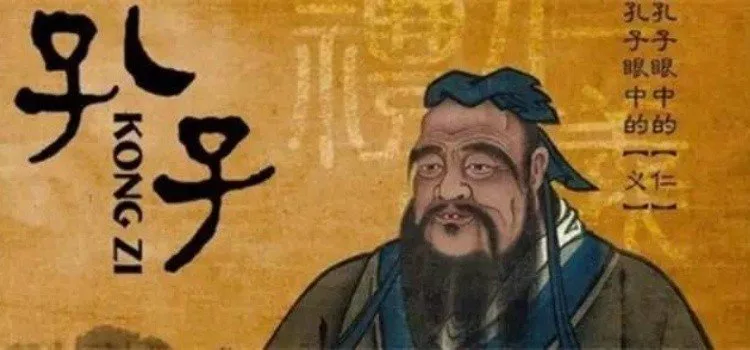
Confucius (孔子, Kōshi) was a Chinese philosopher who lived in China from 551 to 479 B.C. His teachings, known as Confucianism (儒教, Jukyō), had a profound impact not only in China but also in Japan.
According to early Japanese writings, it was introduced to Japan via Korea in the year 285 A.D. Some of the most important Confucian principles are humanity, loyalty, morality, and consideration.
During the Tokugawa Period (1600-1868), Confucianism reached its peak of philosophical influence in Japan. There was a predominant impact on Japanese society at the time, and its influences can still be felt today.
Confucianism in Japanese society
In Japan, Confucianism is an important philosophical teaching introduced at the beginning of civilization in Japanese history. Unlike Buddhism, which came from India, Confucianism was, above all, a distinctly Chinese teaching.
It spread from the Han dynasty in China to Korea and then entered Japan via the Korean Peninsula. Confucianism overflows with elevated ideals that have always challenged humanity to achieve the highest state of perfection and self-realization. The values and customs of Japanese society were strongly rooted in the philosophy of Confucius.
However, as a political doctrine of the ruling elite, Confucianism was often expressed in cynical, if not selfish, ways, contradicting its own ideals. Those at the top of the hierarchy only provided verbal support but did not practice what they preached.
Confucianism in modern Japan
In modern times, resilient Confucian notions have provided conceptual foundations for integrating much of Western thought. Thoughts about oneself, society, family, and politics.
Instead of assuming that history was progressing to ever better levels, Confucianists tended to see ideals in the past. Confucian thought was the philosophical fuel at the time when Japan was a Shogunate.
However, the Western influence that came with the Meiji Restoration ultimately stunted the influences of Confucianism. Nevertheless, this was not the death of this philosophy in Japan. The idealists of the Restoration had their studies in the philosophy of Confucius.
However, at the time of the Restoration, the philosophical, political, and social aspects managed to maintain themselves despite the introduction of Western policies.
Many people want to travel to Japan, but they are afraid or embarrassed because they do not know how to speak the language. In this article, you will understand why you don’t need to worry about the Japanese language to get by in Japan, as well as some useful tips that will help your trip.
Japan is a country made entirely for tourists and foreigners. Anywhere you go, you will find signs with words in English or Roman letters (romaji). Things like traffic signs, train stations, neighborhoods, restaurants, shops, menus, products, etc.
We prepared a video below from our friend Rodrigo Pedraça, who will talk more about this subject and give some tips so you won’t get lost when visiting Japan without speaking the Japanese language:
Why is it not necessary to speak Japanese?
In Japan, everything is designed to make life easier for everyone, so you will rarely need to communicate to solve problems. Brazilians are so accustomed to this ease that many have lived in the country for over 20 years and have not learned to speak the language.
The Japanese are already used to foreigners; they can understand the gestures and basic English words that tourists tend to use. You should at least learn a few basic words that can help you get by in a pinch. As mentioned in the video, you should know at least how to say:
Do you need to know how to speak English to get by in Japan?
You also do not need to know how to speak English to visit Japan, as most Japanese do not speak English. Sometimes, a fluent English speaker struggles much more than someone who knows the basics of Japanese.
An ATM from the convenience stores automatically adapts to the Portuguese language when you insert your credit card. In public places, you will find a lot of material, information, and signs in Portuguese.
It is important to remember that most signs are not filled with sentences in English, just words converted to Roman letters, allowing those who cannot read Japanese to find their way.
You can travel comfortably in Japan even without knowing anything at all in English or Japanese. Your trip will still be enjoyable, and you will be able to go to the most remote and isolated places without fear of getting lost, thanks to current GPS technology, maps, and smartphones.
You can also use gestures to explain and point out what you want. Don’t worry; when you are there, you will see how easy it is to get by in Japan! I hope you enjoyed the tips in this article. We appreciate your comments and shares.
Fullmetal Alchemist is undoubtedly one of the most popular Shounen anime series. With numbers comparable to Naruto, Dragon Ball, One Piece, and Bleach.
The story blends science, mysticism, fiction, and relationships based on love and friendship. A lesson in companionship and affection. It also shows what we are capable of to help others – especially if they are blood-related!
FULLMETAL ALCHEMIST – THE BEGINNING
The acclaimed work was written and illustrated by Hiromu Arakawa – being one of the few women in the 90s to carve out a space in the world of mangakas (Japanese comic artists).
With its first appearance in Japan in the magazine Shonen Gangan – a monthly magazine that publishes various chapters of manga, with Fullmetal Alchemist being its most famous – on July 12, 2001, the engaging story of Edward Elric captured the hearts of fans.
Compared to other series of the same genre, Fullmetal Alchemist remained on the shelves for nine years, concluding on September 11, 2010. The series of 108 chapters was distributed over 27 volumes.
FULLMETAL ALCHEMIST – THE ANIME
The more traditional animes receive over a hundred episodes continuously and achieve great success. They even have various stories – as is the case with Dragon Ball – and many arcs.
However, most of the success of Arakawa’s series was due to the manga. The anime had two versions with a five-year difference in publication between them. The first saga was released on October 4, 2003, and concluded a year later, on October 2, 2004.
This first version was simply titled Fullmetal Alchemist, while the version released on April 5, 2009 was named Fullmetal Alchemist: Brotherhood, following the manga more closely. It also concluded a year later, on July 4, 2010.
The first had only 51 episodes, while Brotherhood reached 64 episodes. Both tell similar stories, but with different styles. The 2003 version had strong dramatic touches, while the 2009 series presented a more humorous and relaxed version to the audience.
One of the openings of the second version of the Anime:
FULLMETAL ALCHEMIST – BRAZIL, GAMES, LIVE ACTION
In Brazil, the comic saga was published by JBC – a nipo-Brazilian publisher. The anime was aired on the subscription TV channel Animax. It also made its way to open TV, where young people watched it on the RedeTV! channel.
Although the anime does not have as many episodes as others, a medium that yielded many fruits for the author was the games. In total, there were thirteen, yes, games for the Game Boy Advanced (GBA), Playstation 2, Playstation Portable (PSP), Nintendo DS (NDS), and Nintendo Wii platforms.
Like Bleach and Death Note, Fullmetal Alchemist received a live-action adaptation based on the manga. It premiered in 2017 in Japanese theaters and is currently available in Netflix’s vast catalog.
In addition to this film, there were also two others in animated versions. The first on September 8, 2006 with the subtitle Conqueror of Shamballa. On April 24, 2012, there was The Sacred Stars of Milos. Both approximately an hour and a half long. Although the stories are not part of the anime and manga, they are a good complement to all the richness that Arakawa built.
Another significant fact for the saga’s revenue was the six light novels – illustrated novels based on the anime/manga style – written by Makoto Inoue. Although she did not participate in the script, Arakawa illustrated each of them.
FULLMETAL ALCHEMIST – THE PLOT
The main device to win the hearts of readers and viewers is the magic involved in the stories, whose main material of creativity is surrounded by alchemy.
Alchemy is the precursor of chemistry. In ancient times, this modern science was replaced by practices that involved rituals and procedures that, according to its scholars, would bring many fruitful benefits to humanity.
It was, obviously, a failed attempt by the “scientists” to believe that this science could yield what they were promising. One interesting point was that alchemists believed it was possible to turn things into gold. Shortly after – about 300 years later – it was discovered that protons are incapable of moving from the nucleus of the atom.
Thus, it was not possible to rub a dead rat’s skin on another material to transfer the proton particles until obtaining the number of protons of gold. This was one of the promises of alchemy.
However, the most famous – which has also been the theme of a movie featuring the famous wizard Harry Potter – is the philosopher’s stone. This mystical article had the ability to cure all diseases, including the most wicked of them: death.
Sometimes treated as a substance – despite the name stone attached to it – whoever ingested its contents would be cured of all ailments and could receive eternal life.
Manga of Fullmetal Alchemist
If you want to buy some volumes of the manga you can access below:
FULLMETAL ALCHEMIST – THE PLOT
The universe of Fullmetal Alchemist tells the story of two brothers, Edward and Alphonse Elric, who face a penalty for trying to bring their mother back to life.
This world is a mix of the European industrial revolution era with a society where alchemy is truly a science – even being considered an art.
The failed attempt to bring their mother back to life caused damage to the brothers. Edward’s idea of using an extremely advanced alchemy ritual resulted in his brother losing his entire body and him losing his left leg.
To save Alphonse, Edward had to sacrifice his right arm to bind his brother’s soul to a steel armor. The feeling of regret, combined with the longing for their mother, drives them to seek the only jewel of alchemy capable of repairing all this damage: the philosopher’s stone.
However, there was no trace or even rumors that any alchemist had managed to create such an artifact. The only way Edward found was to join the Amestris Military State. With this, he could obtain the necessary materials for his in-depth study of alchemical arts.
This part of the plot is followed by Edward’s famous quote: “I know it was a stupid decision, but I will continue lying on this bed of thorns until I achieve my goal.” His goal was to bring his brother back in flesh and blood.
Edward’s genius made him the youngest alchemist to become a military. However, the only reason he joined the federals was the possibility of having the necessary materials for his studies.
The work of a military in the country of Amestris consisted of eliminating certain races belonging to the universe of Fullmetal Alchemist. Thus, Edward, while doing his service, gains allies, but also many enemies.
The majority of the races present in the series are humans who used alchemy to mutate themselves. The main ones are: humans, homunculi, chimeras.
One of the major enemies Edward makes – unintentionally – are the Ishbalans, another race present in the series. This people had a large part of their species decimated by the Amestris military. Scar is one of the few survivors of the Ishbalan race who is clearly seeking revenge for his people.
The homunculi are a powerful race because they contain pieces of the philosopher’s stone in their genetics – how? You’ll have to watch the series to find out. Later, they reveal themselves to be the main villains.
The first part of the saga makes readers and viewers become addicted to the Elric brothers’ quest to find the philosopher’s stone. However, throughout the development, it is revealed that the homunculi control the Amestris Military State.
“Father” is the name of the villain in this final arc of the plot. His goal is to transform all the nations of the universe. And there were only two people capable of stopping him, Edward and Alphonse.
TRIVIA ABOUT THE SERIES
– Having an influence from the industrial revolution and periods of war that actually occurred – such as World War II – one of the villains present in one of the arcs of the plot is Adolf Hitler.
– Despite the five-year difference between the animated series, the only anime that faithfully followed the manga was the Brotherhood saga. The first version from 2003 only followed the written story up to volume 25.
– All this creativity began after Arakawa read about the philosopher’s stone. This was the starting point for her to start researching more about the “science” of alchemy.
– After understanding how this fantastical universe worked, the author decided to give a touch of war and modern world to her stories. The Second World War was her biggest influence. She read several books and watched many documentaries about the war and post-war periods.
– A good example of war influence in the plot was during one of the most famous arcs of the saga: the Ishval War. Arakawa wrote this part of the narrative based on the accounts of various post-war soldiers.
– Just as J. K. Rowling had to shorten her name to avoid being directly recognized as a woman, Arakawa had to change the spelling of her name. Hiromi Arakawa is her real name, while the name Hiromu – in the Japanese language – is a masculine derivative.
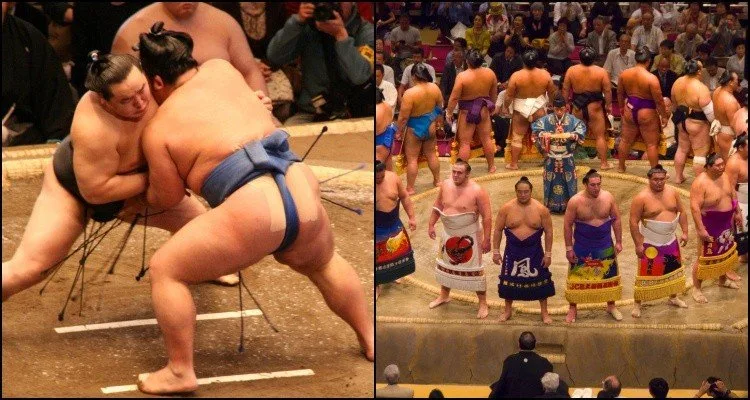
Do you know what sumo means? What is the origin and history of sumo? How does Japan view this sport and its curiosities? In this article, we will see a complete guide on sumo, one of the most important and traditional sports in Japan.
Surely you have seen this ancient martial art practiced by few in some media. Sumo is a sport originating from Japan, being the only country that practices and supports it professionally. This sport is so important that some awards are given by the Prime Minister of Japan.
Some rules and rituals are established, but basically, the sport is quite simple. It consists of one wrestler trying to force the other out of the ring or make him touch the ring with any part of his body. Initially, it was a sport appreciated by powerful and wealthy people, but it eventually became popular among all social classes.
ORIGIN AND HISTORY OF sumo
In romanized Japanese, it is written sumou [相撲] where the ideogram [相] means together and [撲] means to strike, which can be literally translated as to strike each other.
The sumo wrestlers are called rikishi [力士] which literally means strong or powerful man. It is interesting to highlight the ideogram [士] which also refers to a warrior or samurai.
Similar martial arts have been reported and practiced in many parts of the world for a long time. In Japan, the sport was already mentioned in Japanese history books written in the 8th century.
It is reported that at the time of planting rice, sumo was present. Sumo sessions were held as a form of prayer for a good harvest. In other periods, sumo became an event of the imperial court.
But much of what we see today in sumo is due to Shintoism. Sumo was often performed in rituals and festivals, with the aim of entertaining the gods. A certain legend says that these fights were originally practiced by the gods themselves.
THE RITUAL AND the duration of a sumo match
Many wonder how long a sumo match lasts. First, we need to understand a little about the rituals that take place before the matches. These rituals were adopted in the 17th century.
Before the match, a ritual takes place between the 2 players that consists of taking sacred water and throwing salt on the ring before the match. Upon entering the ring, the wrestlers stomp their feet to scare away demons and clap their hands to summon the gods.
Even the sand that covers the dohyo symbolizes purity in Shintoism. Those watching these matches do not leave their seats until the entire ritual is completed. The referee also dresses like a Shinto priest.
The ritual lasts longer than the match itself. The match itself is simple and quick, usually lasting no more than 30 seconds. The goal of the contest is to force the opponent out of the dohyo or make him touch the ground with any part except the soles of his feet.
curiosities about sumo
Never neglecting traditions, sumo today is not just something religious. There are six major tournaments held annually, called hon-basho. To reach such tournaments, the wrestlers called rikishi undergo rigorous training. They follow a reinforced diet of 16,000 calories daily (what a normal person eats in a week).
Rules include having a good diet, daily exercises, and even haircuts and the clothes they wear in public. The association has prohibited wrestlers from driving their own cars due to some incidents. The “thong” they wear in matches is called mawashi, and its color represents the wrestler’s region of origin.
There are 6 basic divisions in sumo that dictate the power and hierarchy of the wrestler. The highest division is Makuuchi and the lowest is Jonokuchi. For the wrestler to rise in rank, he just needs to win the majority of his matches in the main tournaments. The matches are held in a single round and usually last a few seconds.
Another interesting fact is that there is no weight separation in sumo. Thus, a wrestler can face another who weighs double his weight. There is not a good audience for TV broadcasts, as, by tradition, they are aired between 4:00 PM and 6:00 PM. It is at this time that most people are returning home or are at work.
There are many curiosities and even greater is the tradition of the sport in Japan. But today, few young people want to dedicate themselves to the lifestyle of sumo. Sports like soccer and baseball are much more popular.
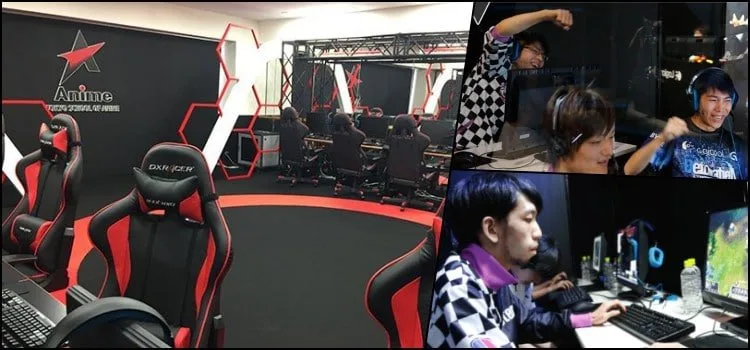
Others blame the decline of the sport even on the trend of video games. Even so, sumo remains alive not only as part of Japan’s tradition and religion but also as a sport and a way of life.
It is obvious that Sumo goes far beyond what is addressed in the article. Therefore, you can expect to read more information about it on our website or in the recommended books below:
Have you heard of Capsule Hotels? How did they come about? In this article, we will talk all about this Japanese invention, the famous capsule hotels in Japan, their curiosities, and origins.
The kapuseru hoteru [カプセルホテル] is a brilliant idea that offers super cheap accommodation without the services provided by conventional hotels. They are shared rooms with thousands of capsules that provide accommodations for a good night’s sleep.
The guest accommodations are inside a modular block made of plastic or fiberglass measuring 2m x 1m x 1.25m, serving as a dormitory. In addition to the capsule, the person has access to a locker with a password or key to store their valuables.
The entertainment options at the facilities vary (most include a television, a console, and a wireless internet connection). Some capsule hotels offer onsen, relaxation areas, massages, and other amenities found in regular hotels.
The price varies greatly depending on the location; if you are lucky, you can find prices between 50 to 150 R$ per night. It may not seem so cheap for Brazilians, but it is very affordable for the Japanese wallet. Prices can vary according to dates and holidays.
Capsule hotels are known for accommodating workers who miss the last train and do not want to pay for a taxi, or for those who overindulged in Sake at bars and karaoke.
Hostels vs Capsule Hotels
If you search through the hostels in Japan, you will come across some capsule hotels. The truth is that the difference between these two places is minimal.
In the West, most hostels tend to be small, friendly shared rooms, but in large cities like Tokyo and Kyoto, hostels are practically giant rooms with about 40 beds that look more like capsules.
I think the only difference between these Japanese hostels and capsule hotels lies in the material surrounding the bed. Hostels are usually made of wood, while traditional capsules are made of fiberglass or plastic.
I personally prefer hostels because they give a more homey impression, while capsules seem somewhat industrial and strange.
Not everything is perfect; cheap options often come with their problems. The capsules have a limited size. Very tall people may literally not fit in the capsule. The stay duration at the hotel is limited.
Night owls may have difficulty adapting to the hotel’s 9-hour philosophy. Fortunately, some capsule hotels allow multiple nights, but you will likely have to check out before 11 a.m.
Capsules are not a good option for those traveling with family. Couples are separated, and children are not accepted in the hotel. There are hotels that prohibit the entry of women; they have valid reasons, but they do not provide options for females.
There are also hotels exclusively for women, but some offer capsules on a mixed floor, allowing you to stay close to your girlfriend or wife, and maybe even share a night in a capsule (you will have to pay for two).
Curiosities about Capsule Hotels
The first capsule hotel opened in 1979 in Osaka;
It is said that the idea to create a capsule hotel came up in a sauna in Osaka;
Shared baths tend to discourage some tourists;
In addition to capsule hotels, there is something similar called “Cabin Hotel”;
In 2009, a capsule hotel was inaugurated in Warsaw, Poland;
In 2011, a capsule hotel was opened in Shanghai, China, but it was closed;
Some capsule hotels consist of up to 700 or more capsules;
One of these hotels offers 4,000 books and mangas for reading;
It is possible to find vending machines in the hotel to have a meal and drinks;
Capsule hotels are easy to find on hotel search sites like Booking and AirBNB.
Have you ever been curious about what gamers in Japan are like? What is the difference between gamers in Japan and gamers in Brazil? Is it cheap or normal to be a gamer in Japan? In this article, we will cover all the details about gamers in Japan.
In Japan, almost half of the population are gamers, about 65 million Japanese people play, even if casually. After all, Japan is famous for pachinko where middle-aged men spend money on gambling games. So basically, the Japanese have gamer blood.
Japan generates over 12.5 billion dollars from games every year, making it the third largest gaming market in the world. About 37% of gamers in Japan are women. Meanwhile, about 30% of the Brazilian population are gamers, and of those, 41% are women.
What are gamers like in Japan?
Most Japanese people are gamers, mainly because of the portability that is widely accepted and embraced in the country. It is common to find various people playing on cell phones or portable devices in the subways and trains throughout Japan.
The kawaii culture and fantasy are well spread in the country, allowing people of all ages to develop some interest in non-casual games, which is uncommon in our Brazilian culture.
People of all ages can be found playing something, whether it’s an RPG or a Pachinko. In schools, there are clubs dedicated to games, both board games and consoles.
Japan can be considered the country of games. It is in this country that the best consoles, the best franchises, and game companies from all over the world emerged. Possibly if it weren’t for Japan, games would be boring and lifeless (like many are today).
People who are addicted to games in Japan are called Otaku. This term can be somewhat pejorative; some relate gaming addiction to the social isolation of a hikikomori.
Computer games are not as popular in Japan compared to consoles. Perhaps because most prefer Japanese games that usually do not receive PC support.
Regarding professional gamers, we have an article discussing gaming schools.
Gamers in Japan vs Gamers in Brazil
Being a gamer in Brazil is not easy; unfortunately, we earn little and pay a lot for consoles and games. Still, Brazilians have a number of gamers who dedicate themselves to their collections and play an infinite variety of games.
To discuss this topic, we chose a video from my friend Rodrigo Coelho along with RkPlay that will talk about the costs of being a gamer in Japan and Brazil. Later, I will add some details and continue with the topics.
I hope you enjoyed the article. We appreciate the comments and shares! We recommend reading:
Have you watched the anime chuunibyou demo koi ga shitai? In this article, we will see some information, curiosities, videos, and images of chuunibyou demo koi ga shitai as well as novels, mangas, and other materials. And also the probability of a continuation or new season.
Could a new season of the anime chuunibyou demo koi ga shitai be released? Many people want to know when this might happen…
Information about chuunibyou demo koi ga shitai
Synopsis of chuunibyou demo koi ga shitai: – Yuuta suffered from chuunibyou when he was in eighth grade. In high school, a girl with chuunibyou appears and makes him remember the traumas of the past.
Genres: Comedy, Romance, School
Anime name in Japanese: 中二病でも恋がしたい (I Want to Love Her, Even with Her Adolescent Delusions!);
Information about chuunibyou demo koi ga shitai: – The anime is based on a Light Novel written by Torako and illustrated by Nozomi Osaka with a total of 3 volumes released in 2011. The anime has 2 seasons of 12 episodes, OVAs, ONAs, and movies. The most recent movie was released on January 6, 2018.
New season of chuunibyou demo koi ga shitai
The website Suki Desu conducted an internet search about a new season of the anime series chuunibyou demo koi ga shitai and here’s what we found.
The Blu-Ray sales of the anime had great sales in the first season, but in the second season, they plummeted. The light novel has already finished, and there is no original material to create new seasons of the anime, unfortunately. Since the anime is a NonSense comedy, there is still a possibility of new adaptations as happened with the movie in early 2018.
Videos of the anime chuunibyou demo koi ga shitai
The video by Marco from IntoxiAnime also explains a lot about the possibility of a third season of chuunibyou demo koi ga shitai:
If you liked watching cartoons on Bom dia e Cia, you probably know Puffy AmiYumi. This cartoon was a production of Cartoon Network in collaboration with TV Tokyo. It was based on a Japanese band called Puffy, also known as Puffy AmiYumi. The animation was produced in 2004, arriving at Cartoon Network Brazil on April 29, 2005.
The cartoon gained more fame in Brazil when it premiered on open TV, on the SBT channel. This happened on April 10, 2006. Very quickly, the cartoon achieved great popularity, with many advertisements and themed products. The cartoon has a simple premise and design. The main characters are Ami and Yumi. These are animated versions of the band members Ami Onuki and Yumi Yoshimura. The basic story of the cartoon tells the adventures of the two as they travel the world in their bus performing shows.
Getting to know the band Puffy AmiYumi
It all started in 1988 when Ami Onuki was still in high school and participated in a band called Hanoi Sex. The band passed an audition held by Sony and were soon signed. However, both the producer and the band could not come to an agreement, causing the band’s activities to be minimal. Over time, the band broke up, and Ami ended up being hired as a solo singer.
Yumi, on the other hand, participated in a Sony music contest in 1993, and was then signed. It was then that she met Ami, and thus began a great friendship. Both did not believe much in pursuing solo careers, so they decided to form a duo. In 1995, already signed by Sony as a duo, they would be named Crazy Virgin. But soon, the producer came up with the name “PUFFY”, which became the official name of the band. They primarily played pop music, but with many elements of rock and jazz.
In 1996, they released their first single called Asia no Junshin. This song sold over a million copies, turning the band into an immediate success. Soon their songs were on TV and in many advertisements. The second single called Kore ga watashi no ikiru michi was the best-selling in the group’s history. In the same year, their first album was released, selling over 3 million copies and staying at the top of the charts for 36 consecutive weeks.
The success only grew, to the point that the band became a reference for others. Not to mention the band’s fashion, which became a teenage craze across the country. Thus, they began touring around the world, with one of the main tours in 2002 in the United States. From this came the invitation to perform the opening for a new Cartoon Network animation. This animation was none other than Teen Titans. From this contact, the idea for an animation based on the band originated.
Hi Hi Puffy AmiYumi
As already mentioned, the cartoon emerged in 2004 and was aimed at a children’s audience. But since the band was already successful at the time, other age groups were reached. Along with the cartoon, a whole advertising campaign was launched. A CD was even released by Sony with all the songs that were part of the animation.
Even though the cartoon was entirely produced in the United States, many references to Japan were noted. Ami and Yumi themselves appeared in many episodes, with the opening song sung by them. With the animation, the band reached new audiences, greatly increasing the number of fans worldwide. In total, there were 39 episodes, divided into 3 seasons.
Today the band is still active, totaling 13 studio albums, with over 14 million in sales. There are still many appearances of the band in commercials, TV shows, and even in movies. In 2016, they released an album in celebration of the band’s twenty years. And to this day, they are considered and named goodwill ambassadors between Japan and the United States.
So, do you know the band or just remember the cartoon? Let us know in the comments and share with your friends.
Are you going to travel to Japan and want to know which months of the year have the most pleasant temperatures for you? In this article, we will share a list with the estimated monthly temperatures throughout the year and in various regions of Japan.
Japan is one of the few countries that follows the famous calendar of the 4 seasons, which are defined as follows:
Winter – December – February
Spring – March – May
Summer – June – August
Autumn – September – November
Temperature table of Japan by month
Months
Normal
High
Low
Precipitation
January
5.2°C
9.5°C
1.2°C
4
February
5.6°C
9.7°C
1.7°C
6
March
8.5°C
12.7°C
4.4°C
8
April
14.1°C
18.3°C
10.0°C
10
May
18.6°C
22.8°C
14.8°C
9
June
21.7°C
25.2°C
18.6°C
12
July
25.2°C
28.8°C
22.3°C
10
August
27.1°C
30.9°C
24.0°C
8
September
23.2°C
26.7°C
20.2°C
10
October
17.6°C
21.2°C
14.2°C
8
November
12.6°C
16.6°C
8.9°C
6
December
7.9°C
12.1°C
3.9°C
3
While researching online, I found these estimates, but it is worth noting that it is very common for temperatures on various days in summer to exceed 40 degrees and in winter to drop to negative degrees.
The table presented above is for Tokyo. There are various factors that can influence the rise or fall of temperature. See below other tables for the extreme north and extreme south of Japan.
The table below shows the Climate of Northern Japan – Sapporo/Hokkaido
Months
Normal
High
Low
Precipitation
January
-4.6°C
-1.1°C
-8.4°C
16
February
-4.0°C
-0.5°C
-8.0°C
14
March
-0.1°C
3.5°C
-3.9°C
13
April
6.4°C
11.1°C
2.2°C
8
May
12.0°C
17.3°C
7.4°C
8
June
16.1°C
21.2°C
12.0°C
7
July
20.2°C
24.8°C
16.6°C
8
August
21.7°C
26.1°C
18.2°C
9
September
17.2°C
21.8°C
12.9°C
10
October
10.8°C
15.7°C
6.0°C
12
November
4.3°C
8.2°C
0.5°C
12
December
-1.4°C
2.0°C
-4.9°C
15
The table below shows the Climate of Southern Japan – Okinawa
Months
Normal
High
Low
Precipitation
January
16.0°C
18.6°C
13.6°C
10
February
16.3°C
19.0°C
13.9°C
10
March
18.1°C
20.8°C
15.6°C
11
April
21.1°C
23.9°C
18.6°C
9
May
23.8°C
26.5°C
21.5°C
11
June
26.2°C
28.8°C
24.2°C
11
July
28.3°C
31.1°C
26.1°C
9
August
28.1°C
30.7°C
25.8°C
13
September
27.2°C
29.9°C
25.0°C
10
October
24.5°C
27.2°C
22.3°C
8
November
21.4°C
24.0°C
19.1°C
8
December
18.0°C
20.6°C
15.7°C
9
The sources for these temperature estimates for Japan came from the website yr.no and holiday-weather.com if you want to check from a specific city or region, there you will find all the information. I hope you enjoyed the article! Thank you!
If you want to see more details about the best time to visit Japan, we recommend the articles below:
Do you know the Japanese Alps? For those who are unaware, alps are high mountain ranges with elevations above 3000 meters. There are exactly 3 ranges located in the center of Japan.
These mountain ranges are known as:
Hida Mountains (飛騨山脈 – hida san myaku);
Kiso Mountains (木曽山脈 – kisou san myaku);
Akaishi Mountains (赤石山脈 – akaishi san myaku);
These 3 mountain groups received the affectionate nickname of Japanese Alps from Walter Weston, who even has a memorial plaque in Kamikochi.
These Japanese Alps have generic names like Northern Alps (Hida), Central Alps (Kiso), and Southern Alps (Akaishi). This does not truly relate to each of these alps; their Japanese names have a more characteristic meaning that we will briefly mention in the article when we look at each of these mountains.
Getting to Know the Mountain Ranges of Japan
The Northern Alps – Hida Mountains – This large range spans the provinces of Toyama, Gifu, Nagano, and Niigata. The most popular mountains located in the Northern Alps are Tateyama, Hakuba, Lan Hotaka, Otemi, and Tsunemake.
Another highlight is the famous Kamikochi Valley, which is often the target of various travel itineraries in Japan. In this valley, you can follow the beautiful Azusa River, which is over 1500 meters above sea level, in addition to various forests, rivers, and crystal-clear lakes.
The ideograms that make up the name Hida mean to fly, to leap (飛) and a white horse with black spots (騨).
The Central Alps – Kiso Mountains – The central alps are located in the center of Nagano, and the main mountains found in Kiso are Hokendake, Komagatake, Utsugi, Ontake, and Ena.
There is a cable car called Komagane RopeWay that passes through these alps in an epic way. The name Kiso (木曽) refers to an ancient tree.
The Southern Alps – Akaishi Mountains – The southern range spans the provinces of Nagano, Yamanashi, and Shizuoka. Here are most of the mountains over 3000 meters. Here we find Kitakodake, which is the second highest mountain in Japan. The name Akaishi literally means red stone.
The Numerous Attractions of the Japanese Alps
In each of the cities around the Japanese Alps, there is a variety of attractions that, depending on the season, can only be seen at a certain time or in a specific location.
In addition to climbs, beautiful valleys, rivers, and forests to explore, each city has highlights perfect for tourists. In Toyama, we have a gigantic snow wall, Omachi a beautiful dam, Shiojiri and Takayama with historical buildings.
Japan is an amazing country to travel, but driving is not the best option to visit the Japanese Alps. You can easily plan to visit Kanazawa, Shirakawa-go, Takayama, Kamikochi, and Matsumoto in a few days.
We recommend scheduling your climb to the Japanese Alps in the officially recommended season for each mountain. It may happen that some buses do not operate at certain times like July and September.
You can search for other cable cars in the Japanese Alps like Shinhotaka Ropeway. Other specific details about each tourist spot in the Japanese Alps can be found in other articles.
Did you like the article? Share it with your friends and leave your comments.
Visual novels are choice-based games, of Japanese origin, that have become quite famous over the years, and now, not only the East but the West also creates these games. But what is so special about them that captivates so many people?
Previously, we wrote an article discussing the origin of visual novels. Today, in this article, we will talk about their characteristics and why simple choice and narrative games are so successful.
The choices in Visual Novels
At certain moments during the texts, you will need to make an important choice that will determine the character’s fate and the game’s ending. It’s almost as if you become the “owner” of everything, as if you could control that world.
In many stories, readers or viewers think about various “what ifs”? In a visual novel, they are real. With simple choices, you can define the fate of an entire story, of several characters. However, all these choices will have consequences, whether good or bad: they can improve or worsen the relationship with a character, they can help or hinder the resolution of a case…
In short, you will have to face these consequences and learn from them if you want to achieve a different ending. Although visual novels stray from reality, being just games and some having supernatural and fantastical content, they also come closer to reality than any other media, as they make you make choices that will reflect on your future. It’s like a life lesson.
The characters in Visual Novels
When playing a visual novel, you are introduced to various unique characters with incredible personalities and stories. Extroverted, shy, funny, cold, sentimental, insensitive characters… you will find it all in these VNs.
You also encounter tragic stories involving family, past loves, traumas that need to be overcome, childhood friends, etc. All these things make them unique and human: their story, their fears, traumas, likes, way of speaking, and that’s why it’s easy to identify with one of them and even easier to get involved with their stories.
Since they are mostly composed of texts and choices, visual novels need to captivate with their characters and stories, and they do this very well.
The Emotions of Playing Visual Novels
With visual novels, you experience a mix of emotions. Whether it’s the emotion of loving and being loved, the adrenaline of an adventure, the tension of a mystery, the sadness of a loss, the fear of the supernatural… Each story presented within this world is unique and each one provides different emotions that you may have never felt before.
The thrill of creating a theory and knowing if it’s correct, the feeling of a right or wrong choice, of getting a good or bad ending, these are some of the emotions you will never forget while playing a visual novel.
The endings of a Visual Novel
As mentioned before, there are endings that are defined by your choices, but what is so special about that? It’s simple! Having multiple endings for a single story makes everything more complete. In a visual novel, you will see happy endings, where everything ends completely well; normal endings, where there are goodbyes and regrets; and bad endings, where fights, losses, and the destruction of relationships will occur.
And it’s possible to see all these endings, all the consequences of your choices, and all of this in a single game, which makes it vast, makes you cry, laugh, smile, feel guilty for something you said or did, or simply keep smiling in front of a computer/mobile because you got what you wanted. It’s a sea of possibilities.
In short, VNs are portals to unique and equally amazing worlds, which is why they should be played by everyone, everywhere, and that’s why they have become so famous worldwide. It’s a way to escape reality while learning to deal with it, with your choices throughout life. It’s a world where you can be anything from a hero/heroine to a villain; where you get attached to or feel anger towards other characters…
If you’re interested in learning more about this world, feel free to join this Amino community and explore all types of visual novels! Article written by Maitê.