
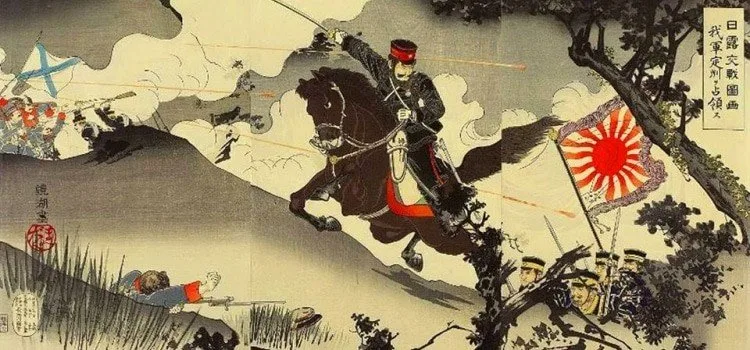
Between 1868 and 1947, Japan went through one of the most radical transformations any modern state has ever attempted. In less than eighty years, the country moved from a closed, feudal island society to the largest military power in Asia — and then collapsed in rubble. To follow that arc, you have to start with the feudal system (shogunate) that had governed Japan for more than two centuries and walk, step by step, through the wars and turning points that defined Imperial Japan.
Imperial Japan, in Japanese Dai-Nippon Teikoku (大日本帝国), was no ordinary state. It was a constitutional monarchy on the Western model, run by a political and military elite that industrialized the country at breakneck speed, militarized it, and pushed it into the modern age. The cost of that rise was devastating: wars against China, Russia, Korea, and eventually the Allies of the Second World War. By the end, in 1945, Japan had surrendered unconditionally.
In this article we walk that era piece by piece. We start with the collapse of the Tokugawa Shogunate and the Meiji Restoration (明治維新), then follow the road through the Satsuma Rebellion, the First and Second Sino-Japanese Wars, the Russo-Japanese War, the First World War and the Pacific War — and close with the dissolution of the Empire in 1947.
Contents 11
Fall of the Shogunate and the Meiji Restoration
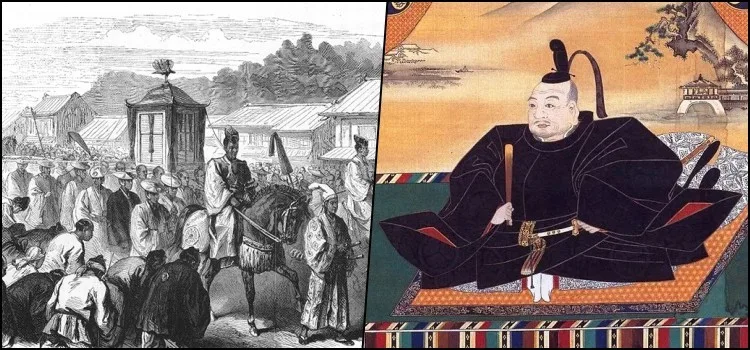
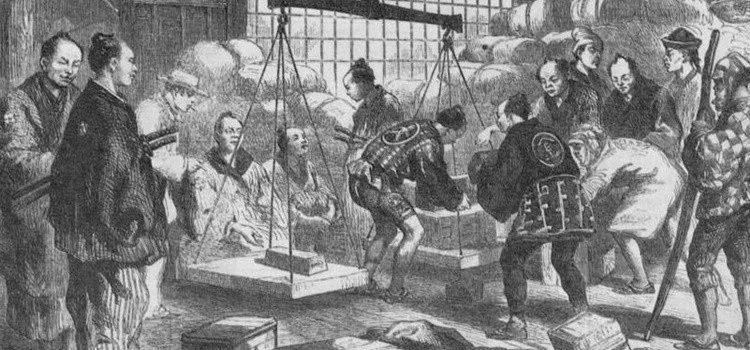
The Meiji Restoration (明治維新, Meiji Ishin) is the cleanest starting point, but it did not come out of nowhere. For more than two hundred and fifty years, the Tokugawa family had run Japan through a feudal military government, the Bakufu (幕府), based in Edo — today's Tokyo. Real power sat with the Shōgun, not with the Emperor in Kyōto, who was treated as a religious and ceremonial figurehead.
That arrangement broke down in the 1850s, when American Commodore Matthew Perry's "Black Ships" forced Japan to open its ports to foreign trade. The Bakufu, which had tried to keep the country isolated, lost legitimacy. A coalition of southern domains — most notably Satsuma and Chōshū — used the crisis to rally behind the young Emperor Mutsuhito. In 1868, they seized power in the Emperor's name. The last Shōgun, Tokugawa Yoshinobu, resigned. The Emperor moved from Kyōto to Edo, which was renamed Tōkyō ("Eastern Capital").
The short civil war that followed, the Boshin War (1868–1869), decided the outcome. Pro-Bakufu forces, the Shōgitai, were defeated. The feudal class system was dismantled: the Daimyō returned their lands to the Emperor in 1869, the samurai (侍) lost their privileged status in 1871, and the old domain boundaries were reorganized into prefectures. In a few years, Japan abolished the system that had ruled it for centuries.
The new leadership moved fast. The Iwakura Mission (1871–1873) sent senior officials on a tour of the United States and Europe to study industry, education, and military organization. A Western-style conscript army replaced the samurai class. Railways, telegraph lines, a modern currency, and a public school system were introduced within a decade. In 1889, the Meiji Constitution — modeled partly on the Prussian Constitution — turned Japan into a constitutional monarchy, with an elected Diet (parliament) sitting alongside the Emperor.
The result, by the early 1890s, was a state that looked modern on paper: a constitution, a parliament, a conscript army, factories, banks, and steamships. Behind that modern surface, however, sat a tight oligarchy of former domains (the genrō) and a growing military that increasingly believed Japan's future lay in expansion on the Asian mainland.
The Satsuma Rebellion and the end of the Samurai
The Meiji reforms were not peaceful. The most serious challenge came from the very people who had made them possible: the samurai. In 1877, Saigō Takamori, a hero of the Restoration from Satsuma, led a large-scale rebellion of discontented samurai against the new government. The Satsuma Rebellion (西南戦争, Seinan Sensō) is the largest revolt of the Meiji era.
It is also, in a sense, the last gasp of the samurai. Saigō's forces had spirit and local support, but they were no match for a modern conscript army equipped with rifles, artillery, and gatling guns. The rebellion was crushed in a few months. Saigō died, by his own choice, at the Battle of Shiroyama. His death was widely mourned, and the government quietly rehabilitated him as a national hero — proof that even the regime that defeated him understood what the samurai had meant for Japan.
After Satsuma, the old warrior class was finished as a political and military force. Japan now had a national army, compulsory for men, and a state that answered to a constitution rather than to a feudal aristocracy. The era of the Bakufu and the Daimyō was officially over.
First Sino-Japanese War (1894–1895)
Less than thirty years after the Restoration, Japan went to war with China. The pretext was a dispute over influence in Korea, where both powers had competing interests. The real cause was that the new Japan needed to test itself and to assert itself as Asia's leading modernized state.
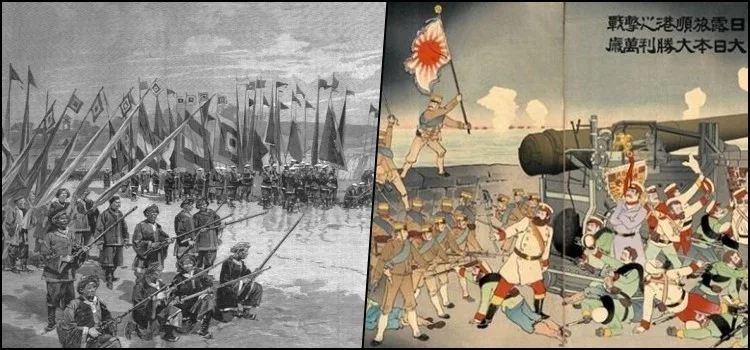
The First Sino-Japanese War (日清戦争, Nisshin Sensō) was short and decisive. Japanese forces defeated the Qing navy, captured Port Arthur (Lüshun) and Weihaiwei, and routed Chinese troops on Korean soil. The Treaty of Shimonoseki (1895) forced China to recognize Korean independence (in practice, opening the door to Japanese influence there), to cede Taiwan and the Liaodong Peninsula, and to pay a large indemnity.
The war announced Japan as a regional power. It also alarmed Russia, France, and Germany, who together forced Japan to return the Liaodong Peninsula — a humiliation that pushed Tokyo toward the alliance with Britain that would come a few years later. Taiwan, on the other hand, stayed under Japanese rule until 1945, and became the first piece of a formal Japanese overseas empire.
The Boxer Rebellion and the road to Tsushima
Between the two great Sino-Japanese conflicts, Japan took part in the international intervention against the Boxer Rebellion in China (1900). Japanese troops were part of the Eight-Nation Alliance that suppressed the uprising in Beijing. The operation, though minor in military terms, gave Japan's army and navy experience working with Western forces, and reinforced Tokyo's image as a disciplined, modernizing partner.
That image was tested almost immediately. Tensions with Russia over Manchuria and Korea had been building since the late 1890s. In February 1904, without a formal declaration of war, Japan attacked the Russian fleet at Port Arthur and landed troops in Korea. The Russo-Japanese War (1904–1905) had begun.
Russo-Japanese War (1904–1905)
The Russo-Japanese War is in many ways the high point of Meiji Japan's rise. Japan, a non-European power, defeated Russia, a major European empire, in a war fought on land and at sea. The political shock around the world was enormous. It was the first time in the modern era that an Asian state had defeated a European great power in a full-scale war.
The war was brutal. The siege of Port Arthur lasted almost five months and ended in early January 1905 with a Japanese assault that cost thousands of lives. On land, the Battle of Mukden in Manchuria (February–March 1905) was, by troop numbers, the largest land battle anywhere in the world up to that point. At sea, the decisive moment came in May 1905, at the Battle of Tsushima, when Admiral Tōgō Heihachirō's fleet destroyed most of the Russian Baltic fleet, which had sailed halfway around the world to reach the Pacific.
The Treaty of Portsmouth, mediated by U.S. President Theodore Roosevelt, ended the war in 1905. Japan won the southern half of Sakhalin, a lease on the Liaodong Peninsula (where Port Arthur sat), and recognition of its interests in Korea. It did not, however, receive an indemnity — a point that left Japanese public opinion deeply dissatisfied and helped feed the resentment that would shape later nationalism.
The strategic consequence was even larger: within a few years, Japan and Britain signed the Anglo-Japanese Alliance (1902, renewed in 1905 and 1911). For the first time, a European great power treated Japan as an equal partner.
Japan in the First World War
When the First World War broke out in Europe in 1914, Japan was still a neutral observer. That changed quickly. Tokyo declared war on Germany in August 1914 and used the opportunity to seize German possessions in East Asia: the Shandong Peninsula and the Marshall Islands, the Mariana and Caroline islands in the Pacific.
The Shandong campaign, fought mostly against German colonial garrisons, was brief. Far more important was what Japan did after 1915. The Twenty-One Demands, presented to the Chinese government in 1915, were a sweeping set of political and economic requirements that, if accepted in full, would have turned China into a Japanese protectorate. Chinese public opinion erupted. The United States and Britain quietly objected. Japan had to walk back some of the demands, but the episode made clear where Tokyo's ambitions now lay.
At the Paris Peace Conference of 1919, Japan won a seat among the victorious powers, joined the new League of Nations, and held the former German Pacific territories as League mandates. The European Allies, exhausted by their own war, accepted Japan's expansion in East Asia. The United States did not: the U.S. Senate refused to ratify the Treaty of Versailles, and the Anglo-Japanese Alliance was eventually allowed to lapse in 1923.
The Taishō democracy and the rise of militarism
The Meiji Emperor died in 1912. He was succeeded by his son Yoshihito, who reigned as Emperor Taishō (大正). The Taishō era (1912–1926) is often remembered as the most liberal period of modern Japan: a real party system in the Diet, an elected prime minister, a more open press, and lively urban culture in cities like Tōkyō and Ōsaka.
But underneath that surface, two trends were pulling Japan in different directions. One was the rise of democratic parties and civilian government. The other was the steady political weight of the army and navy, which operated with significant autonomy from the civilian cabinet and increasingly saw mainland Asia as the natural sphere of Japanese power.
The Great Kantō Earthquake of 1923, the worldwide financial troubles of the late 1920s, and the worldwide economic depression after 1929 deepened social strain. Nationalist and militarist groups grew louder. Political assassinations became routine. In 1931, junior officers of the Japanese Kwantung Army staged the Mukden Incident, blew up a small section of railway near Mukden (today's Shenyang), and used it as a pretext to occupy all of Manchuria. By 1932, they had set up the puppet state of Manchukuo, with the last Qing emperor, Puyi, installed as nominal head.
The road to the Pacific War
The Mukden Incident put Japan on a collision course with the rest of the world. The League of Nations sent the Lytton Commission to investigate; in 1933, Japan simply walked out of the League. The military's grip on policy tightened. Prime ministers were assassinated or removed when they tried to restrain the army. The civilian government that had emerged under the Meiji Constitution was increasingly hollowed out.
The Taishō Emperor had died in 1926 and was succeeded by his son Hirohito, who reigned as Emperor Shōwa (昭和). He ruled for most of the twentieth century, through peace and through the worst war in Japanese history.
By the mid-1930s, Japan was in open conflict with China. The Marco Polo Bridge Incident near Beijing in July 1937 triggered a full-scale war. Japanese forces took Shanghai, then Nanking (Nanjing), the Nationalist capital. The capture of Nanjing in December 1937 was followed by weeks of mass killings, rape, and looting — what historians call the Nanjing Massacre, or the Rape of Nanking. Conservative Japanese and Chinese casualty estimates differ widely, but the event is uncontested as one of the worst atrocities of the war.
In 1940, Japan signed the Tripartite Pact with Germany and Italy, formalizing what became known as the Axis. In September 1940, Japan occupied northern French Indochina. In July 1941, it moved into the south of the same colony. The United States, Britain, and the Netherlands responded with an oil embargo and a freeze on Japanese assets. Without access to Southeast Asian oil, Japan's military machine had months, not years, to run.
Pearl Harbor and the Pacific War
On the morning of 7 December 1941, the Imperial Japanese Navy launched a surprise attack on the U.S. Pacific Fleet at Pearl Harbor, in Hawai'i. The same day, Japanese forces attacked British Malaya, the Philippines, Hong Kong, and other targets across the Pacific.
The first months of the Pacific War went Japan's way. The Allies were caught flat-footed. By spring 1942, Japan had taken the Philippines, Singapore, the Dutch East Indies (today's Indonesia), and much of Southeast Asia and the central Pacific. The Empire now stretched from the borders of India to the Solomon Islands, from the Aleutians to the edge of New Guinea.
That was also, in retrospect, the high-water mark. The Battle of Midway in June 1942 turned the war. Four Japanese fleet carriers were sunk in a single day. After Midway, Japan lost the strategic initiative. The battles of Guadalcanal (1942–1943), Saipan (1944), Leyte Gulf (1944) — the largest naval battle in history — and Iwo Jima and Okinawa in 1945 were all defeats. By 1944, kamikaze tactics had become routine: pilots flying deliberately into Allied ships, not as a battlefield tactic that worked, but as a statement of will.
The defeat of 1945
By early 1945, Japan's cities were being burned down by air. The firebombing of Tōkyō on the night of 9–10 March 1945 killed more people than either atomic bomb would. U.S. strategic bombing, under General Curtis LeMay, deliberately targeted civilian areas of wooden Japanese cities. The destruction was almost incomprehensible. Hiroshima on 6 August 1945, and Nagasaki three days later, ended the war — but most Japanese lives lost in the conflict had already been taken by conventional bombing, famine, and ground combat.
On 15 August 1945, Emperor Shōwa announced Japan's surrender on the radio. The formal instrument of surrender was signed on 2 September 1945 aboard the USS Missouri in Tokyo Bay. The Empire accepted the terms of the Potsdam Declaration: occupation, demilitarization, war crimes trials in Tōkyō, and the eventual restoration of territories taken since the 1930s.
For Japan, 1945 was not the end of the war in the form of a clean political change of government. It was a national collapse. Millions of Japanese soldiers, settlers, and civilians abroad — in Manchuria, China, Korea, Taiwan, Southeast Asia, the Pacific islands — found themselves stranded and, in many cases, dead. The home islands were in ruins. Food was scarce. The Emperor remained on the throne, but his political role was redefined within a few years.
The end of Imperial Japan and the 1947 Constitution
Imperial Japan, in its formal sense, ended in 1947. That year, the new Constitution of Japan came into force, drafted under the American-led occupation. It replaced the Meiji Constitution of 1889, which had described the Emperor as "sacred and inviolable" and treated him as the head of the state and of the armed forces. The 1947 Constitution made the Emperor a symbol of the state and of the unity of the people, with no political power.
The new charter also renounced war as a sovereign right and gave up armed forces altogether — the famous Article 9, under which Japan would later set up the Self-Defense Forces under heavy political debate. Women got the vote. The Diet became the supreme organ of state power. Fundamental human rights were written into the text in unusually explicit terms.
The period we have walked through here — from the fall of the Tokugawa Shogunate in 1868 to the new constitution in 1947 — is short in calendar terms and very long in consequence. In less than a century, Japan went from a closed feudal society to the largest industrial and military power in Asia, fought four major wars on the continent and across the Pacific, suffered a defeat that destroyed its cities, and was then reborn under a democratic constitution. That arc, more than any other in modern Japanese history, explains why Japan is the country it is today.
If you want to follow the next chapter — what happened after 1947, the Korean War, the high-growth decades, the lost decade, and the Japan of the twenty-first century — you can keep reading from here. The story does not stop at the surrender; it just changes register. We are happy to keep going wherever you want to take it next.

Community
Comments
0 comments
There are no published comments in this language yet.
Send comment