
In Japan itself, we see Japanese characters being portrayed in anime in a way that is opposite to their appearance in reality. Colorful hair, big eyes, and tall stature.
In the West, in certain cartoons like South Park, their characteristics are exaggerated, being drawn with very small eyes, large glasses, horse teeth, goofy faces, and an extremely short stature with the intention of satirizing them.
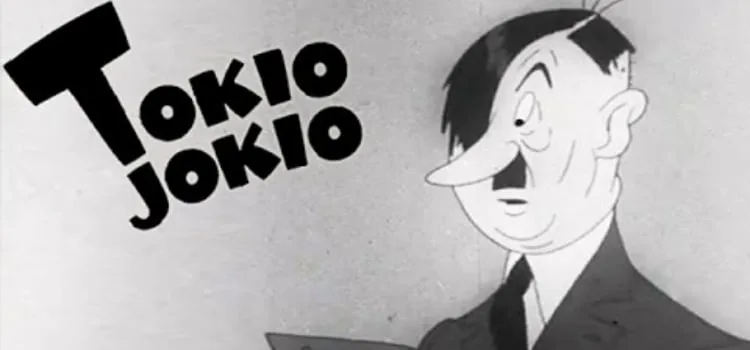
But these caricatures of today are nothing compared to a short film made by Warner Bros. Pictures in 1943, during World War II. The short is called Tokio Jokio, and you can still find it on YouTube: Warner Bros. did not renew the copyright, so the cartoon sits in the public domain.
Contents 3
The animation of Tokio Jokio
Tokio Jokio is a Looney Tunes short released on May 15, 1943. Norman McCabe directed it — billed as Cpl. Norman McCabe, because he had already been drafted into the U.S. Army — for Leon Schlesinger Productions, with Mel Blanc doing the voices. It is black and white, runs about seven minutes, and pretends to be a Japanese newsreel captured by American troops. The title is a pun on Tokyo (Tokio was an older English spelling) and “joke”; some viewers also hear Hideki Tojo in the syllables.
The animation begins with the narrator saying:
“Attention, please! This film now released for public showing has been captured from the enemy. It is a typical example of vicious Japanazi propaganda!”
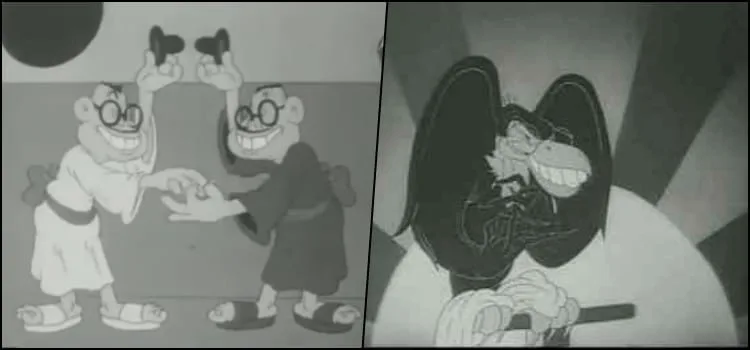
Then, the image changes to a rooster about to crow when suddenly, a big-toothed vulture with large glasses comes out from inside the rooster saying: “Cock-a-doodle-doo, please!” in a Japanese accent.
And then, the image changes to a text that reads “Civil Defense” and soon changes to the image of a village while the narrator talks about the “best air raid siren” and shows two Japanese men poking each other in the rear and screaming.
Next, the scene cuts to the “listening post,” which is basically a pole full of keyholes, and then cuts to the “aircraft spotter” literally decorating a plane with polka dots.
The narrator then talks about the “fire prevention headquarters” with the scene showing the rubble of said headquarters. The narrator then says: “Oh, wow! Too late!”
The scene transitions to an image with a lit incendiary bomb with a text that reads “Incendiary Bombs: First Lesson” and then, a Japanese man appears with an umbrella.
How does the animated short end?
Then, a text appears: “Stay away from incendiary bombs for 5 seconds” and the Japanese man looks at his watch and counts 5 seconds. Then, he approaches and starts roasting a sausage near the bomb that explodes next. When he climbs out of the hole, the gag is literal: he has “lost face.”
Then, the scene changes to “Kitchen Hints,” where it shows Hideki Tojo (the Japanese prime minister at the time) teaching how to make a club sandwich out of ration cards and then hitting himself on the head with an actual club.
After that, the scene changes to the “victory outfit of the Japanese which has no sleeves, pleats, lapel, or uniform” while showing a semi-nude Japanese man feeling cold warming himself with a candle.
The scene changes to the “Main Personalities” showing Admiral Isoroku Yamamoto (responsible for planning the attack on Pearl Harbor) walking on a pair of stilts to appear taller, explaining his intention to dictate peace terms at the White House.
An editor's note appears covering the screen saying: “This is the room reserved for Admiral Yamamoto” and then shows an electric chair. By the time Tokio Jokio reached theaters, Yamamoto was already dead: Allied fighters shot down his plane on April 18, 1943, less than a month before the short’s premiere.
The cartoon also kicks Japan’s Axis partners. A donkey billed as “Lord Hee-Haw” (a jab at the Nazi radio voice Lord Haw-Haw) hands Adolf Hitler a postcard from Rudolf Hess in a prison camp. In Rome, Benito Mussolini sits on a pillar marked as ruin number one, playing with a yo-yo.
The last stretch goes after the Japanese navy. A submarine launches weeks ahead of schedule — with workers still building it underwater. A minesweeper literally sweeps mines with a broom, then blows up. A buoy pops out of the water with the caption that closes the short: “Regrettable incident please.”
What was the intention of Tokio Jokio?
At the time, Japan and the United States were at war and the Americans produced such animation to demoralize the enemy and create anti-Japanese propaganda. During the war, it was common for propaganda to demoralize the enemy (both from the Allied and Axis sides) and boost the nation’s self-esteem.
The Japan on screen is the same Imperial Japan whose Pacific war is traced in the history of Imperial Japan in World War II — an empire already reshaped by the Meiji Restoration long before 1943.
Nowadays, this type of propaganda is considered racist and would not be aired as a regular cartoon. Tokio Jokio is not one of the Censored Eleven, the group of Warner Bros. shorts pulled from circulation for racist Black caricatures, but the studio has shown no interest in putting this one back on television either. After the war it dropped out of the official Looney Tunes rerun packages.
The reason you can still watch it without a studio disc is more paperwork than mystery. Tokio Jokio is one of 122 Warner Bros. animated shorts whose copyright was not renewed in 1971, so it is in the public domain in the United States. Cheap VHS labels picked it up in the 1980s; later it spread online. That lapse is a copyright fact, separate from the embarrassment around the caricatures.
The war the cartoon was laughing at did not vanish overnight either. Some Japanese soldiers kept hiding in the Pacific for decades, a trail followed in soldiers who fought World War II until 1974.



Community
Comments
0 comments
There are no published comments in this language yet.
Send comment