
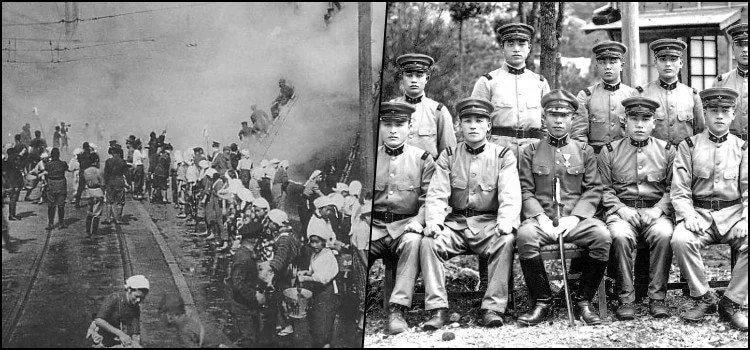
How did a modern industrial nation like Japan fall from the 1929 Wall Street crash into the unconditional surrender of 1945 in just sixteen years? The answer runs through the Great Depression, the seizure of Manchuria, the Second Sino-Japanese War, the Tripartite Pact, and the attack on Pearl Harbor, all the way to the atomic bombs dropped on Hiroshima and Nagasaki. In this article we trace that chain of cause and effect step by step. If you have not read the earlier chapters yet, we suggest starting with our article on the history of Imperial Japan from the Meiji Restoration.
The Empire of Japan, in Japanese Dai-Nippon Teikoku (大日本帝国), was at the start of the 1930s a constitutional monarchy on paper, but in practice a country where the military held more and more of the real power. The Shōwa (昭和) era, named after Emperor Hirohito, had begun in 1926, and it would end in total defeat. In between sat a sequence of crises that Japan stopped resolving democratically and started resolving with tanks, ships, and planes.
We follow here the path Japan walked between 1929 and 1945. We are not only interested in what happened, but also in the moments when the country could still have chosen differently. At turning points such as the Mukden Incident of 1931, the Marco Polo Bridge in 1937, or the eve of Pearl Harbor, alternatives were still on the table, and the people in power made a conscious choice to ignore them.
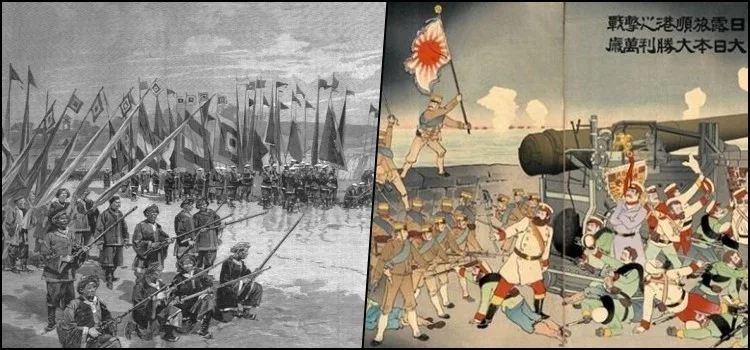
Contents 7
The Great Depression and the road to expansion
When the New York stock exchange collapsed in October 1929, the shockwave reached Tokyo within weeks. Japan in 1929 was already an industrial economy, but a fragile one. The country imported almost all of its iron, rubber, and oil, and it had very little arable land at home. When world trade contracted and silk exports, then Japan's main foreign currency earner, collapsed, factories closed, unemployment rose, and rural communities slipped into poverty. The crisis hit harder in Japan than in most Western countries because the economy was so dependent on a handful of exports and on raw materials that had to be bought abroad.
To keep industry alive, the military and parts of the civilian leadership argued that Japan had to secure its own supply of raw materials. The obvious target was mainland China, and within China, the Manchurian region, rich in coal, iron, and soybeans. The army's Kwantung Army in southern Manchuria had been pushing for a more aggressive line since the late 1920s, and the economic crisis gave that faction the political cover it needed.
On the night of 18 September 1931, a section of the South Manchuria Railway near Mukden was blown up. Japanese officers used the explosion as a pretext to occupy the city and then the whole of Manchuria within a few months. The League of Nations sent the Lytton Commission, condemned the action in 1933, and Japan simply walked out of the League. The following year, in 1932, Japan set up a puppet state called Manchukuo, with the last Qing emperor Puyi installed as nominal ruler. From this point on, Japan's civilian government in Tokyo was losing control of the army in the field.
The Second Sino-Japanese War
For the next few years, Japan consolidated its grip on Manchuria and pushed south into Inner Mongolia. The next great rupture came on the night of 7 July 1937, near the Marco Polo Bridge outside Beijing. A skirmish between Japanese troops on night manoeuvres and Chinese garrison soldiers escalated into a full battle within hours. By the end of the month, Beijing and Tianjin had fallen, and by December Japanese troops had reached the gates of Nanjing, then the capital of the Republic of China under Chiang Kai-shek.
The fall of Nanjing on 13 December 1937 was followed by what is now known as the Nanjing Massacre (also called the Rape of Nanking). Over the following six weeks, soldiers of the Imperial Japanese Army murdered an estimated 200,000 to 300,000 Chinese soldiers and civilians, committed mass rape, looted the city, and burned large parts of it to the ground. The episode is one of the most documented war crimes of the 20th century, and it remains a deep wound in the relationship between Japan and China. The Japanese government of the time censored the events, and full public recognition inside Japan has been slow and incomplete.
The wider war, however, did not end in 1937. China refused to surrender, retreated inland to Chongqing, and kept fighting. Japan was now stuck in a quagmire without a clear off-ramp, a problem familiar from other occupations of the 20th century. The drain on men and resources pushed Tokyo to look for new sources of supply, which in turn pulled Japan into a wider conflict with the Western powers and the Soviet Union.
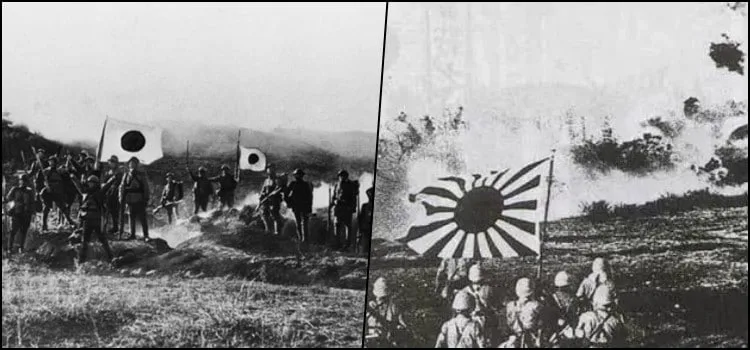
The Tripartite Pact and the slide toward Pearl Harbor
By 1940, Japan had signed the Tripartite Pact with Germany and Italy, formally joining the Axis. In April 1941 came the Soviet-Japanese Neutrality Pact, which freed the Japanese army from the fear of a two-front war with the Soviet Union and effectively ended the undeclared border clashes at Khalkhyn Gol. That left one main target: the European colonial empires in Southeast Asia, and above all the Dutch East Indies, which held the oil Japan desperately needed.
The United States, the United Kingdom, and the Netherlands responded with embargoes. In July 1941, Washington froze all Japanese assets in the United States and stopped shipping oil to Japan. Without oil, the navy and the army could not function for more than a year or two. The diplomatic negotiations that followed, stretching into the autumn of 1941, were the last chance to avoid war. Japan's civilian government, led by Prime Minister Konoe Fumimaro, wanted a deal that would lift the embargo. The army and navy insisted on keeping the gains in China and moving south. Both sides dug in.
On 26 November 1941, the US secretary of state, Cordell Hull, handed the Japanese ambassador a document that amounted to a final offer. The Japanese fleet, already at sea under strict radio silence, was ordered to attack. On the morning of 7 December 1941, in the local time of Hawaii, Japanese carrier aircraft struck the US Pacific Fleet at Pearl Harbor (真珠湾). The attack brought the United States into World War II and, in one stroke, solved Japan's short-term oil problem by handing it a much larger war.
The Pacific War and the tide turning
The first six months of 1942 were Japan's high-water mark. Singapore fell in February, the Dutch East Indies fell in March, the Philippines fell in May, and by mid-1942 Japan had conquered a vast arc of territory from the Aleutians to the Solomons, which it called the Greater East Asia Co-Prosperity Sphere, or Dai-tōa Kyōeiken (大東亜共栄圏). To defend this perimeter, the navy needed a decisive battle that would cripple the US carrier fleet.
That battle came at Midway in June 1942. The Japanese plan was to lure the remaining American carriers into a trap. American codebreakers had read enough of the Japanese naval cipher, JN-25, to know Midway was the target. When the Japanese carriers turned into range on 4 June 1942, they were ambushed. In a single day, Japan lost four fleet carriers and the core of its experienced naval aircrew. The strategic initiative passed to the United States and stayed there for the rest of the war.
From 1943 onward, Japan was on the defensive. The army bled in China and Burma, the navy shrank at every carrier battle, and American submarines cut the merchant fleet that brought oil and rubber from the south. By 1944, long-range B-29 bombers based in the Marianas were within range of the home islands, and the firebombing campaign under General Curtis LeMay was about to begin.
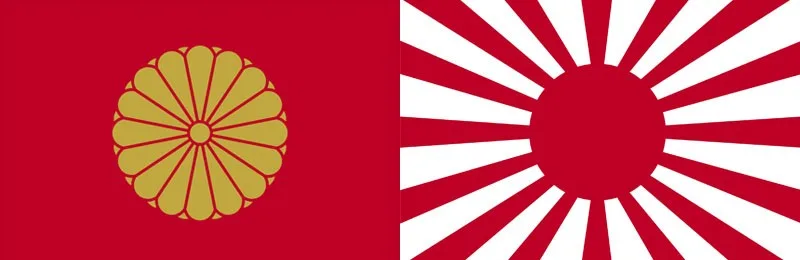
Iwo Jima, Okinawa, and the home islands
The battles of Iwo Jima (February–March 1945) and Okinawa (April–June 1945) showed what an invasion of the Japanese home islands would cost. On Iwo Jima, a volcanic island less than five miles long, more than 18,000 Japanese soldiers and almost 7,000 American marines died in five weeks of fighting. On Okinawa, which is part of Japan proper, Japanese military deaths reached around 100,000, civilian deaths around 150,000, and four US divisions fought for three months against entrenched defenders who often chose death over surrender.
The Japanese high command had already begun to organise civilian and military units into Tokkōtai (特攻隊), the so-called kamikaze, or special-attack, formations, in which pilots deliberately crashed aircraft loaded with explosives into Allied ships. These attacks intensified in 1945. On the home front, air-raid defence associations drilled schoolchildren in cities now under regular B-29 attack. The leadership in Tokyo knew by spring 1945 that the war could not be won, but a faction around War Minister Anami Korechika argued that a final, costly battle on the main islands could still produce acceptable terms.
Hiroshima, Nagasaki, and the surrender
On 6 August 1945, an American B-29 named Enola Gay dropped an atomic bomb on Hiroshima (広島), a city of around 350,000 people. The blast and the firestorm that followed killed an estimated 70,000 to 80,000 people immediately, and the total death toll from acute radiation, injuries, and long-term cancers has been counted at well over 100,000 by the end of that year. Three days later, on 9 August, a second bomb fell on Nagasaki (長崎). The Soviet Union also declared war on Japan that same day and invaded Manchuria.
Inside the Japanese government, the atomic bombings did not by themselves force a surrender. They broke the deadlock in the cabinet, where the deadlock had been between the army's insistence on fighting on and the navy's quiet acceptance that the war was lost. On 15 August 1945, Emperor Hirohito recorded a radio address known as the Gyokuon-hōsō (玉音放送), or Jewel Voice Broadcast, in which he told the Japanese people that the country had accepted the Allied terms of surrender. It was the first time most Japanese had ever heard his voice. On 2 September 1945, the formal instrument of surrender was signed on the deck of the battleship USS Missouri in Tokyo Bay.
The surrender was unconditional, but it was not the end of the story. Japan lost the territories it had conquered since 1895, lost the Kuriles and the southern Sakhalin to the Soviet Union, lost Taiwan to the Republic of China, and accepted a long period of US-led occupation under General Douglas MacArthur. The emperor remained on the throne, a political decision made in Washington rather than Tokyo. In 1947, the new postwar Constitution of Japan came into force, including the famous Article 9, in which Japan renounced war as a sovereign right and gave up the right to maintain armed forces for use in international disputes. With that, the Empire of Japan was over and the country began the long work of rebuilding itself as a democracy.
A century in two chapters
Seen from the distance of today, the fall of Imperial Japan looks less like a single dramatic event and more like a slow slide. A modernising elite that had lifted the country out of feudal isolation in the 1860s and 1870s came to believe that survival depended on empire. Each new crisis, the Great Depression, the war in China, the oil embargo, was met with another expansion, and each expansion made the next war more likely. By the time the atomic bombs fell, the system had already lost the war; the bombs simply forced the leadership in Tokyo to admit it out loud.
If you have come to this article from our piece on the Meiji Restoration, you now have the two halves of the same story: how a country built itself into a great power, and how that same machinery dragged it into a war it could not win. The years between 1929 and 1945 are not only about Japan; they are also a lesson in how economic crisis, militarised ideology, and weak civilian control can combine to push even a sophisticated society toward decisions that, in hindsight, look almost impossible to undo.

Community
Comments
0 comments
There are no published comments in this language yet.
Send comment