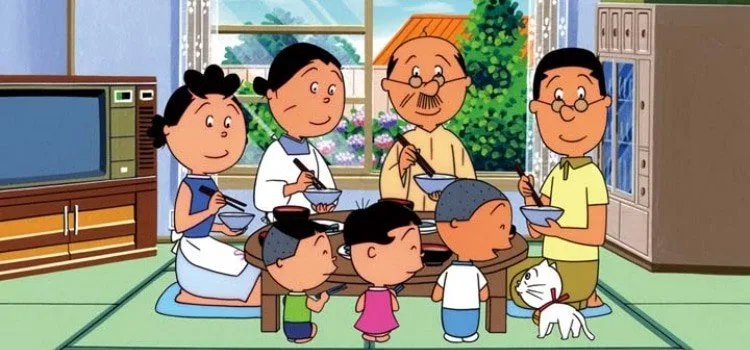
Maybe you have heard of this anime, or maybe not. Sazae-san (サザエさん) has over 7500 episodes and is considered the longest-running animation in the world. It even has official recognition from the Guinness World Records.
The anime is an adaptation of the manga by Machiko Hasegawa and premiered on TV in October 1969. But it had its first appearance in comic strips in the newspaper on April 22, 1946.
Although little known here in the western side, the anime is quite famous in Japan. It is considered one of the main programs for Japanese families. And it has always maintained excellent viewership, with the highest recorded in 1990.
What could be the secret to such success even after many years? Let’s learn a little about the history of this anime.
The story of Sazae-san and her family
The anime depicts the daily life of Sazae, a mother of a family who lives with her parents. It portrayed very well what a family was like after World War II. She was a woman who struggled with her family to overcome the effects of the post-war period and survive the influences of the American occupation.
But everything is portrayed in a light and comedic way. Even without well-developed characters or settings, it conveys a beautiful message to society.
Unlike the traditional, there are no big eyes, epic battles, or clichéd romances. But since its first comic strip, Sazae-san directly addressed the issue of women in society.
The episodes are short and often also show the everyday side of Japan. Things like taking care of children, getting along with neighbors, working for a regular salary, and keeping the house tidy are depicted in this work.
The characters of Sazae-San
Sazae Fuguta = The protagonist of the story;
Masuo Fuguta = After marrying Sazae, he moved in with his family;
Tarao Fuguta = He is the son of Sazae and Masuo;
Namihei Isomo = He is Sazae’s father and the patriarch of the family;
Fune Isomo = She is Sazae’s mother;
Katsuo Isomo = Sazae’s mischievous little brother. He likes to play baseball;
Wakame Isono = She is Sazae’s younger sister, a very kind and gentle girl;
Tama = The family’s pet cat;
Some curiosities about Sazae-san
The creator of the story said that her inspiration for the characters came when she was walking on the beach. In fact, the names of the characters are derived from things related to the sea, even from marine animals.
Sazae is a type of shellfish and all the members of her family have unusual names of seafood. Fune (Boat), Katsuo (Bonito), and Tara (Gadidae). It may seem unusual, but many of these names are common and popular.
The opening and ending music have been the same since the first episode;
Such success of the work that besides the adaptation to anime, it also had adaptations to radio dramas, even with real actors;
Machiko Hasegawa is considered by many as the “great mother of manga”;
Unfortunately, this anime is not easily found with Portuguese subtitles. This is strange, the most popular animes from Japan do not succeed in the west, this happens with others like Detective Conan and Uchuu Kyoudai which were wronged by their graphics or story.
Sazae San Syndrome – Generally Sazae-san is aired on Sundays from 6:30 to 7:00 PM since its premiere in 1969. When the anime ends, some Japanese people feel depressed because it indicates that the weekend is over, and that the next day they have to return to their work routine.
Did you already know the Sazae-san anime? We appreciate comments and shares. We also recommend reading:
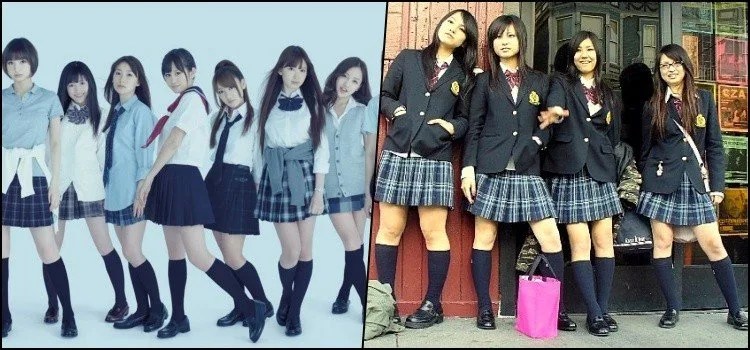
The uniforms of Japanese students often attract attention from around the world, especially their short skirts. Some have noticed that even in the intense winter of Japan, schoolgirls continue to wear their skirts without protecting their legs from the cold. This raises the question of why Japanese students wear short skirts in winter.
Perhaps some wonder how Japanese schools allow these short skirts to be worn both in summer and winter. It is worth remembering that schools have rules, and most students shorten their skirts outside of school. We have written several articles about Japanese students, and we will leave them below:
Some Japanese girls claim that the length of the skirt is a fashion statement, a way to express their individuality, a form of rebellion. We must remember that most teenagers also want to attract the attention of boys. Things are not like in anime, which took advantage of skirts and giant breasts to create fanservice.
Japanese students wear short skirts in winter
When it comes to fashion, Japanese women are willing to stand there shivering in the freezing cold. Some Japanese schools do not allow schoolgirls to wear pants; they must wear tights, and their skirts are long enough to protect them from the cold (they like to roll up their skirts to make them short).
The vast majority of Japanese students do not adhere to this fashion of wearing short skirts in winter. Most of the time, they wear long socks that are quite warm and protect them from the cold. Others wear thermal pants and products to warm their feet and other parts. They can protect themselves with blazers and other accessories, then take them off when they arrive at school.
Some schools and public places have heaters, which makes it easier for schoolgirls to wear short skirts in winter no matter where they are. Some bring a blanket to put on their legs, since schools are not well heated. Each school has its rules, and each student decides how they want to spend their day at school.
Some really prefer to spend the whole day saying “samui, samui” rather than dressing appropriately for the cold. However, we must consider that many Japanese students are prepared for the winter cold. Just because we see photos on the “internet” of girls with their legs exposed rolling in the snow does not mean that it is something extremely common.
The cold helps lose weight more than exercise
A study conducted by endocrinologist Paul Lee claims that shivering in the cold for 15 minutes is as effective as an hour of physical exercise. Perhaps this is one of the great secrets of Japanese slimness and beauty.
It is believed that when exposed to the cold, fat and muscle communicate through hormones and transform white fat into brown fat. Thus increasing energy expenditure to generate heat, lose weight, and burn calories. The cold is also great for keeping the skin youthful.
These were some of the reasons why Japanese students wear short skirts during winter in Japan. What do you think of all this? Do you approve of the idea? We hope to see your comment and sharing.
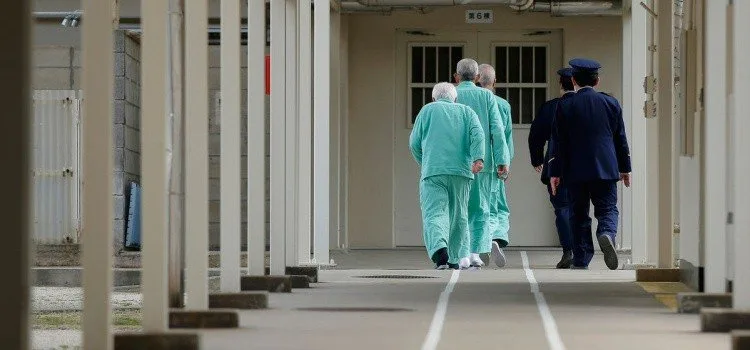
The death penalty or capital punishment is a legal penalty in Japan. It is practically applied only for murder, and executions are carried out by hanging. Death sentences are usually imposed in cases of multiple murders, although some single murderers have also been hanged if their crime was severe.
When did the death penalty arise in Japan?
From around the 4th century, Japan became increasingly influenced by the Chinese judicial system and gradually adopted a system of different punishments for different crimes, including the death penalty.
However, starting in the Nara period, cruel punishments and the death penalty became less common, likely as a result of Buddhist influence, and the death penalty was abolished in the Heian period. The death penalty was not used for the next 300 years, until the Genpei War.
During the Kamakura period, capital punishment was widely used, and execution methods became increasingly cruel, including burning, boiling, and crucifixion, among many others.
During the Muromachi period, even more severe execution methods came into use, such as upside-down crucifixion, impalement by spear, sawing, and dismemberment with oxen or carts.
These harsh methods and the liberal use of the death penalty continued throughout the Edo period and into the early Meiji period, but due to the influence of Confucianism, offenses against masters and elders were increasingly punished more harshly than offenses against those of lower class.
In 1871, as a result of a major reform of the penal code, the number of crimes punishable by death was reduced, and excessively cruel torture and flogging were abolished.
Criteria for the death penalty in Japan
Although technically not a precedent, this guideline has been followed by all subsequent capital cases in Japan. The nine criteria are as follows:
Degree of wickedness;
Reason;
How the crime was committed; especially the manner in which the victim was killed;
Outcome of the crime; especially the number of victims;
Feelings of the victim’s family members;
Impact of the crime on Japanese society;
The age of the defendant (in Japan, the age of majority is from 20 years);
Previous criminal history of the defendant;
Degree of remorse shown by the defendant;
Execution process in Japan
The execution order is signed by the Minister of Justice after internal consultations within the Ministry of Justice. Once the final approval is signed, the execution will take place within five days. By statute, the execution cannot occur on a national holiday, Saturday, Sunday, or between December 31 and January 2.
The death penalty is carried out by hanging in an execution chamber within the detention center. When an execution order has been issued, the condemned prisoner is informed on the morning of their execution. The condemned are given the choice of a last meal.
The family and legal representatives of the prisoner, as well as the general public, are only informed afterward. Since December 7, 2007, authorities have released the names, the nature of the crime, and the ages of executed prisoners.
I hope you enjoyed the article! We appreciate comments and shares. We recommend reading:
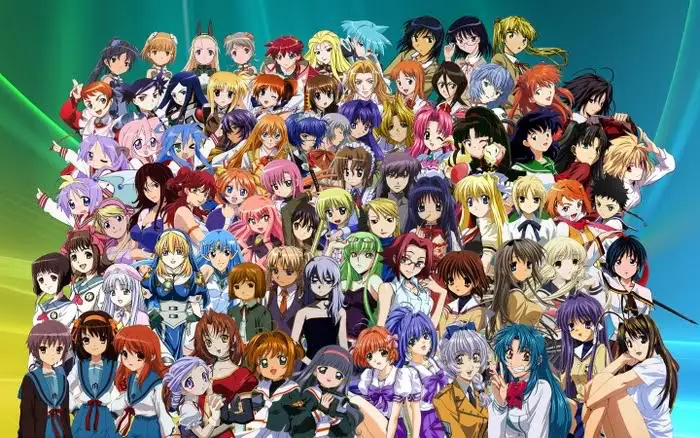
In addition to a lot of action, exciting fights, lessons of friendship and trust, we find many respectful quotes in anime, especially the famous ones like Naruto, One Piece, Death Note, Dragon Ball, and others.
Anime quotes tend to be motivational, sad, or make us think and reflect on our lives. In this article, we will see several quotes from characters from famous and not-so-famous anime. A complete list!
These quotes can even brighten our days, and you can put them in your status or as a caption for that photo. Many are even philosophical and strong. Some of the quotes in this article may help you in your day or with some problem.
There are many quotes from anime of this type, but not all of them will fit in this post. For this reason, I separated the article by anime, so you can find quotes from your favorite characters. To help with the search, we will leave a summary.
“Living is painful if you lose your dreams and if no one needs you” – Haru (Naruto);
“All people live trusting in their wisdom and knowledge, and they get trapped by them. They call this ‘reality.’ However, wisdom and knowledge are ambiguous, thus, reality is nothing but an illusion. People live based on their own beliefs. Isn’t it unpleasant to think?” – Itachi Uchiha;
When you love, there is a risk of hating. – Naruto
Being strong is not everything. Being strong means you will become arrogant and selfish. Even if you never wished for that. – Uchiha Itachi
No matter how powerful you become, never try to do everything alone, otherwise, you will fail. – Uchiha Itachi
No matter what kind of human we are, it is only at the moment of death that we discover our true nature, the true reason for our existence. – Uchiha Itachi
You don’t have to forgive me… No matter what you decide to do from now on, I will always love you. – Uchiha Itachi
Those who are unable to accept who they really are are destined to fail. Just like I failed in the past. – Uchiha Itachi
If you want to kill me… Hate me, curse me, and run away, run away… Live a miserable life running and hiding. Then, when you have the same eyes as I do, seek me out. – Uchiha Itachi
You and I are flesh and blood, I will always be there for you, even if it is just as an obstacle for you to overcome. Even if you hate me, that is what older brothers do. – Uchiha Itachi
We do not know what kind of people we really are until a moment before our death. As death comes to embrace you, you will realize what you are. – Uchiha Itachi
Clinging to the group, clinging to the clan, clinging to the name. These are things that limit our ability. And also, seeing the future. Fearing and hating the unknown… are foolish things. – Uchiha Itachi
“The fear of taking risks is what prevents you from evolving.” – Uchiha Itachi.
You know nothing about me… How much hatred I carry inside me… and how strong I have become because of this hatred. You do not know me, after all. – Sasuke
Quotes from the anime One Piece
The strongest blade is the one that can protect what you want to protect and cut what you want to cut. – Roronoa Zoro
I don’t want to be a hero, heroes share their drink… – Roronoa Zoro
Only those who have suffered for a long time can see light through the shadows. – Roronoa Zoro
No matter what the world says about me, what matters is that I have never done anything that goes against my principles and I never will. – Roronoa Zoro
I don’t want to be a hero, heroes share their drink… – Roronoa Zoro
Until I defeat you and become the best swordsman in the world, I will never be defeated again! Is there something wrong with that, KING OF THE PIRATES! – Roronoa Zoro
Only those who have suffered for a long time can see light through the shadows. – Roronoa Zoro
Quotes from the anime Dragon Ball
Strong people do not bring others down, they help them rise.
My heart is pure… pure evil! – Vegeta
A one in a million chance is better than no chance!
Power arises in response to a need, not in response to a desire.
Limits only exist if you let them exist.
Nightmares do not last forever. One day you wake up and they are gone.
You are not defeated when you lose, but when you give up. – Vegeta
I ask the Earth, the sky, the sea, to give me a little of their energy, I am not asking for myself. I do this for the good of all!
It is beautiful when a planet disappears, no matter what it is.
I can sense danger and chaos and no one will scare me now. With my mind, I go to a thousand places, and my imagination gives me the strength to fly.
Quotes from the anime Death Note
“No matter how hard you try, you alone cannot change the world. But that is the beautiful side of the world.” – L
No one can say what is right and what is wrong, what is good and what is bad. Even if there were a God and I had His teachings in front of me, I would reflect on them and decide what is right and wrong for me.
If you are alive, you can start over. No one has the right to take that away from you.
Look around you and you will see that there are people without whom the world would be better.
You will never win if you are always defending yourself. To win, you have to attack!
In this world, there are very few people who truly trust each other.
First, I never make mistakes. Second, if I do, go back to the first rule. – L
If you can’t win the game… If you can’t solve the riddle… You are just another loser… – L
Keep all important information only in your mind.
Humans are not perfect. We all lie. So much so that I have been careful not to tell lies that hurt others.
Justice always prevails.
Some motivational anime quotes
“Scars do not close when you try to forget them, for trying to forget them makes you remember them.” – (Shigatsu Wa Kimi No Uso);
“What is important is not what others think of you, but how you act in relation to that” – Meliodas (Nanatsu no taizai);
“Flowers are born and then wither… stars shine, but someday they extinguish… Compared to that, a man’s life is nothing more than a simple blink of an eye, a brief moment.” – Shaka of Virgo (Saint Seiya);
“There are people in this world who prefer solitude, but there is no one who can stand it.” – Makarov (Fairy Tail);
“People’s feelings change easily, and everything we see can be an illusion, nothing is completely certain. Even if the moon does not appear, the truth is that it is always there, just changing shape. Never forget that” – Nana Komatsu (Nana);
“Heart? You humans mention it so naturally. It seems like something you can hold in your hand. This eye of mine can see everything. Nothing can hide. Something that cannot be seen does not exist. That is how I believed and fought until now. What is a feeling? If I open your chest, is it something I will see? If I smash your head, will I be able to see it?” – Ulquiorra (Bleach);
“Do not judge who you are, just accept it, if you want to change and be a better person, you will have to accept who you have already been.” – Hunter x Hunter;
“But I always think that I will keep all my memories in my heart until the end. Even if they are sad memories that hurt me a lot. Even if they are so sad that I want to forget about them forever. If I can endure them and not run away from them, then, one day… One day this will make me a stronger person. I want to believe in that. I want to believe that no memory should be forgotten forever.” – Momiji (Fruits Basket);
“Fear is not bad, it tells you where your weakness is. Once you know your weaknesses, you become stronger and kinder at the same time.” – Natsu (Fairy Tail);
“How can a world be so cruel and so beautiful at the same time?” – Mikasa (Shingeki no Kyojin);
Videos about anime quotes
Let’s start by leaving some videos about anime quotes for you to watch:
Did you like the quotes? Did you remember any? Do you want to see a part two? Let us know in the comments and share with your friends.
In this article, we will learn some greetings, salutations, and farewells in Japanese. Knowing this will help you expand your beginner vocabulary in the language and start conversations with Japanese people. There are thousands of different ways to say hello in Japanese, good morning, good afternoon, and good night.
Japan is a country with a millennia-old culture and divided into many provinces, which contributed to the diversity of dialects and words in the country; its writing has origins in Chinese ideograms, resulting in various readings of a single ideogram. Not to mention the very formal language known as keigo. Pay attention to the words we will mention in the table below:
Besides the article, we also recommend watching our video below:
Aisatsu – Greetings and salutations in Japanese
JAPANESE
ROMAJI
PORTUGUESE
挨拶
Aisatsu
Greetings
お早うございます。
Ohayou Gozaimasu
Good morning.
今日は/こんにちは。
Konnichi wa
Good afternoon.
こんばんは/今晩は
Konban wa
Good night
お休みなさい
Oyasumi nasai
Good night – farewell
ようこそ。
Youkoso
Welcome.
どうも。
Doumo
Thank you (Can be used as slang for “Thanks”) / a hello (Can be used as a greeting depending on the situation).
じゃね。/ またね
Jya ne / Mata ne
Bye / See you later.
いらっしゃいませ。
Irasshaimase!
Welcome. (Formal)
ごめん下さい。
Gomen Kudasai
May I come in?
宜しくお願いします
Yoroshiku onegaishimasu
Can be translated as “Please,” “Nice to meet you,” “I count on you,” “I leave this in your hands” (when asking for a favor).
おかえりなさい/お帰りなさい
Okaeri Nasai
Welcome back (home)
さようなら。
Sayounara
Goodbye.
さらば
Saraba
An older goodbye used by samurais.
行ってきます。
Ittekimasu
I’m leaving.
行ってらっしゃい。
Itterashai
Go safely./ Have a good trip.
気をつけて
ki wo tsukete
Take care, a form of farewell.
Curiosities about greetings
Gomen Kudasai literally means: excuse me please. However, it is usually used when entering a place, as a kind of permission;
In Yoroshiku Onegai Shimasu, you can use Douzo before, to be more formal/polite. This expression is also used when there is an interaction with another person, and the person can respond the same or こちらこそ (kochira koso).
Irasshaimase is used more in stores or commerce, to greet/welcome customers;
Ittekimasu and Itterashai are used inside the house when someone leaves or returns, it’s like saying: I’m leaving, and the person in the house responds: Go safely / Have a good trip, take care, come back soon… and it’s just a simple response of interaction between the people in the house;
Many of the greetings can be abbreviated; when speaking informally, you can simply say: Ohayou, Oyasumi, Yoroshiku.
These are some of the main greetings and farewells used in daily life in Japan;
Sometimes you want to see the lyrics of a Japanese song in Japanese with ideograms, but unfortunately, Google often presents results in romanized lyrics (romaji). It seems like something simple to do, but we created an article and video that will help you and give tips on how to find song lyrics in Japanese.
Some beginners end up having difficulty finding the lyrics of the song in Japanese because Google Translate provides erroneous translations for the words “lyrics” or “song lyrics.” The true word you should use to search for song lyrics in Japanese is kashi (歌詞).
You can use the word 歌詞 before or after the name of the song written in Japanese or even romanized, and you will easily find the lyrics in Japanese that you are looking for. We made a quick video discussing this topic, and we will leave it below:
Tips for searching for song lyrics in Japanese
Unfortunately, Japanese websites often block text selection and copying, making it impossible for you to copy the song lyrics to study or paste into a text editor. You will have to search through various sites until you find one that does not have this security measure.
Be careful when searching for song lyrics in Japanese and ending up on a Chinese or English site that ended up using simplified Chinese ideograms, which are different from Japanese kanji.
Some American sites share the lyrics in Japanese alongside the romanized version and sometimes in various languages. One of the most popular sites to find song lyrics, especially from animes, is lyrical-nonsense.
You can also search for song lyrics in Japanese on YouTube to sing using the word karaoke (カラオケ) written in Japanese. The big problem is that you will end up finding versions without vocals or with Japanese voices singing. By using the word kashi (歌詞), you can find original versions with the lyrics, but it is also not that simple.
Try using nico nico douga to more easily find videos that have the lyrics and the original voices of the songs. I hope you enjoyed these tips for finding song lyrics in Japanese. We appreciate your comments and shares. We recommend reading:
Many people prefer to study Japanese alone using traditional Japanese books. With that in mind, our Suki Desu team has compiled a list of quite popular books so that you can study Japanese calmly. There are thousands of books that teach Japanese; we will recommend the best ones and leave a complete catalog of them in this article.
Unfortunately, the best materials for learning Japanese are in English, so we recommend reading our article on English books to study Japanese. The books that have been translated into Portuguese tend to be basic but can indeed take you to a level 4/3 of JLPT (Japanese Language Proficiency Test) if you put effort into your studies.
What books do we recommend you buy?
If you really want a Japanese language book in Portuguese, we first need to know what your priority is. Do you want to learn Japanese for travel? Our list recommends several quick guides. Do you want to learn the basics of the Japanese language? The books in this article can help.
Some people mainly want to buy dictionaries; there are several mentioned in this article. Now, regarding books that teach grammar, you will also find them below, but these books usually do not teach advanced Japanese ideograms and do not facilitate your memorization.
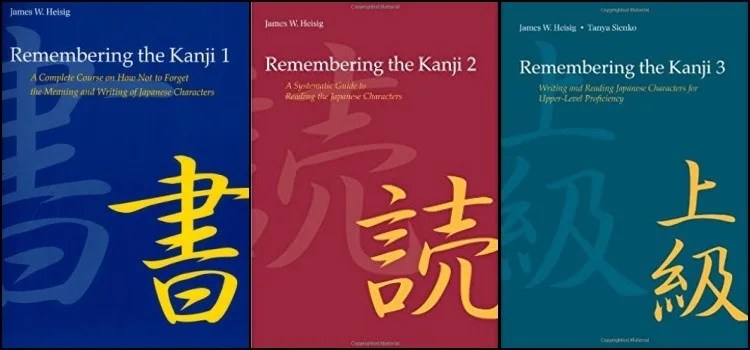
If you want to learn Japanese ideograms the right way, we recommend the book Kanji Imagined to Learn. It might be good for you to buy Japanese manga and manually study the texts using two references and dictionaries. They are much more efficient than fill-in-the-blank books.
List of books to learn Japanese
Below we will show a list of books to learn Japanese. We recommend checking the details and comments on the book’s page to make the best decision in your choice and purchase. The books are available on Amazon, one of the best bookstores in the world. Just click on the book to see all the details on the Amazon website.
I hope you enjoyed the article and this list of books we recommend for you to study the Japanese language. If you know another book in Portuguese, feel free to leave it in the comments. We appreciate the shares!
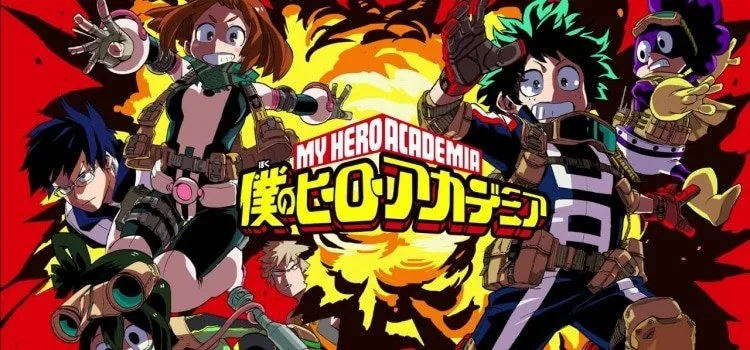
If you are a fan of Western heroes from Marvel and DC, this work is a good choice. Boku no Hero Academia is an anime based on the manga by Kōhei Horikoshi, which has been published by Shōnen Jump since 2014. It even sold nearly 150,000 copies in one week. Boku no Hero showcases the best of popular shounen from Japanese stories, but it also pays homage to American heroes and comic book stories.
Due to its great success in sales and popularity, an anime adaptation premiered in 2016. That same year, a game based on the anime was released. In 2017, the anime received a second season. Many said that after the end of Naruto, this anime would be its successor in fame.
Synopsis of Boku no Hero
Everything happens in a world where, unlike most stories, the strange thing is not having any superpower. More than 80% of the world’s population is born with special abilities and powers. But our protagonist, Midoriya Izuku, to his deep sadness, is part of the 20% that has no power.
Even so, his greatest dream is to become a hero. He spends a good part of his time gathering information about all the villains and heroes. But one in particular has caught his attention since he was little, that is All Might, considered the symbol of Peace and Justice.
As Midoriya grows up, his hopes of realizing his dream begin to fade. Until then, he had not awakened any superhuman power. But one day he meets All Might and discovers that he is sick and losing strength due to years and years of fighting against evil. Even without any power, Midoriya saves one of his classmates. Because of this, All Might notices that the boy is dedicated and honorable and decides to pass his power to him.
But to receive such power, Midoriya undergoes intense training, and shortly after that, he enters the school of individualities. Now he has to learn to control his powers and prove that he has the ability to become a hero. In addition, he has to overcome various problems such as relating to his classmates and even bullying. Will Midoriya be able to get through these difficulties and become the hero he has always dreamed of? You will find out if you watch.
List of Arcs of Boku no Hero Academia
The anime Boku No Hero Academia or My Hero Academia is divided into several arcs that are being released in the manga. Below is a complete list of all the arcs available up to the last update of this article (2021).
Admission Test Arc
The new generation following Izuku Midoriya and his former classmates prepares for the entrance exam of the prestigious U.A. High School, a renowned academy for heroes.
Born without special powers in a world where 80% of the population has them, Izuku Midoriya still dreams of becoming a hero. An unexpected encounter with the legendary hero All Might gives him the chance to change his destiny, but first, he must master his newly acquired power to pass the U.A. admission exam.
Episodes 1 to 4 [1st Season]
Chapters 1 to 4
Individuality Test Arc
Under the threat of expulsion on their first day at U.A., the students of Class 1-A have their ability to properly use their powers judged by their classroom teacher, Shota Aizawa, to determine if they are suitable to be heroes or not.
Episodes 5 and 6 [1st Season]
Chapters 5 to 7
Battle Test Arc
After receiving their hero costumes, the students of Class 1-A are split into teams of two and face each other’s teams in an internal battle trial. Izuku fights with his childhood friend and rival, Katsuki Bakugo, for the first time.
Episodes 6 to 8 [1st Season]
Chapters 8 to 11
U.S.J. Arc
Class 1-A takes a trip to the unexpected simulation joint to enhance their rescue skills. However, the League of Villains unexpectedly appears at the facilities, and the students must survive their first real battle against real villains.
Episodes 9 to 13 [1st Season]
Chapters 12 to 21
U.A. Sports Festival Arc
The U.A. freshmen participate in their first Sports Festival, showcasing their skills in different competitions to attract the attention of professional heroes. Amid Izuku’s first chance to show himself to the world, Shoto Todoroki’s past is revealed.
Episodes 1 to 12 [2nd Season]
Chapters 22 to 44
Hero Killer Arc
Izuku and his classmates travel to their chosen work locations to gain experience while training under the supervision of professional heroes. Meanwhile, evil begins to move in the city of Hosu, leading to a confrontation between three young heroes in training and their first formidable villain.
Episodes 13 to 20 [2nd Season]
Chapters 45 to 59
Final Exams Arc
As the end of the semester approaches, Class 1-A must face a written test and a practical exam. However, in a surprising twist, they must face their teachers in combat to pass the practical exam.
Episodes 21 to 25 [2nd Season]
Chapters 60 to 69
Training Camp Arc
The first term of U.A. has ended and summer vacation has begun. In order to enhance their skills, Class 1-A goes on a school trip to a training camp under the supervision of the hero team, the Pussycats. Their peace does not last long, however, as they are soon surprised by a sudden attack from an elite squad of villains.
Episodes 1 to 7 [3rd Season]
Chapters 70 to 83
Hideout Raid Arc
The League of Villains’ attack on the U.S. summer training camp left deep scars: Katsuki Bakugo was kidnapped and faith in the institution was greatly shaken. Faced with an incident that could mean the end of Hero Society, Pro Heroes and the Police mobilize for a raid on the villains’ hideout to rescue the kidnapped student while the greatest evil begins to move.
Episodes 8 to 12 [3rd Season]
Chapters 84 to 97
Provisional Hero License Exam Arc
U.A. has transitioned to a boarding school; Class 1-A begins their new life living at U.A. The first task that Class 1-A needs to accomplish in their new home is to finish the training they left undone at camp so that they can be ready to take the Provisional Hero License Exam.
Episodes 13 to 24 [3rd Season]
Chapters 98 to 121
Shie Hassaikai Arc
The second semester of U.A. has finally begun, and some freshmen are preparing to apply for internships, despite the slight resistance from U.A. teachers. Midoriya tries to get a position at Sir Nighteye’s office, which is headed by All Might’s former sidekick. Meanwhile, an investigation involving several offices concerning Sir Nighteye ends up leading to the hunt for a former yakuza member and a mysterious young girl…
Episodes 24, 25, 1 to 15 [3rd and 4th Season]
Chapters 122 to 162
Remedial Classes Arc
Having failed the Provisional Hero License Exam, Katsuki Bakugo, Shoto Todoroki, and two family members from Shiketsu High School take remedial courses, tasked with winning the hearts of the children at Masegaki Elementary School. Meanwhile, Endeavor has a serious conversation with All Might.
Episodes 15 to 17 [4th Season]
Chapters 163 to 168
U.A. School Festival Arc
The U.A. School Festival is starting, and Class 1-A wants to put on a performance worthy of the audience that doubts their worth. Amid beauty contests, crazy performances, dance, and food, a gentleman and his partner are desperate to make their mark in history, and U.A. is their target.
Episodes 18 to 23 [4th Season]
Chapters 169 to 183
Professional Heroes Arc
The hero rankings are published biannually, and Endeavor has secured his place as the new number one hero. Divided by the invisible pillar he must protect and his tense family ties, Endeavor and the Number Two hero discuss the rumors behind Nomus when a sudden attack from a new Nomu puts Endeavor’s role as Number One to the test!
Episodes 24 and 25 [4th Season]
Chapters 184 to 193
Joint Training Arc
Classes 1-A and 1-B compete against each other in a Joint Training Battle, joined by Hitoshi Shinso, who is eager to enter the Hero Course. While the exercise is underway, Izuku discovers a new secret about One For All; one that none of the eight previous users could have ever dreamed existed.
Awaiting New Season
Chapters 194 to 217
Meta Liberation Army Arc
The personal confidant of All For One has given Tomura an almost impossible challenge that, if he manages to overcome, will prove that he is worthy of being his master’s successor. Meanwhile, the Meta Liberation Army, a group that opposes the power restriction laws, has kidnapped Giran in an effort to lure the League of Villains into a trap, not wanting them to become more infamous than Destro, the leader of the original Meta Liberation Army.
Awaiting New Season
Chapters 218 to 240
Endeavor Agency Arc
With Hero Work-Studies back in effect, the top three students of Class 1-A study with the new Pro Hero No. 1. Meanwhile, the fire-powered hero undergoes an unusual epiphany.
Awaiting New Season
Chapters 241 to 252
Paranormal Liberation War Arc
After a tip from Hawks and a new source of information in Tartarus, the Heroes have gathered all the information they need to face the Paranormal Liberation Front. This is a large and powerful villain organization formed from the union of the League of Villains and the remnants of the Meta Liberation Army.
Awaiting New Season
Chapters 253 to 288 [Still in publication]
Points we can observe from the work
The anime seems to be a bit slow and spends more time on the fights than the manga itself. The weekly deadlines of Shonen Jump have caused the author to rush and leave some fights aside, like those that happened during the sports festival.
The manga explores themes of law and order, having freedom with their powers or needing licenses. We notice that several characters are punished for engaging in illegal combat with a villain, even in self-defense. So much so that one of the things the group of villains proposes is the freedom of their powers.
If we pay attention to a certain extent, all the characters are single or have not engaged in romantic relationships. The series places much more emphasis on the characters becoming heroes, highlighting friendships and teamwork, leaving romance aside in the anime. A big disappointment for those who enjoy it.
Continuation and New Season of Boku no Hero Academia
Whenever a new season of an anime ends, other people search the internet to find out if there will be a new season or continuation. What about Boku no Hero Academia? Will there be a new season? Continuation? Fifth Season? Sixth Season?
Boku no Hero is a very successful anime with a monthly search above 300,000 people, although curiously most of the searches are for adult content. The universal success of Boku no Hero guarantees 100% the possibility of a new season as long as we have content for it.
In addition to the anime and manga, Boku no Hero has received high-quality and successful film adaptations. We believe that the original material guarantees at least two more seasons of the anime until 2022.
Curiosities about Boku no Hero
Two spin-offs have been released. The first, My Hero Academia Smash, is a gag series parody. The second is titled Vigilante – Boku no Hero Academia: ILEGALS. Made by a different author and artist, this manga takes place shortly before the events of the main series and details the story of a group of unlicensed heroes.
There is a lot of cherry blossom (sakura) symbolism in the anime. When All Might announces that Deku can be a hero, cherry blossoms fall to represent the blossoming of a new hero. Notice the cherry blossom trees in the background of the first opening between Izuku and Katsuki, representing the blossoming of rivals.
Before the anime adaptation premiered, the mangaka Masashi Kishimoto (Naruto) praised Boku no Hero. With this, Horikoshi (Author) cited the Naruto series as the main source of inspiration for his work.
People with powers do not have a joint in their pinky finger. It was explained that this joint is only found in humans, and its absence shows that the person is at a new stage of evolution.
An action game developed by Bandai Namco, My Hero Academia: One’s Justice, was created for the Playstation 4 and Nintendo Switch;
The Chinese city of Qingqing (light happiness) is a play on the Chinese city of Chongqing (heavy happiness)!
Curiosities involving the names of the characters
Mina Ashido does not call Deku just because of his green uniform. She calls him greenie because of his name, which is Midoriya (緑谷), since in Japanese green is midori (緑). The name “Izuku” can also be read as “Deku,” which is a homophone of the term dekunobou, which means “useless,” “worthless” (more precisely a wooden doll).
His Hero name is a reference to the expression Ganbaru Deku (頑張るでく) which can be translated to “I Can Do This,” but everyone thinks of the original meaning of the word.
The name Bakugou (爆豪) is a reference to his power involving bombs and explosions. Bomb in Japanese is literally bakudan, while explosion is bakubatsu. Both words use the same ideogram that is present in Bakugou’s name (爆). Katsuki means “I win,” bakugou literally means big explosion.
Shoto Todoroki also has a name related to his power. Todoroki (轟) means something like “roar,” “great impact,” and Shoto (焦凍) is the combination of the words “toasting” and “freezing.”
Momo Yaoyorozu – The word Aoyorozu” literally means “eight million,” a number that indicates all creation. “Momo” can be read as “hundred” (hyaku, in Japanese). The momo went through indication because in Japan it is common for schools to recommend students with good grades without needing to take entrance exams.
Did you already know the anime? If so, did you like it? Did you become interested in the manga or anime if you haven’t seen it? Leave your opinion about the anime in the comments and share it with friends.
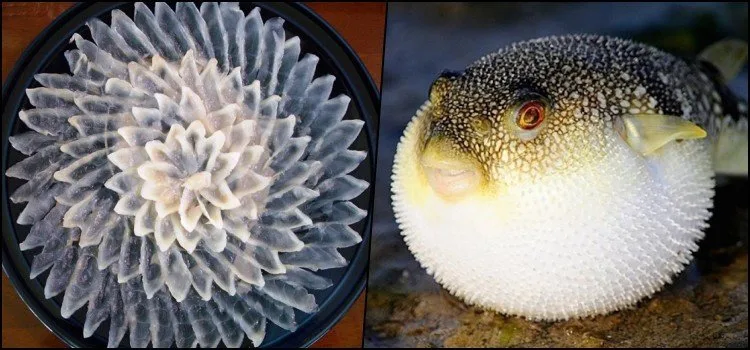
Would you have the courage to eat a fish that, if not prepared correctly, could kill you? The fish fugu, also known as pufferfish, can be very dangerous because of the poison found in its body. It contains lethal amounts of poisonous tetrodotoxin in its internal organs, mainly in the eyes, skin, and liver. Therefore, it must be carefully prepared to remove these toxic parts and not contaminate the meat.
During certain periods in Japanese history, the delicacy was prohibited. And even today, it is the only dish that the Japanese emperor cannot eat, for his safety. Even though the liver is considered one of the tastiest parts, it was banned from restaurants in 1984, as it is the part with the most poison from the pufferfish.
Such poison blocks sodium channels, paralyzing the muscles while the victim remains conscious. The poisoned person is unable to breathe, dying from asphyxiation. The meat of fugu is truly delicious, without fat, with no strong taste, and of a unique whiteness, which makes this dish famous and controversial.
Preparation and consumption of fugu
The law in Japan strictly controls the preparation of this fish in restaurants. Only chefs who qualify after three or more years of training are allowed to prepare it. It requires a lot of skill to remove the poisonous parts of the fish without contaminating the entire meat. There is so much poison in the liver that the chef cannot legally throw it in regular trash. After removal, the organ must be placed in a closed and isolated compartment. A specialized company collects the livers and incinerates them.
Only after these processes and thoroughly washing the meat does the chef begin to prepare it. Fugu is mainly served with sashimi and chirinabe. But it can also be served in salads, as grilled meat, and even cooked. The interesting thing is that the chef cannot completely eliminate the toxin, but can only reduce it. Customers experience effects such as euphoria and tingling sensations. Even so, the fish’s meat is said to have a mild and delicate flavor. Dishes usually cost between 2,000 and 5,000 yen.
Curiosities about the pufferfish dish
Between 1996 and 2006, there were 30 reported poisonings from Fugu in Japan. Most of the victims were fishermen who did not prepare it correctly;
The fish is considered the second most poisonous vertebrate in the world, coming only after a frog found mainly in Colombia;
There is no antidote for pufferfish poison;
The poisonous substance is not produced by the pufferfish, but by bacteria that reside in the fish;
Only two grams of pufferfish poison can kill a person;
Some pufferfish can live in both fresh and saltwater;
The total amount of poison found in a single fish can fatally affect up to 30 people;
The substance of the poison is not produced by the fish themselves, but by bacteria that reside in them;
Would you have the courage to eat a dish made with fugu? Let us know in the comments and share with friends. The folks from the Crazy Science of the Himalayas had the chance to try fugu; we will leave a video of the experience below:
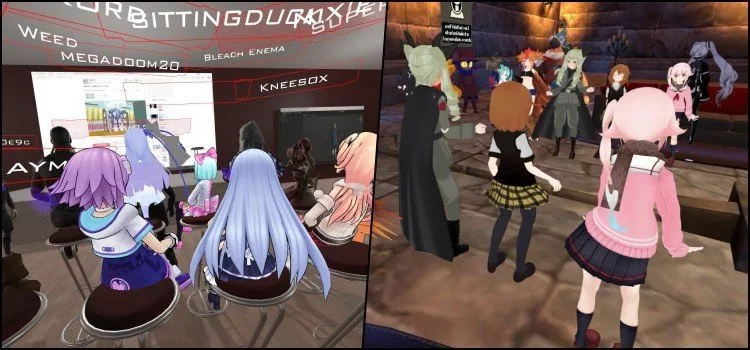
VRchat is an environment created for those who have virtual reality (VR) goggles and wish to make friends in a virtual setting. Fortunately, anyone with or without VR can access this chat/game and enjoy its numerous interactions and mini-games. In this article, we will talk about VRChat, which has currently become a true home for otakus and gamers.
VRChat was launched for free on Steam on February 1, 2017, for Windows and RIFT goggles and HTC Vive. The game/social network allows you to create and shape a character and enter an online environment to chat and interact through voice chat, messages, gestures, and emojis.
VRChat has various mini-games like tennis, bowling, capture the flag, and discs, as well as interactions like dancing, restaurants, and Stand Up. The game is open and allows anyone to create their games, enabling infinite modes of play and interactions.
VRChat – The home of Otakus and Gamers
The game is very funny because it allows players to create their own skins (models) of characters to use. Upon entering the game, you will encounter various characters from anime, games, and other iconic figures. A feast for those who have always dreamed of flirting with their waifus in virtual reality.
VRChat is also a gigantic source of memes and jokes. One of the main memes that spread through VR chat was a group of users using a strange skin of Knuckles (from Sonic) asking with an African accent “do you know the way?” (Do you know the way?).
Being an open game with no rules, you can find many unpleasant conversations and things. Although the team tries to supervise the created skins, it is still possible to encounter certain things… You can find various funny videos within VR chat. We will leave a random one below:
Playing VR Chat is a unique experience that you need to try. Have you had the chance to experience it even without VR? What was your experience in VRChat? We appreciate comments and shares. We also recommend reading:
Daily, thousands of people access suki desu to see a list of Japanese names and their meanings. Unfortunately, it is impossible to create a complete list of Japanese names with all meanings as the possibilities are infinite. In addition to there being several names with the same pronunciations, the ideograms that make up the name completely change the meaning.
We made a summarized video about the subject of this article, we will leave it below for you to watch:
If you have some basic knowledge of the Japanese language and can get the Japanese ideograms of the name you want to know the meaning of, you can easily look it up in the jisho dictionary and find out the meaning of each ideogram. That’s right, a name can have several meanings from each ideogram that makes up the name. And what if you don’t have the ideogram?
Generally, people know absolutely nothing about the Japanese language and just want to know the meaning of a name or choose a name. In this case, the person can write the name they want to know the meaning of in a romanized way using the filter or hashtag #names on jisho.
They will be presented with a huge list of names in Japanese, you will notice that each ideogram represents a sound, so a Japanese first or last name is usually composed of 2 ideograms. Identify the ideograms that form the name you want and research each of them individually to find out the meaning.
Of course, when searching for a romanized name on jisho, it will present various names written with different ideograms. So you will probably have to search several identical names to determine which meaning is best for you and for the name you chose and finally use it for what you want.
When you don’t have a name in mind, you can first look up the meaning of an ideogram and use it to search and list names that use that ideogram. For example: I want a name that means love, so I should search with the hashtag #names the ideogram 愛 (ai).
To know the ideogram that means a certain thing, you should write the word in English and use the hashtag #kanji. You will be presented with several options and can also select the kanji to know details and the readings for “name” that it offers.
When searching for names that use a certain ideogram or kanji, the first pages of the search will present names with only that ideogram and most of the time with one syllable. Just move on to other pages to see more interesting names that use other ideograms.
Japanese names can vary quite a bit. There are no rules in the choices of ideograms and readings for names, but there is a pattern and popular and common choices in Japanese names. To delve deeper into the subject, I will leave a list of articles below that can help you:
Japanese Nicknames Derived from Names
Now that you know a little about the choices of Japanese names, what do you think about choosing nicknames? Yes, Japanese nicknames are quite peculiar.
Generally, Japanese nicknames are chosen with combinations, abbreviations, and alterations of the personal name, or also by adding treatment suffixes.
Have you ever tried to chat on social media with a Japanese person, but can’t remember interesting questions to keep a conversation going? You might even be at an advanced level of Japanese, but if you don’t have practice in conversing, you can feel lost not knowing what to ask.
With that in mind, we have separated some questions for you to ask in a conversation with a native speaker. These are introductory and common questions to be asked with someone you are just getting to know or intend to talk to.
Japanese people are simplistic; they can talk about any common topic that you would find strange to discuss with someone. In Brazil, we already have the habit of meeting someone and immediately asking everything about their life, but it is not usually like that in Japan.
You should take it easy and ask calm questions, and who knows, even talk about bread. Answering questions can be easy, but asking them is not so simple, especially when we are not familiar with Japanese grammar.
Questions to generate topics in Japanese
Let’s skip all those questions that everyone knows, like good morning, good afternoon, how are you, it’s a pleasure… If you don’t know these words, we recommend reading the following articles before continuing here.
What do you do in your free time?
– 暇の時に何するんですか?
– Hima no toki ni, nani surun desu ka?
What’s going on?
– 何してるの?
– Nani shiteru no?
What are your hobbies?
– 趣味はなんですか。
– Shumi wa nan desu ka?
What’s wrong?
– どうしたんですか。
– Doushitan desu ka?
How’s the weather?
– 天気はどうですか。
– Tenki wa dou desu ka?
Are you hungry?
– お腹が空いていますか。
– Onaka ga aite imasu ka?
What is this?
– これは何ですか。
– Kore wa nan desu ka?
Where do you live?
– どこに住んでいますか。
– Doko ni sunde imasu ka?
What is your job?
– 仕事は何ですか。
– Shigoto wa nan desu ka?
How old are you?
– 何歳ですか。
– Nan sai desu ka?
What is your height?
– 身長はどのくらいですか。
– Shinchou wa dono kurai desu ka?
Shall we go out (have fun) one day?
– いつか遊びにいきませんか.
– Itsuka asobi ni ikimasen ka?
What are you doing?
– 何をしているんですか.
– Nani wo shite irun desu ka?
Questions to keep a conversation going is something quite complex to write, as there are thousands of questions to ask a person. I hope you liked this small article, if you have suggestions for questions just comment below. We appreciate the shares!
You who think that all animes are based on mangas, light novels, literary works among others, are mistaken. There are also original animes, which are not based on anything. Their scripts and stories were made exclusively from scratch directly for the anime. Even though they are not the majority, there are great original works that even later become mangas or games.
Making a list of the best original animes depends on taste; I myself, while reviewing the article, would place the last ones mentioned first (Kevin). So don’t think that this list of the best original animes is in any order or ranking. It is worth remembering that most of these works became famous and quickly received mangas. Now see a list of some of these original animes:
Darker than Black (黒の契約者) – 2007
Created by Tensai Okamura and produced by studio Bones.
Synopsis: One day an impenetrable region known as Hell’s Gate appears in Tokyo. From this, people with special powers begin to emerge. These people are divided into two groups, the Contractors, who are people without feelings and become killing machines. The other group is called Dolls, who have no personality or emotions. Treated as mere puppets, they are used by both the government and other organizations for surveillance.
Ergo Proxy (エルゴプラクシ) – 2006
Produced and created by the animation studio Manglobe.
Synopsis: Everything begins in Romdo, a futuristic city, built after a global environmental apocalypse. Humans and Androids live peacefully, in total harmony. Until a series of murders committed by robots infected with a virus destabilizes the social order of the city. It is then that the main character Re-l Maye springs into action. She is in charge of investigating these brutal murders committed by the infected robots.
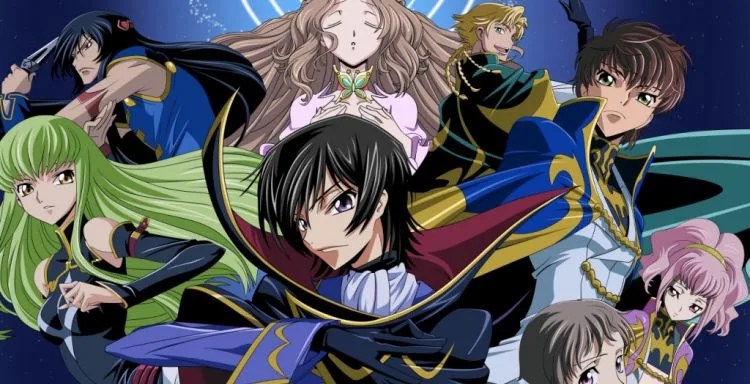
Code Geass: Lelouch of the Rebellion – 2006
Code Geass is an original anime series that tells the story of a young man named Lelouch who lives in a future world where much of it has been conquered by an empire known as the Holy Britannian Empire. Lelouch is a British prince exiled in Japan after his mother was killed in a terrorist attack. In Japan, Lelouch befriends a girl named C.C., who gives him the power of Geass, allowing him to control the minds of others. Lelouch uses his power to lead a rebellion against the Britannian Empire, and eventually becomes the emperor himself.
The story of Code Geass is complex and filled with political intrigue, action, and romance. It is an excellent example of an anime series that manages to mix these elements in a fun and stimulating way. If you are looking for an anime series with psychological thriller, suspense, and intelligence, Code Geass is a must-watch.
Koutetsujou no Kabaneri (甲鉄城のカバネリ) – 2016
The anime was written by Ichirō Ōkouchi, directed by Tetsurō Araki, and produced by Wit Studio.
Synopsis: Amid the industrial revolution, a mysterious virus appears, rapidly infecting people. The virus transforms people into hostile creatures that cannot be defeated unless their hearts are pierced. And most of the weapons used by soldiers are ineffective against them. On a certain island, people live behind walls and have built railway stations to move around. And it is on this island that a boy named Ikoma appears, who creates his own equipment to defeat the creatures.
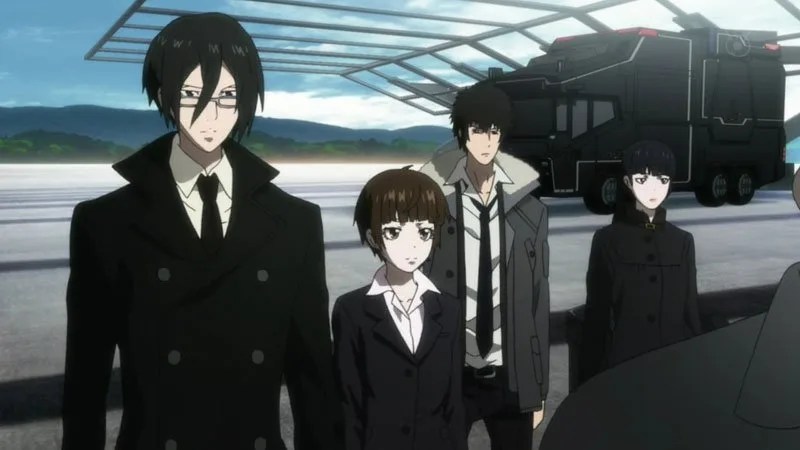
Psycho-Pass (サイコパス)- 2012
It is an anime produced by Production I.G.
Synopsis: The story unfolds in a future where people are judged as innocent or dangerous instantly. This judgment is made by a system called Sybil, which analyzes people’s mental state, determining whether they are criminals or not. If someone is judged as a threat, their sentence can be imprisonment or death, even if they have not committed a crime. Furthermore, the system decides what type of job suits you best.
The police rely on the help of a group of special prisoners, known as Executors. They use a weapon that immediately executes the judgment. Thus, they can even kill people deemed no longer necessary or dangerous by the system. But Akane Tsunemori, a newly transferred police officer, believes that people can change and thinks that there are no irredeemable people.
Kill la Kill (キルラキル) – 2013
This anime was produced by studio Trigger, directed by Hiroyuki Imaishi and written by Kazuki Nakashima.
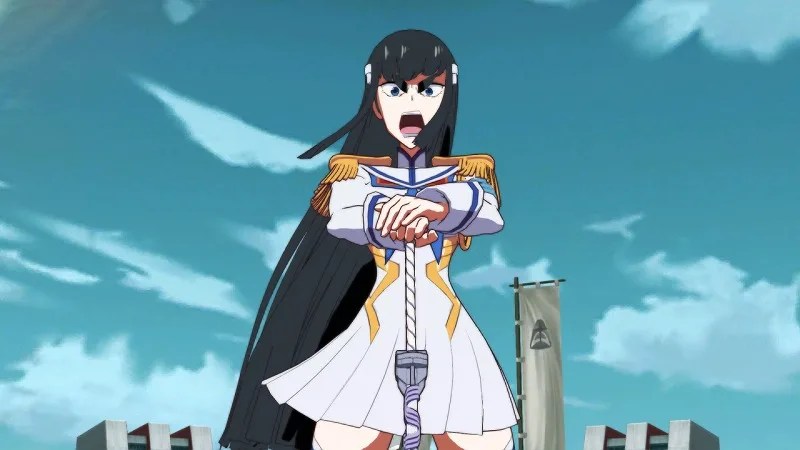
Synopsis: Ryouko Matoi is a student who has just transferred to Honnou school. This school is completely dominated by a strict and frightening student council, led by Satsuki Kiryuin. In this school, there is a hierarchy provided by this council, where a uniform or special outfit given by President Satsuki can grant special powers. But it all depends on the personalities and characteristics of the user.
The transfer student possesses a scissor-shaped sword that can cut such uniforms, challenging everyone. Ryouko has a uniform called Senketsu, which was not given by the council. And all she wants is to find her father’s killer.
Tengen Toppa Gurren Lagann – 2007
In a post-apocalyptic future, humanity is forced to live in underground villages, fearing the surface world ruled by the Spiral King. One day, a young boy named Simon discovers a small mecha called Lagann. With the help of his friends, he forms Team Gurren and leads a rebellion against the Spiral King.
Gurren Lagann is known for its over-the-top action, mecha battles, and unique characters. If you are looking for an anime full of excitement and adventure, Gurren Lagann is the perfect choice!
Aldnoah.Zero – 2014
It was produced by A-1 Pictures, TROYCA and directed by Ei Aoki with 2 seasons. It has one of the best soundtracks in anime composed by Hiroyuki Sawano.
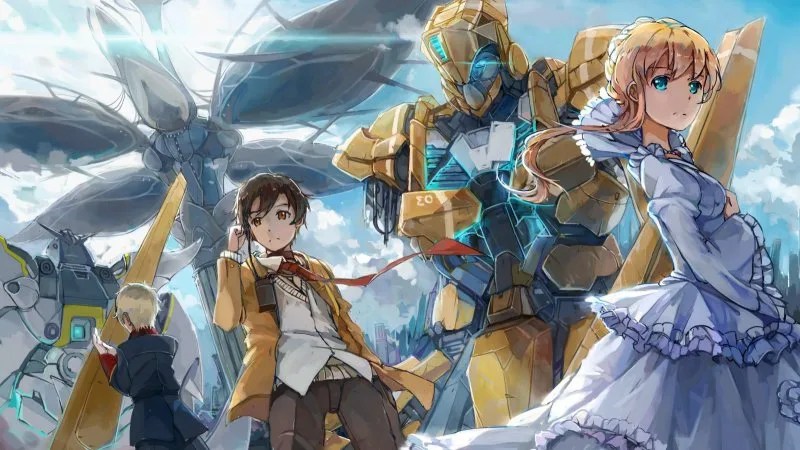
Synopsis: In 1972, a hyperlane was discovered on the surface of the moon, and humanity began to use it to colonize Mars. Years later, a war breaks out between colonizers from Earth and Mars.
I don’t know how to explain the synopsis without giving spoilers, just go with faith and watch! Guilty Crown also has the same composer with its epic soundtrack, and has an epic story, just a tip. Both are full of action, romance, drama, and suspense that provide great emotion.
List of original animes
To complement, let’s leave a more complete list without synopsis for you to take a look:
Code Geass;
Cowboy Bebop;
Puella Magi Madoka Magica;
Samurai Champloo;
Gurren Lagann;
Angel Beats;
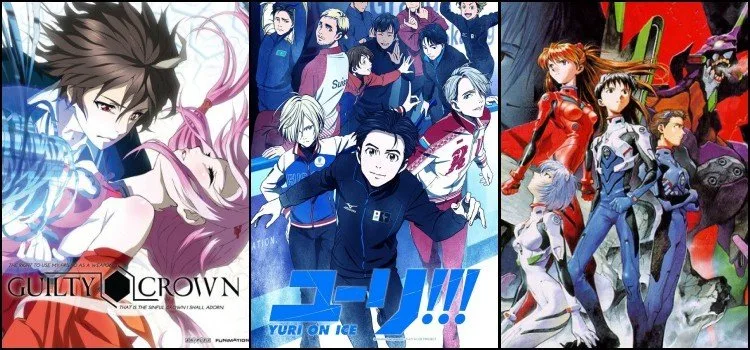
Guilty Crown;
Yuri!!! On Ice;
K- Project;
Zankyō no Terror;
Charlotte;
Wolf’s Rain;
Neon Genesis Evangelion;
Death Parade;
Eureka Seven;
Michiko To Hatchin;
Have you watched any of these? Did you know they were original works for the anime? Comment on any not mentioned, what you thought, and share the article.
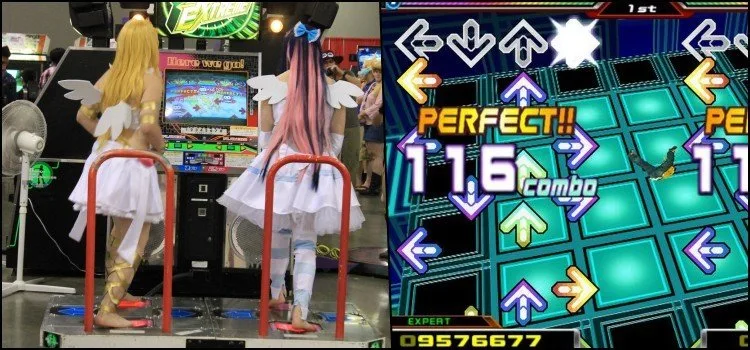
You who dance Just Dance or Dance Central, don’t even realize where all this came from. These games owe a lot to the old classics, especially to Dance Dance Revolution. Its arrow scheme and dance mats were already very popular in arcades around the world. A production by Konami, initially released for arcades in Japan in September 1998.
The idea of the game was to make you feel like a true dancer, even having to pay attention to the multicolored arrows on the screen. The songs were very upbeat and all had a certain electronic touch. The game includes a dance mat with four arrows. You must step on the arrows as they reach a certain point on the screen.
These arrows are synchronized with the rhythm of the music, leading the person to dance to the rhythm of the chosen song. After the song ends, the score is shown based on the player’s synchronization with the movements displayed on the screen.
Video games – The history of games in Japan
The success of dance mats
In 1999, a Korean company called Andamiro created a machine called Pump It Up. This machine had basically the same gameplay as Konami’s game. The biggest difference was that instead of four arrows, the Korean machine had one more in the middle.
This machine was very successful in Latin America, as there were many songs from there, in addition to many from K-pop. Soon Konami filed a lawsuit for plagiarism. But the Japanese company lost the case, precisely because of the “central arrow” that the machine had.
Even so, the game Dance Dance Revolution continued to expand and succeed around the world. Soon after the possibility of playing in pairs, teams and groups began to organize their own events and competitions. It became not just a game, but a lifestyle. So much so that the best and most experienced players became famous and attracted crowds of fans and followers.
The success of Dance Dance Revolution
The game is also praised for functioning as an aerobic activity, with a great expenditure of energy. There are many reports of people who managed to lose weight by regularly practicing Dance Dance Revolution. In many schools and universities, the game has been included in their curriculum, and in some countries, it is officially considered a sport.
Even though the game has lost its space both in Japan and in the West today, Konami continues to produce new versions of it. New dance games with motion sensors like the aforementioned Just Dance and Dance Central gain more space every day.
Even today, the dance mat actively participates in arcade machines, and some enthusiasts try to complete even games like Cuphead and Dark Souls using these mats. Have you ever played on a dance mat? Do you like this style of game? Tell us in the comments and share the article. To finish, let’s leave the following video:
In this article, we will study in depth the meaning of 2 verbs or particles that play an important role in the Japanese language. We will talk about the equivalent of the verb to be in Japanese, called desu [です] and da [だ].
What does Desu mean in Japanese?
The word desu [です] is nothing more than a polite version of “da“[だ]. Its common use in the Japanese language creates various discussions regarding its meaning, so we will examine it in depth in this article.
Its use is quite simple, desu [です] goes at the end of sentences to indicate the idea of “to be” or “is“. On the other hand, da (だ) can also be used to indicate the past of an action or the imperative form of a verb.
These words can come after any word to emphasize, equate, affirm, and declare something. It is a simple formality to correctly end the sentence, without any real effect on the sentence.
The use of these terms in Japanese conversations and sentences is not mandatory; however, their use is fundamental to enrich the conversation and make the sentence more polished. Another alternative to desu or da is dearimasu [であります]
Is Desu really the verb to be in Japanese?
Some claim that desu is the verb to be, but others claim it is not a verb. In reality, desu [です] cannot be a verb, as it is generally used together with a verb.
Explaining in a more technical way, desu [です] is actually a Japanese copula (link), used to grammatically relate a subject to a predicate. Even though it is translated as is or to be, desu cannot be called a verb.
The form da [だ] is an informal way of using desu [です] that is often as natural and common in most informal conversations as if it were a simple particle. Both da and desu are also referred to as verbal auxiliaries.
Simplifying the meaning of Desu
The da and desu are one of the first things we learn when studying Japanese. Some get quite confused with the meaning and use of a particle that should be quite simple.
To make it easier, we can simply compare desu [です] to an = (equals) sign. Where its main function is to say that A is equal to B.
In Japanese, there are 3 ways to end a sentence:
With the copulas だ/です;
Verbs;
Adjectives ending in い;
Sometimes it is used with a complementary or emphasis particle. Some use [です] at unnecessary moments, such as with adjectives [い], just to make the sentence more formal. Do not start using [です] randomly just because you think it sounds nice.
私はケビンです
I am Kevin
watashi wa kebin desu
可愛いですね
Isn’t it cute?
kawaii desu ne?
何時ですか
What time is it?
nanji desuka?
Variations and compound words with desu
Desu can have different variations depending on use, dialect, and context. It can also be used together with a particle or another word to present a different meaning.
To conclude this article, we will share a list of words that are composed with the term desu and a simple and quick translation for its function.
Hiragana
Meaning
でございます
a very formal desu.
でござる
used by ancient samurais.
でした
a desu that refers to the past.
であります
polite form of desu.
ですから
therefore, then.
ですか
indicates a question.
ですら / でさえ
still, but, however.
ですが だが
but, however, still, yet, for all that.
のです
touch of courtesy, it is that, the fact is that, expectation.
ですね
isn’t it?
そうですね
isn’t it?
There are other expressions involving です that are often used with other particles like ですよ to increase emphasis. Some incorrectly tend to end all sentences with です, ですも or ですです to convey a kawaii and childish idea.
What did you think of this article about desu? Did you know these things? I hope you enjoyed it and share our article with friends and comment below. To finish, let’s leave some example sentences about Desu and Da.
10年は待つには長い時間だ。
ichi zero nen wa matsu ni wa nagai zikan da;
Ten years is a long time to wait
潔白であることは美しいことだ。
keppaku de aru koto wa utsukushii koto da;
Being innocent is beautiful
またいつか風のように走るんだ。
mata itsuka fuu no you ni hashiru n da;
One day I will run like the wind
愛のない人生など全く無意味だ。
ai no nai zinsei nado mattaku muimi da;
A life without love is completely meaningless
僕は彼女無しに生きる術を学んだ。
boku wa kanojo nashi ni ikiru jutsu wo mananda;
I learned to live without her
病院にいるよ。雷に打たれたんだ。
byouin ni iru yo. kaminari ni utareta n da;
I am in the hospital. I was struck by lightning
税金を払ったら実生活の始まりだ。
zeikin wo harattara zisseikatsu no hazimari da;
Paying taxes is the beginning of real life
痩せる必要がないというのは残念だ。
yaseru hitsuyou ga nai toiu no wa zannen da;
It is a pity that you don’t need to lose weight
お金を稼ぎたいならアメリカが一番だ。
okane wo kasegitai nara Amerika ga ichiban da;
If you want to make money, America is the best
私のパソコンは何かの役に立つはずだ。
watashi no pasokon wa nani ka no yakunitatsu hazu da;
My PC should do something useful
一緒に旅行してくれる人がいないんだ。
issho ni ryokoushite kureru hito ga inai n da;
No one is traveling with me
うるさくて眠れないんです。
urusakute nemurenai n desu;
I can’t sleep with this noise
マリアさんの髪は長いです。
Maria san no kami wa nagai desu;
Maria has long hair
冬は私の一番好きな季節です。
fuyu wa watashi no ichiban sukina kisetsu desu;
Winter is my favorite season
彼女達は真面目な子たちです。
kanojotachi wa mazimena kotachi desu;
They are serious kids
残念ながらそれは本当なのです。
zannen nagara sore wa hontou na no desu;
Unfortunately, it is true
イタリアはとても美しい国です。
Itaria wa totemo utsukushii kuni desu;
Italy is a very beautiful country
あなたは私の好みのタイプです。
anata wa watashi no konomi no taipu desu;
You are my favorite type
奈良は静かで、きれいな町です。
Nara wa shizuka de, kireina machi desu;
Nara is a quiet and beautiful city
私の趣味は音楽を聞くことです。
watashi no shumi wa ongaku wo kiku koto desu;
My hobby is listening to music
明日図書館で勉強するつもりです。
ashita toshokan de benkyou suru tsumori desu;
I plan to study at the library tomorrow
パスワードは「Muiriel」です。
pasuwa-do wa "Muiriel" desu;
The password is “Muiriel”
彼の誕生日に贈り物をあげたいんです。
kare no tanjoubi ni okurimono wo agetai n desu;
I want to give a gift for his birthday
あなたが戻って来てくれて嬉しいです。
anata ga modottekite kurete ureshii desu;
When we think of Japan, what are the first words that come to mind? Technology and organization! How about getting to know a little bit of this incredible country up close and for free? Yes, it is possible to obtain scholarships to spend some time in that Asian country that is the dream of many people. Let’s now learn how to study in Japan without spending money.
Tips on how to study in Japan for free
The Japanese government is offering scholarships through the Ministry of Education, Culture, Sports, Science and Technology, which will open many doors for various professionals and students from all over the world. The Japanese government guarantees completely free courses in addition to airfare and also a financial contribution for the student to support themselves in the country during classes – this amount can reach up to R$ 5,000 monthly.
How to get these opportunities
To get these opportunities, you need to look for Japanese consulates and embassies or through the recommendation of universities in that country. These are golden opportunities, so it is worth starting to think about packing your bags today and expanding your chances of success in the job market. If you have dual nationality, it is not possible to obtain these scholarships, so check all the regulations available to analyze your eligibility or not.
What courses are offered by the Japanese government?
Research and Postgraduate Studies
If you are up to 34 years old and fluent in Japanese or English, you can spend 2 or 3 years in Japan to pursue a master’s or doctoral degree. Without a doubt, it is an excellent opportunity for you to have a much better Curriculum Vitae in your country. You need to pass the admission exam at the university to start your studies.
Undergraduate
For those aged between 17 and 21, you can choose an undergraduate course, and another condition is to speak one of the languages – English or Japanese. The courses last from 5 to 7 years, so it is an excellent opportunity to take important steps in your life.
Technical School
It is a four-year course in the fields of engineering and technological sciences, and you need to be fluent in Japanese or English.
Vocational Course
If you are between 17 and 21 years old, you can take a course of up to 3 years in administrative, technological, and even nutritional areas. It is essential to speak English or Japanese to access these great courses.
Training for Teachers
If you have up to five years of experience as a teacher and hold a completed higher education degree, this is an excellent opportunity for your growth as a teacher. The courses last a year and a half.
Japanese Language
If you already speak Japanese, you can further enhance your knowledge of this important language for your professional and academic life. Don’t miss this golden chance to live in Japan and learn a little more about the culture of that country.
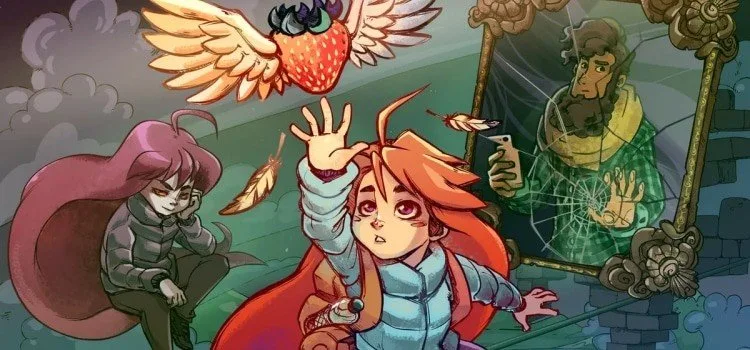
In a world where games are increasingly becoming more of the same, indies are always innovating because they don’t waste too much time on graphics but invest in gameplay, innovation, and story. At the beginning of 2018, one of the great innovations in platform games called Celeste was released! In this article, we will see a small review of this must-play game for Megaman fans.
The Megaman games were famous for their extreme difficulty, but in recent years Capcom has faltered in abandoning the franchise or releasing remakes of old games without any innovation. After the fiasco of Mighty Number 9, many lost hope in difficult platform games. Until Celeste came along and blew everyone away with 93 points on Metacritic.
Many have become accustomed to current games and end up disregarding indies, platformers, and pixel games. I myself saw some negative comments in the news about the game; these gamers have no idea what they are missing… Celeste manages to be better than many AAA (high-budget) trendy and generic games released every year.
Talking about Celeste
The game is simple and has a straightforward jumping mechanic without any shooting weapons. Celeste has a mechanic similar to Super Meat Boy, where you need to jump and grab onto walls to overcome challenges. The game may not have technological advancements, but it is well ahead in creativity.
Your objective is simple: to take the protagonist Madeline to the top of the mountain called Celeste. This unique platforming style can lead the player to anguish, fun, adrenaline, endorphins, anger, anxiety, and many inexplicable emotions.
The character Madeline wants to climb this mountain located in Canada, but she has no idea why. Throughout her adventure, she meets people and faces her own reflection, thus creating a story that addresses philosophical concepts, depression, fear, friendship, psychology, personality, trauma, and choices.
The game features great dialogues and an epic soundtrack that perfectly matches the game’s levels. Celeste manages to have an almost perfect increasing level of difficulty, innovating with new mechanics in each chapter. In this game, you will die at least 3000 times before completing the main story.
The game doesn’t stop there; in addition to the main levels, you can unlock the B and C sides, which are alternative versions of each chapter with a much more extreme difficulty that will make you die over 10,000 times. There are also collectibles (strawberries) that will test your patience and add a replay factor to the levels (if you miss one).
The game is not short like the vast majority of indies; everything will depend on your skill, but you will have at least 10 hours of gameplay and may spend over 30 hours to achieve 100%. Additionally, the game has an arcade version within itself; there is so much content that it makes every penny spent worthwhile.
Celeste is one of the best of 2018
I consider Celeste one of the best games of 2018, not just among indies, but among all games. Besides all the information mentioned, for me, Celeste is one of the few platform games that doesn’t get boring and makes you reach the end with a smile on your face even after so much anger.
I almost forgot to mention the game’s art, which is magnificent, with incredible scenery and a huge amount of challenges. Although the game seems difficult, its difficulty and learning curve are for all players. Anyone can be capable of completing it, even if they get a little frustrated.
If you were looking for a game worthy of this year, with charismatic characters and above-average difficulty, Celeste is definitely the right choice. The game is available for Switch, PS4, PC, and Steam. I hope you enjoyed this review! Share it with friends and let’s play! I will finish by leaving a very technical and detailed video about the game, its story, and mechanics, but beware of spoilers.
Xenoblade – A game that deserves an anime adaptation.
How many kanjis do the Japanese people need to know in order to read, write, and speak their own language? One of the biggest concerns and “headaches” of learning Japanese is the Chinese characters that the language uses, known as kanjis.
How many kanji are there?
Children in Japanese schools must learn 1006 basic characters, the kyōiku kanji, before finishing the sixth grade. This list is a subset of a larger list that was implemented by the Ministry of Education of Japan in 1945.
This list is called jouyou kanji (常用漢字), which literally means common-use Chinese ideograms. Currently, this list of necessary ideograms has about 2136 kanji for the level of fluency in Japanese. This larger list of characters must be mastered by the end of school. Students learn through repetition methods.
In total, it is believed that there are more than 5000 Chinese ideograms in the Japanese language. Over the years, these ideograms have fallen out of use and have been replaced by other words written in hiragana, with other kanji, or even international words written in katakana. Knowing 2000 kanji is more than enough to be fluent in the Japanese language.
Do the Japanese know all the kanji?
It is said that the Japanese do not know all the jōyō kanji, which are the most advanced, as some of them are rarely used in everyday life, and although they learned them in school, the rare use of some kanji causes the Japanese to forget these characters. Depending on the profession, a Japanese person may or may not know all these characters.
A factory worker, for example, certainly will not know/remember all;
A biologist or doctor may know more of these kanjis;
Now, someone who works in the field of education, literature, or any area of the humanities will know almost all these kanjis due to the fact that they deal with these rarely used characters.
However, in texts and newspapers, the rarely used characters contain furigana to facilitate reading for those who do not know them. A well-educated Japanese person can read 3000 kanjis or more. A PhD holder can probably reach up to 5000, especially if related to their field of study.
More than 5000 is possible, but many kanjis would be extremely rare, making it even harder to remember them. In reality, we should not worry about the number of ideograms in the Japanese language. We shouldn’t even count how much we have learned. Just focus on learning words, and deciphering an unknown kanji will become easy with the help of your radicals.
I hope you enjoyed the article, we appreciate comments and shares. We also recommend reading:
Controversial and short animes tend to appear every year, but I doubt you know about the existence of this obscure anime, which involves fights with butts and a war between religions and sects. Today we will talk about a short anime (OVA) that has only 2 episodes. Perhaps, the true inspiration for the anime Keijo!!!!!!!!
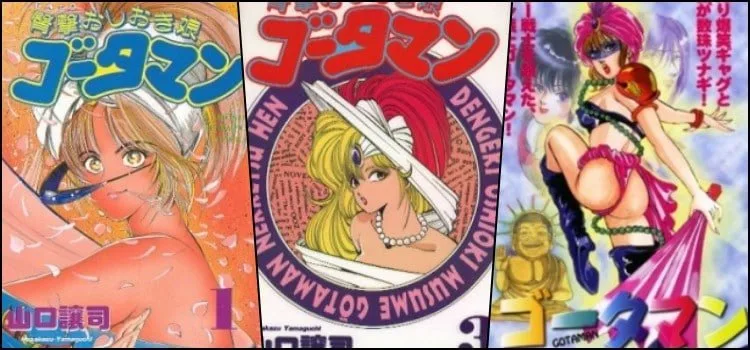
In the 90s, VHS tapes were the easiest way to sell the famous OVAs (original animations). That’s when someone had the great idea to adapt the manga by Masakazu Yamaguchi called Dengeki Oshioki Musume Gootaman created by Animate Film and Studio Kikan (famous for short animes and OVAs) in 1994.
The anime has a duration of 45 minutes and was released in parts:
Dengeki Oshioki Musume Gootaman R: Ai to Kanashimi no Final Battle;
Dengeki Oshioki Musume Gootaman
Mari Amachi is a very devout Christian who transfers to Perfect Religion Academy. A school dedicated to all the religions of the world in an effort to make the students the next world leaders in religion. Her friend Saori is kidnapped by the Black Buddha cult; a group that seeks to take away religious freedom through force and brainwashing.
Mari prays to God for help, but it is Buddha who answers the call. Mari aspires only to help her friend and she is transformed into Dengeki Oshioki Musume Gootaman. To her shame and the delight of everyone else, her outfit involves a costume covered with a sumo belt that exposes her backside.
Basically, her attack and defense consist of movements with her backside. Yes, there are only moves that use the butt, and nothing else! Basically, the anime presents a sexually lurid way of attacking enemies in the name of religious freedom. A rather strange concept that gives a lot to discuss.
In the English version, the title of the anime is Butt Attack Punisher Girl Gautaman. Note that even the word butt appears in the title, and in Japanese, the word oshioki, besides reminding punishment, also reminds butt.
Is it worth watching Dengeki Oshioki?
There is no real depth to any of the characters, which is really to be expected from such a short anime. This does not mean they were not likable. Mari and Saori were charming and friendly as the main protagonists.
The supporting cast and the villains are so shallow and mainly rely on their various visual stereotypes to build their personalities. The anime was such an obscure failure that it is not even found with Portuguese subtitles. There isn’t even a wiki page about the anime. Perhaps it was due to being released on VHS.
The anime is so absurd and nonsensical that it gained the reputation of being “so bad it’s good.” You know those movies with very amateurish and forced acting that you watch just because they are comedic? That’s the case with Dengeki Oshioki Musume Gootaman. It’s only worth watching this anime if you’re in the mood for something so horrible that it becomes funny.
You can easily find this anime on YouTube in Japanese and sometimes with English subtitles. Do you know another anime with absurd and unknown themes? We appreciate comments and shares. We also recommend reading:
The Heian Period [平安時代] or Heian jidai is the last division of classical Japanese history, which runs from 794 to 1185. The period is named after the emergence of the capital of Heian-kyō (now known as Kyoto).
This is the period in Japanese history when Buddhism, Taoism, and other Chinese influences were at their peak. The Heian period is also considered the height of the Japanese imperial court and is noted for its art, especially poetry and literature.
Although the Imperial House of Japan had power on the surface, real power was in the hands of the Fujiwara clan, a powerful aristocratic family that married into the imperial family. Many emperors actually had mothers from the Fujiwara clan. Heian (平安) means “peace” in Japanese.
–
–
–
–
A painted scroll dated 1130, illustrates a scene from “The Bamboo River”.
History of the Heian Period
The Heian period was preceded by the Nara period and began in 794 AD after the capital of Japan was moved to Heian-kyō by the 50th emperor, Emperor Kanmu.
Kanmu first attempted to move the capital to Nagaoka-kyō, but a series of disasters occurred in the city, leading the emperor to move the capital for a second time, to Heian. A rebellion occurred in China in the last years of the 9th century, making the political situation unstable.
Japanese missions to China were suspended, and the influx of Chinese exports stopped, a fact that facilitated the growth of an independent Japanese culture called kokufu bunka.
Therefore, the Heian Period is considered a high point in Japanese culture that later generations always admire. The period is also noted for the emergence of the samurai class, which would eventually take power and initiate the feudal period of Japan.
Rise of the Military Class
Under the early courts, when military recruitment had been centrally controlled, military affairs had been taken out of the hands of the provincial aristocracy. But as the system fell after 792, local power holders became the main source of military strength again. The re-establishment of an efficient military system was done gradually through a process of trial and error.
At that time, the imperial court did not have an army but relied on an organization of professional warriors composed mainly of oryoshi, who were appointed to an individual province, and tsuibushi, who were appointed through imperial circuits or for specific tasks. This gave rise to the Japanese military class. However, final authority remained with the imperial court.
Those who owned Shōen (private property) had access to labor and, as they obtained improved military technology (such as new training methods, more powerful bows, armor, better horses, and swords) and faced worsening local conditions in the 9th century, military service became part of the life of the holder of the shōen.
Not only they, but also civil and religious institutions formed private guard units to protect themselves. Gradually, the provincial upper class was transformed into a new military elite based on the ideals of the bushi (warrior) or samurai (one who serves).
Rise of Buddhism
Buddhism began to spread throughout Japan during this period through two main sects, Tendai and Shingon. Tendai originated in China and is based on the Lotus Sutra, one of the most important sutras of Mahayana Buddhism; the monk Saichō was key to its transmission to Japan. Shingon is the Japanese transmission of the Chinese Chen Yen school. Shingon was brought to Japan by the monk Kūkai.
Emperor Kanmu himself was a notable patron of the Tendai sect. Kūkai impressed later emperors and also future generations with poetry, calligraphy, painting, and sculpture. Shingon, through the use of symbolism and rituals, had broad appeal in the country.
Economic Situation in the Heian Period
Despite all the cultural and religious development in Japan, the economic situation of the country was lamentable.
By the year 1000, Fujiwara Michinaga was able to corner and dethrone emperors at will. Little authority was left for the traditional officialdom, and government affairs were handled by the private administration of the Fujiwara clan.
At that same time, the Fujiwara clan proved incompetent in managing Japan and its provinces, as the economy was so weakened that the government could no longer issue currency, and money began to disappear. Because of this, payment in rice was implemented to replace local money.
The Fujiwara clan also could not maintain adequate police forces, leaving thieves and other criminals roaming freely, which drastically affected the safety of travelers.
The End of the Heian Period
The aristocrats in Heian-kyo lived very well, but in the rural areas of Japan, most people were quite poor. Peasant agriculture and other work financed the rich of Heian-kyo. Even so, the rich despised the poor and ignored their problems.
While the rich focused on culture in Heian-kyo, events in the countryside began to weaken the Heian court. The practice of granting large estates to higher nobles slowly reduced the power of the emperors. Those who owned shoens did not pay taxes. After a while, tax-free land became quite common. The government could no longer collect enough taxes to support the emperor.
The rulers of Japan began to lose control. Criminals roamed the countryside. People of different religions began to unite to attack and rob each other. The government was too weak to provide law enforcement. The owners of shoens created their own police and armies to protect their lands. The profits of landowners were used to pay for their private security instead of supporting the emperor.
In the 12th century, the power of some local lords equaled that of the weakened imperial government. Disputes over land control arose throughout the country. Meanwhile, various clans fought for power in the capital. In 1180, there was a civil war in Japan.
In 1185, Minamoto Yoritomo, head of a military family, took power. A new era began in which military leaders controlled Japan, known as Shogunate.
Chocolate brownies ( チョコレートブラウニー) are a type of dense cake made with melted chocolate. This preparation is a great suggestion to give as giri choco, as it does not need to be decorated with heart or romance motifs.
First of all: Preheat the oven to 180 degrees;
Grease a 20 x 30 cm pan with butter and parchment paper;
Chocolate Brownies Ingredients
200g of sugar
4 eggs
200g of chopped chocolate (recommended dark chocolate)
200g of unsalted butter
5g of salt
80g of cocoa powder
150g of sifted wheat flour
100g of nuts/chocolate chips/walnuts (optional)
How to make Chocolate Brownies
1. Melt the chocolate with the butter in the microwave or in a double boiler;
2. With the chocolate still warm, add the salt and sugar and mix well to slightly dissolve the sugar;
3. Add the eggs one by one, incorporating well;
4. Finally, incorporate the cocoa powder and flour until smooth. If you chose to add nuts, this is the moment;
5. Pour into the pan and bake for 25 minutes or until a toothpick comes out slightly dirty with chocolate. (Unlike cake, brownies finish cooking outside the oven)
6. Wait for it to cool and cut into squares. If you want, you can cut into heart shapes and decorate with melted white chocolate on top. It looks nice, simple, and tasty!
I hope you enjoyed this little recipe. We appreciate the comments and shares.
Have you ever thought if a cat from the future came back in time just to help you? This is basically the story of the famous work called Doraemon. This cat was sent 2 centuries into the future to help the descendants of Nobita Nobi, who does not have such a good future.
He comes to show how the boy can enjoy success instead of suffering financially in the future. Doraemon is the cat from the future, who with advanced equipment, sometimes ends up causing more problems. Many of the stories of Doraemon are treated with good humor.
Moral lessons and demonstrations of values such as courage, respect, family, and honesty are taught throughout the series. Issues related to the environment are also addressed, such as deforestation, pollution, and endangered species. The cat Doraemon became very popular and was even considered the first “anime ambassador” in Japan.
Doraemon, a bit of history and fame
Doraemon is the title primarily of a manga, authored by Fujiko Fujio. It was published for the first time in 1969, published by 6 different magazines. Then, the stories of Doraemon were even compiled and divided into 45 books published from 1974 to 1996.
These books sold more than 80 million copies in 1992. In 1973, the first anime based on the manga was produced. But it did not become very popular. However, in 1979, TV Asahi produced another anime. This one became a huge success, totaling more than 1000 episodes.
In 1980, the first movie based on the manga was released. But even so, some changes are noted from the original work. Such as more action, and more shōnen, also adding exotic and even risky details. In the movies, there are many travels to the age of dinosaurs, other galaxies, and even in the legendary Atlantis. And to celebrate the birth of the anime, in 2005 a new series of Doraemon was made.
In Brazil, the anime arrived in 1992, broadcast by TV Manchete, on the program Clube da Criança. But much because of its dubbing, the anime ended up gaining a bad reputation and was forgotten for many years. Only in December 2014 did it return dubbed to Brazil, through Netflix. Even with some original character names changed, the dubbing was very well done and accepted by the public.
And did you know Doraemon? Where have you seen him? Let us know in the comments and share with friends. We recommend reading:
We know that vocaloids are quite successful with their songs and fan arts. But did you know that these songs were able to create even 2 animated films and a TV anime? Today we will talk about the Kokuhaku Jikkou Iinkai, its series of songs, and its romance animations that are of great quality.
The Kokuhaku Jikkō Iinkai – Renai series is a series of songs by the vocaloid group HoneyWorks. The first song was distributed by Nico Nico Douga with a music video sung by the vocaloid Gumi on November 18, 2011. At first, it seemed like just random songs, but soon a connection began to form between them.
Who is HoneyWorks?
Before proceeding to talk about the confession executive committee, we need to understand a little about HoneyWorks. Perhaps this name is familiar to you, as this musical group was responsible for songs from animes such as:
Sekai Wa Koi Ni Ochiteiru – Ao Haru Ride
Kyou Mo Sakura Mau Akatsuki Ni – Gintama
Beloved X Survival – Brothers Conflict
Nostalgic Rainfall – Koi wa Ameagari no You ni
Kotoba No Iranai Yakusoku – Naruto
Although HoneyWorks gained fame for its vocaloid songs, compositions, and illustrations, the group does a great job in collaboration with real voice groups like CHICO, who is present in almost all the songs mentioned above. I myself only knew HoneyWorks with CHICO and didn’t even know they worked with vocaloid.
The love series – Kokuhaku Jikkou Iinkai
The love series of the Confession Executive Committee tells the story of 6 students who are in their third year of high school. Thus totaling 3 main couples and some secondary love stories that can be perceived throughout the songs and animations.
Natsuki Enomoto and Yuu Setoguchi;
Sota Mochizuki and Akari Hayasaka;
Miou Aida and Haruki Serizawa;
This series of songs shows how difficult it is to confess your love and how conflicts and problems can arise because of it. The series of songs from the Confession Executive Committee expands each year with various singles and albums. Even Light Novels and smartphone games have been released based on this series of songs.
Animes from the Confession Executive Committee
In 2016, 2 animated films were released based on the love series of Kokuhaku Jikkou Iinkai (or Confession Executive Committee):
Zutto Mae Kara Suki Deshita – I’ve Always Liked You;
Suki ni Naru Sono Shunkan – The Moment You Fall in Love;
On November 24, 2017, a 6-episode anime was released that ended up going unnoticed that season. It was named Itsu Datte Bokura no Koi wa 10 Senchi Datta, which translates to “Our love has always been 10 cents away.”
The first film focuses on the love story of Natsuki Enomoto and Yuu Setoguchi. The second film focuses on other couples and Natsuki’s younger brother. The 6-episode anime tells the romance of Miou Aida and Haruki Serizawa, which I found quite moving. It is not necessary to watch the films before watching the anime.
I strongly recommend watching this anime that is filled with drama and romance. The stories of the films may seem a bit cliché, but they are enjoyable to watch and recommended for those who like romance. Perhaps in the future, new films or animations based on this series will appear.
You don’t have to be limited to just the songs of this series. If you look at all the songs from HoneyWorks and their collaborations, you will notice a certain similarity. The music videos manage to tell the story along with the music; most of them are a beautiful love story.
This is not the first time a vocaloid has created series of songs with a story. Have you heard of Story of Evil? Did you know about the Confession Executive Committee? Have you watched the films and the anime? What did you think? I hope you enjoyed this article; we also recommend reading:
Ghost in the Shell (GITS) was a manga series originally created by Masamune Shirow in 1989 that eventually gave rise to a series of films, OVAs, animes, and even a live-action adaptation. The first anime film in the franchise, Ghost in The Shell from 1995, is the one that achieved the most success among audiences and critics alike and is undoubtedly a masterpiece of Japanese animation.
Before influencing Blade Runner, The Matrix, and even other unexpected aspects of pop culture, the big ideas behind Ghost in the Shell were completely new, and practically no one had any idea of the impact they would have on the cultural landscape.
Even the premise behind Altered Carbon, which was recently released on Netflix and features mind transmission across various bodies, was completely influenced by GITS, which is yet another example of how the film continues to be a source of inspiration and how relevant it still is today.
Synopsis of the movie Ghost in the Shell
The film is set in 2029, which in the 80s seemed like a distant future, but today is just a decade away. It is an era in which some multinational corporations have practically dominated the world, and the borders between countries are no longer as well-defined as they are today. It is in this world with a poorly defined physical space that humans coexist with robots and some people are so cybernetically modified that the line between man and machine is so thin that it often seems to disappear.
One of these enhanced humans is Major Motoko, who has so many modifications to her body that only her “soul” is still “original.” In the film, she and the other members of Section 9 try to investigate how the black hat hacker known as the Puppet Master, who is much more than he seems at first glance, uses cyberspace to hack into the minds of humans to achieve his goals.
Highlights of Ghost in The Shell
The film raises several questions about the true nature of artificial intelligence and the likely future that awaits us if it is indeed developed to superhuman levels.
Various philosophical aspects are addressed regarding how memories make us who we are and what truly makes us human. Without major spoilers, the small arc of the film related to the truck driver is one of the saddest and densest moments that a film has ever been able to show, and it is practically impossible for its story not to remain forever in the mind of anyone who watches the film.
The entire plot takes place in a futuristic Japan, featuring some of the most beautiful shots and camera movements ever created, and the director addresses the issue of identity in space in a rarely seen way, with moments of sublime beauty and a vibrant, real city that assures a continued existence even long after the protagonists leave the screen.
The atmosphere and pacing of the film are also completely out of this world, with a masterful soundtrack and long moments of calm and philosophical reflection against an incredible backdrop, which are suddenly interrupted by high-quality action scenes that hold their own against more modern films.
Ghost in the Shell is one of those rare masterpieces, which manages to be both a thought-provoking film that entertains while being full of action. Anyone who enjoys Japanese culture and has at least a slight interest in science fiction will enjoy the film and be able to say they have seen one of the great classics of the genre!
Have you watched it? What did you think? Did you get to see the other versions for comparison? Share your thoughts in the comments and share with friends.