
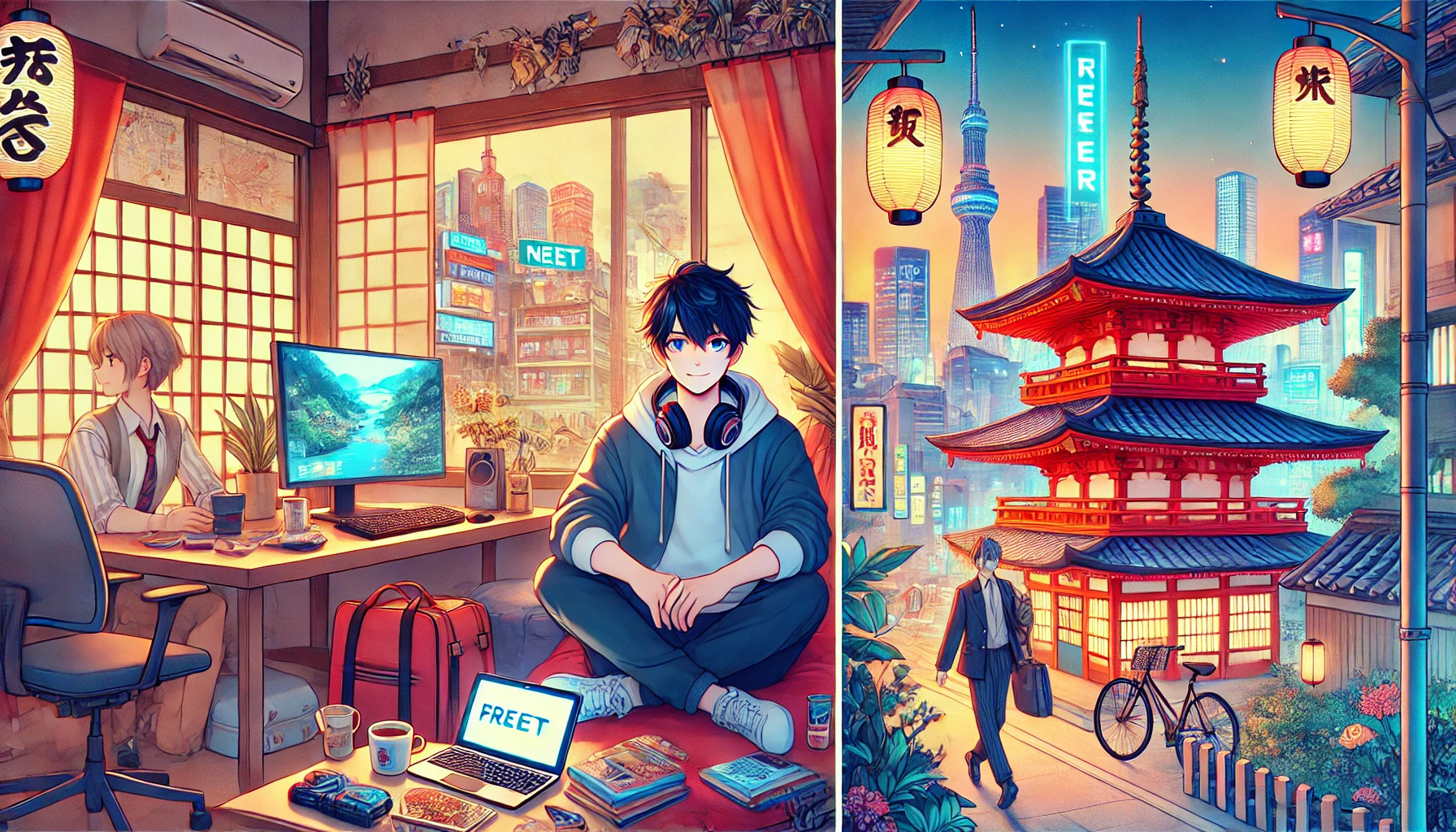
Anime loves the shut-in who never leaves the room — until a quest, a game, or a mysterious letter forces the door open. In real Japan, the words behind that trope are heavier: hikikomori points to prolonged social withdrawal, while NEET tracks who is out of school, work, and training. They overlap a lot in fan talk, but they are not the same label.
If you have heard either term and still mix them up, you are not alone. Below is a clear map of what each word means, why Japan treats them as a social issue, and which series actually dig into that isolation instead of using it as a one-note gag.
Contents 6
What is a hikikomori?
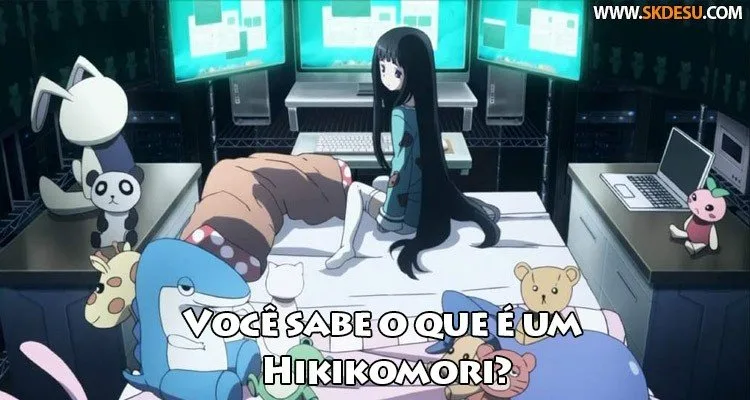
Hikikomori (引きこもり / 引き篭り) comes from Japanese for “pulling inward” or shutting oneself in. In common use — and in government surveys — it describes people who stay largely at home, avoid school, work, and social life outside the family, and remain in that pattern for six months or more. Many are supported by parents; some keep a narrow routine (convenience store, online gigs) without rebuilding a social life.
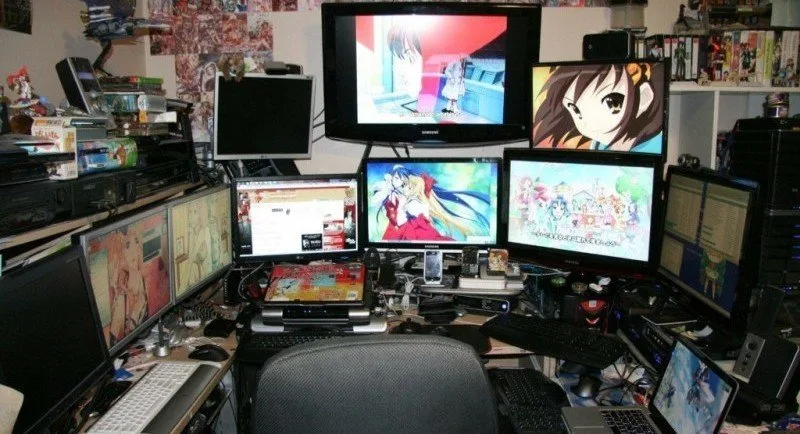
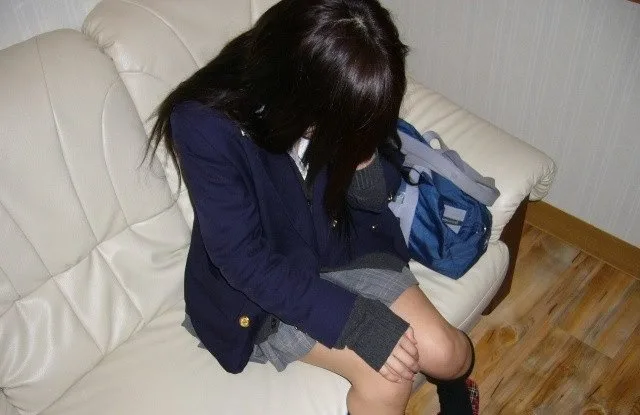
It is often framed as a public health and social problem, not a single diagnosis. Pressure to fit a “normal” path, bullying, shame after failure, and mental health struggles can all stack. That is why so many stories link isolation with the same culture that also produced otaku hobbies — but liking anime or games alone does not make someone hikikomori.
The scale of isolation in Japan
Counts are estimates, because reclusion hides from surveys and families often feel shame. Japanese Cabinet Office research has long put the figure in the hundreds of thousands for younger adults alone; combining age groups, media and experts have talked about more than one million people for years. A later working-age survey (published around 2023) put the estimate near 1.46 million people aged 15–64 who fit a broad hikikomori definition — roughly 2% of that age band.
Those numbers cannot be exact, the same way Japan’s johatsu — people who “disappear” without a clear trail — stay hard to count. What the figures do show is that isolation is not a niche meme: it touches teens, adults in their thirties, and, more visibly over time, people past forty still living with aging parents (the so-called 80-50 problem).
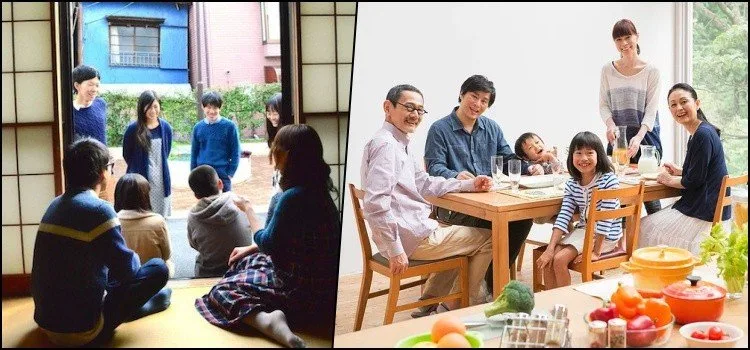
Common patterns described in reporting and clinical writing include low self-esteem, fear of going out, day–night reverse sleep, long stretches online, and, in some households, almost no face-to-face contact even with family. Food left at a bedroom door is the image people remember — and it is not only fiction.
What makes someone withdraw?
There is no single switch. Research and case reports often mention combinations of:
- Intense social and academic pressure to “succeed” on a narrow path;
- Low self-esteem and fear of being judged;
- Preferring a controllable inner world (games, media, online spaces) after real-world setbacks;
- Depression, anxiety, panic, or other mental health conditions that can co-occur;
- Trauma or failure at school or work;
- Strong shyness that hardens into avoidance;
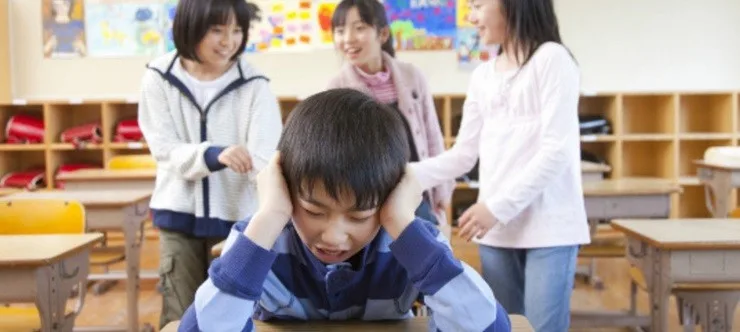
- Ijime (bullying) and other interpersonal scars.
Many people who withdraw describe disillusionment after bullying or crushing workplace norms. The point is not to diagnose strangers from a comment section: it is to see that “just go outside” is rarely a complete answer when trust in people has already collapsed.
What is the difference between hikikomori and NEET?
NEET (ニート, from English) means Not in Education, Employment, or Training. The acronym started in the UK; Japan adopted it as a labor and youth category (often discussed for ages roughly 15–34 in official talk). A NEET is defined by status in school/work/training, not by how often they leave the house.
So the split is simple in principle:
- Hikikomori → prolonged social withdrawal and home confinement (typically six months+), regardless of whether someone has a remote income;
- NEET → not studying, not employed, not in vocational training — and they may still go out, meet friends, or look for work.
Overlap is common: many hikikomori are also NEETs. But a NEET with a social life is not automatically hikikomori, and a shut-in who works or studies online may not fit every NEET definition. Fan culture often glues the two words together because anime likes the “shut-in NEET” package; real labels stay distinct.
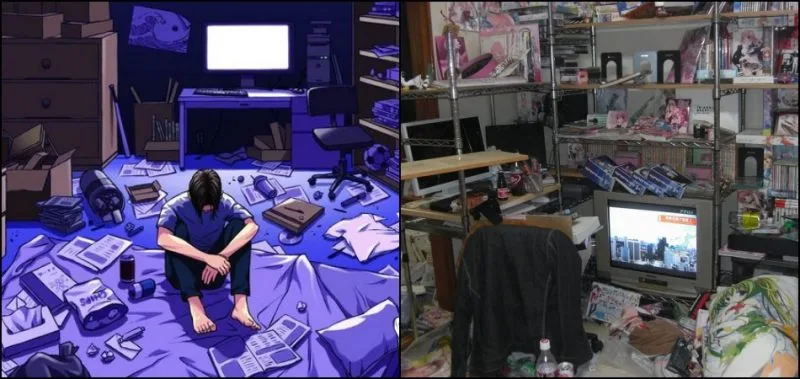
Quick contrast: hikikomori is about withdrawal and isolation; NEET is about being outside education, work, and training. Same person can be both — or only one.
Support and re-entry programs
Japan has treated hikikomori as a policy issue for years: consultation centers, outreach, and programs that try to rebuild trust before forcing employment. Approaches that last tend to start with low-pressure contact — letters, calls, gradual outings — because abrupt confrontation often deepens withdrawal.
NGOs and media have also described “rental sister / rental brother” style support, where a trained visitor builds a relationship over months. The anime Welcome to the NHK (NHK ni Youkoso!) remains the cultural reference many fans use for that mix of conspiracy thinking, isolation, and messy attempts to rejoin the world — drama, not a manual, but emotionally close to how the topic feels.
Treatment talk usually circles the same idea: safety first, then small social and cultural activities, without pretending one movie night “fixes” years of isolation.
Anime that portray hikikomori and NEET lives
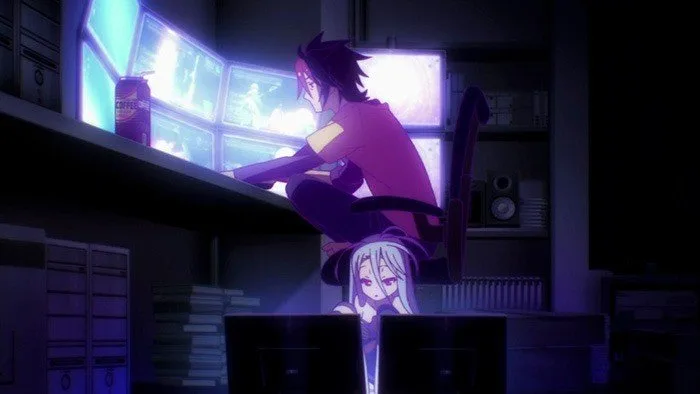
Beyond Welcome to the NHK, several series use reclusion or NEET status as more than a joke. No Game No Life drops siblings Sora and Shiro — socially shut-in gamers known online as “Blank” — into Disboard, where everything is decided by games. The fantasy is loud; the starting point is still two people who could not face ordinary life. Heaven's Memo Pad (Kamisama no Memochou) leans investigative, with NEETs and shut-in energy around Alice’s circle solving urban cases.
The table below is a selection of well-known titles fans often link to hikikomori/NEET themes — not an official ranking, and not every lead character meets a clinical definition.
| Anime | Year |
| Welcome to the NHK! | 2006 |
| Eden of the East | 2009 |
| Heaven's Memo Pad | 2011 |
| Btooom! | 2012 |
| No Game No Life | 2014 |
| Mr. Osomatsu | 2015 |
| Re:ZERO -Starting Life in Another World- | 2016 |
| ReLIFE | 2016 |
| KonoSuba | 2016 |
| Recovery of an MMO Junkie | 2017 |
Other characters fans often bring up: Satou Tatsuhiro, Kaoru Yamazaki, and Kuroki Tomoko from Welcome to the NHK; Takumi from Chaos;Head; Jintan in Ano Hana; Lain in Serial Experiments Lain; and shut-in or NEET-adjacent leads in Rozen Maiden, Sasami-san@Ganbaranai, and Denpa Kyoushi. Oreki in Hyouka is more “energy saver” than classic hikikomori — the list is about vibes and themes, not a checklist.
What do you make of the line between fiction and real isolation? Know a drama or manga that handles it carefully? Share it — the topic is heavy, and good portrayals still help people talk about it without mockery.

Community
Comments
0 comments
There are no published comments in this language yet.
Send comment