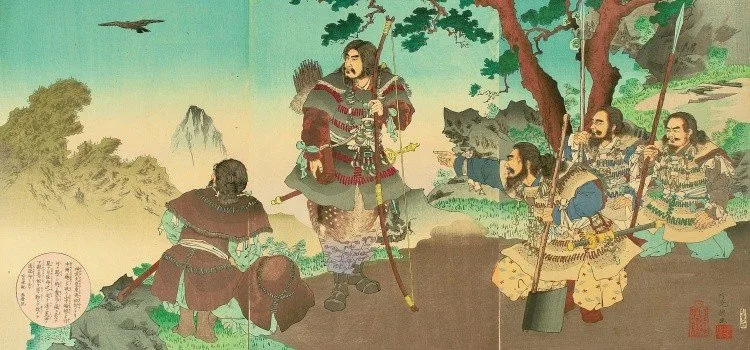
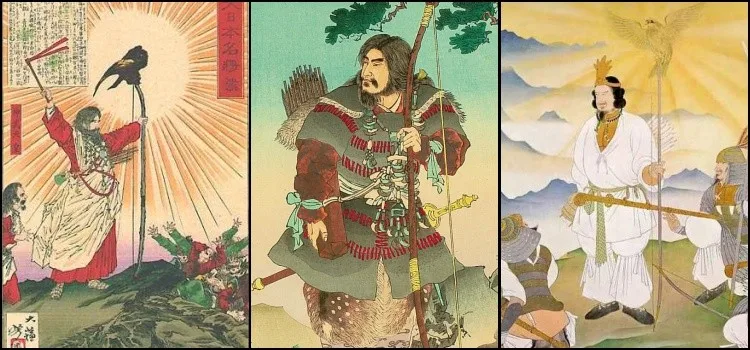
Emperor Jimmu (神武天皇 Jinmu-tennō) was the first emperor of Japan. According to historical records, his reign lasted from 660 B.C. to 585 B.C.
According to Japanese mythology, Jimmu was a descendant of the sun goddess Amaterasu and a descendant of the thunder god, Susanoo.
He is recorded as the first ruler of Japan in two early chronicles, Kojiki and Nihon Shoki.
Nihon Shoki gives the dates of his reign as 660 B.C. to 585 B.C.
He was born as Kamuyamato Iwarebiko on February 13, 711 B.C., in the territory that would be present-day Kyushu.
The Japanese chronicles record his expedition to the east of Hyuga in 607 B.C. along the Inland Sea of Japan, subjugating tribes and arriving in Yamato, where he established his power.
Despite Jimmu's importance as a link between the ruling family of Japan and the divine ancestors, he never had many cults in Japan.
A Shintō shrine was erected by the Japanese government in 1890 at what is believed to be his burial site in Unebi.
Supposed Influences of Buddhism
Buddhism entered Japan through Korea in 520 A.D. Although it was not sponsored by the government until 1638, it always had an appeal to emperors, whose authority could be challenged by the local daimyo claiming to be kami.
By identifying as kami, which in Buddhist terminology was considered a bodhisattva more powerful than other kami, the Emperor increased his mystique and asserted his uniqueness.
After 1867, it became illegal for anyone to identify kami as a bodhisattva.
The word Shintō, translated as "the way," or "the essence," was not used until Buddhism entered Japan.
Legacy of Emperor Jimmu
Above all, whether myth or based on a ruler of Japan, Jimmu holds a place of honor in Japanese tradition.
Therefore, the idea of a special bond between ruler, land, and people helped make governance more stable.
During the shogunate periods, the Emperor was still revered and remained, at least theoretically, the sovereign.
After all, such was the respect for the institution that began with Jimmu, revoking it was unthinkable.
Kevin Henrique has written about the Japanese language, culture, anime, games, and travel since founding Suki Desu in 2014. He first visited Japan in 2016.
Community
Comments
0 comments
There are no published comments in this language yet.

 Despite Jimmu's importance as a link between the ruling family of Japan and the divine ancestors, he never had many cults in Japan.
A Shintō shrine was erected by the Japanese government in 1890 at what is believed to be his burial site in Unebi.
Despite Jimmu's importance as a link between the ruling family of Japan and the divine ancestors, he never had many cults in Japan.
A Shintō shrine was erected by the Japanese government in 1890 at what is believed to be his burial site in Unebi.




Community
Comments
0 comments
There are no published comments in this language yet.
Send comment