
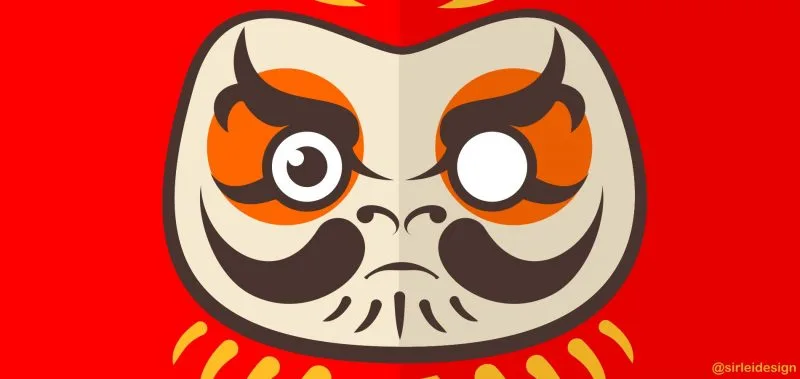
Daruma is an iconic Japanese doll tied to perseverance, willpower, and the stubborn habit of getting back up. In Japan it is a popular good luck charm — not a machine that grants wishes, but a face that stays on the shelf until you do the work.
They are fat, rounded figures, usually red, traditionally made of papier-mâché. They have no pupils, and can even look a little scary, but the idea is brilliant. That blank stare is not decoration. It is a contract.
Contents 7
The Origin and History of Daruma
The Daruma represents Bodhidharma, an Indian monk credited with founding Zen Buddhism in China. Legend says he reached enlightenment after nine years of meditation, sitting still and keeping his eyes open. The doll's limbless, rounded body comes from that story: the monk stayed so long that his arms and legs wasted away under the robe.
The popular lucky-charm version grew around Shōrinzan Daruma-ji, in Takasaki, Gunma. In the Edo period, the temple distributed New Year charms of Bodhidharma; later, wooden molds were given to local farmers so they could make three-dimensional papier-mâché figures. Silk growers, who needed a good harvest, helped turn the doll into a regional mascot. Today Takasaki still produces about 80% of Japan's handmade Daruma.
The tumbler shape also comes from older self-righting toys such as okiagari-kobōshi. Push it over and it stands back up — the proverb nanakorobi yaoki, fall seven times, get up eight, in object form. People use a Daruma to set a wish, as decoration, or as a gift of encouragement. It can look severe, but it is not malevolent: it is a talisman of luck and persistence.
The Meaning of Daruma
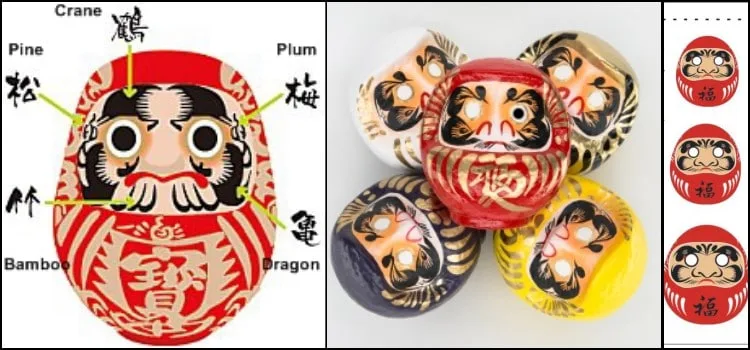
The figure is a tribute to Bodhidharma. The name can be written with the characters 達磨: 達 means to reach, arrive, achieve, and 磨 means to grind, polish, cut, and improve.
Daruma is often seen as a symbol of perseverance and willpower, because the doll remains upright even when pushed aside. That is why people say you should never give up on a goal: whatever knocks you sideways, you keep going.
Characteristics of the Doll
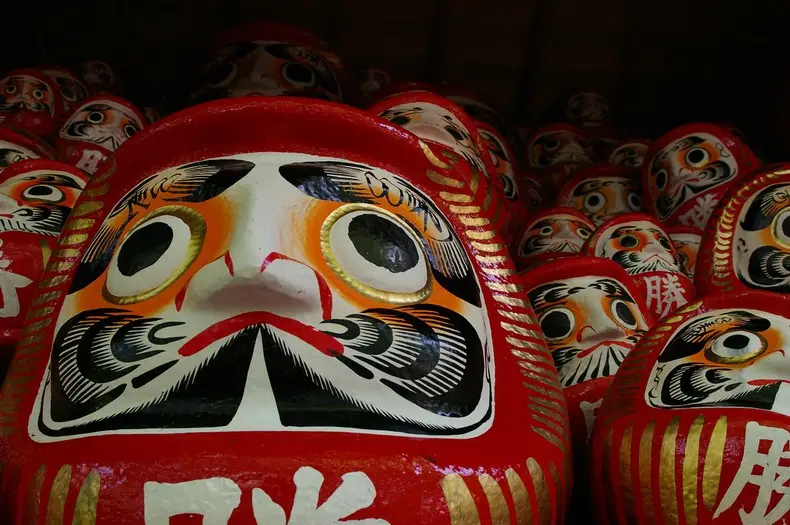
The classic Daruma is red because that color recalls the robe of a high-ranking priest. It is also believed to ward off the evil eye and disease — in the Edo period, red was even tied to recovery from smallpox.
A Daruma has no pupils because legend says the monk Dharma cut his eyelids so he would not doze during those nine years of meditation in a cave.
It is round, fat, and has no arms or legs because the monk spent years sitting with his limbs curled under the red robe. That story of dedication is why the doll is associated with hope, perseverance, patience, and actually finishing what you promised.
Its eyebrows are hand-painted in the shape of a tsuru (crane) and the beard in the shape of a turtle. In Japan those animals stand for long life — “the crane lives a thousand years, the turtle ten thousand.”
If you like other Japanese paper dolls, the Teru Teru Bōzu works on a different promise: it is hung at the window to ask for good weather.
How to Use the Daruma?
During Ōshōgatsu, Japanese families often buy a Daruma to mark wishes and goals for the new year. Companies and even election offices do the same, painting the first eye when they commit to a result.
The usual custom is to write a goal or wish on the back of the doll and then fill in one of the blank eyes — many people start with the doll's left eye, though workshops in Takasaki say there is no single correct order. When the goal is reached, the second eye is painted to close the cycle. That is why a one-eyed Daruma on a desk is not a defect: it is a reminder you still owe the work.
Keep it somewhere you will see it. The stare is the point.
At the end of the year, many people take the old doll back to a temple or shrine for a daruma kuyō (だるま供養), a memorial burning that thanks the figure and closes the cycle. Famous ceremonies happen at places such as Nishi-Arai Daishi in Tokyo. You do not have to wait until the wish comes true, and it is not the same thing as Setsubun. After the fire, people often buy a new Daruma — a gesture that fits the mood of Ōshōgatsu, the Japanese New Year.
Meaning of the Colors of Daruma
Red is still the traditional color. Other colors are newer shop conventions: meanings change from maker to maker, so treat the list as a guide, not a sacred code. Choose the color that matches the goal you actually care about.
- Red: luck, success, protection — the default Daruma.
- White: purity, harmony, a clean start; some shops also tie it to love.
- Yellow or gold: money, security, prosperity.
- Green: health, growth, getting back on your feet.
- Blue: study, work, a calmer kind of focus.
- Pink: love, romance, friendship.
- Black: business strength and a shield against bad luck.
- Purple: health, longevity, long-term self-improvement.
- Orange: school success, energy, a new challenge.
- Silver: status or social position — or whatever the artisan wrote on the box.
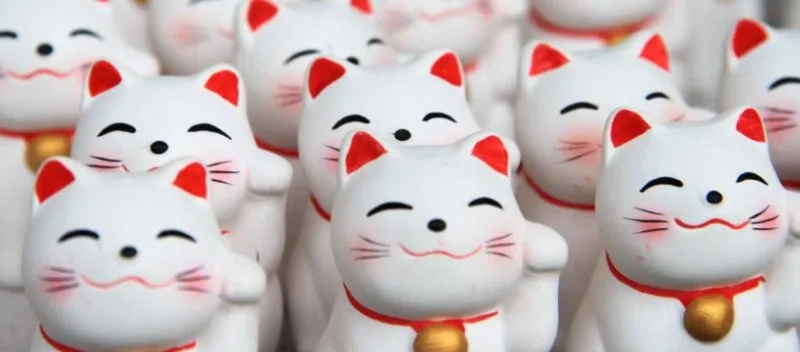
A five-color set is sometimes sold as goshiki Daruma. The Maneki Neko works in a similar way: color is a hint, not a contract. If you want the words themselves, there are several ways to say luck in Japanese.
How are Darumas Made?
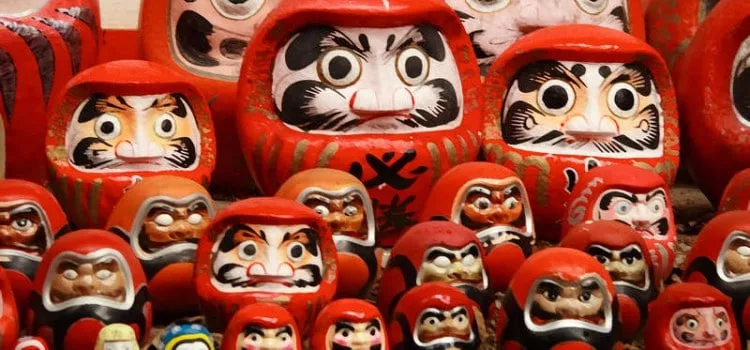
Traditional Darumas are handmade, one doll at a time. The body is not carved wood: artisans use a wooden mold and layers of papier-mâché (often recycled paper), then paint the face by hand.
- Shaping the body: paper pulp is formed over a wooden mold into a hollow oval.
- Drying: the body dries naturally, which can take days depending on size.
- Painting: once dry, it is painted in the chosen color. Red is still the most common.
- Decoration: beard, eyebrows, and other details are added. The eyes stay blank so the owner can paint the pupils.
- Packaging: the finished doll goes into a box, ready for a shop or a New Year market.
Finding the Lucky Doll
Takasaki, in Gunma, still represents about 80% of Japan's handmade Daruma production. The city has made them since the 17th–18th centuries, when farmers used the dolls as harvest amulets. Shōrinzan Daruma-ji remains the spiritual address of the craft, and early January brings a crowded daruma-ichi where people buy a new figure for the year. There is even a special temple atmosphere built around the doll itself.
Darumas come in many sizes, from pocket pieces to large display heads. There are feminine versions called Hime Daruma. Around New Year you will also see other lucky objects for sale, including fukubukuro, the lucky bags.
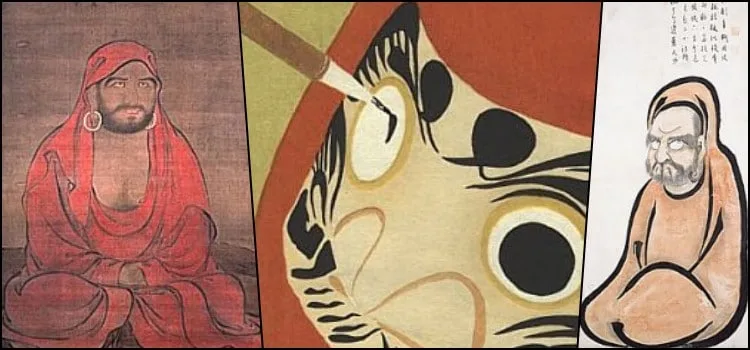
In the Edo period, some irreverent artists drew Daruma in phallic jokes. They linked it to what cannot lie down — the same okiagari stubbornness. Even sex workers of the time earned the nickname daruma, because they were expected to keep the client “standing.” The joke is old, rude, and very Edo.
Jokes and shop talk aside, a Daruma still represents three things: your goal, your action, and the result. What do you think of these Japanese dolls? If you have a detail worth adding, leave a comment. Sharing helps.



Community
Comments
0 comments
There are no published comments in this language yet.
Send comment