
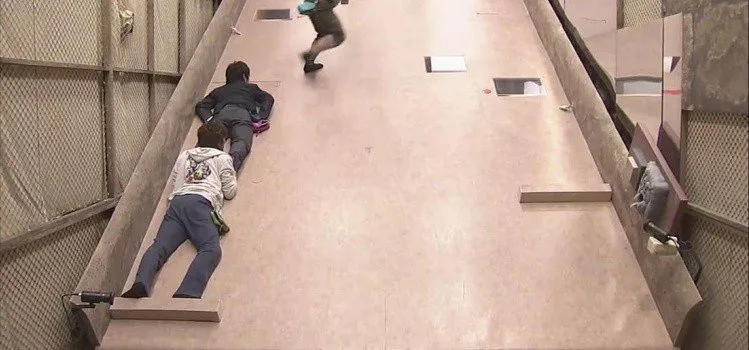
Japanese television is famous abroad for commercials that leave foreign viewers confused, and its game shows push that reputation much further. Contestants answer quizzes inside rooms that fill with water, bend their bodies through moving walls, and risk being wrapped like mummies when they lose. The formats below earned Japanese game shows their strange reputation, and most of them traveled far beyond Japan.
Many clips that circulate under vague titles come from late-night variety programs rather than prime-time game shows. That mix of pressure and absurdity is part of why Japan can seem so strange to outsiders, even when the rules of a game are easy to follow.
Contents 4
The viral classics
Human Tetris (Brain Wall). Brain Wall, a segment of the Fuji TV variety show The Tunnels' Thanks to Everyone, became a worldwide hit on video-sharing sites under the name Human Tetris. A Styrofoam wall about four meters wide and 2.3 meters tall slides toward the contestants with odd-shaped openings cut into it, and each team has seconds to bend into a position that fits. Anyone who misses the opening is pushed into a pool about 1.5 meters deep. The format, licensed by Fremantle, was produced in more than 45 countries as Hole in the Wall, which is why the same game appeared on British, American and Australian television.
Takeshi's Castle. TBS aired Takeshi's Castle from 1986 to 1990, with Takeshi Kitano as a count who watched contestants fail at physical challenges built around mud, water and collapsing props. The show became a cult hit around the world, returned for a live special in 2005, and was rebooted on Amazon Prime Video in April 2023.
Silent Library. The segment inside NTV's Downtown no Gaki no Tsukai ya Arahende!! asked comedians to sit quietly in a library while staged punishments landed on one of them. Staying silent was the whole game, and every failure was played for laughs. MTV adapted the idea for American audiences and ran its own Silent Library from 2009 to 2011.
Quizzes with a physical price
DERO! DERO! aired on NTV from December 19, 2009, to March 9, 2011. Teams were locked in themed rooms and had to solve puzzles before the trap in the room caught up with them. The format was licensed in the United States by Syfy and became Exit, which premiered in June 2013.
TORE! and its mummy room. TORE! followed DERO! on NTV from July 6, 2011, to February 25, 2013, and kept the idea of a quiz under physical threat. Its Mummy Room, introduced on February 13, 2012, gave a single contestant 60 seconds to answer seven multiple-answer questions with no passes allowed. Answering all seven stopped and reversed the machine. When time ran out, the wrapping finished and the player was sealed inside a giant coffin.
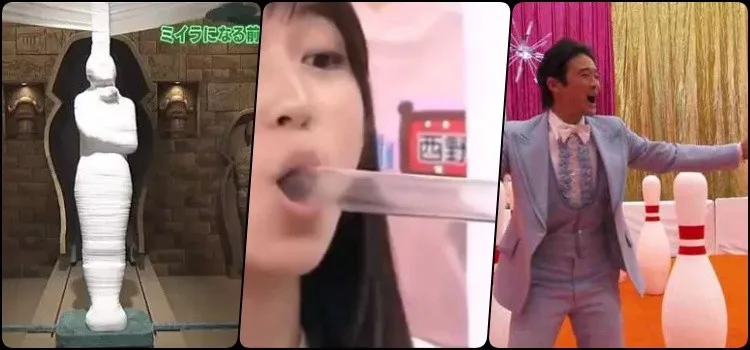
The No Laughing specials. Downtown no Gaki no Tsukai ya Arahende!! has run on NTV since 1989, and its year-end No Laughing episodes put the cast through hours of pranks with one rule: do not laugh. The 2019 special reused TORE!'s mummy room, which says a lot about how Japanese variety television recycles its best ideas.
Endurance and extreme challenges
Kinniku Banzuke and SASUKE. TBS's Kinniku Banzuke, known in the United States as Unbeatable Banzuke, built its episodes around physical ability: balance, grip strength and nerve. Its best-known spin-off, SASUKE, first aired in 1997 and puts 100 competitors on a four-stage obstacle course in Yokohama. The format grew into the international Ninja Warrior franchise, with local versions in around 20 countries.
Susunu! Denpa Shonen. The NTV reality show Susunu! Denpa Shonen ran from 1998 to 2002 and produced one of the most controversial challenges on record. Comedian Tomoaki Hamatsu, known as Nasubi, was left alone and unclothed in an apartment with no contact with the outside world and one goal: win one million yen through magazine sweepstakes. He reached the target after 335 days, a run recognized by Guinness World Records as the longest time survived on competition winnings. The story was revisited in the 2023 documentary The Contestant.
Why the clips look stranger than the shows
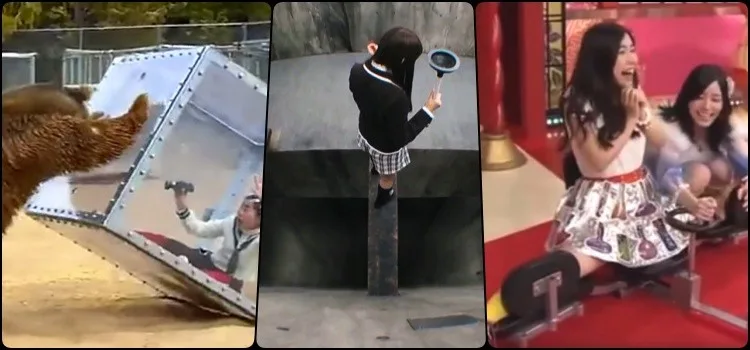
Many clips shared as Japanese game shows come from late-night comedy programs, where embarrassment matters more than the prize. A few that keep resurfacing involve climbing soapy stairs, reaching into a box of snakes and spiders, or running from a costumed lizard. Stripped of their titles and hosts, these two-minute moments end up representing an entire country's television.
The confusion has a simple cause: Japan produces a high volume of variety television, and a single stunt can pass through several shows before it reaches an audience abroad. The formats that survive the trip tend to have a clear physical rule, such as a wall with a hole or a room that fills with water.

What looks bizarre on a phone screen usually follows a recognizable game design: a simple rule, a physical consequence and a camera ready for the moment it goes wrong. That is also what made these formats exportable. Hole in the Wall, Ninja Warrior, Silent Library and Exit all found audiences outside Japan, and each carried a piece of the same formula. What makes it work is the commitment: contestants accept the rules, the show keeps its promise, and the audience watches the plan fall apart.




Community
Comments
0 comments
There are no published comments in this language yet.
Send comment