
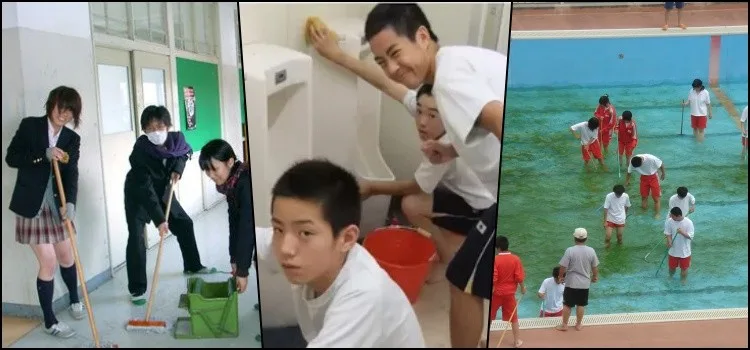
I think that most people are aware that in Japan students are responsible for cleaning the schools. After lunch, or at the end of the day, the class usually has about ten to twenty minutes to sweep, wipe desks, and look after the rooms they use. The principal sometimes helps with that care, and the routine runs from elementary school through high school, in public and private schools alike.
Contents 8
Osouji Jikan - Cleaning Time in Japanese Schools
In Japan, this practice where students clean the schools is called osouji jikan [お掃除時間], which literally means cleaning time. During the first years of school, students eat their meals in the classroom and then clean it together. The 2017 Course of Study places that work among special activities: children learn the meaning of labor and their role in the group, even though the minutes are not counted as a standard subject hour.
This tradition of teaching students to clean the schools is so common that Japanese people find it strange to discover that in Western schools students do not clean.
Even on the school supply list, there is an item called zokin (cloth) that frightens foreigners who are unaware of the custom of cleaning schools. Some foreigners even think that this is work and that students shouldn't do it.
At school, students do not only study subjects, but also learn to take care of what is public and to be more conscious citizens! No one complains because it has always been this way. Toshinori Saito
Curiosities about Cleaning in Japanese Schools
Students are usually organized into groups and rotations so that everyone can do different tasks and no one is stuck with the same task. In high school, students are often assigned to take care of a specific part of the school.
They clean practically everything in the school, taking care of the classroom, bathrooms, swimming pool, sports court, and so on. In addition, they take care of the garden, plants, and pets that exist in schools.
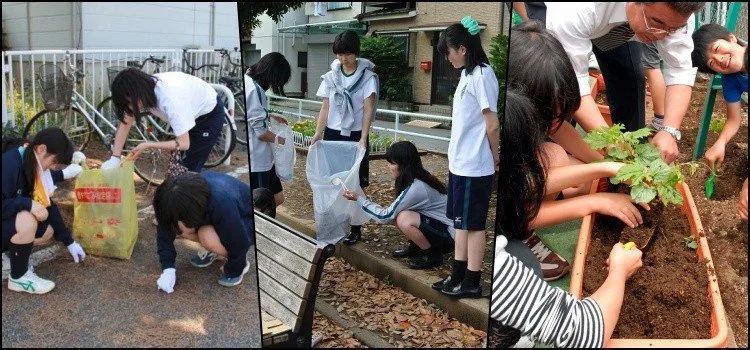
Three times a year, many schools organize a neighborhood cleaning called chiiki seiso [地域清掃]. Students go out to sweep and pick up trash around the school. The class is divided into han [班] (small groups), and each group is responsible for a specific area. Not every school still holds this outing, and from third grade up is a common cutoff when they do.
Every semester there is a general cleaning called ōsōji [大掃除]. The whole school gathers for a deeper clean, sometimes with music over the speakers. Older students are often asked to help first-graders wring a cloth, move desks without scratching the floor, and learn the rhythm of the job.
Truths about Cleaning in Japanese Schools
Not everything is as the news and Western newspapers say. I notice various altered information regarding the school cleaning system in Japan. First of all, not all schools are the same, so it is common to have differences.
There are certain generalizations regarding this, but generally, students clean a large share of the school, and sometimes they also clean the neighborhood and the surroundings of the school with their parents. Now we will see some questions that keep coming up.
Are there no janitors in Japanese schools?
Schools do have non-teaching staff called yōmuin [用務員]. Elementary children cannot leave the school fully clean, so these staff members handle specific cleanings, repairs, and maintenance that sit beyond the daily round.
Sometimes these staff members also perform other activities at the school. Some schools even hire professional services to handle certain situations like painting and gardening.
Still, students are responsible for a large part of the functioning and organization of the schools.
Do students clean the bathrooms in Japanese schools?
In a way, yes, but some tasks stay with the yōmuin. Things are quite different in elementary and junior high; not all students clean together daily.
Sometimes only one group of students from the school is responsible for cleaning the entire bathroom. No student questions something that is so common, even though cleaning bathrooms, especially clogged ones, is unpleasant.
Are there no cafeterias in Japanese schools?
In many elementary schools there are no cafeterias; students eat in the classroom. In some schools and in high schools, there are indeed cafeterias.
Some schools have vending machines and sell meals, but the culture of bringing lunch from home and cleaning does not change. Some schools even have rules about the type of food that can be consumed.
Parents help clean the surroundings of the school
Japan has become famous worldwide for students cleaning the school and taking care of their own meals. What we did not highlight is that even parents participate in events of this type.
Parents are invited to participate with their children in events like cleaning the surroundings of the school, especially before high school. I don't believe this happens in all schools, or that all parents are required to participate in this cleaning. Teachers have always provided support in most of these occasions.
This is not the only time parents participate in something at school; a very famous event that usually brings together parents and children is the Undokai, a kind of sports day and competition between classes. Parents can also be present at the Bunkasai and at the school's entrance and graduation ceremonies.
Teachers also strive to create a good relationship between parents and children through home visits and routine meetings with parents. Unfortunately, not all parents make an effort to have a good relationship with their children, and not all schools care about this.
Don't think that just because parents are present in children's childhood at school, things work 100%. There are many social and relationship problems, especially during school life.
Cleaning Position - Zoukingake
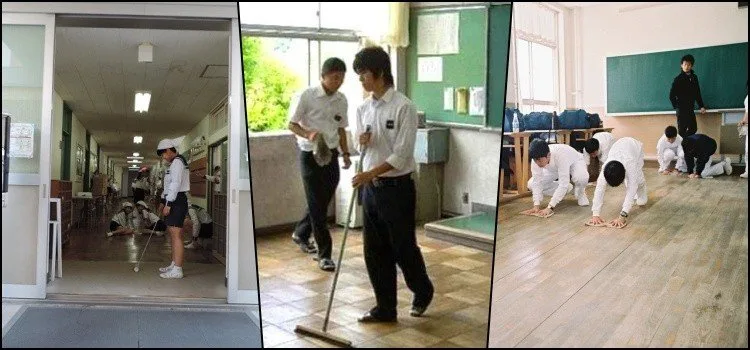
Children in Japan usually clean in a position called zoukingake (雑巾掛け). They kneel and place both hands on the wet cloth, raising their hips so that their torsos make an angle of 35 to 45 degrees with the ground.
From an early age, children are taught to clean. These were some curiosities regarding the cleaning of schools in Japan, and zoukingake is the part visitors remember most: both hands on a wet cloth, hips up, sliding across the classroom floor.


Community
Comments
0 comments
There are no published comments in this language yet.
Send comment