

Many know the flag Hinomaru, the white field with the red sun disc that Japan flies today. It already marked Japanese ships in the Meiji era, yet it only became the legally defined national flag much later—and long before that, other symbols stood for power on the archipelago.
Before a single national banner was fixed in law, Japan was often read through clan crests, war standards, and period ensigns rather than one permanent state flag. The timeline below follows those markers period by period.
Note: Japan only began using a clearly state-facing flag practice in the age of the Tokugawa shogunate, and even then maritime rules came late. Earlier governments ruled under different clans and used emblems known as mon (紋, “crest”). Those crests identified who held power; they were not automatically a modern “national flag,” even when later readers treat them as period symbols.
Contents 6
1. Kamakura Shogunate (1185–1333)

This crest is the emblem commonly tied to the Minamoto line that governed Japan from the late 12th to the early 14th century under the Kamakura bakufu.
After the Minamoto fell in the upheaval that ended with 1333, there was no stable single government to carry one clear state symbol through the brief Kenmu Restoration. In 1336, Ashikaga Takauji took power and a new shogunate imposed its own emblem for the new regime.
2. Ashikaga Shogunate (1336–1573)

This was the emblem that represented Ashikaga rule between the 14th and 16th centuries. It fell out of use as a government marker after Yoshiaki Ashikaga was deposed, when the political center shifted into the Azuchi–Momoyama wars of reunification.
3. Azuchi–Momoyama Period (1573–1600)
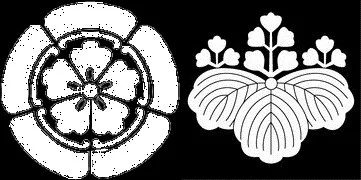
The Oda and Toyotomi clans dismantled Ashikaga authority and dominated the country for a short, intense generation. Japan therefore had two successive ruling crests rather than one continuous “national flag.”
In 1600 the balance tipped again: after Sekigahara, the Tokugawa established a new shogunate that would last into the nineteenth century.
4. Tokugawa Shogunate (1600–1868)

For the first time in this timeline, Japan is regularly described with a rectangular banner rather than only a clan mon: a white field cut by a black band (often shown as white–black–white), used in shogunate maritime and government contexts.
Even so, when people illustrate the Edo period today they often reach for the Tokugawa mon first. The crest remained the family’s signature; the striped banner was a state-facing flag form that sat alongside it.
By the mid-nineteenth century the picture changed again. In 1854 the shogunate ordered Japanese ships to hoist the Hinomaru so they could be told apart from foreign vessels—an early official use of the sun disc at sea, still under Tokugawa rule.
5. Empire of Japan (1868–1947)

After the Meiji Restoration, the sun disc moved into the language of a modern state. In 1870 the Meiji government recognized the Hinomaru as the national flag for merchant ships (and related naval designs followed the same era of proclamations). Its official name is Nisshōki (日章旗, “flag of the sun’s mark”); popular speech kept calling it Hinomaru (日の丸, “sun disc”).
On the right in the image above is the kyokujitsu / Rising Sun design with rays. A version of that pattern remains the ensign of the Japan Maritime Self-Defense Force. During the wars of the imperial era the rayed sun also carried militarist associations, which is why liberal public display of that pattern is still sensitive in parts of East Asia, especially China and Korea.
The 1870 rules did not freeze the design forever. Older merchant proportions and disc placement differed from the version fixed much later by statute—and after 1885, with older laws cleared, the Hinomaru long continued as the de facto national flag without a fresh national-flag act until the end of the twentieth century.
6. Hinomaru (1947–present)
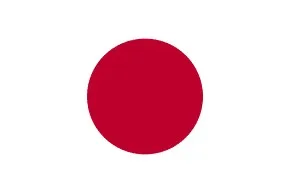
After the end of Imperial Japan and the postwar constitutional order, the same sun disc remained the everyday face of the country. What changed in 1999 was the legal and geometric definition: the Act on the National Flag and Anthem made the Nisshōki Japan’s official national flag, with a 2:3 proportion and a centered disc—standardizing a design that people had already lived with for generations.
So the story is less “a brand-new flag in 1999” than “a familiar sun disc finally written into modern law,” after merchant recognition in 1870, wartime use from 1854, and centuries of mon and banners that never quite filled the same role.
If you want the meanings, colors, and everyday debates around the modern design, there is a full companion piece on the flag of Japan.






Community
Comments
0 comments
There are no published comments in this language yet.
Send comment