
Not every anime is based on a manga, a light novel or a video game. Some series are original anime, written from scratch for the screen. They are a minority, but they include some of the most ambitious productions in the medium.
This article explains what makes an original anime and looks at eight well-known examples in detail. A further list of fourteen recommended originals follows. The order is not a ranking; the selection depends on personal taste.

Contents 12
What are original anime?
An original anime is a series or film whose story does not come from an already published source. The script and characters are developed for the production itself. This separates it from adaptations, which follow a manga or novel whose plot viewers may already know.
Original works often appear when studios and broadcasters develop an idea together and do not need to respect a running source. That allows surprising twists and an ending that does not have to wait for a continuation. The trade-off is a bigger risk, because the audience does not know the story in advance.
Many original anime became successful enough to receive manga, novel or game versions later. Popularity and recognition can therefore grow without any source material.
Darker than Black (2007)
Darker than Black was created and directed by Tensai Okamura and animated by studio Bones. It ran for 25 episodes in 2007. In this world two spatial anomalies, Heaven's Gate in South America and Hell's Gate in Tokyo, appeared and changed the sky, damaging the surrounding land.
People with special powers begin to appear. Some are known as Contractors, who lose their emotions and become tools, while others are called Dolls, without personality or feelings. Both groups are caught between the state, secret services and crime. The series mixes mystery, action and a dark atmosphere.
Ergo Proxy (2006)
Ergo Proxy was produced by Manglobe, directed by Shūkō Murase and written by Dai Satō. The 23 episodes aired in 2006. The story is set in a post-apocalyptic future where humans and androids called AutoReivs live together in the city of Romdo.
When a virus gives the androids self-awareness, a series of murders destabilises the city's order. Inspector Re-l Mayer investigates the cases and is drawn into a conflict that questions the foundations of Romdo. The series is a bleak cyberpunk story known for its measured pacing and philosophical questions.
Code Geass: Lelouch of the Rebellion (2006)
Code Geass was produced by Sunrise, directed by Gorō Taniguchi and written by Ichirō Ōkouchi, with character designs by the artist collective Clamp. It follows the exiled prince Lelouch, who receives the power of Geass from a mysterious woman named C.C. and can give absolute commands to other people.
Lelouch uses that power to lead a rebellion against the Holy Britannian Empire. The series combines political intrigue, mecha battles and moral conflict, and it remains one of the best-known original anime of the 2000s.
Kabaneri of the Iron Fortress (2016)
Kabaneri of the Iron Fortress was made at Wit Studio, directed by Tetsurō Araki and written by Ichirō Ōkouchi. Its twelve episodes ran in 2016. In a world during industrialisation, a virus turns people into aggressive creatures that can only be stopped by piercing their hearts.
The survivors live behind walls and use armoured trains to move between stations. The young Ikoma develops his own weapon and ends up between the fronts. The series is known for its detailed animation and dense atmosphere.
Psycho-Pass (2012)
Psycho-Pass was produced by Production I.G., directed by Naoyoshi Shiotani and Katsuyuki Motohiro, and written by Gen Urobuchi. It is set in a future where the Sibyl System measures people's mental state and decides whether they are innocent or dangerous.
Anyone classified as a threat can be punished without having committed a crime. The police work with special prisoners called Enforcers. The series links crime cases with questions about guilt, freedom and the power of algorithms.
Kill la Kill (2013)
Kill la Kill was produced by Studio Trigger, directed by Hiroyuki Imaishi and written by Kazuki Nakashima. The story follows Ryuko Matoi, who transfers to Honnouji Academy and clashes with Satsuki Kiryuin, who rules the school through a strict student council.
In this world clothing grants special powers whose effect depends on the wearer. Ryuko searches for her father's killer and is pulled into a conflict that engulfs the whole school. The series is known for its fast pace, over-the-top fights and humour.
Tengen Toppa Gurren Lagann (2007)
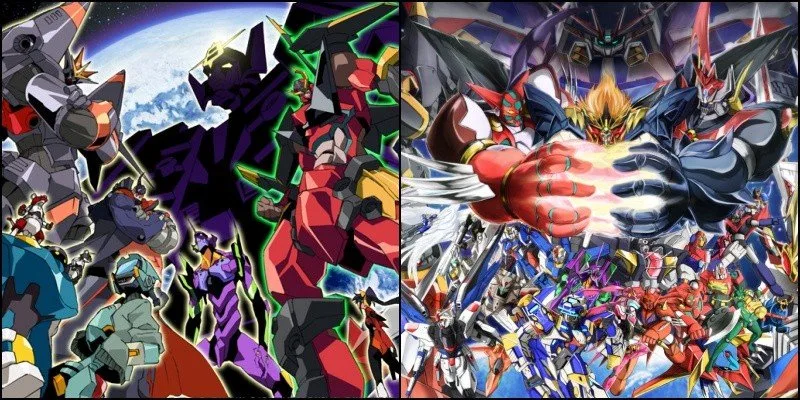
Gurren Lagann was animated by Gainax and directed by Hiroyuki Imaishi, with series composition by Kazuki Nakashima. Its 27 episodes ran in 2007. Humanity lives in underground villages because the surface is ruled by the Spiral King.
The young Simon discovers a small mecha called Lagann and forms the Gurren team with his friends. Together they lead a rebellion. The series is known for its exaggerated action, mecha battles and optimism.
Aldnoah.Zero (2014)
Aldnoah.Zero was created at A-1 Pictures and TROYCA, directed by Ei Aoki and scored by Hiroyuki Sawano. The story begins in 1972 with the discovery of a hypergate on the Moon that makes it possible to settle Mars.
Years later, war breaks out between the settlers of Mars and Earth. The series has two seasons and blends politics, mecha battles and music. Anyone who enjoys Sawano's style will find one of the genre's best-known soundtracks here.
More original anime worth watching
Beyond the series above, there are other original works worth trying. This short list names some of them without a full synopsis:
Cowboy Bebop, Puella Magi Madoka Magica, Samurai Champloo, Angel Beats, Guilty Crown, Yuri!!! on Ice, K Project, Zankyō no Terror, Charlotte, Wolf's Rain, Neon Genesis Evangelion, Death Parade, Eureka Seven and Michiko to Hatchin.
Several of these titles are often mistaken for adaptations because manga or novel versions appeared later. In fact, the stories were written for the anime first.
Why original anime work differently
Original anime can reach an audience with no prior knowledge. Viewers who do not know the source experience twists without expectations. For production, that means more freedom in developing characters but also more responsibility for the story.
Many original series aim for a self-contained ending because no continuation is planned. Others expand later thanks to their success. Both paths exist, and both have strengths.
Conclusion
Original anime show how versatile the medium can be. The eight series above cover mystery, cyberpunk, politics, action and mecha, and the closing list offers further starting points.
Anyone looking for a series without a well-known source will find a good entry point here. Read more: Hiroyuki Sawano, the mecha genre, anime vs manga, Summer Time Rendering and Ghost in the Shell.



Community
Comments
0 comments
There are no published comments in this language yet.
Send comment