
If you have been to a Japanese restaurant or a year-end party, you have probably heard someone raise a glass and say kanpai (乾杯). It is the standard Japanese toast, used for beer, sake, wine or soft drinks, and it comes with its own etiquette.
This guide explains what the word means, why it is sometimes written kampai, when to say it, and which related word you should avoid using at funerals.
Contents 7
What kanpai means
Kanpai is written 乾杯. The first character, 乾 (kan), means «dry» or «to dry», and 杯 (pai) means «cup» or «sake cup». Together the word originally meant «empty the cup»: a toast that asked everyone to drink up.
In modern Japanese the literal sense has softened. Kanpai works as a greeting, as a noun and as a verb: kanpai suru (乾杯する) means «to make a toast». The Chinese equivalent is gānbēi, written with the same characters.
Kanpai or kampai? Both are used
The word is pronounced かんぱい (ka-n-pa-i). In Hepburn romanization, ん before p, b or m is written m for pronunciation reasons, so the same word appears as kampai. Other systems write kanpai, and both spellings are easy to find in menus, T-shirts and social media.
Neither is «wrong»: kanpai is closer to the individual kana, while kampai follows the Hepburn convention. What matters is that people recognize the word. In speech there is no difference.
When to say kanpai
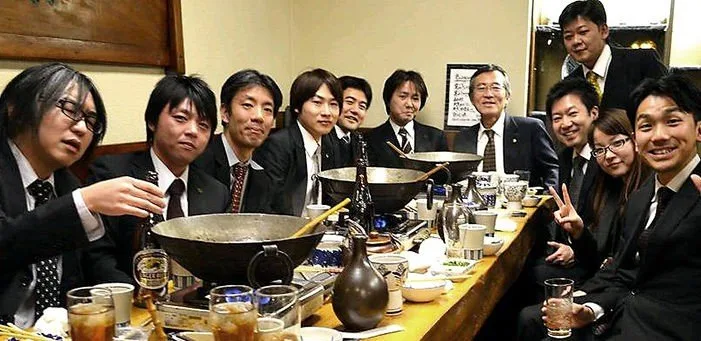
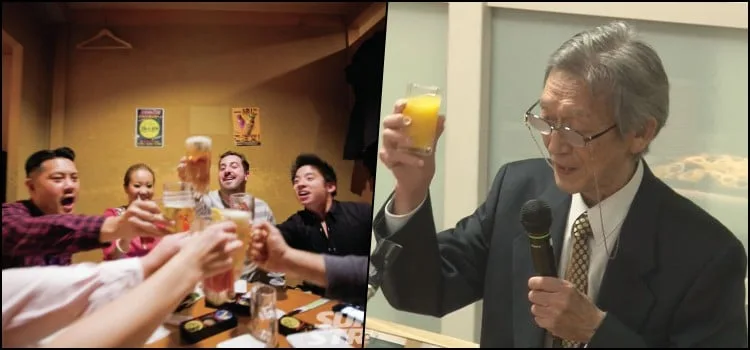
In Japan, you wait for the toast before drinking. Starting your beer before the group says kanpai can look impatient, especially at a formal dinner or with colleagues. The person in charge of the toast, often a manager or the host, says a few words first.
Kanpai is used at bōnenkai (year-end parties), shinnenkai (new-year parties), welcome parties, weddings and casual dinners with friends. At casual gatherings someone may simply say «kanpai!» and everyone starts.
Basic etiquette at the table
- Hold your glass with both hands or with one hand supporting the bottom when someone pours for you.
- Pour for others before refilling your own glass; letting a companion pour is normal.
- When toasting with a boss or an older person, keep your glass slightly lower than theirs.
- Wait for the person leading the toast to finish before drinking.
- Do not force alcohol: it is fine to kanpai with tea, water or a non-alcoholic drink.
At an izakaya, the first order is often toriaezu nama («draft beer for now»), and the toast comes as soon as the drinks arrive. If you do not drink alcohol, say so calmly; Japanese hosts usually accept it, though they may ask once.
Do not confuse kanpai with kenpai
At funerals and memorial services, the toast is kenpai (献杯), not kanpai. The word means offering a cup to the deceased; the glass is raised quietly, without the cheerful «cheers» mood of a party. Using kanpai at a funeral is a serious mistake.
Another related word is banzai (万歳), a celebratory cheer that involves raising both arms, often three times. Banzai is used at weddings and celebrations, but not as a drinking toast in the same way as kanpai.
Useful phrases for a Japanese nomikai
Kanpai! (乾杯): Cheers! / Otsukare-sama desu (お疲れ様です): Thank you for your hard work, said when colleagues meet before a party. Toriaezu nama de (とりあえず生で): «Draft beer for now», a common first order. Osake wa chotto (お酒はちょっと): «Alcohol is a bit difficult for me», a polite way to decline.
If you are the host and want to propose the toast, keep it short: thank the guests, mention the occasion, say «kanpai», and let people drink. Long speeches delay the party and are not the Japanese norm.
Conclusion
Kanpai is a small word with a clear social role: it marks the moment when a group stops being a group of individuals and starts celebrating together. Learn the word, respect the timing, lower your glass for the boss, and you will handle the Japanese table with ease.
To keep exploring, read about banzai, the curiosities of sake, Japanese rice drinks and yatai street food stalls.


Community
Comments
0 comments
There are no published comments in this language yet.
Send comment