
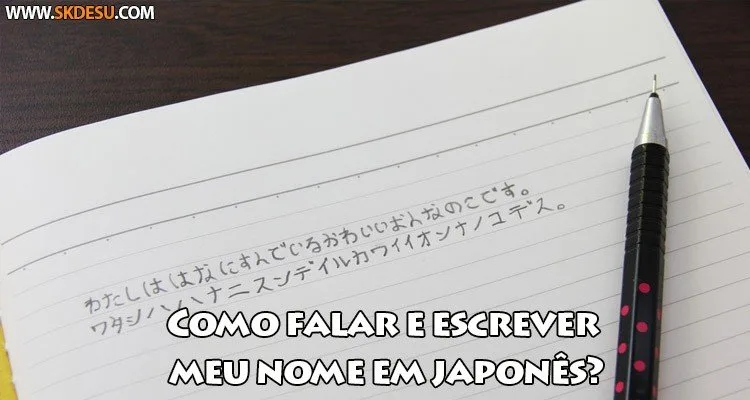
On a form in Japan, on a name badge, or at your first hajimemashite, the same question appears: how do you write your name in Japanese when Latin letters alone often are not enough?
It is rarely a word-for-word translation. Foreign names are adapted phonetically to Japanese syllables — and that is where the interesting gaps begin.
Contents 5
Write your name in Japanese
Automatic conversion is a fast starting point, not a human proofread. Check the result against the rules below — especially long vowels, silent letters, and sounds that Japanese simply does not have.
- If your name ends with a consonant, the Japanese spelling often needs a final vowel (commonly u or o).
- Long vowels are often doubled in romanization or marked with the length mark ー in katakana. Example: “Sarah” may appear as サラ (Sara) or with lengthening as サーラ.
- Syllables with “C” follow the sound: hard C usually becomes “K”.
- Silent consonants (a lone “H”, for example) are not copied blindly — pronunciation decides what stays.
Japanese uses three scripts: hiragana, katakana, and kanji. Foreign names are normally written in katakana. Real Japanese given names and family names usually appear in kanji — sometimes in hiragana.
In Japan and several other Asian countries, the family name comes first and the given name second. In katakana, the two parts are often separated with a middle dot ・, for example スミス・ジョン.

Various ways to write your name
Japanese writes foreign words phonetically. Depending on your name, more than one spelling can sound reasonable. You may choose whether to mark a long vowel, or how to fill a sound that has no exact match in Japanese.
For example, my name is Kevin; it can be written as ケビン or ケヴィン, both roughly “Kebin / Kevin”, because Japanese historically lacked a native “v” sound. Other common adaptations include:
- Sounds that start with “L” usually become “R” in Japanese;
- Final consonants often pick up a vowel such as “U” or “O”;
- Clusters of three letters like BRA are split, as in BURA;
- “TI” often becomes “CHI”;
- Silent letters are dropped when they are not heard.
There is a pattern of names that some people call the “correct” way to write, but in my opinion the name belongs to the person: they write and pronounce it how they prefer. Just as we have Kevin, Keven, and Kelvin, a Keven could still choose ケベン if that matches how they say it.
A small table with names that allow more than one spelling:
| Thiago | チアゴ / チアグ / ティアゴ | Chiago / Chiagu / Tiago |
| Adriana / Adriane | アドリアーナ / アドリアーネ | Adoriāna / Adoriāne |
| Ikaro | イーカロ / イーカル | Īkaro / Īkaru |
| Yago | イアーゴ / ヤーグ | Iāgo / Yāgu |
| Marcos / Marcus | マルコス / マルクス | Marukosu / Marukusu |
| Felipe | フェリッペ / フィリッペ | Ferippe / Firippe |
| Caio | カイオ / カユ | Kaio / Kayu |
Names written with kanji — ideograms
If you have a Japanese name, it can be written with kanji — characters that carry meaning and often several readings. When someone already has a Japanese family name, the characters were usually chosen by parents. Learn more about Japanese names here.
Some people with foreign names create a Japanese-style version so they can use ideograms and attach a meaning. I once met a Noemi who adapted her name to Naomi. Choosing characters for a non-Japanese name is tricky; without solid language knowledge and native feedback, it is easy to end up with an odd or misleading combination — especially for tattoos.
Read next: See how to write your name in kanji — ideograms
Many Japanese people also fall back on hiragana when kanji feel impractical. As a foreigner with a Western name, though, katakana remains the clear standard; hiragana for your own given name often looks unusual in Japan.
How to say my name in Japanese?
It is not wrong to keep your original pronunciation. For Japanese ears, though, clusters and sounds that do not exist in Japanese can be hard to reproduce. Japanese syllables (more precisely, morae) are short, even, and rarely carry the stress patterns of English or other European languages.
A practical tip: paste the katakana version into a translation or text-to-speech tool (for example Google Translate) and listen to the Japanese voice. Compare it with how you usually say your name, then decide which form you want to offer in conversation.
If you want to practice katakana systematically, this page goes deeper: How to learn katakana — practical tips.
Example names in katakana
Below is a mix of common names with a usual katakana spelling and romaji. Many names still allow variants — treat the table as orientation, not a court ruling.
| Name | Katakana | Romaji |
| Anna | アンナ | Anna |
| Thomas | トーマス | Tōmasu |
| Michael | マイケル | Maikeru |
| Julia | ジュリア / ユリア | Juria / Yuria |
| Sarah | サラ / サーラ | Sara / Sāra |
| Daniel | ダニエル | Danieru |
| Laura | ローラ / ラウラ | Rōra / Raura |
| Kevin | ケビン / ケヴィン | Kebin / Kevin |
| Amanda | アマンダ | Amanda |
| Bruno | ブルーノ | Burūno |
| Camila | カミラ | Kamira |
| Carlos | カルロス | Karurosu |
| Eduardo | エドゥアルド | Eduarudo |
| Felipe | フェリペ | Feripe |
| Fernanda | フェルナンダ | Ferunanda |
| Gabriel | ガブリエル | Gaburieru |
| Jessica | ジェシカ | Jeshika |
| João | ジョアン | Joan |
| José | ジョゼ | Joze |
| Lucas | ルーカス | Rūkasu |
| Maria | マリア | Maria |
| Paulo | パウロ | Pauro |
| Pedro | ペドロ | Pedoro |
| Rafael | ラファエル | Rafaeru |
| Rodrigo | ロドリゴ | Rodorigo |
| Sandra | サンドラ | Sandora |
If you have a question about a specific spelling, leave a comment — the answer usually sits in how the name is actually pronounced, not only in the Latin letters on paper.


Community
Comments
0 comments
There are no published comments in this language yet.
Send comment