
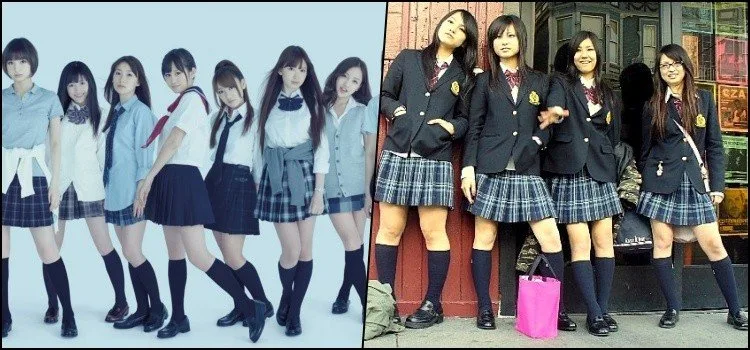
Few images are as strongly associated with Japan as the schoolgirl in a short pleated skirt and sailor collar. Anyone who has watched anime or read manga has seen the uniform (in Japanese, seifuku [制服]) rendered in the same form over and over: a dark top, knee-high socks, and a skirt that ends well above the knee. That visual is so consistent that it is fair to ask whether real Japanese schools actually look like that, or whether popular culture has simply exaggerated the silhouette.
This article takes a sober look at the Japanese school uniform: where the seifuku came from, how short skirts really are in actual schools, what rules govern them, and why the topic has such a contradictory reputation outside Japan.
Contents 3
What the Japanese school uniform actually looks like
The Japanese school uniform is called seifuku [制服] and is mandatory at most secondary schools. Elementary school (shōgakkō [小学校], grades 1 to 6) is generally uniform-free. From middle school (chūgakkō [中学校], grades 7 to 9) and especially in upper secondary school (kōkō [高校], grades 10 to 12), the seifuku is part of daily life. Because a large share of secondary schools in Japan are privately run, this affects almost every student of that age.
For boys, the standard is the gakuran [学ラン], a black or dark-blue jacket with a high stand-up collar, a white shirt, and long trousers. The stiff collar echoes older Japanese military uniforms, which in turn took inspiration from Prussian models of the late 19th century.
For girls, two main models coexist:
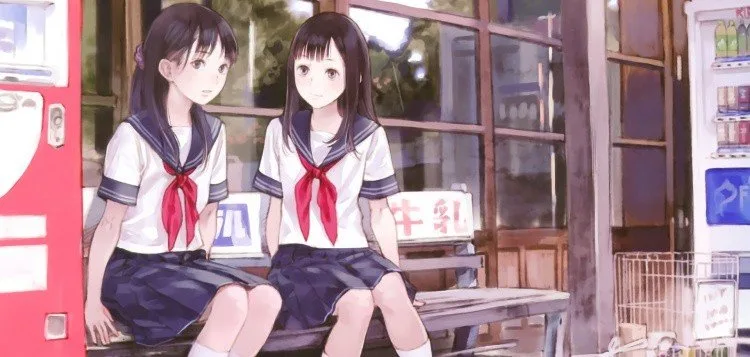
- The classic sērā-fuku [セーラー服], or sailor uniform, with a large triangular collar, a front ribbon, and a pleated skirt. It was introduced in 1921 at Fukuoka Jogakuin, based on the sport uniform worn by British schoolgirls.
- The blazer version with pleated skirt, necktie or bow, and a tailored jacket, modeled on European school uniforms and now the most common style in urban prefectures.
Until around 1920, Japanese schools had used a more formal, kimono-inspired dress. The shift toward Western tailoring began during the Meiji era and accelerated as Japan opened up to European and American educational models.
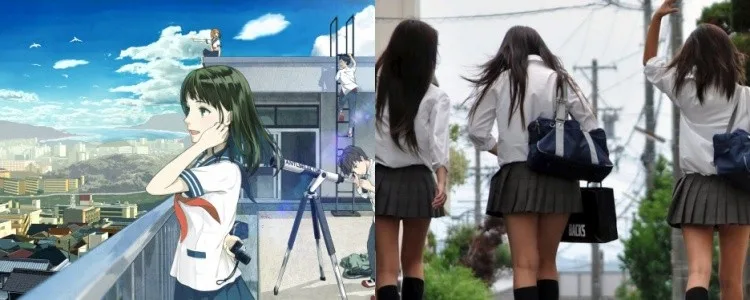
Schools set the colour, the cut, the length, and the accessories of the uniform, and they decide what counts as an acceptable variation. Going outside the standard is treated as a dress-code violation, alongside other rules about hair colour, socks, shoes, and bags. The seifuku is therefore less a personal choice of clothing than a shared identity marker that the school itself defines.
Are the skirts really that short?
The short-skirt image is largely a pop-culture convention. In most anime and manga set in a school, female characters wear skirts that end well above the knee. Many Western viewers assume this is simply how the uniform is designed.
In real schools, the situation is more complicated. Most schools issue a uniform with a skirt that is meant to fall at or just above the knee, not far above it. Two things then happen.
First, students sometimes modify the uniform. Rolling up the waistband of the skirt is a well-documented practice. It is the same kind of adjustment that teenagers in Europe and America make to their clothes: for comfort, for style, and to express a personal reading of the dress code.
Second, the anime visual style tends to push the silhouette further than the real garment. The schoolgirl in manga is drawn as an icon, and the icon is shorter-skirted, longer-legged, and more stylised than the actual uniform would sit on a real student. That gap is part of the appeal of the genre, and it is one of the main reasons the short-skirt image is over-represented abroad.
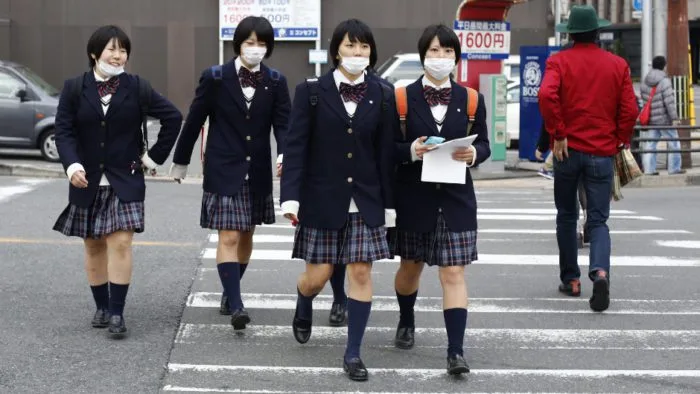
School rules on skirt length vary considerably. Some schools are strict and run regular uniform checks at the school gate. Others tolerate a more relaxed interpretation, especially outside the classroom. There is also a documented gap between the skirt length the school prescribes and the length students actually wear on the commute, where the uniform is no longer supervised.
It is also worth being precise about the social phenomenon often mentioned in this context. In Japan, as in many countries, public-transport harassment is treated as a serious problem, and schools and rail operators run awareness campaigns for it. Short skirts are not designed with that problem in mind; the issue is treated through behaviour and reporting, not through dress code.
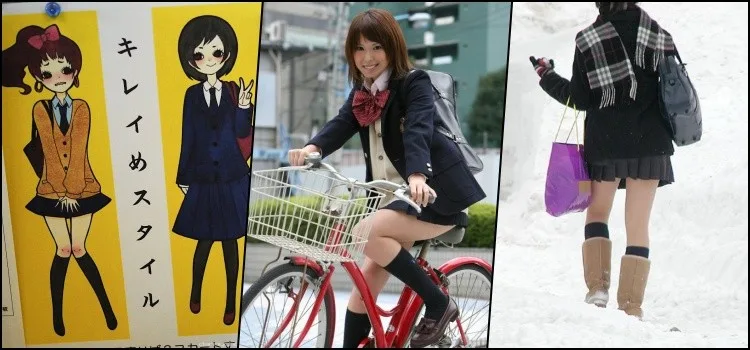
Differences in clothing and skirts across Japanese schools
Uniforms and skirts did not stop at the school gate. From the 1980s onwards, the visual language of the seifuku fed directly into Japanese street fashion. The baggy socks, the loose socks, the dyed hair, the shortened skirt: each of those micro-trends started inside the school uniform and then moved into fashion at large, including in magazines such as egg and in the Harajuku scene.
That overlap is one reason the topic is often misunderstood outside Japan. A school uniform is read as a school document, but in practice it is also a fashion object, especially during the years in which teenagers are most actively building a personal style.
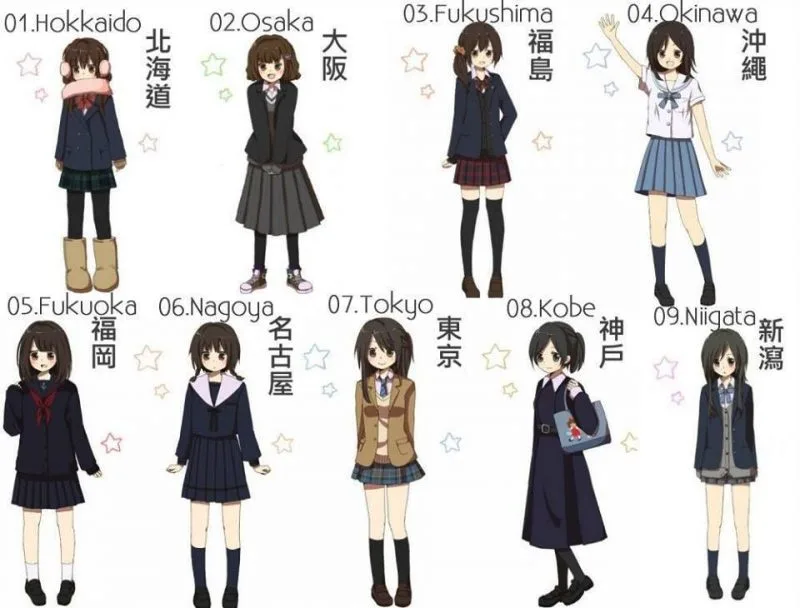
There is regional variation as well. Some prefectures are informally known for shorter uniforms, others for longer ones, and the difference is usually framed in centimetres at the hem. A few Japanese outlets have published informal comparisons between cities, but the numbers are anecdotal rather than official, and the same school can change its rules from one year to the next. The cleaner way to describe the pattern is that skirt length in Japan is set locally, varies year by year, and is enforced unevenly, rather than that any one region holds a national record.
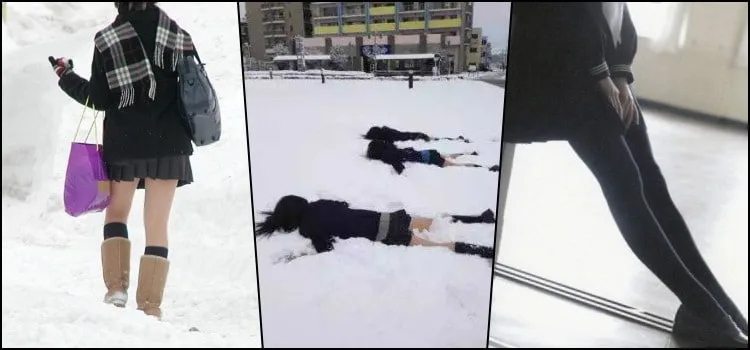
The uniform also continues into colder months. Many students wear thermal tights or long johns under the skirt in winter, sometimes changing out of them only once they are inside the school building. This is a practical choice tied to the dress code: the length of the skirt is fixed, so the only flexibility is in what is worn under it.
For Western observers, the shortest-skirt image of the seifuku is filtered through a chain of references: anime, manga, J-drama, and tourism photography. The reality in schools is closer to the rest of the industrialised world: a uniform, a set of rules, a few regional variants, and the usual gap between what the rule says and what the students actually wear on the way to the station. The visual short skirt is part of that picture, but it is only one of several.
Where did you first encounter the Japanese school uniform: in an anime, in a film, in a travel photo, or in person? It would be interesting to hear which version of the image has shaped your own idea of the seifuku.



Community
Comments
0 comments
There are no published comments in this language yet.
Send comment