
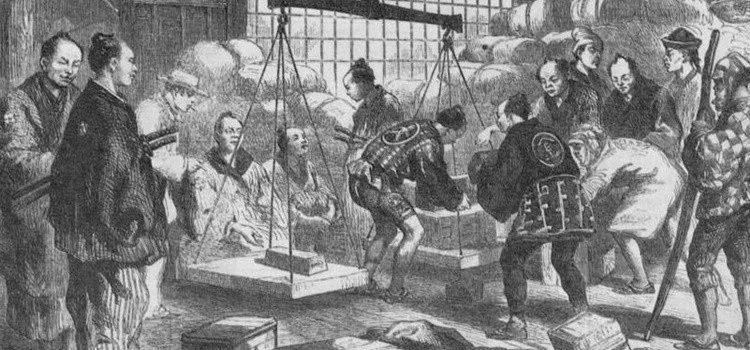
Japan is a monarchy, and if you visit the country today, you will see the Emperor mostly as a symbol: a quiet, deeply respected figure without political power, but with enormous cultural weight. That view is comparatively recent. It goes straight back to one ruler who, in the 19th century, catapulted Japan into the modern age: Emperor Meiji.
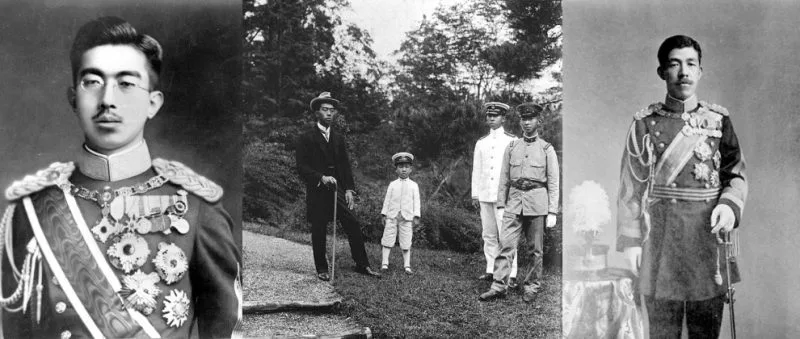
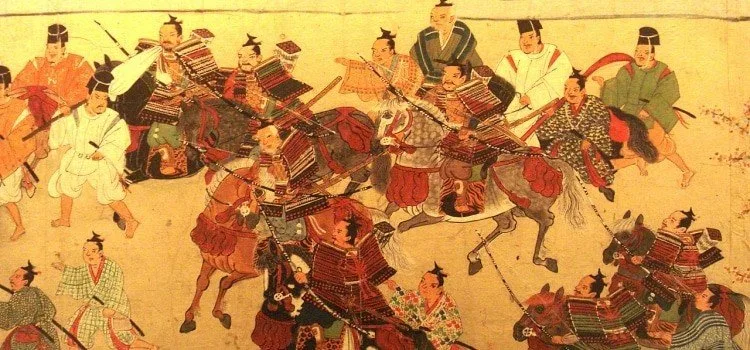
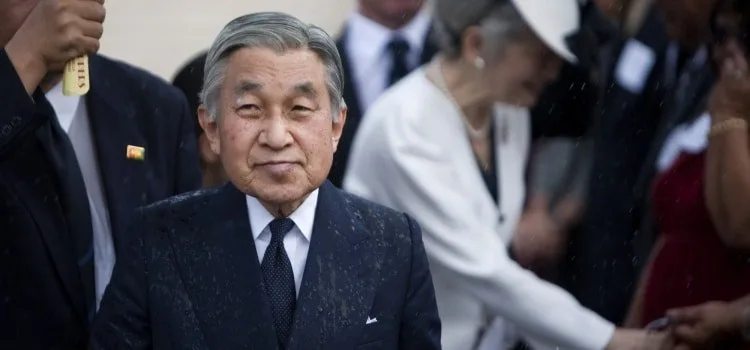
Japan has already had more than a hundred emperors over the course of its history. Between their reigns lie long periods in which real power did not sit with the Emperor in Kyōto, but with warlords, the Daimyō, and the Tokugawa Shogunate in Edo. One of those phases — the Edo Period — is the most famous. It did not fade out gradually; it ended in a political earthquake: the Meiji Restoration (1866–1868). Since then, Japan has had four modern emperors, starting with Meiji himself, followed by Taishō, Shōwa, and the current (now former) Emperor Akihito, who abdicated in 2019.
In this article I want to walk you step by step through what makes Meiji arguably the most influential emperor in modern Japanese history. I will start with a small term that often causes confusion — the posthumous name — and work my way up to his life, the Restoration, and a few curiosities that usually get left out of the standard overviews.
Contents 7
Posthumous name — what it actually means
The word posthumous comes from Latin and literally means "after death". In Japan, the posthumous name (Japanese okurina, 贈諡) is an honorary title officially bestowed on an emperor only after his death. It has nothing to do with the birth name; it describes the era or reign the deceased defined.
In the case of the Japanese emperors, the posthumous name usually follows the name of the reign. That is exactly why the ruler we are looking at in this article is officially called Meiji Tennō (明治天皇) — "Emperor of the Enlightened Rule". His birth name is Mutsuhito (睦仁); in everyday speech, we simply say Emperor Meiji.
It is worth keeping three terms apart, because travelers and Japan fans mix them up all the time:
- Posthumous name — the title given after death, tied to the era of the ruler.
- Era name (nengō, 年号) — the official year-counting system attached to the reign, such as Meiji, Taishō, or Shōwa. In Japan, dates are still often written with the era and the year.
- Temple name — a name used only in religious veneration inside the shrine.
One more interesting piece: Japanese culture also has the Kaimyō (戒名) — a Buddhist posthumous name, but one that is not reserved for emperors. It is given to all believers, and is often decided while the person is still alive, so it is ready to use right after death.
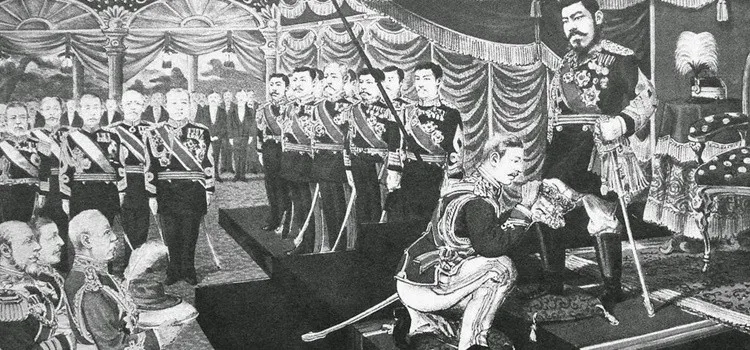
Emperor Meiji (Mutsuhito) — the man behind the throne
Mutsuhito (睦仁) was born on 3 November 1852 in Kyōto. He was the second son of Emperor Kōmei and belonged to one of the oldest ruling dynasties in the world. His posthumous name — Meiji Tennō (明治天皇) — means roughly "enlightened rule" and stands symbolically for exactly the modernization Japan experienced under his reign.
He lived 59 years and ruled for 45 years (1867–1912) — one of the longest reigns in Japanese history. The sheer length of that era explains why it shaped the entire late 19th and early 20th century in Japan.
Family and court life
Mutsuhito ascended the Chrysanthemum Throne in 1867 at just 14 years old — and in the same year he married Masako, who later took the name Haruko (美子) and entered history as Empress Shōken. Haruko was far more than a decorative figure at court: she weighed in on political questions, advised her husband on reform debates, and kept influential contacts with reform-minded Daimyō. An imperial consort with that kind of political role had not existed for centuries.
Haruko could not give him a male heir; Meiji still had 15 children with five ladies-in-waiting (the so-called nyōbō, 女房). Only five of those children reached adulthood, including one prince and four princesses. His direct successor became Prince Yoshihito, the future Taishō Tennō.
Why Meiji changed everything
Almost no other reign transformed a country as fast and as deeply as Meiji's Japan. Three points make the difference clear:
- The end of the Shogunate. The Tokugawa Shogunate — a military government that had lasted more than 250 years — was abolished after the imperial forces won the Boshin War (1868–1869). The Shōgun was originally a general appointed by the Emperor to command the troops; over the course of the Edo Period, the power had quietly reversed.
- The move of the capital. In 1868, the political center was shifted from Kyōto to Edo, which was renamed Tōkyō ("Eastern Capital") — a symbolic break with the old feudal order.
- A new constitution. In 1889, the Meiji Constitution came into force — Japan's first modern constitution, and one of the earliest in Asia. It created a parliament (the Diet, 帝国議会), codified basic rights, and formally concentrated state power in the Emperor — even though in practice he remained a symbol.
Within a few years, Japan built a modern army, a modern navy, a unified currency (the Yen, 円), a nationwide school system, and an industry that by the early 20th century had joined the world leaders.
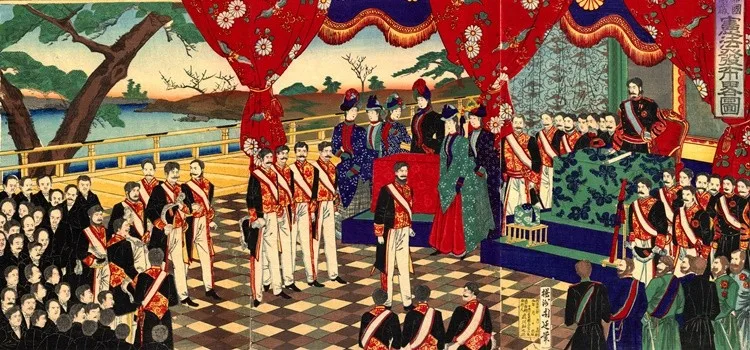
The Meiji Restoration — what actually happened in 1866–1868
The term Meiji Restoration (Japanese Meiji-ishin, 明治維新) sounds like a return to old values. The reality was the exact opposite: a radical modernization that dismantled old feudal Japan within just a few years. The key points, in short:
- It took place between 1866 and 1868 and led into the Boshin War (1868–1869);
- The feudal dictatorship of the Tokugawa Shogunate was finally abolished through the victories of the imperial troops;
- The feudal domain system was dissolved, and a modern, centralized government was proclaimed;
- Japan declared that it would act according to international law from then on — a deliberate signal to the Western powers that it wanted to be treated as an equal nation;
- The Samurai, who had until then served their local lord, the Daimyō, were re-sworn to the Emperor — a clean break with the centuries-old chain of loyalty;
- Meiji himself, despite his title, held almost no real political power; he was a symbolic figure and moral authority, not a ruler in the modern sense. That symbolic role is exactly what made him, to this day, an identity figure for many Japanese people.
The Iwakura Mission (1871–1873), a large study tour through the United States and Europe, is considered the intellectual core of these reforms. A delegation led by the advisor Iwakura Tomomi spent two years traveling the West, studying school systems, industry, transport, and constitutions — and translated that experience into concrete reforms back home.
A few curiosities about Meiji you rarely hear
The plain facts are easy to find. The interesting part is in the details that most guidebooks and overviews skip:
- Mutsuhito took the throne at just 14 years old — at an age when, legally, he was still considered a minor. Real power in the first years sat with the advisors of the daijō-tennō (regency council);
- As in many European monarchies, the education of the crown prince was entrusted to a nobleman. For Meiji, that task fell in part to the later prime minister Sanjō Sanetomi;
- He received two titles in a single day: Imperial Prince and designated Crown Prince. The jurei ceremony (formal appointment as heir) took place on 2 September 1860 — still during his father's lifetime;
- Only five of his 15 children reached adulthood, one prince and four princesses. High child mortality was just as real at the imperial court as it was for the rest of the population;
- He is one of the longest-lived emperors in Japanese history, after the late ruler Emperor Ōgimachi (ruled 1573–1592), who also passed 50. In an era without modern medicine, that was anything but a given;
- Meiji was the first Japanese emperor to appear in public in Western clothing — in the famous 1872 photograph he wears a European military uniform. The image became, both at home and abroad, the symbol of Japan's opening up;
- His body was not, as had been the custom with earlier emperors, buried in Kyōto. It was entombed in a shrine built for the purpose in Fuchū — today's Meiji-jingū in Tokyo, one of the most visited shrines in the country.
If you visit Tokyo, this shrine is well worth a stop: Meiji-jingū sits in the middle of a large forested park, only a few minutes from Harajuku and Shibuya — a quiet counterpoint to the noise of the neighborhood.
Why Meiji still matters today
What Meiji achieved in roughly four decades has very few parallels in modern world history. A country with no real industry, no modern military, and no constitutional tradition stepped, within a single generation, onto the international stage as an industrial power, a colonial power, and a constitutional state — at a time when most Western powers refused to treat Japan as an equal.
Of course, the era also carries shadows: the Meiji Constitution formally concentrated power in the Emperor and locked in an expansionist state. The colonization of Korea and Taiwan, the military buildup, and the road to the Pacific War do not start by accident in the late phase of this period. If you want to understand the Meiji era, you have to see both sides: the enormous modernization achievement, and the darker side of a state that submitted itself to imperial logic without much restraint.
If you want to dig deeper into the topic, the companion article on the history of imperial Japan is a good starting point. And for your Tokyo trip, I would also recommend a stop at Meiji-jingū — the shrine is more than a tourist sight, it is a living piece of memory of the emperor who rebuilt Japan.

Community
Comments
0 comments
There are no published comments in this language yet.
Send comment