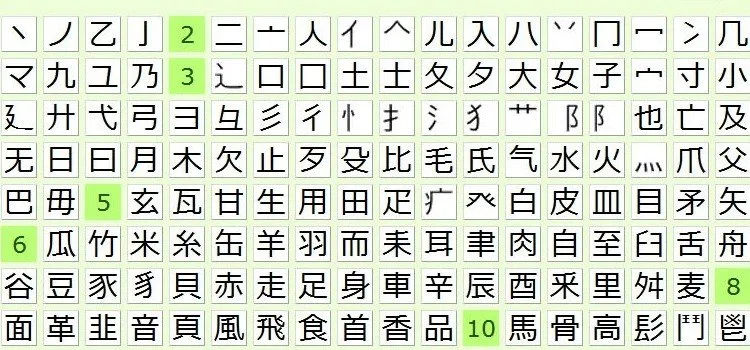
The kanji are classified in dictionaries according to their main components. These components are called Radical in English and 部首 (bushu) in Japanese. Its original name in Japanese is composed of the Kanji which means division, section, group, and with the kanji which means head or neck.

The Radicals are kanji or elements that are found in the structure of an ideogram. Many think that a kanji is formed from several radicals, to some extent yes. However, each kanji only has one radical which is its head. This radical may or may not relate to the final meaning of the kanji word. The radicals are not named and not all have their own meaning, currently there are about 214 radicals.

How is a Kanji formed using Radicals? See below radicals being applied and forming different Kanji:

  • 時 – The radical of this kanji is “sun” 日 – The meaning of the Kanji is “time”;
  • 詩 – The radical of this kanji is “word” 言 – The meaning of the kanji is “poetry, poem”;
  • 持 – The radical of this kanji is “hand” 扌 – The meaning of the kanji is “to hold”,

Did you notice that the radical for hand 扌 is not the same as 手. This is because not all radicals are being used in the Japanese language, most are used only to form the kanji. You should also know that Japanese is full of ideograms that have the same meaning.

Classification of Radicals – Position

The radicals are usually classified by the position they occupy in the kanji, knowing this position will facilitate their use.

JapanesePosition
へん (hen)left side
つくり (tsukuri)right side
かんむり (kanmuri)on top
あし (ashi)below
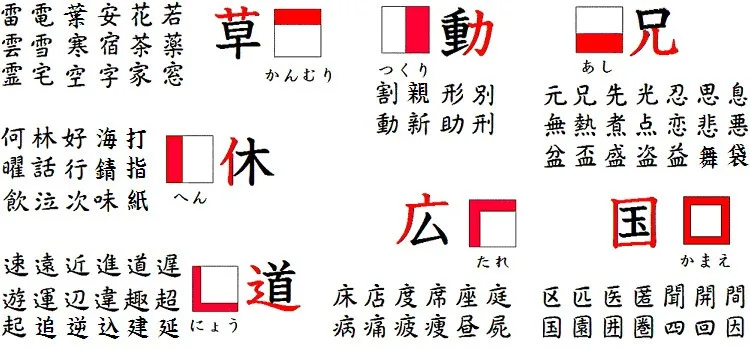
かまえ (kamae)surrounds the kanji from outside to inside
たれ (tare)covers the kanji from top to bottom.
にょう (nyou)left side encompassing also the bottom part of the kanji.

The image below will show examples of kanji and the positions of their radicals.

Bushu - Radicals - Structures of Kanji and their variants

What are the benefits of knowing the Radicals of Japanese?

It is important to have knowledge of these elements that compose the kanji, so it becomes easier to find a certain kanji in a dictionary and even understand the essence of its meaning.

Another advantage is that over time, you will be able to identify meaning in the ideograms and will stop seeing only strokes. Knowledge of these elements helps you remember the kanji and its meaning.

We know that several words in the Japanese language are the combination of kanji, for example: 手紙 (letter) is the combination of the ideograms for hand (手) and paper (紙). The same thing happens with the radicals. See some examples:

  • The Kanji and Radical 木 (tree) can become 林 (grove) and 森 (forest);
  • The Kanji and Radical 木 together with 几 (table) form the kanji 机 (desk / work table)

Imagine that you found a kanji and do not know its meaning or how to look for it. You can use the radical search on the jisho website or on Windows itself in a feature called IME Pad, which can be accessed by right-clicking on the Japanese language keyboard icon in the Windows taskbar.

Table with Radicals of Japanese

Below we have a table with the main radicals, the number of strokes, a meaning, and their position in Japanese. Remembering that the meanings of the radicals are quite varied, do not cling to that, it is just an informative meaning.

StrokesRadicalPositionMeaningNotes
1 one, horizontal stroke 
1 vertical stroke 
1 dot 
1 stroke for a diagonal stroke 
1 the second 
1 the secondvariant of ⼄(おつ)
1 vertical stroke with a hook 
2 two 
2かんむりcap, top 
2 person 
2 personvariant of ⼈(ひと)important
2?かんむりpersonvariant of ⼈(ひと)
2 human legsimportant
2 enter 
2 eight 
2けいがまえinclude 
2かんむりcovering, crownimportant
2へんice 
2 table 
2かんむりwindvariant of ⼏(きにょう)
2 container, open box 
2 knife, sword 
2つくりknife, swordvariant of ⼑(かたな)important
2 power 
2 wrap 
2つくりspoon 
2 box 
2はこがまえhide, hide 
2 ten 
2 oracle 
2つくりstamp, a seal 
2 cliffimportant
2 private, Katakana Mu 
2 again, the right hand 
3 mouth 
3くにがまえborder, territorial bordersimportant
3 earth 
3 man, scholar, samurai 
3 the following 
3あしgo slowly 
3 night 
3 big, large 
3 woman 
3 child, son 
3かんむりroof, houseimportant
3 inch (2.25 cm) 
3 small 
3かんむりsmallvariant of ⼩(しょう)
3つくりlame leg 
3たれcorpse, awning 
3 sprout 
3 mountain 
3 meandering river 
3 rivervariant of ⼮(まがりがわ)
3 work, carpenter, skill 
3 ego 
3 cloth 
3 dry, shield 
3 young, slight 
3たれslanted roofimportant
3にょうto move, stretch 
3あしthe folded hands 
3 dart 
3 bow (in archery) 
3 pig’s head 
3 pig’s headvariant of ⼹(けいがしら)
3つくりhair-style, rays of light 
3へんstep, step, street, goimportant
3かんむりgrassvariant of ⾋(くさ)important
3にょうroad, on foot, advancevariant of ⾡(しんにょう)important
3つくりvillage, country, cityvariant of ⾢(むら)important
3へんhill, moundvariant of ⾩(こざと)important
3かんむりkatakana Tsu 
3へんheart, mind, spiritvariant of ⼼(こころ)important
3へんhandvariant of ⼿(て)important
3へんwatervariant of ⽔(みず)important
3へんbeastvariant of ⽝(いぬ)important
4 heart, mind, spirit 
4あしheart, mind, spiritvariant of ⼼(こころ)
4 spear, weapon 
4 door 
4⼿ hand 
4 branch 
4つくりactivity, to strike, hit 
4つくりactivity, to strike, hitvariant of ⽁(ぼくづくり)important
4 literature, letters 
4つくりBig Dipper, shell, 18 liters 
4つくりaxe 
4 direction, flag 
4 no 
4 sun, day, hour 
4 to say 
4 moon, month, period 
4へんmoon, month, periodvariant of ⽉(つき)
4 tree, wood 
4 to lack, yawn 
4 to stop 
4 death and die, to decompose 
4つくりshaft of a spear, action 
4 no, mother 
4 to compare 
4 hair 
4 family, clan 
4 steam, air 
4 water 
4 fire 
4あしfirevariant of ⽕(ひ)important
4 claw, nail 
4かんむりclaw, nailvariant of ⽖(つめ)
4 father 
4 to mix 
4へんwood of division 
4 wood of division 
4 cow 
4 dog 
4へんaltar, festival, religious servicevariant of ⽰(しめす)
4 liquidvariant of ⽹(あみ)
4かんむりage, old agevariant of ⽼(おいかんむり)
5 darkness 
5 jewels 
5 tile 
5 sweet 
5 birth, to be born, alive 
5 to use 
5 rice field 
5 piece of cloth 
5へんpiece of clothvariant of ⽦(ひき)
5たれdiseaseimportant
5かんむりopen legs, departure 
5 white 
5 skin, to hide 
5 dish, bowl 
5 eye 
5 halberd 
5 arrow 
5 stone 
5 altar, festival, religious service 
5 footprint 
5へんgrainimportant
5 hole, cave 
5 to rest 
5 watervariant of ⽔(みず)
5かんむりliquidvariant of ⽹(あみ)
5? liquidvariant of ⽹(あみ)
5へんclothingvariant of ⾐(ころも)important
5 novariant of ⽆(むにょう)
6 bamboo 
6かんむりbamboovariant of ⽵(たけ)important
6 rice 
6 thread 
6 clay jar 
6 liquid 
6 sheep 
6 sheepvariant of ⽺(ひつじ)
6 feather, wing 
6 feather, wingvariant of 羽(はね)
6 age, old age 
6 and also 
6へんplowed 
6⽿ ear 
6 writing brush 
6 meat, meats 
6 retainer, minister 
6 ego 
6 to arrive 
6 mortar, quern 
6 tongue 
6 opposite, to err 
6 ship, boat 
6 limit 
6 color 
6 grass, plant 
6かんむりtiger 
6 worm, insect 
6 blood 
6ぎょうがまえto goimportant
6 clothing 
6 cap, to the west 
6 cap, to the westvariant of ⾑(にし)
6 melonvariant of ⽠(うり)
7 gate, door 
7 hill 
7つくりto capture 
7 small bird 
7 rain 
7かんむりrainvariant of ⾬(あめ)important
7 blue, green 
7 blue, greenvariant of ⾭(あお)
7 wrong, no 
7へんfood, to eatvariant of ⾷(しょく)
7 similarvariant of ⿑(せい)
8 metal, gold, mineral 
8 long 
8もんがまえgate, door 
8 hill 
8つくりto capture 
8 small bird 
8 rain 
8かんむりrainvariant of ⾬(あめ)important
8 blue, green 
8 blue, greenvariant of ⾭(あお)
8 wrong, no 
8へんfood, to eatvariant of ⾷(しょく)
8 similarvariant of ⿑(せい)
9 face, surface 
9 leather 
9 leek 
9 sound, noise 
9つくりhead, pageimportant
9 wind 
9 to fly 
9 food, to eat 
9 head 
9 perfume 
10 horse 
10 bone 
10 high 
10かんむりlong hair 
10もんがまえfight 
10⾿ herbs 
10 tripod 
10 demon 
10 leathervariant of (なめしがわ)
11 fish 
11 bird 
11 salt 
11 deer 
11 wheat 
11 hemp 
11 yellowvariant of ⿈(き)
11 blackvariant of ⿊(くろ)
11 turtlevariant of ⿔(かめ)
12 yellow 
12 millet 
12 black 
12 to embroider 
12 toothvariant of ⿒(は)
13 frog 
13 tripod 
13 drum 
13 mouse, rat 
14 nose 
14 similar 
15 tooth 
16 dragon 
16 turtle 
17 flute 
Kevin Henrique

Kevin Henrique

Asian culture expert with over 10 years of experience, focusing on Japan, Korea, anime, and gaming. A self-taught writer and traveler dedicated to teaching Japanese, sharing travel tips, and exploring deep, fascinating trivia.

Discover more from Suki Desu

Subscribe now to keep reading and get access to the full archive.

Continue reading