
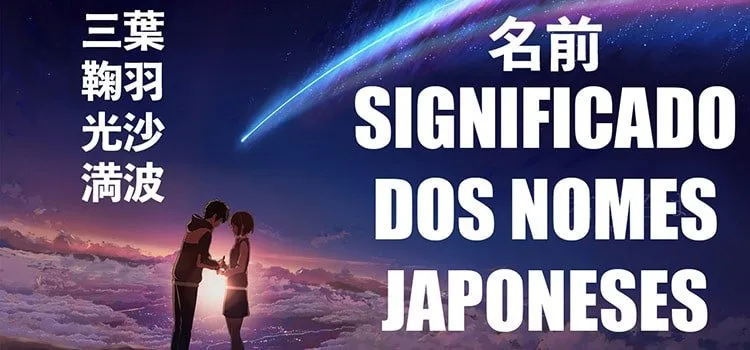
Japanese names cannot be looked up like European names in a list with fixed meanings. The written form decides the meaning, and the same pronunciation can be written with several combinations of kanji. Anyone who wants to understand a name has to read the characters it is made of.
This article explains how to work out the meaning of Japanese names step by step, which tools help and which mistakes are common. The examples come from everyday name searches and from the structure of Japanese name dictionaries.
Contents 9
Why Japanese names are ambiguous
A Japanese name usually consists of a family name and a given name, mostly written in kanji. The pronunciation follows its own rules. Parents can decide which reading to use for the characters they choose. As a result, the same written form may have several readings, and the same reading may be written with different kanji.
On top of that, the meaning does not come from the name as a whole but from the characters. A single kanji often carries several meanings, and only the combination creates the impression the name is meant to convey. A complete list of all Japanese names with meanings is therefore impossible. Name dictionaries record thousands of entries, but the number of possible combinations is much larger.
Starting from the kanji
If you know the kanji of a name, you can go through a dictionary. Each character can be looked up on its own and broken down into meanings and readings. For beginners, the online dictionary jisho.org is practical because it combines kanji, vocabulary and names in one search. If you cannot type the characters, copy them from a text or use the radical search.
Searching for a single kanji shows its basic meanings, the on reading from Chinese and the kun reading from Japanese. These details are the starting point for interpreting a name. They do not replace a name dictionary, however, because names can use additional readings that appear only marginally in standard dictionaries.
When you only know the romanization
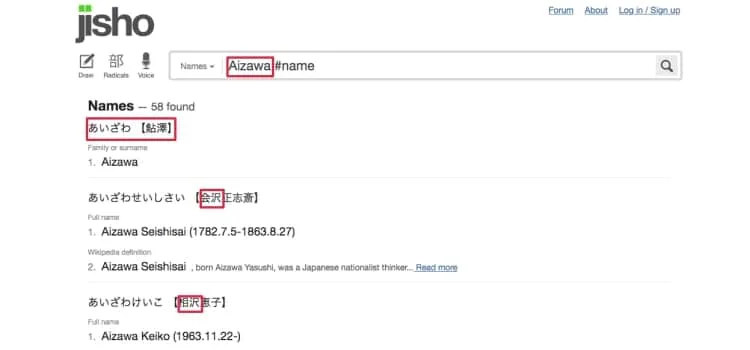
Many people know a Japanese name only in Latin script, for example from an anime or from an acquaintance. In that case, searching for names in the dictionary helps. On jisho.org you can limit the search to name entries with the filter #names. The result shows several spellings for the same reading, each with the kanji used.
From those results you can choose which spelling and meaning fits best. If you are looking for a name for yourself or for a character, you can decide between variants on purpose. If you want to understand an existing name, check which spelling the family or the person actually uses, because the pronunciation alone does not allow a clear assignment.
Choosing a name by meaning
The search also works the other way round. If you are looking for a character for a concept, enter the word in the dictionary and compare the matching kanji. Then combine the character with the #names filter to see which names contain it. For love, for example, that would be the character 愛 (ai), which appears in many given names.
The first results of such a search often show short names with a single character. Further pages show longer combinations that add other meanings. Anyone choosing a name should therefore compare several variants and check which reading is established in everyday use.
Understanding readings: on, kun and nanori
Kanji have two basic types of reading. The on reading goes back to the Chinese pronunciation, the kun reading is the Japanese reading of a word. Names add a third group: nanori, readings used only in names and otherwise not found in everyday language.
These nanori are the reason name dictionaries remain necessary. A dictionary lists the standard readings of a character, but a name may carry its own, traditionally grown reading. To pronounce a name correctly, ask the person or check the spelling in a name dictionary.
Typical patterns in Japanese names
Although there are no fixed rules for naming, patterns are visible. Many given names consist of two kanji that together express a quality, an image from nature or a virtue. Frequent elements are characters for light, water, forest, flower or heart. The endings are also informative: the suffix -ko was long typical of female given names, while endings such as -tarō or -suke are traditionally associated with male names.
Family names work differently. They often refer to landscapes, places or historical professions and were assigned over the course of history. Many of the most common surnames in Japan go back to geographical descriptions. When interpreting a surname, look for the origin of the name rather than a personal quality.
Common mistakes when interpreting names
The most common mistake is to treat the meaning of a single character as the meaning of the whole name. A name containing the character for light does not automatically mean light; it can express a combination of qualities the parents chose for their child.
A second mistake is confusing homophones. Many Japanese names sound the same but are written differently. If you only know the pronunciation, you cannot determine the meaning with certainty. A third mistake is assuming a dictionary gives the complete answer. Names require a name dictionary and, when in doubt, confirmation from the person concerned.
Nicknames derived from given names
Japanese nicknames often come from shortening, combining or changing a given name. A longer given name is frequently reduced to its first syllable or a shortened form, to which an attached suffix is added. The suffixes -chan and -kun are common in everyday life, and their use depends on the relationship between the people involved.
If you understand the meaning of a name, you can also place nicknames better. The reverse is true as well: a nickname says more about the relationship between people than about the original meaning of the name.
Conclusion
The meaning of a Japanese name comes from its kanji, their combination and the chosen reading. Separating these three levels lets you interpret names far better than a list of translations alone.
In practice, a dictionary, a name dictionary and some patience are enough. For a deeper look, these articles help: writing your own name in Japanese, Japanese surnames, unisex Japanese names, Japanese nicknames and Korean nicknames.




Community
Comments
0 comments
There are no published comments in this language yet.
Send comment