
A robot from the 22nd century travels back in time to help a boy who keeps failing at school and in life. That is the premise of Doraemon, one of the most recognisable characters in Japanese pop culture. In Asia the blue robot cat is about as famous as Mickey Mouse is in the West.
This article explains who Doraemon is, how the manga began, what the story says about Nobita, which gadgets and characters belong to the series, how the anime shows and films developed, and why the character still matters in Japan.
Contents 12
Who is Doraemon?
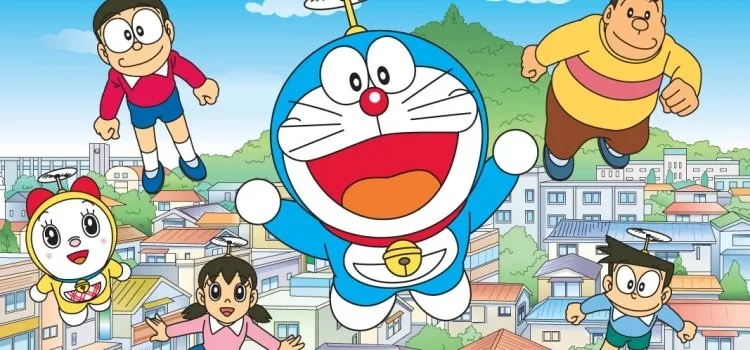
Doraemon is a robot cat born on 3 September 2112 and sent back from the 22nd century to help the schoolboy Nobita Nobi. He carries a pouch on his belly, the four-dimensional pocket, from which he pulls out a gadget for almost any situation.
He was originally yellow and had ears. After a robot mouse gnawed his ears off, he developed a panic fear of mice and cried until he turned blue, which explains his current colour.
The manga by Fujiko F. Fujio
The manga was created by Fujiko F. Fujio, the pen name of Hiroshi Fujimoto. It began in December 1969 and ran until 1996 in magazines published by Shogakukan, including six primary school magazines and later CoroCoro Comic.
The chapters were collected into 45 volumes published between 1974 and 1996. The series is estimated to have sold hundreds of millions of copies worldwide, making it one of the best-selling manga in history.
The story and Nobita
Nobita Nobi is a boy from the Nerima district of Tokyo who forgets his homework, loses every contest and is often bullied by other children. His great-great-grandson Sewashi sends Doraemon back so that the family's future improves.
The story shows Doraemon trying to help Nobita with gadgets from the future. Something usually goes wrong, and the situation becomes more complicated than before. That humorous pattern shapes the series.
The characters around Nobita
The main characters include Shizuka Minamoto, whom Nobita loves, the strong and aggressive Gian, the boastful Suneo and Nobita's mother. Each character represents a different personality type, and their conflicts drive the stories.
Doraemon has human weaknesses: he likes to eat, is afraid of mice and argues with Nobita. These flaws make him sympathetic to readers.
The gadgets in the pocket
The best-known gadgets include the Take-copter, a small propeller for the head, the Anywhere Door, which opens onto any place, and the pocket itself, which leads into another space and therefore offers endless room.
Each gadget follows a simple idea that is often taken literally. A tool that grants wishes can produce the opposite result. In that way the series also talks about the limits of technical solutions.
The first anime series of 1973
A first anime series of 26 episodes was produced for Nippon TV in 1973 by Tokyo Movie Shinsha. It was not a major success and is now remembered mainly as an early attempt.
The second series brought the breakthrough. On 2 April 1979 it started on TV Asahi, animated by Shin-Ei Animation and directed by Tsutomu Shibayama.
The long series of 1979
The 1979 series ran until March 2005 and consists of 1,787 episodes plus 30 specials. It shaped the image of the characters for a generation and is still associated with the best-known voice of Doraemon.
On 15 April 2005 a new series started, retelling the story for a younger audience. It is still running and has modernised the characters without changing the basic idea.
The films
Since 1980 a feature film has appeared almost every year. Many of them take Nobita and his friends to distant times and places: to the age of the dinosaurs, to other galaxies or to the legend of Atlantis.
The films are often more action-oriented than the short manga chapters and count as a separate part of the franchise. In 2014 and 2020, Stand by Me Doraemon also brought computer-animated versions to cinemas.
Doraemon as a cultural figure
Doraemon became a symbol of Japan. In 2008 the Japanese Ministry of Foreign Affairs appointed the character as the country's first anime ambassador, tasked with spreading understanding of Japanese culture.
In Europe the series was most successful in Italy, Portugal and Spain. In Germany and the United States it remained little known for a long time, even though it has been part of everyday life in Asia for decades.
Doraemon in Brazil
In Brazil the series arrived in 1992 on TV Manchete, as part of the children's programme Clube da Criança. The dub was received unevenly at the time, and the series was forgotten by many for years.
Only in December 2014 did Doraemon return with a new dub released on Netflix. The new voices were better received, even though some character names were changed.
Why Doraemon still works
The stories are simple and repeatable: a problem, a gadget, a lesson. At the same time they deal with friendship, family, honesty and the way people treat the environment.
That mix of humour and moral purpose explains why the character has remained present for more than five decades. Doraemon is also an example of how a children's manga can become national heritage.
Conclusion
Doraemon became a cultural symbol: a robot with gadgets who tells the story of a boy learning to live with his mistakes, and of a friend who helps him without solving every problem completely.
Anyone who wants to understand Japanese pop culture will meet Doraemon sooner or later. Read more: Sazae-san, kawaii and moe anime, anime vs manga, manhwa and manhua and Japan's unusual official mascots.



Community
Comments
0 comments
There are no published comments in this language yet.
Send comment