
Did you know that it is possible to write your name in kanji (ideogram), even if your name is not Japanese? If you study Japanese, you already know the usual path: foreign names are written in katakana. But there is nothing wrong with writing a name in kanji – in fact, it is fun, because you get to pick ideograms that give a real meaning to the sound of your name.
Writing a foreign name in kanji is not difficult, because before katakana existed, the Japanese writing system used kanji exclusively. Take Chinese, for example: it gets by with ideograms alone. In everyday life in Japan, katakana is of course the easier choice for a foreign name. But have you ever wondered how your name would look in kanji? Which characters you would pick, and what they would mean? In this article, we walk you through it step by step.
Contents 5
What Are Kanji?
Kanji (漢字) are the Chinese characters that have been used in Japanese writing for centuries. In modern Japan, the writing system combines kanji with the two syllabaries hiragana (ひらがな) and katakana (カタカナ). While kana represent syllables, a single kanji stands for a whole word or a core of meaning – often with two possible readings: the original Chinese on'yomi (音読み) and the Japanese kun'yomi (訓読み).
Before katakana existed, names of any origin were written in kanji. Even today, most official Japanese first names come from a fixed pool: the jinmeiyō (人名用漢字, "kanji for use in personal names"), an extension of the everyday jōyō (常用漢字). When you write a foreign name, you step outside that pool – but you can still find kanji whose readings match the sound of your name, and whose meaning fits the impression you want to give.
Finding Kanji for a Name
Choosing kanji for a non-Japanese name is not an easy task. Japanese ideograms have many readings, and the reading used inside a name can differ from the standard reading you learned when you first studied the character. The key idea is simple: you are not changing your name, you are taking the syllables of your name, written in katakana, and finding kanji that match them.
Two things are worth keeping in mind. First, some kanji feel more feminine and others more masculine in a given name – it is not a strict rule, but native Japanese speakers hear the difference right away. Second, not every kanji is suitable for names, and not every kanji has a name reading. So check the meaning, the reading, and the usual context before you commit.
The most important tool here is the method of ateji (当て字). Ateji means using kanji for their sound rather than for their original meaning. That is exactly the principle you use when you transfer a foreign name into Japanese: you pick, for each syllable, a kanji whose reading sounds close to the original, and you combine the characters so that they form a pleasant or meaningful whole.
Tools and Resources
The fastest place to start is the website jisho.org. Type your name in Latin letters into the search bar and look specifically in the Names section. You will get a list of kanji that are used in Japanese first names, with readings and English meanings. At a glance, you can see which characters fit purely by sound, and which ones also bring a positive meaning with them.
A useful complement is the site kanjizone.com. You enter your name and get direct suggestions of ideogram combinations, with meanings attached – very practical when you want to compare several options before deciding.
If you want something even more concrete, look through a Japanese name dictionary such as the jinmei jiten (人名辞典), or simply ask a Japanese friend. Real knowledge of ateji, jinmeiyō and the way names are usually read lives mostly in the heads of experienced native speakers – and they are the ones who can tell you whether an unusual combination actually sounds good.
Cultural Meaning: Inkan, Hanko and the Power of the Characters
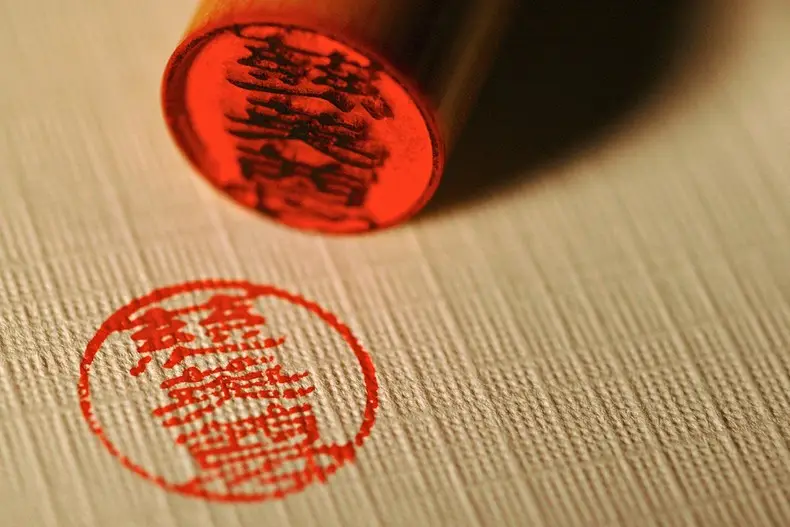
If you have ever opened a bank account, signed a lease, or stamped an official document in Japan, you have run into the inkan (印鑑) or hanko (判子) – the personal name seal that replaces a handwritten signature. Here, too, kanji play the leading role: the carved face of the seal shows your name in a form that can be both read and recognised as a single image. That double nature – sound and picture – is exactly what makes kanji a perfect fit for a name stamp and for the inkan as a personal signature.
When Japanese people choose the characters for a name, three factors usually matter: the meaning, the stroke count, and the visual balance. Ideograms with a positive sense (such as beauty, honesty, growth, or light) are traditionally preferred. Very complex characters with many strokes can look crowded in a small seal, so many people go for simpler variants – as long as the reading still matches the sound of the name.
One important caveat: the kanji version of your name is not an official replacement for your regular signature. For documents, contracts and official procedures in Japan, you still need the Latin spelling of your name, or a registered seal. The kanji form of your name is, above all, a personal mark, a conversation starter, and – especially for Japan fans – a small keepsake of your own encounter with Japanese culture.
Tips and Examples
Always start on jisho.org, in the Names section, and see which kanji are even available for the syllables of your name. That way you avoid combinations that sound right in theory but feel awkward or unusual in Japanese.
What really matters is the combination. A single character can sound great on its own, but it is the way several characters work together that creates a coherent meaning. So write down several options, compare meaning and stroke count, and, if you can, ask a Japanese person for a quick read.
A concrete example: my own name is Kevin (ケビン). Using jisho.org and with the help of a Japanese family, I came across options like these:
- 計敏 (Keibin) – 計 (kei) means plan, scheme, measure; 敏 (bin) means intelligent, quick and alert.
- 花敏 (Kabin) – 花 (ka) means flower.
I ended up keeping one of these options. At first I was told that using 花 felt a little feminine, but after a short discussion it turned out not to be a real problem. There are many other ideogram combinations with different shades of meaning – the choice is, in the end, a very personal one.
If you are starting from scratch, the easiest order is this: write your name in katakana, look up each syllable on jisho.org, note the meanings, pick a combination that hangs together well, and let a Japanese speaker proofread the result. Step by step, a kanji name emerges that matches the sound of yours and carries a meaning that fits you.
If you are generally curious about the Japanese writing system, it is worth looking at katakana, hiragana and the basics of kanji – it helps to understand why foreign names are adapted the way they are.





Community
Comments
0 comments
There are no published comments in this language yet.
Send comment