
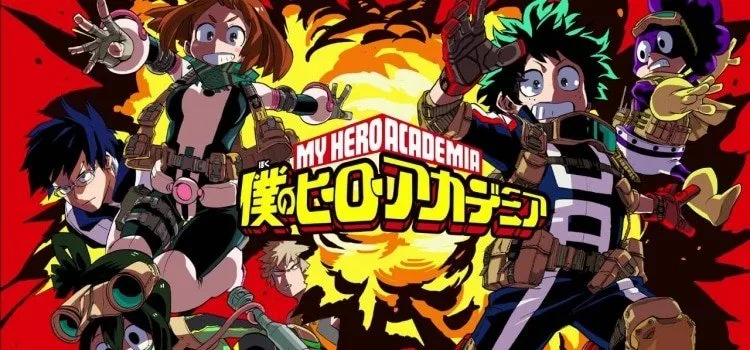
My Hero Academia, known in Japanese as Boku no Hero Academia, is a manga series by Kōhei Horikoshi and one of the most successful shōnen titles of the 2010s. The story mixes the Japanese hero tradition with American superhero comics, and the anime adaptation by Studio Bones made it famous around the world.
This article covers the plot, the main characters, the structure of the manga and the anime seasons. It also explains how the series was created, which films and spin-offs exist, and what the characters' names reveal.
Contents 10
What is My Hero Academia?
My Hero Academia is set in a world where almost every person is born with a special ability. These abilities are called Quirks. About 80 percent of the population has one, and society has adapted completely: heroes are professions, authorities issue licences, and schools train teenagers to fight crime.
The manga ran from July 2014 to August 2024 in Shueisha's Weekly Shōnen Jump and spans 42 volumes and 430 chapters. By April 2024 it had more than 100 million copies in circulation, spin-offs included. The series won awards such as the Sugoi Japan Award and the Harvey Award for Best Manga.
The world of Quirks
Quirks can be inherited and range from small everyday tricks to powers that reshape whole cities. Almost every ability has a drawback: a usage limit, self-injury, or a permanent physical mutation. Those rules keep the fights readable, because strength always has a price.
As more people were born with powers, a system of professional heroes emerged. Heroes work with the authorities, rescue people and arrest villains. Anyone who intervenes without a licence counts as a vigilante and breaks the law, even with good intentions. U.A. High School in Shizuoka Prefecture is one of the most respected schools for future heroes.
Plot and main characters
The story follows Izuku Midoriya, called Deku. He is born without a Quirk and belongs to the small group of people without an ability. He still dreams of becoming a hero. When he sees his classmate Katsuki Bakugo attacked by a villain, he rushes in without hesitation, even though he cannot do anything.
All Might, the greatest hero in the world, watches the scene and recognises Midoriya's character. He passes on his power, One For All, which has been handed down through generations. Midoriya passes the U.A. entrance exam and trains there with Bakugo, Shoto Todoroki, Ochaco Uraraka and the rest of class 1-A.
Behind All Might stands the dark opposite: All For One, a villain who can steal and pass on Quirks. He caused the injury that weakens All Might, and he pulls the strings of the League of Villains. With One For All, Midoriya inherits not only strength but a responsibility carried across generations.
One of the most interesting characters is Shoto Todoroki. His father Endeavor, later the number one hero, forced him into training that destroyed the family. Shoto's story shows how the hero system shapes people and how hard it is to break free from a parent's expectations.
Beside the heroes, a threat grows. The League of Villains, led by Tomura Shigaraki, later merges with the Meta Liberation Army into the Paranormal Liberation Front. The conflict between heroes and villains becomes a fight over the order of the whole society.
Manga, author and creation
Kōhei Horikoshi published Barrage before My Hero Academia, and that series was cancelled after two volumes. He then revisited a one-shot called My Hero and used it as the basis for his new series. Horikoshi is a big fan of American comics and films, including Sam Raimi's Spider-Man trilogy, Star Wars and X-Men. He names Naruto, Dragon Ball, Ultraman and Kamen Rider as his main artistic influences.
The manga was planned as a manageable work rather than a decades-long series. Horikoshi said several times that he had the ending in mind before the first chapter. In August 2024 the story ended with chapter 430 and a conclusion that brings the main characters together one last time.
The story arcs
The manga is divided into arcs, each built around a new enemy, a tournament or a training unit. The list below summarises the most important stages.
- Entrance exam: Midoriya passes the U.A. test and earns his first points as a candidate.
- Quirk assessment: the class learns about its abilities and limits.
- Battle test: the first training fights show how far the students really are.
- U.S.J.: villains attack the school and the class faces real danger for the first time.
- U.A. sports festival: the students compete in public to attract attention from hero agencies.
- Hero Killer: Stain and his followers question the whole idea of heroism.
- Final exams: the class must prove it can combine theory and practice.
- Forest training: a training camp becomes a target for the League of Villains.
- Raid on the hideout: the heroes strike back against the League and lose All Might as an active fighter.
- Provisional hero licence: the students take the exam for their first real deployment.
- Shie Hassaikai: a conflict over a girl and a dangerous drug leads the heroes into the underworld.
- Remedial course: the class works on its weak points and on teamwork.
- U.A. school festival: a class performance is threatened by a new enemy.
- Professional heroes: the students work in agencies and experience a hero's daily life.
- Joint training: two classes train together and test each other in practice fights.
- Meta Liberation Army: a new organisation openly challenges the hero system.
- Endeavor's agency: the three best students learn from the new number one hero.
- Paranormal Liberation War: heroes and villains meet in a large battle that decides what comes next.
- Final phase: the last part brings the conflicts around All For One, Shigaraki and the future of society to a close.
Anime, films and spin-offs
Studio Bones adapted the manga as an anime series starting in April 2016. Eight seasons aired until December 2025 and covered the complete story. Four films followed: Two Heroes, Heroes Rising, World Heroes' Mission and You're Next. There are also eleven OVAs and a television special that adapts a bonus chapter from the final volume.
The success produced more spin-offs. My Hero Academia: Smash!! is a short gag series that parodies the main characters. My Hero Academia: Vigilantes follows unlicensed heroes shortly before the events of the main story and was also adapted as an anime. Team-Up Missions brings characters from different parts of the story together in small adventures. A live-action film by Legendary Entertainment is in development.
What makes the series special
My Hero Academia tells classic shōnen stories but asks questions about law and order. Several characters are punished for fighting villains without a licence, even when they save people. The villains argue for the freedom to use their powers. That conflict makes the series more political than it first appears.
Romance barely matters. The plot focuses on friendship, teamwork and character growth. Readers looking for a love story will be disappointed; readers looking for action and hero drama find it in almost every arc.
The series celebrates heroism and shows its dark side. Heroes become brands, rankings define their value, and authorities decide who may act. That mix of admiration and criticism is what makes the story interesting for adult readers.
Interesting details
The anime uses cherry blossoms again and again. When All Might announces that Deku can become a hero, sakura petals fall to mark the beginning of a new stage. Trees also appear between Izuku and Katsuki in the first opening, symbolising their rivalry.
People with Quirks lack the joint in their little finger. The in-world explanation is that only people without a Quirk have this joint, so its absence marks a new evolutionary step. Another small joke hides in a Chinese city name: Qingqing means light luck, a pun on Chongqing, which means heavy luck.
Before the anime started, Naruto author Masashi Kishimoto praised the work. Horikoshi in turn named Naruto as his main inspiration and said the series gave him a love for drawing hands.
The franchise also includes video games. My Hero Academia: One's Justice by Bandai Namco was released for PlayStation 4 and Nintendo Switch and turns the fights of the series into an action game.
The eighth season closed the story at the end of 2025. The series therefore ends with a fixed conclusion that the author had announced years earlier, not with a promise of further seasons.
Names and their meaning
The characters' names often reveal their powers. Mina Ashido calls Deku greenish because his family name Midoriya contains midori, the Japanese word for green. Izuku can also be read as Deku, which echoes dekunobou, a term for a useless wooden puppet. His hero name refers to the phrase ganbaru deku, roughly I will do my best.
Katsuki Bakugo carries the explosion in his name. Bakudan means bomb and bakubatsu means explosion, and both words use the character 爆 found in Bakugo. Katsuki means I win, while Bakugo literally means great explosion. Shoto Todoroki combines heat and cold in his name: Todoroki suggests thunder and a great impact, while Shoto is written with the characters for roasting and freezing.
Momo Yaoyorozu carries the number eight million in her name, a figure that stands for all creation. Momo can also be read as hundred. She entered U.A. through a recommendation, which is common in Japan when schools accept excellent students without an entrance exam.
Conclusion
My Hero Academia is a finished work that combines shōnen tradition with superhero culture. The manga ended in 2024, the anime in 2025, so the story of Midoriya, All Might and class 1-A is now complete.
Anyone new to the series can start with the anime and then read the manga, which tells some fights in more detail. Read more: how to tell whether an anime gets a new season, the 50 best anime, Tokyo Ghoul facts, manga, manhwa and manhua compared and VRChat for otakus.
Community
Comments
0 comments
There are no published comments in this language yet.
Send comment