

Konata Izumi can spend a painful stretch of an episode deciding which end of a chocolate cornet to bite first. That frame is still the cover of this page: Lucky Star treats snack logistics like a boss fight, and Japan still turned the argument into a hit.
A lot of anime collapse into something ridiculous the second you squeeze them into one sentence. Some were written to sound that way. Others piled school romance, giant robots, and childhood promises until the logline started laughing at itself. Landing on this list does not mean the show is bad. Tengen Toppa Gurren Lagann is still the best anime I have ever watched, galaxies and all.
Ridiculous and idiotic anime
Lucky Star — Four high-school girls, almost no plot, and conversations that can orbit a pastry, a game, or how sailor uniforms actually work. Kyoto Animation's 2007 series became an otaku time capsule because Konata is the gremlin in the middle, not because anyone saved the world.
Nisekoi — A yakuza heir who likes cooking, a childhood promise, a fake relationship with the rival boss's daughter, and a pile of girls who might be "the one." GREAT, and also a harem with extra family meetings.
Tengen Toppa Gurren Lagann — A fighting anime whose robots eventually punch using galaxies. Don't be fooled: it is still the best anime I have seen in my life. It is absurdly over the top, and it can still wreck a grown man. Perfect.
Saint Young Men — Jesus and Buddha as roommates in a Japanese apartment, doing laundry and tourist bits. Sacred figures, convenience-store snacks, neighbor problems.
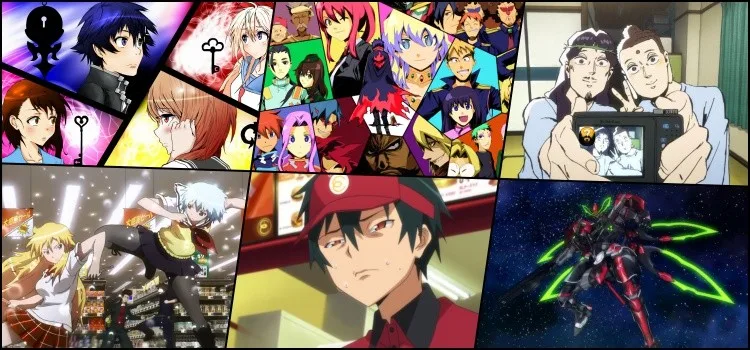
Ben-to — Students wage supermarket war over discounted bento. It is a tournament arc about leftover fried chicken, and it plays the fights straight.
Hataraku Maou-sama! — The Demon Lord clocks in at a fast-food counter on Earth. Hell's staffing problem becomes a part-time job in a paper hat.
Kakumeiki Valvrave — High schoolers in a space colony, mechs whose pilots stop being fully human and need to feed, the militaristic Dorssia empire, and hidden aliens called Magius pulling strings. The official stack is already that loud: vampire-like pilots, giant robots, and a war in orbit.
Outbreak Company — An otaku gets posted as a cultural diplomat in a fantasy kingdom and starts exporting doujin, figures, and idol logic to elves and dragons.
Yuri Kuma Arashi — Bears who can look human, a girl taught to hate bears, and a yuri story about who gets pushed out of the circle. The premise is the allegory wearing a costume.
Akikan! — Soda cans that turn into cute girls, then a war over which metal is superior. If Japan can turn a drink can into a moe girl, the rest of this list starts to look almost reasonable.

Midori no Hibi — Seiji wakes up with his crush living as his right hand. The logline is cursed; the series plays it as a sweet high-school romance anyway.
Sekkou Boys — Four Greco-Roman plaster busts try to make it as an idol unit. Classical sculpture, glow-up lighting, and a manager who has to take marble seriously.
Gintama — Edo occupied by aliens, odd-job samurai, and a comedy that will drop a parody in the middle of a sword fight. Famous for a reason: the gag is the plot, until it suddenly isn't.
And then the premise derails
Samurai Flamenco — It starts as a guy in a cheap hero suit cleaning streets. Then aliens, ranger teams, and killer monsters crash the party. Watch it for the derailment: the first stretch is sincere, the rest refuses to stay in that lane.
Bobobo-bo Bo-bobo — In the year 300X, the Hair Hunt Empire shaves the planet bald. A gold-skinned man with a blonde afro fights back with the Fist of the Nose Hair, a parody of Fist of the North Star that keeps abandoning the fight for a skit. The nonsense is the martial art.
Keijo!!!!!!!! — Girls compete in a pool using hips and breasts as legal weapons. The title carries eight exclamation marks because one would have been dishonest.
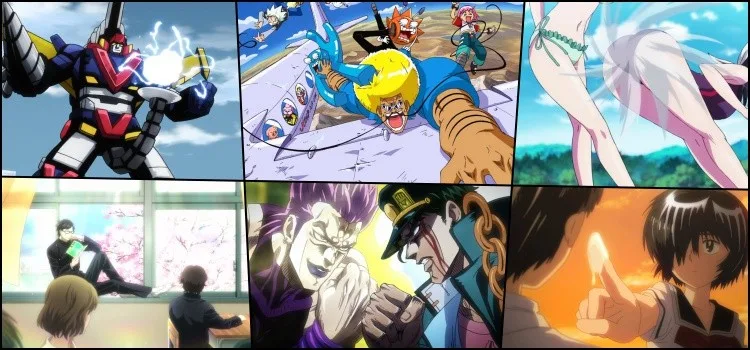
Sakamoto desu ga? — A high-schooler who is unfairly good at everything and makes the whole class suffer for it. Just watch.
JoJo's Bizarre Adventure — Generations of Joestars fighting vampires, ancient beings, a Nazi-era plot in Battle Tendency, and later Stands. The title already confessed that the bizarre part is the method, not an accident.
Nazo no Kanojo X — A romance that runs on exchanged saliva. Mysterious Girlfriend X treats that as the whole mechanic, then gets surprisingly earnest about first love.
Unko-san — The title is Mr. Poop. Unko-san is a luck-granting fairy on an island full of other poop people; un is luck and unko is poop, so the pun was the pitch. Short episodes, no dignity required, and a straight line into Japan's wider unko luck culture.
Qwaser of Stigmata — Super-powered Qwasers refill by drinking soma from a partner's breasts. The premise is also the warning label.
If you can pitch the show to a friend and watch their face stall, it belongs here. That still leaves a weekend choice: chase the ones born as jokes (Bobobo-bo Bo-bobo, Unko-san) or the ones that kept adding genres until the pile became the entertainment (Kakumeiki Valvrave, Samurai Flamenco).
Japan's studios will keep greenlighting both kinds. The only useful filter is whether the episode is still fun after the blink. Start with Ben-to if you want the joke played straight, or Samurai Flamenco if you want to watch a sincere hero show fall down the stairs.

Community
Comments
0 comments
There are no published comments in this language yet.
Send comment