
Few shows run as long as Sazae-san. Since October 5, 1969, the Japanese broadcaster Fuji TV has aired new episodes every Sunday evening, and the time slot has never changed. The series holds the Guinness World Record as the longest-running animated television series and is part of the weekend routine in Japan. Outside the country, hardly anyone knows it.
This article explains where the series comes from, how the family is built, why it has lasted so long and what it says about the way Japan changed.
Contents 9
What Sazae-san is
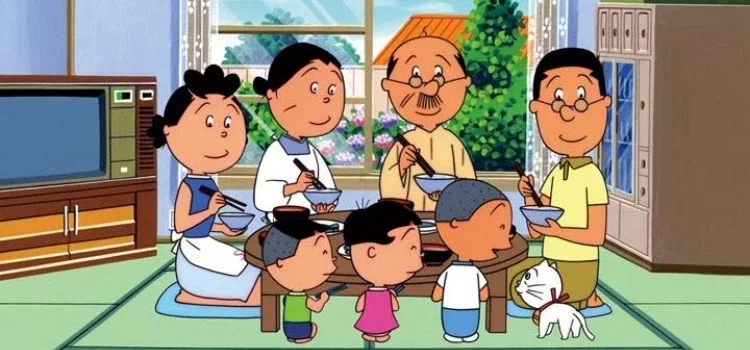
Sazae-san (サザエさん) is a yonkoma manga by Machiko Hasegawa and the anime series based on it. The story follows the everyday life of the Isono family in a suburb of Tokyo. After Sazae marries Masuo, he and their son Tarao move in, so three generations live in one house.
The anime has aired on Fuji TV since 1969. Each broadcast runs about 25 minutes and contains three short episodes. What viewers see is calm, humorous family life without major conflict. That simplicity is still the trademark of the series.
A comic born after the war
The manga first appeared on April 22, 1946 in the local newspaper Fukunichi Shimbun. From 1949 the Asahi Shimbun printed the strips nationwide until the series ended on February 21, 1974. In book form the manga runs to 68 volumes with roughly 6,500 strips; other counts of the individual stories reach about 10,000.
By 1999 more than 86 million copies were in circulation. The name Sazae comes from a turban snail (サザエ), a seafood associated with food in the postwar years. Other characters also carry food names, because media figures of the time were often named after ingredients.
Hasegawa drew a family living through the reconstruction after the war. Her heroine works at home but also speaks her mind. The early stories were openly political; later the everyday and satirical side dominated.
The family and its characters
Sazae is 24 in the anime and 27 in the manga. She is a housewife, cheerful and sometimes outspoken. Her husband Masuo works at a trading company; he is 32 in the manga and 28 in the anime. Sazae occasionally helps out as a maid for a wealthy family in the neighbourhood.
Her father Namihei is 54, strict and proud of the single tuft of hair on his head. He scolds the children but is warm underneath. Mother Fune is 48 in the manga and in her fifties in the anime; she holds the household together. The younger siblings Katsuo (11) and Wakame (9) bring the school day into the stories, and son Tarao is three years old.
The stories are set in the present but deliberately timeless. There are no smartphones and no convenience stores. Seasons, festivals and visits to neighbours shape the episodes. Many episodes draw on several strips, and because the source material is limited, motifs return with new variations.
The anime since 1969
The anime started on October 5, 1969. It was produced first by the studio TCJ, later renamed Eiken; Fuji TV has been involved as producer since 1985. The Sunday slot from 18:30 to 19:00 has stayed the same for more than five decades.
In the beginning the show was a slapstick comedy with references to classic cartoons. Within a year it shifted to family drama. Direction, scripts and character design have hardly changed since then. That consistency makes the series popular on one side and open to criticism on the other, because it leaves out modern technology.
In 2013 the era of traditional cel animation ended: until then Sazae-san was the last series still drawn on cels, and afterwards the production worked fully digitally. Directors and writers changed, the narrative style did not.
Records and numbers
On September 5, 2013, Guinness World Records recognised the series as the longest-running animated TV series. The count is not simple: one weekly broadcast consists of three segments, and specials add to it. By December 2025 more than 2,850 broadcasts had aired; counted in segments that is over 9,000 episodes. Older sources name around 7,500 episodes.
A second record belongs to Midori Katō, who has voiced Sazae since 1969. In 2019 she was recognised for the longest career as a voice actor in the same animated role. Other voices changed over the decades, for example after deaths or because of age.
Why the country keeps watching
A survey by the Nippon Research Center in 2020 found a recognition rate of 97 percent. For many families the show belongs to Sunday evening like dinner itself. The calm tone, the recurring characters and the seasonal motifs give the audience a sense of stability.
Since November 1991 every broadcast ends with a rock-paper-scissors game between Sazae and the viewers. Before that she tossed a bean or a rice cake into the air and caught it in her mouth. Fuji TV changed the scene after doctors warned that children might copy it and choke.
The opening sequences have shown places Sazae visited on her travels since 1974. The settings change about every three months, and since 2000 prefectures and municipalities have contributed several million yen in support because they see the programme as tourism promotion.
Criticism and change
Because the series leaves out current devices and fashions, some critics call it anachronistic or a portrait of a vanished era. The production answers that everyday life and relationships are the core of the show, and that they do not plan to add elements which would change that basis.
In other places the series has adapted: smoking and corporal punishment, once part of daily life, were removed or shown differently. The show remains both a window into the postwar years and a product that reacts to social expectations.
Almost unknown in the West
The rights holders long prevented broadcasts abroad. Only in January 2026 was it announced that the series would go to Taiwan, airing from January 26 on the channel MOMOTV. For most viewers outside Japan it therefore stays a phenomenon they hear about but never see.
Merchandising and home video releases are limited as well. Hasegawa did not want the series commercialised, and that wish has been respected after her death. Older episodes are therefore hard to find, which strengthens the archival character of the show.
Conclusion
Sazae-san is not a spectacular anime but a daily story about a family. That is exactly where its effect comes from: it records the changes in Japan without explaining them, and it keeps running because it offers reliability. Anyone who watches it gets a view of Japanese everyday life that goes beyond the plot.
Read more: longest anime by episode count, the longest manga series, long and funny anime titles, anime tourism in Japan and Hiroyuki Sawano and anime soundtracks.




Community
Comments
0 comments
There are no published comments in this language yet.
Send comment