
Anime fans pick up oppai [おっぱい] almost as fast as they pick up kawaii — then treat it like a caption under a chest that would not survive a packed train in Shinjuku. In Japanese the word is messier than that: informal, a little childish, used for breasts and for breast milk, and not reserved for the giant drawings in ecchi.
The other half of the search is usually a stereotype. Japanese women must have tiny breasts, so why do the characters look like that? Cup letters do not travel across the Pacific the way people think, and a Japanese C is not a U.S. C. The slang, the measuring tape, and the drawing style are three different conversations.
Contents 12
The meaning of oppai
Anyone who stays around anime or Japanese pop culture meets oppai [おっぱい] early. It means breasts — and, in baby talk, breast milk. What many English-language fans miss is that it is slang, closer to boobs than to a medical noun.
The everyday body word is mune [胸], the chest as a whole, sometimes used figuratively. Oppai points at the soft, physical part: breasts you can see, measure, or nurse from. It works in the singular and the plural, and both women and men use it when they mean a woman's breasts.
It is informal, not forbidden. You still hear it in ordinary talk about breastfeeding. It is not a classroom word, and it is not automatically dirty — though English-speaking anime fandom borrowed it in a much more sexual register than Japanese baby talk ever needed.
The sound itself has a bounce. Some speakers hear a bit of Japanese onomatopoeia in it, the boing of a round chest. That is impression, not a dictionary rule — the origin stories are older and less tidy.
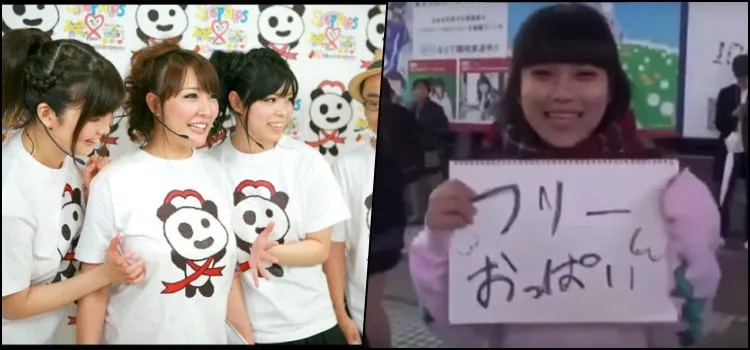
Origin of the word oppai
Nobody has a single clean etymology. The most common folk story is that it grew out of paipai [ぱいぱい], the reduplicated baby word children use for a mother's breasts. That would explain why oppai still feels a little childish even when adults say it.
A late-Edo essay, Orokaoi [於路加於比], written around 1859–1860, already treats the word as children's speech and guesses it shortened ooumai [をおうまい] — roughly “oh, tasty” — as if a nursing infant had named the milk. Other people derive it from ippai [いっぱい], “full.” Both guesses are old; neither is proven. What the record does show is that the word was already in circulation by the end of the Edo period, in the childish register, not as a modern anime export.
There is no standard kanji. You write おっぱい in hiragana or オッパイ in katakana. The Oppai hoodie worn by Saitama in One Punch Man is a joke that only works because the word is already this informal.
Ways to say breasts in Japanese
If you are studying nihongo, oppai is only one slot in a larger set. The polite or anatomical words sit next to baby talk, loanwords, and slang that anime made famous. There is a sister article on oshiri, the Japanese word for butt.
What does mune mean?
Mune [胸] is the chest as a region: breasts, yes, but also the ribcage, the lungs, the place that tightens when you are nervous. Songs use mune for heartache because kokoro [心] is broader still — mind, spirit, the inner life. In ordinary Japanese, mune is probably more common than oppai.
Other ways to say breasts in Japanese
- ぱいぱい — paipai (childish);
- ブレスト — buresuto (from English breast);
- 母乳 — bonyū (mother's milk);
- ボイン — boin (slang for a large, bouncy chest);
- カップ — kappu (bra cup);
Other synonyms:
- Chibusa [乳房] — breasts, mammary glands, also used for an animal's udder;
- Kyōbu [胸部] — chest, thorax;
- Munaita [胸板] — chest plate, the flat of the chest;
- Chichi [乳] — milk, breasts;
- Muneniku [胸肉] — breast meat, usually chicken;
Vocabulary for bras and measurements
Useful if you are actually buying a bra in Japan, not only reading manga.
- Bra — ブラジャー (burajā);
- Chest — 胸 (mune);
- Breasts — おっぱい (oppai), informal;
- Cup — カップ (kappu);
- Baby-talk breasts — ぱいぱい (paipai);
- Bust — バスト (basuto), from English bust;
- Cleavage — 谷間 (tanima), also “valley” or “ravine”;
Pettanko, paizuri, bakunyū, kyonyū
Anime and internet Japanese have a whole ladder of size slang. There is even vocabulary for the social awkwardness of being flat-chested or very large. Two pages on this site go deeper:

Japanese bra sizes and how cups are measured
In Japan the cup letter comes from a simple subtraction: measure the fullest part of the bust, measure again directly under the breasts, then subtract. The leftover centimeters are the cup. Bands are labeled in centimeters and rounded to the nearest 5 — 65, 70, 75, 80 — and the tag usually writes the cup first, as in C75 or B70.
Japanese cups step by about 2.5 cm. That is not the same staircase as a U.S. or U.K. letter, which is why a Japanese C often sits closer to a North American B than to a North American C. You cannot keep your home letter and only convert the band.
| Japanese cup | Bust minus underbust |
| A | about 10 cm |
| B | about 12.5 cm |
| C | about 15 cm |
| D | about 17.5 cm |
| E | about 20 cm |
| F | about 22.5 cm |
| G | about 25 cm |
A 70 cm band is roughly a U.S. 32, 75 is roughly a 34, 80 a 36. Brands still cut cups differently, and Japanese styles often run smaller in volume with more padding, so the chart is a starting point — not a fitting.
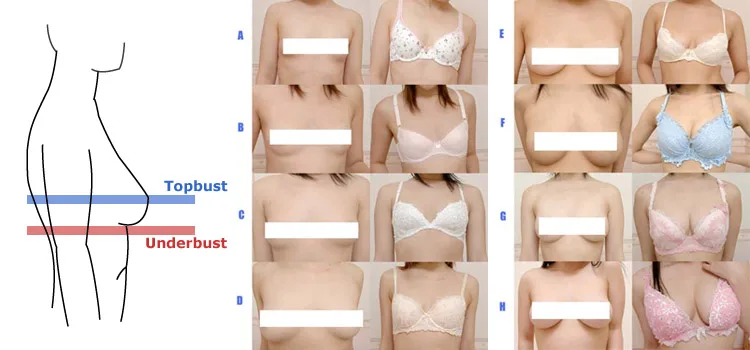
Average breast size of Japanese women
Lingerie sales are not a census, but they are what Japan actually publishes. Triumph International Japan has tracked cups since 1980. In that first year, only about 4.5% of its customers needed a D cup or larger. By 2018 the same company put that share at 53.1%. A-cup sales, once the majority, collapsed to a few percent. The firm's own white paper still places most Japanese women in the B-to-D band — a middle, not a cartoon flat chest.
Older magazine maps used to rank prefectures by best-selling cup: Kyoto and Gifu high, Saitama low. Later sales maps shuffled the same names. Treat those lists as lingerie gossip, not geography of bodies. Diet, Westernized cutting, and — as Triumph itself has said — women learning to scoop breast tissue into the right cup can move a letter without anyone “growing.”

Do Japanese women really have small breasts?
The stereotype is lazier than the tape measure. A Japanese A is a small difference on a small frame, not a moral fact about the country. Because cups are proportional, a slim torso can wear a C or D that still looks modest under a blouse.
International “average cup” lists that put Japan at A–B are using a different letter system and often a different decade. They also ignore that the Japanese letter itself drifted upward over forty years of sales data. Surveys that claim to rank every country are never a full population study; they are a snapshot of whoever bought a bra or answered a form.

Why do anime characters have large breasts?
The short answer is drawing, not demography. Large chests, visible panties, and impossible angles are fan service: a tool to hold a male gaze the same way oversized eyes and impossible hair colors hold a silhouette. They are clichés of the medium, not a portrait of women on the Yamanote Line.
Mangaka also draw the opposite on purpose. Flat-chested heroines, hidden big-bust reveals, and every step on the hinnyū to bakunyū ladder exist because the industry sells types, not averages. In real life, a very large chest can still draw comments from other women; anime has used that embarrassment as a joke for decades. That is social writing, not a measurement.
Oppai is not Korean oppa
A lot of searches for “oppai in Korean” are just a mix-up with oppa [오빠], the honorific a woman uses for an older brother or an older man she is close to. The two words are not related. Oppa is Korean kinship. Oppai is Japanese body slang.
Koreans who watch anime recognize the Japanese word. If you actually need Korean, the ordinary words are 가슴 (gaseum, chest or breasts) and 유방 (yubang, the anatomical breast). 젖가슴 (jeotgaseum) is more explicitly “breasts.” None of those is a cousin of oppai.





Community
Comments
0 comments
There are no published comments in this language yet.
Send comment