
In the 1990s Japan produced a large number of short OVA anime that are almost forgotten today. One of them is Dengeki Oshioki Musume Gōtaman, a two-part series that mixes a religious school, a kidnapping and a heroine whose fighting style is built on an unusual idea.
This article explains where the story comes from, how the two OVAs were made, what the plot is about, how the anime was received and why it is remembered mainly as a curiosity of the 1990s.
Contents 9
What is Dengeki Oshioki Musume Gōtaman?
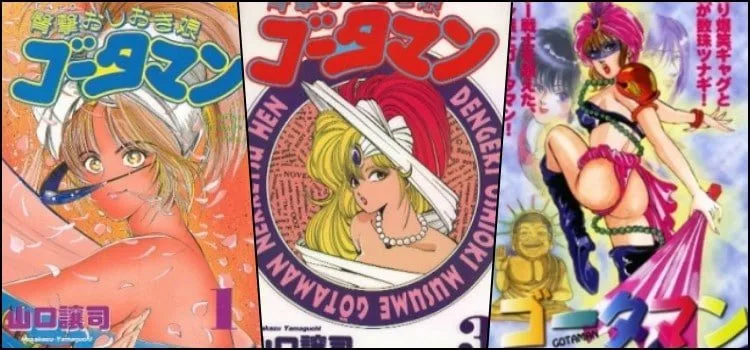
The title roughly means “Electric Punishment Girl Gōtaman” and is hard to translate directly. Internationally the series is also known as Butt Attack Punisher Girl Gautaman. It is a 1994 manga adaptation released as two short OVAs.
The story combines comedy and action with strong ecchi elements. The humour rests almost entirely on a single joke that is repeated throughout both episodes.
The manga by Masakazu Yamaguchi
The source material is by Masakazu Yamaguchi and was serialised in Weekly Shōnen Champion from 1991 to 1993. The chapters were later collected in six volumes.
The manga is classified as action and comedy with an ecchi theme. In Italy it was published as Gotaman: La ragazza in perizoma, which shows how directly the marketing played with the provocative concept.
The two OVAs
The first OVA, subtitled Gōtaman Tanjō-hen (“The Birth of Gōtaman”), was released on 24 May 1994 and runs 45 minutes. It was directed by Iku Suzuki, with a screenplay by Yū Yamamoto.
The sequel, Gōtaman R: Ai to Kanashimi no Final Battle (“Final Battle of Love and Sorrow”), followed on 24 October 1994 and runs 46 minutes. Animation was handled by Animate and Studio Kikan, and Bandai Visual distributed both parts.
Both were made for the video market rather than television, which was common for short anime of the period because VHS tapes allowed direct sales to a niche audience.
The plot
Mari Amachi is a devout Christian who transfers to the Perfect Religion Academy, a school dedicated to all the religions of the world and intended to train students as future religious leaders. Her friend Saori Minami is kidnapped by the Black Buddha gang.
Mari prays to God, but Buddha answers and offers to turn her into Gōtaman. In that form she tries to rescue her friend and defend freedom of religion. The costume consists of a sumo belt and leaves her rear exposed, and that is also how her attacks work.
The anime deliberately plays with the absurdity: the heroine is embarrassed, the enemies overreact, and the religious setting serves as a backdrop for slapstick. The plot is more of a pretext than a self-contained story.
The characters and the voice cast
Mari Amachi is voiced by Yuri Shiratori and her friend Saori Minami by Miki Itō. Buddha is voiced by Kenichi Ogata, a familiar actor in anime of that period.
The side characters remain one-dimensional. Their purpose is to carry the humour: the vice principal, the pope and the members of the Black Buddha gang are mostly visual caricatures.
The humour and the ecchi elements
The anime is a comedy whose central idea depends on breaking a taboo. Anime News Network labels the first OVA “Significant” and the second “Intense” for objectionable content.
Viewers who do not share the joke will find little to enjoy. The gags repeat, the plot is thin and the presentation is built around a single punchline. That is exactly what makes the OVAs an example of trash entertainment for some viewers.
Reception
The anime was not a commercial success and remains poorly documented. There are almost no official releases outside Japan, and the series appears mostly in lists of bizarre or obscure anime.
On Anime News Network the first OVA sits in the middle of the ratings. Most votes call it average, some bad and only a few good. Its reputation as “so bad it is funny again” has followed the series ever since.
Why the anime is still interesting
The OVAs are an example of the experimental spirit of the 1990s. Short productions for the video market allowed absurd concepts that would never have reached television.
Anyone interested in the history of anime production will find a case that shows how closely comedy, ecchi and religious motifs were combined at the time. As entertainment for a broad audience, the series has little to offer.
Conclusion
Dengeki Oshioki Musume Gōtaman is a curiosity: a manga from Weekly Shōnen Champion, two short OVAs from 1994 and a premise that is hard to take seriously. Viewers who collect bizarre anime of the 1990s will find it here.
For everyone else it remains an example of how far a single idea can be stretched. Read more: the most bizarre anime, OVA, ONA and OAD explained, what ecchi and hentai mean, unusual services in Japan and religion in Japan.





Community
Comments
0 comments
There are no published comments in this language yet.
Send comment