
Anyone who plays Just Dance or Dance Central today rarely sees where those games came from. Their arrow patterns and dance mats owe a great deal to Dance Dance Revolution, which was already a hit in arcades around the world in the late 1990s.
Dance Dance Revolution, or DDR, is a music game series produced by Konami. It appeared in Japan in 1998 as part of the Bemani line and reached North America and Europe in 1999. It is considered the founding series of the rhythm and dance genre and helped establish video games as a form of exercise.
Contents 9
What is Dance Dance Revolution?
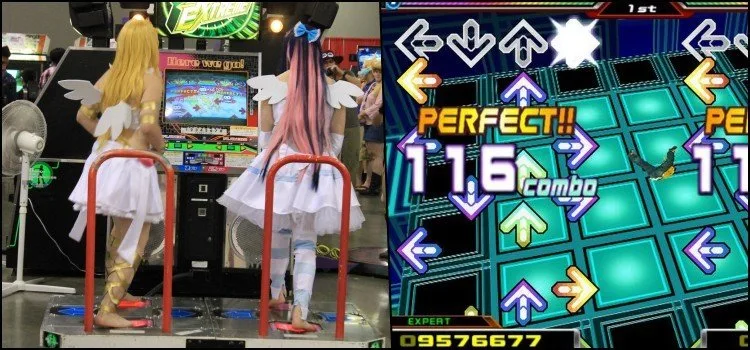
The player stands on a dance platform with four arrow panels arranged in a cross. Coloured arrows scroll up the screen towards a target line. When an arrow reaches the line, the player has to step on the matching panel with a foot.
The arrows are synchronized with the rhythm of the music, which creates the impression that the player is dancing to the song. When the song ends, the game shows a score based on how accurately the steps were timed.
Gameplay and difficulty
Each song offers several difficulty levels, from simple step patterns to very dense sequences. Taps are graded as Perfect, Great, Good or Miss, and the final result combines accuracy and combo.
DDRMAX introduced the Groove Radar, a visual display showing how demanding a chart is in categories such as maximum step density. In competition, the higher difficulties and scoring accuracy matter most.
Music and licensing
The series relies on a mix of original tracks by Konami's in-house artists and licensed songs from many genres. Early releases focused on eurodance and disco, and later versions added J-pop, rock and electronic music.
Some of the best-known songs are “Butterfly” by Smile.dk and “Captain Jack” by Captain Jack. Many of them came from the Japanese Dancemania album series and were later reused in further DDR releases.
Arcade and home versions
The first version appeared as an arcade machine in Japan in 1998. Dozens of arcade releases followed in several countries, along with hundreds of home versions for platforms such as the PlayStation, PlayStation 2, Dreamcast, GameCube, Wii and Xbox.
The home versions added their own modes, including training and workout functions. The current arcade release is Dance Dance Revolution World, which came out on June 12, 2024.
From the arcade to the living room
The move from arcades to living rooms was decisive for the series. Home versions used plastic dance mats connected to the console through a controller port, which made DDR a game people could play with friends at home.
Early mats were simple and could slide on smooth floors. Later, sturdier metal pads appeared, especially among competitive players. This accessory shaped the image of the series as much as the music did.
Competition and similar games
DDR's success led to many imitators. The best known are Pump It Up from Korea and In the Groove from the United States. Konami took legal action against In the Groove and later acquired the rights to the game.
Communities with tournaments and custom step charts formed in Japan and North America. Competitions still exist today, with players facing each other at the highest level.
DDR as sport and exercise
DDR was soon seen as a form of movement and endurance training. Many home versions estimate calories burned based on the player's weight and offer a workout mode that logs the results.
The exact calorie burn has not been fully measured in scientific studies. The amount of active movement required, however, shows that the game can be a reasonable part of a training routine.
Impact and legacy
DDR influenced the development of Just Dance, Dance Central and many other rhythm games. The dance mat became a well-known accessory that stood in many living rooms.
The series also showed that games can encourage movement and community, not only entertainment. For many players, DDR was their first contact with the genre.
Conclusion
Dance Dance Revolution is more than an arcade machine from the 1990s. The series shaped an entire genre, anticipated fitness games and still has an active competitive scene.
Anyone who enjoys rhythm games, or wants to understand where dance mats came from, will find a good starting point here. Read more: the history of video games in Japan, Pac-Man, Hatsune Miku, Vocaloid explained and enka music.





Community
Comments
0 comments
There are no published comments in this language yet.
Send comment