Blog

  • Japanese Food Pyramid – Japan’s Dietary Guide

    Japanese Food Pyramid – Japan’s Dietary Guide

    In this article, we will talk about the Japanese Food Pyramid (食事バランスガイド), a great foundation and guide for those who want a good diet in Japan. This pyramid is a bit old and has circulated in Japan and on the internet when we talk about food pyramids.

    In this article, we will understand this pyramid involving the Japanese diet. It is worth clarifying that this cannot be considered as something 100% accurate, it is just a guide and base detailing what the Japanese diet is or should be.

    Inverted Japanese Food Pyramid

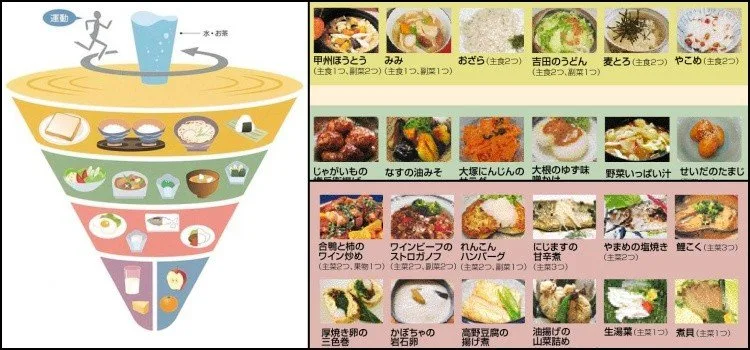
    For some reason, the Japanese food pyramid has been turned upside down. At the top, we find a man running symbolizing exercise. The core at the top symbolizes water and tea.

    The yellow section represents grains, rice, bread, onigiri, noodles, and pasta. According to the size of the base, you should consume 5 to 7 servings per day, and about 4 average servings should be rice.

    The green section represents vegetables such as potatoes, mushrooms, and seaweed. You should consume 5 to 6 servings per day. The brown section represents meat, fish, eggs, and soy dishes. You should consume 3 to 5 servings per day.

    Japanese Food Pyramid

    The last section is divided into 2. On the left, we have dairy products that you should consume about 2 or 3 servings per day. On the right, we have fruits that should also be consumed 2 times a day. The small blue rope on the left represents sweets, drinks, coffee, and other processed products that should be consumed in moderation.

    It is noticeable that the chart accurately shows the amount of food and how many servings they represent. For example, one serving of fried chicken is equivalent to 3 servings, while one serving of fried tofu is equivalent to one.

    Undoubtedly, this food pyramid is different from those of other countries. In general, you will notice how this food pyramid strongly correlates with a traditional Japanese meal at dinner and breakfast.

    Remember to enjoy your meals. Establish a healthy pace by keeping regular hours for your meals that should be balanced with staple foods. Combine vegetables, fruits, dairy products, and fish in your diet. Remember to avoid fat and salt in your diet and do not forget about physical activities. I hope you enjoyed this little article. xD

  • Do you know the history of cinema in Japan?

    Do you know the history of cinema in Japan?

    With well over 100 years, cinema in Japan has been growing more and more each day. In 1899, the first Japanese film, called Geisha No Teodori, a feature-length documentary, was produced. However, the first major production of Japanese cinema only happened in 1913, which was the first version of Chushingura, the 47 Ronins, based on the legend of masterless samurais.

    For a certain period, as happened in other countries, the film industry was controlled by the military. The cinemas showed educational films and militaristic propaganda in large quantities. They also began to produce films focusing on loyalty to the Emperor and personal sacrifice for the benefit of the people. Thus, during World War II, films acquired the objective of ideological propaganda.

    Cinema in Japan after World War II

    In the post-war period, Japan was both devastated in terms of infrastructure and psychologically. Cinema became a tool for re-education for the country, but gradually, with economic growth, space opened up for major studios like Toho, Shochiku, and Daiei to rebuild. During this period, Western influence became stronger and more evident among people, thus reflecting in cinema.

    Do you know the history of cinema in Japan?

    It is in this scenario that the Japanese director Akira Kurosawa emerges, debuting in 1943 with Sugata Sanshiro. (Sugata Sanshiro – A Judo Saga). Kurosawa began to gain popularity in Japan, creating stories where good and evil are not easily defined. In 1951, international recognition came when Akira Kurosawa was awarded in Venice for his film “Rashomon,” many even say that this film originated the category of the Oscar for Best Foreign Film.

    Two years later, Teinosuke Kinugasa, an actor and director of Japanese cinema, filmed “Samurai Loves” (Jigokumon), which was the first color film from Japan to have an international premiere, and in 1954 this film would receive two Oscars. From then on, Japan’s film production grew considerably, with 300 films annually in the following years, when for the first time, Japanese cinema surpassed American cinema in theaters in Japan.

    Diversifying cinema in Japan

    The themes varied greatly, ranging from dramas to comedies, and it was during this time that the first cinema divas began to appear, as women played a central role in cinema. Musical films reappeared, as well as action and superhero films. And in 1954, after the popularization of the Godzilla series, science fiction and fantasy films gained their space.

    cinema in Japan

    In the 60s and 70s, new central themes began to emerge. Directors like Nagisa Oshima, Shohei Imamura, Masahiro Shinoda, and Seijun Suzuki broke tradition, addressing modern themes in a provocative and even shocking manner, tackling issues such as crime, sex, the role of minorities, and anti-heroes, also using surrealism and unconventional narrative forms for that time.

    In 1988, Katsuhiro Otomo began his animation career with the famous and revolutionary Akira. The film depicted a pessimistic future after a nuclear war, combining technology, juvenile delinquency, and political conspiracies. In the same year, Hayao Miyazaki adapted his manga Nausicaä of the Valley of the Wind (Kaze no tani no Naushika) for cinema.

    In 2001, Hayao Miyazaki released Spirited Away, a film that broke box office records worldwide. It won the Golden Lion in Venice and the Oscar for Best Animated Feature. In 2016, another film called Kimi no na wa appeared to break more box office records.

    Today, Japanese cinema continues its growth and popularity both nationally and internationally. With great films, authors, directors, and actors, it is driving the economy of this medium.

    Article written by Marcelo do Carmo.

  • Neko Cafe – Shall we play with the cats?

    Neko Cafe – Shall we play with the cats?

    Have you ever imagined having coffee while playing with cats? That’s the idea of the Neko Cafe!

    You may have heard of “maid cafes” where girls dressed as maids serve you coffee and food. Or you might have heard of cosplay cafes, which are the same thing, but the girls are dressed as characters from some anime or other work. But it doesn’t stop there; in Japan, there are also “Neko Cafes” or “Cat Cafes” where you interact with real cats.

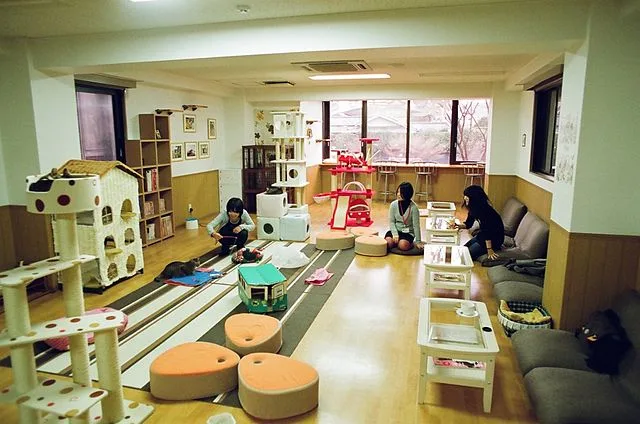
    Inside a neko cafe, you can play with cats, pet them, and hug them while having coffee. Perfect for those who cannot have cats at home and wish to enjoy the benefits of having one.

    We also recommend reading:

    Origin of the Neko Cafe

    The first “cat cafe” in the world opened in Taiwan in the city of Taipei in 1998. The Neko Cafe became famous in Japan and began to attract many tourists. In Japan, the first Cat Cafe opened in the city of Osaka in 2004.

    neko cat cafe

    Like cats, Cat Cafes are quite popular in Japan. To enhance marketing and profits, some take advantage of the cat cafe to sell souvenirs and create a complete store for the cats.

    The first Cat Cafe was created by Norimasa Hanada in 2005. Over time, this business expanded, and by 2010, more than 100 cat cafes appeared in Japan. Currently, there are more than 40 Neko Cafes just in Tokyo.

    Cat cafes have strict rules to ensure the cleanliness and well-being of the animals. They need to ensure that the cats are not disturbed by excessive or unwanted attention, such as from small children or when they are sleeping. Some cat cafes encourage the adoption of the animals.

    Videos of cat cafes

    Cat cafes are a very kawaii and lovely environment. Here you can find cats of various breeds and sizes, an environment made for the cats to feel at home and completely comfortable, in addition to toys to interact with them.

    See below some videos for more details about Cat Cafes:

  • 5 animes about bakery and confectionery

    5 animes about bakery and confectionery

    In this article, we will see 5 animes about bakery and confectionery. For those who enjoy making sweets or eating them, these animes are inspiring. The dreams of the following characters are something that drives anyone to want to make sweets with excellence. The Japanese show how effort and consideration yield results. And then you understand a little of why Japanese sweets and breads are so beautiful and well-crafted. Get inspired!

    Bonjour Koiaji Pâtisserie (Bonjour Sweet Love Pâtisserie)

    Classic harem-style anime. Sayuri Haruno, the protagonist, enrolls in the famous Fleurir academy, an elite school for pastry chefs. There she finds herself surrounded by 4 charming boys who show her the true passion for sweets. The anime has 24 episodes of 5 minutes each.

    Yakitate!! Japan (2004)

    Azuma Kazuma is great at making bread. His dream is to create the perfect bread and be famous internationally. He is hired by Pantasy Bakery, where he begins his journey to achieve his goals. This anime is large, with 69 episodes of 20 minutes each.

    Yumeiro Pâtissierè (2009)

    This story tells the adventures of Ichigo Amano, who dreams of being a professional patissier, just like her grandmother was in the past. For this, she will have the help of 3 sweet geniuses. This story is great for getting an idea of how to make international sweets with history and decoration suggestions. It has 24 episodes.

    bakery and confectionery

    Yumeiro Pâtissierè Professional (2010)

    Follows the second season of Yumeiro Patissiere, where Ichigo and her friends aim to maintain a shop in a large shopping center. This is recommended for those who intend to open a business. There are several tips on operation and planning. It has 13 episodes of 20 minutes each.

    Antique Bakery (2002)

    Antique Bakery tells the story of 4 men who work in a small confectionery. Each character has their personality problems that, despite being different, manage to make Antique a success. This anime even inspired a Japanese dorama and a Korean film in 2008.

  • What is the power of the Japanese passport? Free Access?

    What is the power of the Japanese passport? Free Access?

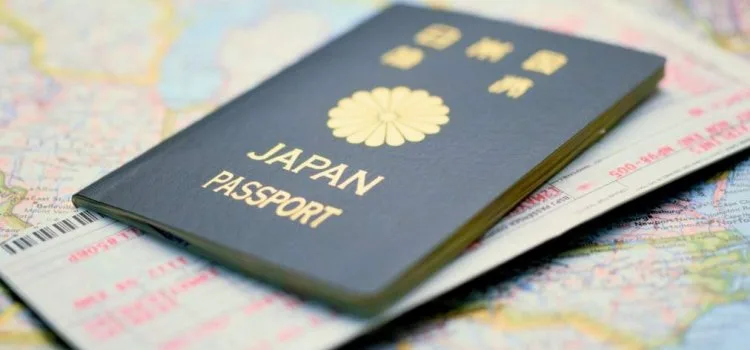
    We have already written an article talking about Japanese Citizenship and that its main benefit is having a Japanese passport. Today we will talk about the numerous benefits that this Japanese passport provides! The power of the Japanese passport is so great that it allows free entry into more than 155 countries.

    With Japanese nationality and the Japanese passport, we are treated as Japanese in other countries, which can help us obtain scholarships and integrate into research groups abroad.

    The Japanese passport is the 4th most powerful passport in the world, and it allows entry into countries that are difficult to obtain a visa for, such as the USA. In this article, we will see a list of countries where the Japanese passport allows entry without a visa or with a visa.

    Countries that the Japanese passport allows entry

    Below we have a list of countries, it will indicate whether the country allows entry without a visa, or requires a visa. Some countries require an ETA, which is an electronic travel authorization that is done quickly and easily.

    CountriesPermission
    AfghanistanVisa required
    AlbaniaWithout a visa
    AlgeriaVisa required
    AndorraWithout a visa
    AngolaVisa required
    Antigua and BarbudaWithout a visa
    ArgentinaWithout a visa
    ArmeniaVisa on arrival
    AustraliaETA
    AustriaWithout a visa
    AzerbaijanVisa on arrival
    BahamasWithout a visa
    BahrainVisa on arrival
    BangladeshVisa on arrival
    BarbadosWithout a visa
    BelarusWithout a visa
    BelgiumWithout a visa
    BelizeWithout a visa
    BeninVisa required
    BhutanVisa required
    BoliviaWithout a visa
    Bosnia and HerzegovinaWithout a visa
    BotswanaWithout a visa
    BrazilVisa required
    BruneiWithout a visa
    BulgariaWithout a visa
    Burkina FasoVisa required
    BurundiVisa required
    CambodiaVisa on arrival / eVisa
    CameroonVisa required
    CanadaETA
    Cape VerdeVisa on arrival
    Central African RepublicVisa required
    ChadVisa required
    ChileWithout a visa
    ChinaWithout a visa
    ColombiaWithout a visa
    ComorosVisa on arrival
    CongoVisa required
    Congo (Dem. Rep.)Visa required
    Costa RicaWithout a visa
    Côte d’Ivoire (Ivory Coast)Visa on arrival / eVisa
    CroatiaWithout a visa
    CubaVisa required
    CyprusWithout a visa
    CzechiaWithout a visa
    DenmarkWithout a visa
    DjiboutiVisa on arrival
    DominicaWithout a visa
    Dominican RepublicWithout a visa
    EcuadorWithout a visa
    EgyptVisa on arrival
    El SalvadorWithout a visa
    Equatorial GuineaVisa required
    EritreaVisa required
    EstoniaWithout a visa
    EthiopiaVisa on arrival
    FijiWithout a visa
    FinlandWithout a visa
    FranceWithout a visa
    GabonVisa requirement / eVisa
    GambiaVisa required
    GeorgiaWithout a visa
    GermanyWithout a visa
    GhanaVisa required
    GreeceWithout a visa
    GrenadaWithout a visa
    GuatemalaWithout a visa
    GuineaVisa required
    Guinea-BissauVisa on arrival
    GuyanaWithout a visa
    HaitiWithout a visa
    HondurasWithout a visa
    Hong KongWithout a visa
    HungaryWithout a visa
    IcelandWithout a visa
    IndiaVisa on arrival
    IndonesiaWithout a visa
    IranVisa on arrival
    IraqVisa required
    IrelandWithout a visa
    IsraelWithout a visa
    ItalyWithout a visa
    JamaicaWithout a visa
    JordanVisa on arrival
    KazakhstanWithout a visa
    KenyaVisa on arrival / eVisa
    KiribatiWithout a visa
    KosovoWithout a visa
    KuwaitVisa on arrival / eVisa
    KyrgyzstanWithout a visa
    LaosWithout a visa
    LatviaWithout a visa
    LebanonVisa on arrival
    LesothoWithout a visa
    LiberiaVisa required
    LibyaVisa required
    LiechtensteinWithout a visa
    LithuaniaWithout a visa
    LuxembourgWithout a visa
    MacauWithout a visa
    North Macedonia (ARJM)Without a visa
    MadagascarVisa on arrival
    MalawiVisa on arrival
    MalaysiaWithout a visa
    MaldivesVisa on arrival
    MaliVisa required
    MaltaWithout a visa
    Marshall IslandsVisa on arrival
    MauritaniaVisa on arrival
    MauritiusWithout a visa
    MexicoWithout a visa
    MicronesiaWithout a visa
    MoldovaWithout a visa
    MonacoWithout a visa
    MongoliaWithout a visa
    MontenegroWithout a visa
    MoroccoWithout a visa
    MozambiqueVisa on arrival
    Myanmar [Burma]Visa requirement / eVisa
    NamibiaWithout a visa
    NauruVisa required
    NepalVisa on arrival
    NetherlandsWithout a visa
    New ZealandWithout a visa
    NicaraguaWithout a visa
    NigerVisa required
    NigeriaVisa required
    North KoreaVisa required
    NorwayWithout a visa
    OmanVisa on arrival
    PakistanVisa required
    PalauVisa on arrival
    Palestinian TerritoriesWithout a visa
    PanamaWithout a visa
    Papua New GuineaVisa on arrival
    ParaguayWithout a visa
    PeruWithout a visa
    PhilippinesWithout a visa
    PolandWithout a visa
    PortugalWithout a visa
    QatarVisa on arrival
    RomaniaWithout a visa
    Russian FederationVisa required
    RwandaVisa requirement / eVisa
    Saint Kitts and NevisWithout a visa
    Saint LuciaWithout a visa
    SamoaVisa on arrival
    San MarinoWithout a visa
    São Tomé and PríncipeWithout a visa
    Saudi ArabiaVisa required
    SenegalWithout a visa
    SerbiaWithout a visa
    SeychellesVisa on arrival
    Sierra LeoneVisa required
    SingaporeWithout a visa
    SlovakiaWithout a visa
    SloveniaWithout a visa
    Solomon IslandsVisa on arrival
    SomaliaVisa required
    South AfricaWithout a visa
    South KoreaWithout a visa
    South SudanVisa required
    SpainWithout a visa
    Sri LankaETA
    Saint Vincent and the GrenadinesWithout a visa
    SudanVisa required
    SurinameWithout a visa
    SwazilandWithout a visa
    SwedenWithout a visa
    SwitzerlandWithout a visa
    SyriaVisa required
    TaiwanWithout a visa
    TajikistanETA
    TanzaniaVisa on arrival
    ThailandWithout a visa
    Timor-LesteVisa on arrival
    IranVisa on arrival
    TongaVisa on arrival
    Trinidad and TobagoWithout a visa
    TunisiaWithout a visa
    PeruWithout a visa
    TurkmenistanVisa required
    TuvaluVisa on arrival
    UgandaVisa on arrival
    UkraineWithout a visa
    United Arab EmiratesVisa on arrival
    United KingdomWithout a visa
    United States of AmericaETA
    UruguayWithout a visa
    UzbekistanVisa required
    VanuatuWithout a visa
    Vatican CityWithout a visa
    VenezuelaWithout a visa
    VietnamWithout a visa
    YemenVisa required
    ZambiaVisa on arrival
    ZimbabweVisa on arrival

    What do you think of the power of the Japanese passport? Do you think it is worth obtaining Japanese Citizenship to have this passport?

  • Does Rosetta Stone really work for learning Japanese?

    Does Rosetta Stone really work for learning Japanese?

    Rosetta Stone is a very old language learning software. It offers the teaching of more than 20 languages. It is a well-known program, mainly for having an innovative method.

    But does Rosetta Stone really help you learn the Japanese language? Let’s find out here. I used the program for 5 months, until I finished the last lesson of the Rosetta Stone Japanese course.

    How Does Rosetta Stone Work?

    Rosetta Stone presents three levels in the Japanese course (and five in other languages). They work like this:

    Level 1: helps build a fundamental vocabulary base and an essential structure of the language. Skills and vocabulary include:

    • Greetings and introductions;
    • Simple questions and answers;
    • Shopping;
    • Listening skills;
    • Basic writing and reading skills;

    Level 2: allows people to explore the environment as they increase the vocabulary and essential structure of the language from Level 1. Skills and vocabulary include:

    • How to give and get directions;
    • Using means of transportation;
    • Telling the time;
    • Going out to eat;
    • Enjoying basic social interactions;
    • Professional life;
    • Academic subjects;
    • Art and culture;
    • Past, present, and future;

    Level 3: allows people to connect to the world around them, enhancing the language fundamentals and conversational skills developed in Levels 1 and 2. Skills and vocabulary include:

    • Ideas and opinions;
    • Expressing feelings and talking about daily matters;
    • Interests;
    • Work;
    • Current events;
    • Birth, marriage, death, and health and body-related concerns;
    • Complementary terms indicating frequency, duration, and degree;
    Does Rosetta Stone really work for learning Japanese?

    Rosetta Stone Method

    The method of this software is different from what we are used to, as it teaches us basically with images and audio. It never uses translation. On one hand, this method is great because it helps us think in the language and understand what is said without needing to mentally translate to Portuguese. We would be learning Japanese as if it were our mother tongue, immersed in the language.

    On the other hand, this method leaves us in great doubt, because sometimes it is necessary to think hard to understand what is happening in order to grasp what a sentence/word means. The images we associate with the audio and text are well selected, which gives us a bit of understanding of the sentence, but it doesn’t always help. This makes it quite difficult, but it can be easily resolved if we just look up the word in a dictionary or Google Translate.

    The grammar also complicates things a bit, but later it is absorbed naturally with the spaced repetition of the software, as it ends up creating a repetition (sometimes excessive) of the lesson content. We can also set our focus on reading and writing or speaking and listening, or everything.

    There is also voice recognition. The voice recognition is not bad, but it needs a quiet environment and a good microphone. Fortunately, this option can be turned on or off, and we can set the difficulty of speaking and a few other options.

    We also have a section where we only listen to something in Japanese and associate the audio with the image, with no text to help, only the audio. In addition, we also have speech recognition and pronunciation exercises, as well as writing and reading, where we first learn the hiragana and katakana, and then some kanji.

    Is it Worth Buying Rosetta Stone?

    Rosetta Stone is a super expensive software. It is available on the Play Store and can be downloaded on PC, with a CD that must be purchased and activated. I used the program from start to finish and can say that it does not bring you even close to fluency, even though it helps a lot.

    If you complete the entire course, you could buy something in Japan, talk about likes, express what we think, but we wouldn’t understand an anime or manga, for example. And the worst part is that the Japanese course has only 3 levels, while some others have 5.

    I also believe that the price of the software is a rip-off, at least in our current times, because it could be much cheaper. But for beginners, I’m sure they will be impressed with the speed at which they will learn things, how they will manage to do grammatical exercises without much complication, and how they will start to understand simple things (and some a bit more advanced).

    So, if you are determined to spend money on this software with the hope of learning the basics, it is recommended. If you want fluency or to reach an advanced level, I do not recommend it. You probably won’t get past level N4, because it is considered a basic course. So that was the summary of my experience with Rosetta Stone, I hope you enjoyed it.

  • 10 rude habits that are considered normal in Japan

    10 rude habits that are considered normal in Japan

    It is already imaginable that Japan is full of rules and etiquette that can be a challenge for foreigners. However, the opposite also happens; some habits that we find rude in our country are normal things in Japan.

    In this article, we will see 10 rude habits that are common or even part of Japanese culture. Sometimes some issues may seem obvious but should be mentioned.

    Rude habits that are normal – Eating

    Calling the waiter loudly – While in the West we raise our hand or discreetly look to get attention, in Japan instead of simply shouting “waiter,” it is common to say sumimasen (excuse me) until someone comes running to assist you; otherwise, they won’t understand your secret signals.

    Making noise while eating noodles or soup – In the West, it is rude to make noise while eating; in Japan, this is natural. Slurping noodles or soup shows that you are enjoying the food.

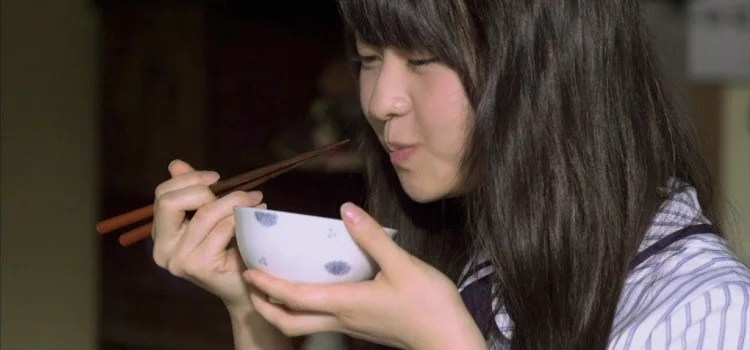
    Drinking directly from bowls – In the West, we do not use bowls, but it is considered quite strange for someone to hold the plate at a table to eat closely (at least I have been scolded for that). In Japan, it is very common to hold bowls to drink the broth or finish the dish. In fact, bowls are made for that.

    rude habits

    Eating sushi with hands – For Westerners, the most polite way to eat sushi is with hashi (chopsticks). In Japan, however, it is perfectly normal and acceptable to eat all varieties of sushi with hands.

    Letting others pour your drink – Sometimes it is common in Brazil for us to pour our own drinks to avoid bothering others; however, in Japan, it is the opposite; you need to let others serve your drink when you are with colleagues or friends. Perhaps when pouring for everyone, you can serve yourself.

    Rude habits in the West and common in Japan

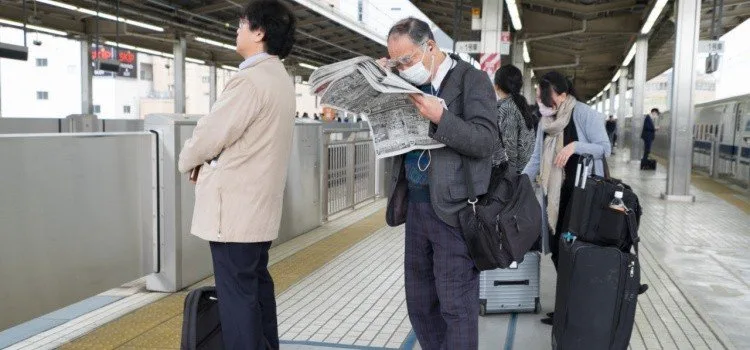
    Sleeping during activities – It is not a very acceptable habit, but it is common to see people sleeping at work, in school, and especially on the train.

    rude habits

    Holding or opening doors – While in the West we need to open, hold, and close doors, especially for women. In Japan, it is not common for this to happen frequently, even when someone is visiting your home. In reality, opening and closing doors is not related to chivalry in Japan.

    Cars passing on the crosswalk with pedestrians crossing – At some large intersections, even with the pedestrian signal open, cars tend to cross alongside pedestrians, as their signal is also open.

    It is normal, but it may seem strange to a tourist, as in Brazil it is prohibited to pass with a car while someone is on the crosswalk (although they do not respect it). Some simply stop in the middle of the intersection for pedestrians to pass.

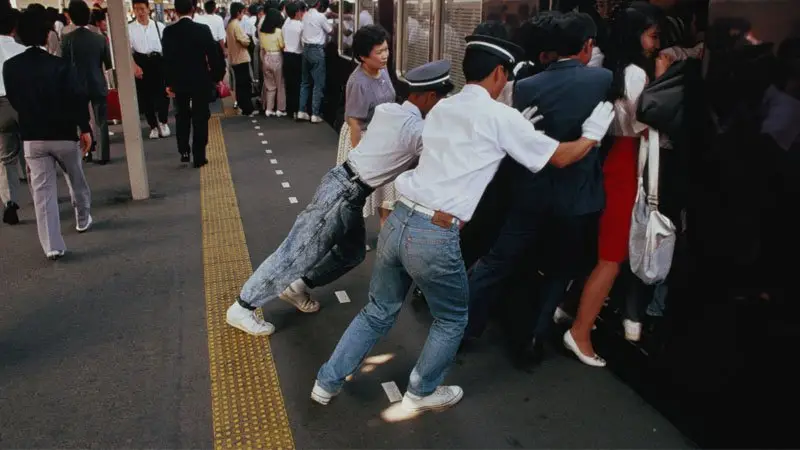
    Pushing in trains – It is common for you to be pushed or to push people inside trains during rush hour. No one will feel bothered unless you are a pervert.

    rude habits

    Weird fashions – In various situations, Japanese people wear clothes that would be embarrassing or wrong in the West. It is common to wear fundoshi that looks like underwear, going out in pajamas in the middle of the street to shop at a konbini, not to mention the freedom that Japanese people have with fashion, such as matching and wearing the same clothes as others or wearing cosplay.

    Many things that are strange in the West can be normal in Japan or at least acceptable. If you remember any that did not appear in this article, feel free to comment with us.

  • What does Doumo [どうも] really mean?

    What does Doumo [どうも] really mean?

    Have you heard of the word doumo [どうも]? In this article, we will try to understand the full meaning behind this word. Remember that we will use both romanizations in this article, doumo and dōmo.

    Whenever we hear this word being said in various situations and with different meanings, it ends up leaving us confused. So, what does doumo or dōmo really mean? In what occasions and how to use it?

    Meaning of the word doumo

    According to the basic dictionary, the word dōmo [どうも] means thank you, but what about arigatou? In reality, this word has nothing to do with thanks.

    The word doumo [どうも] is a combination of the word dou [どう] and the particle mo [も] where dou can convey the sense of “how?” and mo the meaning of never, even, so much and also.

    The word doumo [どうも] is constructed in the same way as the word totemo [とても] which means very. In reality, both can have the same meaning.

    The original meaning of the word doumo [どうも] can be literally translated into Portuguese as:

    • no matter how;
    • anyway;
    • in all cases;
    • I understand that;
    • for some reason;
    • I don’t know why;

    Thus, Doumo is an adverb to indicate that one cannot make a definitive statement about something, due to a lack of concrete evidence.

    Many words in Japanese have a meaning, but their use goes far beyond having no relation to the original meaning. This happens with doumo, which is often used to thank, greet, and say goodbye.

    Situations in which Doumo is used

    どうも is used before arigatou to give the sense of “thank you very much“, it is used in formal occasions, and tends to express humility and words like “a lot, I’m very sorry”.

    Currently, doumo is often used in informal occasions without arigatou to thank some friends and acquaintances. Other common occasions where you can use doumo as thanks is when you are in a store and someone opens or holds the door for you, you can thank by saying dōmo.

    Doumo alone is usually used when people do simple favors for you without needing or asking, it’s as if you are thanking and at the same time saying, I’m sorry for the inconvenience.

    The same thing happens if you need to leave in the middle of a conversation quickly. You just bumped into a friend, exchanged a few words but you are in a hurry, you can say doumo, you are expressing: excuse me? I have to go… (don’t think of using this instead of saying goodbye in formal occasions).

    Body language train

    When you bump into someone you can use doumo to apologize and thank. When entering a store and the person says welcome or greets you, you can say doumo. Simplifying, in various occasions doumo can be thanks, apologies, and greetings.

    The most common use is in the phrase doumo arigatou gozaimasu [どうも有難うございます], the most formal way to say thank you.

    How dōmo is used in texts and conversations?

    Doumo is also an adverb and needs to be used in other situations, sentences, and expressions within conversations, let’s see some examples of use below:

    • この文の意味がどうもよく分からない 。
    • Kono bun no imi ga dōmo yokuwakaranai;
    • I don’t know why, but I can’t understand this sentence very well;

    The above sentence shows that he cannot make a definitive statement about something.

    • このごろどうも体の調子がよくないんです。
    • Kono goro dōmo karada no choushi ga yokunain desu;
    • I don’t know why, but lately I haven’t been feeling well;

    In this sentence, the final predicate is openly negative. It is noted that this sentence literally used the body (体) to talk about his health condition.

    • どうも理解できない。
    • Dōmo rikaidekinai;
    • I simply can’t understand this;
    • No matter how, I can’t understand
    • Somehow I don’t understand;

    In this sentence, we observe the different translations of the expression in Japanese.

    • あの商人はどうもしつこいよね。
    • Ano shōnin wa dōmo shitsukoi yo ne;
    • This merchant is quite persistent, isn’t he;
    • I think the merchant is very annoying;

    Now dōmo was used to express very and quite.

    The examples above may end up being found written in another way using other terms and expressions instead of doumo. Therefore, it may be uncommon to use or find doumo in sentences, but it is there present and doing justice to its meaning. There are just various ways to say one thing in Japanese.

    With this article, we conclude that doumo [どうも] can be used as greetings, thanks, apologies, adverb, and negative. I hope you enjoyed and found it useful, we appreciate the comments and shares.

  • How to use the Air Conditioner in Japan?

    How to use the Air Conditioner in Japan?

    The summer in Japan is very hot and rainy, many end up suffering from heatstroke. A great lifesaver is the Air Conditioning, however some foreigners who encounter it feel lost with those words entirely in Japanese. Of course, there are air conditioners from various brands and different types. Knowing the main words written on an air conditioner will help you use it.

    Each remote control is different, so it is pointless to put a photo here indicating each button. What we can do is present a list of words that are present on remote controls so you know what each button does.

    JapaneseHiraganaRomajiPortuguese
    停止ていしteishistop, turn off
    運転うんてんuntenturn on, operate
    冷房れいぼうreibouAir conditioning
    暖房だんぼうdanbouHeating
    除湿じょしつjoshitsuDehumidify
    ドライdoraiDehumidify
    自動じどうjidouAutomatic

    These are the main basic functions of a Japanese air conditioner. The Dehumidify option is used to save energy, it does not heat the room but reduces the humidity in the air. The automatic option keeps the temperature at the standard suggested by the manufacturer.

    japanese air conditioning

    More complete air conditioning

    Some air conditioners have many more functions and settings. See below some words you may find on these air conditioners or even on heaters:

    JapaneseHiraganaRomajiPortuguese
    温度おんどondoControl temperature
    風向ふうこうfuukouFan direction
    メニューmenyuuMenu
    進むすすむsusumuadvance
    戻るもどるmodorureturn
    入タイマーNyuu taimaaTurn on timer
    切タイマーsetsu taimaaTurn off timer (cut)
    スイングsuinguSwing function
    ハイパワーhaipawaaHigh power
    ランドリーrandoriiLaundry mode
    省パワーshou pawaaEnergy saving
    風量切換かぜりょうきりかえfuuryou kirikaeair flow
    運転切換うんてんきりかえunten kirikaeair flow
    送風そうふうsoufuuventilate
    強風きょうふうkyoufuustrong, high
    弱風じゃくふうjyakufuuweak, low, fan
    微風びふうbifuuvery low, breeze
    静音せいおんseionsilent mode
    運転うんてんuntenoperate, turn on

    Some of the settings mentioned above can be controlled from top to bottom. The words after air flow usually appear on the screen to show how it is configured.

    • The swing function allows the fan to rotate from top to bottom;
    • The laundry mode adjusts the temperature and humidity to dry your clothes;
    • The air flow can be controlled to low, weak, and silent. You click the button several times to set it the way you want;

    Well, I hope these words help you understand how the air conditioning works in Japan. I know that it is still necessary for you to have a basic understanding of temperature and how an air conditioner works to know how to set it the way you want.  If you have any tips or suggestions, feel free to leave them in the comments below.

    We also recommend reading:

  • 10 Strange services that exist in Japan

    10 Strange services that exist in Japan

    Japan is famous for its simplicity; everything in Japan can be resolved in a simple yet sometimes strange way. Of course, not everything is automatic as some might imagine; sometimes people are hired to do strange things and services that we wouldn’t think of. In this article, we will see 10 strange services that exist in Japan that you never imagined existed.

    Oshiya. – In some stations during peak hours, there are oshiya. These employees are hired to push people into trains when necessary.

    Homework service. – A professional does the homework, even imitating handwriting and freeing the person from getting low grades in school.

    Apology service. – Need to hire someone to apologize for you? In Japan, there are companies that do this for you.

    Advertising on women’s bodies. – Some women end up selling advertising through tattoos on bold parts like thighs and breasts; they wear short clothes to attract customers’ attention.

    services

    Cleaning a sumo wrestler’s butt. – There are reports that a sumo wrestler cannot clean his buttocks, so people are hired to do this. This is a legend that circulates in Japan; we do not know its veracity, but sumo wrestlers do have assistants.

    Archiving memories of past relationships. – The company Miniku Love stores your memories, such as gifts, photos, and letters, so you don’t have to throw them away or cause problems in your new relationship.

    Strange services for the lonely

    Chamego. – This service promises to relieve some loneliness. A young and beautiful man or woman is hired to sleep with you. However, they are only paid to sleep, with no sexual services; the most the person receives is a gentle head scratch. This service can also be known as soine ソイネ.

    Ear cleaning. – In this service, the person works dressed in a kimono, cleaning people’s ears with a cotton swab, serving tea, and chatting with the client.

    services

    Fake Friend. – Friend rental – In Japan, there are websites where you can hire a fake friend or even a fake girlfriend/boyfriend. Why do this? Some are lonely and want to make a good impression, and instead of making friends, they pay to have company, take photos, and go out. Some say they charge about 8,000 yen for 2 hours of service.

    Solo wedding service. – Girls who want to get married but can’t find a spouse can hire a fake wedding service and do it alone, complete with a dress, makeup, ceremony, and even a honeymoon. In addition to this service, there is also another service where people can hire guests for a wedding.

    To finish, let’s leave a video of our friend Velberan talking about some of these services:

  • Costumes and rules in public transportation in Japan

    Costumes and rules in public transportation in Japan

    The main public transport in Japan is the train, followed by buses. As expected, the Japanese have customs and rules to follow in these places; in this article, we will see curiosities regarding these customs and rules.

    Not talking on the phone in public

    There are various posters and notices prohibiting phone conversations inside the train, the main reason is not to disturb others. This is quite ironic because I see groups of schoolchildren talking loudly (shouting) inside the trains. It is not a rule that everyone would obey, but most do so not only because of public disturbance, but for privacy and etiquette.

    If it is not right to talk on the phone inside the train, it also means that it is not right to talk loudly with people inside the train, as it will disturb others in the same way. Remember to always keep your phone on silent; there is no problem watching or listening to music as long as you use headphones. The Japanese avoid doing things like sitting on the floor, spreading their bags, putting on makeup, sitting with their legs open or crossed, and anything else that might disturb others.

    Not giving up seats to the elderly or needy

    You may be impressed by the politeness of the Japanese, but when riding public transport, it is not hard to see young people sitting in seats while some elderly people stand. This is because the elderly feel uncomfortable when offered a seat. This makes them feel old, and most tend to refuse.

    Customs and rules in public transport in Japan

    Another factor that causes this to happen is that the Japanese themselves feel embarrassed to offer their seat, exactly because of the thought of labeling the person as old. Some discreetly tend to leave the area and head to another train car or to the exit of the transport. The fact is that there are priority seats, so avoid sitting in them.

    Not touching objects on the floor

    Everyone knows about the honesty of the Japanese; I have witnessed several times lost items inside the train, but no one picks them up. This is because they leave it for the train staff to collect and take to the lost and found at the stations. You can take the item directly to lost and found, but most avoid doing so. Many feel embarrassed or imagine that others might think they are stealing the item.

    Sleeping on public transport

    A very common practice inside trains and public transport is Inemuri (居眠り), where the Japanese simply sleep sitting or even standing. It is very common to find people sleeping inside the trains; the amazing thing is that they manage to wake up at the right station.

    Customs and rules in public transport in Japan

    Pushing in trains

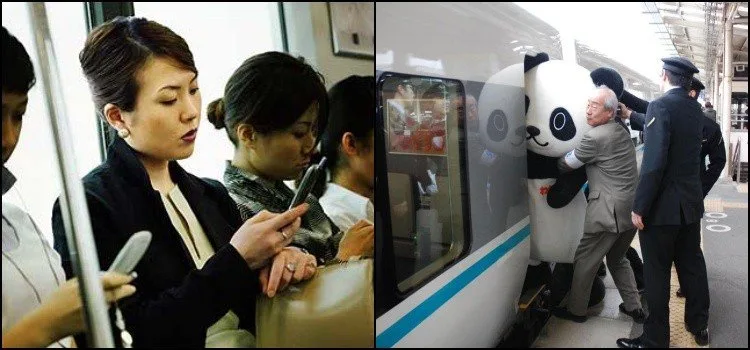
    When the transport is full, it is common for people to push each other to pass, exit, and enter a train. Some stations even hire staff to push people inside the trains to fit everyone. Unfortunately, some perverts take advantage of these occasions to touch where they shouldn’t. When entering a train, you should wait for others to exit to avoid bumping into each other.

  • Kimi ni Todoke – Valentine’s chocolate – Recipe

    Kimi ni Todoke – Valentine’s chocolate – Recipe

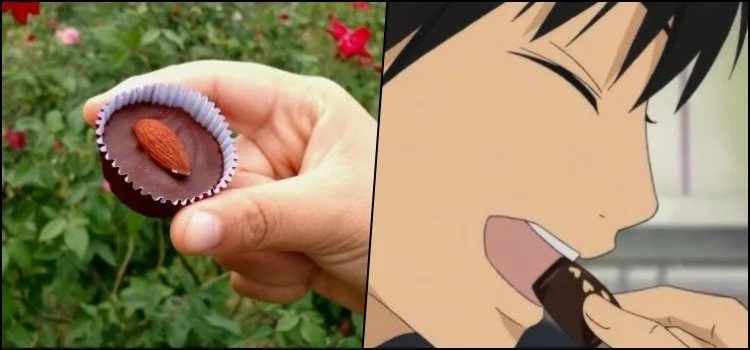
    In this article, we will learn step by step how to make the sweet that Kurumi took so long to deliver to Kazehaya. On Valentine’s Day, Kurumi makes chocolates both for her beloved and for her dear friends in the series. This chocolate is given to people who are valued. It is something to gift and show affection and consideration on Valentine’s chocolate.

    Chocolate Ingredients

    • 30 grams of almonds with skin;
    • 90 grams of cream or heavy cream or soy milk;
    • 300 grams of semi-sweet chocolate (you can use, if you want, 150 grams of milk chocolate and 150 grams of semi-sweet chocolate);
    • 1 tablespoon of essence of your choice (suggestions: almond, hazelnut, vanilla, or if the recipient is an adult, you can add liqueur or rum);

    You will also need:

    • Metallic candy molds size 3;
    • 1 piping bag;
    • Colored sprinkles (optional);
    • Pie molds (optional);

    Note: Brazilian metallic molds are sturdier and are the ones that most resemble chocolate molds from Japan.

    Kimi ni Todoke - Valentine’s chocolate - Recipe

    How to Make

    First, you should flavor the almonds, making them crunchy and easy to eat.

    1. Preheat the oven to 180°C for 10 minutes;
    2. Place the almonds on a small baking tray and bake for 15 minutes;
    3. Remove from the tray and let cool before using;

    Now, make the chocolate

    1. Chop the chocolate finely, or if you prefer, grate the chocolate. This step is important so that the chocolate is of equal size, facilitating melting. Set aside;
    2. Place the cream (or the chosen liquid from the listed ingredients) in a saucepan and heat over medium heat until it starts to boil (bubbles start to appear at the edge of the pan. Do not leave it on the heat longer, as it may burn the chocolate). Turn off the heat;
    3. Add the chocolate to the saucepan with the hot liquid. Do not stir the chocolate yet. Cover the saucepan and wait between 1 to 2 minutes;
    4. Stir the chocolate until smooth;
    5. Use it as soon as you finish making it;
    Kimi ni Todoke - Valentine’s chocolate - Recipe

    Finally, the assembly of the chocolates

    1. Place the chocolate in a piping bag;
    2. Carefully add the chocolate to the molds. This is when you can use pie molds to make it easier to pick up the mold;
    3. Let it rest for 10 minutes at room temperature;
    4. Place the cooled almonds and the sprinkles;
    5. Refrigerate for 20 minutes, or until set;

    Done!

    You can also use your imagination and decorate as you wish. Use colored bags and satin ribbons to wrap your gift. Did you like this recipe? What anime recipes would you like to see here on the site? If you reproduce this recipe, let us know how it went!

    We also recommend reading: 

  • Learn how to Obtain Japanese Citizenship

    Learn how to Obtain Japanese Citizenship

    Those who think that only people of Japanese descent can naturalize as Japanese are mistaken. Anyone can change their nationality and obtain Japanese citizenship, as long as they meet various requirements. The thousands of foreigners in Japan hold a permanent visa and often think it is impossible to obtain Japanese nationality; some have reasons to prefer the visa over nationality.

    What is the difference between a visa and citizenship?

    When a person holds a permanent visa, they have permission to stay in Japan and most of the rights of citizenship. A naturalized citizen, however, has all the rights that Japanese people have and cannot be expelled from the country, because they belong to and are a citizen of that country. Another advantage and benefit of being a Japanese citizen is that you can have a Japanese Passport (4th most powerful) that allows entry into 147 countries without a visa, including the USA.

    Japanese citizenship nationality naturalization

    Only descendants or children of Japanese can obtain nationality easily before turning 3 months old. Even if a person marries a Japanese or a child of Brazilians is born in Japan, they do not receive nationality but rather a permanent visa. Of course, any of these people can pursue nationality if they meet the requirements we will see below.

    The majority of Brazilians living in Japan prefer not to attempt to obtain Japanese citizenship because in addition to being a long process, Japan allows only 1 nationality; if you choose Japanese nationality, you cease to be Brazilian.

    Requirements for naturalization in Japan

    Below we will see the minimum requirements to obtain Japanese nationality or citizenship:

    • Be over 20 years old;
    • Have lived in Japan for more than 5 years (3 if married to a Japanese);
    • Not be outside Japan for more than 80% (72 days) during a year;
    • Present good mental health and have no criminal record;
    • Prove the ability to support oneself or support the family;
    • Show good conduct during the stay in Japan;
    • Be up to date with taxes;
    • Agree to renounce the nationality you currently hold;
    • Have proficiency in the Japanese language;

    If you meet these requirements and wish to obtain Japanese citizenship, you need to contact the Homukyoku (Legal Affairs Bureau) of the Ministry of Justice closest to your home. Remember that bad conduct or criminal history is one of the reasons Japan may reject your citizenship application.

    Japanese citizenship nationality naturalization

    Documents required to apply for Japanese Citizenship

    In addition to the basic requirements, there is a huge list of documents you need to present when applying for Japanese citizenship:

    • Application form for naturalization;
    • Form with first-degree relatives’ information;
    • Signed oath;
    • Form with information on trips abroad;
    • Personal curriculum form (detailed and in order);
    • Form with a description of monthly living expenses and bank accounts;
    • Form with payroll details, filled out and signed by the company;
    • Form declaring children, filled out and signed by the applicant’s father;
    • Handwritten letter describing the reason for the desire for naturalization;
    • University graduation certificate (if applicable);
    • Certificate of Japanese driver’s license registration;
    • Certificate of personal data from the date you entered Japan and your spouse;
    • Certificate of tax payments (gensen and nozei shomeisho) for you and your spouse;
    • Certificate of residence;
    • Certificate of bank account;
    • Birth certificate of the applicant and all siblings;
    • Marriage certificate for you and your parents;
    • Death certificate of parents if deceased;
    • Nationality certificate;
    • Map of the place of residence and work;
    • Guarantor;

    These are the necessary documents, but we recommend checking everything before starting the process. Each case is unique, so some procedures may differ from those mentioned in the article.

    During the process of obtaining Japanese nationality, you will have an interview and they may visit your home to verify everything is in order. The process takes from 8 months to over a year. Japan accepts most applications (99%); once approved, you will be invited to attend a lecture and submit your document. And do you think it is worth having Japanese citizenship? I would like to see your opinion and experience in the comments.

  • Translating songs – The world has fallen in love

    Translating songs – The world has fallen in love

    In this article, we will study the song Sekai Wa Koi Ni Ochiteiru (世界は恋に落ちている) the opening of the Anime Ao Haru Ride by CHiCO and HoneyWorks. Surprisingly, it is thanks to this song that the name of the Site is Suki Desu, and it’s worth noting that this expression appears only once in the song, and that was enough for me to choose it as the name of the site.

    The name of the song can be literally translated as “The world has fallen in love” or has fallen in love Sekai Wa Koi Ni Ochiteiru (世界は恋に落ちている)… Below we will see the lyrics of the song in Japanese, romaji and in Portuguese.

    Lyrics of the song in Japanese

    Click here to expand the text

    世界は恋に落ちている 光の矢胸を射す
    君をわかりたいんだよ
    「ねぇ、教えて」

    すれ違う言葉にちょっとだけの後悔
    涙こぼれて
    忙しい感情 鼓動にリンクする
    チューニング確かめたいんだ
    目的ばっかにとらわれて大事なものが霞んで逃げて
    今日もリスタート

    世界は恋に落ちている 光の矢胸を射す
    全部わかりたいんだよ
    「ねぇ、聞かせて」
    たった1ミリが遠くて
    駆け抜けた青春(ひび)に
    忘れない 忘れられない 輝く1ページ

    お似合いの二人になんだか複雑な気持ちがいるよ
    初めての感情 鼓動にリンクする
    体温計壊れちゃったかな?
    自分のことわからないまま あの子にアドバイスまでしちゃって
    胸が痛いや…

    世界は恋に落ちている 光の矢胸を射す
    気付いたこの想いは
    「もう、遅いの」
    あの子の方が可愛いの知ってるよ
    だけど
    「うまくいかないで」
    なんてね…逃げだしたくせに…。

    バカ…

    春に咲いた花が恋をした
    花は必死に上を向いて笑った
    青い夏の蕾も恋をした
    咲かない花と火薬の匂い

    ホントの気持ち言葉にして大事なこと話せたら今日もリスタート

    鈍感な君だから口に出して言わなきゃ
    今君に伝えるよ
    「ねぇ、好きです」

    世界は恋に落ちている 光の矢胸を射す
    全部わかりたいんだよ
    「ねぇ、聞かせて」
    手繰り寄せてもう0センチ
    駆け抜けた青春(ひび)に
    忘れない 忘れられない 輝く1ページ

    Lyrics of the song Romanized

    Click here to expand the text

    Sekai wa koi ni ochiteiru hikari no ya mune wo sasu
    Kimi wo wakaritainda yo
    Nee, oshiete

    Surechigau kotoba ni chotto dake no koukai namida koborete
    Isogashii kanjou kodou ni rinku suru
    Chuuningu tashikametainda

    Mokuteki bakka ni torawarete
    Daiji na mono ga kasunde nigete
    Kyou wa mou restart

    Sekai wa koi ni ochiteiru hikari no ya mune wo sasu
    Zenbu wakaritainda yo
    Nee, kikasete
    Tatta ichi-miri ga tookute
    Kakenuketa hibi ni
    Wasurenai wasurerarenai kagayaku ichi peeji

    O-niai no futari ni nandaka fukuzatsu na kimochi ga iru yo
    Hajimete no kanjou kodou ni rinku suru
    Taionkei kowarechatta kana?

    Jibun no koto wakaranai mama
    Ano ko ni adobaisu made shichatte
    Mune ga itai ya

    Sekai wa koi ni ochiteiru hikari no ya mune wo sasu
    Kizuita kono omoi wa
    Mou, osoi no
    Ano ko no hou ga kawaii no shitteru yo dakedo
    Umaku ikanai de nante ne nigedashita kuseni

    (Baka)
    (Kimi no koto zenbu wakaritaitte omotchau)
    (Kore ga koi date hajimete kizuita no)
    (Zettai furimuite hoshii))
    (Osokattakedo akirametakunai)
    (Datte suki dakara)

    Haru ni saita hana ga koi wo shita
    Hana wa hisshi ni ue wo muite waratta
    Aoi natsu no tsubomi mo koi wo shita
    Sakanai hana to kayaku no nioi

    Honto no kimochi kotoba ni shite
    Daiji na koto hanasetara
    Kyou mo risutaato

    Donkan na kimi dakara kuchi ni dashite iwanakya
    Ima kimi ni tsutaeru yo
    Nee, suki desu

    Sekai wa koi ni ochiteiru hikari no ya mune wo sasu
    Zenbu wakaritainda yo
    Nee, kikasete
    Taguri yosete mou zero-senchi
    Kakenuketa hibi ni
    Wasurenai wasurerarenai kagayaku ichi peeji

    Lyrics of the song in Portuguese

    Click here to expand the text

    The world is falling in love and an arrow of light pierces my heart
    I just want to understand you
    Hey… Tell me

    Those words carry a little remorse, I can’t help the tears
    These complicated feelings connect to my heartbeats
    I wish I could adjust them a bit

    You do whatever it takes for your goals
    But still, the most precious thing slipped away from you
    Today is a new beginning

    The world is falling in love and an arrow of light pierces my heart
    I just want to understand everything about you
    Hey… Tell me
    Even a single millimeter feels so far in this hectic day to day
    But I will not forget. I cannot forget
    This brilliant first page

    We seem to be a perfect couple, but there are complicated feelings
    Feelings I am having for the first time
    Like a thermometer, but I think it’s broken

    Although I still don’t know what’s happening to me
    I went and gave advice to a girl
    And now I have this pain in my chest

    The world is falling in love and an arrow of light pierces my heart
    I realized what this feeling is
    But it’s already too late
    I know she is cuter than me, but
    I can’t believe I’m hoping she fails, when I was the one who ran away in the first place

    (Idiot)
    (I just wanted to know everything about you)
    (And for the first time I realized that this is love)
    (I will definitely make her look back at me)
    (I know I waited a long time, but I will not give up)
    (Because… I love you)

    In spring a flower bloomed and fell in love
    This flower desperately tried to look up and smile
    During the bright blue summer, a bud also fell in love
    A flower that did not bloom with the smell of gunpowder

    If I can put my feelings into words
    And say what is really important
    Today will also restart

    You are not very perceptive, so I need to say it with my words
    I will tell you right now
    Hey… I love you

    The world is falling in love and an arrow of light pierces my heart
    I just want to understand everything about you
    Hey… Tell me
    I pull you closer and our distance is now zero centimeters
    In this hectic day to day
    But I will not forget. I cannot forget this brilliant first page

    Translating songs - Sekai wa koi ni ochite iru

    Breaking Down the Song – Sekai wa koi ni ochite iru

    世界は恋に落ちている 光の矢胸を射す 
    Sekai wa koi ni ochiteiru hikari no ya mune wo sasu

    The world is in love and an arrow of light pierces my chest.

    • 世界 (sekai) – World
    • 恋 (koi) – Love, passion
    • 落ちている (ochiteiru) – Falling, present continuous
    • 光 (hikari) – Light, brightness
    • 矢 (ya) – Arrow
    • 胸 (mune) – Chest (sometimes refers to the heart)
    • 射す (sasu) – Shine, also refers to shooting with a bow
    君をわかりたいんだよ 「ねぇ、教えて」 
    Kimi wo wakaritainda yo Nee, oshiete

    I want to understand you! Hey, tell me.

    • 君 (kimi) – You
    • わかりたい (wakaritai) – I want to know, understand (from the verb 分かる – wakaru)
    • んだよ (nda yo) – Exclamatory form to reinforce the expression
    • ねぇ (nee) – Hey
    • 教えて (oshiete) – Teach, tell, instruct
    すれ違う言葉にちょっとだけの後悔 涙こぼれて 
    Surechigau kotoba ni chotto dake no koukai namida koborete

    Those words carry a little remorse, tears spill.

    • すれ違う (surechigau) – Pass by, disagree
    • 言葉 (kotoba) – Words
    • ちょっと (chotto) – A little
    • だけ (dake) – Only, just
    • 後悔 (koukai) – Regret, remorse
    • 涙 (namida) – Tears
    • こぼれて (koborete) – Spill, fall, overflow
    忙しい感情 鼓動にリンクする 
    Isogashii kanjou kodou ni rinku suru

    These agitated feelings connect to my heartbeats.

    • 忙しい (isogashii) – Busy, agitated
    • 感情 (kanjou) – Emotions, feelings
    • 鼓動 (kodou) – Beat, heartbeat
    • リンクする (rinku suru) – Connect, link
    チューニング確かめたいんだ 
    Chuuningu tashikametainda

    I would like to adjust them a bit.

    • チューニング (chuuningu) – From English tuning (to adjust)
    • 確かめたいんだ (tashikametainda) – I want to verify, confirm
    目的ばっかにとらわれて大事なものが霞んで逃げて 
    Mokuteki bakka ni torawarete daiji na mono ga kasunde nigete

    You do what is necessary for your goals, but the important things escape from you.

    • 目的 (mokuteki) – Purpose, goal
    • ばっか (bakka) – Emphasis, always, nothing but
    • とらわれて (torawarete) – Being captured, trapped
    • 大事 (daiji) – Important, valuable
    • もの (mono) – Thing
    • 霞んで (kasunde) – To become hazy, blurred
    • 逃げて (nigete) – Escape, flee
    今日もリスタート 
    Kyou mo restart

    Today is a new start.

    • 今日 (kyou) – Today
    • も (mo) – Also, once again
    • スタート (sutāto) – From English start (beginning, to start)
    世界は恋に落ちている 光の矢胸を射す 
    Sekai wa koi ni ochiteiru hikari no ya mune wo sasu

    The world is in love, and an arrow of light pierces my chest.

    • 世界 (sekai) – World
    • 恋 (koi) – Love, passion
    • 落ちている (ochiteiru) – Falling (continuous action)
    • 光 (hikari) – Light
    • 矢 (ya) – Arrow
    • 胸 (mune) – Chest
    • 射す (sasu) – To shoot, to shine
    全部わかりたいんだよ「ねぇ、聞かせて」 
    Zenbu wakaritainda yo Nee, kikasete

    I want to understand everything, hey, tell me.

    • 全部 (zenbu) – Everything
    • わかりたい (wakaritai) – I want to understand
    • んだよ (nda yo) – Exclamatory emphasis
    • ねぇ (nee) – Hey
    • 聞かせて (kikasete) – Tell me, let me hear
    たった1ミリが遠くて 駆け抜けた青春(ひび)に 
    Tatta ichi-miri ga tookute Kakenuketa hibi ni

    A single millimeter feels so far, in these days we rushed through youth.

    • たった (tatta) – Just
    • 1ミリ (ichi-miri) – 1 millimeter
    • 遠くて (tookute) – Far
    • 駆け抜けた (kakenuketa) – Run through, pass quickly
    • 青春(ひび)(seishun hibi) – Youth (days)
    忘れない 忘れられない 輝く1ページ 
    Wasurenai wasurerarenai kagayaku ichi peeji

    Unforgettable, impossible to forget, a shining page.

    • 忘れない (wasurenai) – Not forget
    • 忘れられない (wasurerarenai) – Impossible to forget
    • 輝く (kagayaku) – To shine
    • 1ページ (ichi peeji) – 1 page

    From here can you study on your own?

  • 7 common myths and stereotypes about Japanese culture

    7 common myths and stereotypes about Japanese culture

    All countries end up being victims of myths and stereotypes. In this article, we will debunk 10 myths and stereotypes about Japan and its culture.

    It is worth remembering the importance of researching a particular subject before forming an idea. Unfortunately, most of these myths and stereotypes are fueled by a lack of information, confusion, and fake news.

    Myth 1 – Women are submissive

    Sometimes Japanese films convey a wrong idea about women. Many believe that Japanese women are submissive and do everything we want, like fetching a beer, rubbing our backs in the bath, or always smiling.

    This is an outdated view of geishas and hostesses, where they need to be submissive to clients. Of course, many women are humble and kind anywhere in the world, but in Japan, there are many assertive and stressed women who wear the pants in the family. In reality, it is part of Japanese culture for the woman to manage the family finances.

    7 common myths and stereotypes about Japanese culture

    Myth 2 – Japan is strange

    It’s hard to strongly disagree with this myth; the definition of what is strange varies from person to person. However, many believe that Japan is strange due to various bizarre TV shows, and some end up thinking that all of Japan is like that.

    However, these bizarre videos that people watch are from comedy and humor shows, where the goal is to be bizarre. Japan is a capitalist and ancient country, which leads to the creation of many different things that are unimaginable in our culture.

    7 common myths and stereotypes about Japanese culture

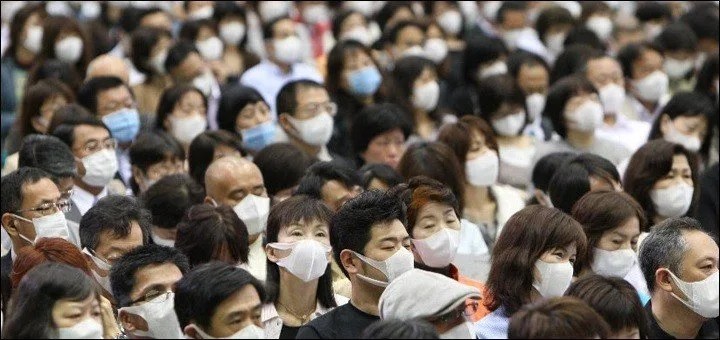
    Myth 3 – Japan wears masks because of pollution

    Japan wears masks for various reasons, and pollution is not one of them! Japanese people wear masks because of the flu, to avoid spreading germs to others.

    Sometimes some wear masks during certain periods due to hay fever (pollen allergy). Masks are also worn because it is considered rude to cough and sneeze in public.

    7 common myths and stereotypes about Japanese culture

    Myth 4 – Japanese people work too much

    There are various cases of death due to overwork in Japan. Japan also has a reputation for working many overtime hours, but that does not mean that all Japanese people work too much.

    In reality, Japanese people are becoming increasingly lazy. The number of people who work excessively in Japan is much lower than people imagine.

    7 common myths and stereotypes about Japanese culture

    Myth 5 – Everyone watches anime, cosplay is everywhere

    Even though ordinary people of all ages watch anime, Otaku are a minority in Japan. Anime in Japan is just a TV show; there are people who have watched one or two anime in a long time, as well as people who have never watched an anime in their lives.

    Cosplay is not found as easily as one might think. I spent a week in Akihabara and did not see any cosplay besides Maid and Idol.

    7 common myths and stereotypes about Japanese culture

    Myth 6 – Japan is all about technology

    Japan uses its technology to make people’s lives easier, but that does not mean that the whole country is technological. There are no robots serving in every store, and not everything there is automatic.

    In reality, there are more rural areas without technology than touchscreen displays on the streets, as some might imagine. Japanese people do not care much about technology, to the point that they use flip phones.

    April Fool's

    Myth 7 – Japanese people are very polite

    There is an idea that all Japanese people are polite, always bowing, smiling, and willing to do anything to please others. But this is largely a myth. In fact, this respect and politeness is often due to social construction and not personal will.

    It is part of Japanese culture to respect others; in Japan, you are either polite or labeled as an idiot. In Japan, you can indeed find ignorant, rude people who curse and do not care about others.

    If you are interested in seeing other generalizations that people make or stereotypes, read the articles below:

  • Karoshi – Death from overwork in Japan

    Karoshi – Death from overwork in Japan

    Karoshi (過労死) or death from overwork is not uncommon in Japan. This happens due to its work culture and various other factors. We have already written several articles discussing work in Japan, but today we will specifically talk about karoshi.

    The main medical causes of deaths from karoshi are heart attacks and strokes due to stress. There are also malnutrition and suicide where work is one of the main causes. Japan is the only country with a separate category to report deaths from overwork. Karoshi has been part of public consciousness since 1980.

    What causes Karoshi?

    The main factor that causes death at work is overtime. Although the government or some companies set a limit on overtime hours, many end up exceeding it even if they are not being compensated. Some people in the corporate world even work when they get home simply for the pleasure of finishing the job quickly.

    Karoshi - Death from overwork in Japan

    The culture of overworking emerged after World War II when people were encouraged to work 12 hours a day for up to 7 days a week to boost the country’s economy. Nowadays, this is not necessary, but 25% of overtime still draws a lot of attention.

    It is not just stress or health problems that cause death from work, but also suicide. Unemployment is responsible for 57% of all suicides, with work-related stress (such as prolonged overtime), work fatigue, and work-related depression being the other main factors leading to suicide. It is worth noting that there is no shortage of jobs in Japan, but simply losing a position or job leads a Japanese person to wish to give up on life.

    There are several cultural factors that make a person work more than they should. Things like pride, honor, shame, and the desire to do their best end up causing Japanese people to work more than they should without even realizing it. Japanese people who exceed 80 hours of overtime per month are subject to karoshi. Even those Japanese who do not work excessively end up neglecting their health. They simply leave work and go drink or stay up all night on the computer, leaving no time to rest.

    Karoshi - Death from overwork in Japan

    When will Karoshi end?

    It is sad to say, but karoshi will not disappear anytime soon. The government has imposed fines and set limits, but unfortunately, the problem is the Japanese desire to work. Some companies have tried to combat the phenomenon with various programs, but the change must start at a cultural level, which can take decades. As long as the Japanese continue doing excessive overtime voluntarily, cases of Karoshi will continue to happen. And you? What do you think about this subject? We await your comment.

  • RTK Method – The best way to learn Kanji

    RTK Method – The best way to learn Kanji

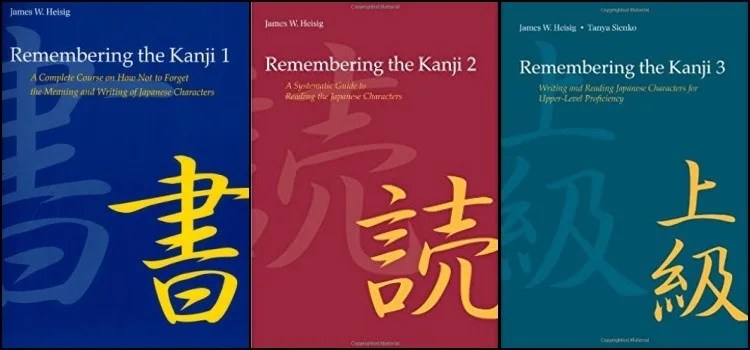
    Kanji, the ideograms in Japanese that were imported from China, are one of the most daunting things to learn. There are over 2000 kanji, and you need to learn at least about 1200 to achieve a certain fluency in Japanese. Many people feel completely lost and have no idea how to learn the kanji of the Japanese language; in this article, we will discuss one of the best methods to learn this language, the famous RTK – Remembering the Kanji method.

    RTK (remembering the Kanji) is a three-volume book written by James Heisig aimed at teaching the 3007 frequently used kanji in the Japanese language. The book is available in several languages besides English, including Portuguese. In Brazil, it is sold under the name Kanji Imaginar para Aprender. James Heisig created his own method and managed to learn over 3000 ideograms of the Japanese language in a few months. He shares everything in this book that we will cover in this article.

    We made a recent video talking a bit about RTK:

    What is the goal of the Book – RTK

    The goal of this book is to teach Kanji in a completely different way from the JLPT. In this book, they do not teach in the traditional way, strokes, etc. Here they teach using radicals and composite parts of the ideograms to facilitate the understanding of even unknown ideograms. The aim of the book is to ensure that you do not forget the meaning and strokes of the Kanji using imaginative memory.

    rtk - remembering the kanji - imagine to learn

    The goal of the book is to provide the Japanese language student with a simple method to correlate the writing and meaning of Japanese characters, so that both aspects become easy to remember. This method offers a new perspective for learning kanji, showing how to overcome the complexities of the Japanese writing system, highlighting its basic elements and suggesting ways to reconstruct meanings from such elements. Even advanced Japanese students often use and know the method.

    The method requires the student to invent their own stories to associate the meaning of the keyword with the written form. The book presents detailed stories, and over time, less detailed stories. This is to encourage the student to use the stories as practice to create their own. The method may seem quite random, but it requires you to really know the components and meanings of the ideograms before trying to create your own stories and reconstruct the elements. Therefore, the book dedicates itself to explaining each radical and kanji that serves as a component.

    Does using RTK mean abandoning JLPT?

    JLPT separates kanji by frequency of use, while RTK values the strokes, radicals, and kanji that are used as components. In my opinion, the order in which you learn Kanji makes no difference, because I always advise people to learn Japanese according to their own needs.

    It is a fact that the best way to learn kanji is by using its radicals and components along with your imagination. It doesn’t matter if you follow the learning order of JLPT or your own order. Thus, we conclude that the RTK method can be applied alongside any study method.

    The JLPT- Nihongo Nouryoku Shiken - Japanese proficiency test

    Japanese students who are at a very advanced level seek to use this method. Even if you have learned kanji using the order of strokes and their ON and KUN readings, it is important to learn kanji using the RTK method because each kanji has a story that will help you associate other related kanji. We recommend using all methods together for a more comfortable experience.

    Examples of the RTK Method

    Let’s see a list of the method being applied simply below:

    – This is the ideogram of affection, liking, and love. It is composed of the kanji woman (女) + child (子); we can associate the love of a mother for her child or the child’s love for the mother to remember the meaning and essence of the kanji. A friend of mine remembered it differently; he thinks a man likes a young woman since 女の子 means girl.

    – This is the ideogram for big. It is composed of the ideogram for person (人) with a stroke that represents the arms. It occupies a large space with its legs and arms extended, which is why it means big.

    – This ideogram means Fat. It is the simple ideogram for big with a stroke underneath. We can imagine a fat person tired with their tongue out or sweating a lot.

    – This kanji means cliff; I think it is unnecessary to reason why, just look and imagine.

    – This kanji means stone; it is the combination of cliff (厂) + mouth (口). To remember and imagine this kanji, we can picture a cave under the cliff that is closed off by a large rock. It is worth noting that this ideogram is used for any size of stone.

    – This is the kanji for see and look. It is the combination of the ideograms for eye (目) and the radical for leg (儿). This clearly shows large eyes attached to a leg, representing the ability to see.

    rtk - remembering the kanji - imagine to learn

    Where to get the RTK Book?

    This book is essential for anyone who wants to delve into the meanings of Japanese ideograms and learn them in a simpler and more enjoyable way. We can find these books for sale on Amazon Brazil itself. We will leave the links below for you to buy if you wish; just click and purchase.

    Unfortunately, Volume 2 and 3 seem to be unavailable in Portuguese, but don’t worry; Volume 1 already covers over 600 ideograms and enables you to naturally discover meanings and components of ideograms that you have never seen in your life.

    It is worth clarifying that the book alone will not make you master knowledge of all the ideograms of the Japanese language. No book, course, or teacher can make you fluent unless you dedicate yourself! Have you had the chance to read this book? Leave your opinion in the comments and share the article with friends.

  • Official Vergo’s Burger – One Piece – Recipe

    Official Vergo’s Burger – One Piece – Recipe

    Learn how to make a Japanese-style handmade hamburger, with a recipe narrated by Sanji himself! This recipe was taken from a brochure of the Weekly Shonen Jump from 2013. In this brochure, there are some recipes that appeared during the manga, where Sanji shows his favorite ingredients and chef tips.

    This hamburger appeared in the series in the Punk Hazard arc, chapter 673, during the presentation of the antagonist Vergo, who appears with a piece of hamburger on his face. Before starting, read the recipe carefully and make sure you are cooking the meat at the correct temperature, so you don’t eat raw meat! Let’s get started!

    We also recommend knowing a little about the D of One Piece.

    One Piece Hamburger Recipe

    Recipe Ingredients

    For the hamburger:

    • 1 egg
    • ½ stale bread grated, or toasted bread crumbs
    • ¼ teaspoon of salt (a pinch)
    • black pepper (a pinch)
    • grated nutmeg (a pinch)
    • ½ chopped onion
    • 10 grams of butter, or margarine
    • 1 clove of chopped garlic
    • 4 squares of cheese cut to 3 cm thick (can be mozzarella, cheddar, standard minas, or prato)
    • 400 grams of ground chuck or brisket
    One Piece

    How to Make

    1. Put the onion and butter in a microwave-safe bowl and microwave for 45 seconds. (Note: In the original recipe, it asks to put it for 1 minute and 30 seconds, but Brazilian microwaves have a lot of power and may burn the onion)

    2. In a bowl, combine the meat, breadcrumbs, egg, salt, nutmeg, pepper, garlic, and the cooked onion in butter. Mix everything with your hands.

    3. Take a small amount of the meat in your hands and shape it. Place the cheese and a bit more meat on top. Place the hamburgers on a plate.

    4. Put a bit of butter in a frying pan and fry the hamburgers on low heat for 4 to 5 minutes on each side.

    The sides are suggestions from Sanji to eat with the hamburger. They are:

    • Seasoned corn
    • Just add a pinch of salt and black pepper to a drained can of corn;

    Rustic potatoes – Wash 4 potatoes using a brush. Boil for 5 minutes. Then cut each potato into 4 pieces and fry.

    Fried egg – Fry the egg in hot butter.

    Plate arrangement – First place the corn, then the hamburger in the center, and finally the potatoes and the egg. Eat while it’s hot! Did you like this recipe? Would you like to see more anime recipes on the site? We would love to hear your suggestions!

  • How to become an author of books and mangas?

    How to become an author of books and mangas?

    In Japan, books, novels, and mangas drive the country’s entertainment. Both anime and games, dramas, and movies are based on these works. Therefore, many dream of becoming a manga author (mangaka) or a writer of light novels or other book formats. In this article, we will discuss whether it is possible for a foreigner to become a famous author, and what steps are necessary to achieve this.

    Before we start, I would like to say something quite obvious: You need to be fluent in writing and in the Japanese language! You need to be at least at N2 of the JLPT to have the ability to create mangas, and preferably N1 to write books and novels. And it is not enough to have diplomas; you need to know the dialects, keigo, and slang to create good works. The most important thing is that you can write something acceptable to be accepted by the publisher! So the first step is to know Japanese! It doesn’t have to be perfect; there will always be some mistakes in the drafts and original files you present to the publisher. Even the Japanese don’t speak Japanese correctly…

    If you want to write mangas, you need to know how to draw, you need to show that you are a professional! The same goes for writing the story; you need to be a professional! We will not discuss how to write your story, draw it, or how to create it. The focus of the article is to explain that it is possible for you to become a famous author and what you need to do to achieve that.

    How to become an author of books and mangas and light novels

    Can a foreigner be an author of books and mangas?

    Some believe that the simple fact of being a foreigner makes it impossible to become an author of books in Japanese or a mangaka. It is true that for both a Japanese and a foreigner, the biggest difficulty in becoming a famous author is creating a successful work. However, the only obstacle that separates a foreigner from a Japanese is being fluent in the language.

    There are many foreigners who are authors of books, light novels, and mangas. Even at a university in Kyoto, the head of the manga department claims that 600 students at the school were foreigners. It is worth noting that most light novel and manga authors use pseudonyms and have never appeared in public, so there may be foreigners among them.

    There is even a Brazilian illustrator named Lucas Thiago Furukawa (pseudonym of Yuu Kamiya) who became famous for writing the light novel of No Game No Life, which even got an anime adaptation. Other famous foreigners include Tony Valente, Åsa Ekström, Shindo L, Boichi, and Hagin Yi. Despite the pseudonyms, some are from France, Korea, Sweden, and the USA.

    It doesn’t matter how old you are, your gender, your experience, or even what country you are from. What matters is whether the book or manga will attract the Japanese audience and sell.

    How to become an author of books and mangas and light novels

    The first steps to becoming a famous author

    Now that you are fluent in Japanese, are a writer or artist, and have created your successful story, you need to keep in mind that succeeding as an author of light novels, books, or manga is a dream for many Japanese, and you are competing with them! There are thousands chasing the same dream, but it is not impossible!

    You need to present your story! You have 2 options: try to contact a publisher or expose your work to the world on your own. Many people, before becoming famous mangakas or light novel writers, publish their stories on the Internet or take them to events like Comiket. Others start by trying to participate in competitions or events that some magazines, publishers, and organizations hold.

    To participate in the events and contests we mentioned, you need to research each one and keep track of all the dates and rules. Remember that exposing your manga or book on the Internet does not necessarily mean creating a blog or website; there are online sites specifically for this, with thousands of readers waiting for independent works. Now let’s talk about the most common option, which is contacting the publisher.

    How to become an author of books and mangas and light novels

    Contacting the Publisher

    You need to choose the publisher you want to publish your works and contact them. You can find the phone number or email address in their magazines and books. Try to contact them or even show up in person and schedule a meeting with an editor to present your works. Anyone can do this, regardless of experience.

    We recommend trying to schedule a meeting in person, even though some publishers encourage contact via the internet. Sometimes, trying to send your work online, you may not always receive feedback or even a response. Keep in mind that there are thousands of people sending their works and stories to the publisher, especially if it is a famous publisher.

    In these meetings, you meet an editor who will read your work and give their opinion. If you really write a successful work, you will probably be accepted, or perhaps the editor will suggest tips and procedures for you to succeed, even if not with them. You can try as many times as you want; editors encourage you not to give up if they see some potential in you.

    If you are rejected by the publisher, don’t give up on becoming a mangaka! You can write doujinshi (independent works) and achieve success on the internet until someone notices you. And don’t give up on having meetings and presenting different works to the editors of the magazines.

    How to become an author of books and mangas and light novels

    The Publishers of Japan

    The publishers mentioned above are responsible for publishing your stories to the world. Most publishers, especially those of mangas, publish weekly or monthly chapters of works by various different authors in magazines that look more like thick books. This is the way publishers have found to measure the success of authors and determine if their works are famous enough to get an anime adaptation and continue being published.

    We also recommend reading: Tips to become a mangaka

    Below, we will leave a list of Light Novel and Manga publishers. It is important to clarify that you need to research them, as some specialize in certain genres or types.

    The main Light Novel publishers to contact:

    • Dengeki Bunko;
    • Famitsu Bunkom;
    • Fujimi Fantasia;
    • GA Bunko;
    • Gagaga Bunko;
    • Jump J-Books;
    • Kadokawa Benas Bunko;
    • Kodansha BOX;
    • Kodansha Ranobe Bunko;
    • MF Bunko J;
    • MF BOOKS;

    The main manga publishers to contact:

    • Akaneshinsha;
    • Akita Shoten;
    • ASCII Media Works;
    • Bunkasha;
    • Bushiroad;
    • Bungeishunjū;
    • Core Magazine;
    • Chuokoron Shinsha;
    • Daitosha;
    • Enterbrain;
    • Fujimi Shobo;
    • Fusosha;
    • Futabasha;
    • Gakken;
    • Gentosha;
    • Hakusensha;
    • Hayakawa Publishing;
    • Houbunsha;
    • Ichijinsha;
    • Issuisya;
    • Kaiohsha;
    • Kadokawa Shoten;
    • Kobunsha;
    • Kodansha;
    • Mag Garden;
    • MediaWorks;
    • Nihon Bungeisha;
    • Ohzora Publishing;
    • Sansai Books;
    • Shinshokan;
    • Shinchosha;
    • Shodensha;
    • Shogakukan;
    • Shobunkan;
    • Shonen Gahosha;
    • Shonen Jump;
    • Shueisha;
    • Square Enix;
    • Tokuma Shoten;
    • Tokodo;
    • Ushio Shuppan;
    • Wani Books;

    Now you know how to become a successful light novel author or mangaka. Have you tried sending a work to any publisher? Contest or website? We hope to see your experience in the comments.

  • 5 crazy and strange Japanese urban legends

    5 crazy and strange Japanese urban legends

    Japan is a country full of legends, mythologies, and superstitions. In this article, we selected 5 urban legends from Japan that are completely strange and crazy. We also recommend reading our article about monsters, myths, and Japanese legends that are also quite bizarre.

    Fire Pants and Women of 1932

    On December 16, 1932, the eight-story Shirokiya department store caught fire in Tokyo, killing 14 people. There are rumors that women at the location who were dressed in kimono were forced to go to the roof and refused to jump into the firefighters’ safety nets for fear of exposing themselves. This is because women usually do not wear underwear when they are in kimono.

    It is believed that after the incident, the store management ordered all saleswomen to wear underwear along with kimono, and this practice slowly spread throughout Japan. Despite the legend being strong and appearing in books, it has never been proven.

    Curse of the Red Room

    The legend was based on a horror flash animation (swf). A pop-up appears on the Internet and a recording will ask, “Do you like the red room?” Even if you close the pop-up, it will keep reappearing until the recording finishes asking the question. Shortly after, the viewer will be killed and their room will be painted red with their own blood.

    The urban legend gained notoriety after it was discovered that the 11-year-old student who killed a 12-year-old (Sasebo Slashing) had the Flash animation saved in her computer’s favorites.

    Cursed Kleenex Commercial

    In 1986, Kleenex released three exclusive commercials for Japan. As you can see in the ad above, many viewers found this advertisement disturbing. Because of these commercials, curses began to spread.

    Rumors started saying that the song “It’s a Fine Day” was a German curse (despite being sung in English), and led the crew members to face premature deaths. The biggest incident happened with the lead actress of the ads, Keiko Matsuzaka. She would die, or be institutionalized, or give birth to a demon child. None of this actually happened.

    crazy and strange Japanese urban legends

    The Curse of Colonel Sanders

    According to fans of the baseball team Hanshin Tigers, Colonel Sanders of KFC was the main reason the team did not win the championship in 1985!

    This is because after the team’s first victory in a championship, fans threw a statue of Colonel Sanders into the Dōtonbori river in Osaka. Since then, the team has not been able to win any other championships. Fans believe that the curse will end when the original statue is recovered. To this day, they have not found the hand or the glasses of Colonel Sanders.

    crazy and strange Japanese urban legends

    Kiyotaki Tunnel

    This tunnel was built in 1927. It is 444m long (4 is a cursed number in Japan, similar to the number 13 for most Western people). Kiyotaki is, according to legends, cursed by all the workers who died while building it, due to the terrible working conditions of the time, which forced them to work like slaves, and by all those who died in the tunnel, victims of accidents caused by the spirits of the workers.

    It is said that ghosts can be seen in the tunnel at night, and that they can even possess your car and cause an accident. It is also said that there is a mirror in this tunnel, and that if you look into it and see a ghost, you will have a horrible death. The length of the tunnel can also vary, depending on the time and the period in which you are measuring it (night or day).

  • Claw Machines – UFO Catcher – Are you up for it?

    Claw Machines – UFO Catcher – Are you up for it?

    During my trip to Japan, I came across various claw machines to grab stuffed animals, especially anime figures, absolutely everywhere. The arcade stores were crowded, and there were shops solely dedicated to claw machines and similar ones. In this article, we will talk a little about these claw machines that in Brazil we know as crane or teddy bear grabbing machines. In Japan, these machines are called UFO CATCHER.

    The teddy bear grabbing machines in Japan have various prizes besides plush toys. There you can find anime and manga figures, bags, clothes, chocolates, and even ice creams. These machines usually cost 100 yen or 6 tries for 500 yen. In Japan, we find people of all ages playing these prize-grabbing machines, and they always manage to grab the desired prizes without spending hundreds of yen. So I came to the conclusion that these claws are not games of chance; they just require skill.

    Types of claw machines – UFO Catcher

    There are various types of claws and also other machines with the same purpose. Let’s see some of them below:

    The pincer – This claw has only 2 arms that close in a pincer motion. The machines with pincers have prizes of all values. As expected, the strength of the arms is very weak, and the claws have no grip, which makes it difficult to grab the prize.

    Claw Machines - UFO Catcher - grabs bears

    Single finger – This claw has only one finger and works the same way as the pincer. To grab the prizes, you need to fit this single claw into a ring to hold and lift the object.

    Suspended prizes – Some machines have prizes suspended in various ways. Some are hung on a rod, and you can try to grab them, push them, and knock them down. Others are on top of a platform, and your goal is to try to cut a ribbon or fit a geometric figure into the perfect space for the prize to fall. There are various types of claws and different games. There are other types of machines where the prizes are inside capsules.

    My experience with these machines

    My experience with these UFO catcher machines in Japan was not very good. Walking in the neighborhood of Nipponbashi Denden Town in Osaka (equivalent to Akihabara), I came across several stores of this type, and in all of them, there was a pretty girl dressed as a schoolgirl to attract customers. One of them caught me distributing that little card that I didn’t know you had to play to get. During this fun, I ended up using my beloved yen coins. I tried harder, and the girl with that voice saying Ganbatte made me spend 3,000 yen.

    Claw Machines - UFO Catcher - grabs bears

    I had tried a bit on the claw and saw that it was complicated. Then she took me to a machine that seemed easier; I had to fit something into a circle, but it was not easy at all. In the end, I couldn’t grab the figure of Sinon from Sword Art Online. And to be more ironic, she let me do a test once, and during that test, I managed to grab it on the first try. Stay away from these machines; they are addictive, even though I only continued playing because of the girl.

    If a person has skill, it is not difficult to win from these machines or grab a figure without spending much. In the store I went to, the girl gave me the option to choose the prize, and then she placed it inside the machine. I really wanted to have grabbed that figure.

    Tips to win at UFO Catcher machines

    Look for easy machines. – Many people end up trying to grab the prize but give up right when it is hanging close to falling. Look for those machines that are easy to grab, even if you spend a little trying; it will be much more advantageous than trying to push a prize from the start.

    Keep an eye on the employees. – The employees always keep an eye on the machines; if they see that a machine has already yielded many wins, they change the difficulty or place a prize in an easy position. Keep an eye on the employees to pick the best machine.

    Claw Machines - UFO Catcher - grabs bears

    Analyze the prizes. – You need to pay attention to the size and shape of the prizes. Ask yourself: is this prize too big or heavy for this claw? Is this prize too small for the claw to grab? Can I use the claw to push the prize instead of grabbing it?

    Watch someone play first. – Keep an eye on someone else’s game to see if that machine is suitable for you. Observe and ask yourself: How fast does the claw move? When does the claw stop grabbing? Does the claw change position? By paying attention to others’ games, you can devise your own strategy.

    What is the goal of UFO Catchers?

    I think everyone should know that these claw machines are made to generate profit. The chances of winning are practically impossible; the claws never act the way we want or simply do not have enough strength to grab the prizes.

    However, the employees like it when we win, and some are nice. If you say: iten wo toriyasui basho ni oitekure masuka? they may leave the prize in an easier position. Most people play on these cranes just for fun. If you want to play on this UFO Catcher, think only about the fun, forget that you will spend money, and bring a predetermined amount.

    If you have ever had the experience of playing on these machines, we would love to see it in the comments. We thank you for reading and sharing. I hope you enjoyed this article. Let’s finish by leaving a video to motivate you to not play!

  • Drawing Courses and Tips for Beginners

    Drawing Courses and Tips for Beginners

    Do you dream of being a designer but don’t know how to draw? Or do you already know how to draw something, but have specific difficulties? Maybe you feel a bit lost, thinking it’s impossible because you “don’t have the gift.” After all, those who “are born with the gift” pick up a pencil and start drawing since they were babies, right?

    Well, that’s completely wrong! Of course, there are people who can draw well from a very young age, but there are also those who only learn after they grow up and become good artists just the same. So, forget about this story of “gift” and go for it! Don’t know how to draw? Having trouble drawing? Let’s try to solve that!

    If you live in one of the major capitals of the country, you will find drawing courses that teach you to draw step by step. They are not as numerous as language courses, for example, but there are certainly some of good quality. These establishments also often offer workshops or mini-courses for specific difficulties, explaining how to make certain drawings step by step.

    With a Google search, you can find the most well-known drawing courses, and from there it’s just a matter of carefully choosing the best option. Some examples of good drawing courses are Quanta Academia de Artes, Área E, and Impacto Quadrinhos. Consider location, cost, and schedule of the courses and go check out the facilities; if possible, ask to attend a class.

    Now, if there is no drawing school where you live, or if you don’t have enough resources to pay for a course, it gets a bit more difficult, but not impossible. Don’t get discouraged! There is a way to learn to draw well without spending much.

    Drawing Courses and Tips for Beginners

    Drawing Tips and Tutorials on the Internet

    The internet is a great source to discover cheap or even free alternatives to learn. By searching, you can find online drawing classes, step-by-step drawings, tips for drawing, and much more. But be careful: be aware that there are no miracles. It doesn’t matter if you found a super cool drawing tutorial or a video that promises to teach you how to make beautiful and easy drawings; it will only help if you put in the effort. It’s no use reading a thousand and one drawing tips if you don’t pick up paper and pencil and put those tips into practice. Therefore, first and foremost, make a commitment to yourself to do your part to achieve your dream. Are you ready? Then, let’s go!

    As we said, the internet is a great source to discover alternatives, yes, but you also need to pay attention to separate what works or not for you. A drawing tutorial made for professionals, for example, probably won’t help you, as it would be too difficult. Those who are starting need more basic information. Look for things like step-by-step drawings, or tutorials with step-by-step drawings for beginners.

    Many people turn to YouTube, and you can really find a lot there. Online drawing classes, step-by-step drawings, tips for drawing or how to draw well, or even videos teaching how to draw step by step, search and you will find!

    A positive point of this media is that you can observe how to make drawings step by step, see how to hold the pencil, and other cool things. There are very good videos that really teach how to make step-by-step drawings for absolute beginners. And those who do this usually choose beautiful and easy-to-make drawings as models, like in this video where the artist Ivan Querino teaches in a video how to draw Princess Elsa from the movie Frozen, which helps motivate those watching. After all, who doesn’t get excited about beautiful and easy drawings? There are also many other videos that give very good tips on how to learn to draw well, just search.

    The downside of an online drawing class or a drawing tips video is that afterwards you don’t have the exercises on paper to use as a reference for studying. You would have to play the video again, pause, and often the paused image is not good enough to see all the details. To solve this problem, some YouTube channels sell booklets of their activities. It’s a good option if you like the videos enough to invest. But before making a decision, check if there are any complaints from people who bought the booklets and didn’t receive them. It’s always good to be careful when shopping online.

    Another problem is that it may happen that that great video, which shows how to make step-by-step drawings just the way you wanted, is in another language. And then, when the professional explains some important detail that doesn’t appear in the video, you can’t understand anything! Unless you are multilingual or have a friend who is, this can make things a bit difficult.

    Drawing Courses and Tips for Beginners

    Free Drawing Courses

    A good way to facilitate your search for information is to turn to comic and manga sites. Some indicate links to good videos and texts on how to make step-by-step drawings and things like that.

    Others have their own section of drawing tips. These sites usually publish periodically texts with tips for drawing, such as how to learn to draw well, information about materials, and much more.

    Some, like Heróis no Papel, in addition to a tips section, also offer drawing courses teaching how to draw step by step. The content varies in level, cost, and format. In the case of Heróis no Papel, for example, the course is basic, free, and in text, but with illustrations showing the drawings step by step for beginners.

    Other Tips and Techniques for Drawing

    If you are just starting in the world of drawing, a great exercise for you to practice is simply to make straight lines by hand. Draw two points, one point ‘A’ and one point ‘B’ and start drawing the straight line between those points. This will train your stroke much more than you imagine!

    Another great exercise is simply to observe the strokes of other artists. Observe how everything was done and also try to research what methods and techniques were used by that artist.

    And, of course, the most valuable tip of all is: practice! Practice always and practice all the time! Only practice and effort lead to perfection and will make you a great artist!

    In short, whatever method you choose – taking an in-person or online course, or studying alone through drawing tutorials and tips – what matters is that it works for you. And, above all, that you are aware and committed to doing your part and putting in your best effort.

    Now take a deep breath and go after your dream!

  • How is it to be vegetarian in Japan? Is it difficult?

    How is it to be vegetarian in Japan? Is it difficult?

    Doing some research I found out that it is not easy to be a vegetarian in Japan. Although Japan has a low cancer rate and a long life expectancy, it is not because they stop eating meat. In reality, the Japanese diet consists of a lot of meat everywhere, making life difficult for vegetarians or vegans.

    Although you can find several dishes that apparently do not contain meat, most of them have sauce and broth with fish oil and meat, sometimes even the salad has fish flakes. Being a vegetarian in Japan is complicated, mainly because it is not customary in Japan to alter or remove any ingredient from a particular dish. Asking the cook not to add a certain item to the dish is considered rude, and therefore some refuse to do it.

    vegetarian in Japan

    What is a vegetarian called in Japan?

    Vegetarian in Japanese is called bejitarian (ベジタリアン), a word borrowed from English. The native concept in Japanese is saishokushugisha (菜食主義者), but they can still eat fish.

    The closest thing to strict vegetarianism that we know in the West is shoujin ryouri (精進料理) or devotional cuisine, which comes from the practice of Buddhist monks with principles of non-violence. Here they avoid eating even plants where it is necessary to kill the stem, such as potatoes and carrots.

    Japan consumes a lot of meat, even in dishes that shouldn’t have meat, they add it. Research states that only 0.08% of Japanese people are ideological vegetarians.

    vegetarian in Japan

    Suggestions for vegetarians in Japan

    It can be difficult, but it is not impossible to find vegetarian restaurants, especially in cities like Tokyo. Just do a quick search on Google Maps and find the desired location. If it is hard to find a vegetarian restaurant, we recommend a list of dishes that do not contain meat (I hope). Unfortunately, buying vegetables and fruits at the market can be a bit expensive, but nothing exorbitant. Feel free to access some articles about the foods mentioned below by clicking on them:

    In addition, you can find processed products for vegetarians like meat, burgers, fillets, and even soy sausages. Being a vegetarian in Japan may seem complicated, but despite the difficulties people talk about in finding options, Japan is rich in choice and variety of foods. Do you know or have any tips? Leave them in the comments. To finish, I will leave a video with an interview that a friend did with a vegetarian living in Japan.

  • Magic: The Gathering – Vocabulary in Japanese and English

    Magic: The Gathering – Vocabulary in Japanese and English

    In this article, we will see the Japanese vocabulary of the card game Magic: The Gathering (マジック:ザ・ギャザリング ). We will translate the cards from Japanese to English and Portuguese. For those who don’t know, this is one of the best and most famous TCG games in the world. It is estimated that there are over 12 million players around the world.

    Even if you don’t play Magic, but end up playing other TCGs, this vocabulary list can be useful for you, because most TCGs use similar words.

    Why would I buy a card in Japanese? According to the official rules of Magic, all languages are accepted in battle, there are no rules discriminating languages. Thus, you can get a rare card or a cheaper deck.

    We recommend having at least some knowledge of hiragana and katakana to be able to play Magic in Japanese. It is worth remembering that you also need to have good skills in speaking numbers in Japanese.

    Magic: The Gathering in Japanese

    Let’s get straight to the point, below you will find a list of terms and words related to the Game. This way you can play Magic in Japan or buy the cards in Japanese. (Unfortunately, some important terms may be missing…)

    Responsive Table: Scroll the table sideways with your finger >>
    JapaneseRomanizationEnglishPortuguese
    こうげきkougeki Attack Ataque
    こうげきをしますkougeki wo shimasu I am attacking Eu ataco
    ライブラリraiburari Library Grimório (deck)
    カードkado Card Carta
    手札tefuda Hand Mão (baralho)
    ターンtann Turn Turno
    ゲームgaymu Game Jogo
    戦場senjyou Battlefield Campo de batalha
    カウンタkaownta Counter Counter
    ゆうはつyuuhatsu Trigger Desencadear
    せんこうsenkou Play First Primeiro
    こうこうkoukou Play Second Segundo
    shima Island Ilha
    yama Mountain Montanha
    mori Forest Floresta
    平地 heichi Plains Planícies
    numa Swamp Pântano
    荒地 arechi Wastes Exílio
    無色 mushoku Colorless Incolor
    高名 koumei Renown Renome
    威迫 ihaku Menace Ameaça
    魔巧 makou Mastery Maestria
    生け贄 iikayniae Sacrifice Sacrifício
    墓地 bochi Graveyard Cemitério
    ライフをえる raifu wo aeru Gain (life) Obter vida
    追放 sueiiho Exile Exílio
    はんこん hankon Lifelink Vínculo com a Vida
    ひこう hikou Flying Voar
    さいせい saisei Regenerate Regenerar
    防衛 bouei Defender Defender
    はかい hakai Destroy Destruir
    速攻 sokou Haste Ímpeto
    接死 sesshi Deathtouch Toque Mortífero
    先制攻撃 senseikougeki First Strike Iniciativa
    警戒 kaykai Vigilance Vigilância
    呪禁 jyugon Hexproof Resistência à magia
    瞬速 shunsoku Flash Lampejo
    すてる suteru Discard Descartar
    破壊されない hakaisarenai Indestructible Indestrutível
    いかく iikaku Intimidate Intimidar
    二段攻撃 nidan cougeki Double Strike Golpe Duplo
    装備 soubi Equip Equipar
    はずれる hazureiru Unequip Desequipar
    うちけされない oochikay saraynai Can’t be countered Não pode ser anulado
    打ち消す oochikay su counter Anular
    到達 toutatsu Reach Alcance
    召集 shoushuu Convoke Convocar
    占術 senjutsu Scry Vidência
    果敢 Kakan Prowess Destreza
    覚醒 kakusei awaken Despertar
    結集 kesshu Cally Reunir
    収斂 shuuren Convergec Convergir
    上陸 jyouriku Landfall Aterragem
    嚥下 engai Ingest Ingerir
    欠色 kesshoku Devoid Desprovido
    支援 shien Support Suporte
    昂揚 kouyou Delirium Delírio
    変身 henshin Transform Transformar
    調査を行う chousa wo okonau Investigate Investigate
    マッドネス maddonesu Madness Loucura
    潜伏 senpuku Skulk Esquivo
    増呪 zouju Escalate Escalar
    現出 gen shutsu Emerge Emergir
    合体 gattai Meld Fusão
    製造 sei zou fabricate Fabricar
    エネルギーカウンター energi kounter energy counter Contador de energia
    構築物 kou chiku butsu construct Construir
    紛争 funsou Revolt Revolta
    即席 sokuseki Improvise Improvisar
    サイクリング saikuringu Cycling Reciclar ou Revezar