The main public transport in Japan is the train, followed by buses. There are customs and rules to follow in these places. This article looks at the curiosities around those habits once you are actually inside the car.
Contents5
Phone calls inside the train
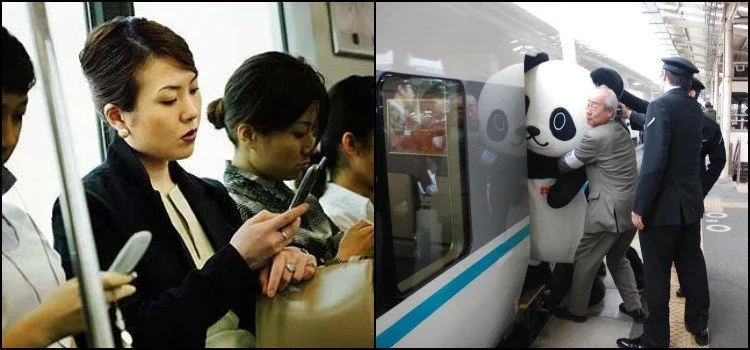
There are various posters and notices asking people not to hold phone conversations inside the train, the main reason being not to disturb others. This is quite ironic because I see groups of schoolchildren talking loudly (shouting) inside the trains. Most adults still skip voice calls, for privacy and etiquette as much as for noise.
If talking on the phone inside the train disturbs the car, talking loudly with the people next to you does the same job. Keep the phone on silent. In Japan that setting is called manner mode (マナーモード). There is no problem watching or listening to music as long as you use headphones. JR East and other operators in eastern Japan still ask riders to switch the phone off near priority seats when the train is crowded, and to avoid calls everywhere else. A longer conversation belongs between cars on a shinkansen, or after you get off.
The Japanese also avoid sitting on the floor, spreading their bags, putting on makeup, sitting with their legs open or crossed, and anything else that might disturb others in a packed car.
Priority seats and the elderly
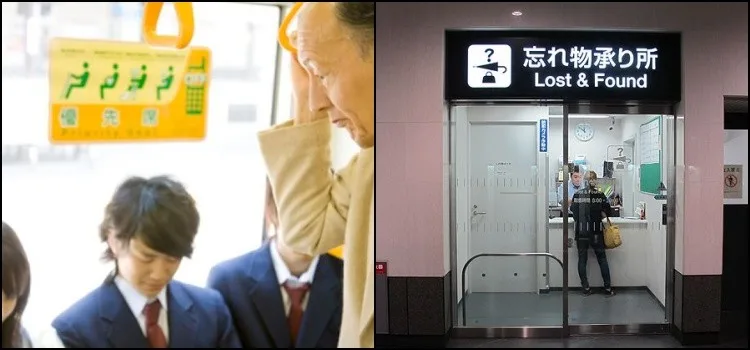
You may be impressed by the politeness of the Japanese, but when riding public transport, it is not hard to see young people sitting while some elderly people stand. This is because many elderly riders feel uncomfortable when offered a seat. The offer can make them feel old, and most tend to refuse.
Another factor is that people offering the seat also feel embarrassed, exactly because of that thought of labeling the person as old. Some discreetly leave the area and head to another train car or toward the exit, so the seat is free without a scene.
Those marked seats are yūsen-seki (優先席), usually a different color near the doors, for older passengers, people with disabilities or injuries, pregnant riders, and anyone with a small child. A red Help Mark on a bag can signal a need that is not obvious. Sitting there on a quiet train is fine. Get up as soon as someone who needs it boards, or skip those seats when the car is busy.
Lost items on the floor
Everyone knows about the honesty of the Japanese. I have witnessed several times lost items inside the train, but no one picks them up. Passengers often leave the object for train staff to collect and take to lost and found at the stations. You can take the item to the nearest attendant yourself, which is the practical way to get it into the system. Many still avoid doing so. They feel embarrassed, or they imagine that others might think they are stealing the item.
JR East registers items found in stations and cars and can search them by date, line, and description. Unclaimed property later goes to the police.
Sleeping on public transport
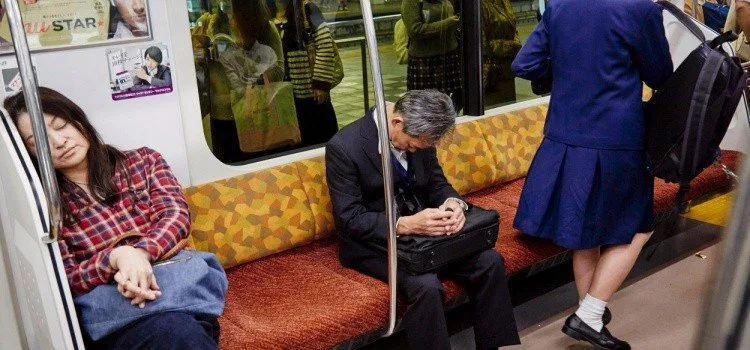
A very common practice inside trains and public transport is Inemuri (居眠り), where people simply sleep sitting or even standing. It is very common to find people sleeping inside the trains. The amazing thing is that they manage to wake up at the right station.
Pushing in trains
When the transport is full, it is common for people to push each other to pass, exit, and enter a train. Some stations still put staff on the platform, known as oshiya (押し屋), to help passengers and bags clear the doors so the train can leave. The job first showed up at Shinjuku Station in 1955. Today the work is mainly keeping the doorway clear so the doors can close.
Dense cars are also where chikan, unwanted sexual touching, has long been a problem. Many lines run women-only cars during weekday rush hours, most often in the morning, marked in pink on the platform and on the train. Hours and car numbers change by operator, so the sign on the floor is what to follow. Boys of elementary-school age, and passengers with disabilities plus a carer, are usually allowed in as well.
When entering a train, wait for others to exit to avoid bumping into each other. The marks on the platform show where to queue. If you are standing by the door on a packed train, stepping off briefly to let others out, then getting back on, is ordinary.
The useful habits are small. Manner mode on, backpack held in front when it is crowded, skip the yūsen-seki if you can stand, hand a lost bag to staff, and let the car empty before you board. The rest is reading how dense the car is and staying out of other people's space.
Kevin Henrique has written about the Japanese language, culture, anime, games, and travel since founding Suki Desu in 2014. He first visited Japan in 2016.
Community
Comments
0 comments
There are no published comments in this language yet.

 Another factor is that people offering the seat also feel embarrassed, exactly because of that thought of labeling the person as old. Some discreetly leave the area and head to another train car or toward the exit, so the seat is free without a scene.
Those marked seats are yūsen-seki (優先席), usually a different color near the doors, for older passengers, people with disabilities or injuries, pregnant riders, and anyone with a small child. A red Help Mark on a bag can signal a need that is not obvious. Sitting there on a quiet train is fine. Get up as soon as someone who needs it boards, or skip those seats when the car is busy.
Another factor is that people offering the seat also feel embarrassed, exactly because of that thought of labeling the person as old. Some discreetly leave the area and head to another train car or toward the exit, so the seat is free without a scene.
Those marked seats are yūsen-seki (優先席), usually a different color near the doors, for older passengers, people with disabilities or injuries, pregnant riders, and anyone with a small child. A red Help Mark on a bag can signal a need that is not obvious. Sitting there on a quiet train is fine. Get up as soon as someone who needs it boards, or skip those seats when the car is busy.



Community
Comments
0 comments
There are no published comments in this language yet.
Send comment