
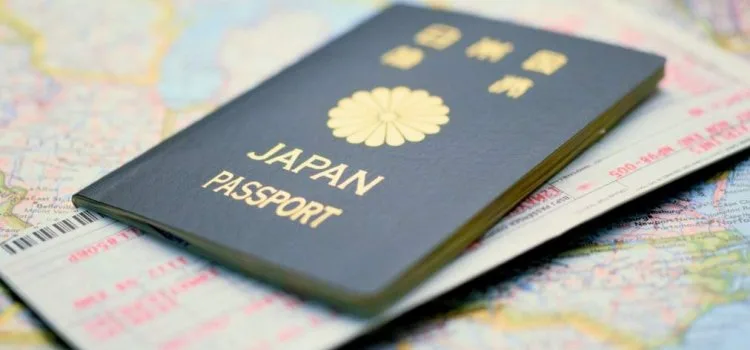
We have already written about Japanese citizenship, and one of the main benefits is holding a Japanese passport. Today we look at the travel that document actually opens: how high it ranks, which countries Japanese citizens can enter without applying for a visa in advance, and where an online authorization such as ESTA or ETA still sits in the way.
With Japanese nationality and a Japanese passport, we are treated as Japanese in other countries. That can help with scholarships and with joining research groups abroad.
On the Henley Passport Index for June 2026, Japan sits in 2nd place, tied with South Korea and the United Arab Emirates, with access to 188 destinations without a prior embassy visa. Singapore leads with 192. Those scores move every few months, so treat them as a snapshot.
Contents 5
What “powerful” means on paper
Henley counts destinations you can enter without first getting a visa from an embassy. Visa-free entry, visa on arrival, and electronic travel authorizations all feed that score. The index uses IATA data across 199 passports and 227 destinations.
A high score still leaves immigration in charge. Officers can ask for a return ticket, proof of funds, or a hotel address. A ranking does not replace the rules of the country you are flying to.
Visa-free travel and the online forms that look like visas
Most of Europe is straightforward for Japanese citizens: the Schengen Area usually allows 90 days in any 180-day period with no prior visa. South Korea, Taiwan, Hong Kong, Singapore, Thailand, Malaysia, Indonesia, Vietnam, the Philippines, Mexico, Argentina, Chile and much of Latin America also allow short stays without an embassy visa.
Brazil is a good example of how fast older lists age. Japanese citizens have been able to enter Brazil without a visa for short stays since 2019, for up to 90 days.
China resumed a unilateral 30-day visa-free stay for Japanese ordinary-passport holders in late 2024, and the Chinese Embassy in Japan says that trial runs through 31 December 2026. The exemption covers business, tourism, family visits, exchanges and transit. Work and study still need a visa beforehand.
Five popular destinations keep the “no embassy visa” label while requiring an online authorization before you board:
- United States: Japan has been in the Visa Waiver Program since 1988. For tourism or business of up to 90 days you apply for an ESTA (Electronic System for Travel Authorization) on the official CBP site.
- Canada: an eTA is required for visa-exempt travelers arriving by air.
- United Kingdom: visa-exempt visitors, including Japanese citizens, need a UK ETA before travel.
- Australia: an ETA, usually issued through the official app.
- New Zealand: an NZeTA, plus the International Visitor Conservation and Tourism Levy in most cases.
Sri Lanka also uses an ETA. India is easier than a paper visa for many travelers, but the usual route is an eVisa rather than a stamp on arrival.
Countries that still require a visa in advance
A handful of states still demand an embassy or consular visa before you fly. Typical examples in recent lists include Russia, North Korea, Algeria, Afghanistan, Pakistan, Syria, Yemen, Libya, Iraq, Sudan, South Sudan, Nigeria and several other African states. Cuba often needs a tourist card rather than a classic visa. Rules here change with diplomacy, so confirm with the destination’s mission.
Angola is another reminder that country tables go stale: it has moved toward visa-free entry for Japanese citizens for short tourism stays, after years of appearing as “visa required” on older lists.
A practical snapshot of common destinations
The table below is a short list of popular routes, not a catalogue of every border on earth. Stay lengths are typical tourist limits and can differ for other purposes. Always check the destination government before you buy the ticket.
| Destination | Usual entry for Japanese citizens |
| Schengen Area / most of the EU | Visa-free, typically 90 days in any 180-day period |
| United Kingdom | ETA required |
| United States | ESTA (Visa Waiver Program), up to 90 days |
| Canada | eTA for air arrivals |
| Australia | ETA |
| New Zealand | NZeTA |
| Brazil | Visa-free, up to 90 days |
| China | Visa-free, 30 days (trial through 31 December 2026) |
| South Korea | Visa-free |
| Taiwan | Visa-free |
| Hong Kong | Visa-free |
| Thailand | Visa-free |
| Singapore | Visa-free |
| India | eVisa |
| Russia | Visa required in advance |
| North Korea | Visa required in advance |
If you still travel on another passport, entering Japan is a different set of rules. We covered that in how to get a Japan tourist visa, or enter visa-free.
The passport only exists with Japanese nationality
The booklet is issued to Japanese nationals, in red for the 10-year adult passport and blue for the 5-year version, which is the only option under 17. Getting it means naturalizing or already holding Japanese nationality. Japan generally expects you to give up your previous nationality.
For people who want to live in Japan first, without Japanese ancestry, the realistic routes sit on the residence-status side. We gathered those paths in 10 ways to live in Japan without Japanese ancestry.
What do you think of the power of the Japanese passport? Do you think it is worth obtaining Japanese citizenship to have this document, given the single-nationality rule?



Community
Comments
0 comments
There are no published comments in this language yet.
Send comment