
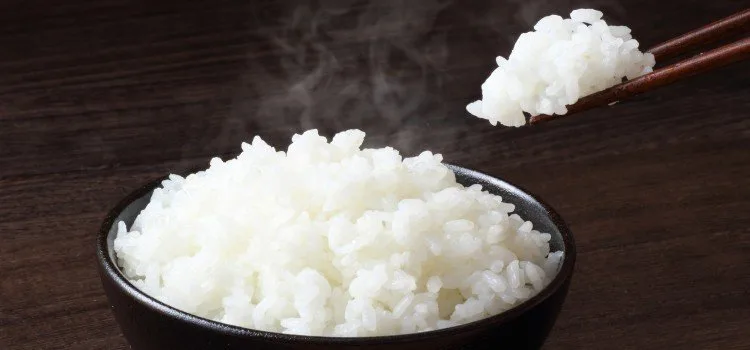
At breakfast, it will be there. In the school lunch, it will be there. When you want to eat something different at home, it will be there too. How present is rice in Japanese daily life? This article is about gohan (ご飯), Japanese rice: fluffy and firm, yet sticky at the same time, straight from the rice fields of Japan.
Contents 5
History and curiosities of Japanese rice
Rice has been cultivated in Japan since the Yayoi period, more than 2,000 years ago. It needs a warm, humid summer and well-watered, nutrient-rich soil.
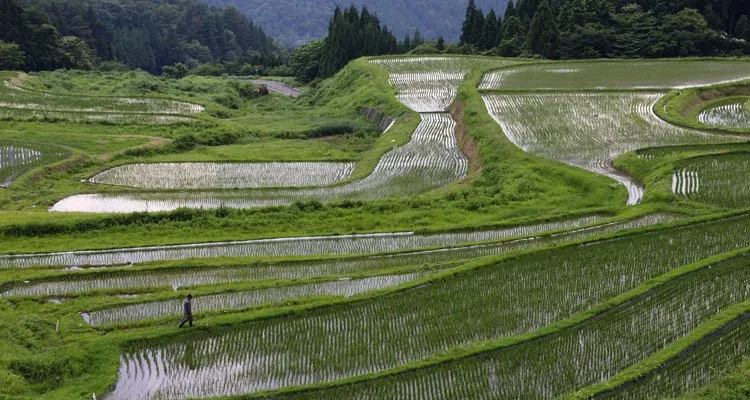
Because most of Japan is covered by mountains and steep terrain, farmers grow rice in tanada (棚田), terraced fields built by hand on hillsides. The work is traditional and largely done by older farmers, since younger generations are drawn to city life.
Rice was already used as currency in the Kamakura period (12th century).
Rice appears on special occasions and as an offering to gods and deceased loved ones. Some Japanese believe that gods live inside each grain of rice. There is a rice god named Inari, who is also the god of foxes and fertility.
Types of Japanese rice
Two main types of rice are most commonly used in Japan. Uruchimai (粳米), known as Japanese rice, is the most widely used. Its grain is translucent and short. After cooking, it becomes sticky, making it easy to pick up with chopsticks.
Mochigome (もち米), known as glutinous rice, is short and opaque. After cooking, it becomes even stickier and firmer. It is used to make mochi and dishes that need more binding, such as sekihan. Glutinous rice is so sticky that chemical tests have identified it in the mortar used in parts of the Great Wall of China. Of course, many other types of rice are also grown and eaten in Japan.
Japanese rice recipe
This is a basic recipe for Japanese rice, to eat plain in a bowl or to shape into onigiri. It is a flexible recipe, so you decide how much to make. As a reference, use twice as much water as rice.
Ingredients
- Japanese rice: 500 g
- Water: 1 liter
How to make:
- 1. Wash the rice, passing your hand gently between the grains so they do not break.
- 2. Wash it three times, or until the water runs as clear as possible. Drain.
- 3. Put the rice in a bowl and add the water you will use for cooking (1 liter in this batch).
- 4. Let it soak for at least 30 minutes, or overnight.
- 5. Put the rice and water in a pot. Important: the water should sit about two fingers above the leveled rice. If it rises well above that, pour some off before cooking. If you are cooking a small amount, a little extra water is fine.
- 6. Place the pot on high heat, uncovered, until it starts to boil.
- 7. Lower the heat and cover the pot with a kitchen towel and the lid.
- 8. Cook for at least 5 minutes and keep an eye on the rice. The cooking time depends on how long it soaked: the longer the soak, the shorter the cooking time.
- 9. Turn off the heat. Wait 10 minutes, then transfer the rice to a container. Be gentle: the grains break easily.
Done! Serve the gohan hot, plain in a bowl or shaped into onigiri. For mochi and festive dishes such as sekihan, use mochigome, which stays firmer and stickier after cooking.


Community
Comments
0 comments
There are no published comments in this language yet.
Send comment