
Rosetta Stone is a long-running language learning program. It currently teaches 25 languages, and it is still known for a method built on images, audio, and no translation.
But does Rosetta Stone really help you learn Japanese? I used the program for 5 months, until I finished the last lesson of the Rosetta Stone Japanese course.
Contents 3
How Does Rosetta Stone Work?
Rosetta Stone presents three levels in the Japanese course, while several other languages go up to five. They work like this:
Level 1: helps build a fundamental vocabulary base and an essential structure of the language. Skills and vocabulary include:
- Greetings and introductions;
- Simple questions and answers;
- Shopping;
- Listening skills;
- Basic writing and reading skills;
Level 2: allows people to explore the environment as they increase the vocabulary and essential structure of the language from Level 1. Skills and vocabulary include:
- How to give and get directions;
- Using means of transportation;
- Telling the time;
- Going out to eat;
- Enjoying basic social interactions;
- Professional life;
- Academic subjects;
- Art and culture;
- Past, present, and future;
Level 3: allows people to connect to the world around them, enhancing the language fundamentals and conversational skills developed in Levels 1 and 2. Skills and vocabulary include:
- Ideas and opinions;
- Expressing feelings and talking about daily matters;
- Interests;
- Work;
- Current events;
- Birth, marriage, death, and health and body-related concerns;
- Complementary terms indicating frequency, duration, and degree;
Rosetta Stone Method
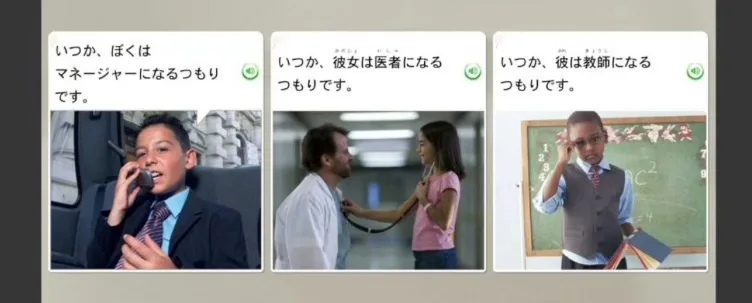
The method of this software is different from what we are used to, as it teaches us basically with images and audio. It never uses translation. This method is great because it helps us think in the language and understand what is said without needing to mentally translate to English. We would be learning Japanese as if it were our mother tongue, immersed in the language.
The same method also leaves us guessing, because sometimes it is necessary to think hard to understand what is happening in order to grasp what a sentence or word means. The images we associate with the audio and text are well selected, which gives us a bit of understanding of the sentence, but it doesn't always help. This makes it quite difficult, but it can be easily resolved if we just look up the word in a dictionary or Google Translate.
The grammar also complicates things a bit, but later it is absorbed naturally with the spaced repetition of the software, as it ends up creating a repetition (sometimes excessive) of the lesson content. We can also set our focus on reading and writing or speaking and listening, or everything.
There is also voice recognition, currently called TruAccent. The recognition is not bad, but it needs a quiet environment and a good microphone. Fortunately, this option can be turned on or off, and we can set the difficulty of speaking and a few other options.
We also have a section where we only listen to something in Japanese and associate the audio with the image, with no text to help, only the audio. In addition, we also have speech recognition and pronunciation exercises, as well as writing and reading, where we first learn the hiragana and katakana, and then some kanji.
Is Rosetta Stone Worth It for Japanese?
Rosetta Stone is a super expensive program. The old boxed CD is gone: today it runs as a subscription on the website and on the phone apps, with access to all 25 languages. I used the program from start to finish and can say that it does not bring you even close to fluency, even though it helps a lot.
If you complete the entire course, you could buy something in Japan, talk about likes, express what we think, but we wouldn't understand an anime or manga, for example. And the worst part is that the Japanese course has only 3 levels, while some others have 5.
I also believe that the price of the software is a rip-off, at least in our current times, because it could be much cheaper. But for beginners, I'm sure they will be impressed with the speed at which they will learn things, how they will manage to do grammatical exercises without much complication, and how they will start to understand simple things (and some a bit more advanced).
So, if you are determined to spend money on this software with the hope of learning the basics, it is recommended. If you want fluency or to reach an advanced level, I do not recommend it as your only course. You probably won't get past JLPT N4, and much of the material sits closer to N5, because it is a basic course. After that you need grammar study and real conversation, which is the next step in most methods to learn Japanese. That is the limit I hit after finishing every lesson.





Community
Comments
0 comments
There are no published comments in this language yet.
Send comment