Blog

  • Japanese course – Erin’s Challenge

    Japanese course – Erin’s Challenge

    Today we will talk about a free Japanese course, the Erin’s Challenge. This Japanese course is one of the most comprehensive free courses I have ever seen. Today we will get to know a little more about this great site for studying Japanese.

    Well, see below a video about the site:

    Well, now let’s see how the site works ^-^

    The motto of the Erin’s Challenge site (エリンが挑戦) is にほんごできます (nihongo dekimasu) which basically means “I can speak Japanese” or “I understand Japanese”.

    How do the classes work?

    The site contains 25 different lessons. Each lesson has 7 different “topics”, where we explore a subject. Let’s discover them.

    The Basic Dialogue is where we study a dialogue. We watch a video and follow the subtitles below. In the subtitles, you can choose to see the subtitles in Japanese (kana and kanji), hiragana, romaji, and Portuguese. It’s really cool. After that, still in the basic dialogue, we go to the script. There, we can see just the script, and we can hover over the words to see their translation.

    In addition, we can listen to the dialogue again and even download the content to listen/read later! And, of course, for free. After that, we have the manga. I really liked the idea of creating the manga, as we can see the same situation from the basic dialogue, in manga! Additionally, we can learn things like onomatopoeias, which are also taught in the course. And finally, we have the Basic Dialogue Review Exercises. There we answer some questions about the dialogue. It’s very good, as you won’t just be learning words in the course, you will also be learning to interpret the texts!

    The Advanced Dialogue is where we listen to another dialogue, a bit more complex in most cases. The structure is the same as the basic dialogue: We can select subtitles and see the script, and we can also download the audio and the PDF material of the dialogue. It just doesn’t have the manga in the advanced dialogue. After that, we go to the Review Exercises, which are also similar to the basic dialogue.

    Memorization methods

    In the Important Phrases we study some important structure along with エリン (erin) ホ二ゴン (honigon) and N21-J. This helps us learn a bit of grammar, in addition to being quite fun! There, we see the class, 100% in Japanese, but with options for subtitles that you already know (Japanese, kana, romaji, and Portuguese). After that, we see Explanations and examples of sentences. There we see a grammatical explanation and some examples of sentences, which come with audio, and you can add them to Anki. Then we go to Uses in different situations, where we see how a “grammar rule” (that we learned in this article) can be used in different situations (I think this is amazing, really a great idea). And then, grammatical exercises.

    In What is this? we discover some curiosity about Japanese culture, something different, a different food, etc. First, a photo of something will be presented, and you will have to guess what it is (there will be 4 options to choose from). After that, we see a video about it, with the subtitle options you already know, and the correct answer.

    In Let’s see we learn a little more about Japanese culture. It’s very similar to What is this?. These two options are great for those who want to learn about Japanese culture.

    In Let’s try we learn a bit more about the culture, watch a video, and then see an explanation. And after that, comes the coolest part: We can play a mini-game about the subject! Really, the site is very comprehensive.

    Training Japanese vocabulary

    And finally, the Increasing Vocabulary, where we learn some new words to “increase vocabulary”. It’s not very easy to learn, as you have to use traditional methods of “memorizing words”. After that, we play a little game, where we must match the words we have already learned with the corresponding images.

    Did you see how the site is full of content? In the basic dialogue and in the advanced dialogue we can even download the content to listen later, anywhere you are!

    You can even create an account on the site and track your progress. And you can also download hiragana and katakana tables, and a calendar in Japanese!

    For people living in Japan, they can even buy some DVDs of the lessons, which also come with extra lessons that are not on the site. Each volume costs 2,400 yen, and the three volumes cost 7,200 yen (+ taxes). The DVDs total 604 minutes of duration.

    Is it worth it?

    Well, from the description I made of the course, you must have noticed that the site is very comprehensive, interactive, and fun. This course will certainly boost your vocabulary a lot. To help with your studies, you can download the audio of the dialogues, which are available on the site, to listen to while walking, driving to work, cleaning the house, washing dishes, etc., and the PDF material as well, so you can read.

    But the site is not 100% perfect. You need to know hiragana and katakana, and understand how kanji works to be able to start using it (or else, use romaji). The course also does not teach kanji and uses practically the same method that traditional schools use, just more fun.

    The site will leave you with a great level of Japanese if you use it correctly, calmly. But even so, you won’t be very close to fluency. It is true that you will understand A LOT OF SIMPLE DIALOGUES, a lot indeed, it was about 80% to 90%. But really simple dialogues, the ones you find in everyday life.

    So, it’s worth it. To start, it’s good to already have a basic knowledge of Japanese to help. It will really help you a lot, but of course, it will never be enough. It will be a great tool to guide you on your journey to fluency, but it won’t be able to guide you all the way.

    The main character, Erin, is a student who came from the United Kingdom to Japan to study. There she meets friends like 咲 (saki) and 健太 (kenta). Have fun with them and happy studying!

  • Fansub – The two sides of fansubs

    Fansub – The two sides of fansubs

    Today, in the 21st century, we can witness and say that there is competition everywhere, well, we will talk about fansub’s. Analyzing the morphology of this word, we will see that it is an acronym of fan (fan) and subtitle (subtitle) which are derived from English, meaning subtitled by fans, that is, non-profit.

    Fansub is the designation for a group of people who translate something from a different language to their native language, not specifically from Japanese to Portuguese. However, this term arose among otaku communities to specify groups that subtitle from Japanese to their native language. In our case, Portuguese. Generalizing, it can thus be defined.

    The work of a fansub

    Fansubs subtitle animes from a foreign language to their native language as mentioned earlier. How is it done? Well, today fansubs can translate Japanese/Portuguese, English/Portuguese, Spanish/Portuguese, and Portuguese from Portugal to Brazilian Portuguese, but this is not general, it will depend on who and the translator, as they may have knowledge of another language besides their native one. And many, regardless of the language, value quality.

    fansub

    What is the translation process like?

    The episode is aired in Japan, and then someone will record it and post it on trackers, like nyaa.se. After that, the translator will download and subtitle it to their native language. Using programs like Aegisub to subtitle. Then, after the translation is ready, it will be posted on the fansub’s website. The translation chain is quite varied, with the most common being listed below:

    1. Japanese to English
    2. English to Spanish
    3. Spanish to Portuguese

    Who releases faster:

    There are two types of translation, known as speedsub and qualitysub. As the name suggests, speedsub values the speed of releasing subtitles, while qualitysub, which takes longer, values quality and final result.

    Speedsub

    Speedsubs subtitle faster, that is, they come out first. Well, you might be thinking that speedsubs can only translate from Japanese to Portuguese, but the answer is no. This definition applies to the group that simply translates quickly to their native language, and this can be done from any foreign language, as there are no reviewers in these groups.

    Some speedsubs:

    • Punchsub
    • Animakai
    • Visionfansub
    • Subproject
    • Fênix fasub
    fansub

    Qualitysub

    These are the ones that do everything in the smallest details, in the translation process, review, and they also handle all the work of karaoke production, as doing the timing of karaoke is a big task and takes a lot of time, as all episodes, despite having the same opening and ending, have minimal changes in the timing of these.

    The members take care to create pleasant fonts and readable sizes. Because those who watch animes have the ability to recognize the fansub just by the subtitle, that is, of course, if they have seen any of their projects. These translate directly from Japanese, and also from other languages.

    Some qualitysubs:

    • Bruthais fansub (the only one that subtitled almost all of Pokémon)
    • OMDA
    • MDAN
    • ANSK
    • Dollars
    • Kyoteru fansub
    • Subproject

    The opposite side of fansubs

    There is still much more… those we will mention have almost no work in the production of the episode, they simply distribute the episode on reencode sites and streamers, these are more widespread in this hierarchy, so we can say. These, in turn, do not give due credit to the fansub’s and team members.

    fansub

    Reencode sites

    Their job is simply to download the episode from the fansub, with a size ranging from HD 300MB to fullHD 500MB, then compile it to a smaller size, around 70 to 80 MB, and upload it to a server, making it available for download. Reencode sites have a vast amount of animes, however, with lower quality than fansub’s. These, at least, usually give credit to the groups that do the translations, despite being a salvation for people with poor internet, who cannot download or watch animes in HD and Full HD.

    Some reencode sites:

    Anbient (this is one of the rare exceptions, as they give due credit to fansub’s, and also, their site has no ads and, in addition, the quality of the episodes is incredible for a 100MB anime, being equal/similar to an HD episode).

    • Sakura animes
    • Animes vision
    • Animes cx
    • Hyuuga download
    • Anime house (one of the oldest, existed since 2002 and closed in 2015)
    • Among many others..;
    fansub

    Streamer

    Some fansub’s simply lose interest in doing translations because of the streamer, as many times they provide the episode without giving credit, and the streamers imply that they did all the work alone. Streamers manage to attract a large audience due to their convenience of being online, helping, again, those with inferior internet.

    Some streaming sites:

    • Animetube
    • Animesproject
    • animeyokai
    • Among many others..;

    The work of the Fansub – team

    Like any structure, organization and division of tasks are necessary. In a fansub, this is divided and composed of:

    • administrator – Team leader;
    • raw-hunter – Searches for video files as quickly as possible;
    • translator – Translates the subtitle from English or Japanese to Portuguese;
    • timer – Responsible for timing the subtitles correctly;
    • styler – Chooses the fonts, colors, and sizes of the subtitle text;
    • typersetter – In charge of the logo, credits, and others;
    • karaokemaker – Responsible for the opening, ending, and songs in the anime;
    • editor – Responsible for analyzing and choosing the best way and form of translation possible;
    • reviewer – Responsible for looking for typing and Portuguese errors;
    • encoder – Responsible for merging the subtitles with the video;
    • quality checker – Responsible for watching and reviewing the entire episode;
    • Upload – Member responsible for uploading the video;
    • Web Designer – Responsible for managing the website;

    Conclusion

    The work of a fansub is large and arduous, and unfortunately, there are those who take over the work of others, but not everyone is like that! Everything said here comes from years of relationship with these anime sites and with fansub’s, many research, and online discussions.

    Although it is piracy, it is a benefit to the anime market, as many of us would not know about animes and might not even have contact with Japanese culture. However, there are also legalized options like Crunchyroll, an official anime streamer, helping it you will also be helping the anime industry and supporting the work of mangakas and various authors.

    This was a light approach to the topic, in future articles, I will bring more related things.

  • Translating songs: World is mine – Hatsune Miku

    Translating songs: World is mine – Hatsune Miku

    Hello, in this article we will get to know the song “World’s mine,” by Hatsune Miku.

    See below a video on YouTube with the song:

    Original lyrics of the song

    Click here to expand the text

    世界で一番おひめさま
    そういう扱い 心得てよね

    その一 いつもと違う髪形に気が付くこと
    その二 ちゃんと靴まで見ること
    いいね?
    その三 わたしの一言には三つの言葉で返事すること
    わかったら右手がお留守なのを
    なんとかして!

    べつに
    わがままなんて言ってないんだから
    キミに心から思って欲しいの
    かわいいって

    世界で一番おひめさま
    気が付いて ねえねえ
    待たせるなんて論外よ
    わたしを誰だと思ってるの?
    もう何だか あまいものが食べたい!
    いますぐによ

    欠点? かわいいの間違いでしょ
    文句は許しませんの
    あのね、私の話ちゃんと聞いてる?
    ちょっとぉ……
    あ、それとね 白いおうまさん
    決まってるでしょ?
    迎えに来て
    わかったらかしずいて
    手を取って「おひめさま」って

    べつに
    わがままなんて言ってないんだから
    でもね
    少しくらい叱ってくれたっていいのよ?

    世界でわたしだけのおうじさま
    気が付いて ほらほら
    おててが空いてます
    無口で無愛想なおうじさま
    もう どうして! 気が付いてよ早く

    ぜったいキミはわかってない!
    わかってないわ……

    いちごの乗ったショートケーキ
    こだわりたまごのとろけるプリン
    みんな みんな 我慢します……
    わがままな子だと思わないで

    わたしだってやればできるもん
    あとで後悔するわよ

    当然です!だってわたしは

    世界で一番おひめさま
    ちゃんと見ててよね
    どこかに行っちゃうよ?
    ふいに抱きしめられた
    急に そんな! えっ?
    「轢かれる 危ないよ」
    そう言ってそっぽ向くキミ

    ……こっちのが危ないわよ。
    Oh, hey baby

    Romanized lyrics of the song

    Click here to expand the text

    Sekai de ichi-ban ohime-sama
    Sou-yu atsukai kokoro-ete
    Yo ne

    Sono-ichi
    Itsumo to chigau kami-gata ni kiga-tsuku koto
    Sono-ni
    Chanto kutsu made mirukoto, ii ne?
    Sono-san
    Watashi no hito-koto niwa mittsu no kotoba de henji suru koto
    Wakatta ra migite ga orusu nanowo nantoka-shite!

    Betsuni wagamama nante itte nain-dakara
    Kimi ni kokoro kara omotte hoshii no kawaii tte

    Sekai de ichi-ban ohime-sama
    Kiga-tsuite ne e ne e
    Mataseru nante rongai yo
    Watashi wo dare-dato omotte runo?
    Mou! Nan-daka amai-mono ga tabetai!
    Ima suguni yo?

    Oh, check one two… Ahhhhhh!

    Ketten? Kawaii no machigai desho
    Monku wa yurushi-masen no
    Anone? Watashi no hanashi chanto kiiteru? Chottoo
    A, soreto ne? Shiroi ouma-san kimatte-ru desho?
    Mukae ni kite
    Wakatta-ra kashi-zuite tewo totte “ohime-sama”tte

    Betsu ni wagamama nante itte nain dakara
    Demo ne sukoshi kurai shikatte kuretatte iino yo?

    Sekai de watashi dakeno ouji-sama
    Kiga tsuite hora hora
    Otete ga aite masu
    Mukuchi de buaiso na ouji-sama
    Mou, doushite? Kiga tsuite yo hayaku
    Zettai kimi wa wakatte nai!… Wakatte nai wa

    Ichigo no notta shortcake
    Kodawari tamago no torokeru pudding
    Minna, minna gaman shimasu
    Wagamama na ko dato omowa-nai de
    Watashi datte yareba-dekiru mon
    Atode koukai suru wa yo

    Touzen desu! Datte watashi wa
    Sekai de ichi-ban ohime-sama
    Chanto mitete yone dokoka ni icchau yo?
    Fui-ni dakishime-rareta kyuuni sonna eh?
    “Hikareru abunai yo”sou-itte soppo muku kimi
    Kocchi noga abunai wa yo

    Oh, hey baby

    Translation of the song

    Click here to expand the text

    The number one princess in the world
    Remember to treat me like one
    Okay?

    No. 1
    Notice when I wear a different hairstyle than usual.
    No. 2
    Look at me completely, even my shoes, understood?
    No. 3
    For everything I say, respond with three words.
    If you understood, do something with my free right hand!

    It’s not like I said something selfish,
    I just want you to think from the bottom of your heart that I’m sweet…

    The number one princess in the world,
    Hey, hey, notice this.
    Making me wait is out of the question,
    Who do you think I am?
    For some reason, I want to eat sweets!
    Right this moment.

    Checking, one, two

    Flaws? You meant cuteness, right?
    I won’t accept complaints.
    Excuse me? Are you listening to what I’m saying? Wait a minute…
    Ah, and you know what? You need to have a white horse, don’t you think?
    Come pick me up,
    If you understood, take my hand and call me “Princess”.

    It’s not like I said something selfish,
    But, you know, you can scold me a little if you want, okay?

    A prince just for me in the whole world,
    Come on, come on, notice this.
    My hand is free,
    A silent and unfriendly prince.
    Seriously, why?! Notice it quickly.
    You really don’t understand! You don’t understand anything…

    Shortcake with strawberries on top,
    Melting pudding made from selected eggs,
    All of this, all of this, I will hold back,
    Don’t think I’m a spoiled girl.
    But I can do it if I want,
    You will regret it later.

    But of course! After all, I am
    The number one princess in the world,
    Keep an eye on me, I might run away somewhere, huh?
    Unexpectedly, I am hugged.
    Like, suddenly, what?
    You’re going to hit someone, be careful; you say looking around
    I think you’re even more dangerous.

    Oh, hey baby

    Breaking down the song

    世界で一番おひめさま
    sekai de ichiban ohimesama

    The number one princess in the world

    • 世界 – world
    • 一番 – first place, greatest, number one
    • おひめさま – princess
    そう言う扱い 心得てよね
    Sō iu atsukai kokoroete yo ne

    Remember to treat me like one, okay?

    • そう – like this
    • 言う – to say
    • 扱い – to treat, treatment
    • 心得  – knowledge, to know – (in the case of the sentence it would be “remember”)
    • よね – right, okay, understood?
    気が付いて ねえねえ
    Kigatsui tenē nē

    Hey, hey, notice this.

    • 気が付い – aware, to notice
    • ねえねえ – hey, hey
    • (Other translations: Hey, hey, be aware of this – Hey, hey, notice this)
  • What happens in Accel World? – Novel Spoilers

    What happens in Accel World? – Novel Spoilers

    The Light Novel series Accel World received a somewhat troubled anime adaptation. While some hate it, others love it and think it’s much better than Sword Art Online. The big problem is that after the 2012 anime adaptation we never had any information about a new season. And due to its low success, it’s hard to find information about the Novel on the Internet. In today’s article, we will try to explain some things that happen in the novel and share some spoilers for those who don’t mind that.

    The anime adapted only about 4 novels, while we currently have more than 20 volumes. This means that a lot has happened that piques our curiosity. I think it’s impossible to summarize the 20 volumes in one article, so I will only mention a few important curiosities and the direction the story takes to satisfy your curiosity.

    I will try to summarize in a simple way without giving too many spoilers, just so you know the direction the story has taken. Any mistakes or suggestions, I appreciate the comments.

    Summary of the Arc – Chrome Disaster

    One of the first arcs that happen after the Anime is that of the cursed armor that remained inside the Silver Crown.

    In volume 5, Lime Bell tries to recover Sky Raker’s legs, but without success since her legs were cut off by Black Lotus using the incarnate system. In this novel, there is a major race called the Sky Race. During the race, the cursed armor takes the consciousness of Silver Crow, but Lime Bell uses her ability to turn back time to temporarily restore Haru’s consciousness.

    accel world

    In volume 6, Haru goes to the second meeting of the 6 kings of pure colors. He was given 7 days to get rid of the Chrome Disaster (cursed armor) or there will be a big reward on his head. Haru asks for help from Shinomiya Utai (a former member of Nega Nebulous) to remove the Chrome Disaster parasite.  In this volume, the KIT ISS (Incarnate System Study Kit) was also introduced, which allows the user to use the incarnate system easily; however, the KIT stimulates the user’s negative emotions, making them more violent.

    In volume 7, Silver Crow learned the complete history of the armor through a sequence of dreams while remaining inside the Imperial Palace in the Unlimited Field. Taku ends up getting infected with the KIT ISS. In volumes 8 and 9, many things happen until finally, Haru manages to seal the cursed armor, which now becomes the armor “Destiny”.

    In volume 10 Aqua Current and Kuroyukihime go to Okinawa.

    Summary of the ISS Kit and Oscillatory Universe arc

    From volumes 11 to 16, the arc of the ISS Kit that we already mentioned takes place. This kit was created by the Acceleration Research Society a dark and mysterious organization that uses the illegal implanted chip that Noumi used.

    accel world

    In these volumes, we discover that Kuroyukihime’s sister is the white queen known as Transient Eternity or White Cosmos. She is one of the main antagonists of the series and president of the Acceleration Research Society.  

    In the past, Kuroyukihime’s sister tricked her into killing the red king. Her goal was to take the weapon Seven Roses. Kuroyukihime became angry, tried to kill her sister in real life, thus she ended up being expelled from home and began to be treated as someone with mental illnesses. That’s why no one visited her in the hospital after the accident.

    In volume 15, we meet Metatron, an artificial intelligence that helps Haru. In the following volumes, Nega Nebulous and other kings join forces to battle against the Oscillatory Universe, the white queen’s legion, and the ARS.

    Origin of Kuroyukihime

    Kuroyukihime was born from an artificial womb and is considered a Machine Child, explaining the barcode on her neck. The code reads 20320930, which is literally Kuroyukihime’s date of birth 30/09/2032; records indicate that she had a gestation of 13 months.

    She was born with STL technology, which was acquired by RECT from Yuuki Shouzou, who created Alfheim Online, and also from the Kamura company where her father works. It’s interesting the connection that the name Kamakura has with kuroyukihime, both are written with the same ideograms [黒雪姫].

    Interesting facts are that Kuroyukihime shares her birthday with Asuna, and since Kuroyukihime’s parents controlled her artificial gestation that lasted 13 months, they probably waited for that specific day, which must have some significance and connection.

    Curiosities and spoilers of Accel World

    Do you remember Ash Roller? That skull on the motorcycle? That is a woman named Kusakabe Rin. Her character is a man because the avatar belongs to her brother who is in a coma. She confesses her love to Haru.

    The romance between Haru and Kuroyukihime doesn’t progress much, Fuuko and Niko continue to tease Haru, and in novel 16 he seems to like Metatron, but she appears to be an Artificial Intelligence.

    accel world

    The Imperial Palace appears quite a bit in the future volumes of the novel. The Chiyoda palace located in the heart of Tokyo appears as a backdrop in most of the game’s scenarios. The big problem is that the palace is a game arena, but there are no cameras in the location, making it a place full of mysteries. It is considered by all players as “impenetrable” because it is protected by the Four Gods. Kuroyukihime believes that the end of the game is found there.

    Seven Arcs “The Seven Stars of the Accelerated World”. These are the strongest weapons in the game, and it is believed that 3 are located within the Imperial Palace.

    • The Impulse, from Blue Knight;
    • The Tempest, from Purple Thorn;
    • The Strife, from Green Grandee;
    • The Illuminary, from White Cosmos;
    • The Infinity, from Azure Heir;
    • The Destiny, from Chrome Falcon/ Saffron Blossom;
    • The Fluctuating Light;

    The first 100 children to win the Buster Linker are called originators. The green king and the white queen are originators.

    There are 2 other games similar to Brain Buster called Cosmos Corrupt 2040 and Accel Assault 2038. 

    These are some curiosities and spoilers about Accel World, I hope you enjoyed it. 

  • JAXA – Japan Aerospace Exploration Agency

    JAXA – Japan Aerospace Exploration Agency

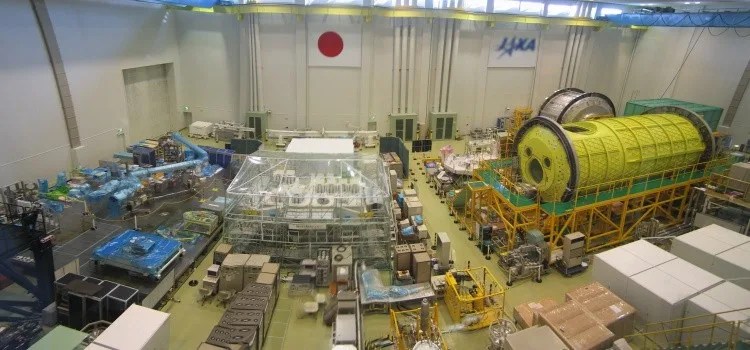
    The Japanese Aerospace Exploration Agency, or JAXA, is the national space agency of Japan. The JAXA works on various projects and develops major works for aerospace exploration both Japanese and global.

    The JAXA is responsible for investigations, technological developments, and satellite launches into orbit, developing many complex missions. For example, the exploration of asteroids and possible crewed explorations to the Moon. Its motto is One JAXA and its corporate slogan is Explore to Realize.

    History of JAXA

    The JAXA is the union of three organizations that were merged to form a single entity on October 1, 2003, to create the New JAXA: Institute of Space and Astronautical Science (ISAS), the National Aerospace Laboratory of Japan (NAL), and the National Space Development Agency of Japan (NASDA). The JAXA was formed to be an independent administrative institution, however, managed by the Ministry of Education, Culture, Sports, Science and Technology (MEXT) and the Ministry of Internal Affairs and Communications (MIC).

    Before the merger, ISAS was responsible for space and planetary research while NAL focused on aviation research. NASDA, founded on October 1, 1969, developed rockets, satellites, and also built the Japanese Experiment Module. NASDA also trained Japanese astronauts, who flew on U.S. Space Shuttles.

    In 2012, new legislation changed the mandate of JAXA to allow it to include military space developments for peaceful purposes, such as early warning systems for future missiles in Japanese lands and skies. With the political control of JAXA moving from MEXT to the Prime Minister’s Office with the inclusion of a new Cabinet for Space Strategy.

    JAXA - Japanese Aerospace Exploration Agency

    Rockets

    The JAXA uses the H-IIA rocket (H “two” A) belonging to the former NASDA along with its H-IIB variant for satellite launches for engineering tests, weather satellites, etc. For scientific missions that use, for example, X-ray astronomy, the JAXA uses the Epsilon rocket.

    Japan launched its first satellite, Ōsumi, in 1970, using the L-4S rocket from ISAS. Before the merger, ISAS used small vehicles for space launches with solid fuel. Meanwhile, NASDA developed launch vehicles with greater payload capacity.

    Initially, NASDA used licensed American models. The first launch vehicle model was made from the use of liquid fuel, the H-II model, from 1994. However, in the late 1990s, with two launch failures of the H-II, Japan began to be criticized regarding the technology of Japanese rockets.

    The first space mission of Japan under the name of JAXA was the launch of an H-IIA on November 29, 2003. It ended in failure due to the great pressure of the moment. After a hiatus of 15 months, JAXA successfully launched the H-IIA rocket at the Tanegashima Space Center, placing a satellite into orbit on February 26, 2005.

    JAXA’s Successes

    Before the birth of JAXA, ISAS had performed very well in its space program in the field of X-ray astronomy during the 80s and 90s. Another successful area for Japan was Very Long Baseline Interferometry (VLBI) with the HALCA mission. Other successes included solar observation, magnetosphere research, among other areas.

    JAXA - Japanese Aerospace Exploration Agency

    NASDA was primarily active in the field of satellite communication technology. However, since the Japanese satellite market is completely open, it was only in 2005 that a Japanese company won a contract for a civil communication satellite. Another focus of NASDA was Earth climate observation.

    The JAXA was awarded the John L. “Jack” Swigert, Jr. award from the Space Foundation for Space Exploration in 2008.

    Human Space Programs

    Japan has ten astronauts, but a crewed spacecraft has not yet been developed. A HOPE-X space project for the launch of an H-II, which was developed for several years, ended up being postponed. Several other projects have been proposed, some accepted, but postponed or not accepted.

    The first Japanese citizen to fly in space was Toyohiro Akiyama, a journalist sponsored by TBS, who flew on the Soviet Soyuz TM-11 in December 1990. Akiyama spent more than 7 days in space at the Mir space station, considered by the Soviets as their first commercial space flight, which allowed them to earn about $14 million.

    Japan participates in American and international programs, which include flights of Japanese astronauts. A mission for the space shuttle STS-47, in September 1992, was partially funded by Japan. This flight included the first astronaut from JAXA, Mamoru Mohri.

    The Japanese have plans for a crewed lunar landing, which is in development. However, the plans were shelved in 2010 due to budget constraints.

    In June 2014, the Japanese Ministry of Science and Technology stated that it was considering a space mission to Mars. In a document, it was mentioned an uncrewed exploration. Missions to Mars and long-term settlements on the Moon are objectives of JAXA, for which they seek international cooperation.

    Uchuu Kyoudai

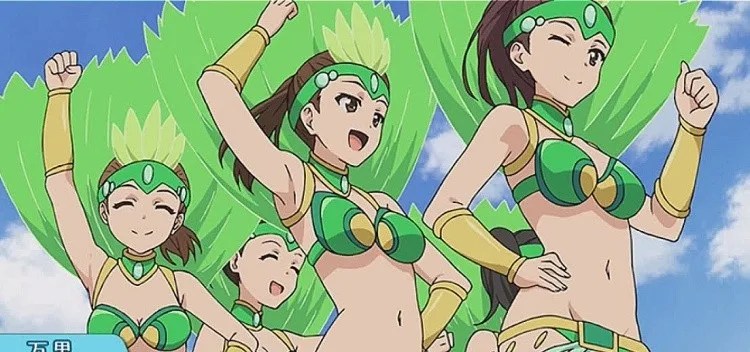
    You can learn a lot about Japan’s space station by watching the anime Uchuu Kyoudai.

    JAXA - Japanese Aerospace Exploration Agency

    Uchuu Kyoudai tells the story of two brothers: Mutta and Hibito, with Mutta being the older brother. When they were children, the two witnessed a UFO, and since then they promised to go to space. Years pass, and only Hibito becomes an astronaut and is about to go to the Moon. Meanwhile, his brother Mutta ends up losing his job for headbutting his boss.

    Mutta remembers his old dream, which due to everyday problems was completely forgotten. With the help of his brother, that dream could somehow be achieved. The anime shows the entire process necessary to apply and become an astronaut.

  • Creating Karaoke with Aegisub

    Creating Karaoke with Aegisub

    Are you used to watching anime and enjoy singing the opening, closing, and in-anime songs? If you end up watching anime from a speedsub, you won’t find the lyrics to the song. Sometimes, if it’s a qualitysub, then you’ll have that karaoke with special effects. For example: the syllables spinning, disappearing, catching fire, etc.

    However, sometimes we want a full karaoke video of the song, and we can’t find it on YouTube. Or maybe you want the lyrics written in Japanese, or even an AMV with the lyrics? In this article, we will talk about a program that will help you, called Aegisub.

    What is Aegisub?

    Aegisub is originally used for subtitling anime. As our site does not support piracy, we will not talk much about that in this article. We will only encourage you to subtitle your songs, openings, and endings.

    Basically, to create a karaoke you will only need a video and get the lyrics from the internet or even put in your own translated lyrics, if you know the language of the lyrics. To make effects and transitions in the subtitles, it will be necessary to have a little knowledge of the program’s tags and the Lua language.

    The program is available for all operating systems. The installation is very simple. After installation, you will soon need to choose an opening or clip of your choice to make the karaoke.
    Advantages of Aegisub – With this program, you can be able to:

    • Subtitle anime, movies, series, and videos;
    • Put the lyrics of the song in videos, openings, and endings;
    • Insert ready-made subtitles into videos;
    • Allows you to follow an audio graph while subtitling the video;

    Basic Aegisub Tutorial

    This program is a complete package, before you start using it fully, it’s good to know at least some tips and information for beginners:

    1 – The first step is to load the video to be subtitled. Go to the top bar of the program, click on Video  and click on Open video and select the file.

    2 – Before you start editing, it is necessary to open the audio of the video. Just go to audio and then Open audio from video.

    3 – Now, if you want to create a subtitle from scratch, click on file > new subtitles.

    4 – Write your subtitle in the text field at the corner, press play and pause where you want the subtitle to end. Repeat the process until you manage to subtitle what you want.

    Creating the Karaoke Subtitle

    In the link of the video below, created by me, there is a basic tutorial for creating a karaoke, but later I will create more articles and video lessons related to Aegisub and also about embedding the video with the subtitle and I will also talk about its tags.

    Sorry for the audio quality.

  • Shine shine little star – Japanese version

    Shine shine little star – Japanese version

    In today’s article, we will present to you the song Twinkle, Twinkle, Little Star in the Japanese version. For those who do not know, Twinkle, Twinkle, Little Star is a very famous lullaby. Its original version is called Twinkle, Twinkle, Little Star and was written by the British poetess Jane Taylor.

    The Japanese version is named kira kira boshi きらきら星 and is in the public domain. This has led to various different versions of this song emerging in Japanese and other languages. See below a video with the simplest and most famous version in Japanese.

    Song Lyrics – きらきら星

    きらきらひかる
    お空の星よ
    まばたきしては
    みんなを見てる
    きらきらひかる
    お空の星よ
    きらきらひかる
    お空の星よ
    みんなの歌が
    届くといいな
    きらきらひかる
    お空の星よ

    Repeats the first chorus.

    Romanized Lyrics – kira kira boshi

    kira kira hikaru
    o sora no hoshi yo
    mabataki shite ha
    minnna wo miteru
    kira kira hikaru
    o sora no hoshi yo
    kira kira hikaru
    o sora no hoshi yo
    minnna no uta ga
    todoku to iina
    kira kira hikaru
    o sora no hoshi yo

    Repeats the first chorus.

    Breaking Down the Song

    Below we will break down the Japanese version of the song:

    • きらきら – Twinkle
    • ひかる – Light, shine
    • – sky
    • – star
    • まばたき – blink, twinkle (of stars)
    • 見てる – see, look
    • みんな – people, everyone
    • – song
    • 届くと – arrive, reach, cross

    We can notice some different phrases such as:

    • Twinkle twinkle star in the sky;
    • It keeps blinking and everyone is watching;
    • The song of everyone will reach;
    twinkle twinkle little star

    Brazilian Version – Twinkle Twinkle Little Star

    • Twinkle, twinkle little star
    • I want to see you shine
    • Make believe it’s just mine
    • Only for you will I sing
    • Twinkle, twinkle little star
    • Twinkle, twinkle up in the sky
    • I’ll stay here sleeping
    • To wait for Santa Claus

    The Japanese version is similar to the Brazilian version in some ways, but the expressions change places. In the Japanese version, we also do not find the expression of Santa Claus, probably because there are not many Christians in Japan and Christmas is different. In the Japanese version, we also do not find the expressions “sleep” or “make believe it’s just mine.”

    Other Japanese Versions

    Another Japanese version of the song is below. Let’s quickly try to see its translation.

    おほしさまぴかり
    ぴかぴかぴかり
    あちらのそらで
    こちらのそらで
    おほしさまぴかり
    ぴかぴかぴかり
    • ぴかぴか – shine, sparkling
    • ほしさま – Mr. Star
    • あちら – direction, there, beyond, distant
    • そらで – in the sky

    What did you think of the Japanese version of the song Twinkle, Twinkle, Little Star? Do you know another popular version of the song? We await your comments and shares.

  • Vague Japanese – Does that mean yes or no?

    Vague Japanese – Does that mean yes or no?

    Japanese has few syllables, which is why many Japanese words are the same. This is usually not a problem thanks to the context. The big issue is the numerous meanings that are present in a single word. In today’s article, we will see some words that can confuse people. Words that even the Japanese themselves struggle to differentiate or explain, making Japanese vague.

    We already know words that are the same with different meanings and ideograms. Take the example of the word Hashi, which can mean bridge, chopsticks, edge, and bank. Another example is the word Kami, which can mean God, Paper, or hair. We have already addressed this in the article words that are the same with completely different meanings. But today we will address words that are the same but can give the opposite sense of their meaning.

    vague japanese

    Words with vague and opposite meanings

    This happens even with words we use in our daily lives, but we never stop to think about it. In Portuguese, this also happens when a person ends up offering something to us, and we say it’s okay or thank you; sometimes the person gets confused about whether we are accepting or not. The same thing happens in Japanese with the word daijoubu 大丈夫.

    The word daijoubu means to be fine; it is usually used as a response after something bad happens. Just like thank you, you can use it to reject something that is offered to you, saying that everything is fine and you don’t need it.

    Something similar happens with the word ii “いい”; in this case, it can be an abbreviation of 2 different words, 良い which means good and いいえ which means no. Suppose you invite someone to do something, and they respond sore wa ii – それはいい, it is more likely that you think they accepted, but it can happen that this いい means no.

    Another example that confuses any Japanese student is the phrase それ好きかも (sore suki kamo); some people end up using this phrase to say they like someone. The big problem is that the word かも means possibly, maybe, could, or can. So does this mean they like the person or not?

    Another quite vague response you might hear in Japanese is どっちでも (dotchidemo), which means either one or whatever. It may seem that the person does not care about the conversation or really does not want something.

    vague japanese

    Why is Japanese so vague?

    Another confusing word is yabai, which can mean something good or bad; we wrote an article discussing this word, you can read it by clicking here. Another slang is the word Ukero, which means to receive or take, but young people use it to mean ridiculous or hilarious. These are just a few of the thousands of vague words that exist in Japanese. Paying attention and knowing the context is the best way to identify its meaning.

    Japanese is full of vague expressions, and truly understanding the real meaning is not easy. Vague words prevent shy Japanese people from saying yes or no directly or clearly. Japanese people like to give vague answers to avoid hurting or saying something that is bad for another person; they also have difficulties expressing what they really think or their feelings. Perhaps this is one of the main reasons why Japanese has very vague words without a defined meaning.

    This article was inspired by episode 9 of the drama Nihonjin no Shiranai Nihongo, which I highly recommend for those who are learning Japanese. What do you think about these vague and undefined words in the Japanese language? Can you understand their meaning?

  • Do the Japanese eat dogs or insects?

    Do the Japanese eat dogs or insects?

    Many Westerners have deep-rooted prejudices about Japan and the Japanese, perpetuated by rumors and misinformation that have circulated for decades. Among the most popular are stories that the Japanese consume foods considered “disgusting,” such as rats, insects, dogs, frogs, and even human flesh. But does this have any basis in reality? Why do such myths continue to exist in the 21st century? This article explores these questions, providing an objective and fact-based analysis.

    Japanese cuisine is one of the richest and most respected in the world, known for its sophistication and nutritional balance. The association with unusual eating practices attributed to Japan generally arises from cultural confusions and misdirected prejudices. Let’s better understand the origins of these ideas and clarify what really is part of the Japanese diet.

    Do Japanese people eat dog meat?

    No, Japanese people do not eat dog meat.

    Unlike some Asian countries like China and South Korea, where the consumption of dog meat has been recorded in historical contexts, this practice is nonexistent in Japan. Dogs are widely seen as pets and treated as family members. Additionally, the cost and regulation of dog breeding in Japan make any idea of consumption unfeasible.

    The relationship of the Japanese with dogs is marked by care and respect, with many investments in veterinary clinics, pet supply stores, and even spas for animals.

    Read also: Consumption of dog meat

    Do Japanese people eat insects?

    Yes, but in extremely specific contexts.

    The consumption of insects in Japan is very rare and generally restricted to rural areas or traditional events. In some regions, such as Nagano, there is a custom of consuming inago (grasshoppers cooked with soy sauce) or hachinoko (bee larvae), but these dishes are exceptions and do not represent the modern Japanese diet.

    Historically, during periods of food scarcity, such as in the post-war era, the consumption of insects was a necessity for some rural populations. Today, such dishes are seen as cultural curiosities or a way to preserve regional traditions.

    The popular insects of Japan

    Do Japanese people eat cockroaches?

    No, cockroaches are not part of Japanese cuisine.

    Contrary to what some rumors suggest, cockroaches are not consumed in Japan and are seen as pests, just like in most countries. The confusion may come from countries like Thailand, where various insects, including cockroaches, are sold in street markets. In Japan, the focus is on fresh, high-quality foods, something that does not include unwanted insects like cockroaches.

    Do Japanese people eat human flesh?

    Absolutely not.

    Japan has strict laws prohibiting cannibalism. This absurd idea is usually the result of urban legends or an attempt at sensationalism to denigrate Japanese culture, further increasing prejudice. Respect for human life and cultural traditions is a deeply rooted value in Japanese society.

    Stop believing everything you read on the internet!

    Do Japanese people eat live creatures?

    Not exactly.

    A famous and often misunderstood dish is the Katsu Ika Odori-don, where the squid “dances” when served. However, it is important to clarify that the squid used is already dead at the time of preparation. Its head is severed beforehand, and the movements that seem “alive” are muscle reflexes activated when soy sauce is added, due to the sodium.

    This practice is not common in Japan and is usually offered as a culinary experience in specific restaurants. Despite being controversial for some, it reflects more of a scientific curiosity than a widespread eating habit.

    Katsu Ika Odori-don - The controversial squid

    Do Japanese people eat frogs?

    Yes, but rarely.

    In some specialized restaurants, frogs can be found on the menu, usually in dishes like stews or fried preparations. However, the consumption of frogs is very rare and does not form part of everyday life or traditional Japanese cuisine.

    Comparatively, in various regions of Brazil, such as the interior of São Paulo, frog meat is also appreciated and recognized for its flavor and texture. Just like in Japan, it is a delicacy consumed by a very restricted audience and in specific contexts.

    Do Japanese people eat whale?

    Yes, but in specific contexts and increasingly less frequently.

    The consumption of whale meat in Japan is a historical practice that dates back centuries, especially in coastal regions where communities relied on fishing and hunting for their livelihood. In the post-World War II period, whale meat was widely consumed due to food scarcity, but today it plays a much smaller role in the Japanese diet.

    We recommend reading: Whaling in Japan – Lies and Truths

    The origin of the myths

    The perpetuation of rumors about Japanese food often originates from a stereotypical and simplistic view that “Orientals are all the same.” This mentality ignores the cultural differences between Asian countries such as China, South Korea, and Japan.

    The Chinese influence on prejudices

    In China, the consumption of dog meat, insects, and other animals was a historically recorded practice, especially during periods of famine. Today, such customs are increasingly rare and subject to criticism both internally and externally. Still, this reality is often mistakenly associated with Japan, even though the two countries have completely distinct cultures.

    Sensationalism and lack of information

    Sensationalist media and videos about “shocking scenes” from Asian markets have contributed to the spread of these rumors. The absence of historical and cultural context fuels prejudices and creates a distorted view of Asian countries, including Japan.

    The True Japanese Cuisine

    The traditional Japanese diet, based on rice, fish, vegetables, and soy, is considered one of the healthiest in the world. The longevity of the Japanese is often attributed to these eating habits. Furthermore, Japanese cuisine has evolved to incorporate international influences while maintaining its essence and quality.

    To conclude that the Japanese consume “disgusting foods” is not only unfair but also misinformed. It is essential to deconstruct these prejudices and appreciate the richness and complexity of Japanese culture. How about taking the opportunity to try fresh sushi or artisanal ramen? You might be surprised by the delicacy and flavor of true Japanese cuisine.

  • Bullet train and the kingfisher; the penguin and the owl

    Bullet train and the kingfisher; the penguin and the owl

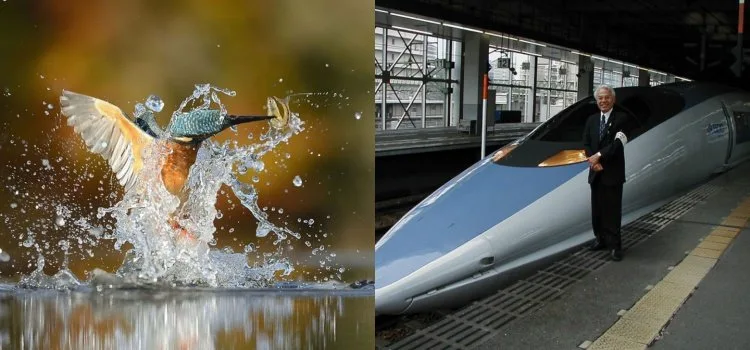
    Since always, man has been inspired by nature to create his inventions. Did you know that the nose of the bullet train, the shinkansen, was inspired by nature? In this article, we will understand a little about why the bullet train has a nose and what led it to have this.

    The first bullet trains in Japan reached an average speed of 200km/h. Japanese researchers always tried to improve the speed of the bullet train, however, they encountered a big problem. The sound emitted by the bullet train was very loud; when exiting a tunnel, a sonic boom occurred, and a vibration reached up to 400 meters away. The sound was waking up people living nearby and disturbing wildlife.

    Bullet train and the kingfisher; the penguin and the owl

    The solution to this problem was found by Eiji Nakatsu, an engineer and bird watcher. Observing the kingfisher feeding, he noticed that the bird could dive at high speed without splashing much water. He wondered how the kingfisher adapts so quickly to the transition from low air resistance to high water resistance. Its English name KingFisher can be literally translated as king fisherman.

    The beak of the kingfisher

    The train was designed and conceived around 1989 and 1995. The goal was to allow passengers to travel from Osaka to Hakata in about 2 and a half hours, which required an average speed of 350 km/h. The problem was noise, vibration, and pressure waves.

    The shape of the kingfisher’s head allows it to glide through the air and dive into the water to catch fish. It is the most efficient animal when it comes to transitioning from low pressure to high pressure. Thus, Eiji Nakatsu reshaped the nose of the bullet train imitating the kingfisher and eliminating the noise.

    kingfisher

    Thanks to the kingfisher, the air pressure produced by the train was reduced by 30%, it travels more quietly, 10% faster, and uses 15% less electricity. Thus, when the shinkansen passes through a tunnel, it does not produce a loud bang.

    Other inspirations from nature for the bullet train

    The kingfisher is not the only animal that inspired parts of the bullet train. The pantograph, a piece that connects the train to the power source, also used to make noise. Japanese researchers used the concave face of the owl and its serrated wings to reshape the pantograph and absorb this noise.

    Another animal that influenced the modeling of the pantograph was the penguin. It has a shape that allows it to move easily through the water to catch fish. The support axis of the pantograph was reshaped like the body of a penguin to reduce wind resistance and thus decrease aerodynamic noise.

    bullet train

    Thanks to these inspirations from nature, the generation of bullet trains in Japan has become faster and quieter. Thus, more than 64 million people can travel safely and peacefully on one of the best-designed and safest inventions in the world. The Japanese trust their designs so much that the bullet train doesn’t even have seat belts. Rail transport produces the least amount of greenhouse gases, in addition to being faster and safer. Thanks to the shinkansen, more than 2,000 traffic deaths are avoided in Japan.

    Not only the bullet train, but several other human inventions have been inspired by nature. What lesson can we take from this? I personally find it hard to believe that something like this came about by chance.

  • Japanese techniques and secrets for weight loss

    Japanese techniques and secrets for weight loss

    Being thin is part of the beauty standard in Japan and other Asian countries. You might be wondering, how do they manage to be so thin? There are several secrets and techniques that Japanese women use to keep their bodies slim and light.

    In this article, we will reveal some of these secrets to help you lose weight and slim your waist. We have already written an article discussing the secret of Japanese beauty, but in this article, we will go further and reveal some important techniques for weight loss.

    We also recommend reading:

    Lose weight with the right diet

    You should know that the Japanese diet helps a lot in keeping the waist slim. Japanese people drink a lot of tea, have miso soup daily, and consume plenty of vegetables and fish.

    Japanese people also use light cooking techniques and low temperatures to preserve the nutrients in food. They usually season food with various ingredients but use little salt.

    It is normal to eat rice, even at breakfast, which for some may cause weight gain due to being a large source of carbohydrates. But Japanese rice is richer in fiber than others. Noodles are also a nearly daily dish for the Japanese.

    A Japanese meal consists of small portions, various accompaniments of light broths, and a slower and healthier eating pace; they eat more than 5 varieties of vegetables in one meal.

    Japanese people also cook in an artistic way, which helps to satisfy and trick the stomach. They use chopsticks, which makes them eat less than a spoonful.

    Japanese techniques and secrets for weight loss

    There is also a great Japanese technique for weight loss called Hara hachi bunme. While most people stop eating when they are completely full, those who use this technique stop eating when they are 80% full.

    After 20 or 30 minutes, they decide if they are still hungry; if so, they have a small snack. The brain is not regular in indicating whether we are truly full or not, and this pause will help determine that.

    Eating slowly also helps the brain in this decision. We recommend you take a look at the Japanese Food Pyramid. Japanese cuisine greatly helps the Japanese stay slim.

    Also read: Japanese Food Pyramid – Japan’s dietary guide

    Japanese people lose weight by breathing

    A Japanese actor named Ryosuke Miki developed a technique that consists of spending two minutes a day focusing on taking long breaths and then exhaling aggressively. He was using this technique to alleviate back pain and noticed he was losing weight.

    This long breathing diet should be done in a specific position, inhaling for 3 seconds and exhaling for 7 seconds. There are 2 techniques:

    • 1 – Squeeze your buttocks to create ripples in your rear (check this by placing your fingers on the area formed by the compression), place one foot in front of your body, crossing your legs, putting 90% of your body weight on your back foot. You should inhale with your arms above your head;
    • 2 – Squeeze your buttocks and place one hand on your belly and the other on your lower back;
    Japanese techniques and secrets for weight loss

    In both techniques, you should inhale for 3 seconds and exhale for 7 seconds very strongly, tensing all the muscles.

    It is believed that the long breathing diet increases muscle strength and speeds up your metabolism, raising oxygen levels in the blood. The results are excellent for the spine and abdomen, resulting in a slimmer waist.

    Lose weight and improve posture lying down

    There is another famous weight loss technique that is also good for posture, called Fukutsuji. It was created by Toshiki Fukutsuji, a doctor who was developing a method to prevent poor posture.

    See also: Lose weight with the Japanese Fukutsuji method

    The technique consists of taking a regular towel, rolling it up, and tying it to create a sausage shape. Then the person should lie on their back on a hard, flat surface and place the towel at the level of their navel, where the spine begins to curve.

    Japanese techniques and secrets for weight loss

    When you are straight and in the correct position, you should place your feet shoulder-width apart with your toes pointing towards each other.

    Stretch your arms above your head with your palms facing down and your pinky fingers touching each other. You should do this procedure for 5 minutes. It is recommended to do it 3 times a day for better results.

    Another similar technique involves lying down and tying your big toes together with a hair elastic. This technique helps to position the pelvis correctly and prevents fat from concentrating in the abdominal area.

    Losing weight with Japanese exercises

    Another quite famous technique consists of taking a towel and holding each end, then making movements like the infinity symbol (∞) or a sideways 8.

    Make 10 movements on each side with your back straight and arms extended. Only your arms should move; hold the towel firmly. It is not recommended for people with back problems. If it hurts, stop!

    We notice that most of the exercises here involve contracting the abdomen and keeping the spine straight. Exactly, for weight loss, this is essential. I hope you enjoyed these Japanese techniques. Have you tried any of them? Leave your experiences in the comments.

    To conclude the article, I will leave a video from my friend Roberto Pedraça teaching 3 tips on how to lose weight used by the Japanese:

  • The most bizarre festivals in Japan

    The most bizarre festivals in Japan

    Japan is famous for its numerous festivals that take place throughout the year. Some go beyond the limit and become something bizarre and strange for us Westerners, or perhaps even for them. In today’s article, I have selected some bizarre and strange festivals for you to feel like participating.

    Hokkai Heso Matsuri

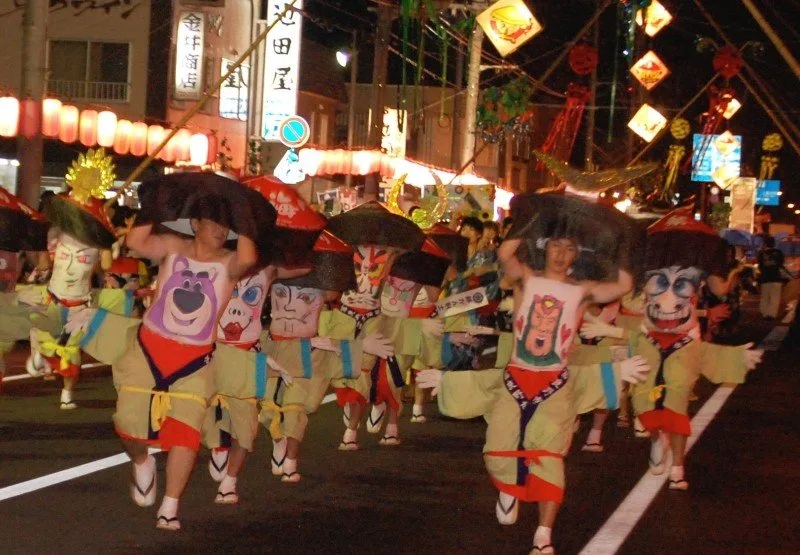
    In the city of Furano in Hokkaido, the Heso Matsuri or Belly Button Festival takes place. In this festival, participants paint faces on their bellies and wear special costumes that give the belly face a “body”.

    They then dance to compete for prizes, although perhaps the real winners are the spectators! This is a fun game with about 5,000 participants exposing their bellies on the 28th and 29th of July each year (article cover photo).

    Kanamara Matsuri

    The Kanamara Matsuri is a very popular festival in Japan and is known internationally. Held annually on the first Sunday of April, Shinto priests carry around a portable shrine called mikoshi with a metal penis on top of a boat-shaped structure.

    In modern times, many people gather to take pictures of the metal member and buy souvenirs like lollipops, chocolate-covered bananas, and other somewhat curious items. Then they complain about saying that Japan is strange and bizarre.

    bizarre festivals

    Hitorizumo Matsuri (sumo)

    In Ehime Prefecture, a great battle for the fate of the rice crop takes place every May 5th, or Children’s Day. This fight is held at the Oyamazumi Shrine on Omishima Island. This battle is fought by a sumo wrestler against the spirit of rice. That is, someone invisible. How will we know if the sumo wrestlers are not cheating when they say they won the fight?

    Hadaka Matsuri – Naked Men Desperate for an Amulet

    Many who visit Japan need to prepare for nudism in public places like onsen (hot springs) and sento (public baths), places where modesty is left at the entrance. So it is no surprise that there are festivals that celebrate nudism.

    In Hadaka Matsuri, men wear nothing but a fundoshi (loincloth). The most famous takes place at Saidaji Temple in Okayama Prefecture. In this festival, about 10,000 male participants wear loincloths in a tight space rubbing against each other. They desperately compete for lucky amulets called shingi.

    bizarre festivals

    The festival takes place on the third Saturday of February each year, and the weather is absolutely freezing. In addition, participants take a plunge into cold water! Are you brave enough to face this violent and testosterone-filled weather?

    Nakizumo Festival

    Nakizumo is a festival aimed at bringing good health to babies, but for that, they must cry. During the time of Sensoji in Tokyo, about 60 babies are taken to a sumo ring, where wrestlers gently shake the babies, and the one who cries first wins.

    A referee is on hand shouting “NAKE, NAKE!” (“Cry, Cry!”) and if the babies still do not cry, some volunteers with masks enter the ring to scare the children and speed up the process. Nakizumo competitions take place in various parts of Japan, and depending on the region, the baby that cries first is the loser! This ritual has been happening for about 400 years, although the event at Sensoji Temple only started in 1991.

    Pantu Festival

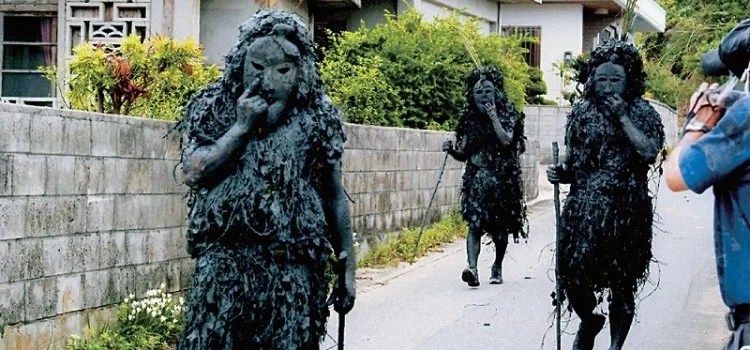
    Actually, there are two versions of this festival, both practiced in Miyako on the island of Okinawa. Both involve the Pantu, supernatural beings that exist somewhere between gods and demons and wander the city with a procession of priests to drive away evil spirits. It is believed that the festival is related to similar festivals in Indonesia and Micronesia.

    The festival in the Hirara Shimajiri area is called Pantu Punaha, and it is the last of three festivals held at different times throughout the year, collectively called Pantu Satupunaha. One of the modalities of this festival involves three men covered in grass and mud walking around everywhere. They carry sticks in one hand and a scary mask in the other. People who get dirty by the Pantu will have a year of protection. Homeowners also invite the Pantu to bless their homes.

    bizarre festivals

    Namahage Matsuri

    Another strange festival used to scare children is the Namahage Matsuri. The Namahage is a demon that wears a mask and goes around scaring children in the city of Oga in Akita. On New Year’s Eve, the Namahage walks around the area dancing and shouting at lazy and disobedient children.

    Parents invite them into their homes, offering mochi (rice cake) and sake in exchange for the promise of good health and a good harvest in the new year. But these “demons” make sure to scare a little the disobedient children before moving on to the next place. The video below shows the entire process, from the purification of the Namahage.

  • How to better manage your time and produce more?

    How to better manage your time and produce more?

    What people complain about the most is the lack of time, even those who have a lot of free time end up not being able to take time to produce or do what they want. Some believe that working for themselves or having flexible hours is more than enough to accomplish what is necessary and desired. However, many end up wasting a lot of time browsing social media, sleeping, playing, and watching, and end up leaving important things aside.

    How can you make better use of your time and produce more? In this article, we will talk about this and provide some tips that will help you manage your time better and be more productive.

    Managing your time better

    To produce more in less time, you need to manage your time better. To do this, we recommend that you define your priorities, plan, and simplify. You should also avoid things that steal your time.

    Defining your priorities – Have you made a list of what you need to do and determined whether that task is important or not? One of the main things you need to do is organize yourself through a list, calendar, checklist, etc. Even mind maps can help you manage your time better and produce more.

    How to manage your time better and produce more?

    Maybe you like to be free and don’t want every minute of your life to be controlled by a schedule. It’s not easy to define the importance of a task, much less to follow a list or calendar, but if you can’t do that, you won’t be able to manage your time well.

    The first step is to define what is most important to you; if you can’t follow your list because of other things, try simply eliminating the useless things. Know how to say “no” to things that are not important or that consume time. Avoid trying to do too many tasks, otherwise, you will never be productive.

    Don’t waste your time

    The things that steal time the most, besides distractions, are indecision, procrastination, and perfectionism. Analyze each of these 4 points below calmly and make two changes! Eliminate what hinders you!

    Distractions – Social media, music, YouTube, cell phones, WhatsApp, games, series, laziness, visits, etc. The number of distractions that steal your time never ends. But it is not possible to eliminate distractions; it is necessary to learn to live with them. It’s not hard to avoid using them when you are dedicating yourself entirely to productivity. Just close them, put them on silent, etc.

    Indecision – I am super indecisive; I have a great difficulty in choosing things. Ideas are not lacking, but which one to start with? How to do it? How much time should I spend? If you have difficulty choosing, just pick any one and that’s it! Avoid wasting your time deciding what is best, otherwise, you will end up with nothing.

    How to manage your time better and produce more?

    Procrastination – One of the most complicated things; I myself have a lot of difficulty with this. I ordered a book to study a language, and it has been two years and I have never picked it up to study the language, and this language is part of my work. Procrastination is the act of postponing things; avoid postponing things, be punctual. It’s not easy, but it’s worth it.

    Perfectionism – If you are a person who seeks perfectionism, it’s better to give up. Even with all the time in the world, you will not be able to produce perfect things. Don’t keep looking for perfection! Be aware that everyone makes mistakes, and you shouldn’t worry about that.

    Tips to produce faster

    There are several tips that people use to produce more in less time. Let’s list some and detail others, and you can try to apply them in your life.

    • Get a good rest;
    • Use methods that facilitate production;
    • Maintain a good diet;
    • Set aside a time just for producing;
    • Have focus;
    • Set a deadline;

    To be productive, you must eliminate distractions and plan everything we talked about during this article. Also, have energy to produce; a good diet and rest are super necessary.

    How to manage your time better and produce more?

    Do you work on the computer? Why not use tools to speed up your work? Why not try working standing up? This helps some people produce faster and avoid distractions. Remember that to produce, you need to have focus and a schedule. If you set deadlines and are a responsible person, you will try to meet them.

  • Punctuation and special characters of the Japanese language

    Punctuation and special characters of the Japanese language

    Like any language, Japanese has punctuation and special characters called yakumono (約物).  These punctuations include various marks, exclamation, question mark, commas, and some special characters that do not exist in Portuguese. In this article, we will briefly learn about some punctuations and special characters and how to use them.

    In this article, we will not talk about dakuten, because there is already a specific article about it, and it falls more into the category of accentuation. We have also written an article discussing space in the Japanese language. 

    It is worth noting that on the keyboard, these punctuations are usually spaced, making it unnecessary to include a space after them to start writing. Punctuation began to be used in Japanese around the 19th century, influenced by European languages.

    Punctuation in the Japanese language

    Comma – tōten – 読点 – The comma in the Japanese language is inverted, being (、) instead of (,). It is commonly used in many contexts to mark separated elements within a sentence.

    Ellipsis – riidaa – リーダー – The famous three dots (…) in the Japanese language are called ellipses or dotted lines. It indicates an intentional omission or abbreviation, a pause in speech, or an unfinished thought. Rarely do you find other variations written with only 2 dots or more than 3 with a similar meaning.

    Period – kuten – 句点 – The period at the end of Japanese sentences is usually larger and has a hole in the middle (。). Unlike the Western period, it is often used to separate consecutive sentences instead of ending each sentence. It is also often omitted if the sentence stands alone or if the text ends with quotation marks.

    Exclamation mark – kantanfu – 感嘆符 – It is generally used after an interjection or exclamation to indicate strong feelings or loud volume, usually marking the end of a sentence.

    Question mark – Gimonfu – 疑問符 – In normal Japanese, no symbol is used to mark interrogative sentences; it is usually understood to be a question just by the か. However, the question mark is often used in casual, creative writing or in manga, especially in sentences that are questions but do not end with か.

    Points and special characters

    Colon – koron – コロン – In Japanese, it is used to inform the reader that what follows proves, clarifies, explains, or enumerates elements referred to before (:).

    Dash – Nakasen – 中線 –: The Japanese dash (―) can place things side by side for explanatory emphasis, expressing something like “from… to…”. It can also be used to add names and numbers in addresses separately. Be careful not to confuse it with the dash used to extend the sound of katakana.

    Partial alternation mark – The mark () is often used to indicate that the excerpt was taken from a song, or that the person in the text is singing. Also known by the names ioriten 庵点 or utakigou 歌記号.

    Musical note – ♪ – As the name suggests, it is used to indicate lyrics of a song, or that someone is singing the phrase.

    Repetition Signs

    Some important signs are often used to replicate or repeat a Japanese character.

    • Dounojiten (々・仝): Used to double a Kanji or composition;
    • Ichinojiten (ヽ): Doubles the previous Katakana;
    • Katakanagaeshi (ヾ): Doubles the previous Katakana with dakuten;
    • Hiraganagaeshi  (ゝ): Doubles the previous Hiragana;
    • Hiraganagaeshi  (ゞ): Doubles the previous Hiragana with dakuten;

    Interposition point – nakaguro – 中黒

    It can be literally translated as black center, represented by a black dot in the middle (). It can be used to:

    • Separate Japanese words where the intended meaning would not be clear if the characters were written side by side;
    • Separate listed items instead of a comma;
    • Separate foreign words and names written in katakana;
    • Separate titles, names, and positions;
    • Functions as a decimal point and a double hyphen;
    • Used instead of hyphens, dashes, and colons when written vertically;

    Wave dash – Nami dasshu – 波ダッシュ

    Similar to the tilde accent, the difference is that it stays in the middle (〜). It is often used to:

    • Indicate ranges, used instead of kara and made;
    • Separate a title from a subtitle on the same line;
    • Mark subtitles; Indicate origin フランス〜 (from France);
    • Indicate a long or prolonged vowel with a comedic or beautiful effect;
    • Indicate or suggest that music is playing;

    Brackets and Quotation Marks – kakko – 括弧

    In Japanese, there are several types of brackets. They are used in pairs to separate or interpose text within another text. In vertical writing, these brackets are rotated 90º.  See a list of brackets below:

    • { } – namikakko (波括弧);
    • ( ) – marukakko (丸括弧);
    • [   ]  – kakukakko (角括弧);
    • 【   】  – sumitsukikakko (隅付き括弧);

    Brackets or parentheses are also used to:

    • Show readings and additional information;
    • In mathematics or geometry;
    • Show hidden information, close a mathematical interval 【   】[   ];
    • Delimit words or lines{ }.
    • In addition to brackets, there are quotation marks represented by (「 」 and 『 』). They have the same function as quotation marks in the Portuguese language, with few rules and different changes. Double quotation marks (『 』) should be used when a quotation is within another.
  • Wage inequality of women in Japan

    Wage inequality of women in Japan

    One of the complaints I often hear regarding Japan is the salary difference between women and men. While a man earns 1200 yen per hour, a woman in a similar job receives only 1,000 yen. This seems unfair, but to what extent is this wage inequality?

    The salary difference between women tends to be large, and there is a huge range of factors responsible for this. While men can earn around 350,000 yen per month, there are women doing the same job who earn around 250,000 yen. The difference between the average salaries paid to men and women corresponds to 25.9% of the average salary of men.

    Remembering and making it clear here: Do not generalize! 

    Why do women earn less?

    There are several factors that explain this distortion in Japan’s wage patterns. Let’s see a list below:

    • The national and international trends that influence the diverse Japanese labor market have contributed to greater gender inequality;
    • The working hours of women tend to be shorter;
    • Women are often employed in lower-paying occupations;
    • Employers believe that women should earn less because they should exert less effort than men;
    • Loopholes in laws allow companies to pay women less than men for the same work;
    • The wage gap is more evident in factories;
    • A small hint of machismo still prevails;
    • Many women end up leaving their careers due to family, which scares companies from investing too much in them;

    There is still a philosophy that men should take on the role of head of the family and breadwinner, while for women, a part-time job is enough to supplement the income.

    Wage inequality of women in Japan

    Women’s work in Japan

    Women fill 63% of baito or part-time jobs in Japan. The consequence of this is that non-regular workers earn 38% less than the average regular workers. Women dominate jobs in hotels, restaurants, etc.

    This wage difference has been gradually decreasing. Gender inequalities in the Japanese professional world have significantly decreased for university graduates. Nowadays, women have shown themselves capable and tend to hold more than 15% of high-level positions in companies. The Prime Minister of Japan wants at least 30% of women to hold these positions in all possible areas.

    Japan is the land of opportunities for anyone who wants and seeks. If even foreigners can secure significant positions in companies, women have shown their ability to excel and be well compensated.

    According to research, it is common for Japanese women to resign due to feeling uncomfortable with their salaries, promotions, and the rare leadership roles they receive.

    Take the beam out of your eye, Brazil!

    Everyone should complain and fight for equal rights; the big problem is that many think this only happens in Japan. Some even attack Japan, saying it is a sexist and very unequal country. The big problem is that unfortunately, Brazil ranks among the last places in the salary equality ranking, at least it has been second to last. So before starting to use Japan as an example of a country with wage inequality, it is good to reevaluate our own country.

    Wage inequality of women in Japan

    The wage difference between men and women in Brazil can reach up to 40,000 reais per year. To note that Japan is not so sexist, it has a portion of 22% of female members in government, while Brazil has only about 15%.

    Although the salaries of Japanese women remain lower than those of men, their average is still 8,000 reais per month. Even though the economy and cost of living in Japan are more expensive (not as much as one might think), the purchasing power of the Japanese is much greater.

    The wage difference between men and women is a global problem, and unfortunately, research reveals that this will only disappear in 135 years. What do you think can be done regarding this issue?

  • Izanagi and Izanami – Creator gods of Japan

    Izanagi and Izanami – Creator gods of Japan

    The stories of the gods Izanagi and Izanami, where Izanagi means ”The one who is invited” and Izanami ”The one who invites”, are stories told by the books Nihongi and Kojiki created in the 8th century around the years 710 to 720. These two books contain stories of mythological legends and also accounts of historical events from the 8th century. Basically, Japanese mythology explains the creation of the world, how the gods emerged, and the origin of the Japanese emperors.

    The emergence of Izanagi and Izanami

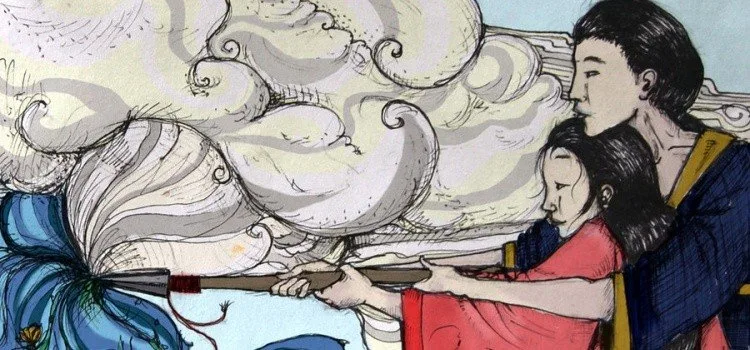
    After the creation of heaven and earth, the superior gods were to gather for a meeting to debate and decide what the fate of the earth would be. Thus, the superior gods came to the conclusion to bring into existence two divine beings, whom they called Izanagi and Izanami. These two gods would represent the earth and the sky. The superior gods gave them a spear called Amenonuhoko and proposed that they create their own homes.

    Izanagi and Izanami went to the floating bridge of heaven and waved the spear of heaven (amenonuhoko) over the ocean. After they pulled the spear from the water, the drops that dripped into the ocean formed an island called ”Onogoro-Shima”. On this island, they fell in love with each other and decided to marry and have children. Therefore, they created a wedding ceremony and also made a sacred pillar that they circled in different directions, with Izanagi going to the right and Izanami to the left.

    After the wedding, the couple had two children, Hiruko and Awashima. Both were born imperfect and were placed in a boat that was carried away by the currents of Onogoro-Shima. The couple decided to seek explanations from the superior gods, and they said that the initiative for sexual intercourse had to come from Izanagi and not from Izanami.

    Izanagi and izanami

    The death of Izanami and the underworld

    Then Izanagi and Izanami followed this indication from the superior gods, and numerous deities were born, many of which are very popular today. She also gave birth to the islands that form Japan. The fire god Kagutsuchi was the last child to be born, for shortly after Kagutsuchi’s birth, he ended up burning Izanami, who thus died. But even in death, Izanami’s body continued to give birth to dozens of gods.

    In great anger and hatred towards his son, Izanagi decapitated Kagutsuchi with a sword. As he raised the sword, the drops of blood from the fire god that spilled from the sword generated eight gods, and from the dead body emerged eight mountain deities.

    Distressed, Izanagi then went to Yomi (hell) to try to bring Izanami back to life. It didn’t take long for him to find her; she was at the gate of hell. Izanami demanded that Izanagi wait far enough away so that he could not see her in the darkness. Izanami told Izanagi that it was too late because she had already eaten the food of Yomi. Izanagi, shaken by the news, agreed to return to the upper world. As a farewell act, he asked to be allowed to sleep at the entrance of the underworld near her. And Izanami slept peacefully, but Izanagi could not sleep because he would live without the company of his beloved wife.

    Izanagi decided to see his wife’s face one last time before returning to the upper world. So, while she slept, he took a hairpin that held Izanami’s hair and set fire to the pin to serve as a torch, and the light of the torch illuminated the entire place. Izanagi was shocked and disgusted to see that his wife Izanami was decomposing and full of worms, snakes, and other demonic creatures wandering over her body.

    Izanagi and izanami

    The fury of Izanami

    Izanami became furious at her husband’s audacity. She sent thunder gods, horrendous women, and an entire army of Yomi soldiers to eliminate him. After managing to escape from all these demonic creatures, Izanagi closed the passage that connected the underworld to the upper world with a huge rock, and then Izanami, on the other side of the rock, spoke to Izanagi, and the two ended their marriage. Izanami promised Izanagi that she would kill a thousand men in one night. Then Izanagi asserted that he would bring forth 1,500 men. From then on, Izanami would represent death, due to her pride and suffering.

    After these events, Izanagi went to purify himself in the sea, as he felt somewhat dishonored. During this process, several evil gods were generated from the dirt and impurities of his body. When he washed his face, the most important gods emerged: Amaterasu (the sun goddess) who was born from his left eye, Tsukuyomi (the moon god) from his right eye, and from his nose emerged Susanoo (the god of the seas and storms).

    There are dozens of stories of gods that emerged from Izanami and Izanagi, and these stories are fantastic. The mythological legends of Japan are great and there are references to them everywhere, whether in anime, games, and others. We hope this article has served as a source of knowledge on the subject.

    We also recommend reading: 

  • Magnesium – The secret of the longevity of the Japanese

    Magnesium – The secret of the longevity of the Japanese

    In this article, we will talk about a chemical element essential for human life that has influenced the longevity of the Japanese. We know that Japan is one of the countries with the highest number of centenarians in the world and an archipelago full of volcanoes. Japan has soil rich in magnesium, while Brazil is poor due to the use of chemical fertilizers.

    Its presence in the soil makes the crops, water, including hot springs, rich in this and several other minerals. In Brazil, it is common to find Magnesium Chloride a type of supplement that can be consumed daily for health benefits.

    In Japan, you can find Nigari a type of magnesium found in crystal form or a type of salt that is used in the preparation of tofu, soy milk, miso, and other beverages. Nigari is obtained from seawater through a process of filtration, centrifugation, and concentration that gives rise to Nigari crystals.

    Types of Magnesium

    Although magnesium is a chemical element, there are different types of magnesium that are marketed, each with a different function and indication.

    • Magnesium Chloride – To detoxify cells and tissues, stimulate metabolism;
    • Magnesium Hydroxide – Milk of magnesia
    • Sulfate – Epsom salt / Bitter salt – To relieve asthma and relax muscles (dangerous);
    • Citrate – Used as a mild laxative and for constipation;
    • Oxide – Has a poor absorption rate;
    • Chelate – For headaches and migraines;
    • Taurate – For people with cardiovascular problems;
    • Malate – For people suffering from fatigue;
    • Glycinate – Less likely to induce diarrhea;
    • Carbonate – For those suffering from indigestion and acid reflux;
    • Glutamate and Aspartate – Avoid as it is dangerous;

    Each type of Magnesium has other chemical compositions present, so we do not recommend taking any before consulting a doctor. The most common one that can be consumed without problems is magnesium chloride.

    magnesium

    Benefits of Magnesium for Health

    The benefits of Magnesium for health are enormous. It is essential for human life and has done a good job in Japan, making the Japanese appear youthful and preserving the lives of the elderly for longer. Below is a huge list of benefits of consuming Magnesium:

    • Acts as a blood purifier;
    • Is rich in calcium, strengthening bones;
    • Helps eliminate acid that accumulates in the kidneys;
    • Stimulates brain functions and nerve impulse transmission;
    • Stimulates the proper functioning of the cardiovascular system;
    • Reduces levels of bad cholesterol;
    • Is a powerful anti-stress agent;
    • Prevents problems like hemorrhoids;
    • Prevents cramps;
    • Fights fatigue and helps prevent muscle tiredness;
    • Fights and prevents muscle injuries;
    • Regulates body temperature;
    • Prevents prostate problems;
    • Fights cancerous tumors;
    • Strengthens the immune system;
    • Prevents premature aging;
    • Prevents osteoporosis;
    • Prevents the formation of kidney stones;
    • Reduces PMS symptoms and stimulates hormonal regulation;
    • Fights free radicals, preventing tumors and warts;
    • Promotes cleaning of the arteries, preventing arteriosclerosis;
    • Helps regulate blood pressure and combat hypertension;
    • Prevents stroke;
    • Helps with intestinal problems and colic;
    • Helps fight depression;
    • Helps fight epilepsy;
    • Helps fight multiple sclerosis;
    • Helps fight Parkinson’s;
    • Prevents kidney stones;
    • Helps with dizziness and nausea;
    • Helps against thyroid issues, bronchitis, and asthma;
    • Helps maintain a healthy weight;
    • Improves sleep;
    • And many others;

    The only contraindication for magnesium consumption is for people suffering from diarrhea, and some kidney diseases. Remember that taking antibiotics can reduce the effectiveness of some of them.

    magnesium

    Foods Rich in Magnesium

    Magnesium is usually present in the sea and in the soil. So basically, most planted foods can be rich in magnesium if the country has soil rich in that sense. The fact that Japan is surrounded by the sea and has many volcanoes influences this. However, there is a list of foods where you can find Magnesium, let’s see below:

    • Nuts, coconut, almonds and chestnuts;
    • Seaweed, fish, leafy greens;
    • Fruits like banana, apricot, peach, and plum;
    • Pure cocoa and dark chocolate;
    • Avocado, sweet potato, alfalfa sprouts;
    • Cereals like oats and brown rice;
    • Pumpkin seeds, sesame, sunflower, lentils, and peas;
    • Brewer’s yeast, quinoa, and others;

    Symptoms of Magnesium Deficiency

    If a person suffers from magnesium deficiency, they may experience the following symptoms:

    Dizziness, nausea, loss of appetite, constipation, headaches, vertigo, weakness, and constant fatigue, pressure in the chest, difficulty swallowing, sensation of a “lump” in the throat, tremors and insomnia.

    If the deficiency is severe: frequent cramps, blurred vision, swelling and tingling in the extremities, photophobia (sensitivity to light), seizures, mood changes, hallucinations and delirium, abnormal heart rhythm, cartilage degeneration, and others.

    Therefore, we strongly recommend foods rich in this mineral or even starting to take magnesium chloride for the sake of your health! What did you think of the article? Did you already know about these thousands of benefits? Have you felt the results?

  • The 15+ best Harem animes for you to watch

    The 15+ best Harem animes for you to watch

    Do you know what harem animes are? They are not perverted animes with ecchi where the main character ends up with several girls. Harem animes are any types of animes where the main character is surrounded by other characters of the opposite sex and ends up creating a romance with some of these characters.

    Harem genre animes are a Russian roulette. This is because most Japanese animes have some type of harem, and often this idea ends up going wrong and ruining the anime. However, there are some harem genre animes that turned out very well, and in this article, we will see the best harem animes of all time.

    The requirement for the animes on this list is to have at least 3 characters as romantic options for the main character. We will separate the animes into categories for you to better understand which anime you want to watch.

    We will not number the animes in rankings; this list will only have the best ones. As always, I will try to make a simple and quick synopsis for you to decide if you want to research and watch the anime.

    Animes where the character chooses someone

    Unfortunately, in most harem animes, the character is a loser who ends up dating no one and being alone. This category is dedicated to the best harem animes where the main character dates or hooks up with everyone.

    harem animes

    Zero no Tsukaima – In this anime, Saito is summoned by Louise from another world who is a student at a magic school; he ends up becoming her pet. Although the story seems cliché, this is one of the best romantic comedy animes of all time.

    Nisekoi – The anime tells the story of 2 kids who made a promise to meet again; the main character is in love with a girl and, at the same time, is looking for his childhood girl. Things happen, and he is forced to date the mafia’s daughter, whom he can’t stand. A great romantic comedy full of suspense and gripping scenes. The manga has already finished, and the character chose his girl.

    Kimodameshi – The courage test

    Love Hina – A classic of animes, one of the first successful harems that even received a Portuguese dub. The anime tells the story of Keitaro, who wants to enter Tokyo University but has failed the entrance exam 3 times; he ends up being forced to work as a janitor in a boarding house where only women live. (One of the first animes I watched in my life.)

    Harem Animes with ecchi

    The list below contains harem animes with ecchi where the character hooks up with the girls or vice versa.

    harem animes

    To Love Ru – This is one of the most popular harem animes with ecchi of all time, with more than 3 different seasons and a strong appeal for romance, ecchi, and harem. The anime tells the story of an alien who ends up falling to Earth, where she meets a boy and forces him to marry her, even though he likes another girl. This ends up generating numerous accidents and the appearance of several other characters to form the harem.

    The best ecchi animes of all time

    High School DxD – Finally, a harem and ecchi anime where the main character is not a loser. The anime mixes demons, comedy, fights, breasts, and a lot of fanservice, becoming one of the most popular in the genre.

    Kiss x Sis – One of the most perverted harem animes of all time, where the character is surrounded and attacked by 2 perverted stepsisters who are in love with him, in addition to other characters that appear in the anime. This is one of the best options for those looking for this genre.

    harem

    School Days – The anime tells the story of a boy who is in love with a girl, and a friend helps him win her over, until many things happen. (Highly Recommended) xD

    Ichiban Ushiro no Daimaou – A comedy and fantasy anime about a student who wants to become a wizard. However, he discovers that he is destined to become a Demon King, knowing this, he tries to fight against this destiny.

    Grisaia – This anime has a very complex story, and the main character finally dates the girls. The anime contains psychological thriller, past stories that will captivate and move you.

    Light Harem Animes

    The animes below do not have ecchi or fanservice as the main focus. They are animes focused on comedy, story, romance, and action without excessive sensuality.

    harem

    Hentai Ouji to Warawanai Neko – A small harem full of comedy that tells the story of a character who says perverted things, a girl who never smiles or expresses feelings, and cat statues. The anime is great and has an original story that captivates you and makes you laugh.

    Boku wa Tomodachi ga Sukunai – An anime that shows a character with difficulties making friends who ends up joining a club full of problematic girls.

    Kami nomi zo Shiru Sekai – The anime tells the story of a boy who prefers the 2D world and spends his time playing games to win girls. He receives a challenge that forces him to win girls in real life; otherwise, his head will be cut off.

    harem

    Mayo Chiki! – The comedy anime tells the story of a boy with a fear of girls; he meets a girl who disguises herself as a butler and promises to help him cure this fear.

    Kore wa zombie Desuk ka? – A comedy that tells the story of a protagonist who dies and becomes a zombie and lives surrounded by a magical girl, a necromancer, and a ninja vampire.

    Sora no Otoshimono – Tomoki is a normal boy who likes to live in peace until one day a mysterious android girl appears saying she will grant all his wishes, turning his life into chaos. The anime focuses on comedy with a bit of ecchi.

    Other Harem Animes

    The list will not stop there; to complement and finalize the article, we will leave a list of other harem animes that are among the most recommended on myanimelist.

    • Yamada-kun to 7-nin no Majo;
    • Isekai no Seikishi Monogatari;
    • Sekirei;
    • Date A Live;
    • Monster Musume;
    • Rosario to Vampire;
    • IS: Infinite Stratos;
    • Strike the Blood;
    • Hayate no Gotoku!!;
    • Trinity Seven;
    • Shinmai Maou no Testament;
    • Gakusen Toshi Asterisk;
    • Yosuga no Sora;
    • Freezing;
    • Nyan Koi!;

  • Why are there no spaces in Japanese? When to use them?

    Why are there no spaces in Japanese? When to use them?

    If you are a Japanese student, you must have noticed that it does not use spaces between words in most sentences. However, in some texts, you can indeed notice spaces between some words or phrases, leaving you a bit confused. In this article, we will understand why the Japanese do not use spaces in their language and when they do.

    Why does Japanese not use spaces?

    The fact that Japanese is a language formed by syllables and has 3 different writing systems makes spaces unnecessary. In addition, particles, verb endings, and expressions make it easy to understand sentences and separate words without the need for spaces. Japanese sentences tend to always have a pattern, which helps in the separation of words.

    Another factor that contributes to the lack of space in the Japanese language is that many kanjis and words are quite short. If they used spaces to separate words, it would be very strange to read something like this: 私 は ケビン です。When it is very easy to read and separate the words in this sentence 私はケビンです。Also, note that the space on the Japanese keyboard is larger than in other languages.

    The biggest difficulty of the lack of spaces in Japanese is the particle (wa) which can rarely end up being the beginning of a word and leave you totally confused. The lack of spaces is yet another reason to understand the importance of Kanji in the Japanese language. In any case, spaces in Japanese are unnecessary because the separation of words is already quite obvious. Of course, for those who are learning, it can be confusing.

    Why are there no spaces in Japanese? When to use them?

    When does Japanese use spaces?

    The Japanese language usually only uses spaces when it is the end of a sentence separated by a comma or period. Sometimes, spaces are used to separate clauses, especially when punctuation is left out.

    Spaces are also used in texts made for children or written only with hiragana or katakana. Sometimes, you may find rare spaces in manga, novels, and some textbooks. You may also find spaces in karaoke or movie subtitles, but in that case, it is due to pauses. There may be a space between the first name and the family name.

    Curiosities regarding space

    • It is not necessary to leave a space after a comma, parentheses, brackets, or punctuation. On the Japanese keyboard, these characters are already written with a space;
    • The word space in Japanese came from English スペース (supēsu). Do not confuse it with the word for outer space, which in Japanese is 宇宙 (uchuu);
    • Some foreign students tend to put a space after the particle to help avoid confusing words with particles;
    • Instead of a space, in some cases, a black dot () in the center called nakaguro (中黒) is used to separate one complicated word from another. This dot has various uses such as separating lists, titles, names, etc.;

    Thus, you do not need to worry about space in the Japanese language. With time and practice, you will be able to understand and separate words easily. What do you think about this subject? Does the lack of space make Japanese more difficult for you? We look forward to your opinion in the comments and your possible sharing.

  • Shigatsu Baka – April Fool’s Day in Japan – Day of Lies

    Shigatsu Baka – April Fool’s Day in Japan – Day of Lies

    Did you know that Japan also celebrates April Fool’s Day? This special day is the famous day of lies or the day of fools. In Japan, this day is called 「4月馬鹿」 (Shigatsu Baka) or in English 「エイプリルフール」 (Eipuriru Fuuru – April Fool). There isn’t much to say about this date, only that it is the day when you find the most false news and information, especially on the internet. In this article, we will show the biggest April lies from Japan.

    Research conducted in Japan indicates that less than 20% of the population has participated in a prank of this kind or ended up falling for an April lie. The number may be lower, as surveys are not usually conducted throughout Japan.

    The cover image of the article featured an Audi car where it is possible to cook and prepare meals; unfortunately, this is a big lie, but a brilliant idea that could be applied in the future.

    April Fool's Day in Japan – 1st April Fools

    April Fools’ Lies in Japan

    Astro Boy: In 2003, the Tokyo Newspaper reported that the Japanese government planned to send robots based on Astro Boy to help rebuild Iraq after the war.

    Oil found in Japan: In 2003, the Tokyo Newspaper reported the discovery of 110 billion barrels of oil in Tokyo Bay. Did someone forget it was April Fool’s Day and invest in stocks?

    Lottery tickets instead of pension payments: Again, the Tokyo Newspaper said in 2004 that the government was considering including lottery tickets instead of pension payments to make cuts and balance the economy.

    Canned pizza. – In 2013, Domino’s Pizza Japan announced a canned pizza.

    april fool's day

    Giant Penguin: In 2014, Ueno Zoo announced the discovery of a giant penguin measuring 165cm tall and weighing 80kg. The penguin was presented to the public (a guy in a costume).

    Coca-Cola business cards: In 2015, Coca-Cola Japan was forcing its employees to carry bundles of Coca-Cola and hand them out to people as if they were business cards.

    Smartphone Airbag: The company Volvo Japan was concerned about cell phone users and created an AirBag for smartphone users. However, this airbag is for people and not for the smartphone.

    Ultraman Figure: In 2015, it was announced that Bandai was selling a 40-meter tall Action Figure of Ultraman. Its price was 78 million yen and delivery was free.

    LIXIL’s Smart Toilet Bike (2019): The company LIXIL, which manufactures bathroom products, announced a bicycle that supposedly transformed human waste into biogas while you pedaled.

    Mizkan’s Drinkable Sushi Vinegar (2021): Mizkan, a food company, claimed to have created a sushi vinegar that could be drunk directly from the bottle, like a refreshing drink.

    Sushi-flavored Beer: A company announced in 2017 the creation of a sushi-flavored beer, causing much curiosity and laughter among consumers.

    McPasta: In 2016, McDonald’s Japan pulled a prank announcing the launch of “McPasta,” a line of Italian pasta to compete with sandwiches.

    There are many more famous April lies from Japan, but I hope these are enough for you! If you know of others, feel free to leave your comments, and don’t forget to share with your friends.

    April Lies from International Japanese Companies

    Nissin’s Edible Noise-Canceling Fork (2016): Nissin, known for its instant food products, announced a noise-canceling fork that supposedly blocked the sound of people eating instant noodles.

    Banana PlayStation: In 2019, Sony announced that it was releasing a special edition of the PlayStation in the shape of a banana, as a fun way to celebrate April Fool’s Day.

    PlayStation Flow: In 2015, Sony joked about the launch of “PlayStation Flow,” a supposed virtual reality device for playing underwater.

    Pizza Hut Japan’s Mini Delivery Scooter (2017): Pizza Hut Japan introduced a miniature delivery scooter, which was presented as an efficient solution for quick pizza delivery in congested areas.

    Pokémon GO Dead Bodies (2018): An April Fool’s prank made by a Japanese website claimed that Pokémon GO players had found human bodies while playing, generating some temporary commotion.

  • Hachiko – ハチ公 – The story of the loyal dog

    Hachiko – ハチ公 – The story of the loyal dog

    Have you heard about the story of a Japanese dog named “Hachiko”? The story of this dog moved many Japanese people and people around the world, due to its living example of love and loyalty.

    The story of Hachiko

    Hachiko (ハチ公), or the faithful dog Hachikō (忠犬ハチ公), was an Akita breed dog, who is remembered even today, after so much time, for his example of loyalty to his owner. In 1924, Hachiko was brought to Tokyo by his owner, Ueno, a professor at the University of Tokyo. Professor Ueno, who had always been a dog lover, named Hachi (Hachiko) and filled him with love and affection.

    Hachiko accompanied Ueno to the Shibuya train station, returning to meet him at the end of the day when Ueno came back from work. The sight of the two, arriving at the station in the morning and returning home together at night, deeply impressed everyone who passed by. The routine continued until the professor did not return on his train, as usual. Hachiko’s life as Professor Ueno’s pet was interrupted. Ueno suffered a Stroke (AVC) at the university where he worked and never returned to the station where Hachikō was waiting for him.

    On May 21, 1925, Professor Ueno suffered a stroke during a meeting and died. The story goes that, at Ueno’s wake, Hachiko broke the glass doors of the house and made his way to the room where the body was placed and spent the night lying next to his master, refusing to leave.

    hachiko

    After his owner died, Hachi went to live with relatives of the deceased professor, who also lived in Tokyo. But he escaped several times and returned to the house in Shibuya. Realizing that his owner no longer lived in the Shibuya house, Hachi began to go to the Shibuya station every day, as he had always done. And he stayed there, waiting for his deceased owner, day after day.

    Hachiko in the Media

    Hachi was later noticed by a former student of the deceased professor. He happened to be studying the Akita breed. This student would always visit Hachi and also wrote several articles about Hachiko’s incomparable loyalty. His story was sent to the 朝市新聞 (asashi shinbun), which was published in September 1932.

    His story became known in Japan. Hachiko’s example was even used as an example to instruct children.

    Hachi’s fame made no difference in his life, as he continued in the same way as always, waiting for his owner. In 1929, Hachi ended up getting mange, bringing him to the brink of death. Hachi was already covered in many wounds and was thin, to the point that one of his ears no longer stood up. He looked horrible.

    hachiko

    On the night of March 8, 1935, Hachiko passed away, at the age of 11, still at the Shibuya station, waiting for his owner. Some tributes were made to Hachiko, such as a bronze statue, which is located at the Shibuya ticket office. Also, every March 8, a ceremony is held at the train station.

    The story became so famous that even a movie was made called: “Always by Your Side.” The story is practically the same, the difference is that the movie is an American adaptation.

    The story of Hachiko is a true example of love and loyalty to the owner. The Akita breed has been considered special in Japan for a long time. There are several reports of dogs of this breed that died nobly, trying to defend their owner.

  • Father’s Day in Japan – Chichi no Hi

    Father’s Day in Japan – Chichi no Hi

    Father’s Day in Japan is celebrated in the third week of June, while in Brazil we celebrate it on the second Sunday of August. In Japan, this date is called chichi no hi (父の日). In this article, we will see some curiosities about this date and how it is celebrated in Japan.

    Father’s Day in Japan became popular around 1950. In Japan, this date is celebrated discreetly; families usually honor their fathers and fathers-in-law and give small gifts like ties, drinks, food, or something that the father likes. Some children tend to make drawings, origami, or give a bouquet of roses. Others usually take their fathers to eat at a fancy restaurant that serves wagyu beef, or to drink sake.

    The role of fathers in Japan

    Fathers in Japan are like those in any country; some are fun, quiet, serious, and angry. Like any father, they want to see their children grow up and want to take good care of them.

    father's day

    Some fathers tend to be a bit absent, most of the time because they work a lot. Some Japanese people said they usually see their father only 3 times a week. Of course, one should not generalize; in the house where I stayed, I noticed the father taking a lot of time to care for and play with his daughters, a beautiful scene that I rarely witness.

    Other fathers tend to be absent but always support their children even after they become adults. This can be a big problem that generates problematic people called Hikikomori or Neet. There is also the typical father who wants to define the child’s destiny and path; many guide their children to continue or follow the same career as the family.

    Father’s Day in Japanese

    There are two ways to say father in Japanese, which are 父(chichi) that refers to one’s own father and お父さん (otoosan) that is used most of the time to refer to someone else’s father. Children also tend to say パパ (papa). To conclude the article, we will leave 2 phrases related to Father’s Day.

    父の日おめでとうございます
    Chichi no hi omedetou gozaimasu;

    Happy Father’s Day;

    お父さん、いつもありがとう。
    Otousan, itsumo arigatou;

    Father, thank you for everything;

    We also recommend reading:

  • 5 Tips to start thinking in Japanese

    5 Tips to start thinking in Japanese

    The secret to learning a language is to think directly in it, but what would it mean to think in Japanese? It involves being able to speak and understand words in Japanese from your own mind without doing a mental translation. In other words, you simply think and know the meaning of a word in Japanese without needing the translation and meaning of it in Portuguese to come to mind.

    Thinking directly in Japanese will help you understand various expressions and phrases that cannot be understood and translated literally. Thinking in Japanese will help you see the world in a different way. For this reason, we have separated 6 tips to help you start thinking in Japanese and greatly enhance your learning of the language.

    1 – Read materials in Japanese every day

    The big secret to learning to think in Japanese is to do research, read books, news from websites, conversations, and dialogues in Japanese on the internet. How to do this the right way? Start by choosing familiar topics, ones you have already read in Portuguese or have knowledge about.

    thinking in Japanese

    Read the entire article without translating, even if you don’t understand some words. After reading everything, choose some unknown words and look up their meaning in a dictionary. A person should fully expose themselves to the Japanese language through content absorption.

    2 – Watch and re-watch episodes of your favorite Animes and Doramas

    Put Japanese subtitles on the video, watch episodes that you already know or that are easy to understand. The goal is to understand the words and phrases in Japanese without thinking in Portuguese. Then try to remember some words and expressions and examine them carefully in the dictionary.

    3 – Converse in Japanese

    Another thing that will help you think in Japanese is simply conversing. Whether with friends, through messages, or even alone. Try to converse in Japanese with someone for at least 15 minutes a week. Try to pronounce words and names you encounter around you every day to help you think in Japanese.

    5 Tips to start thinking in Japanese

    4 – Use mobile apps to study

    You can use the thousands of apps that teach Japanese to enhance your vocabulary. Remember not to push yourself too hard or use exaggerated methods of memorizing grammar and vocabulary. You should use these apps in a relaxed way so you don’t get bored and fail to memorize or think about anything.

    5 – Seek out content

    The internet is full of content to learn Japanese, our website itself has an extensive range of articles that teach Japanese in detail. In addition, we have been working on generating exclusive content in our VIP area. Another thing you can do is follow online events like Japanese Week, watch Lives and channels that talk about the language or even Japan; getting involved in the environment will help you think in Japanese.

    If you want to receive more tips, including a book that teaches the basics of the Japanese language, sign up on our website using the form below. Don’t forget to share these tips with your friends and also leave your opinions and tips that you use to think in Japanese.

  • Is the Eshima Ohashi Bridge really steep?

    Is the Eshima Ohashi Bridge really steep?

    Eshima Ohashi Bridge (江島大橋) is a bridge that became famous due to some images and videos circulating on the internet. This bridge spans Lake Nakaumi, connecting the cities of Matsue in Shimane with Sakaiminato in Tottori. The road has a total length of 1.7 km, and about 1.44 km is over the lake, its width is 11.3 meters, making it the largest reinforced concrete bridge in Japan and the third largest in the world.

    The truth is that this bridge does not incline more than 6% and all the photos and videos we find on the internet belong to a TV commercial used by the car manufacturer Daihatsu Motor Co. The optical illusion used in the commercial made the viewer believe that the bridge was extremely steep and dangerous. The company wanted people to believe that the bridge was frighteningly steep, to demonstrate the strength of their new car.

    Eshima Ohashi

    What is the real Eshima Ohashi bridge like?

    The image above shows what the Eshima Ohashi bridge really looks like. Although it may not seem like much, it really gives a roller coaster view when you are about to ascend. This is because the entire incline can create an optical effect that makes it look higher than it actually is. You can notice this on roads when you leave a flat section and ahead comes an elevated section. The bridge is impressive, but what stands out is the asphalt and the cleanliness of the roads.

    The Eshima Ohashi bridge was built from 1997 to 2004. It has an impressive height of 44 meters. On the Shimane side, its incline is 6.1% and on the Tottori side, it is 5.1%. It is worth mentioning that its name in Japanese is simply Eshima Ohashi (江島大橋) which can be literally translated as Great bridge of Eshima.

    The videos below show what the real Eshima Ohashi Bridge is like, which is still inclined!