If you are a lover of Japanese culture and enjoy something more detailed than a simple movie, the series called “Shogun: The Glorious Saga of Japan” arrives on February 27, 2024. It is available on Disney+ and Star+. The series will feature a lot of history, battles, and a portrayal of feudal Japan. The plot takes place in the 1600s, and viewers will be able to see rich details about the culture and customs of the time. Some compare the storyline to the famous “Game of Thrones” (an American series that narrates a war for the Iron Throne).
Disclosure: Star+
The comparison arises because the latest series also features power struggles and wars. Shogun is based on the bestseller by James Clavell (a novel written in 1975) and has 10 episodes. Although the story is Eastern, the filming took place in Vancouver, Canada, with sets that portray Japan.
One of the most important settings is the Osaka Castle, where much of the story takes place both inside and around the location. The city became one of the main ones during the Edo period.
Plot and Similarities
The plot begins in 1603 at the start of the Edo period and marks the clash of the protagonists Yoshi Toranaga, the warlord, – played by Hiroyuki Sanada – who fights to survive. In contrast, his enemies unite to harm him. A ship that came from Europe is found near a fishing village, and from there emerges the English sailor John Blackthorne – played by Cosmo Jarvis – who has geographical experiences and knowledge that can alter the course of Japan.
The author was concerned that the characters were inspired by reality; the protagonist, for example, resembles William Adams, recognized as the first English navigator to arrive in Japan. The future shogun, Yoshi Toranaga, represents Tokugawa Ieyasu, considered one of the greatest unifiers of the country and the precursor of the Edo shogunate.
Check out the trailer:
Protagonists
Hiroyuki Sanada, MBE (真田 広之) is from Hiroyuki Shimosawa (下澤 廣之) Tokyo. He is a Japanese actor, known for his work in The Last Samurai, Sunshine, and Life. At just 5 years old, he began photographing for magazines and studying theater at the Himawari Drama Company.
Disclosure: Star+
Harrison Cosmo Krikoryan Jarvis is from Ridgewood, New Jersey; in addition to acting, he is a musician and filmmaker. In 2015, he auditioned and was cast to play the character of Sebastian in William Oldroyd’s debut film, Lady Macbeth (2016).
Disclosure: Star+
Anna Sawai (アンナ・サワイ) is from New Zealand and in addition to being an actress, she is also a singer and dancer. She landed her first acting role at the age of 11, as the titular character in the Nippon TV production of Annie in 2004, shortly after moving to Japan. She also played the character Kiriko in James McTeigue’s 2009 neo-noir martial arts film, Ninja Assassin.
Since its debut in 1997, One Piece has captivated a global audience with its engaging story, charismatic characters, and, of course, the intriguing powers known as “Haki.” This ability has been a source of mystery and fascination for fans, but what is the true origin of the word “Haki” in Japanese?
In this article, we will dive into the etymological roots of the term, explore its literal meanings, and analyze how it became a fundamental element of the One Piece narrative.
What is Haki in One Piece?
Haki is a special ability present in the fictional world of One Piece. It allows certain individuals to access and control their energy to perform extraordinary feats. Haki is a crucial part of the combat system and narrative of One Piece, playing a significant role in various situations, from battles to social and political interactions, such as in the meeting between “Shanks” and “Whitebeard.”
Haki works through the manipulation of the user’s energy. This energy is manifested in different ways, depending on the type of Haki used. Haki users are able to perceive and interact with the world around them in ways that go beyond normal physical capabilities, making them formidable fighters and influential individuals in One Piece.
Haki is one of the few abilities capable of damaging Logia-type Akuma no Mi users. We recommend reading our article: All “Akuma no Mi” from One Piece
What does the word Haki mean in Japanese?
The word “Haki” in One Piece is written with the Japanese ideograms “覇気”. They have a meaning that makes total sense with power in the work, let’s examine the ideograms below:
覇 (Ha)
This ideogram represents the idea of “supremacy,” “leadership,” or “supreme power.” It is often associated with concepts of control, authority, and superiority.
In Japanese culture, “覇” is associated with historical or legendary figures who demonstrated supremacy in battles, political leadership, or mastery in a particular field, such as martial arts.
気 (Ki)
This ideogram has multiple meanings, including “energy,” “spirit,” “mind,” and “intention.” In the context of “Haki” in One Piece, “Ki” can refer to the spiritual or mental energy used by characters to perform supernatural feats.
In Eastern philosophy, “気” is fundamental to concepts such as “Qi” (vital energy), “Kiai” (energy concentrated in martial arts), and “Kokoro” (mind/spirit). It is often associated with practices such as meditation, martial arts, and holistic healing.
Types of Haki in One Piece
Kenbunshoku Haki (Observation Haki)
Functioning: This type of Haki allows the user to perceive the presence, intentions, and emotions of the people around them. They can anticipate attacks, predict movements, and even sense the presence of invisible or hidden beings.
Examples of Use: Prediction of enemy attacks, detection of ambushes, and evasion of dangers. It was first introduced in the Skypiea arc referred to as Mantra.
Busoshoku Haki (Armament Haki)
Functioning: Busoshoku Haki allows the user to harden their body or objects around them, making them immensely more resistant and capable of injuring beings that would normally be immune to physical attacks.
Examples of Use: Increased resistance to attacks, ability to injure devil fruit users with elemental protection.
Haoshoku Haki (Conqueror’s Haki)
Functioning: This is the rarest and most special type of Haki. Haoshoku Haki allows the user to exert their dominant will over others, causing weak individuals to faint simply from the presence of the user’s intense commanding aura.
Examples of Use: Subjugation of weak opponents, influence over crowds, and demonstration of innate leadership. It was first seen in the meeting of Shanks and Whitebeard.
Ryou – Meaning of Another Name for Haki
In the Wano arc of One Piece, Ryou is presented as an alternative name for Haki, more specifically Busoshoku Haki (Armament Haki). What is the meaning of this term?
Ryou is a technique that allows the user to channel their energy, known as Haki, in a more focused, intense, refined, and precise manner.
In the Wano arc, the advanced Haki technique known as Ryou is represented by the ideograms 「流桜」. Let’s explore the meaning of each ideogram in Japanese:
流 (Ryuu): This ideogram means “flow,” “current,” or “continuous flow.” It is often used to describe the fluid movement of something, like water in a river or energy in a dynamic system. In the context of Ryou in One Piece, this ideogram can represent the fluidity and ability to control spiritual energy dynamically and continuously.
桜 (Ou/Sakura): This ideogram means “cherry blossom” or “cherry tree.” Cherry blossoms are very symbolic in Japanese culture, representing ephemeral beauty, renewal, and the passage of time. In the context of Ryou in One Piece, this ideogram can symbolize the beauty and ephemerality of the technique, as well as its connection to Japanese tradition and culture.
Together, the ideograms 流桜 (Ryou) suggest a Haki technique that flows in a continuous and dynamic manner, possibly with a beauty and ephemerality characteristic of cherry blossoms.
Who can use Conqueror’s Haki in One Piece?
Only those with an exceptionally strong will and natural charisma can awaken and master Haoshoku Haki. In terms of well-known characters who can use Haoshoku Haki in One Piece, they include:
Monkey D. Luffy: The protagonist of the series, Luffy, is one of the few characters who has demonstrated the ability to use Haoshoku Haki. He awakened this form of Haki during the war at Marineford.
Portgas D. Ace: Luffy’s older brother, Ace, was also capable of using Haoshoku Haki. He demonstrated this ability during a confrontation with the guards of Impel Down.
Edward Newgate (Whitebeard): Whitebeard, one of the most powerful pirates in the world of One Piece, had the ability to use Haoshoku Haki. His dominant and imposing aura was a direct reflection of his mastery over this form of Haki.
Boa Hancock: The pirate empress Boa Hancock is another character who possesses Haoshoku Haki. She demonstrated this ability by subjugating her sisters and various creatures during her appearance in the series.
Kaido: One of the Yonkou (Emperors) of the sea, Kaido, is also confirmed as a user of Haoshoku Haki, showing his power over his subordinates and enemies.
Donquixote Doflamingo: Doflamingo is one of the most notable villains in One Piece, and he also possesses Haoshoku Haki. He demonstrated this ability when confronting Luffy during the Dressrosa saga.
Charlotte Linlin (Big Mom): Big Mom, also known as Charlotte Linlin, is one of the Yonkou of the sea and is capable of using Haoshoku Haki. Her dominant presence and influence over her subordinates are indicative of her mastery over this form of Haki.
Silvers Rayleigh: Rayleigh is a veteran character in One Piece and is considered a master of Haki. He taught Luffy about the different types of Haki, including Haoshoku Haki, indicating that he himself is capable of using this ability.
Shanks: Shanks is another of the Yonkou of the sea and is one of the most influential characters in One Piece. Although we have not directly seen Shanks use Haoshoku Haki in action, it is widely assumed that he possesses this ability due to his status and reputation in the world of One Piece.
Kozuki Oden: A legendary character in One Piece, Kozuki Oden was also capable of using Haoshoku Haki. His strength and dominant presence were legendary among the inhabitants of the world of One Piece.
Probably other people have used Conqueror’s Haki in the series at least once. I hope these characters presented are enough to satisfy your curiosity.
FAQ – Questions and Answers
What is Haki in One Piece?
Haki is a special ability present in the fictional world of One Piece that allows characters to access and control their spiritual energy to perform extraordinary feats.
How does Haki work?
Haki works through the manipulation of the user’s energy or “Ki,” allowing them to perceive, interact, and perform actions that go beyond normal physical capabilities.
What are the types of Haki in One Piece?
Kenbunshoku Haki (Observation Haki): Allows the user to perceive the presence, intentions, and emotions of the people around them.
Busoshoku Haki (Armament Haki): Allows the user to harden their body or objects, increasing defense and ability to injure.
Haoshoku Haki (Conqueror’s Haki): Allows the user to dominate others with their will, causing weak individuals to faint around them.
What is Ryou in the Wano arc of One Piece?
Ryou is an alternative name and advanced technique related to Busoshoku Haki, allowing the user to channel energy in a more focused and intense manner.
Have you ever wondered what time it is in Korea? Perhaps you are planning a trip to Seoul or are simply curious about the Korean time zone. In this article, we will dive into Korea’s time, its peculiarities, and interesting facts.
It is worth mentioning and recommending our previous article that specifically talks about Japanese time. We recommend reading the article titled: How Many Hours in Japan? Understand Japanese Time
KST (Korea Standard Time)
The official time in Korea is called KST, which stands for Korea Standard Time, known in Korean as 한국 표준시 (Hangook Pyojunsi). Korea’s time zone is UTC/GMT +9, which means it is 12 hours ahead of Brazil (UTC -3).
It is interesting to note that Korea, like Japan, does not observe daylight saving time. Therefore, the time difference remains constant throughout the year. If it is 3 PM in Brazil, it will be 3 AM the next day in Korea.
In addition to Japan, Korea shares its time zone with Indonesia and some regions of Russia, such as Yakutsk. The sunrise in Seoul, for example, occurs around 5:30 AM, while sunset happens around 7:30 PM, varying according to the season.
Time in Korea – Differences and Curiosities
Just like in Japan, Korea also practices going beyond 24:00 hours in certain situations. In Korea, this is common in TV programming, work hours, and even public transport, making it easier to understand that activities continue into the early morning without changing the date.
12-Hour Clock in Daily Life: Although the official system is 24 hours, in daily life, Koreans often use the 12-hour system, especially in informal conversations. They differentiate morning and afternoon using “오전” (before noon) and “오후” (after noon).
Historical Influence on Time Measurement: During the period of Chinese influence, Korea adopted the zodiac system to count the hours, which reflects the shared culture and philosophy with China. This ancient system divided day and night into 12 periods, each named after the signs of the Chinese zodiac.
Cultural Significance of Hours: Certain hours have cultural meanings in Korea. For example, 4:44 AM or PM is often avoided, as the number “four” is associated with death in Korean culture.
Daylight Saving Time: South Korea briefly experienced daylight saving time from 1948 to 1951 and again from 1987 to 1988, but since then, it has not adopted the time change, maintaining the same standard time throughout the year.
The History of Time and Clocks in Korea
In pre-modern Korea, time was measured differently from Western conventions. The traditional Korean system uses the Korean zodiac to divide day and night into 12 periods each. This system is called “시경제” (Sikyeongje), where the duration of each cycle changes according to the seasons, as they are calculated based on the amount of sunlight.
Before modernization, Korea followed a traditional time system, where each region had its own time calculation based on the sun. With the adoption of the standard time zone, Korea simplified time measurement across the country, especially after the expansion of the railway network.
Clocks were introduced to Korea in the 17th century, but it was during the period of Japanese influence that the country adopted the current time zone. Before that, Korea had water clocks and sundials, reflecting a traditional way of measuring time.
Water Clocks and Sundials
Koreans used water clocks called “물시계” (Mulsigye), common in Asia, to measure time by the flow of water. These devices were highly complex and crucial for keeping time in palaces and temples. The most famous water clock in Korea, the Jagyeongnu, was invented in the 15th century and was considered one of the most advanced water clocks of its time.
In addition to water clocks, sundials called “해시계” (Haesigye) were also used to measure time during the day, especially in public places and temples.
Foreign Influences and Modernization
During the Joseon period, especially in the last centuries, Korea began to come into contact with Western technologies, including mechanical clocks. This foreign influence accelerated the modernization of the time measurement system in the country.
In the late 19th and early 20th centuries, Korea began to adopt the solar 24-hour time system, more aligned with international conventions. This movement was part of modernization and westernization reforms.
Standardization of the Time Zone
The standardization of the time zone in Korea occurred during the Japanese occupation in the early 20th century when Korea was unified under the GMT+9 time zone, the same as Japan. This change was maintained after independence and continues to be the standard to this day.
The history of time and clocks in Korea is a testament to the social, cultural, and technological changes in the country. From traditional time measurement methods to the adoption of international standards, the Korean time system reflects Korea’s rich history and modernization.
How to Tell Time in Korean?
Korean has two numerical systems, a native one (숫자) and a Sino-Korean one (한자). To tell time, the Sino-Korean system is usually used. For example, “three o’clock” is “세 시” (se shi), where “세” (se) is three in Sino-Korean.
For hours, the number is followed by “시” (shi), which means hour. For minutes, the number is followed by “분” (bun). For example, “3:15” would be “세 시 십오 분” (se shi ship-o bun).
Time of Day: Korea also uses the terms “오전” (ojeon) for a.m. (before noon) and “오후” (ohu) for p.m. (after noon). Therefore, “9:00 a.m.” would be “오전 아홉 시” (ojeon ahop shi). Midnight is expressed as “자정” (jajeong), and noon as “정오” (jeong-o).
To say “quarter of an hour,” like “quarter to three” or “three fifteen,” Koreans say “삼시 십오분” (samsi ship-obun) for 3:15 or “삼시 사십오분” (samsi saship-obun) for 2:45, respectively. When referring to an exact hour, like “at three,” just say “세 시” (se shi).
Time Difference Between Korea and the Rest of the World
Korea shares the same time zone as Japan, Indonesia, East Timor, and Yakutsk (Russia). Korea is 1 hour ahead of China and 2 hours ahead of Australia.
The list below shows the time difference between Korea and other major cities and countries around the world:
Have you ever wondered what the longest animes of all time are? The animes with the most episodes? Or the biggest anime in the world? In today’s article, we will share a complete list of the longest animes and those with the most episodes in history.
When it comes to long animes, people think of One Piece, Naruto, but there are several animes that exceed 100 to 200 episodes. Some are quite old, others are for children, or some end up being divided into seasons.
This list of long animes was made in November 2016, so the episode counts for some animes may change over time. If you want to know about mangas, we have already written an article talking about the longest mangas in the world.
It is worth mentioning that we will not include synopses or many details about the animes below; it is just a list with few details. If the title piques your curiosity, do a search on our site or in our Anime List kyaneko.com.
Remember that animes in production can gain more episodes. Even those that have finished can get a new season. Some may not be on the list because they have different names instead of seasons.
This anime has over 7500 episodes!
List of Long Animes in Production
Some animes are released and simply never end. There are several years without stopping the airing; how about we take a look at some of these animes below?
Some of these animes are released in seasons, others are continuous, but the fact is that there is always a new confirmed season being aired for many years.
Anime
Date
Episodes
Sazae-san
5 Oct 1969
7701
Doraemon
1 Apr 1973
3009
Nintama Rantarō
10 Apr 1993
2,199
Ojarumaru
5 Oct 1998
1827
Soreike! Anpanman
3 Oct 1988
1700
Chibi Maruko-chan
7 Jan 1990
1463
Shimajirō
13 Dec 1993
1411
Pokémon
1 Apr 1997
1280
Transformers
17 Sep 1984
1184
Crayon Shin-chan
13 Apr 1992
1168
Detective Conan
8 Jan 1996
1100
One Piece
20 Oct 1999
1102
Yu-Gi-Oh!
4 Apr 1998
1023
Naruto
3 Oct 2002
1009
Gundam
7 Apr 1979
980
Pretty Cure
1 Feb 2004
890
Dragon Ball
26 Feb 1986
854
Beyblade
8 Jan 2001
580
GeGeGe no Kitarō
3 Jan 1968
515
Digimon
7 Mar 1999
474
Jewelpet
5 Apr 2009
463
Battle Spirits
7 Sep 2008
401
Yo-kai Watch
8 Jan 2014
332
Lupin III
24 Oct 1971
321
Saint Seiya
11 Oct 1986
318
Cardfight!! Vanguard
8 Jan 2011
314
Tamagotchi!
12 Oct 2009
297
Sailor Moon
7 Mar 1992
247
Future Card Buddyfight
4 Jan 2014
212
It is possible that some of the animes on the list have already ended.
Date of the last update: April 30, 2024.
Cours – How Anime Releases Work
One of the reasons our list of long animes and those with the most episodes is not so accurate is that some animes are divided into several seasons, and not all are on this list.
Generally, an anime is made and categorized according to the number of seasons of anime per year. These seasons are based on the four seasons, and each anime can display 12 to 14 episodes per season.
When an anime airs 12 to 14 episodes and ends, we call it 1 cour; when an anime reaches between 22 and 24 episodes, passing from one season to another, we call it 2 cours.
Each cour corresponds to a season or term in which the anime is aired. If an anime is aired in one season and then returns to be aired after the break of another season, it is generally called a slip cour.
Generally, when taking this seasonal break, the anime returns as a second or next season. Animes aired for several seasons without breaks can be referred to by the number of cours aired.
List of the Longest Animes of All Time
This list was last updated on September 23, 2021. If you are reading this in another year and the anime is in production, add about 48 episodes per year. I hope you enjoy the list of the longest animes of all time:
Number of Episodes
Anime Name
Release Year
End Year
7542+
Sazae-san
1969
In Production
2245
Nintama Rantarō
1993
In Production
1857
Oyako Club
1994
2013
1818
Doraemon
1979
2005
1787
Ojarumaru
1998
In Production
1565
Kirin no Monoshiri Yakata
1975
1979
1525
Soreike! Anpanman
1988
In Production
1498
Kirin Ashita no Calendar
1980
1984
1494
Manga Nippon Mukashi Banashi
1975
1995
1428
Hoka Hoka Kazoku
1976
1982
1274
Monoshiri Daigaku Ashita no Calendar
1966
1970
1274
Chibi Maruko-chan
1995
In Production
1124
Doraemon (2005)
2005
In Production
1068
Crayon Shin-chan
1992
In Production
1015
Detective Conan
1996
In Production
1006
Sekai Monoshiri Ryokō
1971
1974
1000
One Piece
1999
In Production
773
Kotowaza House
1987
1994
744
Asadayo!Kaishain
2016
In Production
726
Shima Shima Tora no Shimajirō
1993
2008
696
Ninja Hattori-kun
1981
1987
599
Hana Kappa
2010
In Production
526
Perman
1983
1985
510
Obake no Q-tarō
1985
1987
500
Naruto: Shippuden
2007
2017
475
Morning Ninja team Gatchaman
2011
2013
453
Shimajiro no Waow
2012
In Production
400
Cooking Idol I! My! Mine!
2009
2013
373
Kochira Katsushika-kuKameari Kōen-mae Hashutsujo
1996
2004
367
Gintama
2006
2018
366
Bleach
2004
2012
366
Kirin Monosjiri Daigaku: Manga Jinbutsushi
1970
1971
365
Charady no Joke na Mainichi
2009
2010
358
Keroro Gunso
2004
2011
331
Kiteretsu Daihyakka
1988
1996
330
Atashin’chi
2002
2009
328
Fairy Tail
2009
In Production
312
Otogi Manga Calendar
1962
1964
305
Manga Hajimete Monogatari
1978
1984
300
Hyppo and Thomas
1971
1972
296
Hamtaro
2000
2006
296
Ikkyū-san
1975
1982
291
Dragon Ball Z
1989
1996
283
Dotanba no Manners
1984
1987
276
Pokémon (original series)
1997
2002
260
Gan to Gon
1974
1975
260
Hoshi no Ko Poron
1974
1975
258
Folktales from Japan
2012
2017
253
A Penguin’s Troubles
2008
2013
243
Good Morning!!! DORONJO
2015
2016
243
Dr. Slump Arale-chan
1981
1986
240
Itazura tenshi Chippo-chan
1970
1970
237
Ohayo The Genie Family
2014
2015
227
Mazinger ZIP
2013
2014
225
Miracle! Mimika
2006
2009
224
Yu-Gi-Oh! Duel Monsters
2000
2004
220
Naruto
2002
2017
214
Yo-kai Watch
2014
2018
212
Boruto: Naruto Next Generations
2017
In Production
203
Katekyō Hitman Reborn!
2006
2010
201
Ojamajo Doremi
1999
2003
200
Sailor Moon
1992
1997
200
Holly the Ghost
1991
1993
200
Parasol Henbee
1989
1991
199
Gatapishi
1990
1991
196
Let’s Go COOKR’n
2013
2015
195
Tamagon the Counselor
1972
1973
195
Urusei Yatsura
1981
1986
193
Astro Boy
1963
1966
193
Inuyasha
2000
2010
193
Pokémon: Advanced Generation
2002
2006
191
Pokémon: Diamond & Pearl
2006
2010
182
Star of the Giants
1968
1971
180
Yu-Gi-Oh! GX
2004
2008
178
Aikatsu
2012
2016
178
The Prince of Tennis
2001
2005
175
Zenmai Zamurai
2006
2010
172
Mirmo de Pon!
2002
2005
170
Chirorin Mura Monogatari
1992
1993
170
Pokonyan!
1993
1996
170
Yadamon
1992
1993
164
Obocchama-kun
1989
1992
163
Dokaben
1976
1979
163
Hai! Akko Desu
1988
1992
162
Sobakasu Pucchi!
1969
1969
161
Ranma ½
1989
1992
159
Dragon Ball Kai
2009
2015
156
Odenkun
2005
2009
156
Bōken Shōnen Shadar
1967
1968
156
Chō Tokkyū Hikarian
1997
2000
156
Otoko do-Ahou! Koushien
1970
1971
156
Pinch to Punch
1969
1970
156
Otoko Ippiki Gaki Daishou
1969
1970
156
Urikupen Kyuujo-tai
1974
1975
155
Lupin III Part II
1977
1980
154
Major
2004
2010
154
Yu-Gi-Oh! 5D’s
2008
2011
153
Dragon Ball
1986
1989
153
Pro Golfer Saru
1985
1988
153
Kirarin Revolution
2006
2009
152
Fist of the North Star
1984
1988
151
Cooking Papa
1992
1995
151
Tetsujin 28-go Gao!
2013
2016
150
Zatch Bell!
2003
2006
148
Hunter × Hunter (2011)
2011
2014
148
The Kindaichi Case Files
1997
2000
148
Yu-Gi-Oh! Arc-V
2014
2017
147
Toriko
2011
2014
145
Eyeshield 21
2005
2008
131
Dragon Ball Super
2015
2018
120
Yu-Gi-Oh! VRAINS
2017
In Production
116
D.Gray-man
2006
2016
112
Yu Yu Hakusho
1992
1994
I hope you enjoyed the article! If you liked it, share it and leave your comments.
Who doesn’t like to go to different places, visit museums, go to exhibitions. Really feel the smell of the place. But an exhibition in Japan caught attention on social media for allowing enthusiasts to smell the real scent of the animals’ rear ends. That’s right, what you just read! You may have smelled perfume in those cosmetic magazines, but have you ever been curious about what a penguin’s bottom smells like?! Well, you can have this experience for free at the Atoa Aquarium, located in the city of Kobe, Japan. The place allows visitors to feel close to the habitat of various species of animals it has there. The venue was inaugurated in 2021 and has been receiving people not only from Japan but from several other countries.
Several frames are arranged on the wall of the room and people can bring their noses close and smell the photographs. Among the animals displayed are: penguins, tigers, orangutans, and others. They keep their tails in the olfactory booth. In other words, not everyone has the courage to fully experience this.
Olfactory Experience
The Atoa Aquarium is not only known for this peculiarity; the place also has an amphibian forest and a cave with lights and mirrors for an underwater experience sensation. The location was inaugurated in 2021 and has since been well received by visitors and tourists. However, the novelty of smelling the animals’ bottoms is more recent and emerged in 2023. Penguins, tigers, and orangutans are among the animals displayed in frames in the olfactory gallery. The exhibition is free, but entry to the Atoa Aquarium costs 2,400 JPY.
The exhibitions are located on the second, third, and fourth floors and are divided into eight different environments. Among the zones is one that resembles a cave; another feels like floating in the sea with various tanks spread out and different marine species; one mimics a forest; another has interaction with what is displayed; there is an environment that shows the four seasons according to the lighting; it is possible to feed the koi fish with special food sold there; and there is even a part that connects outer space with the ocean floor.
In the Japanese language, adjectives can be divided into 2 types, those that end in “i” [い] and those that end in “na” [な]. In this article, we will learn a little about the Japanese adjectives ending in “i” [い] called keiyoushi.
Japanese adjectives are words that attribute a quality or characteristic to nouns. The adjectives of type [い] have this name because they end with the letter [i].
So whenever you come across a Japanese word that ends with [い] before a noun, it is probably an adjective.
The “-EBA” [えば] form is used to indicate condition, for example: if it is red;
赤ければ
akakereba
なる Form – To Become
By ending adjectives with “NARU” [なる] (meaning to become or transform), you can create the following expressions: My room will be bigger;
私の部屋は広くなる
watashi no heya wa hirokunaru
かった Form – Past
You can use “KATTA” [かった] which indicates the past:
furukatta ie [古かった家] House that was old;
sugokatta desu [凄かったです] It was cool;
sugokunakatta [凄くなかった] It was not cool;
There are other forms as well, but we will not go into details to avoid too much confusion. Not to mention that there are many ways to merge the adjective with verbs. Below, we will leave some other forms of conjugation:
souda [そうだ] Indicates seeming to be. Except for ない (なさそう) and よい;
kattari [かったり] Indicates a momentary situation;
kunakattari [くなかったり] Negative form of かったり;
kute [くて] Connection form;
kunakereba [くなければ] Negative form of ければ;
sugiru [すぎる] Equivalent to “too much”; excessive;
sa [さ] Transforms the “adjective” into a “noun”;
ki [き] Used poetically;
me [め] In a way…
mi [み] Adjectives become verbs with the ending む, like kanashimu, tanoshimu, kurushimu;
List of Adjectives ending in i [い]
Now let’s see a list of adjectives ending in [い] so you can practice and memorize.
Download this audio to practice speaking using the table below: Click Here.
Abunai [危ない] Dangerous.
Akai [赤い] Red.
Akarui [明るい] Bright, illuminated; cheerful person. ⇔ Kurai 暗い
Amai [甘い] Sweet. ⇔ Nigai 苦い
Aoi [青い] Blue, green (in the case of traffic lights).
Arai [荒い] Rough (attitude); coarse (surface).
Arigatai [ありがたい] Grateful.
Asai [浅い] Shallow, not deep. ⇔ Fukai 深い
Atarashii [新しい] New. ⇔ Furui 古い
Atatakai [暖かい] Warm, cozy. ⇔ Samui 寒い
Atsui [厚い] Thick. ⇔ Usui 薄い
Atsui [暑い] Hot (environment). ⇔ Samui 寒い
Atsui [熱い] Hot (object). ⇔ Tsumetai 冷たい
Awatadashii [あわただしい] Said when one is very busy and does not know what to do.
Ayashii [怪しい] That causes distrust.
Chiisai [小さい] Small. ⇔ Ookii 大きい
Chikai [近い] Close. ⇔ Tooi 遠い
Darui [だるい] Said when the body is weak.
Erai [偉い] Important, grand; extreme
Fukai [深い] Deep. ⇔ Asai 浅い
Furui [古い] Old. ⇔ Atarashii 新しい
Fusawashii [相応しい] Appropriate, fitting, due.
Futoi [太い] Thick in diameter; thick. ⇔ Hosoi 細い
Hageshii [激しい] Violent; expresses being more than normal.
To finish, let’s share some videos for you to study. I hope you enjoyed this short article… If you liked it, share our list of adjectives ending in i [い] with your friends.
Looking for animes that show the life of an otaku? Where the protagonist or various characters are or represent the role of a real-life otaku? In this article, we will see the best animes about otaku.
Today we will look at various animes where characters watch or discuss animes, games, and other hobbies that make them great addicts and face problems in social life and at school.
What are animes about otaku?
Do you know what an otaku is? This Japanese term is used to refer to people who are addicted to things, especially animes, games, and mangas. In the West, this term is used to refer to anyone who likes animes or even things from Japan.
We also made a video below that explains in detail the meaning of Otaku:
In Japan, an otaku is someone who queues to buy products related to their favorite works, collects items, cosplays, and participates in events like Comiket.
There are also those otakus who live isolated in their rooms playing and watching all day long. In this article, we have separated some animes that show otaku characters and the lifestyle they lead.
These are must-watch animes for anyone who considers themselves an otaku. Today we will talk about the best animes about otaku culture.
Most otakus are gamers in some way, whether playing a visual novel or eroge. That’s why some animes related to games are included in this list. I hope you enjoy and share this article. xD
The best animes about the life of otaku
Ore No Imouto Ga Konna Ni Kawaii Wake Ga Nai
The anime is nicknamed oreimo and translated as “there’s no way my sister can be this cute. It tells the story of an otaku girl addicted to erotic games and mahou shoujo animes.
Although the theme may seem adult, the anime does not present ecchi or adult conversations; it leans towards comedy and romance and has a story that keeps you engaged from start to finish. INMY TOP 10!
Oreimo – Ore no Imouto
1
This anime shows the adventure of a club of university otaku students. During the course of the anime, you witness the growth of the group, the formation of bonds between the characters, and also the club’s activities such as group outings to anime and manga events.
1
This comedy anime shows a girl who is quite popular in dating games but is a complete failure in real life. All of this is a result of her otaku lifestyle; the anime shows her failures in trying to relate and change her life.
Animes Oreimo, Genshiken, and Watamote
1
This anime shows a normal student who meets a talented and perfect girl. He discovers that she is an otaku addicted to animes and manga, and the two become friends, where the main character tries to keep her secret and supports her with the problems that arise.
Images from the animes Nogizaka Haruka, Lucky Star, and NHK ni Youkoso
1
Lucky Star tells the story of a group of four students, each with a unique personality. The main character is a lazy girl who is addicted to animes and video games. The anime is full of references to the otaku world and other animes and mangas.
1
This anime focuses on a hikikomori character who faces great difficulties in society. The anime is captivating and inspiring, helping to understand the problems and fight against them.
NHK ni Youkoso
1
“Denpa Kyoushi” is an anime and manga about Kagami Junichirou, a lazy genius obsessed with otaku culture. Forced to leave his reclusive lifestyle, he becomes an unusual physics teacher, using methods inspired by his otaku passion to teach and motivate his students.
1
“Himouto! Umaru-chan” is a comedy revolving around Umaru Doma, a perfect student at school but a lazy otaku at home. Her older brother, Taihei, struggles to deal with her two personalities. The series portrays the contrast between exemplary school life and obsession with video games, animes, and mangas, showing the hidden side of otaku culture and the duality of behavior in different environments.
1
The anime follows the story of Narumi, a yaoi otaku, and Hirotaka, a hardcore gamer, who start dating. The series explores the complexities of romantic relationships between people with intense otaku passions.
Animes about the Otaku Industry
Below we will recommend animes that relate to or highlight a bit of the culture and industry such as Light Novels, Mangas, and anime production.
1
This anime shows two friends who dedicate themselves to becoming famous mangakas and getting adaptations for TV (anime) of their works. A captivating and inspiring work that shows the universe of mangas and animes from a different perspective. PERFECT!
1
“Shirobako” is an anime series that offers a realistic and detailed view of the Japanese animation industry. The story follows five young women who seek to fulfill their dreams of working in anime production.
They face various challenges and obstacles typical of the industry, such as tight deadlines, creative pressures, and the struggle to balance personal life with work demands. The series is a tribute to the passion and dedication needed to create anime.
1
“Eromanga Sensei” explores the world of light novels through the life of Masamune Izumi, a high school student and light novel author. His world is shaken when he discovers that his anonymous illustrator, “Eromanga Sensei,” is actually his reclusive sister, Sagiri.
She became reclusive after their parents’ death, finding refuge in art. The story revolves around the complicated relationship of the siblings, their passion for writing and illustration, and their interactions with other authors and fans of otaku culture.
1
“Saenai Heroine no Sodatekata” follows the life of Tomoya Aki, an otaku who dreams of creating the perfect dating game. He recruits several girls from his school, each with unique skills in art, writing, and music, to help with his project. The anime dives into the creative process of bishoujo games (dating games), highlighting the difficulties and dedication required, while also exploring the social and romantic dynamics within the group.
1
“Denki-gai no Honya-san” takes place in a manga store, where the employees are all otakus with their quirks. The series offers a humorous look at the experiences and daily life of working in a manga store, from managing manga releases to serving customers with unique tastes. The interactions between the characters reflect different aspects of otaku culture, including cosplay, collectibles, and anime events.
Fantasy and Supernatural Otaku Animes
1
“Blood Lad” follows Staz, a powerful vampire and leader of a district in the demon world, who is secretly an otaku obsessed with Japanese culture, especially animes and mangas. When he meets Fuyumi, a human girl, and she turns into a ghost, his journey to bring her back to life begins. The series mixes supernatural elements with otaku humor, exploring the clash between the worlds of demons and Japanese pop culture.
1
“No Game No Life” follows siblings Sora and Shiro, unbeatable gamers who are transported to a world where everything is decided by games. They use their intellect and gaming skills to challenge the laws of this world and achieve their ultimate goal. The series is a celebration of gaming and intelligence, with references to otaku culture and games, highlighting strategy and wit over brute force.
1
“Chaos;Head” revolves around Takumi Nishijou, a reclusive and paranoid otaku who finds himself involved in a series of mysterious events and brutal crimes. He struggles to distinguish between reality and delusion, often retreating into his world of animes and games. The series explores themes of isolation, mental disturbance, and the fine line between reality and fiction in the otaku universe.
Other Animes Involving Otaku
Below we will leave a list of more animes that have some relation to the otaku universe:
Otaku no Video;
SKET Dance;
Chuunibyou demo Koi ga Shitai!;
Oregairu;
Gekkan Shoujo Nozaki-kun;
Gamers;
Netoge no Yome wa Onnanoko ja Nai to Omotta;
Boku wa Tomodachi ga Sukunai;
Danna ga Nani o Itteiru ka Wakaranai Ken;
Otaku Characters from Animes
Many other animes from various genres have many references and characters that are otaku. I will leave a small list with the most otaku characters and the names of the animes they are present in. We will not include characters that already appear in the previous animes of this article…
Kouta Hirano (Highschool of the Dead);
Yoshiteru Zaimokuza (Oregairu);
Souta Takanashi (Working!!);
Gakuto (Prison School);
Walker Yumasaki (Durarara!!);
Daru (Steins;Gate);
Shimura Shinpachi (Gintama);
Kae Serinuma (Kiss Him, Not Me);
Renge Hoshakuji (Ouran High School Host Club);
Tamako Arai (Barakamon);
Yukiko (Nijiiro Days);
Gabriel (Gabriel Dropout);
List of Novels and Mangas about Otakus
To conclude the article, we will leave a complete list of mangas that talk about otaku culture. There are many, some may even have received anime adaptations and we don’t know. Thank you for reading the article, we appreciate the shares and comments.
The World’s Greatest First Love: The Case of Ritsu Onodera
Welcome to the NHK! (Light Novel)
Monthly Girls’ Nozaki-kun
Princess Jellyfish
Bakuman
Otakare Fujo Kano
Wotakoi: Love is Hard for Otaku
Genshiken
Saekano: How to Raise a Boring Girlfriend (Light Novel)
A Drifting Life
Kingyo Used Books
Genshiken: Second Season
Saekano: How to Raise a Boring Girlfriend
Love Stage!!
Nogizaka Haruka no Himitsu (Light Novel)
Welcome to the NHK!
Still Sick
Blend S
Himouto! Umaru-chan S
Otaku no Musume-san
Outbreak Company
Ikusaba Animation
Koi wa Nanairo Shichihenge!?
Mangaka-san to Assistant-san to
Asatte ni Kiss
Lucky Star
Himouto! Umaru-chan
Maniac Road
2.5 Jigen Kareshi
A Zoo in Winter
The High School Life of a Fudanshi
Tashiro-kun, Kimi tte Yatsu wa;
A Pair of Otakus
Denki-Gai no Honya-san
Dojin Work
No Matter How I Look at It, It’s You Guys’ Fault I’m Not Popular!
Kami nomi zo Shiru Sekai: On the Train+Pilot Films
Shinozaki-san Ki wo Ota Shika ni!
Mangaka-san to Assistant-san to 2
Akihabara@Deep
Tonari no Kashiwagi-san
Reiraku
My Wife Is Wagatsuma-san
Even a Monkey Can Draw Manga
That Was Good
Kaichou-kun no Shimobe
Dramacon
Penguin Musume Max
Comic Studio
Saekano: How to Raise a Boring Girlfriend – Egoistic Lily
Megane to Koi to Aoi Tori
Sound of My Voice
Akihabara Fall in Love
Genshiken: Return of the Otaku (Light Novel)
Nogizaka Haruka no Himitsu
Sonna Koe Dashicha Iya!
Omae o Otaku ni Shiteyaru kara, Ore o Riajuu ni Shitekure!
Shoujo Nemu
23:45
Danna ga Nani o Itteiru ka Wakaranai Ken
Ikebukuro Hatsu, Zensekai Yuki!
Fudanshi-kun’s Honey Days
Koibito Kakin
Aoi Destruction!
Gouin Sakka to Makeinu no Hatsukoi
Hadaka no Taiyou
Comic Party
Sairuiu
Spoiler Wars
Jitaku Keibihime Terrass
Daydream★Nightmare
Ani-Com
Ore ga Fujoshi de Aitsu ga Yuriota de
Comic
Metal Heart
Ore no Kirai na Tsugaisama
Insufficient Direction
Ikenai Mousou Fudanshi
Penguin Musume
Anata no Jinsei Hikiukemasu!
Moekoi
(G) Edition
Fudanshi Baby
Manga Dogs
Vampire Killer
Pushu~ke~!! Psyche!
8 Tales of the ZQN
Boku x Kano
Haruwaka
Yuri Danshi-kun
Choir!
Akiba Romance!
Next Door Honey
Ubunchu!
Happy End o Shinjiteru
Maid wo Nerae!
0 kara Hajimeru Manga Kyoushitsu
Comiket Douwa Zenshuu
Oshi ga Watashi de Watashi ga Oshi de
One Piece: Copy-ni no Kobiyama – Urifutatsu Nagi no Daihihou
Koisuru One Piece
Ai… Shirisomeshi Koro ni…
Amazing Stranger
Fudanshi Kakumei
Comic-ban Sekai no Denki: Ishinomori Shotaro
Tezuka Osamu: 21-seiki wo Design Shita Manga-ka
Fujiko F. Fujio: Kodomo no Yume wo Egaki Tsuduketa “Doraemon” no Sakusha
Edu-Manga: Osamu Tezuka
Otaku and Mr.Taoist
Pastel Memories
Fudanshi-kun’s Citrus Days
Deng Bang
Pen Love
Doujin Katsudou, Hajimemashita!?
Doujin Katsudou no Susume!
Kusare Joshi!
Yahari Otaku de Machigainai;
Dakara Otaku wa Yamararenai;
Chuugoku Yome Nikki
Empire of the Z
I Like Gay Manga, So What?
Mangaka-san Irasshai! R’s Bar: Mangaka no Atsumaru Mise
Ichigo Switch!
Uchi no Kore ga Kore na mon de;
Himouto! Umaru-chan SS
Metamorphose no Engawa
Motokare ga Fudanshi ni Natte Orimashite;
Himouto! Umaru-chan G
Skull-Face Bookseller Honda-san
Outbreak Company (Light Novel)
France Nikki
Bakuman. (Light Novel)
Kami Eshi Nisshi
Dead or Animation
Tokusatsu Gagaga
Kare to Kanojo no (Otaku)²
Ichikyuu Kyuupeke
Comic Master J
Shimekirisama ni Oyurushi o
Omae o Otaku ni Shiteyaru kara, Ore o Riajuu ni Shitekure! (Light Novel)
In this article, we will present a list of stadiums in Japan, Korea and China ordered by capacity. Then we will share another list with stadiums spread across Asia and their capacity.
Perfect for those who want to know the name of a stadium and its city. Remembering that some of the stadiums below may be exclusive to a certain sport, most football or baseball. There are stadiums that are mixed, as in the case of Sapporo Dome, which has both fields.
List of stadiums in Japan
Below is a list of stadiums in Japan:
N
Stadium
Capacity
City
House of
1
New National Stadium
80,016
Tokyo
Football and Rugby National
2
Nissan Stadium
72,327
Yokohama
Yokohama F. Marinos
3
Saitama Stadium 2002
63,700
Saitama
Urawa Red Diamonds
4
Tokyo Dome
55,000
Tokyo
Yomiuri Giants
5
Shizuoka Stadium
50,889
Fukuroi
some Júbilo Iwata and Shimizu S-Pulse matches
6
Osaka Dome
45,000
Osaka
some Orix Buffaloes games
7
Ajinomoto Stadium
49,970
Tokyo
F.C. Tokyo, Tokyo Verdy
8
Miyagi Stadium
49,133
Rifu
some Vegalta Sendai matches
9
Fukuoka Dome
48,000
Fukuoka
Fukuoka SoftBank Hawks
10
Koshien Stadium
47,508
Nishinomiya
Hanshin Tigers
11
Yanmar Stadium Nagai
47,000
Osaka
Cerezo Osaka
12
Kobe Universiade Memorial Stadium
45,000
Kobe
some Vissel Kobe matches
13
Toyota Stadium
45,000
Toyota City
Toyota Verblitz, some Nagoya Grampus matches
14
Ōita Stadium
43,254
Ōita
Oita Trinita
15
Sapporo Dome
42,831
Sapporo
Consadole Sapporo, Hokkaido Nippon Ham Fighters
16
Niigata Stadium
42,300
Niigata
Albirex Niigata
17
Nagoya Dome
40,500
Nagoya
Chunichi Dragons
18
Panasonic Stadium Suita
39,694
Suita
Gamba Osaka
19
Kashima Soccer Stadium
39,026
Kashima
Kashima Antlers
20
Hiroshima Big Arch
36,906
Hiroshima
Sanfrecce Hiroshima
21
Home’s Stadium Kobe
34,000
Kobe
Vissel Kobe, Kobelco Steelers
22
Hiroshima Municipal Stadium
31,984
Hiroshima
Hiroshima Toyo Carp
23
Kintetsu Hanazono Rugby Stadium
30,000
Higashiōsaka
Kintetsu Liners
List of Stadiums in China
Below is a list of stadiums in China:
Stadium
Capacity
City
Guangdong Olympic Stadium
80,012
Guangzhou
Beijing National Stadium
80,000
Beijing
Hangzhou Sports Park Stadium
80,000
Hangzhou
Workers’ Stadium
66,161
Beijing
Qingdao Guoxin Stadium
62,500
Qingdao
Guangxi Sports Center
60,000
Nanning
Harbin International Convention and Exhibition Center Stadium
60,000
Harbin
Hefei Olympic Sports Center Stadium
60,000
Hefei
Hohhot City Stadium
60,000
Hohhot
Jinan Olympic Sports Center Stadium
60,000
Jinan
Nanjing Olympic Sports Center
60,000
Nanjing
Shenyang Olympic Sports Centre Stadium
60,000
Shenyang
Shenzhen Universiade Sports Centre
60,334
Shenzhen
Tianjin Olympic Centre Stadium
60,000
Tianjin
Wuhan Sports Center Stadium
60,000
Wuhan
Chongqing Olympic Sports Center
58,680
Chongqing
Shanghai Stadium
56,842
Shanghai
Tianhe Sports Centre Stadium
56,000
Guangzhou
Dalian People’s Stadium
55,843
Dalian
Helong Sports Center Stadium
55,000
Changsha
Wulihe Stadium
55,000
Shenyang
Huainan Sports Stadium
52,080
Huainan
Guiyang Olympic Sports Center
52,000
Guiyang
Yellow Dragon Stadium
51,139
Hangzhou
Shaanxi Province Stadium
51,000
Xi’an
Guangzhou Higher Education Mega Center Central Stadium
50,000
Guangzhou
Henan Provincial Stadium
50,000
Zhengzhou
Jiangxi Olympic Sports Center
50,000
Nanchang
Jilin People’s Stadium
50,000
Jilin City
Xinjiang Sports Centre
50,000
Urumqi
Yanji People’s Stadium
50,000
Yanji
Weifang Sports Center Stadium
45,000
Weifang
Yantai Sports Park Stadium
45,000
Yantai
Zibo Sports Center Stadium
45,000
Zibo
Shandong Provincial Stadium
43,700
Jinan
Zhuzhou Stadium
42,740
Zhuzhou
Chengdu Sports Center
42,000
Chengdu
Bao’an Stadium
40,000
Shenzhen
Huizhou Olympic Stadium
40,000
Huizhou
Jiangwan Stadium
40,000
Shanghai
Kunming Tuodong Sports Center
40,000
Kunming
Olympic Sports Centre
40,000
Beijing
Taizhou Sports Center
40,000
Taizhou
Wuhu Olympic Stadium
40,000
Wuhu
Luoyang Stadium
39,888
Luoyang
Changchun Stadium
38,500
Changchun
TEDA Football Stadium
37,450
Tianjin
Yutong International Sports Center
37,000
Shijiazhuang
Century Lotus Stadium
36,000
Foshan
Yiwu Meihu Sports Centre
35,260
Yiwu
Ordos Dongsheng Stadium
35,107
Ordos
Jiaxing Sports Centre Stadium
35,000
Jiaxing
Liuzhou Sports Centre
35,000
Liuzhou
Suzhou City Stadium
35,000
Suzhou
Wutaishan Stadium
35,000
Nanjing
Xinhua Road Sports Center
35,000
Wuhan
Zhuhui Stadium
35,000
Zhuhui
Quanzhou Sports Center
34,000
Quanzhou
Qinhuangdao Olympic Sports Centre Stadium
33,572
Qinhuangdao
Hongkou Football Stadium
33,060
Shanghai
Beijing Fengtai Stadium
33,000
Beijing
Green Island Stadium
33,000
Shenyang
Shenzhen Stadium
33,000
Shenzhen
Nantong Stadium
32,244
Nantong
Datianwan Stadium
32,000
Chongqing
Fushun Leifeng Stadium
32,000
Fushun
Hailanjiang Stadium
32,000
Longying
Shanxi Provincial Stadium
32,000
Taiyuan
Tai’an Sports Center Stadium
32,000
Tai’an
Xiamen Stadium
32,000
Xiamen
Yanghe Stadium
32,000
Chongqing
Weihai City Commercial Bank Stadium
31,800
Weihai
Xinxiang Stadium
31,800
Xinxiang
Chengdu Longquanyi Football Stadium
30,800
Chengdu
Jinzhou Stadium
30,776
Dalian
Jiangyin Stadium
30,161
Jiangyin
Changshu Stadium
30,000
Changshu
Changzhi Stadium
30,000
Changzhi
Dazhou Xiwai Stadium
30,000
Dazhou
Fujian Provincial Sports Centre Stadium
30,000
Fuzhou
Hagongda Stadium
30,000
Harbin
Hankou Cultural Sports Centre
30,000
Wuhan
Hohhot People’s Stadium
30,000
Hohhot
Jiangning Sports Center
30,000
Nanjing
Jinshan Sports Centre
30,000
Shanghai
Kunshan Sports Centre Stadium
30,000
Kunshan
Langfang Stadium
30,040
Langfang
Mianyang Nanhe Sports Centre Stadium
30,000
Mianyang
Qilihe Stadium
30,000
Lanzhou
Rongcheng Stadium
30,000
Rongcheng
Tengzhou Olympic Center Stadium
30,000
Tengzhou
Tiexi Stadium
30,000
Tiexi
Wuxi Sports Center
30,000
Wuxi
Xiamen Sports Centre Stadium
30,000
Xiamen
Xiangtan Sports Centre
30,000
Xiangtan
Xiannongtan Stadium
30,000
Beijing
Yiyang Olympic Park
30,000
Yiyang
Zhengzhou Hanghai Stadium
30,000
Zhengzhou
List of Stadiums in Korea
Below is a list of stadiums in South Korea:
Stadium
Capacity
City
Seoul Olympic Stadium
69,950
Seoul
Seoul World Cup Stadium
66,806
Seoul
Daegu Stadium
66,422
Daegu
Busan Asiad Main Stadium
56,000
Busan
Incheon Munhak Stadium
52,200
Incheon
Ulsan Munsu Football Stadium
44,466
Ulsan
Gwangju World Cup Stadium
44,118
Gwangju
Suwon World Cup Stadium
43,959
Suwon
Jeonju World Cup Stadium
43,348
Jeonju
Jeju World Cup Stadium
42,256
Seogwipo
Goyang Stadium
42,055
Goyang
Daejeon World Cup Stadium
41,295
Daejeon
Bucheon Stadium
35,803
Bucheon
Ansan Wa~ Stadium
35,000
Ansan
Chuncheon Civic Stadium
35,000
Chuncheon
Gumi Civic Stadium
35,000
Gumi
Hwaseong Stadium
35,000
Hwaseong
Incheon Sungui Stadium
35,000
Incheon
Masan Stadium
35,000
Masan
Paju Public Stadium
35,000
Paju
Uijeongbu Stadium
35,000
Uijeongbu
Duryu Park Stadium
32,500
Duryu
Cheonan Baekseok Stadium
32,000
Cheonan
Suwon Sports Complex
32,000
Suwon
Daejeon Hanbat Sports Complex
30,000
Daejeon
Dongdaemun Stadium
30,000
Dongdaemun
Gimcheon Stadium
30,000
Gimcheon
Gimhae Stadium
30,000
Gimhae
Jecheon Stadium
30,000
Jecheon
Jeju Stadium
30,000
Jeju
Jeonju Stadium
30,000
Jeonju
Sangju Civic Stadium
30,000
Sangju
Yangsan Stadium
30,000
Yangsan
List of Stadiums in Asia
Below is a list of stadiums in order of capacity from various countries in Asia that were not included in the previous lists:
Stadium
Capacity
City
Country
Rungrado 1st of May Stadium
114,000
Pyongyang
North Korea
Bukit Jalil National Stadium
87,411
Kuala Lumpur
Malaysia
Salt Lake Stadium
85,000
Kolkata
India
Shah Alam Stadium
80,372
Shah Alam
Malaysia
Azadi Stadium
78,116
Tehran
Iran
Gelora Bung Karno Main Stadium
77,193
Jakarta
Indonesia
King Fahd International Stadium
75,000
Riyadh
Saudi Arabia
Aleppo International Stadium
75,000
Aleppo
Syria
Naghsh-e Jahan Stadium
75,000
Isfahan
Iran
Kim Il-sung Stadium
70,000
Pyongyang
North Korea
Palaran Stadium
67,075
Samarinda
Indonesia
Yadegar-e Emam Stadium
66,833
Tabriz
Iran
Eden Gardens
66,349
Kolkata
India
Basra International Stadium
65,000
Basra
Iraq
Jaber Al-Ahmad International Stadium
65,000
Kuwait City
Kuwait
Jawaharlal Nehru Stadium
60,000
New Delhi
India
Jawaharlal Nehru Stadium
60,000
Kochi
India
Shaheed Veer Narayan Singh International Cricket Stadium
60,000
Naya Raipur
India
DY Patil Stadium
55,000
Navi Mumbai
India
Greenfield International Stadium
55,000
Thiruvananthapuram
India
Rajiv Gandhi International Cricket Stadium
55,000
Hyderabad
India
Gelora Bung Tomo Stadium
55,000
Surabaya
Indonesia
Singapore National Stadium
55,000
Kallang
Singapore
Kaohsiung National Stadium
55,000
Kaohsiung
Taiwan
EMS Corporation Stadium
53,000
Kozhikode
India
Phnom Penh Olympic Stadium
50,000
Phnom Penh
Cambodia
Ekana International Cricket Stadium
50,000
Lucknow
India
Jharkhand State Cricket Association
50,000
Ranchi
India
M. A. Chidambaram Stadium
50,000
Chennai
India
Sultan Mizan Zainal Abidin Stadium
50,000
Kuala Terengganu
Malaysia
Shaheed Mohtarama Benazir Bhutto International Cricket Stadium
50,000
Garhi Khuda Bakhsh
Pakistan
Khalifa International Stadium
50,000
Doha
Qatar
The Sevens
50,000
Dubai
United Arab Emirates
Cần Thơ Stadium
50,000
Cần Thơ
Vietnam
Rajamangala National Stadium
49,722
Bangkok
Thailand
Zayed Sports City Stadium
49,500
Abu Dhabi
UAE
Camille Chamoun Sports City Stadium
49,000
Beirut
Lebanon
Jinnah Sports Stadium
48,700
Islamabad
Pakistan
Sardar Patel Stadium
48,000
Ahmedabad
India
Sher-e-Bangla National Cricket Stadium
47,000
Dhaka
Bangladesh
Batakan Stadium
46,000
Balikpapan
Indonesia
Dr. Y. S. Rajasekhara Reddy ACA–VDCA Cricket Stadium
In this article, we will see a list of various Japanese words related to the study of physics and mathematics. Like any discipline, some terms tend to be more specific and less known to the general public and students.
Have you heard about the suicide forest in Japan? Today we will talk about the famous Aokigahara Forest, its curiosities, tourist spots, number of suicides, urban legends, and much more.
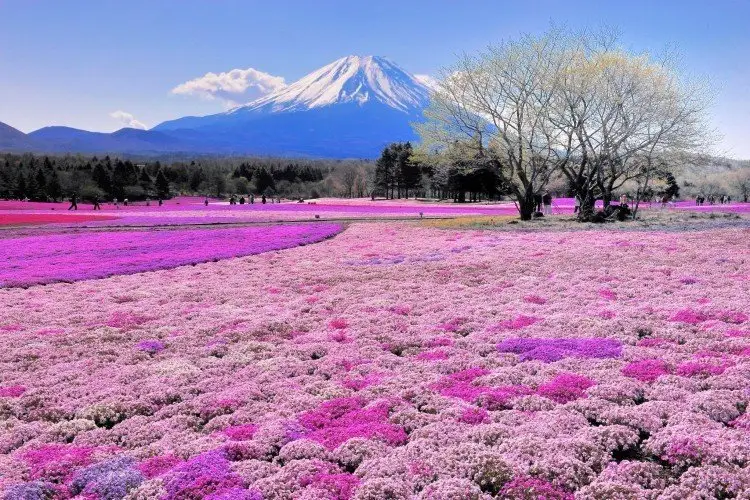
Aokigahara, also known as the Sea of Trees, is a 35km² forest located at the northwestern base of Mount Fuji in Japan. The forest is made up of thousands of trees, rocks, and ice caves, and has many popular tourist attractions.
Aokigahara [青木ヶ原] is known for being strangely silent; the density of the trees, which block the wind, makes wildlife difficult. Many legends are told about this forest, some related to demons and evil spirits from Japanese mythology. But its main fame is due to the large number of suicides that occur every year in the forest.
More than 50 people commit suicide in Aokigahara every year, and the bodies found exceed 100; it is possible to find decomposing bodies and even skeletons. Aokigahara is considered the largest suicide spot in Japan and the second largest in the world, only behind the Golden Gate Bridge in San Francisco.
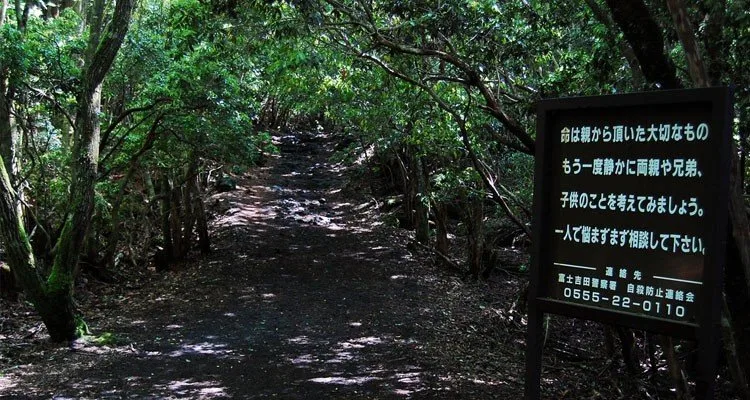
The high suicide rate has drawn the attention of Japanese authorities, who have placed warnings in Japanese and English discouraging the act. Every year, a team of prepared individuals ventures into the dense forest in search of bodies.
Mount Fuji is also another popular destination among Japanese people who wish to die. Some people think it would be easier to climb Mount Fuji than to climb Yama (the Hindu god of death).
My Visit to Aokigahara
At the end of 2023, we had the chance to visit Aokigahara forest; we arrived by bus using the “fujipass” from the city of “Fuji-shi,” with only a few buses per day, but it is possible to enjoy it.
See a bit of our tour in Aokigahara in the video below:
What to do in Aokigahara?
Although many believe that Aokigahara is haunted, it actually has numerous natural attractions for visitors. For example, the forest has beautiful waterfalls and maple trees perfect for warm autumn hikes.
In addition to its natural beauty, Aokigahara also has over 1,000 Buddhist temples and shrines to explore. To top it off, the surrounding area offers many accommodation options, including campsites and lodgings managed by the Yamanashi Prefecture.
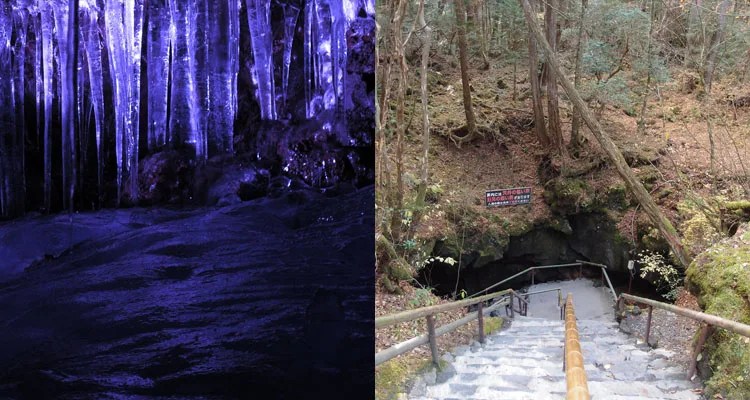
Other tourist spots to explore include caves; we have the Ice Cave and the Wind Cave. There are over 200 caves in Aokigahara forest, some even have shrines.
Tourists often place ribbons in the forest to mark the trails they are exploring, so the forest becomes filled with ribbons marking trees for others not to get lost.
Although there are several misconceptions about what happens in Aokigahara Forest due to the suicides – these places really have a lot to offer tourists beyond death.
Legends about Aokigahara
The aforementioned legends refer to demons and spirits. Some Japanese people fear the forest and believe that once you enter, you will never return. This may be true; it is easy to get lost on the trails, and the volcanic soil causes compasses and phones to malfunction.
Another reason why people believed that the forest is haunted is due to Yurei, the souls filled with hatred, sadness, and a desire for revenge. According to legend, people would take their relatives to the forest and leave them to die there.
In Japanese popular belief, if a person dies in a deep feeling of hatred, anger, sadness, or a desire for revenge, their soul cannot leave this world and continues to wander.
This legend still frightens people today. Body hunters often leave the bodies found in a room before taking them to the authorities. The legend says that if the body is left alone in the room, its yurei will move around screaming in the room. Body hunters often play Jankenpo to decide who will take care of the body.
The Legend of Kobo Daishi
Is it believed that a positive achievement has ended up generating stories of evil spirits? Kōbō-Daishi is said to have meditated in Aokigahara forest for over fifty years until achieving sainthood.
As would be expected from such a sacred place, Kōbō-Daishi encountered some devotees who would undertake long journeys here to achieve spiritual enlightenment with him.
To expedite their journey and gain peace of mind before their ascent to heaven, these pilgrims would end their lives in Aokigahara so they could begin another journey immediately after death.
Over time, stories about evil spirits inhabiting this forest gained strength – could this be the reason why some Japanese people decide to commit suicide in this forest?
Movies and Videos about Aokigahara
There are 2 movies that tell a bit about this macabre forest:
The Suicide Forest – from 2009, tells the story of some students who go to the forest to make a kind of amateur documentary about its legends and stories. They end up getting lost there, and terrible things happen. Horror
The Sea of Trees – Tells the story of two men, the American Arthur Brennan (Matthew McConaughey) and the Japanese Takumi Nakamura (Ken Watanabe), who go to the forest wishing for suicide but end up starting a journey of reflection and survival deep in the woods. Drama
The Japanese culture is very influential around the world, and many people adopt its lifestyle, beliefs, and even spiritual rituals and customs of the country. One of the rituals that has been widely discussed on social media is the “Hishaku.”
Today’s text will address and further develop this Japanese purification ritual, exploring its meaning and how it is performed, as well as explaining how this tradition survived the pandemic and the equipment used in the celebration.
What is Hishaku?
The hishaku is a purification ritual originating from Shintoism, a native religion of Japan that emphasizes the importance of purity and spiritual cleanliness. Generally performed at shrines and temples throughout Japan, the hishaku is an integral part of a broader ritual known as “Chozu.” This ritual is an essential preparation, where participants purify their bodies and minds before entering the sacred space to perform their prayers and offerings to the kami, the spirits or deities revered in Shintoism.
The hishaku, specifically, refers both to the act of purification and to the instrument used in this process—the wooden ladle. This object is traditionally made of bamboo or another type of wood considered pure and is used to pour water over certain parts of the body. This act symbolizes the cleansing of physical and spiritual impurities, preparing the faithful for a respectful and sacred encounter with the divine.
Procedure of the Hishaku Ritual
The hishaku ritual is meticulous and symbolic, with a specific sequence that must be followed to ensure its effectiveness:
First, water is poured into the left hand.
Next, the right hand is purified.
Water is placed in the mouth for internal cleansing.
Finally, water is poured over the handle of the ladle, symbolizing the purification of the instrument used in the ritual.
Spiritual and Emotional Benefits
Practitioners and followers of Shintoism report various positive sensations and spiritual benefits resulting from the hishaku, including:
Emotional balance: The purification helps stabilize feelings and emotions, promoting internal balance.
Sensation of peace and tranquility: The ritual induces a state of calm and peace, distancing stress and agitation from daily life.
Greater contact with oneself: Provides a moment of introspection and self-knowledge.
Unique encounter between body and mind: Creates harmony between the physical and spiritual, aligning thoughts and actions.
hishaku: learn more about the Japanese purification ritual
Origin of Hishaku
The hishaku, as an object and ritual practice, has its origins deeply intertwined with the traditions of Shintoism, the native religion of Japan that celebrates the sacredness of nature, ancestors, and kami (spirits or deities). Since ancient times, Shintoism has incorporated purification rituals (known as “Misogi” and “Harai”) aimed at cleansing spiritual impurities, known as “kegare.”
Historical and Cultural Context
The hishaku ritual developed as part of Chozu, which is a simplified process of Misogi, adapted for daily practice at shrines. Traditionally, Misogi involved bathing in sacred rivers or waterfalls, but with urbanization and the evolution of religious practices, it became necessary to find more accessible forms of purification for visitors to shrines and temples.
Evolution of Purification Instruments
The wooden ladle, or hishaku, was adopted as a practical tool for this purpose. Its use allows for the performance of symbolic cleansing gestures, pouring water over the hands and mouth, without the need to fully submerge in water. This adaptation was crucial for integrating the purification ritual into the daily routine of practitioners, facilitating its execution in public and private spaces.
Symbolic Importance
The hishaku is more than just a functional utensil; it carries a deep symbolic meaning. Traditionally made of bamboo, a material considered pure in Shintoism, it symbolizes the connection with nature and the passage of purification. Bamboo, due to its resilience and flexibility, is seen as an example of purity and moral strength.
By incorporating the practice of hishaku into rituals and daily life, the Japanese maintain a vital connection with their spiritual and cultural traditions, reaffirming their respect and reverence for the kami and the natural environment.
Resilience and Adaptation During the Pandemic
The tradition of hishaku demonstrated remarkable resilience during the COVID-19 pandemic. The nature of the ritual, which emphasizes cleanliness and purification, found new meaning in a world concerned with hygiene and health.
Shrines and temples adapted their practices to ensure the safety of participants, implementing measures such as social distancing and disinfection of hishakus, ensuring that the tradition continued to be a source of comfort and spiritual renewal, even in times of crisis.
Conclusion
The hishaku is not just a ritual; it is a gateway to a deeper understanding of Japanese culture and spirituality. It continues to be a vital practice in the lives of many, offering a connection to the past and a path to purification and inner peace.
In a rapidly changing world, rituals like the hishaku remind us of the importance of maintaining harmony with our traditions and with ourselves.
Have you ever eaten street food in Japan? They are called yatai 「屋台」 which literally refers to the carts that sell food. Japan is a country rich in festivals, events, and tourist spots, and it is normal to imagine that over 200,000 events take place every year in Japan.
Some of the occasions where you can find street food in Japan are:
Street food is not usually found in regular restaurants, but some can be bought at fairs or even made at home easily. Japanese street foods are based on ancient dishes from the 20th century or earlier and can be prepared easily. In this article, we will see the main street dishes found at festivals in Japan.
Yaki Imo (焼き芋)
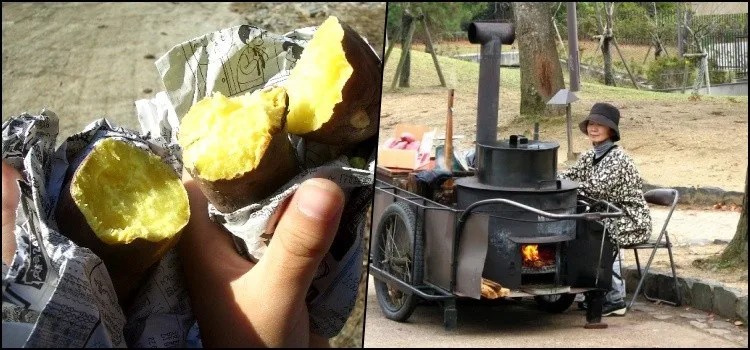
Yaki Imo are sweet potatoes baked in a wood-fired oven. Trucks and carts equipped with wood stoves can be found all over Japan. The trucks can drive around slowly repeating “yaki imo… yaki imo… yaki imo” on a loudspeaker.
Boiled
In addition to the sweet potato cooked in a wood stove, you find “Jaga Bata,” a peeled boiled potato covered with butter. I don’t even need to mention that it’s common to also find French fries, popcorn, and other vegetables at street festivals in Japan. Something more extreme are the “Onsen tamago,” which are eggs that have been boiled in a natural hot spring, or onsen.
Crepes are quite popular in Japan, both as street food and in specialized shops. You can find sweet and savory crepes of all kinds, and they can be found in strategic locations and tourist spots. It is very common to find small shops filled with models throughout their display. One of the most popular among the street foods of Japan.
Okonomiyaki 「お好み焼き」 are savory Japanese pancakes filled with meat, seafood, and vegetables. They can be topped with mayonnaise, katsuobushi, nori, pickled ginger, and a sauce similar to tonkatsu sauce.
This dish is quite popular throughout Japan and has various regional variations. It can be easily found on the street. Okonomiyaki is one of the most sought-after street foods in Japan by foreigners. The Kansai region is one of the places where this dish is popular.
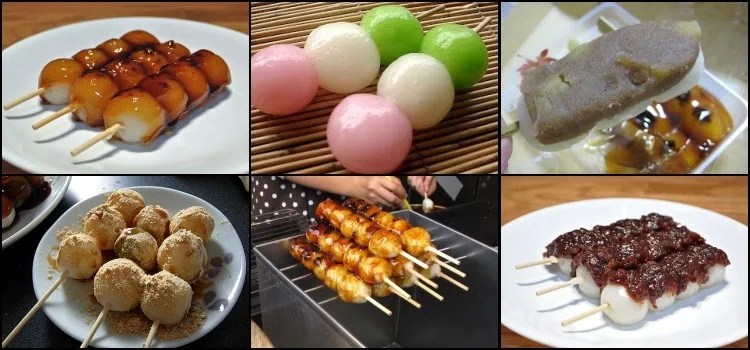
“Dango”「団子」 is a Japanese dumpling made from mochiko (rice flour). It is served on a skewer with 3 or 4 dangos and is usually eaten with green tea. “Dango” is a classic dessert available in endless varieties, its texture is similar to mochi.
The “Dango” is quite popular at shrines and temples and tends to stand out at certain times of the year. During the Mitarashi festival at the Shimogamo Shrine, “Dango” is the main offering to the deities.
Besides “Dango,” any type of mochi can be a good choice during a festival in Japan, especially at the end of the year.
Senbei (せんべい)
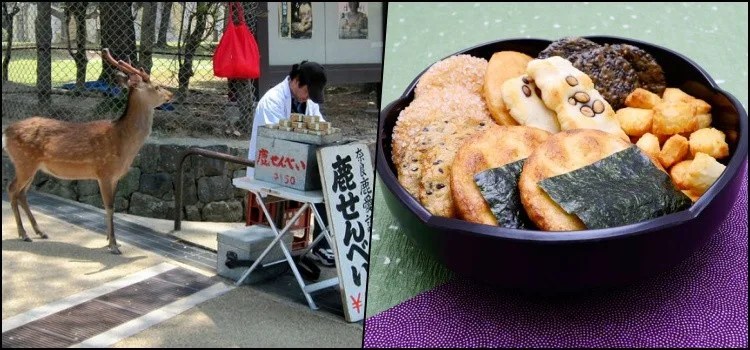
“Senbei” are simple crackers made from rice with a variety of sweet and savory flavors. At festivals, you can find a fresh and grilled senbei, in the city of Nara tourists buy senbei to feed the city’s deer.
Ramune (ラムネ)
You can accompany these crackers with a famous drink called “ramune.” A lemon soda that comes in a different glass bottle with a marble at the top. This drink is also quite popular at street festivals.
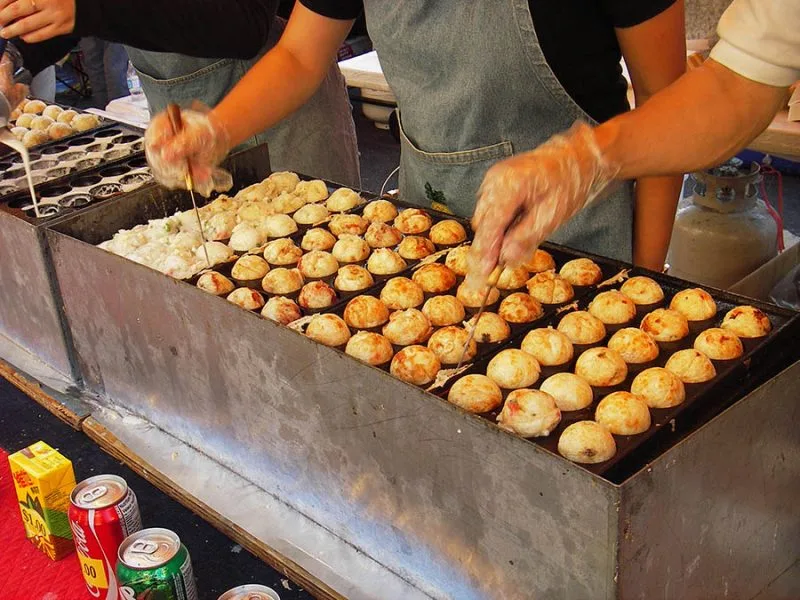
Takoyaki (たこ焼き), literally fried or grilled octopus, is a popular round Japanese dumpling that resembles a seasoned pancake made with a very soft, almost liquid batter, and fried on a special griddle. It is quite common to find stalls with these dumplings at festivals, cultural fairs, and also in specialized Takoyaki places. It is usually filled with cut pieces of a small whole octopus, tempura scraps (tenkasu), chopped ginger, and green onions.
Kare Pan – It is a fried bread filled with kare. These are just a few of the various types of bread found at street festivals in Japan;
Baby Kasutera – miniature Japanese cake that ends with a bite;
Shioyaki (塩焼き)
Grilled fish on a skewer (usually mackerel). It tends to be saltier than salt itself. In addition to grilled fish, it is worth mentioning another popular street food called “Ikayaki,” which are grilled squid.
To delve deeper into skewers, let’s mention some skewer dishes like “Chocobanana,” which consists of a banana covered with chocolate and sprinkles on a stick. We also have grilled corn with miso, butter, and soy sauce on a skewer called “Tomorokoshi.” Even cucumbers have not escaped and can be found on a skewer with miso paste called “Kyuri.”
Taiyaki is a sweet (or savory) cake made with flour, water, and yeast… It is usually filled with sweet red bean paste (azuki) and grilled in a mold shaped like a sea bream. Taiyaki is basically a normal pancake or waffle in the shape of a fish. It is placed on a grill with molds on both sides. It is quite similar to those Swiss crepes. It can contain sweet and savory fillings!
Oden (おでん)
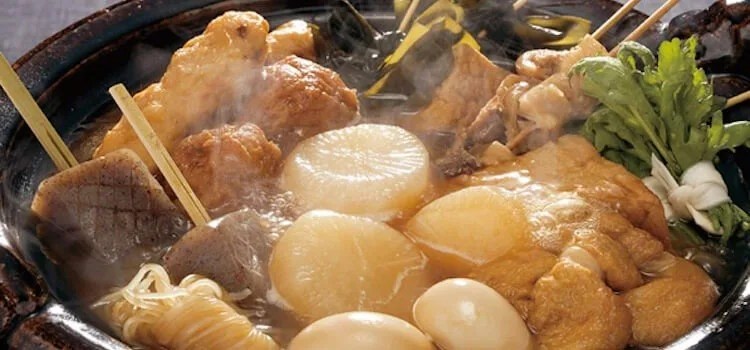
Oden is a Japanese winter dish consisting of various ingredients slowly cooked in dashi broth. Some common ingredients include boiled eggs, fried tofu, daikon, konjac, and fish cakes.
Yakisoba (焼きそば)
Yakisoba is a fried noodle dish commonly found at street food stalls. The noodles are fried with vegetables, meat (such as chicken, pork, or shrimp), and seasoned with yakisoba sauce, resulting in a tasty and comforting dish.
Gyoza (餃子)
Gyoza are Japanese dumplings filled with ground meat (usually pork) and vegetables, such as cabbage and green onions. They are steamed and then lightly fried until golden and crispy on the outside.
Dorayaki (どら焼き)
Dorayaki is a popular Japanese dessert made of two small pancake cakes (made with wheat flour, sugar, eggs, and water) filled with a generous layer of sweet red bean paste.
Tempura (天ぷら)
Tempura is a Japanese dish of seafood, vegetables, or meat battered and fried in very hot oil. The light and crispy coating contrasts with the soft interior of the ingredients, creating a delicious texture.
Yakitori (焼き鳥)
Yakitori are grilled chicken skewers traditionally cooked over charcoal, but they can also be prepared on grills or barbecues. The pieces of chicken are skewered on bamboo sticks and are usually seasoned with tare sauce (made from soy sauce, mirin, sake, and sugar).
Obentō (お弁当)
Although not exclusively street food, Obentō is a practical and portable Japanese meal prepared in a lunch box (bentō). It can contain a variety of items such as rice, grilled fish, fried chicken (karaage), pickled vegetables (tsukemono), and Japanese omelet (tamagoyaki).
Ramen (ラーメン)
Although ramen is more associated with restaurants, some street food stalls serve simplified versions of the dish. This can include a bowl of noodles with hot broth and some toppings, such as sliced pork and green onions.
Kushikatsu (串カツ)
Kushikatsu are skewers of meat, vegetables, or seafood that are breaded and fried. At festivals, you can find stalls offering a variety of kushikatsu, usually accompanied by tasty dipping sauces.
Since its debut in 1996, “Apocalypse of Games: Kaiji,” a 90s manga created by the talented Nobuyuki Fukumoto, has captured the imagination of fans around the world. The fascinating universe of Kaiji, filled with tension and high-stakes games, was so well received that it spawned two anime adaptations, titled “Kaiji: The Ultimate Survivor” and “Kaiji: Against All Rules.”
To this day, Kaiji is celebrated as one of the most remarkable gambling animes ever created. The engaging narrative and intense characters place Kaiji on a level rarely achieved by other works in the genre, including notable titles like “Kakegurui” and “Death Parade.”
The Uniqueness of Kaiji
What distinguishes Kaiji in the anime universe is its ability to immerse the viewer in the dark world of gambling. Through the story of Kaiji Itō, a player living in misery, we are taken to a world where every bet could be the last. Deceived by a loan shark, Kaiji finds himself in a tournament of games where each participant desperately seeks to settle their debts.
Kaiji stands out not only for its plot but for the way it portrays the clashes and games, ranging from modified versions of rock, paper, scissors, to challenges that put the players’ lives at risk, such as crossing a beam over an abyss without safety nets. These competitions, laden with tension, show how despair and hope walk hand in hand in the lives of the players.
The influence of “Apocalypse of Games: Kaiji” can be seen in various other works, including the South Korean survival drama “Squid Game.” Both series share the theme of extreme desperation and the fatal consequences of defeat, although each presents its own peculiarities.
Variety of Gambling Games in the Story
The true brilliance of “Apocalypse of Games: Kaiji” lies not only in its high-stakes games or its suspenseful plot but in the deep exploration of human character under extreme pressure. Kaiji Itō, with his flaws and vulnerabilities, is a mirror to the human soul, fighting against adversity with a mix of despair and courage. The series not only entertains but also provokes reflections on human nature, ambition, and redemption.
Each game in Kaiji is a work of art in itself, created with meticulous attention to detail by Nobuyuki Fukumoto. From “One Poker” to the “17-Step Minesweeper Game,” each challenge presents a new level of strategy and danger, keeping viewers on the edge of their seats. The inventiveness of these games stands out in the anime landscape, bringing a freshness to the genre.
While Kaiji captures the thrill of high-stakes games, it also offers a critical look at the dangers of gambling addiction. Kaiji’s journey is a continuous reminder of the traps that can consume a player’s life, shedding light on the psychological and social impacts of addiction. “Apocalypse of Games: Kaiji” is not just entertainment; it is a cautious exploration of human complexity.
The Invitation to the Universe of Kaiji
If you haven’t yet dived into the intriguing world of Kaiji, the journey can begin with the first seasons of the anime, followed by the mangas that continue the saga beyond what was adapted for TV. And for those interested in the behind-the-scenes, it is fascinating to know that creator Nobuyuki Fukumoto rarely ventures into gambling but designed Kaiji’s games with a meticulously planned point system, adding an extra layer of originality to the work.
So, if you are a fan of intense narratives, charismatic characters, and breathtaking games, “Apocalypse of Games: Kaiji” is a choice that promises to engage you from start to finish, offering a deep reflection on the highs and lows of a player’s life.
Have you noticed when a kanji ends up having a reading as if it had dakuten? For example, in the word goddess, why does me [女] + kami [神] become megami [女神] when gami is not a reading of kami [神]? This phenomenon in Japanese is called rendaku and we will talk about it in this article.
The word “rendaku” [連濁] means sequential vocalization, euphonic change, or sequential pronunciation. The “rendaku” is a morphophonological phenomenon of the Japanese language that regulates the pronunciation of the initial consonant of the non-initial portions of compound or prefixed words.
In simple terms, “rendaku” is a phenomenon that changes the reading of a hiragana to its “dakuten” version on certain occasions to make pronunciation easier and less confusing. Since there is no “dakuten” in ideograms, it becomes complicated to identify when this phenomenon occurs.
For those who don’t remember, “dakuten” are those 2 dots that look like accents that appear on some hiraganas and katakanas to change their sounds such as: [KA-か = GA-が] [TA-た = DA-だ]…
The word rendaku [連濁] is composed of the ideograms [連] which means to unite, connect, join, link, carry and [濁] which means sonorous, impurity or wrong.
LIST OF RENDAKU WORDS
I mentioned some examples and tried to explain in detail how this phenomenon works. Some may still not have understood, but it becomes easier with some examples below:
Without rendaku
With rendaku
Person – hito – 人
People – hitobito – 人々(this is equivalent to another 人)
Flower – hana – 花
Flower arrangement – ikebana – 生け花
Temple – toki – 時
Sometimes – tokidoki – 時々(are 2x 時)
Paper – Kami – 紙
Origami – 折り紙
Japanese Character – Kana – かな – 仮名
Japanese Alphabet – hiragana – ひらがな
Sushi – 寿司
Type of sushi – makizushi – 巻き寿司
Temple – tera – 寺
Temple in the mountain – yamadera – 山寺
Blood – chi – 血
Nosebleed – hanaji – 鼻血
Fire – hi – 火
Fireworks – hanabi – 花火
Use – tsukai – 使い
Anxiety – kokorodzukai – 心使い
Deep – fukai – 深い
Deep – okubukai – 奥深い
Discount – hiku – 引く
Tax excluded – zeibiku – 税引き
Tooth – ha – 歯
Bucktooth – deppa – 出っ歯
To hate – kirai – 嫌い
Cat hater – nekogirai – 猫嫌い
Photo – shashin – 写真
Blueprint – aojyashin – 青写真
Country – koku – 國
China – Chuugoku – 中国
The examples above are the most popular when we talk about rendaku. Unfortunately, there is no rule for when rendaku is applied to the word; often it is something random, but there are sets of rules that can help you understand how this phenomenon works.
The first thing you need to know is that if you type a word on the keyboard and forget about this phenomenon, the ideograms or kanji will still appear to be selected on the keyboard. This phenomenon is something more phonetic and usually occurs only with kanji.
Most words that use the same kanji twice tend to use rendaku.
There is a list of ideograms that most of the time their composition generates a rendaku. These words are called “rendaku-lovers” and some of them are: 花, 風呂, 寿司, 骨, 笛, and 箱;
When does a word use rendaku?
It is worth remembering that these rules I will mention do not affect your learning of the Japanese language; they serve only to satisfy curiosity. When you learn, for example, the word goddess [女神], you already learn it as “Megami” and not “Mekami,” so knowing or not knowing the rules of rendaku will not change anything in your life.
Fortunately, knowing the rules may or may not help you predict the rendaku in some unknown word. We recommend knowing at least the basics about dakuten and handakuten to understand the little rules created in this article.
Rendaku is most often present in a compound word. That is, when two words come together to form another word. There are exceptions, but practically all words that use this phenomenon:
Are of Japanese origin;
Do not have any dakuten or handakuten in the compound word;
Are not an onomatopoeia;
The second word starts with K, S, T, or H;
Foreign origin words can have a rendaku as in the case of the word karuta [かるた] which comes from carta and refers to a card game or deck. This exception occurs in the word irohagaruta [いろはがるた]. It only happened because the word karuta was 100% absorbed into Japanese.
The Lyman Law and Lexical Properties
The Lyman Law states that rendaku does not occur if the second consonant of the second element is obstructively vocalized. Or simplifying, it does not happen when the second consonant of the second already contains a dakuten.
Japanese origin words usually do not have two consonants with dakuten. These syllables with accents can also be called murky sound or dakuon [濁音].
The compound word yama [山] + kaji [火事] cannot be pronounced yamagaji because ji [じ] is a dakuon. Other similar words are hitoritabi, tsunotokage, and harukaze.
There are rare cases where the second word is composed of 3 syllables. In some of these cases, the word may have a phenomenon where the dakuten of the second syllable is swapped to the first syllable. Some examples are: [した + つづみ = したづつみ] –[あと + しざり = あとじさり];
Despite many exceptions, words with lexical properties do not usually manifest rendaku. In simple terms, if you see any syllable with dakuten in the first word, it is likely that the consonant of the second kanji will not manifest rendaku. Japanese does not usually have two dakuten syllables in a row.
The compound word mizutama [水玉] remains mizutama because of the zu [ず], unlike akadama [赤玉] which transformed the tama into dama.
Dvandva Semantics and Suffixes
There is a phenomenon in some languages called Dvandva which are compound words but convey the idea of two words as if there were an “and” in between them. In Portuguese, we have the word agridoce which is bitter and sweet or words like espaço-tempo which also fall into the Dvandva category.
When two words come together to form a compound word of the dvandva category, rendaku is not used. There are some exceptions of words that use rendaku, but they are two different words, for example:
山川 – yamakawa – Mountains and Rivers;
山川 – yamagawa – River of the mountain;
A word that would fit perfectly in rendaku is shiro + kuro [白黒] which could be written shiroguro [白黒], but this does not happen because shirokuro [白黒] means black and white. Meanwhile, the word iro + kuro becomes iroguro [色黒];
Besides onomatopoeias, words that are composed of a suffix or prefix also do not transform into a rendaku. See a list of suffixes below that completely eliminate this phenomenon:
一 [hito];
下 [shita]
二 [futa];
先 [saki];
唐 [kara];
土 [tsuchi];
姫 [hime];
御 [o, mi];
毎 [mai];
浜 [hama];
潮 [shiyo];
煙 [kemuri];
片 [kata];
白 [shiro];
紐 [himo];
血 [ketsu]
黒 [kuro];
Generally, compound words that contain these ideograms with these readings functioning with a suffix or prefix block the possibility of the word being a rendaku.
These were some of the little rules and tips related to rendaku. We recommend not getting stuck on these rules because there are many exceptions among them. The best thing is to learn word by word without worrying about it.
I hope you enjoyed this article; I tried to simplify it as much as possible.
Sakurajima, one of the most active and notorious volcanoes in Japan, is located in Kagoshima Prefecture on Kyushu Island. This impressive volcano is a central point in the local landscape and an icon of powerful natural forces that characterize the region.
Sakurajima is a constant presence in the lives of local residents and a point of attraction for tourists from around the world. This article explores the history, volcanic activity, and tourist impact of Sakurajima, providing a comprehensive view of this impressive natural phenomenon.
Geological History and the Great Eruption of 1914
Sakurajima has a rich and turbulent history. The most significant of its eruptions occurred in 1914 and was one of the most violent volcanic eruptions of the 20th century in Japan. This event transformed the local geography, connecting the then island of Sakurajima to the mainland through an isthmus formed by solidified lava.
Since then, Sakurajima has ceased to be an island and has become a peninsula, but this has not diminished its activity. It remains one of the most active volcanoes in Japan, with frequent small eruptions that are carefully monitored by scientists.
Continuous Volcanic Activity
Sakurajima is not only famous for its history but also for its continuous activity. The volcano has been in a state of almost constant eruption since 1955, with its volcanic ash regularly affecting the surrounding area, including the city of Kagoshima.
These frequent eruptions, although generally small, are a constant reminder of the power of nature and the need for continuous vigilance.
Tourist Impact
The volcano is an important tourist destination, attracting visitors interested in closely observing its spectacular eruptions and the unique landscape it creates.
The site offers spectacular views, especially from the Yunohira observatory, which allows visitors to see the volcano from a safe vantage point.
Additionally, the region is known for its natural hot springs, fed by the geothermal activity of the volcano, providing ideal relaxation after a day exploring the area.
Environmental and Agricultural Impact
The volcanic activity of Sakurajima has a profound effect on the local environment. The volcanic ash, despite being a challenge for residents, enriches the soil with minerals that are beneficial for agriculture.
The region around Sakurajima is known for its agricultural products, especially the giant daikon (radishes), which are a local specialty. However, wildlife and crops need to be carefully managed to protect against the adverse effects of frequent ash falls.
The presence of an active volcano like Sakurajima creates a unique habitat for various forms of life. The areas surrounding the volcano are home to endemic species that have adapted to local conditions. Protecting this biodiversity is crucial, especially as volcanic activity continues to alter the habitat. Conservation programs and ecological studies are essential to understand and mitigate the environmental impacts of volcanic activity.
Living with Sakurajima
Living near one of the most active volcanoes in the world has its challenges. The residents of Kagoshima and adjacent areas are accustomed to frequent ash falls and eruption warnings.
The local community and authorities are well-prepared to deal with the risks associated with volcanic activity, with evacuation plans and safety measures in place to ensure that everyone is safe in the event of a major eruption.
Conclusion
Sakurajima is more than a volcano; it is a symbol of the interaction between humanity and nature, a reminder of the indomitable force of the Earth, and a testament to human resilience. For Japan, Sakurajima is not only a natural wonder but also an integral part of the cultural and natural identity of the Kagoshima region.
Through tourism and constant observation, Sakurajima continues to be both an attraction and a challenge, representing the dynamism and dangerous beauty of the natural world.
Want to learn Japanese with quotes from the Anime Naruto? In this article, we will share several phrases for you to study like a Ninja. Enjoy the Japanese phrases from Naruto, Sasuke, Hokage, and many other characters from the series.
Japanese Phrases from Naruto Uzumaki
仲間一人救えねぇ奴が火影になんてなれるかよ。
nakama hitori sukuenee yatsu ga hokage ni nante nareru ka yo.
How can a guy who can’t save a friend become Hokage?
✩ウソつけ!言い訳はいいってばよ!
usotsuke. iiwake wa ii tteba yo.
You liar! Enough with the excuses!
これならどう?
kore nara dou.
How about now?
オレってばもっと強くなりてーんだ。
ore tteba motto tsuyoku nariteen da.
I want to become stronger.
オレには分かるってばよ…こいつもオレと同じだ…
ore niwa wakaru tteba yo. koitsu mo ore to onaji da.
I can understand… He is just like me…
オレも一人ぼっちだった…
ore mo hitoribocchi datta.
I was alone too…
生きてる理由が分からなくて苦しくて…
ikiteru riyuu ga wakaranakute kurushikute.
I was suffering because I couldn’t find a reason to live…
The Michelin Guide is one of the most renowned travel guides in the world. If you are looking for a high-level Japanese restaurant, you should definitely look for restaurants with Michelin stars and prepare your wallet. In this article, we will see restaurants in Japan that have Michelin stars.
Remember that the Michelin Guide awards from one to 3 stars to measure culinary excellence. It is not like that classic 5-star rating that some use. In culinary arts, critics judge with only 3 stars.
The list below has the most updated stars from 2019-2020. It may happen that a restaurant loses its star or has not been judged by a certain date. I hope you enjoy the list of restaurants in this article.
We will not go into details about the restaurants on this list. We recommend searching by name to access the official website or see reviews on sites like Google Maps.
How much does a Michelin Star Restaurant cost in Japan?
The costs of a Michelin star restaurant in Japan can vary greatly depending on various factors, such as location, chef’s reputation, number of stars, type of cuisine, among others.
However, to give a general idea, prices usually start at around 10,000 yen per person in more affordable restaurants with one Michelin star.
In high-end restaurants, with two or three stars, prices can easily exceed 30,000 yen per person, potentially reaching even higher amounts depending on the menu and selected options.
Michelin Restaurant Recommendations in Japan
We can’t just list the restaurants without talking a bit about the dishes, so below I will recommend the main restaurants by briefly describing the dishes of each one.
Sukiyabashi Jiro (Tokyo)
Specialty: High-quality sushi, prepared with refined techniques and carefully selected fresh ingredients.
Ryugin (Tokyo)
Specialty: Contemporary kaiseki cuisine, known for creative dishes that combine tradition and innovation.
Sushi Saito (Tokyo)
Specialty: World-class sushi, emphasizing simplicity and the perfection of ingredients, especially fresh fish.
Kitcho Arashiyama Honten (Kyoto)
Specialty: Traditional Japanese kaiseki cuisine, with elaborate dishes and impeccable presentation, using seasonal ingredients.
Kohaku (Tokyo)
Specialty: Kaiseki haute cuisine, focusing on the harmony of flavors, textures, and aesthetic presentation of dishes.
Makimura (Tokyo)
Specialty: High-class Japanese cuisine, emphasizing seasonal dishes prepared with technical skill and creativity.
Quintessence (Tokyo)
Specialty: High French gastronomy with Japanese influences, offering refined and complex dishes with exceptional flavors.
Michelin Star Restaurants in Tokyo
See below the names of Michelin star restaurants in the greater Tokyo area. In the first column, we have the name of the restaurant, followed by its location in the second column and how many Michelin stars it has in the third column.
The list below has restaurants from other cities spread across Japan. Following the order of first the name of the restaurant, then the city and the number of stars.
Hanakoji Sawada (花小路 さわ田) Hokkaido 3 stars
Hanakomichi Ishida Hokkaido – 3 stars
Hijikata (土方) Nagoya, Aichi 3 stars
Kaniyoshi (かに吉) Tottori 2 stars
Michel Bras Toya Japan (ミシェル・ブラス トーヤ ジャポン) Hokkaido 2 stars
Fortnite is one of the games with the largest third-party collaborations, resulting in various skins and anime appearances. You can play with your favorite character without any problem. In this article, we will explore all the anime skins available in the game Fortnite and how you can get them.
Original Anime Skins in Fortnite
The anime style was introduced at the end of 2020, but before that, we had some skins that resemble anime characters from Japanese games, ninjas, samurais, and others.
Even after the anime style was introduced in Fortnite, the company also released several skins with original anime styles, without referencing famous characters, but having their own style and game.
In the image below, we can see which Anime Skins were most successful in Fortnite, probably due to their easy acquisition in the “Battle Pass”.
In the image, we find Erisa, Lexa, Toona Fish, and Zoe Clash as original characters from Fortnite. We also have Spider-Man skins that can be highlighted as anime style.
As expected, characters from the Animes “Dragon Ball,” “Naruto,” “Shingeki no Kyoujin,” and “Boku no Hero” stand out as the most popular in Fortnite.
Other original characters created by Epic Games for Fortnite are Lennox Rose, Imani, Toon Meowscles, and Reina (a Christmas character).
List of Anime Skins in Fortnite
Below is the list with the names of all the anime skins in Fortnite and their values:
Skin
Origin
Date
Price
Vi
Arcane
06/11/2021
1,600
Jinx
Arcane
06/11/2021
1,600
Vi (Neon)
Arcane
25/11/2021
1,900
Powder
Arcane
25/11/2021
1,500
Vi (Zaun)
Arcane
25/11/2021
1,500
Meowscles (Shadow)
Item Shop
14/05/2020
1,500
Meow Skulls
Item Shop
28/10/2021
1,200
Harley Quinn (Rebirth)
DC Comics
06/10/2020
1,500
Catwoman
DC Comics
19/11/2021
1,200
Goku
Dragon Ball Super
16/08/2022
1,800
Vegeta
Dragon Ball Super
16/08/2022
1,800
Bulma
Dragon Ball Super
16/08/2022
1,200
Naruto Uzumaki
Naruto Shippuden
23/11/2022
1,500
Sasuke Uchiha
Naruto Shippuden
23/11/2022
1,500
Sakura Haruno
Naruto Shippuden
23/11/2022
1,200
Master Chief
Halo
27/11/2020
1,500
Chun-Li
Street Fighter
02/08/2018
1,200
Vi
Arcane
06/11/2021
1,600
Jinx
Arcane
06/11/2021
1,600
Vi (Neon)
Arcane
25/11/2021
1,900
Powder
Arcane
25/11/2021
1,500
Vi (Zaun)
Arcane
25/11/2021
1,500
Meowscles (Shadow)
Item Shop
14/05/2020
1,500
Meow Skulls
Item Shop
28/10/2021
1,200
Harley Quinn (Rebirth)
DC Comics
06/10/2020
1,500
Catwoman
DC Comics
19/11/2021
1,200
Goku
Dragon Ball Super
16/08/2022
1,800
Vegeta
Dragon Ball Super
16/08/2022
1,800
Bulma
Dragon Ball Super
16/08/2022
1,200
Naruto Uzumaki
Naruto Shippuden
23/11/2022
1,500
Sasuke Uchiha
Naruto Shippuden
23/11/2022
1,500
Sakura Haruno
Naruto Shippuden
23/11/2022
1,200
Master Chief
Halo
27/11/2020
1,500
Erisa
Battle Pass
Chapter 3, Season 2
–
Nezumi
Battle Pass
Chapter 4, Season 1
–
Reina
Reindeer Raiders
Chapter 3, Season 1
1,200
Orin
Y-Labs Rescue
Chapter 2, Season 5
1,200
Lexa
Battle Pass
Chapter 2, Season 5
–
Chun-Li
Street Fighter
02/08/2018
1,200
What is the first Anime Skin in Fortnite?
The first anime skin to arrive in Fortnite that resembles Japan was “Hime” and “Musha,” released on March 17, 2018. These skins were part of the “Samurai” set and brought a Japanese anime style to the game. Unfortunately, it is not the first skin with anime-style traits, still maintaining the original Fortnite traits.
The first anime crossover with Fortnite was the “Naruto” skins that arrived on November 16, 2021. The first original anime skin from Fortnite was “Lexa” on December 2, 2020.
How to get Anime Skins without buying V-Bucks
If you have been playing Fortnite for many years, you must have noticed that once you manage to gather V-Bucks to buy the Battle Pass, you will be able to get unique skins over the years.
The best way to acquire an Anime Skin is through the battle pass. Only a few exclusive collaborations sell skins in the item shop, requiring you to spend your money to acquire them.
So, keep playing frequently, and you will be able to gather V-Bucks and buy your battle pass, acquiring the latest anime skins released in Fortnite.
Gartic Phone is a new way to play the famous Gartic and the classic game of telephone. In this article, we will share some information about the game and a list of Ideas and phrases for Gartic Phone, as well as an Idea Generator powered by Artificial Intelligence.
In this game, you can think of anything or any phrase, but many still run out of ideas for Gartic Phone. Besides the list of ideas, we will also share some suggestions for you to create perfect phrases that suit your group’s tastes.
This is an online version of a children’s game that tests your drawing skills. Logged into the site, you can create rooms with friends to have fun. It all starts by receiving an anonymous phrase in the chat, then the participants need to draw until the end of the round when the results will be displayed.
How to play Gartic Phone?
To start the game, you need to create a room and invite your friends to participate. It won’t take long for you to set how the round will be. There are several options on the screen of the room you create.
After that, you must create a very funny or completely random phrase to start the game.
After sending your phrases, all participants will eventually receive one, so you need to trust your creativity and timing, as participants will need to create an illustration for each described phrase.
When completed, the phrase ends up being displayed to the participants along with the drawings of the creator, as if it were a final gallery. All players display their illustrations until the round restarts.
It is not a competition, but rather a fun game to have laughs and showcase your artistic skills. Perfect also for generating funny ideas.
How do I access Gartic Phone? Is there a Mobile App?
To access Gartic Phone, you need to go to the official game website. Currently, this is the only way available to play with friends. However, there are no secrets.
This allows anyone to play directly from their browser. So, if you want to play on your phone, there is no problem. Just access the official website or download an app that runs the site in full screen.
Currently, unlike the first Gartic, the game does not have an official app for Android and iOS. The game’s developer, Onrizon, has also not stated whether the game would have a specific app.
Phrase Generator for Gartic Phone or Telephone
Use our phrase generator for Gartic Phone or Telephone below, just enter the keywords and it will generate some phrases for you to play:
To play Gartic Phone, you need to create a room to invite your friends to participate in the game. This is very simple:
Enter the game and put your name or any nickname you want in the space. Then, click on “Create Room”;
After that, it will give you options like the number of participants and the format of the round. You make the choices and organize how you want to play with your friends;
At the bottom of the disk, there is a button called “Invite”;
Click on it and the room link will be automatically copied. Then just send it to your friends and wait for them to join the room and start playing.
How to get Ideas for Gartic Phone?
Although we have a list of phrases in this article, we prefer that you use your creativity to generate the phrases. Always try to include the hobbies of the friends who are playing to make everything more fun.
If you are a Gamer, you can use elements from games; if you are an Otaku, you can use elements from anime and manga. If you are a fan of Japanese culture, you can use elements from Japan. Just think of a hobby and create your phrases.
Another way to create basic phrases is to think about how they are formed. You can first think of an animal or person, followed by some color or adjective, followed by an action and some object.
Always remember to think first of the subject, then the adjective, followed by the action and the object. Let’s see below some ideas to create your own phrases:
A Certain Color Animal plays a Musical Instrument;
A Famous Person in a certain outfit practices a certain activity in a certain place;
A Person Attacks something with some object;
A person does some action against another person in a certain place;
Of course, the phrases will vary depending on the language you are playing in. If the explanations above do not make sense to you, try using the lists of phrases in this article for inspiration. You don’t need to copy them, just swap the actions, objects, and people in them.
Anime Ideas for Gartic Phone
As the main focus of our site is anime and Japan, before the random phrases and strange ideas for Gartic, we want to make a personal selection of phrases involving anime and fanservice.
Goku getting beaten by 5 characters;
Naruto running on Mount Everest;
Edward and Alphonse transformed into Chimera;
Two waifus fighting in Galaxies;
Minecraft beating Roblox;
Characters from Fall Guys in the world of Fortnite shooting everyone;
An anime character spending money on Diamonds in FreeFire;
Character transforming into Super Saiyan
Character doing the “Final Flash” pose
Character defeating a powerful villain
Character using a powerful combat technique
Character with a special eye power activated
Character performing a powerful attack with their hands
Character stretching body parts to attack
Character using multiple weapons at the same time
Character studying a map or book
Transformation of a character into a powerful creature
Cool Ideas and Phrases for Gartic Phone
Let’s see some phrases and ideas for Gartic Phone?
The eraser erases the pencil, the eraser erases the chalk;
Ted’s toolbox fixes Fred’s friend’s Ford;
The big box on the road;
Grandma’s little house surrounded by vines, the coffee is taking too long, surely there is no powder;
Chinese food is made with sugar and spices, and a lot of rice;
No one’s favorite food is cabbage;
Education is important, but big muscles are more important;
The entrance is guarded by a nearsighted dragon that breathes fire and is afraid of heights;
The entrance is guarded by a psychic dragon who is afraid of heights;
The store ran out of yoga mats;
The easiest way to make an adult man cry is to force him to watch Toy Story 3;
The door closed behind the poor;
The little light seems gloomy;
The queen sat on her throne and ate spiky kumquats;
The quick brown fox jumps over the lazy dog and says hello to the cat;
The secret password is cock-a-doodle-doo-diddle-doodad;
The Eiffel Tower in my uncle’s house;
The only thing better than a tall, dark, and handsome man is carrying a pizza box;
The only thing I like more than reading a book is watching the movie and never reading the book;
The spotted cow was soaked by another spotted cow;
The spotted cow was soaked by another wet and spotted cow;
Sweet sparkling sugar;
Alex, the Alsatian, ate eleven Éclairs at night with an espresso;
Someone opening an ice cream jar and finding beans;
Crispy coconut lovers of sweets;
I learned to swim when I was 14;
The best fries are chocolate;
Astronaut meditating in the middle of space;
Unlucky Laura lost lunch in the library last week;
Too blue to survive;
Fat dwarf Batman running with the thrush;
Round SpongeBob with glasses and a tall limbo passing by;
Bob the Builder rented Oswald’s apartment and borrowed Noddy’s car;
My cousin’s doll dressed in a tutu;
Dog running after its own tail;
Blue chair at the table;
Dogs digging holes in search of big bones;
Kaleidoscopes, Calliope, and Christopher Columbus;
Walking in a Winter Wonderland;
Cell phones invading a mall shooting laser beams;
Chocolates make my teeth hurt;
Blonde koala, straightening, getting married in church;
Crispy coconut covers cold;
Rabbits resonate, giants grumble, dogs bark in the dark, and wolves run in the blue;
Classmates climbing cars for money;
Counting cars silently;
Jokers, fools, and jugglers swung, jumped, and swayed for the King of Jordan;
Ten cups in the cupboard;
Two tiny frogs ate fat flying flies;
Twelve purple people falling pulled turnips;
Dracula drinks dark drool;
It’s good to have black rats;
And if we all scream “CRABAPPLE!” In unison now?
She sells seashells;
Elephant playing guitar in a country band;
Do they allow bumbershoots at the noodle bar?
Then Betty told me that Ali told you that Carmen sat on Martha’s bean bag;
Scarecrows steal soft sandwiches;
I’m cursed with the terrible fate of endlessly interrupting everyone around me;
I’m shouting now; can you hear me? I think I might have laryngitis;
Exploding pure puree;
I would love to eat grilled cheese and tuna sandwiches;
I still think Nicolas Cage would have made a great Superman;
I love money, but I’m not reciprocated;
I wish I had a pet rabbit;
I like Voltage more than Code Red, but not as much as Livewire;
I broke my toy robot;
I really need to break my habit of opening a million new tabs that I will never look at;
I only Riverdance when I’m happy;
I am a ladybug rowing a lettuce boat with paddles made of baby spoons;
Farofa made with lots of fluffy flour makes ugly gossip;
Puppies surfing in lava;
End of the year 2021 on Jupiter;
Dental floss is my favorite snack;
Fiona crying for Shrek in the castle;
Snowflakes will soon slide gently;
White flowers with thorny stems;
Leaves like loose piles;
Spin spin sunflower, in the circle of a flower pointing at the sun;
Short-legged giraffe, in a bathtub drinking soda;
Ghostly gum tastes sticky;
Little Hulk in the garden;
Jackie Chan dancing ballet with a tutu;
Jackie Chan dancing ballet in space;
Red ladybug at the circus;
Junie B Jones likes Jamba juice;
Cleo the caterpillar wearing ballet slippers;
Lane didn’t wash the dishes;
Orange, are you happy I didn’t say cabin?
Justice League robbing an old lady;
Lightening McQueen likes loaded lunches;
Monkeys flying in heels;
Doorknobs and door frames with hasps and hinges;
More housekeepers scrub hotels;
Suitcase with a new suit;
Whether open or closed, I am always the lock;
Messi scoring a penalty;
Messi at Shakira’s house;
Is my breath really bad right now, or is it just me?
Phrases and Ideas for Telephone
Below are some more ideas for Gartic Phone or phrases to use in games similar to Telephone (Phone Game).
My dad gave me a pink balloon;
My guilty pleasure is watching FailArmy;
My ponytail got stuck in my shirt;
My sensual dance moves were described as a mix of Beyoncé and Mr. Bean;
Micky Mouse likes raw fish;
My underwear are funders;
Many maids clean motels;
Grumpy mummies chew on moldy naphthalene;
In second grade, I peed in my own shoe and pretended I stepped in lemonade;
Don’t tell me brands and generics are the same until you’ve tried generic macaroni and cheese;
Don’t move! There’s a gigantic spider behind you!
I have no idea what I’m doing, but I know I’m doing it very well;
Noisy Ned needs nuggets;
Not even an iceberg could sink our friendship!
No one could sink our friendship!
In high school, I was voted most likely to become a cat lady;
The three-headed dog at a party;
The dog says “woof,” the cat says “mew,” and the aardvark says some really unflattering things about your grandmother;
The cashew of Juca and the jackfruit of cajá; The jackfruit of juju and the cashew of caá;
The funny rabbit hid the colorful candies in the colorful jar;
The wolf that sings in the favelas of Brazil;
The real name of Dumbo is Jumbo Junior;
The mouse chewed the clothes of the King of Russia that the Queen, angry, decided to mend;
The green bag burst big bubbles;
The ice cream was melting;
The shark tank has a guppy;
Look at the frog inside the bag;
The henchmen would look very strange with contacts;
The Martians invested in stocks when the NASDAQ fell several meters;
The eggs just broke on the way;
The angry birds ate candies and crushed the subway surfer;
Koala bears are cute and panda bears are cuddly;
The Avengers taking a car ride;
I heard you have strong opinions about condominiums;
For this year’s Christmas, I’m asking Santa for an Amazon gift card;
Recess stones restless roosters;
Pedro nailed a nail on the black door;
Deep thoughts: “butt” rhymes with “but”?
Piano that wanted to work as a clown and is playing in a circus;
Penguin coughing in the snow while calling for its mother;
Teachers take tons of mushrooms;
When I grow up, I want to be an excavator;
When you’re in an exam and can’t stop coughing;
Wednesday is hump day, but the camel is happy about it;
Who whispers the tail stretches eats bread with lizard;
Who is your friend who likes to play, Bing Bong, Bing Bong!
Rapunzel dancing next to the cat in boots;
Mouse taking a bath;
I recently retired from the apple sauce factory;
Roger squeezed seventeen balls against Sylvester alone;
Red roses with thorny stems;
Sally sells sushi by the sea;
If life gives you lemons, make lemonade;
If marbles were dumbbells, we would all have some pie!
If I could go back in time, I would shout at Troy: “It’s a trap!”;
If there’s one thing that ruins my day, it’s night;
Mermaid dancing ragatanga in space;
I’m a rolling thing, so I pass the ball;
Fat dwarf Superman exercising;
Fat and dwarf Superman exercising;
Bull drinking juice on a stage;
I brought three plates of wheat for three sad tigers to eat;
Trump with Michael Jordan eating pizza;
A plane dancing reggaeton at the Eiffel Tower;
A puppy dancing at a party;
A dog named Moose ran loose through the fir forest chasing a goose;
A dog dancing on a table at a party;
A dog with wings that has laser eyes;
A computer accessing a human;
A dinosaur with glasses watching a movie in the cinema;
An elephant with long legs crossing the bridge;
An elephant dancing Argentine tango;
A gorilla with a tie on a roller coaster;
A guppy in a shark tank;
A lemon, a thousand lemons, a million lemons;
A monkey so sneaky scares the coward;
A papaya with eyes singing opera;
A Martian scoring a penalty;
A bunch of yellow bananas thrown on a blue boat;
A strawberry dancing forró with an octopus;
A pink pig and an annoying donkey flew a kite at night;
A building jumping rope;
A whirlwind full of soda would be effervescent, but sticky;
A rhinoceros watching a movie in the cinema;
A sick tiger drinking mate tea;
A pumpkin head rolling down a hill;
A short-legged giraffe in a bathtub;
A vegetarian sausage;
A girl eating rice with chicken in Madrid;
A kite meditating in the cinema while watching cartoons;
A Taco Bell chicken quesadilla with extra creamy jalapeno sauce;
A fingernail cooking chicken rice;
Once I saw a rainbow in London;
Vampire walking in school;
Should you eat moss from a dirty log?
Are you Team Ketchup or Team Catsup?
You’re a sad and strange little man, and you feel sorry;
You smell very good today;
You were voted off the island;
Have you ever noticed it only seems to rain when you have to go somewhere?
Do you know when you’re in an exam and can’t stop coughing?
I’m going to sleep like a two-year-old after eating pizza;
Wend who likes to play, Bing Bong, Bing Bong!
Complicated Ideas for Telephone
“In the enchanted forest, a lonely fairy dances under the silver moon.”
“In the deep ocean, a ghost ship haunts the dreams of sailors.”
“In the futuristic city, rebellious robots plot a silent revolution.”
“In the scorching desert, a caravan seeks the lost oasis.”
“In the abandoned mansion, shadows lurk in the silent corridors.”
“In the fairy kingdom, a princess is captured by an evil spell.”
“In outer space, a dying star implodes in a supernova.”
“In the quiet village, ancient secrets are revealed in the ruins.”
“In the mysterious circus, clowns hide dark smiles.”
“In the secret laboratory, scientists create a new form of life.”
Flowers have a special meaning in Japanese culture and are highly valued for their beauty and symbolism. Since ancient times, flowers have been used in important ceremonies and celebrations, such as weddings, funerals, festivals, and religious ceremonies. Each flower has its own symbolic meaning, which is often mentioned in Japanese literature, poetry, and art.
In this article, we will present 50 Japanese flowers and their meanings, from the most well-known and popular to the lesser-known, but equally valued in Japanese culture. To help you navigate, we have also classified the flowers based on their popularity and symbolic meaning.
Among the most popular flowers in Japan are sakura (Japanese cherry blossom), ume (Japanese plum), kiku (Japanese chrysanthemum), ayame (Japanese iris), and himawari (Japanese sunflower). In addition to these, we will present another 45 Japanese flowers with their respective symbolic meanings and cultural stories.
Get ready for a journey of beauty and symbolism as we explore the world of Japanese flowers and their significance in Japanese culture and tradition.
Sakura, or cherry blossom, is probably the most well-known and iconic Japanese flower. It has a special meaning in Japanese culture, symbolizing the beauty and transience of life. The cherry blossom is appreciated during “hanami,” a Japanese tradition of enjoying flowers and having picnics under the fully blooming cherry trees.
Every spring, cherry trees bloom all over Japan, creating stunning landscapes with their delicate pink flowers. The cherry blossom has been the subject of countless works of art and poetry, and continues to be a lasting symbol of Japan and its culture.
In addition to its cultural and symbolic importance, the cherry blossom is also valued for its aesthetic beauty. There are over 200 varieties of cherry trees, each with its own characteristics and flower colors, ranging from pure white to deep pink.
Ume: The Plum Blossom
Ume, or plum blossom, is another highly appreciated and celebrated Japanese flower. The plum blossom is one of the first to bloom each year, usually in late winter or early spring, symbolizing resilience and renewal. Plum flowers are a sign that spring is coming, bringing hope and joy after the cold winter months.
Plum flowers are very similar to cherry blossoms, but can be distinguished by their petals, which are more rounded and lack notches. Plum flowers also have a sweet and delicate fragrance that attracts people and pollinators. They vary in color from white to deep pink and are often used in floral arrangements and as artistic motifs in paintings, ceramics, and fabrics.
The tradition of enjoying plum blossoms, called “ume matsuri,” takes place in various parts of Japan, with festivals and events dedicated to celebrating the beauty of these flowers. During the blooming season, people visit parks and gardens with plum trees to enjoy the flowers and take photographs. Additionally, the Japanese plum (Prunus mume) is valued not only for its flowers but also for its fruits, which are used in Japanese cuisine to make preserves, liqueurs, and other delicacies.
Kiku, or chrysanthemum, is an extremely popular and significant Japanese flower that plays an important role in the culture and traditions of the country. The chrysanthemum is the national flower of Japan and represents nobility, longevity, and resilience. The throne of the Japanese emperor is known as the “Chrysanthemum Throne,” and the flower is also used as an imperial symbol and in Japanese heraldry.
Chrysanthemums come in a wide variety of shapes and colors, from simple flowers with only a few petals to extremely elaborate and double flowers. They can be found in a variety of colors, such as white, yellow, orange, pink, red, and purple. The diversity and beauty of chrysanthemums make them a popular choice for floral arrangements and decorations at events and celebrations.
In Japan, the Chrysanthemum Festival is a tradition that celebrates the beauty and importance of this flower. The festival takes place throughout the country, usually in October and November, when chrysanthemums are in full bloom. During the festival, gardens and temples are decorated with elaborate arrangements and exhibitions of chrysanthemums, often showcasing unique forms and styles of cultivation. Visitors appreciate the flowers and participate in activities related to Japanese culture and traditions.
Ayame, or Japanese iris, is another flower widely appreciated in Japan for its beauty and cultural significance. There are several species of iris native to Japan, such as Iris ensata (Japanese iris) and Iris laevigata (water iris). These stunning flowers are especially popular in Japanese gardens and as themes in art and poetry.
The Japanese iris is known for its large and elegant petals, which can come in a wide range of colors, including purple, blue, white, yellow, and pink. The blooming of irises occurs in late spring and early summer, attracting visitors to gardens and parks to admire their beauty. The iris also has medicinal properties and is used in traditional Japanese medicine.
The tradition of enjoying Japanese irises is called “kakitsubata matsuri.” During this festival, people visit gardens and parks with iris plantings and participate in special events, such as dance and music performances. Iris gardens are specially designed to display the flowers harmoniously, integrating landscape elements like stones and water to create a tranquil and contemplative atmosphere.
Tsubaki: The Japanese Camellia
Tsubaki, or Japanese camellia, is a flower highly valued in Japan for its elegance and lasting beauty. The Japanese camellia is native to East Asia and has been especially popular in Japan, where it has been cultivated for centuries. There are many varieties of camellias, with flowers ranging from white to deep red and from pink to yellow.
The camellia is known for its large and showy flowers, which bloom in winter and spring. The flowers are composed of several layers of petals, with some varieties having simple flowers while others have double flowers. The camellia is a perennial plant that retains its bright green leaves year-round, adding visual interest to gardens even when not in bloom.
The Japanese camellia has been cultivated and appreciated for centuries, both as an ornamental plant and for its medicinal and cosmetic properties. The oil extracted from camellia seeds is known as “tsubaki-abura” and is traditionally used for hair and skin care. Additionally, the camellia is also a symbol of love and admiration in Japanese culture, and its flowers are often used in floral arrangements and tea ceremonies.
Higanbana, also known as the spider lily or Lycoris radiata, is a unique and distinctive Japanese flower. Higanbana has a striking appearance, with bright red petals that curl back and long stamens that protrude outward, creating a shape reminiscent of a spider. This stunning flower blooms in autumn, providing a vibrant touch of color at the end of the flowering season.
Higanbana has a unique cultural significance in Japan, where it is associated with the afterlife and the passage of time. It is often found growing near cemeteries and temples, and it is believed that the flower helps guide the souls of the deceased on their journey to the beyond. The flower is also known for its toxicity, traditionally used as a pest repellent for rodents and insects.
Despite its association with death and toxicity, Higanbana is admired for its unique and striking beauty. Its presence in autumn landscapes, such as rice fields and riverbanks, attracts visitors who wish to capture the ephemeral beauty of this flower. Higanbana has also been represented in Japanese art and literature, symbolizing the impermanence of life and the passage of time.
Yuzu: The Japanese Lemon Flower
Yuzu is a flower from the Japanese lemon tree highly valued for its fragrant aroma and unique citrus flavor. The yuzu flower is generally white, small, and delicate, blooming in spring. Although yuzu flowers are not as prominent as flowers from other plants, such as cherry blossoms or camellias, they are still highly valued for their importance in Japanese cuisine and traditional remedies.
Yuzu is a medium-sized citrus fruit that grows on Japanese lemon trees. The fruit has a rough skin and a tangy flavor, and is often used to make seasonings, sauces, beverages, and sweets. The yuzu flower is used in teas and medicinal baths, and is known for its relaxing and invigorating properties.
In Japan, yuzu is appreciated as a symbol of luck and prosperity, and is often used in celebrations and festivals. Yuzu is widely cultivated throughout the country, especially in the Shikoku and Kyushu regions, where the warm and humid climate is conducive to its growth. Visitors who wish to experience the unique flavor and fragrance of yuzu flowers can visit specialty tea and food shops or participate in festivals dedicated to this delicious citrus fruit.
Ajisai, or Japanese hydrangea, is a very popular flower in Japan for its beauty and diversity of colors. Ajisai is native to East Asia, and its name in Japanese means “purple garden flower.” The flowers are large, with multiple petals that vary in color from white to pink, blue, and violet.
The blooming of hydrangeas occurs during summer, filling gardens and parks with colors and fragrances. Hydrangeas are often planted in Japanese gardens, public parks, and along streets, adding a touch of color and beauty to the urban landscape. Additionally, hydrangeas are often used in floral arrangements and tea ceremonies, symbolizing humility and grace.
The tradition of enjoying hydrangeas is called “ajisai matsuri” and takes place in many parts of Japan during the blooming season. During this festival, people visit parks and gardens with hydrangea plantings and participate in cultural activities and special events. Additionally, Ajisai is often used in wedding decorations, where it symbolizes sincere love and marital happiness.
Fujibakama: The Autumn Herb
Fujibakama, or autumn herb, is a rare Japanese flower highly valued for its beauty and importance in the culture and traditions of the country. Fujibakama is a flower that blooms in September, usually in mountainous terrains and uncultivated areas. It is known for its delicate and fragrant white petals, which open in a shape similar to camellia flowers.
Fujibakama is a flower that has been cultivated and appreciated for centuries in Japan. It is often used in tea ceremonies and floral arrangements, where it is valued for its unique beauty and delicacy. The flower is also considered a symbol of purity and simplicity, important values in Japanese culture.
Despite its beauty, Fujibakama is a rare and endangered flower. It grows in mountainous areas and is often threatened by human activities, such as deforestation and urbanization. As a result, the cultivation and preservation of Fujibakama have become a priority for many botanical gardens and conservation institutions in Japan.
Sumire: The Japanese Violet
Sumire, or Japanese violet, is a flower native to Japan that blooms in winter and early spring. Sumire is a small and delicate flower, with heart-shaped petals that vary in color from white to purple. This flower is one of the first to bloom in spring and is often seen in gardens and public parks throughout the country.
Sumire has an important cultural meaning in Japan, often associated with humility, modesty, and sincere love. The flower is frequently used in wedding ceremonies, where it symbolizes devotion and eternal love. Additionally, Sumire is also appreciated as an ingredient in many Japanese dishes, such as desserts, teas, and beverages.
In Japan, the cultivation and appreciation of Sumire are an integral part of the country’s culture. There are many different varieties of violets, each with its own distinct characteristics and unique beauty. People visit gardens and public parks throughout the country to admire the beauty of violets and participate in festivals and exhibitions related to the flower.
Nadeshiko: The Wild Pink Flower
Nadeshiko, or wild pink flower, is a flower that grows in the mountains and fields throughout Japan. The flower has a sweet and gentle aroma and a simple, elegant beauty. The petals of Nadeshiko vary in color from pink to red, and the flower blooms throughout the summer.
Nadeshiko is highly valued in Japanese culture, often used as a symbol of beauty and femininity. The flower is frequently mentioned in Japanese poetry and literature, and is a popular theme in paintings and other works of art. Additionally, Nadeshiko is used in many traditional Japanese floral arrangements, adding a delicate touch of color and aroma.
Despite its beauty, Nadeshiko is a rare flower and threatened with extinction in some parts of Japan due to habitat loss and environmental degradation. As a result, the preservation and cultivation of Nadeshiko have become a priority for many botanical gardens and conservation organizations throughout the country.
Tsubaki, or Japanese camellia, is a very popular flower in Japan for its beauty and simplicity. Tsubaki has large, bright petals that vary in color from white to pink and red. The flower blooms in winter and early spring, providing a touch of color and beauty at a time of year when many other flowers do not bloom.
Tsubaki is highly valued in Japanese culture, often used in floral arrangements and tea ceremonies. The flower is often associated with purity, elegance, and modesty, and is a popular symbol of beauty and femininity. Additionally, Tsubaki seed oil is used in many Japanese beauty products due to its moisturizing and antioxidant properties.
Camelias are widely cultivated throughout Japan, and there are many different varieties of Tsubaki available, each with its own beauty and distinct characteristics. People visit gardens and public parks throughout the country to admire the beauty of camellias and participate in festivals and exhibitions related to the flower.
Botan: The Japanese Peony
Botan, or Japanese peony, is a flower highly appreciated in Japan for its lush beauty and medicinal properties. Botan has large, bright petals that vary in color from white to red and pink, and blooms in spring. The flower is often used in floral arrangements and tea ceremonies, and is highly valued for its sweet and gentle fragrance.
Botan is known for its medicinal properties and is often used in traditional Japanese medicine to treat a wide variety of ailments and conditions. The flower is rich in antioxidants and anti-inflammatory substances, and is considered a natural remedy for fatigue, headaches, joint pain, and other health issues.
In addition to its medicinal properties, Botan is highly valued for its beauty and elegance. People visit botanical gardens and public parks throughout the country to admire the flowers of Botan and participate in festivals and exhibitions related to the flower. Additionally, Botan is often used in wedding decorations and other ceremonies, where it symbolizes love and marital happiness.
Kikyo: The Japanese Bellflower
Kikyo, or Japanese bellflower, is a flower native to Japan that grows in mountainous terrains and uncultivated areas. Kikyo has star-shaped petals that vary in color from white to blue and violet, and blooms in summer and early autumn. The flower is highly valued in Japanese culture for its delicate beauty and symbolic meaning.
Kikyo is often associated with humility and sincerity, and is a popular symbol of friendship and true love. The flower is frequently used in tea ceremonies and floral arrangements, adding a delicate touch of color and aroma. Additionally, Kikyo is often mentioned in Japanese literature and poetry, where it is valued for its beauty and simplicity.
People visit gardens and public parks throughout Japan to admire the beauty of Kikyo and participate in festivals and exhibitions related to the flower. Additionally, Kikyo is often used in wedding decorations and other ceremonies, where it symbolizes fidelity and devotion.
Yukiyanagi: The Japanese Willow
Yukiyanagi, or Japanese willow, is a tree native to Japan that is highly valued for its beauty and cultural importance. The tree has an elegant and graceful appearance, with long branches and delicate leaves that gently sway in the wind. Yukiyanagi blooms in early spring, producing small yellow flowers that add a touch of color and beauty to the landscape.
Yukiyanagi is often used in floral arrangements and tea ceremonies, and is a popular symbol of elegance and simplicity. The tree is frequently mentioned in Japanese literature and poetry, where it is valued for its beauty and its ability to symbolize the transience of life. Additionally, Yukiyanagi is often used in landscaping, adding a touch of serenity and harmony to gardens and public parks.
People visit botanical gardens and public parks throughout Japan to admire the beauty of Yukiyanagi and participate in festivals and exhibitions related to the tree. Additionally, Yukiyanagi is often used in wedding decorations and other ceremonies, where it symbolizes harmony and peace.
Photo by shell_ghostcage on Pixabay
Hagi: The Japanese Bush Clover
Hagi, or Japanese bush clover, is a plant native to Japan that blooms in late summer and early autumn. The plant has dark green leaves and small, delicate flowers that vary in color from white to pink and purple. Hagi is highly valued in Japanese culture for its beauty and its symbolic importance.
Hagi is often associated with humility and perseverance, and is a popular symbol of overcoming and resilience. The plant is frequently mentioned in Japanese literature and poetry, where it is valued for its delicate beauty and its ability to symbolize strength and determination. Additionally, Hagi is often used in floral arrangements and tea ceremonies, adding a touch of color and aroma to the decoration.
People visit gardens and public parks throughout Japan to admire the beauty of Hagi and participate in festivals and exhibitions related to the plant. Additionally, Hagi is often used in wedding decorations and other ceremonies, where it symbolizes perseverance and determination.
Renge: The Japanese Lotus
Renge, or Japanese lotus, is an aquatic plant highly appreciated in Japan for its beauty and symbolic meaning. The plant has large and showy flowers that vary in color from white to pink and red, and is one of the most sacred and important plants in Japanese Buddhist culture.
Renge is often associated with spiritual purity, renewal, and enlightenment, and is a popular symbol of peace and harmony. The plant is often used in Buddhist ceremonies and rituals, where it is valued for its ability to symbolize the spiritual journey of the individual. Additionally, Renge is often mentioned in Japanese literature and poetry, where it is valued for its beauty and its ability to symbolize eternal life.
People visit Buddhist temples and public gardens throughout Japan to admire the beauty of Renge and participate in festivals and exhibitions related to the plant. Additionally, Renge is often used in wedding decorations and other ceremonies, where it symbolizes purity and spiritual renewal.
Himawari: The Japanese Sunflower
Himawari, or Japanese sunflower, is a popular and highly valued flower in Japan for its beauty and symbolism. The flower has bright yellow petals that surround a dark central disk, and is one of the most well-known and loved flowers worldwide. Himawari blooms in summer and is highly valued in Japanese culture for its joy and vitality.
Himawari is often associated with happiness, optimism, and love, and is a popular symbol of friendship and loyalty. The flower is frequently used in floral arrangements and decorations, adding a touch of color and joy to the environment. Additionally, Himawari is often mentioned in Japanese literature and poetry, where it is valued for its beauty and symbolism.
People visit gardens and public parks throughout Japan to admire the beauty of Himawari and participate in festivals and exhibitions related to the flower. Additionally, Himawari is often used in wedding decorations and other ceremonies, where it symbolizes happiness and prosperity.
Other Japanese Flowers
Want more flowers? Here you go:
Ayatori: a flower similar to a daisy that blooms in early spring.
Botan: the popular Japanese peony, blooms in late spring and early summer.
Fuji: the wisteria flower, a vine that blooms in spring.
Hanashobu: the Japanese iris that blooms in late spring and early summer.
Katakuri: a small violet flower that blooms in early spring.
Nadeshiko: a pink flower with fringed petals that blooms in summer.
Rengetsu: the flower of the azalea, which blooms in early spring.
Satsuki: the flower of the Japanese rhododendron, which blooms in early summer.
Shion: the Japanese violet flower, which blooms in late spring and early summer.
Tsubaki: the popular Japanese camellia, which blooms in winter and early spring.
Names of flowers in Japanese with Kanji
Not satisfied yet? Here are more Japanese flowers:
Akebi (アケビ)
Amanatsu (甘夏)
Aoi (葵)
Asagao (朝顔)
Asatsuyu (朝露)
Azami (薊)
Botanboufu (牡丹防風)
Chrysanthemum yezoense (蝦夷菊)
Fuyu-gaki (冬柿)
Gaku (岳)
Gomphrena (千日紅)
Hanaguruma (花車)
Hanaikada (花筏)
Hanakotoba (花言葉)
Hanamomo (花桃)
Hanazakura (花桜)
Higanbana (彼岸花)
Hikagezakura (日陰桜)
Himesayuri (姫小百合)
Hototogisu (杜鵑)
Inuharigon (犬針子)
Katsura (桂)
Kikyō (桔梗)
Kirishima (霧島)
Kokia (コキア)
Kuchinasi (梔子)
Kusabira (草茸)
Kuwana (桑名)
Nadeshiko (撫子)
Nageia (南天竹)
Nezumisou (鼠草)
Obana (尾花)
Renzokuujou (連続鳩杖)
Sagiso (鷺草)
Sazanka (山茶花)
Shakuyaku (芍薬)
Shirayuri (白百合)
Suisen (水仙)
Tachibana (橘)
Tawara (俵)
Tenjikubotan (天竺牡丹)
Tomoe (巴)
Tsurukame (鶴亀)
Utsugi (空木)
Wagayama (我谷)
Wakamurasaki (若紫)
Yamabuki (山吹)
Yama-aoi (山葵)
Yomogi (蓬)
Yurine (百合根)
Flower Vocabulary in Japanese:
To finish, let’s leave a video below showing some flowers in Japanese:
In this article, we will see a list of Japanese male names with their ideogram and meaning. This list can be useful for those who want to name their child or even a pet.
Remembering that the meaning is quite shallow and sometimes does not make sense because it requires the person to know the ideogram and its essence to understand the deep meaning of each name. Therefore, I do not guarantee a 100% correct translation but rather a literal one.
I recommend that before deciding on your child’s name, do extensive research on the meaning of these ideograms using a dictionary. This way you can be sure if this name is used as a first name or surname.
To make the search easier, you can press (CTRL + F) and type the name you are looking for. I hope you enjoy this list of Japanese names for men! xD Make a good choice!
The video below may help you find more Japanese names and their meanings using the online Japanese dictionary. This is the best way to know the meanings of names in Japanese and find new male names.
I hope you enjoyed this list of Japanese male names… If you liked it, share and leave your comments. Do you have questions and suggestions for male names to add to the list?
In this article, we will be teaching some basic phrases, expressions, and words in the Japanese language. It is a basic of the Japanese language that you can use during your daily life with your Japanese friends or on your trips to Japan.
The Japanese language is considered by some to be a difficult language, but with the right methodology, you can shorten your path and master it in less time. In this text, we will present structures that will save you during your trips to Japan, conversations with Japanese people, and in various contexts where you need to speak or ask for something, going deep into the meaning of each of these useful expressions.
Greetings, salutations, and farewells
Kon’nichiwa – こんにちは
The famous “Hello” or “Good afternoon,” this expression is used when you just meet someone, usually in the afternoon. This term does not exactly mean good afternoon; it is more like a “Hello” that is specifically used during the afternoon period.
Ohayougozaimasu – おはようございます
The famous “Good morning.” in more formal situations. Also used as; Ohayou – おはよう, in more casual contexts, such as between friends and acquaintances. This expression is exclusively for the morning period. In even more casual contexts, you may find it being used as Ohaa – おは〜, however, this style of speech is exclusive to young Japanese people.
Kon’banwa こんばんは and Oyasuminasai – おやすみなさい
As the evening approaches, what do the Japanese say at these moments? They use the famous Kon’banwa こんばんは, this expression is used when meeting other people at night. When saying goodbye to someone who is going to sleep, Oyasuminasai – おやすみなさい is used.
Mata ato de ne また後でね or Sayounara – さようなら
The mata ato de ne is a casual way to say goodbye to others, literally meaning “We’ll meet again later, okay?!” The famous Sayoonara has the sound of “o” elongated. It means goodbye, see you someday; it is a way to say goodbye when you already know it may take a long time to see that person again.
Hisashiburi 久しぶり or Hisashiburi dana 久しぶりだな
After a long time has passed since you last met someone, it is natural to say Hisashiburi, which is precisely the “long time no see?!” that we usually use in Portuguese. The difference between it and Hisashiburi dana – 久しぶりだな, is that Hisashiburi dana – 久しぶりだな, uses “dana – だな” which would mean “isn’t it?!”
Thanks
Arigatou – ありがとう or Arigatougozaimasu – ありがとうございます
They are the famous thank you, which everyone knows, however, the difference between the two is one of formality. Arigatou, which has the sound of “o” elongated, becoming “arigatoo,” is a very casual way, meaning it will be used among friends and acquaintances or intimate people.
On the other hand, Arigatou-gozaimasu is a more polite way to say “thank you,” and the level of gratitude and courtesy can increase, with expressions like;
Makoto ni arigatou gozaimasu – 誠にありがとうございます
Carrying a greater sense of gratitude and in a more respectful manner.
Doumo – どうも
Shifting to a more intimate and casual context, we have doumo, pronounced as “doomo,” again with the elongated “o,” meaning “thank you,” just like the other expressions, what changes is that it is even more casual. It originates from
Doumo arigatou gozaimasu – どうもありがとうございます
Which is indeed a more polite way, utilizing the very doumo.
Requests and solicitations
Onegaishimasu – お願いします or Kudasai – ください
Onegaishimasu is the “please” in a tone of elevated politeness and respect. You can say, for example.
Menyuu o onegaishimasu – メニューをお願いします ” The menu please”.
The onegaishimasu also carries a sense of desire in general, such as: a hope for the future, a prayer, and among others.
Kudasai implies a direct request to a person; it conveys a more objective desire. For example, imagine yourself in a store and you find what you want, you can say;
Kore o kudasai – これをください “This please.”
Thus, as explained, kudasai focuses essentially only on making the request.
If we delve into slightly more advanced grammar topics, you will discover that Kudasai ください can be linked to verbs. Partially changing the meaning of that verb, giving, so to speak, a new characteristic to it. For example:
O misete kudasai – お見せてください
Show me please. “o mise お見せ” originally comes from “omiseru お見せる” which means to show. To include a request construction in this verb, it will be transformed into “misetekudasai – 見せてください” which is precisely “show me please.”
It may seem complicated at first, but as you read and listen, this construction becomes clearer to you. Never forget, it’s all about habit; that’s how we learned Portuguese too, by repeatedly seeing the same thing.
Mitekudasai 見てください – See please.
Tabetekudasai 食べてください – Eat please.
Kiitekudasai 聞いてください – Listen please.
Mattekudasai 待ってください – Wait please.
Finally, remember to write down and review everything you learned here, so you can use it when you need it. If you are interested in learning Japanese more deeply, with video lessons where we teach the basics of the Japanese language and also through Japanese media, that is: animes, mangas, dramas, and music. Access the link below!
Looking for a complete list of Japanese female names with meanings and ideograms (Kanji)? Suki Desu has just shared one of the best lists you will find in your life, with great names to give to your daughter or pet.
It is worth mentioning that although we present a meaning, it is shallow and superficial; if you research the ideogram in depth using a dictionary, or even change the ideograms used in the writing of the name, it can gain a new different meaning.
To make your search easier, you can press CTRL + F and type the name you are looking for.
Unfortunately, our list is limited and does not contain even 5% of the existing Japanese female names and does not specify details of their meanings.
How to discover the meaning of a Japanese female name
We created an article that serves as a Guide to Japanese Names where we talk about everything related to Japanese names, their origin, and how to discover the meaning and choose a name. We will briefly discuss Japanese female names in this article.
Before the list begins, we recommend watching our video about Japanese names that can help you choose other names that you may not find in the list, in addition to deepening the meaning of each of the Japanese female names.
Japanese Female Names by Period or Era
Taisho Period [1912-1926] – The most popular Japanese female names of the Taisho Era were Chiyo and Fumiko.
Showa Period [1927-1980] – Kazuko and Sachiko were among the most chosen options in the Showa Period. Around 1958, the names Kumiko, Yumiko, and Keiko were the most given to baby girls in Japan. By around 1965, we had Mayumi, Naomi, and Akemi. In the 1980s, many babies were named Ai, which means love.
Heisei Era or Period [1989-2019] – At the beginning of the Heisei Era of Emperor Akihito, the choices were between Narumi, Noriko, and Saki. In the 2000s, most children were named Sakura, Haruna, and Yuzuki.
Japanese Female Names Inspired by Nature
Let’s start our list by mentioning Japanese female names inspired by nature, such as flowers and natural elements.
Japanese female names with meanings of flowers
See below a list of Japanese female names of flowers and their meanings:
Sakura (桜): Cherry blossom, a symbol of ephemeral beauty and renewal.
Hana (花): Flower, representing beauty and delicacy.
Kiku (菊): Chrysanthemum, a symbol of longevity and nobility.
Rika (莉花): Jasmine, a flower associated with sweetness and femininity.
Ayame (菖蒲): Iris, a flower that symbolizes courage and hope.
Sumire (菫): Violet, a flower associated with modesty and simple beauty.
Momo (桃): Peach, a flower that symbolizes longevity and femininity.
Yuri (百合): Lily, a flower that represents purity and innocence.
Kaede (楓): Maple, a tree whose red autumn leaves are a symbol of ephemeral beauty.
Ran (蘭): Orchid, a flower that symbolizes rare and exotic beauty.
Japanese Female Names of Natural Elements
The following list presents Japanese female names with meanings of natural elements such as Moon and sky:
Amaya (雨夜): Rainy night, a name that evokes the beauty and mystery of rain.
Sora (空): Sky, representing vastness and freedom.
Hotaru (蛍): Firefly, a symbol of light and hope.
Mizuki (水樹): Tree by the water, a name that refers to the beauty and serenity of nature.
Tsuki (月): Moon, associated with beauty, mystery, and femininity.
Inazuma (稲妻): Lightning, a name that evokes the strength and energy of nature.
Kasumi (霞): Mist, a name that suggests mystery and ethereal beauty.
Arashi (嵐): Storm, a name that represents the strength and unpredictability of nature.
Niji (虹): Rainbow, a symbol of hope and joy after the rain.
Yukina (雪奈): Snow and beauty, a name that combines the beauty of snow with feminine grace.
Suzume (雀): Sparrow, a bird that symbolizes joy and simplicity.
Hoshi (星): Star, a name that represents the beauty and mystery of the night sky.
Popular Japanese Female Names
See below popular Japanese female names and their meanings:
Yui (結衣): Clothing tie, a name that symbolizes unity and connection. It is a very popular name in Japan, often associated with beauty, grace, and kindness.
Emi (恵美): Blessed beauty, a name that expresses grace and beauty. It can also be interpreted as “lovely smile,” adding a touch of joy and charm to the name.
Akari (明里): Bright light, representing joy and hope. It is a name that evokes a radiant and optimistic personality.
Haruka (遥): Distant, a name that suggests mystery and distant beauty. It can also be interpreted as “spring,” adding a touch of freshness and renewal.
Kaori (香織): Fragrance, a name that evokes beauty and delicacy. It is a name that suggests a sweet and gentle personality.
Sakura (桜): Cherry blossom, a symbol of ephemeral beauty and renewal. It is a very popular name in Japan, especially in spring when the cherry blossoms bloom.
Hana (花): Flower, representing beauty and delicacy. It is a simple yet elegant name that evokes the beauty of nature.
Aoi (葵): Mallow, a plant that symbolizes perseverance and strength. It is a name that suggests a strong and determined personality.
Hinata (日向): Sunny place, a name that evokes the joy and warmth of the sun. It is a name that suggests a cheerful and optimistic personality.
Rin (凛): Dignity, a name that suggests a strong and independent personality. It can also be interpreted as “cold,” adding a touch of mystery and elegance.
Aoi (葵): Mallow, a plant that symbolizes perseverance and strength. It is a name that suggests a strong and determined personality.
Ayumi (歩美): Path of beauty or beauty in motion, representing a journey of growth and personal development.
Kanon (花音): Sound of the flower or music of the flower, a name that evokes the beauty and harmony of nature.
Mao (真央): True center or center of truth, a name that suggests an honest and authentic personality.
Nana (七海): Seven seas, a name that represents the vastness and depth of the ocean.
Rio (莉緒): Jasmine and thread, a name that combines the beauty and delicacy of jasmine with the strength and connection of a thread.
Yuna (優奈): Gentleness and apple tree, a name that suggests a gentle and compassionate personality.
Momoka (桃花): Peach flower, a name that symbolizes longevity, femininity, and beauty.
Mei (芽衣): Sprout and clothing, a name that represents the beginning of life and growth.
Rina (莉奈): Jasmine and apple tree, a name that combines the beauty and delicacy of jasmine with the strength and nourishment of the apple tree.
Japanese Female Names with Dark Meanings
Although the list below presents dark names, it is worth remembering that these names are likely to be written with other ideograms and may have different meanings.
Shizuka (静): Silent, calm. It may evoke an aura of mystery and introspection.
Tomoko (朋子): Friend of wisdom. Despite the positive meaning, the name may be associated with obscure or hidden wisdom.
Reika (麗華): Beautiful flower. Beauty may be associated with seduction and danger.
Rin (凛): Cold, dignified. The name may suggest a distant and enigmatic personality.
Mei (冥): Darkness. A short and direct name that evokes the dark side.
Kurumi (胡桃): Walnut. The walnut is associated with death and the underworld in some cultures.
Yoru (夜): Night. Night is often associated with mystery, the unknown, and danger.
Tsubaki (椿): Camellia. The red camellia is a symbol of death and sadness in some Japanese traditions.
Ayako (綾子): Pattern of colored silk. It may suggest a complex and multifaceted personality, with a hidden side.
Misaki (岬): Cape, promontory. It may evoke a sense of isolation and loneliness.
Rare Japanese Female Names
Below we will see rare Japanese female names, but which are real proper names and can be found in some regions of Japan.
Himiko (卑弥呼): Child of the sun. Name of an ancient shaman queen of Japan, wrapped in mystery and legends.
Umeko (梅子): Plum blossom. Represents beauty, resilience, and hope that blooms even in harsh winter.
Koharu (小春): Little spring. Suggests the beginning of something new and promising, a fresh start.
Chinatsu (千夏): Thousand summers. Evokes the idea of a long and prosperous life, full of joy and warmth.
Noa (乃愛): Of love. A short and simple name, but with a deep meaning of love and affection.
Hotaru (蛍): Firefly. Symbolizes light in darkness, hope, and ephemeral beauty.
Saya (紗綾): Fine silk and pattern. Suggests elegance, delicacy, and artistic beauty.
Akemi (明美): Bright beauty. Evokes a radiant personality, cheerful and full of life.
Hikaru (光): Light, shine. Represents hope, joy, and positivity.
Izumi (泉): Spring, source. Symbolizes life, purity, and renewal.
Japanese Female Names of Virtues and Feelings
The names listed below mean virtues and feelings:
Ai (愛): Love.
Aika (愛佳): Love song.
Aiko (愛子): Child of love.
Aimi (愛美): Love and beauty.
Akemi (明美): Bright beauty.
Aki (秋): Bright or autumn.
Akiko (秋子): Child of autumn or bright child.
Asami (麻美): Beauty of the morning.
Chie (恵): Wisdom.
Chieko (恵子): Wise child.
Etsuko (悦子): Joyful child.
Hiro (裕): Abundant.
Hiroko (裕子): Abundant child.
Hiromi (裕美): Abundant beauty.
Hisako (久子): Long-lived child.
Hisoka (密): Reserved.
Junho (順): Obedient.
Junko (順子): Obedient child.
Kei (恵): Blessing, luck.
Keiko (恵子): Blessed child.
Kou (幸): Happiness.
Kyo (杏): Apricot.
Kyoko (恭子): Child of the city.
Madoka (円): Circle.
Mana (愛): Affection, love.
Manami (愛美): Affectionate beauty.
Masako (雅子): Elegant child.
Masami (雅美): Elegant beauty.
Masuyo (益世): Benefit the world.
Megumi (恵): Blessing.
Mi (美): Beauty.
Akira (明): Bright, clear.
Atsuko (篤子): Child + type.
Chikako (千香子): Very fragrant child.
Etsuko (悦子): Joyful child.
Gina: Silvery (compare with other forms of Gina).
Harumi (春美): Spring + beautiful.
Hideko (秀子): Splendid child.
Hisoka (密): Reserved.
Kimi (君): Lord, noble (originally “you”).
Masayo (益世): Benefit the world.
Nobuko (信子): Faithful child.
Sachiko (幸子): Happy child.
Shigeko (成子): Luxuriant child.
Sumiko (澄子): Child with clear thought, pure.
Susumu (進): Progressing.
Yasuko (康子): Peaceful child.
Yoshie (佳江): Beautiful river.
Arts and Aesthetics
Kotone (琴音): Sound of the harp.
Mai (舞): Dance.
Maiko (舞子): Dance + child.
Shiori (詩織): Poem; weave.
Discover the Meaning of the Name with AI
Use our artificial intelligence to discover the meaning of any name not found in the article. You can also request suggestions for names that have a certain meaning:
Enter the ideogram or desired meaning, and our AI will generate the result:
Did you enjoy our list of Japanese female names with meanings? Did you find the name you wanted? If you didn’t find it, we recommend reading our other articles about Japanese names:
Have you ever wondered how to say north, south, east, and west in Japanese? In this article, you will expand your Japanese vocabulary by learning the directions, cardinal, and relative points. Direction in Japanese is called houkou [方向].
Directions and Cardinal Points in Japanese
Portuguese
Japanese
Reading
Rōmaji
North
北
きた / ほく
kita / hoku
(N) to the east
東
ひがし
higashi
(N) South, Proceeding south (P)
南
みなみ
minami
(N) to the west
西
にし
nishi
Northeast (Direction)
北東
ほくとう
hokutou
Northeast (Region)
東北
とうほく
tōhoku
Northwest (Direction)
北西
ほくせい
hokusei
Northwest (Region)
西北
せいほく
seihoku
Southeast (Direction)
南東
なんとう
nantou
Southeast (Region)
東南
とうなん
tounan
Southwest (Direction)
南西
なんせい
nansei
Southwest (Region)
西南
せいなん
seinan
North-Northeast
北北東
ほくほくとう
hokuhokutou
East-Northeast
東北東
とうほくとう
touhokutou
Perhaps you are also interested in reading about the regions of Japan. Learning the regions of Japan will help you not get lost when looking for a direction. For example, we have Hokkaido, a region that is located in the north of Japan.
Examples:
Kitamuki [北 向き] – Facing north;
Kitakaze [北風] – North wind;
Kitanihon [北日本] – North of Japan;
You also noticed that to change a direction to a region, just invert the kanji.
Below we will study the directions in Japanese such as left and right and some relative locations like corners, inside, outside, and others. You may also be interested in reading about Japanese numbers.
Portuguese
Japanese
Reading
Rōmaji
(A) to the left
左
ひだり
hidari
(A) right
右
みぎ
migi
above
上
うえ
ue
below
下
した
shita
upper left
左上
ひだりうえ
hidariue
lower left
左下
ひだりした
hidarishita
upper right corner
右上
みぎうえ
migiue
lower right
右下
みぎした
migishita
forward
前
まえ
mae
backward
後ろ
うしろ
ushiru
Straight
真っ直ぐ
まっすぐ
massugu
vertical
縦
た て
tate
horizontal / Side / Lateral
横
よ こ
yoko
diagonal
斜め
な な め
naname
4 Directions
東西南北
とうざいなんぼく
touzainanboku
Near
近く
ちかく
chikaku
Far
遠い
とおい
tooi
Distant
離れて
はなれて
hanarete
Next, beside
隣
となり
Tonari
Next
そばに
soba ni
Before, In front
前
まえ
mae
After
あと
Ato
Inside, in the middle
中
なか
naka
Between the (the)
間に
あいだに
aidani
Outside
外
そと
soto
Up
上がり
あがり
agari
Down
下り
くだり
kudari
Around
まわり
mawari
[真っ直ぐ] is normally written [真っすぐ];
Examples:
Migite [右手[ – Right hand;
Nishikaigan [西海岸] – West coast;
Ienosoto [家の外] – Outside the house;
Example Sentences in Japanese
Below are some example sentences for you to study the cardinal points and directions in Japanese:
It is straight.
真っ直ぐです.
Massugu desu.
This city is like this.
その道に沿って行って下さい.
Sono michi ni sotte itte kudasai.
Go right to reach the city.
町を沿って真っ直ぐ行って下さい.
Machi o sotte massugu itte kudasai.
Please go to the city.
町に行って下さい.
Machi ni itte kudasai.
Turn left.
左に曲がって下さい.
Hidari ni Magatte kudasai.
Turn right.
右に曲がって下さい.
Migi ni Magatte kudasai.
It is in front of the bank.
銀行の向かいで す.
Ginkou no mukai desu.
It is next to the bank.
銀行の隣です.
Ginkou no tonari desu.
It is located on the opposite side.
反対側です.
Hantai-gawa desu.
Videos about Directions in Japanese
To conclude the article, we will leave some videos that talk more about the cardinal points and directions in Japanese.
I hope this article has helped you understand directions in Japanese. If you liked it, don’t forget to share and leave your comments.

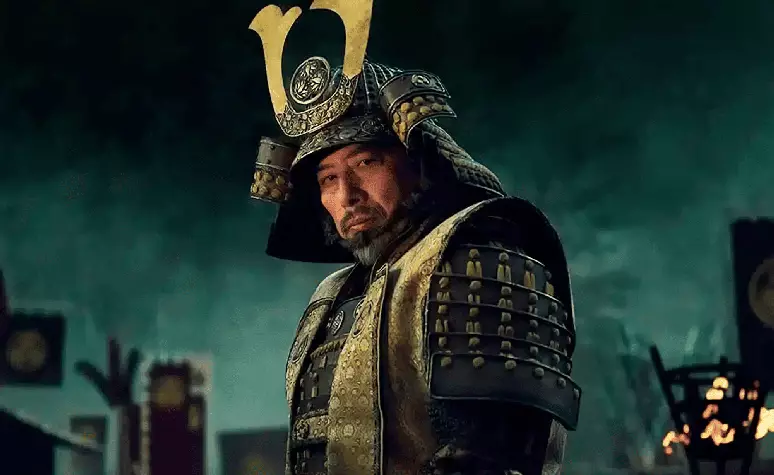






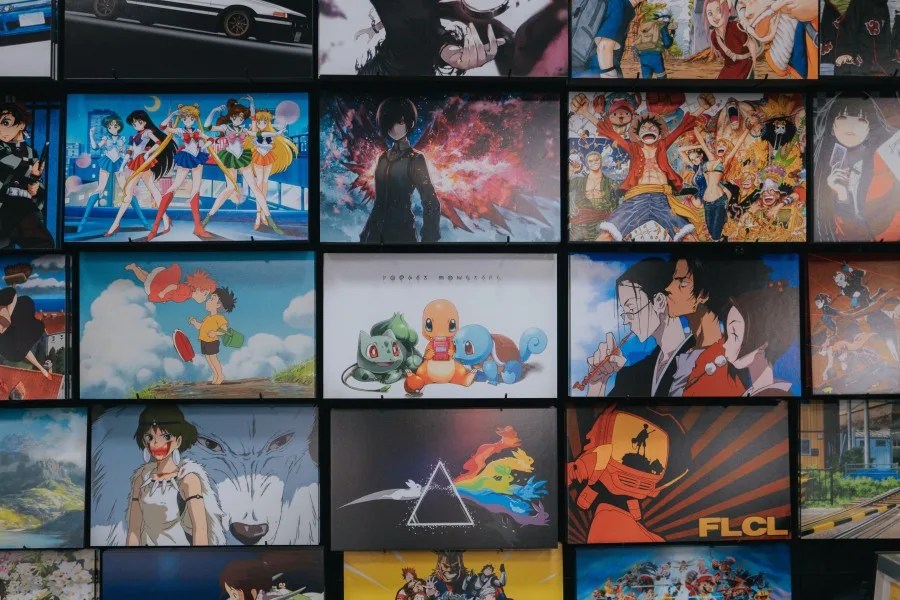


![Keiyoushi – Japanese adjectives of the type i [い]](https://skdesu.com/wp-content/uploads/2014/12/adjetivos-nihongo.webp)
![Keiyoushi – Japanese adjectives of type [い] – List](https://i0.wp.com/skdesu.com/wp-content/uploads/2014/12/adjetivos-nihongo.webp?ssl=1 "Keiyoushi – Japanese adjectives of type i [い] – List")