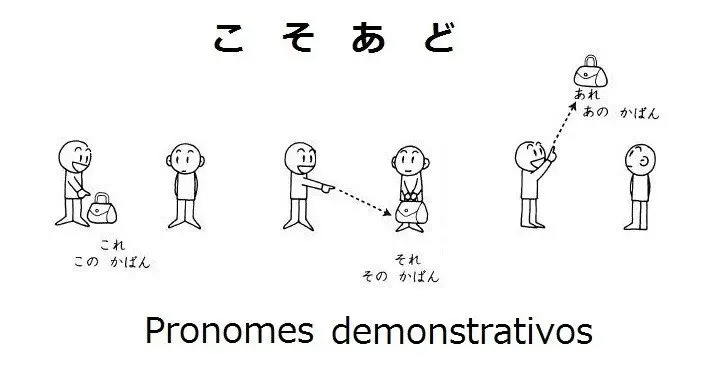
Have you ever wondered how to express “this”, “that”, “that over there”, “which”, “where”, “here”, “there”, “over there” and other demonstrative pronouns in Japanese? In this article, we will explore these pronouns known as kosoado.
The demonstrative pronouns, known as “shinjigo” [指示語] and “shijishi” [指示詞] in Japanese, play a fundamental role in indicating positions and references in a conversation. Additionally, they can be used to indicate places, objects, individuals, directions, and various other functions in the Japanese language. Keep reading to better understand how these pronouns work and how to use them in Japanese.
The name Kosoado is a compound of 4 series that classify the demonstrative pronouns, represented by the initial kana of each pronoun. They are:
Ko [此] – or “Kinshou” [近称], represents something close to the speaker;
So [其] – or “Chuushou” [中称], represents something close to the listener;
A [彼] – or “Enshou” [遠称], represents something distant from both the speaker and the listener;
Do [何] – Represents something of indeterminate position, which can be used for questions;
The kosoado pronouns are divided into 7 types:
Jibutsu [事物] – Things;
Bashou [場所] – Place;
Houkou [方向] – Direction;
Ninshou [人称] – Personal;
Rentaishi [連体詞] – Prenominals;
Fukushi [副詞] – Adverb;
Keiyoudoushi [形容動詞] – Nominal Adjectives;
It is also worth remembering that within KOSOADO are the personal pronouns that we will also examine shortly:
Type
KO
SO
A
DO
Thing
Kore [これ] This
Sore [それ] That
Are [あれ] That over there
Dore [どれ] Which
Place
Koko [ここ] Here
Soko [そこ] There
Asoko [あそこ] Over there
Doko [どこ] Where
Direction
Kocchi [こっち] Here
Socchi [そっち] There
Acchi [あっち] Over there
Docchi [どっち] Which
Direction
Kochira [こちら] Here
Sochira [そちら] Here
Achira [あちら] Over there
Dochira [どちら] Which
Personal
Koitsu [こいつ] This person
Soitsu [そいつ] That person
Aitsu [あいつ] That person
Doitsu [どいつ]
Personal
Konata [こなた] This person
Sonata [そなた] This person
Anata [あなた] That person
Donata [どなた] Which
Pronoun
Kono [この] This
Sono [その] This
Ano [あの] That
Dono [どの] Which
Adverb
Kou [こう] This way
Sou [そう] This way
Aa [ああ] That way
Dou [どう] What?
Adverb
Kou [こう] This manner
Sou [そう] Like this
Aa [ああ] Like this
Dou [どう] How?
Adjective
Konna [こんな] Such as this
Sonna [そんな]
Anna [あんな]
Donna [どんな]
Jibutsu [事物] – Demonstrating things in Japanese
“Jibutsu” (事物) is a Japanese word that means “thing” or “object”. It is used to refer to any physical or conceptual inanimate entity such as plants and animals.
これは本です。
Kore wa hon desu.
This is a book;
それは猫です。
Sore wa neko desu.
That is a cat;
あれは花です。
Are wa hana desu.
That over there is a flower;
どれがあなたの車ですか。
Dore ga anata no kuruma desu ka?
Which is your car?
Bashou [場所] – Demonstrating places in Japanese
“Bashou” (場所) is a Japanese word that means “place” or “location”. It is a common word used to refer to any geographical area, physical space, or specific position.
ここはブラジルです。
Koko wa burajiru desu.
Here is Brazil!
そこは熱いですか。
Soko wa atsui desuka?
Is it hot there?
あそこはきれいな町があります。
Asoko wa kireina machi arimasu.
There is a beautiful city;
有希さんはどこですか。
Yuki-san wa doko desuka?
Where is Yuki?
Houkou [方向] – Showing direction in Japanese
“Houkou” (方向) is a Japanese word that means “direction” or “orientation”. This type of pronoun is used to indicate the way or path in which something is moving or pointing.
こっちの水は甘いです。
Kocchi no mizu wa amai desu.
The water here is sweet;
こちらは一番大きい家です。
Kochira wa ichiban ooki ie desu.
Here is the biggest house;
そっちの花はもっときれいです。
Socchi no hana wa motto kirei desu.
The flowers there are more beautiful;
そちらの道はやばいです。
Sochira no michi wa yabai desu.
This road is dangerous;
あっちへ行って!
Acchi e itte!
Go over there!
あちらの山は寒いです。
Achira no yama wa samui desu.
That mountain is cold;
こっちか?そっちか?どっち?
Kocchi ka? Socchi ka? Docchi?
Is it this way? Or that way? Which?
学校どちらですか。
Gakkou ha dochira desuka?
Which direction is the school?
Ninshou [人称] – Indicating a person
“Ninshou” (人称) is a type of Japanese pronoun used to refer to “person” or “individual” usually in an informal way in different contexts.
こいつは意志薄弱な男です。
Koitsu wa ishi hakujakuna otokodesu
This guy is a weak man.
そいつはいい考えだ。
Soitsu wa ī kangaeda.
That is a good idea. [does not need to indicate a person directly]
あいつを撃つ。
Aitsu o utsu.
Shoot him;
Rentaishi [連体詞] – Prenominal pronouns
Unlike kore, sore, are the prenominal pronouns are used to specify a little more the sentence and must always be followed by a noun. The image at the beginning of the article will help you understand the difference.
このかばんはいくらですか?
Kono kaban wa ikura desu ka?
How much is this bag?
そのかさは千五百円です.
Sono kasa wa sen gohyaku en desu.
That umbrella is 1500 yen.
あのじてんしゃは八万六百円です.
Ano Jitensha wa hachiman roppyaku en desu.
That bicycle [over there] is 80,600 yen.
ど のとけいが千円ですか?
Dono tokei ga sen en desu ka?
Which watch is 1000 yen?
Fukushi [副詞] – Adverbs
Fukushi (副詞) in Japanese refers to adverbs, a class of words used to modify verbs, adjectives, other adverbs, or entire phrases, providing additional information about the manner, time, place, or intensity of the action or characteristic described.
その漢字はこう書くんです
Sono kanji wa kō kaku ndesu
This kanji is written like this
そうです
soudesu
That’s right / exactly / that’s correct;
ああいう人は見たことない
Aa iu hito wa mita koto nai
I have never seen a person like that;
どういういみですか
Dōiu imidesu ka
What does that mean?
Keiyoudoushi [形容動詞] – Nominal Adjectives
“Keiyoudoushi” (形容動詞), often translated as “nominal adjectives” in Japanese, are a class of words that combine characteristics of adjectives and nouns.
どんなことには耐えられないよ
Don'na kotoni wa tae rarenai yo
I can’t stand something like this
そんな感じです
Son'na kanjidesu
It’s such a feeling / It’s that feeling!
なんでそんなことしたの
Nande son'na ko to shita no
Why did he do that?
あんなやつ大嫌いだ
An'na yatsu daikiraida
I hate that person
どんなことでも
Don'na kotode mo
It doesn’t matter what, anything!
Conclusion
These were the KOSOADO and some examples of use, we did not go into many details so you don’t get overwhelmed, it may seem confusing at first, but only with time and practice will you understand the feeling of each word.
Any mistakes, suggestions, or doubts, leave your comments, and don’t forget to share with friends. To learn more Japanese, we recommend that you subscribe to our site and check out our Japanese course.
The perceptions about the lifestyle of the Japanese, especially regarding food, often generate misconceptions. Many believe that the characteristic thinness of the population and the fact that Japan is an island that imports a good part of its products indicate that the Japanese eat little or that food in the country is absurdly expensive. But does this view reflect reality?
In fact, food in Japan is complex and full of nuances. It is not limited to minimal consumption, nor is it dominated by exorbitant prices that restrict people’s access to a good diet. Let’s analyze some points that influence this view, but that can be misinterpreted if not properly contextualized.
The Price of Food in Japan
The cost of food in Japan is one of the most frequently used factors to justify the impression that the Japanese eat little. However, this perspective ignores a crucial detail: the country’s economy. Comparing prices in Japan directly with those of other countries without considering the average salary and purchasing power distorts reality.
For those living in Japan, the cost of food is quite balanced in relation to the average income. For example, while items like beef or cheese may be relatively expensive, Japan offers a huge diversity of affordable meals. Restaurants are spread on every corner, ranging from sophisticated options to places where one can have lunch for extremely low prices. In fact, it is common for the Japanese to have lunch outside the home, taking advantage of the vast range of options, such as the famous yakiniku (Japanese barbecue), where an all-you-can-eat option can be surprisingly affordable.
During a trip to Japan, even items considered expensive, such as cheeses and hams, do not pose an insurmountable problem for most residents. One example is the typical Japanese breakfast, which is not modest at all. It can include rice, fish, vegetables, and even proteins like ham and eggs. These examples reinforce that, although prices may seem high for tourists, the cost of food is proportional to income and allows for a varied diet.
Smaller Portions: A Lifestyle
Another factor that can generate the idea that the Japanese eat little is the size of food portions. Indeed, many products in Japan are packaged in small quantities. This is not a matter of scarcity, but rather of convenience and food culture. The Japanese have the habit of consuming small portions throughout the day, maintaining a balanced eating pattern.
Moreover, this division into smaller portions aims to avoid food waste and prolong the freshness of products. Convenience stores, known as konbini, are ubiquitous in Japan and offer meals, snacks, and drinks for all tastes. Vending machines, which sell everything from iced tea to hot coffee, ensure that the Japanese can eat constantly without needing to stock large quantities of food at home.
Separating food into different bowls also contributes to this impression. A traditional Japanese meal may include rice, soup, vegetables, and protein, each in its individual container. For those not used to it, this may seem like a “smaller” meal, but it is actually a way to savor a variety of flavors and textures without excess.
The Role of Meat and the Japanese Diet
The consumption of meat in Japan is a matter of cultural preference and, to some extent, economic. Although beef is expensive, the Japanese diet is historically based on fish, seafood, and pork, which are cheaper and easier to find. This preference is reflected in popular dishes, such as sushi and tonkatsu (fried pork cutlets).
Interestingly, even with the high price of beef, it is not uncommon to see Japanese people enjoying barbecues in yakiniku restaurants. Moreover, fish options are vast and often accessible. The idea that Japanese people eat little because of the price of meat ignores the variety of accessible protein sources and the abundance of healthy foods available.
Overall, excessive eating that leads to obesity is a global problem. In Japan, there are cases of obesity, especially among children and young people, influenced by the increase in the consumption of processed foods. However, the traditional Japanese diet is rich in vegetables, fish, and low-fat foods. Thus, the impression that the Japanese eat little or in a limited way is more of a myth than a fact.
Conclusion
The reality of the Japanese diet is complex and full of particularities. Even with smaller portions and products packaged in reduced quantities, the Japanese enjoy a variety of foods and flavors throughout the day. The notion that food is expensive or that the diet is restrictive does not hold when considering the cultural context, the economy, and the rich gastronomic diversity that Japan offers.
Most websites say that you can only buy the JR Pass before going to Japan, but this is not entirely true. In this article, we will teach you how you can buy the JR Pass while already in Japan.
The JR Pass is a special train pass offered by the Japan Railways Group, allowing unlimited travel on many of its trains, including the famous Shinkansen (bullet train), for a fixed period.
Is it possible to buy the JR Pass in Japan?
Buying the Japan Rail Pass (JR Pass) while already in Japan is an important question for many tourists and travelers.
Sometimes they did not intend to use the JR Pass due to its high cost, but decided to purchase it to make a longer trip because of a change in itinerary.
The JR Pass is a product mainly aimed at international tourists, offering a convenient and economical way to travel around Japan. Traditionally, it was necessary to purchase the pass outside Japan before arrival, but recently, the policy has changed, allowing purchase at selected locations within Japan.
Despite the change, this fact is little reported by websites and agencies, as they earn a commission from advance sales. Some sites like Klook can sell the JR Pass with Global delivery, but it is more complicated than going to an agency in Japan.
Buying the JR Pass in Japan
Purchase Locations: The JR Pass can be purchased at major train stations and some airports in Japan. This is a recent change, and not all sales locations may offer the pass. This pass is usually found at JTB stores.
Additional Cost: Buying the JR Pass in Japan may be slightly more expensive than purchasing it abroad. This is due to operational costs and pricing policies. Personally, I did not find this price difference and paid the amount I intended to pay for the regional pass.
Eligibility: To buy the JR Pass, you must be a foreign tourist on a short-term visit (less than 90 days) in Japan. You will need to show your passport with a “Temporary Visitor” stamp/sticker.
Types of Pass: There are different types of passes, including national and regional passes. Choose the one that best fits your itinerary. In addition to passes, you can also buy single Shinkansen routes with a tourism discount.
Where to find an Agency in Japan?
Recently I bought mine at the JTB agency in Namba Osaka station, I purchased the Sanyo-san and North Kyushu regional pass for 26,000 yen.
At the agency, I noticed Shinkansen passes from Osaka to Tokyo with up to 3,000 yen discount, in addition to a national JR Pass for 7 days for 26,000 yen.
Payment can be made by credit card or cash. I think one of the main reasons people buy in their own country is the option to pay in installments through some other agency.
“Yu Yu Hakusho” is not just a title in the pantheon of classic anime; it is a gateway to a world where the supernatural and the everyday intertwine in a fascinating way. Created by the renowned mangaka Yoshihiro Togashi, this anime transcended the barriers of Japan to captivate fans around the world. Through its action-packed adventures, unforgettable characters, and engaging plots, “Yu Yu Hakusho” has established itself as a masterpiece of the genre.
In this article, we will explore the meaning and etymology behind the intriguing name “Yu Yu Hakusho.” Delving into the linguistic and cultural roots of the title, we will discover how it perfectly encapsulates the essence and themes explored in the series. Additionally, we will address fascinating curiosities that highlight the lasting influence of “Yu Yu Hakusho” in the world of anime.
Origin and Meaning of Yu Yu Hakusho
“Yu Yu Hakusho” is a title that carries a deep and multifaceted meaning, reflecting the essence of the story and its characters. The literal translation of “Yu Yu Hakusho” from Japanese to Portuguese is “Report of the Poltergeist” or “White Document.”
Etymology
Yu Yu (幽☆遊): The word “Yu” (幽) in Japanese has connotations of “ghostly” or “supernatural.” The repetition of the character emphasizes these supernatural themes present in the series.
Hakusho (白書): “Hakusho” literally means “white report” or “official document.” In the context of the series, this can be interpreted as the reports of the adventures and supernatural cases faced by the protagonist.
The Intrinsic Meaning
The choice of the name “Yu Yu Hakusho” is not just a matter of style, but also reflects the central themes of the series, such as the supernatural, the afterlife, and the constant struggle between good and evil. The idea of a “report” or “document” suggests a detailed and investigative narrative of supernatural occurrences, something that is central to the series.
In Japanese culture, the concepts of ghosts and supernatural phenomena are treated with a mix of respect, fear, and fascination. The title “Yu Yu Hakusho” encapsulates this fascination with the unknown and the supernatural.
Detailed Analysis of the Kanji “Yu” (幽☆遊)
Let’s dive into the analysis of the two characters “Yu” (幽☆遊) and understand how each contributes to the overall meaning of the title.
First “Yu” (幽)
Meaning: The first “Yu” (幽) is associated with concepts such as “dark,” “silent,” or “unclear.” It evokes images of something mysterious, almost ethereal or ghostly, reflecting the supernatural themes of the series.
Connotation: This kanji suggests an atmosphere of mystery and the unknown, aligning with Yusuke’s journey in the spiritual world and his interactions with supernatural beings.
Second “Yu” (遊)
Meaning: The second “Yu” (遊), contrasting with the first, means “to play,” “to stroll,” or “to wander.” It brings an idea of freedom, adventure, and exploration. Connotation: This kanji reflects Yusuke’s journey and his friends, filled with adventures and challenges, both in the human and spiritual worlds.
The Combination of the Two Kanji
The combination of the two “Yu” creates a play on words and meanings. While the first “Yu” brings the idea of the supernatural and the hidden, the second “Yu” introduces an element of adventure and discovery. Together, they encapsulate the essence of “Yu Yu Hakusho”: the exploration of the unknown and supernatural through exciting adventures.
Curiosities
Influence on Martial Arts: Despite its focus on the supernatural, “Yu Yu Hakusho” is also known for its intense fight scenes and martial arts tournaments, influencing other manga and anime series.
Global Popularity: The series achieved massive popularity not only in Japan but also internationally, becoming one of the most beloved anime series of the 90s.
Togashi’s Works: Yoshihiro Togashi, the creator of “Yu Yu Hakusho,” is also known for another famous series, “Hunter x Hunter,” which shares some themes and narrative styles.
Cultural Influences: The use of kanji with multiple meanings is a common practice in Japanese literature and art, demonstrating the richness and complexity of the language.
Impact of the Series: “Yu Yu Hakusho” continues to influence generations of fans and creators, standing out as a notable example of narrative and character design in anime.
Being in a relationship in the 21st century seems not to be as simple as it could be. Despite there being many more possibilities to meet someone – especially online – a good part of young people remains single and even uninterested in starting a family. This behavior is even more pronounced in Japan, which is facing a sharp decline in birth rates that worries the government.
Due to the single youth, a market for rental boyfriends is growing in the Asian country, as well as actions from the government itself to encourage citizens to start families again. However, there is another trend that may also influence these people: anti-dating apps.
Little interest in relationships
In the last three decades, the number of single people, especially of reproductive age, has grown significantly. But what worries is not just the marital status but the outlook. Of the total number of singles, about half do not wish to get involved with anyone, according to this research from Revista Planeta. These people prefer to engage in other activities, such as maintaining a hobby and dedicating themselves to their careers.
But what does intimate behavior have to do with society in general? Because of the decline in birth rates, which is a direct reflection of low interest in starting families. Consequently, the country has seen the number of older people grow, while the base of the pyramid, which would be the younger ones, diminishes. In a few years, there will be few citizens of working age to work and many retirees, which represents a challenge for any government.
Inside the dating market
If on one hand there is no interest in having a serious relationship, on the other hand, people still feel the need to receive a bit of attention and affection. In this context, the rental boyfriend concept emerged in the rental boyfriend stores.
In practice, it works like this: the woman goes to a host café where she meets various men with whom she can talk, receive affection, and attention for a few minutes. While they get to know each other and chat, the consumer spends money on drinks.
The main objective of rental boyfriends is to increase the sales of the establishments. But for that, they need to treat women well, making them feel special.
Digital Cupid from the government
The Tokyo government announced that it will launch an app for people to meet each other. The idea is not new, as there are other examples in the market, such as Tinder, Bumble, etc.
The aim is to reduce the rate of single people aged up to 50, especially due to the low birth rate. The system will be open in 2024 for those who live or work in Tokyo and are over 18 years old.
Importance of anti-dating apps
Despite the name, anti-dating apps can be quite beneficial for those who wish to start dating again. According to the ExpressVPN blog, these platforms serve those who want to deal with their emotions after the end of a relationship, as well as to make new friendships.
Although they were not specifically created for the Japanese audience, they can be quite useful for them. Check out the main examples of this type of technology:
Break-up boss: created by relationship writer Zoë Foster Blake, this app serves as a friendly member for those ending a relationship. It is filled with practical advice, therapeutic games, and other activities to make the routine of those letting go more positive;
Halmos: this app offers community support for those who have separated. It is a true social network where users can share feelings and memories, creating a kind of virtual cemetery to vent and reflect without reservations about this moment;
Mend: featuring an AI chat system, this app allows users to receive psychological guidance to help them move on. There are podcasts and free materials on the topic, but subscribers have access to other interesting resources, such as mini-classes and a community of people going through the same situation.
As can be seen, there is an effort from the market and even the government for people to connect, especially in Japan. After all, despite being an intimate topic, it can impact the entire community by hindering population growth. For those who are single, it is worth considering the possibilities and resources available to meet new people, at least in the realm of friendship.
Judo, originating from Japan, is a testament to the combination of physical skill and mental discipline. It is more than a martial art; it is a philosophy that emphasizes respect, efficiency, and control. This disciplined approach is reflected in the tactical and strategic aspects of betting on judo. With the advent of online sports betting, especially with the emergence of new betting houses 2024, betting on judo has become increasingly popular, attracting both judo enthusiasts and betting aficionados. This article explores the key aspects of judo and how to approach betting on this intricate martial art, providing a comprehensive guide for novice and experienced bettors.
Characteristics of Judo Discipline
Rules
In judo, competitors or judokas engage in a strategic battle to score points through various techniques, including throws, holds, and submissions. The highest score, an “Ippon,” is achieved by effectively immobilizing the opponent, leading to an immediate victory. Points are also awarded for smaller but significant techniques, such as “Waza-ari” and “Yuko.” Understanding these scoring mechanisms is vital for anyone interested in betting on judo matches.
Weight Categories
The sport is divided into weight categories, ensuring that fights are fair and that competitors are balanced in terms of size and strength. Each category brings a different dynamic to judo, which can greatly influence betting strategies and outcomes. Bettors should pay close attention to these categories, as they can often predict the pace and style of the fights.
Belts and Levels
Judokas progress through a color belt system, indicating their level of knowledge and experience. This ranking system is an essential aspect to consider in betting, as it is generally related to the athlete’s skill and competitive history. In judo, the color of the belt can provide a quick insight into their likely performance in a match.
Types of Bets
Bets on judo can range from simple win and loss bets to more complex bets, such as predicting the exact method of victory or the duration of the match. In 2024, innovative betting sites introduced more sophisticated betting options, including live betting during matches, offering a more immersive experience for bettors. This diversification in betting types caters to both casual bettors and those seeking more complex betting challenges.
Major Judo Tournaments
The Olympics and the World Judo Championship are the premier events on the judo calendar, attracting the best judokas and the attention of bettors worldwide. Other important tournaments include the European Judo Championship and the Judo Grand Slam, each with its unique characteristics and betting opportunities.
What to Observe When Betting
Effective betting on judo requires a deep understanding of the sport. Factors such as an athlete’s recent form, psychological resilience, and even their performance in specific types of venues can be crucial. Additionally, considering aspects like training style, injury history, and specific rivalries between athletes can provide a more comprehensive insight for making bets.
Betting Strategies
A strategic approach to betting on judo involves not only closely following the sport but also understanding the betting market. Specializing in certain weight categories, focusing on the individual athlete’s progress, and analyzing confrontation styles can be beneficial. Furthermore, understanding the odds, recognizing value bets, and maintaining a disciplined approach to betting are key to long-term success.
Conclusion
Betting on judo provides a unique and engaging way to connect with this esteemed martial art. The advent of new betting houses has made betting on judo more accessible and exciting. A combination of comprehensive knowledge about judo and strategic betting can lead to an enjoyable and potentially profitable experience. As with all betting, it is important to participate responsibly and in a manner that respects the rich cultural heritage of the sport and the principles on which it was founded. For both enthusiasts and bettors, betting on judo is not just about winning bets; it is an opportunity to deepen appreciation for the sport and its athletes. Ultimately, betting on judo enriches the sports experience, combining the thrill of competition with the excitement of strategic betting.
In animes, battles are often the climax of exciting narratives, combining intense action with character development and intricate plots. In this article, we explore some of the longest fights in animes, analyzing not only their duration in terms of episodes and years but also their impact on the narrative and pop culture.
Luffy vs Kaido – “One Piece”
Duration: The fight spans 61 episodes and 64 chapters in the manga.
Episodes: 893/914 – 1081 (end of the arc)
Period: 2019 – 2023
The fight between Luffy and Kaido in the Wano arc is an example of how “One Piece” manages to keep its audience engaged and invested in its stories, even after hundreds of episodes. This confrontation is not just a physical fight but also a clash of ideals and wills, representing the peak of long-term character and plot development.
Luffy vs. Donquixote Doflamingo – “One Piece”
Duration: The fight spans several episodes.
Episodes: Most of the fight occurs between episodes 700 and 733.
Period: 2014 – 2016
The battle between Luffy and Doflamingo is central to the Dressrosa arc. It is marked by intense physical combat, clever strategies, and dramatic revelations about Doflamingo’s past and his influence in Dressrosa. Luffy, along with his allies, faces Doflamingo and his subordinates in an effort to free the kingdom of Dressrosa from Doflamingo’s tyrannical control.
This fight is notable not only for its duration but also for how it explores themes of freedom, tyranny, and the nature of true power. The confrontation culminates with Luffy unlocking a new form of his King Haki power and defeating Doflamingo with a spectacular technique called “Gomu Gomu no King Kong Gun”.
The Dressrosa arc is one of the longest and most complex in “One Piece,” encompassing various characters and subplots, and the fight between Luffy and Doflamingo is one of its most memorable moments.
Luffy vs. Katakuri – “One Piece”
Duration: 22 episodes
Episodes: 856 to 877
Period: 2017 – 2018
In this epic battle, Luffy faces one of the strongest members of Big Mom’s family, Katakuri. The fight is an incredible demonstration of endurance, skill, and strategy. With Luffy trying to overcome Katakuri’s future predictions and reach a new level of power with his Observation Haki, the fight is both a physical and mental confrontation. Luffy’s determination and the mutual respect that develops between the two fighters make this fight memorable.
Goku vs. Freeza – “Dragon Ball Z”
Duration: 19 episodes
Episodes: 87 to 105
Period: 1990 – 1991
This is one of the most iconic fights in anime. It begins with Goku facing Freeza in his original form and goes through several transformations, culminating in Goku’s ascension as a Super Saiyan. Each episode is filled with tension, increasing powers, and dramatic revelations, making this fight an exciting and visually stunning journey.
Naruto vs. Pain – “Naruto Shippuden”
Duration: 8 episodes
Episodes: 163 to 170
Period: 2010
In this intense battle, Naruto faces Pain, the leader of the Akatsuki, to protect the Hidden Leaf Village. The fight is filled with complex strategies, massive powers, and emotional flashbacks. Naruto, employing Sage Mode and later the power of the Kyuubi, demonstrates incredible growth, both in power and maturity. This fight is crucial for Naruto’s evolution as a central character.
Ichigo vs. Ulquiorra – “Bleach”
Duration: 9 episodes or more
Episodes: 266 to 274
Period: 2010
This fight, set in the Hueco Mundo saga, is crucial for the “Bleach” series. Ichigo Kurosaki faces Ulquiorra Cifer, one of the most powerful Espadas. The fight is filled with twists, with Ichigo reaching new levels of power. The emotion and intensity of this battle make it one of the most memorable in the series.
Aizen vs. Everyone – “Bleach”
Duration: Several episodes
Episodes: 308 to 310
Period: 2011
Sosuke Aizen, the main antagonist of “Bleach,” faces a series of characters in an epic battle that culminates in the Arrancar saga. This sequence of fights is significant for the number of characters involved and the surprising revelations about Aizen’s abilities and motivations.
Conclusion
These fights are more than just simple confrontations; they are stories told through action and conflict. They represent the peak of character development, narrative, and technical innovation in animation. By extending these battles over several episodes, animes manage to create an immersive and exciting experience that stays in the memories of fans for years to come.
If you are looking to learn Korean, there are a ton of great resources out there. And with the proliferation of smartphones and tablets, there are more ways than ever to learn Korean wherever you want and whenever you want.
The best way to learn Korean is to find a method that works best for you. There are many different ways to learn the Korean language, but not all methods are created equal.
One way to learn Korean is to use one of the many Korean learning apps available. These app-based learning tools are designed to help you learn Korean in various ways, depending on your needs and preferences.
Here are the 15 best Korean learning apps you can use to start learning Korean today:
1. Duolingo:The Classic for Beginners
Duolingo is a very popular language learning app, and its Korean version is a great option for beginners. The lessons are short, fun, and gamified, which helps you learn while having fun. Duolingo also offers a community of learners for you to interact with and ask questions.
Features and Benefits:
Gamified lessons
Personalized progress
Community of learners
2. LingoDeer:Focus on Grammar and Writing
LingoDeer is an app focused on teaching you Korean grammar and writing in a structured way. The lessons are clear and easy to follow, and you can track your progress through skill trees. LingoDeer also offers writing exercises for you to practice what you’ve learned.
Features and Benefits:
Interactive lessons
Skill trees
Writing exercises
3. Memrise:Fun Memorization
Memrise is an app that helps you memorize Korean vocabulary and phrases in a fun and effective way. It uses flashcards, memory games, and other resources to keep you motivated. Memrise also offers themed courses for you to learn about different topics.
Features and Benefits:
Flashcards
Memory games
Themed courses
4. Mondly:Immersive Experience
Mondly is an app that offers you an immersive and interactive learning experience. It uses augmented reality and virtual reality to place you in a virtual environment where you can practice Korean naturally. Mondly also offers conversation with bots to help you develop your speaking skills.
Features and Benefits:
Augmented reality
Virtual reality
Conversation with bots
5. Pimsleur:Fluent Conversation
Pimsleur is an app focused on helping you develop listening comprehension and conversation in Korean. It uses an audio method based on repetition and conversation with native speakers. Pimsleur is ideal for those who want to learn Korean quickly and effectively.
Features and Benefits:
Audio method based on repetition
Conversation with native speakers
6. Lingodeer
Lingodeer is an app similar to LingoDeer, which offers you a structured course focused on Korean grammar and vocabulary. The lessons are interactive, and you can track your progress through skill trees. Lingodeer also offers writing exercises for you to practice what you’ve learned.
Features and Benefits:
Interactive lessons
Skill trees
Writing exercises
7. Mango Languages:Focus on Conversation
Mango Languages is an app that helps you develop your conversation skills in Korean. It offers authentic dialogues and pronunciation activities to help you speak Korean naturally. Mango Languages also provides information about Korean culture.
Features and Benefits:
Authentic dialogues
Pronunciation activities
Korean culture
8. Drops: Learning in Short Intervals
Drops is an app that helps you learn Korean in short intervals. It offers 5-minute micro-lessons that you can do anywhere, anytime. Drops also uses games and quizzes to keep you motivated.
Eggbun is an app that connects you with native Korean speakers so you can practice your conversation skills. You can have private lessons or join group classes. Eggbun also offers resources to help you learn Korean on your own.
Features and Benefits:
Lessons with native speakers
Group classes
Resources for self-study
10. Udemy:Courses for All Levels
Udemy offers a wide variety of Korean courses for all levels, from beginners to advanced. You can find courses focused on different aspects of the language, such as grammar, vocabulary, conversation, and pronunciation. Udemy also offers specific courses for those who want to learn Korean for business, travel, or study.
Features and Benefits:
Wide variety of courses
Courses for all levels
Courses focused on different aspects of the language
Courses specific to different needs
11. Lingopie:Learn with Authentic Videos
Lingopie helps you learn Korean with authentic videos, such as dramas, movies, and TV shows. You can watch the videos with Korean and English subtitles, and the app helps you learn the vocabulary and phrases used in the videos. Lingopie also offers exercises to help you practice what you’ve learned.
Features and Benefits:
Learn with authentic videos
Korean and English subtitles
Exercises to practice
12. Talk To Me In Korean
Talk To Me In Korean is a comprehensive resource for learning Korean. It offers podcasts, videos, courses, and much more. The site also has a forum where you can interact with other Korean learners and ask questions.
Features and Benefits:
Podcasts
Videos
Courses
Forum to interact with other learners
13. KoreanClass101
KoreanClass101 offers a comprehensive learning system that includes videos, vocabulary, grammar, exercises, and even an online dictionary. The site also offers the option to have a private Korean teacher.
Features and Benefits:
Videos
Vocabulary
Grammar
Exercises
Online dictionary
Private teacher
14. Go Billy Korean:
Go Billy Korean is an app that helps you learn Korean with Billy, a virtual teacher. Billy guides you through interactive and fun lessons that help you learn vocabulary, grammar, and conversation. Go Billy Korean also offers exercises to help you practice what you’ve learned.
Features and Benefits:
Learn with Billy, a virtual teacher
Interactive and fun lessons
Exercises to practice
15. TTMIK (Talk To Me In Korean):
TTMIK is the official app of the Talk To Me In Korean website. The app provides access to audio lessons, podcasts, ebooks, and other resources to help you learn Korean. TTMIK also offers the option to have a private Korean teacher.
Features and Benefits:
Audio lessons
Podcasts
Ebooks
Private teacher
Conclusion
With so many amazing apps available, there are no excuses not to start learning Korean today! Explore the options listed in this article and find the perfect app for you.
Remember:
Learning a language takes time and dedication. Be patient with yourself and practice regularly.
Combine the use of apps with other forms of learning, such as watching Korean dramas, listening to Korean music, and conversing with native speakers.
Above all, have fun! Learning a new language should be an enjoyable and rewarding experience.
Have you ever thought about making your selfies look like anime or manga? Want to discover your anime version or manga version? In this article, we will explore 15 applications that transform photos into drawings.
Today, doing this with a mobile phone is quite easy. There is a wide variety of apps for both Android and iOS. Check out our list of the 20 best apps to transform photos into Animes and caricatures with various types of filters and effects available for Android and iPhone.
Before we move on to the applications, we can mention that artificial intelligence is present in most of these apps, but today you can use tools like ChatGPT or any other image AI to transform a photo and convert it into different drawing styles, it can be manga or even colored anime.
We placed Artificial Intelligence in the zero position because it is something super broad. Every day a new artificial intelligence website emerges that performs modifications or generates images based on parameters defined by the user. If you want to use one of these applications, we will leave some tips below:
Vidnoz
Vidnoz is a free-to-use website that allows you to easily generate AI portraits from photos in your browser without downloading. When a user uploads a photo, the AI analyzes facial features and generates portraits in seconds to minutes.
Vidnoz is capable not only of generating AI portraits but also transforming them into videos. Just upload a photo, enter the text, select the language and gender, click generate, and in a few seconds, you will have an AI portrait video that can speak. In some cases, you may be asked to register, but this happens because the video is very large and must be sent via email. This tool is completely free, so you can use it without worry!
My Experience Using AI to Transform into Anime
The image below was created using ChatGPT; I sent one of my travel photos from Japan that you will see throughout the article in the Second Application (ZmoAi), and ChatGPT sent this result.
Although it is not a transformation of the image, I liked that it maintained our characteristics such as hair color, clothing, accessories, and even understood that we took a selfie.
I did nothing but send the photo and ask for it to be transformed into anime characters. Everything was written in Portuguese without any complicated “prompt” using GPT-4.
List of Prompts to Use in AI
Below is a list of prompts in English to use with artificial intelligence that will transform photos into anime and manga drawings in different styles and with better results.
“Transform my photo into an anime character with big eyes, long black hair, and a school uniform.”
“Make me look like a character from a seinen manga with a serious expression, short hair, and a black suit.”
“Draw me in a cute chibi style with a pink dress and a ribbon in my hair.”
“Turn my photo into a cel-shaded anime scene with a dramatic background.”
“Apply a vintage filter to my photo and make me look like a character from a classic manga.”
Tips:
Be specific in your prompt for better results.
Use keywords that describe the style you want.
Experiment with different prompts to find what you like best.
Combine prompts to create unique results.
1. AnimeMe
AnimeMe is a revolutionary app that uses cutting-edge artificial intelligence technology to transform your photos into stunning cartoons in seconds. With a simple and intuitive interface, you can easily upload your photos and watch as AnimeMe transforms them into animated works of art with impressive details.
What makes AnimeMe even more amazing is that it is completely free and constantly evolving. New painting styles are regularly added, ensuring that you always have fresh and exciting options to try. So, if you want to impress your friends with incredible cartoon portraits or just have fun exploring different art styles, AnimeMe is the perfect app for you. Come try it and let your creativity flow with AnimeMe!
2. Zmo AI Cartoon
Zmo AI Cartoon is an AI-powered photo editing tool that takes photo-to-cartoon transformation to a new level. With advanced technology, this app can create highly detailed and realistic cartoons from your photos in just a few clicks.
A unique feature of Zmo AI Cartoon is its customization capability. You can adjust different elements such as outlines, shading, and colors to create a cartoon that meets your exact preferences. Additionally, the app is regularly updated with new styles and features, ensuring a consistently fresh and exciting experience for its users.
3. Toonify
Toonify is a photo editing tool that adds a fun and animated touch to your images, transforming them into vivid and captivating cartoons. With an intuitive and easy-to-use interface, this app allows you to turn your photos into cartoon-style artworks with just a few clicks.
What sets Toonify apart is its advanced artificial intelligence technology, which ensures impressive and realistic results. The tool also features different creation styles such as 3D characters, Disney princesses, and many others.
4. Anime Camera – Manga, HQ
With this app, you will be able to transform your photos quickly. With various filters, animated backgrounds, and other options to customize your creations. You can share your photos with anyone. One downside is that it is only available for Android.
Anime Camera
5. Anime Face Changer
In Anime Face Changer, you can create anime vs real-life photos, as well as create an anime avatar; you can also get animated versions in seconds, along with an animated photo editor.
A wide variety of styles. Animation, selfie, kiss face, manga photos, kawaii anime camera, manga eyes, cartoon creator, manga stickers, cartoon transformation. Available only for Android.
Anime Face Changer
6. Cartoon Photo Editor
The Cartoon Photo Editor allows you to add cartoon filters to your images to make them look like they were drawn by a famous painter, with a wide variety of effects.
You can even create drawings to animate your photos and with the drawing creator, add filters and special effects with just a click of a button. Also available only for Android.
7. Drawing – Cartoon Photo Editor
Cartoons is more than just a simple app; it is where you can unleash your inner artist with many image filters (photo to caricature, cartoon yourself, cartoon photo maker, and others).
Features:
Transform my photo into a cartoon drawing;
Cartoon photo editing;
Cartoon photo filter(s);
Cartoon photo frames;
Cartoon photo creator;
10 apps to transform photo into anime, manga, and drawing
8 – TwinFACE — Transform into Anime
TwinFace delivers on its promise, transforming your photo in just a few seconds. It can be quickly and easily saved to your gallery or shared directly with your friends on social media. One downside of this app is that it requires an internet connection and is only available for Android.
9. Comica
This app is the ideal meme creator. You can transform your photos into animated graphics or comics. Select any photo from your gallery (or take a new one) and apply filters to turn it into a cartoon or comic.
You can also add comic-style speech and thought bubbles. Type your message and create beautiful memes or posters.
10. Voilà AI Artist Photo Editor
This app is definitely one of the best on this list. By combining your creativity with the artificial intelligence of this app, you can create fun and amazing drawings.
Simple, fast, and intuitive, it allows you to create fun drawings and caricatures from old or recent photos. After downloading the tool, the user is not required to create a login or password, which is a significant difference compared to other applications.
After creating your work, you can easily save it to your gallery or publish it on your social media. The app is available for free on both iOS and Android.
Photo Lab is one of the most versatile apps for transforming photos into drawings, with over 800 effects available in its library.
In addition to styles, you can apply filters, frames, and create montages. All of this in a very intuitive way that even inexperienced users will find easy to use.
The volume of resources available in the free version is sufficient for most users, but if you prefer, you can access additional tools in the Pro version. Available for both platforms.
10 apps to transform photo into anime, manga, and drawing
12. ToonMe
ToonMe is a simple app that delivers on its promise. It simply makes your image look like a drawing, and after that, you will have the option to add some embellishments like glasses, mustaches, and other options to achieve a more pleasing result. If you want a simple option, it’s worth downloading on Android or iOS, especially since it’s free.
10 apps to transform photo into anime, manga, and drawing
This option is not an app but rather a platform that can be accessed from your smartphone.
The Selfie 2 Waifu website employs an algorithm known as UGATIT to transform photos into anime-style illustrations. In practice, all you need to do is upload an image from your computer or phone, and the page will automatically revert to your Japanese animation version.
This site works best when used with an image that has your face prominently featured in a 3×4 style. It tends to deliver better results for women.
It is also worth noting that the anime-style image is available only in low resolution – but it is still usable on social media.
10 apps to transform photo into anime, manga, and drawing
14. AnimeArt
AnimeArt is a powerful tool for anime and manga lovers who want to transform their photos into stylized works of art. With a wide variety of filters and effects inspired by Japanese style, this app offers an immersive and fun photo editing experience. From adding characteristic manga strokes to applying vibrant hues, AnimeArt allows users to customize their images according to their creative vision using AI.
Whether to create unique portraits, impressive profile images, or simply to have fun experimenting with different styles, AnimeArt is an excellent choice for anyone looking to add an anime touch to their photos.
15. Cartoonify
Cartoonify is like a digital art studio in your pocket! It takes your photos and transforms them into cartoons or mangas with incredible quality. The best part is that you can customize every detail – from line thickness to color palette.
It’s like having a magic pencil that turns any bland selfie into an animated masterpiece. Whether to impress your friends on social media or just to have fun, Cartoonify is the perfect app to unleash your creativity.
Other Apps to Convert Photo into Anime
There are hundreds of apps you will find on the Play Store or App Store, search well using related keywords, check the app ratings, as the vast majority do not deliver what they promise.
Additionally, as mentioned at the beginning of the article, we have several AIs capable of converting images into photos. Naming them is very complicated; a new one emerges every day. I will mention some names that the AI itself recommended to me:
List of AI Sites to Transform Photos:
Fotor
MyEdit
VanceAI
ZMO.AI
Different Dimension Me
Vidnoz
Anime Art Painter
Pica AI
To conclude, we will leave a video from our channel about the apps:
Flowers have a deeply rooted presence in Eastern culture, transcending their merely decorative role to become vehicles of meanings and deep connections.
While in the West flowers often adorn environments as aesthetic elements, in Eastern culture, they play significant roles in various spheres of life.
In this exploration, we delve into the ways in which flowers intertwine with the culture, tradition, and spirituality of the East.
Intrinsic Meanings of Flowers in Eastern Culture
In Eastern culture, flowers are a subtle and eloquent language for expressing feelings and emotions. Each flower carries a distinct meaning, conveying complex messages on various occasions. The Lily, with its delicate beauty, represents purity and innocence.
The chrysanthemum, with its elegant petals, evokes longevity and honesty. The Cherry Blossom, with its brief and stunning display, symbolizes the ephemerality of life and fleeting beauty.
Ikebana, originating from Japan in the 7th century, transcends mere floral arrangement to become an artistic expression. Each element of the arrangement is chosen with care, from the selection of flowers to the arrangement of leaves and branches. The result is a visual representation of harmony and balance between man and nature.
Hanami: Celebrating the Ephemerality of the Cherry Blossom
One of the most emblematic festivities in Eastern culture is Hanami, a reverence for the ephemeral beauty of cherry blossoms. Taking place annually in Japan between March and April, Hanami attracts people from all over to appreciate the majesty of cherry blossoms.
Under these flowering trees, families and friends gather to share food, drink, and joy, establishing a special bond with nature and each other.
The colors of flowers play a vital role in Asian culture, each carrying distinct meanings. Red represents happiness and good luck, white communicates innocence and peace, while yellow is associated with friendship and respect.
Beyond their aesthetic beauty, many flowers play a crucial role in traditional Asian medicine. The Lotus Flower, for example, besides its stunning appearance, is used in Chinese medicine to treat heart problems. The Tea Flower, known for its delicate fragrance, is used to relieve headaches and insomnia, demonstrating the deep interconnection between nature and human well-being.
Floral Influence in Asian Fashion
The influence of flowers in Eastern culture is not limited to traditions and rituals, extending to fashion. Floral patterns are common in traditional Asian garments, such as kimonos and yukatas, reflecting the ongoing connection between clothing and nature. This persistent influence highlights how flowers have transcended the boundaries of the ephemeral, finding a lasting representation in fashion and style.
Flowers in Asian Life
The importance of flowers in Eastern culture goes beyond their aesthetics, playing a vital role in the expression of emotions, traditions, and human connections. Whether through elaborate floral arrangements, vibrant festivals, or influence in fashion, flowers are intrinsic to the essence of life in the East. They represent a lasting connection between people and nature, a universal language that transcends borders and cultures, forming fundamental pillars of the rich tapestry of Asian life.
In today’s article, I present a selection of common questions and expressions used in daily Japanese life. These brief expressions can be employed to ask different types of questions, and therefore we will explore their multiple translations and meanings.
Hontou? 「本当」
The expression “本当?” (Hontou?) is used in Japanese to express surprise or disbelief regarding something that was said or happened. It can be translated as “Is it true?” or “Really?”. This question is commonly used in informal conversations among friends, colleagues, or family when someone is surprised by new or unexpected information.
本当? Hontou?
Seriously?
Are you sure?
Are you sure about that?
Are you all sure?
Is it really?
Nanikore「なにこれ」
The questions “なにこれ” (Nanikore) and “これなに” (Korenani) are used in Japanese to express astonishment, perplexity, or confusion in the face of something that has not been understood or that is considered strange, unusual, or surprising. Literally, “なにこれ” means “What is this?” and “これなに” means “What is this?”, but in practice, both are used similarly to express surprise or curiosity regarding something that has caught the speaker’s attention.
These questions are commonly used in informal situations among friends, colleagues, or family, and can be accompanied by gestures or specific intonations to emphasize astonishment or confusion.
何これ Nanikore
これ何?Korenani
What is this?
What is that?
What is it?
This here, what is it?
What is that supposed to be?
Nanishiteruno 「何してるの」
The questions “何してるの?” (Nanishiteruno?), “何するの?” (Nanisuruno?), “何をしていますか?” (Naniwo shiteimasuka?) and “何してんの?” (Nani shitenno?) are all used to inquire about the activities, future plans, or actions of the person you are talking to. They differ in terms of formality and context of use:
“何してるの?” is informal and is used among friends or family to know what the person is doing at the present moment.
“何するの?” is informal and asks about the person’s future plans or immediate activities.
“何をしていますか?” is formal and shows respect when asking what the person is doing at the present moment, suitable for work environments or formal situations.
“何してんの?” is informal and abbreviated, common among friends or close people to know what the person is doing at the present moment.
These questions are used according to the level of formality of the situation and the degree of closeness with the person you are communicating with in Japanese.
The phrase “何に使うの” (Nani ni tsukau no) in Japanese can be translated as “What are you going to use this for?” or “What will this be used for?”. This expression is used to inquire about the purpose or intent of something, questioning how an object or resource will be used in a given situation.
It is common to hear this question when someone shows a new or unknown object, or when discussing the use of something specific in a practical context.
何に使うのNani ni tsukau no
For what?
For what purpose?
What are you going to use?
Nan’notameni 「何のために 」
The phrase “何のために” (Nan’notameni) in Japanese can be translated as “For what?” or “For what reason?”. This expression is used to inquire about the purpose or intent of something, questioning the reason or motive behind a specific action, decision, or situation.
For example, you can use this expression to ask why someone is doing something or what the objective behind a certain action is.
何のために Nan'notameni
What is the objective?
For what purpose?
For what?
For what purpose?
With what purpose?
For what?
nannohanashi 「何の話」
The expression “何の話” (Nannohanashi) in Japanese can be translated as “What subject are we talking about?” or “What are we discussing?”. This phrase is used to clarify the theme or topic of conversation, indicating interest in knowing about the subject being discussed. It is common to use it when you want to better understand the context of the conversation or when you want to focus on a specific topic.
何の話?nannohanashi?
What are you talking about?
What are you talking about?
What are you all talking about?
What are you talking about?
Dakara nani 「だから何」
This expression in Japanese is translated as “So what?”. It is a direct way to express indifference or lack of interest regarding something that was mentioned earlier. It can be used in informal contexts among friends or in situations where one wishes to demonstrate a relaxed attitude.
だから何?dakara nani?
So what?
And now?
And then?
Where are you going with this?
Nanda kore 「何だこれ?」
“Nanda kore” (or “Nan da kore”) is an expression that means “What is this?” or “What is that?” in Japanese. It is used when you want to ask about a specific object that is nearby or that has been mentioned in the conversation. This question is common in situations where something sparks curiosity or when you do not recognize something and want an explanation of what it is.
何だこれ?Nanda kore?
What is that?
What is this supposed to be?
What is that supposed to be?
Nani no youda 「何の用だ」
“Nani no youda” is an expression that can be translated as “What do you want?” or “What is your purpose?”. It is used to question someone’s intention or purpose regarding something specific. It can be employed in various contexts, from informal conversations to more formal situations, depending on the tone and intonation used.
何の用だnani no youda?
What do you want?
What do you desire?
What do you want?
What do you all want?
What is it that you want?
What do you want?
What do you desire?
What is it that you wish for?
Nandatte 「何だって。」
“Nandatte” is an informal Japanese expression that can be translated as “What do you mean?” or “What did you say?”. It is used in situations where you did not understand something that was said or when you want a clearer explanation about a subject. It can express surprise, curiosity, or the need for clarification.
何だって。
nandatte?
What do you mean?
What did you say?
Excuse me?
Nani ga shitai 「何がしたい?」
“Nani ga shitai” is an expression that means “What do you want to do?” in Japanese. It is used to ask about someone’s desires, plans, or intentions regarding specific activities. It can be used in both informal and formal contexts to inquire about the person’s interests or objectives.
何がしたい?Nani ga shitai?
What do you want to do?
What do you want to do?
What would you like to do?
What is it that you want to do?
Nani ka atta 「何かあった?」
“Nani ka atta” is a Japanese expression that can be translated as “Did something happen?” or “Was there any news?”. It is used to ask if something new has happened or to find out if there is any relevant or interesting information to be shared. This expression is common in everyday conversations to check if there are any updates or recent events to discuss.
何かあった?Nani ka atta?
Any news?
Something new?
Any updates?
Anything new?
Did something happen?
Nani kangae teru no 「何考えてるの」
“Nani kangae teru no” is a Japanese expression that means “What are you thinking about?” or “What are you pondering?”. It is used to inquire about someone’s thoughts, reflections, or ideas. It can be employed in various contexts to better understand what the person is contemplating or considering.
何考えてるのNani kangae teru no
What are you thinking about?
What are you pondering?
What are you thinking?
What are you thinking?
What are you thinking about?
Nani matteru no 「何待ってるの?」
“Nani matteru no” is a Japanese expression that can be translated as “What are you waiting for?” or “What are you waiting on?”. It is used to ask what someone is waiting for or expecting to happen in a given situation. It can be used in various contexts to inquire about expectations or timelines.
何待ってるの?Nani matteru no?
What are you waiting for?
What are they waiting for?
What are you all waiting for?
Nani ga hoshī no 「何が欲しいの」
This expression in Japanese, “何が欲しいの” (Nani ga hoshī no?), is used to ask “What do you want?” or “What do you desire?”. It is a direct way to inquire about someone’s desires or needs regarding something specific. It can be used in various contexts to question what the person is interested in obtaining or achieving. The use of this expression shows interest in understanding the other person’s preferences and aspirations.
何が欲しいのNani ga hoshī no?
What do you want?
What do you desire?
What do you want?
What do you all want?
What do you want?
Conclusion
I hope you enjoyed this brief article about some common questions in Japanese. Did you notice that most questions end with the particle 「の」? This is an important characteristic of the Japanese language that helps indicate possession or connection between elements in the sentence. It is interesting to observe that some of these questions can be formulated differently, such as using the form 「ですか」 at the end of the sentence or changing the position of 「何」 to the end, which demonstrates the flexibility and versatility of the structure of the Japanese language.
If you have more questions or want to learn more about the Japanese language, do not hesitate to explore other topics or seek more information. Thank you for reading!
The selection of animes available on the Netflix platform offers a wide range of options for enthusiasts of Japanese animation. This article aims to provide guidance and suggestions for those who wish to explore this catalog, presenting both renowned titles and exclusives from the platform.
When navigating through Netflix’s extensive anime catalog, one may wonder which title to choose for a satisfying viewing experience. However, with the right guidance, it is possible to find true gems that cater to a variety of tastes and preferences.
Netflix, known for its offering of dubbed content in various languages, including Japanese, provides a flexible experience for its users. It is important to highlight that, even with the presence of dubbing, many animes are available in their original version with subtitles, thus offering a more authentic experience for fans of the Japanese language and culture.
In addition to well-known and popular titles, the platform also features a series of exclusive and original productions that contribute to the diversification of the catalog and attract a broader and more diverse audience. These exclusive titles can be an excellent option for those seeking new and unique narratives within the anime universe.
The Best Animes on Netflix
Starting with what matters most, that is, those that are worth watching and will not disappoint. Here is a good list of animes available on the platform that I have compiled here based on popularity and ratings on MyAnimeList, so there is no point in arguing if a lesser-known anime is not among the top ones.
But to not seem cruel, I have included a list of extras at the end of the article, where you will find almost all the animes that can be found on Netflix and that are not on this list of the best. It may be the first time that some reader wants to watch an anime on Netflix, so let’s list the ones that intend to start with the best.
Unfortunately, not all the best animes will be on this list. Some arrived only after the writing of this article, animes like PsychoPass, which is one of my favorites, are already available on Netflix.
Death Note
Light Yagami, a high school student and genius, finds a peculiar notebook called Death Note. This notebook is originally a possession of the Shinigamis, but due to an irrelevant event, it ends up falling to Earth.
This notebook has the power to kill anyone whose name is written in it, as long as the person who wrote it knows the exact face of the target. And since Light hates the deplorable and filthy state the world is in, he decides to cleanse the world of criminals and scum with this notebook.
Your Name – Kimi no na wa
Mitsuha Miyamizu, a high school girl, deeply wishes to live life in the bustling city of Tokyo. She has a dream that contrasts with her present life in the countryside. Meanwhile, in the city, Taki Tachibana lives a busy life as a high school student, while juggling his part-time job and hoping for a future in architecture.
One day, Mitsuha wakes up in a room that is not hers and suddenly finds herself living the dream life in Tokyo – but in Taki’s body! Elsewhere, Taki finds himself living Mitsuha’s life in the humble countryside. In search of an answer to this strange phenomenon, they begin to look for each other.
Castlevania
There is a legend that every 100 years Vlad Dracula would rise from the darkness with the main goal of dominating the entire Earth. The only ones capable of stopping such a threat are the members of the Belmont family, also known as the clan of hunters against Count Dracula.
Now, these brave warriors embark on this dangerous mission to save Eastern Europe from the vampire’s hands. This is an original Netflix animation with an American team, but it tries to stay true to the traits of the Japanese game made by Konami.
One-Punch Man
Saitama is, at first glance, ordinary and weak, but he has a peculiar hobby of being a hero. Since childhood, he had this dream and for this, he trained for three long years, losing all his hair as a consequence, but he also managed to become powerful enough to defeat any enemy in a single punch.
But this does not mean that he is happy. On the contrary, he now lives in a slump since he can no longer enjoy all the beauty and fun of battles, thus becoming extremely bored. But everything changes with the arrival of a cyborg named Genos, who wishes to become Saitama’s disciple after witnessing his power.
Puella Magi Madoka Magica
Madoka Kaname and Sayaka Miki are normal high school girls with ordinary lives, but all of this changes when they meet Kyuubey, a magical familiar, and Homura Akemi, the new transfer student.
Kyuubey offers them a proposal: he will grant any one of their wishes and, in exchange, each of them will become a magical girl, gaining enough power to fulfill their dreams. However, Homura Akemi, a magical girl, urges them not to accept the offer, stating that everything is not what it seems. Sword Art Online
In 2022, virtual reality technology is extremely advanced, and a large RPG game called Sword Art Online has been released, where players can control their avatars using only their thoughts, fully immersing themselves in the virtual world while forgetting their bodies in the real world.
Kirito is one of the 10,000 players in this game. However, a chain of dark events occurs from the game’s launch day. The game’s creator traps them inside the game until they completely clear all one hundred stages. But with the warning that there will be no second chance, and anyone who dies in the game will also die in reality.
Fate/stay night: Unlimited Blade Works
The Holy Grail War is a battle that occurs between seven mages who act as Masters. Masters, who through the use of command seals, which are given to them as a way to identify the participants of the war, can command Heroic Spirits to fight for them in battle.
In the fifth Holy Grail War, Rin Toosaka is one of the chosen for the competition. With her servant, Archer, she wishes to obtain the ultimate prize – the Holy Grail, a magical artifact capable of granting its bearer any wish.
At the same time, one of Rin’s classmates, Emiya Shirou, accidentally enters the competition and commands a servant known as Saber. However, upon encountering common enemies, Rin and Shirou decide to form a temporary alliance while challenging their opponents in the Holy Grail War.
The Seven Deadly Sins – Nanatsu no Taizai
In a world resembling medieval Europe, the feared and respected Holy Knights of Britannia use magic to protect the region of Britannia and its kingdoms. However, a small group of Knights is accused of treason and of attempting to depose the rulers.
This group was dispersed, but rumors of their existence continue to circulate, in which these legendary knights known as the “Seven Deadly Sins” are said to be wandering the land.
The Irregular at Magic High School – Mahouka
At the dawn of the 21st century, magic, which was considered fairy tales, has become a systematized technology. In contrast to the past, it is now taught as a technical skill. At First High School, the institution for magicians, students are separated into two groups based on their entrance exam scores.
The story follows Tatsuya and Miyuki Shiba, two siblings enrolled in this school. But upon taking the exam, the prodigy Miyuki is placed in the First Course, while Tatsuya is left for the Second Course.
Although his practical test results and status as a “weed” show that he is magically inept, he possesses extraordinary technical knowledge, physical combat abilities, and unique magical techniques – making Tatsuya the irregular in a magical school.
Fate/Zero
With the promise of granting any wish, the Holy Grail has caused three wars in the past, each so cruel that it left no winners. Despite this, the wealthy Einzbern family trusts that the Fourth Holy Grail War will not have the same outcome.
And just for this reason, the terrible “mage killer” Kiritsugu Emiya is hired by the Einzberns, with the marriage of their only daughter Irisviel as a mandatory contract. Kiritsugu is now in a fierce game where all he wants is survival.
To do so, the participants must face six other competitors, each armed with a heroic spirit from the past. Accompanied by his own familiar, Saber, Kiritsugu soon finds his worst enemy in Kirei Kotomine.
Saiki Kusuo no Psi-nan
Kusuo is a high school student facing an uncommon dilemma, living with very strong psychic powers. For most, these powers are a good thing, but for him, they couldn’t be more contrary to this opinion. And all he longs for is a normal life free from the problems his powers cause.
But although Kusuo tries not to attract attention by keeping his powers hidden, he ends up having the opposite result and draws the attention of his classmates. He is then forced to deal with the madness of his classmates while always longing for a peace that seems never to come.
Violet Evergarden
A girl who spent her life being used as a weapon of war, and was not taught to have feelings or anything else that would give her a more human nature. She only had one goal and purpose, to receive orders and execute them even if it cost her life.
But this ends when she is “given” to an army officer who does not see her as a weapon; he sees her as a fragile girl who deserves affection, yet he cannot fulfill her wishes. However, after a battle, the officer dies and the girl is pulled from the front lines as the war is over.
However, this girl loses her purpose in life and must face some dilemmas to learn how to live her life on her own. For this, she needs to understand what the things the officer said to her mean, which she heard but did not comprehend.
Devilman Crybaby
Akira Fudou is a teenager who has always had a kind heart, and even when his childhood friend asked for his help to discover demons, he did not refuse. However, upon arriving at the place where they would find the demons, they are attacked. To save his childhood friend, Akira is possessed by a demon and becomes a Devilman.
Although this brings him great power, this partnership also brings some commitments and risks for Akira. Thus, his job now is to find and destroy demons that pose a great danger to humanity.
Fate/EXTRA Last Encore
Tsukimihara Academy, an artificial high school that serves as the stage for the Holy Grail War. It houses souls that qualify to become a “master.” However, there are a total of 256 souls, and 128 of these will be chosen.
Hakuno is one of these chosen souls and manages to summon his servant after being nearly killed and pursued by an unknown existence. However, his servant, Saber, frees him from his pursuer, and together with Hakuno, they must begin their journey, discovering various secrets and trying to survive in the process.
For this topic, those animes that everyone should watch, even if they are not a junkie like me. These are the ones that anyone watches and enjoys. However, they are classics that have managed to attract many people to the world of animes. And best of all, they can be found on the platform.
One Piece
Yu-Gi-Oh!
Naruto
Bakugan
Fullmetal Alchemist: Brotherhood
Fullmetal Alchemist
Samurai X
Beyblade: Metal Fusion
Pokémon
Digimon
Original Animes from Netflix
The following animes were distributed or created by Netflix or in conjunction with it. They usually have official dubbing in most countries where Netflix tends to dub.
7 Seeds
A Condition Called Love
A Whisker Away
A.I.C.O. -Incarnation-
Aggretsuko
Ajin: Demi-Human
Akuma-kun
Altered Carbon: Resleeved
B – The Beginning
Back Street Girls
Baki the Grappler
Bastard!!
Beastars
Beat & Motion
Black Clover: Sword of the Wizard King
Blame! (film)
Blue Period (manga)
BNA: Brand New Animal
Bright: Samurai Soul
Bubble (2022 film)
Cagaster of an Insect Cage
Cannon Busters
Carole & Tuesday
Case Closed: The Culprit Hanzawa
Case Closed: Zero’s Tea Time
Chi’s Sweet Home
Children of the Whales
Cyberpunk: Edgerunners
Dandadan
Delicious in Dungeon
Devil May Cry (TV series)
Devilman Crybaby
Dino Girl Gauko
DokiDoki! PreCure
Dorohedoro
Dragon Pilot: Hisone and Masotan
Dragon’s Dogma (TV series)
Drifting Dragons
Drifting Home
Eden (2021 TV series)
Edens Zero
Exception (TV series)
Fate/Apocrypha
Fate/Extra
Forest of Piano
Four Knights of the Apocalypse
Gamera Rebirth
Garōden
Ghost in the Shell: SAC 2045
Godzilla Singular Point
Good Night World
Great Pretender (TV series)
Gundam: Requiem for Vengeance
Hero Mask
Hi Score Girl
High-Rise Invasion
ID-0
Ingress (TV series)
Japan Sinks
Japan Sinks 2020
JoJo’s Bizarre Adventure: Stone Ocean
Junji Ito Maniac: Japanese Tales of the Macabre
Kakegurui (2017 TV series)
Kakegurui Twin
Kengan Ashura
Kimi ni Todoke
Knights of the Zodiac: Saint Seiya
Komi Can’t Communicate
Kotaro Lives Alone
Kuromukuro
Lady Napoleon
Last Hope (TV series)
Levius (manga)
Little Witch Academia
Lookism (manhwa)
Lost Song (TV series)
Maboroshi
Make My Day (TV series)
Monsters (manga)
Moonrise (TV series)
My Daemon
My Happy Marriage
My Oni Girl
Onimusha (TV series)
Onmyōji (novel series)
Ōoku: The Inner Chambers
Pacific Rim: The Black
Pluto (manga)
Pokémon (TV series)
Pokémon Concierge
Record of Ragnarok
Resident Evil: Infinite Darkness
Revisions (TV series)
Rilakkuma and Kaoru
Rising Impact
Romantic Killer
Scott Pilgrim Takes Off
Shaman King
Shaman King: Flowers
Sirius the Jaeger
Skull Island (TV series)
Smile PreCure!
Spriggan (manga)
Super Crooks
Sword Gai
Teasing Master Takagi-san
Tekken: Bloodline
The Disastrous Life of Saiki K.
The Grimm Variations
The Imaginary (film)
The Orbital Children
The Seven Deadly Sins (manga)
The Seven Deadly Sins: Grudge of Edinburgh
The Way of the Househusband
Thermae Romae
Thus Spoke Rohan Kishibe
Tiger & Bunny
Time Patrol Bon
Transformers: War for Cybertron Trilogy
Ultraman (manga)
Ultramarine Magmell
Uncle from Another World
Vampire in the Garden
Violet Evergarden
Yakitori: Soldiers of Misfortune
Yasuke (TV series)
What did you think of the animes on Netflix?
Well folks, these are all the animes that have been or are being released on Netflix. There aren’t many, due to the fact that this platform is not specialized in this type of entertainment and it is still progressing. However, I don’t believe it will take long for it to direct more attention to this sector.
Consequently, we will soon see the platform streaming several titles simultaneously with Japan, since at least in Brazil this industry is successful. But anyway, this is the list of titles that are available for now; however, Netflix tends to release several animes out of season, so soon we may have several additional titles.
What remains for us is to wait for updates; however, the article ends here. If you have any questions, criticisms, or anything of the sort, just leave them in the comments. And don’t forget to share on social media, and leave your rating to let us know if you liked the content. Thank you for reading the article up to here, and see you next time, bye.
Many boast about their 3 consecutive days of holiday, but did you know that there is an entire week of holidays in Japan? We are talking about the golden week, the famous Golden Week. Today we will see what happens during this great Japanese week and which holidays take place in it.
The Golden Week [ゴールデンウィーク] or golden week is the combination of four Japanese holidays in a period of 7 days, usually having combinations with weekends. The Golden Week is one of the 3 major Japanese holidays and takes place from April 29 to May 5.
Golden Week is a national holiday, so many workers and students take the opportunity to go on vacation and rest at relatives’ houses, travel, or enjoy. It is recommended to make advance reservations at hotels, as during this holiday, practically everything gets crowded.
What are the holidays or dates that constitute the Golden Week? Let’s see below a little about each special date of the Golden Week.
What is Golden Week?
As already mentioned, it is the longest holiday period in Japan. Many Japanese citizens take paid leave during this holiday, and some companies are completely closed and grant leave to their employees.
The Golden Week is the longest vacation period of the year for many Japanese workers. Only two other Japanese holidays last almost the entire week: the Japanese New Year in January and the Obon festival in August.
The holiday can also be called “oogatarenkyuu” [大型連休] which literally means long holiday or big holiday. In Japanese, Golden Week can also be written as “oogonshuukan” [黄金週間].
See below the holidays that make up the Golden Week:
Date
Holiday
Japanese Name
Celebrated
April 29
Emperor’s Birthday
Tencho Setsu [天長節]
1927-1948
April 29
Emperor’s Birthday
Tenno Tanjobi [天皇誕生日]
1949-1988
April 29
Greenery Day
Midori no Hi [みどりの日]
1989-2006
April 29
Showa Day
Showa no Hi [昭和の日]
2007 to present
May 3
Constitution Day
Kenpō Kinenbi [憲法記念日]
1949 to present
May 4
Citizen’s Holiday
Kokumin no Kyūjitsu [国民の休日]
1988-2006
May 4
Greenery Day
Midori no Hi [みどりの日]
2007 to present
May 5
Children’s Day
Kodomo no Hi [子供の日]
2007 to present
History and Origin of Golden Week
Due to the implementation of the national holiday law in 1948, the holidays were concentrated in the period from April 29 to May 5, and this period became known as Golden Week because of the influence of the film world.
In 1951, the film Jiyū Gakkō recorded higher ticket sales during this holiday-filled week than at any other time of the year (including New Year and Obon). This led the managing director of Daiei Film Co., Ltd. to dub the week “Golden Week” based on the Japanese radio jargon “golden time,” which indicates the period with the highest listener ratings.
At that time, April 29 was a national holiday celebrating the birth of Emperor Shōwa. After his death in 1989, the day was renamed to “Green Day.” In 2007, Green Day was moved to May 4 and April 29 was renamed Showa Day to commemorate the late Emperor.
April 29 – Start of the Golden Week
In the past, this was also the date of the Emperor’s Birthday, but this National Holiday refers to the Reigning Emperor. So much so that currently this holiday occurs on February 23. The reign of Emperor Hirohito is still remembered by the name Showa no Hi.
Showa no hi (昭和の日) is the name of the current holiday that celebrates the birthday of the former Emperor Showa, who died in 1989. On this day, the Japanese remember the 63 years of the Showa Era and also the difficulties they had to endure during that turbulent time.
Before World War II, this holiday was also called Tenchōsetsu [天長節] which referred to the birthday of the Empress’s consort. After the war, the new government renamed it to Tennō tanjōbi, in less formal language. Between 1989 and 2006, April 29 was used to refer to Green Day.
May 3 – Kenpōkinenbi (Constitution Day)
Constitution Day (憲法記念日) is an important day, where the Japanese reflect on the meaning of Japanese laws, democracy, and the Japanese government. This holiday came into effect in 1947.
This constitution was responsible for the peace treaty signed in 1952. Japan has a peaceful policy and does not engage in wars, only in legitimate defense.
May 4 – Midori no hi (Green Day)
Until 2006, Green Day (みどりの日) used to be celebrated on April 29, on the date of the former Emperor Showa’s birthday, but it was moved to the 4th to fill the gap. The day is dedicated to the environment and nature.
This day was created because the emperor loved plants and nature. He also studied and published several works in the field of Marine Biology. This harmony with nature has a strong connection with the principles of Shintoism.
On this day, many activities take place involving tree planting, park cleaning, lectures on environmental issues, and bringing the Japanese closer to nature.
May 5 – Kodomo no hi (Children’s Day)
“Kodomo no hi [こどもの日]” is considered Children’s Day, but this date is also known as “Tango no Sekku” (Boys’ Day). The Tango event takes place on the 5th of the fifth month, but in the past using the Chinese calendar, the day was June 5.
This day is to celebrate Children’s Day, but it is mainly intended for boys. Girls have their own day, the Hina Matsuri which takes place on March 3. There is also a children’s festival called shichigosan.
On this day, carp streamers called koinobori are hung in gardens to symbolize strength and determination. Families also display samurai dolls, armor, helmets, and other samurai weapons to represent the heroes Kintaro.
In addition, other symbols such as Shoki, Momotaro, and Shobu are used. On this day, children eat chimaki, rice cakes wrapped in bamboo leaves, and kashiwa mochi. On this day, the carp song called Koinobori uta is sung.
This is one of the most important weeks in Japan. For many, it is vacation and fun, for others, it is to remember these important dates and celebrate them. And for you? Did you like the article? Share and leave your comments below.
Silver Week – Silver Week
If there is a golden week, is there a silver week? Yes, it is called Silver Week [シルバーウィーク] and can refer to any series of holidays that are not the Golden Week. Generally, holidays that occur in September, October, and November.
In 2009, this term gained strength to refer to sequences of 3 holidays that occur in September. This advertising term was created and promoted by the film industry in the 1950s to refer to a period centered around Culture Day.
It can refer to the period before and after Thanksgiving days in November. Not every year does the sequence of holidays manage to adapt for a long period or catch a weekend. Generally, they are dates like Respect for the Aged Day, Culture Day, and others.
Golden Week in China
The Chinese also copied the same holiday scheme from Japan. The Golden Week [黄金 周], in the People’s Republic of China, is the name given to a semiannual national holiday of 7 or 8 days, implemented in 2000.
There is more than one Golden Week in China. The first is called Chunyun which occurs around the Chinese New Year in January and February. Another Golden Week can happen on October 1, if the autumn festival is close to National Day.
There is also the Golden Week of Labor Day which starts on May 1. This week was discontinued in 2007 but was reintroduced in 2019. What do you think of these holidays abroad? Could Brazil have its Golden Week? Could it be Carnival?
FAQ – Questions and Answers about Golden Week
The Golden Week, or “Golden Week” is a period of extended holidays in Japan. It usually takes place between the end of April and the beginning of May and encompasses a series of consecutive national holidays, making it one of the most anticipated times for travel and leisure in the country.
The holidays that make up the Golden Week include: April 29 – Showa Day (birthday of Emperor Showa) / May 3 – Constitution Day (Kenpō Kinenbi) / May 4 – Green Day (Midori no Hi) / May 5 – Boys’ Day (Kodomo no Hi), also known as Children’s Day
The Golden Week, or Golden Week in English, usually lasts about a week, as the name suggests. However, the exact number of days may vary slightly depending on the calendar and how the holidays align in a given year. When these holidays fall on weekdays, and not on weekends, it is common for companies and schools to grant additional days off, resulting in a full week of break or even more, depending on the policies of each employer or institution.
To make the most of the Golden Week holiday in Japan, plan ahead by booking flights and accommodations, explore popular destinations like Tokyo and Kyoto, participate in festivals and cultural events, try local cuisine, visit historical and cultural sites such as temples and castles, enjoy nature in parks and mountains, and experience the different means of transportation available in the country, always respecting local traditions and safety guidelines.
Among the holidays that make up the Golden Week in Japan, Showa Day (April 29) is generally considered the most significant and important. This holiday celebrates the birthday of Emperor Showa (Hirohito), who was the emperor of Japan during a remarkable period in the country’s history, including World War II and the subsequent reconstruction and economic development. Showa Day is a time for reflection on Japan’s history and values, and many people take advantage of the Golden Week to visit historical sites, participate in cultural events, and honor the memory of the emperor.
Learning Japanese may seem like a challenging task, but there is an effective method that has helped many students, including me, to progress in a more natural and intuitive way. Today I will share with you a technique that I use regularly to enhance my vocabulary and fluency: the “Thinking in Japanese” method. It is a simple and accessible approach that can be applied every day, anywhere. The best part? The results are remarkable and lasting.
The central concept of the method is to train your mind to think directly in Japanese, instead of translating from Portuguese. Since you are already used to thinking in your native language, the idea here is to gradually replace that habit by relating your daily activities directly with Japanese expressions. And the most interesting thing is that this practice can become part of your routine, making learning happen in a constant and spontaneous way. Want to see how it works in practice?
How Does the “Thinking in Japanese” Method Work?
The method is incredibly simple to understand and apply. Basically, it involves learning to express all the actions you do throughout the day in Japanese. Think of the countless activities we perform, like brushing our teeth, studying, or leaving the house. These actions are constant and therefore generate numerous opportunities to practice. For example, you could start by learning phrases like:
私は食べます。
Watashi wa tabemasu
I will eat.
歯を磨いて日本語を勉強します。
Ha o migaite nihongo o benkyō shimasu
I will brush my teeth and study Japanese.
学校行きます。
Gakkō ikimasu
I will (go) to school.
Once these sentences become natural for you, the process of speaking Japanese will become more automatic. What makes this approach even more useful is that human actions are practically infinite. Each day offers new activities for you to describe and practice.
How to Study the Right Way?
The practical application is simple, but it requires consistency. To start, you should focus on basic actions and build your sentences around them. See how helpful it can be to break down the process:
Create a sentence bank: List the daily activities you frequently perform. It could be something like “Having breakfast,” “Working,” “Resting,” or “Going to the gym.” Then, translate these phrases into Japanese and memorize them.
Practice throughout the day: When you are about to do something, say the action in Japanese. For example, before leaving the house, think: “I will go out” (出かけます – dekakemasu). Or, while preparing dinner, say: “I am cooking” (料理しています – ryouri shiteimasu). This way, you reinforce the words and expressions by associating them with what is happening in real time.
Include questions and interactions: Don’t limit yourself to just talking about yourself. Also memorize phrases to ask or comment on the actions of others, such as: “What are you doing?” (何をしていますか – nani wo shiteimasu ka?) or “Where are you going?” (どこへ行きますか – doko e ikimasu ka?). This further expands your vocabulary and makes the method more interactive.
Long-Term Benefits
Following this method daily offers several benefits. First, you start to think in Japanese automatically, which is essential for gaining fluency. The continuous practice of the same actions makes the words and phrases stick in your long-term memory, facilitating spontaneous communication. Additionally, you will learn to use different verb tenses (past, present, and future) in a practical way, which helps to master the nuances of the language.
Another interesting benefit is the ability to expand your vocabulary without relying so much on books or word lists. By interacting with the world around you, you will encounter new situations and words naturally, and your learning will become more dynamic. Think of learning as a cycle: the more you use the words in your daily life, the more comfortable you will feel using them in real conversations.
Tips to Make the Method More Efficient
Use a notebook: Write down phrases you don’t know yet, especially those that refer to common actions in your day. Review these notes regularly.
Adapt to your level: If you are a beginner, start with simple phrases. As you gain confidence, add complexity, such as describing emotional states or using more advanced grammatical particles.
Incorporate Japanese media: Watch videos or listen to audios that showcase everyday dialogues. This reinforces how actions are used in context and helps refine your pronunciation.
The “Thinking in Japanese” method is not only practical; it is a fun and engaging way to make language study part of your daily life. How about starting today?
Phrases to Study
昼食を食べてお風呂に入って学校に行った。
Chūshoku o tabete o furo ni haitte gakkō ni itta
I had lunch, took a shower, and went to school.
今、私はショッピングモールに行きますよ。
Ima, watashi wa shoppingumōru ni ikimasu yo
Now, I will (go) to the mall.
昨日「花町」というイベントに行きました。
Kinō 'hanachi' to iu ibento ni ikimashita
Yesterday I went to an event called “Flower Town”.
週末は寿司を食べた。
Shūmatsu wa sushi o tabeta
This weekend I ate sushi.
テレビを見ている。
Terebi o mite iru
I am watching TV.
私は日本語を勉強しています。
Watashi wa nihongo o benkyō shite imasu
I am studying Japanese.
今日、学校に行きません。でも明日行きます。
Kyō, gakkō ni ikimasen. demo ashita ikimasu
Today, I am not going to school but tomorrow I will.
アニメを見ました。
Anime o mimashita
I watched anime.
Study phrases with actions that you do in your daily life, so your vocabulary will gradually improve.
Did you know that in Japan the hours go beyond 24? Have you ever asked what time it is in Japan? Perhaps you wondered how many hours it is in Tokyo? In this article, we will understand a little about Japan’s time, its differences, and curiosities.
What time is it in Japan? Japanese Time
The time in Japan is known by the acronym JST (Japan Standard Time), in Japanese it is known as Nihon Hyoujunji (本標準時). Japan’s time zone is UTC/GMT +9, 12 hours ahead of Brazil which is UTC -3.
I think we all know that Japan is 12 hours ahead, so if it is 3 PM here, it is 3 AM there. It is worth noting that Japan does not have daylight saving time, so be mindful of this when converting our time to Japan’s time.
Besides Japan, countries like Korea, Indonesia, and Yakutsk have the same standard time. The sun rises about 89º east of Japan at 05:26. The sunset occurs at 17:42 at 272º west. The day lasts about 12 hours and 16 minutes in Japan.
The time in Japan goes beyond 24:00
Japan uses both the 24-hour and 12-hour formats in everyday life. However, in TV programs or some places, they exceed the 24:00 existing on the clock. How so? Japan finds it easier to keep the early morning hours on the same day.
This is because the Japanese have a very active nightlife, it can be confusing for some to see a TV program starting at 21:00 and ending at 1:00. Therefore, they prefer to list it from 21:00 to 25:00 instead of leaving it as 1:00 AM.
Other countries besides Japan, such as the United Kingdom, Korea, Hong Kong, and China, use hours beyond 24:00 when business hours extend past midnight. This also prevents train tickets without any date from issuing times like from 22:00 to 01:00.
This avoids common cases that happen in Brazil when we say Sunday night at 2 in the morning, when it is already Monday. You may find Japanese time exceeding 24:00 on TV, stations, radios, shows, stores, hotels, theaters, and even in bathhouses.
The history of time and clocks in Japan
Before the Meiji Era (1868-1912), each region of Japan had its own time zone that depended on the position of the sun. When trains became popular in Japan, the practice of telling time through the highest position of the sun became a source of confusion. Trains in Osaka would often arrive 20 minutes early in Tokyo due to the slight time difference.
During World War II, countries like Singapore and Malaysia adopted Japan’s time, but this was reversed after Japan surrendered. In the past, the islands of Okinawa and Taiwan used the time which is UTC +8, meaning one hour less than Japanese time, but this ended in 1937.
Clocks have existed in Japan since the mid-7th century in the form of water clocks. In the past, during the Edo period, Japan had a traditional mechanical clock. It used a seasonal time system, based on a mechanical clock from Europe.
This traditional Japanese clock is called Wadokei (和時計) and was introduced by Jesuit missionaries or Dutch merchants. They were lantern clocks made of bronze or iron.
How many hours in Tokyo?
Besides Japan’s national time, most people tend to look for how many hours it is in Tokyo. Japan’s time is the same throughout the country, regardless of region and locality. There is no time zone difference like in some states of Brazil.
So, if you are wondering how many hours it is in Okinawa, or how many hours it is in Osaka, remember that Japan’s time is the same everywhere. In fact, South Korea’s time is the same as Japan’s.
We recommend reading other related articles below:
Although Japan adopts the same time in all its cities, Okinawa tends to have more sunlight due to its location in the south of the country, it also adopts other time zones.
Although the main time is still the same as Japan’s (JST), Okinawa has also used Okinawa Standard Time (OST) which has a one-hour difference. There is not much information about this currently.
Traditional Japanese time
The traditional clock of Japan had six numbered hours from 9 to 4, counting backwards from noon to midnight. The numbers 1 to 3 were not used for religious reasons, as these numbers were used by Buddhists for prayer.
The counting went backwards because the first artificial clocks in Japan used incense that burned to tell time. Dawn and dusk were therefore marked as the sixth hour in the Japanese hour counting system. Traditional Japanese clocks also had the symbols of the Chinese zodiac. (Source: Wikipedia);
Zodiac
Nocturnal Zodiac
Number
Solar Hour
卯 – Rabbit.
酉 – Rooster.
六 – 6
sunrise / sunset.
辰 – Dragon.
戌 – Dog.
五 – 5
巳 – Snake.
亥 – Pig.
四 – 4
午 – Horse.
子 – Rat.
九 – 9
afternoon / midnight.
未 – Goat.
丑 – Ox.
八 – 8
申 – Monkey.
寅 – Tiger.
七 – 7
.
Japanese are Strict with Time
Punctuality is extremely important in Japanese culture, and this is reflected in their schedules. Trains in Japan are known for their punctuality, with delays of only a few seconds. Stores and restaurants generally open and close on time.
Being late in Japan is very rare and a source of shame, so all Japanese people try to be as punctual as possible.
The Japanese Legal Time was established in 1895. Before that, Japan used various local time zones. The unification of the time zone facilitated communication and transportation in the country.
What time do stores open in Japan?
Unlike some countries like Brazil, stores do not open very early and do not close very late. It is common to find restaurants closed at 8:00 PM, and large retail stores opening at 11:00 AM.
See the average opening and closing times for each establishment in Japan:
Department stores and large retailers: generally open from 10 AM to 8 PM, Monday to Saturday.
Street shops: generally open from 10 AM to 7 PM, Monday to Saturday.
Convenience stores: generally open 24 hours a day, 7 days a week.
Lunch restaurants: generally open from 11 AM to 2 PM, Monday to Friday.
Dinner restaurants: generally open from 5 PM to 10 PM, Monday to Saturday.
Izakayas (Japanese pubs): generally open from 5 PM to 11 PM, Monday to Saturday.
Banks: generally open from 9 AM to 3 PM, Monday to Friday. On Saturdays, some banks may open from 9 AM to 12 PM.
Museums: generally open from 9 AM to 5 PM, Tuesday to Sunday.
Time difference between Japan and the rest of the world
Japan has the same time zone as South Korea, Indonesia, East Timor, and Yakutsk (Russia). Japan is 1 hour ahead of China and 2 hours ahead of Australia.
The list below shows the time difference between Japan and other major cities and countries around the world.
Bulgaria (-7 hours)
Croatia (-8 hours)
Czech Republic (-8 hours)
Denmark (-8 hours)
England (-9 hours)
France (-8 hours)
Germany (-8 hours)
Greece (-7 hours)
Netherlands (-8 hours)
Italy (-8 hours)
Latvia (-7 hours)
Portugal (-9 hours)
Russia (-6 hours)
Spain (-8 hours)
Sweden (-8 hours)
Switzerland (-8 hours)
Ukraine (-7 hours)
Accra (-9 hours)
Angola (-8 hours)
Argentina (-12 hours)
Auckland (+4 hours)
Beijing (-1 hour)
Cairo (-7 hours)
Costa Rica (-15 hours)
Dallas (-15 hours)
Doha (-6 hours)
Dublin (-9 hours)
Djibouti (-6 hours)
Isfahan (-5.30 hours)
Ghana (-9 hours)
Hanoi (-2 hours)
Hong Kong (-1 hour)
Iran (-5.30 hours)
Ireland (-9 hours)
Jakarta (-2 hours)
Johannesburg (-7 hours)
Korea (0)
Kyiv (-7 hours)
Las Vegas (-17 hours)
Lome (-9 hours)
Los Angeles (-17 hours)
Luanda (-8 hours)
Madrid (-8 hours)
Malaysia (-1 hour)
Mexico (-15 hours)
Montreal (-14 hours)
Moscow (-6 hours)
New Delhi (-3:30 hours)
New York (-14 hours)
Oklahoma City (-15 hours)
Orlando (-14 hours)
Ottawa (-14 hours)
Paraguay (-12 hours)
Philadelphia (-14 hours)
Port of Spain (-13 hours)
Reykjavik (-9 hours)
Rio de Janeiro (-11 hours)
Saudi Arabia (-6 hours)
Seoul (0)
Shanghai (-1 hour)
Singapore (-1 hour)
Sydney (+2 hours)
Tbilisi (-5 hours)
Tehran (-5.30 hours)
Thailand (-2 hours)
Toronto (-14 hours)
Tunisia (-8 hours)
United Kingdom (-9 hours)
Vancouver (-17 hours)
Vladivostok (+1 hour)
Wellington (+4 hours)
Winnipeg (-15 hours)
Yamousoukro (-9 hours)
These were some curiosities about the time in Japan.
FAQ – Questions and Answers about Time in Japan
What is Japan’s time zone?
Japan follows the JST (Japan Standard Time) time zone, which is UTC+9:00. This means that Japan is 9 hours ahead of Brasília time (UTC-3:00).
Does Japan have daylight saving time?
No, Japan does not have daylight saving time. The entire country follows the same time zone throughout the year. This has been considered, tested, but never really implemented. Studies have shown that daylight saving time does not save energy in Japan. Daylight saving time can have a negative impact on health, such as sleep disturbances and digestive problems, as well as affecting the productivity of the Japanese.
How can I adjust to Japan’s time zone?
To minimize the effects of jet lag during your trip, it is recommended to gradually adjust your sleep, going to bed and waking up a little earlier each day in the days leading up to your departure. Additionally, it is important to expose yourself to natural light during the day to help regulate your circadian rhythm. Avoiding caffeine and alcohol consumption at night is also advisable, as these substances can impair sleep quality. Staying hydrated by drinking plenty of water is essential to avoid dehydration, which can worsen jet lag symptoms.
Hello Kitty is certainly one of the biggest icons of kawaii culture in Japan. Her success and popularity have significantly marked not only Japanese culture but also that of much of the world.
It is very difficult for you to have at least not seen Hello Kitty or other Sanrio characters printed on school supplies like pencil cases, bags, pencil sharpeners, as well as in drawings, movies, and various other products.
In this article, we will learn a little more about Hello Kitty and other iconic characters from the series. We will see how Hello Kitty was conceived? How did she become an icon of Kawaii culture?
Who is Hello Kitty?
Her full name is Kitty White (キティホワイト, Gata Branca), she is a character depicted as a white kitten of the Japanese Bobtail breed. She usually wears a blue overalls, a yellow shirt, and a red bow on her head.
The kitten has a simple design with few features but is incredibly cute. One of the most interesting details about her design is the fact that she does not have a mouth, which later caused a series of rumors about the character.
According to Sanrio, Hello Kitty does not have a mouth because they want people to project their “feelings” onto the character and have a connection with her. Another explanation from the company is that their mascot “speaks from the heart” and is not tied to any language.
Hello Kitty was born in London on November 1st, has a sweet, friendly, and very extroverted personality, and is very close to her family, which consists of her father George, her mother Mary, and her twin sister Mimmy.
In addition to her family, she has a boyfriend named Daniel and several friends, among whom we can highlight My Melody, who is her best friend. We will talk about these characters later.
Her origin
Hello Kitty was originally created by designer Yuko Shimizu in 1974 for the Sanrio company where she worked, about a year later she left the company and her character passed into the hands of Setsuko Yonekubo until 1980, from then on the responsibility passed into the hands of Japanese designer Yuko Yamaguchi.
The name “Kitty” was based on a black cat that the main character Alice played with in the book “Alice Through the Looking Glass” by Lewis Carroll.
After choosing the name Kitty, Sanrio’s founder Shintaro Tsuji wanted the kitten to carry the company’s motto “social communication,” which is how the character became “Hello Kitty.”
She was designed for the pre-teen female market and had a good acceptance from the public leading to the expansion of her products to clothing, school supplies, plush toys, toys, stickers, bags, and a giant array of products.
She made her first appearance on a vinyl coin purse that became the best-selling item of that year in Japan. The great popularity of Hello Kitty made her one of the most influential characters in the Kawaii scene and the official mascot of Sanrio, which also created Gudetama, with a recognition of about 92% of the global population.
Her first animated series on television was called “Hello Kitty’s Furry Tale Theatre” which was produced in 1986 and contains 13 episodes. Its plot was basically Hello Kitty along with her friends reenacting famous fairy tales.
In 1993, a new animated series titled “Hello Kitty and Friends” was released, which also contained 13 episodes. Some time later, “Hello Kitty’s Paradise” was released in 1999 with 16 episodes.
In 2004, “Hello Kitty Stump Village” was released in Korea containing 26 episodes. In 2006, Sanrio Digital and Dream Cortex produced a 3D animated series called “The Adventures of Hello Kitty and Her Friends,” which has 52 episodes.
In 2018, Hello Kitty gained an official channel on YouTube, which features vlog-style videos where Kitty talks about her interests and shows her travels. In 2020, Sanrio launched a free series on YouTube on the channel “Hello Kitty and Friends.”
Some of Hello Kitty’s characters
Now, let’s talk a little about some of the Sanrio characters that accompany her in the Hello Kitty series.
Mary White
Mary White is Kitty’s mother and George White’s wife. She is a white cat that resembles Hello Kitty’s design, wearing a yellow hat, a long dress with an apron, and shoes.
Mary has a very cheerful, kind personality and shows to be quite protective and caring towards her husband and daughters.
In addition to her pleasant personality, Mary has great cooking skills and is also an excellent seamstress. She has a clothing repair business in which she is successful.
George White
George White is Hello Kitty and Mimmy’s father and Mary’s husband. He is the head of the White family and his appearance is also similar to the rest of the family, that is, he is a white cat.
He has a more serious appearance and usually wears office attire such as: collared shirts, ties, dress pants, shoes, and black glasses. He also smokes a pipe.
George has a calm and serious personality, is very hardworking, and despite spending a lot of time working, he always manages to find time to enjoy with his family.
Mimmy White
Mimmy White is Kitty’s twin sister. Being an identical twin, she has the same physical appearance as her sister, being a white cat with a yellow nose and like Kitty, she does not have a mouth. She also wears a yellow bow on her left ear.
She has a more introverted and shy personality than her sister and is also very polite and attentive. Mimmy is very close to Kitty and they have a strong bond.
My Melody
My Melody is Hello Kitty’s best friend, she is a white rabbit and wears a red or pink hood with a flower or a bow on the right side of the hood.
My Melo (as she is often known) is a cheerful girl who was born in the Mariland forest in London. Her favorite food is an almond pound cake and her hobby is baking cookies with her mother.
DearDaniel
Dear Daniel or Daniel Star (as he is generally known) is Hello Kitty’s childhood friend and boyfriend, he is a cat of the same breed as Kitty (Bobtail), and they have known each other since childhood.
Daniel is vain and always cares about being fashionable, he is also very kind and attentive. Both he and his family have lived in various places around the world, before returning to England they had a stint in New York.
This experience allowed Daniel to become a great dancer. He dreams of becoming a celebrity or a photographer like his father in the future.
Details about Hello Kitty
Full name: Kitty White.
Birth date: November 1, 1974 (Scorpio sign).
Place of birth: Suburb of London, England.
Family:
Father: George White.
Mother: Mary White.
Twin sister: Mimmy White (yellow bow).
Pet: Cat Charmmy Kitty.
Creator: Yuko Shimizu.
Company: Sanrio (Japan).
Creation objective: Attract the female audience to school products.
Characteristics
Age: 3rd grade of elementary school.
Height: 5 apples.
Weight: 3 apples.
Favorite food: Apple pie.
Hobbies:
Traveling.
Making new friends.
Listening to music.
Playing piano.
Playing tennis.
Curiosities:
She has no mouth so that people can project their own emotions.
The red bow on her left ear is her favorite fashion item.
She was named a UNICEF ambassador in 1983.
She has a line of licensed products that includes clothing, accessories, toys, stationery, and much more.
Cultural impact
Global icon: Recognized in over 100 countries.
Symbol of kawaii culture: Represents cuteness, innocence, and optimism.
Billion-dollar brand: Generates billions of dollars in sales each year.
Inspiration for artists and designers: Collaborations with famous brands like Chanel, Louis Vuitton, and Supreme.
Presence in pop culture: Appearances in movies, series, music videos, and songs.
Less known facts
Not a cat: Despite her appearance, Sanrio defines her as a “happy girl.”
Has a boyfriend: Daniel Star, a British boy.
Inspiration for the name: “Kitty” comes from a character in the book “Alice in Wonderland.”
Had an anime series: “Hello Kitty’s Paradise” aired from 1996 to 1997.
Hello Kitty Museum: Located in the city of Hakone, Japan.
In the rich universe of the Japanese language, the precise choice of words is fundamental for effective communication. Among the nuances that can confuse learners, we find the terms 苦手 (nigate) and 下手 (heta), both with the general meaning of “being bad at something.” So what is the difference between them?
What does Nigate mean?
Nigate (苦手) means “to have difficulty in,” “to be bad at,” or “not to be good at.” It is written with the kanji 不 (“not”) and 得意 (“to be good at”). It indicates a natural or acquired inability in a specific area, emphasizing the difficulty in performing a task or activity.
Examples:
私はスポーツが苦手です。 (Watashi wa supōtsu ga nigate desu.) – I am bad at sports.
数学が苦手です。 (Sūgaku ga nigate desu.) – I am bad at math.
人前で話すのが苦手です。 (Hitomae de hanasu no ga nigate desu.) – I do not like speaking in public.
What does Heta mean?
Heta (下手) means “to be bad at,” “to be clumsy,” or “to be incompetent.” It is written with the kanji 下 (“down”) and 手 (“hand”). It indicates a lack of skill or technique in a specific action, emphasizing the inadequate execution of a task or activity.
Examples:
絵が下手です。 (E ga heta desu.) – I am bad at drawing.
ピアノが下手です。 (Piano ga heta desu.) – I do not play the piano well.
料理が下手です。 (Ryōri ga heta desu.) – I do not cook well.
Differences between Nigate and Heta
Although nigate and heta are often translated as “being bad at,” they have subtle differences that can easily confuse learners of Japanese. To master the precise use of these terms, it is crucial to understand their nuances and how they apply in different contexts.
Nigate generally indicates a natural or acquired difficulty in a specific area. Heta generally indicates a lack of skill or technique in a specific action. It can be used to express:
Aspect
Nigate
Heta
Meaning
Difficulty in
Lack of skill in
Emphasis
Task accomplishment
Task execution
Examples
Sports, math
Drawing, piano
Nigate: can be used for things you do not like to do because you find them difficult.
Heta: can be used for things you try to do but do not do well.
Mastering the choice:
When choosing between “nigate” and “heta,” consider:
Your intention: Do you want to express a general difficulty or a specific lack of skill?
The context: Is the conversation formal or informal?
The tone: Do you want to be honest, self-deprecating, or humorous?
Remember: context is crucial. Pay attention to the tone of the conversation and the relationship between the speakers to ensure clear and effective communication.
Enhance your Japanese skills:
Practice using “nigate” and “heta” in different contexts.
Observe how native speakers use these terms.
Consult dictionaries and grammars for more information.
With the mastery of “nigate” and “heta,” you will be better prepared to express yourself accurately and naturally in Japanese.
Conclusion
Mastering the differences between “nigate” and “heta” enhances your communication in Japanese. By choosing the correct term, you accurately convey your skills, difficulties, and nuances in your conversations.
Remember: context is crucial to determine the proper use of each word. Pay attention to the tone of the conversation and the relationship between the speakers to ensure clear and effective communication.
Do you know everything about the chopsticks that the Japanese and other Asian countries use to eat? Do you know the correct way to hold the chopsticks? In this article, we will share some tips and rules on how to use chopsticks.
In Asia, it is common to use chopsticks (箸) to eat certain foods. They are 2 sticks that form a kind of pincers. In Japan, eating with them is not only practical but is also considered an art.
Knowing a little about customs will help you avoid embarrassment, make friends, and close deals. In this article, we will see 15 basic rules that you should remember to avoid embarrassment when eating with chopsticks.
In Korean, chopsticks are called Jeotgarak, in Chinese they are called kuàizi, in Thai they are called takiap, and in Indonesian, they are called sumpit.
If you don’t know how to eat using chopsticks or even how to hold them correctly, it’s quite simple but requires a bit of practice.
First, the lower chopstick should go between the thumb and index finger and rest on the ring finger. Next, hold the upper chopstick with the index, middle, and thumb fingers in the same way you hold a pen. Now, just open and close by moving the upper chopstick with the index and middle fingers.
It’s easier said than done. This part takes quite a while to master. Observe how others hold their chopsticks and follow their example; patience is necessary. If you really want to learn, practice as much as you can. After gaining enough practice, you’ll see how they become very practical.
The correct way is to hold the chopsticks with the right hand and use the left to lift the rice and soup bowls while eating. Never pick up food in a vertical position; always from the sides.
You can practice eating with chopsticks by just holding one of them as if it were a pencil. Below, we will leave a video that presents more tips on how to eat with chopsticks and hold them correctly.
Tips for Eating with Chopsticks
When Storing Chopsticks
In most restaurants, a holder will be provided for placing the chopsticks, so just use it. Never, ever, place the chopsticks vertically in the plate, especially in rice, because it resembles a ceremony performed at funerals in Japan. If you don’t see a holder, as in the case of disposable chopsticks, when not using the chopsticks, place them in front of you, with the tips facing left.
Do Not Eat Directly from the Plates
It is very common for the Japanese to leave trays full of sushi or other food for you to take and place on your plate, so never take food directly from the public tray and eat it; you should place it on your plate first.
Never Share Food
This is the biggest taboo at the Japanese dining table; never pass food to another person directly using chopsticks, because this resembles a custom at Japanese funerals when bones are ceremonially passed. If you are sharing food, take it directly to the plate. Sometimes, a separate chopstick is left for this purpose.
Do Not Mix, Cut, Dig, or Lick
Avoid starting to eat with chopsticks and then switching to utensils, and also avoid using both at the same time.
Most dishes come in the right size to eat in a single bite. Yes, there will be occasions when it is necessary to cut large foods, but sushi and other small items, avoid!
Do not use chopsticks to dig around looking for other foods on the plate; eat normally, taking what is within your reach.
Do not lick the ends of the chopsticks; this is something ugly and called Neburi bashi.
Ways of eating with chopsticks differ in China and Korea; the rules are completely different. Do not worry too much; even the Japanese have not fully mastered the art. Do not be afraid to make mistakes, but do your best.
What You Should Not Do with Chopsticks
Do not navigate with chopsticks. Decide before picking up your food; do not hover with the chopsticks over the plates, avoid filling the plate all at once, avoid choosing. This is considered greed (sashi bashi).
Chopsticks are not toys – Never point chopsticks when talking to someone. Never rub chopsticks together several times after separating them, because it is a sign that you think the chopsticks are cheap and bad.
Do not cross chopsticks – When storing chopsticks next to the plate, avoid leaving them crossed, because it also resembles a funeral.
Do not stir chopsticks in your soup – When you do this, it looks like you are trying to clean them. This is sometimes tempting because miso soup remains suspended and does not dissolve. Resist the temptation!
Do not move plates or bowls with chopsticks – Sometimes you may have this crazy idea; do not embarrass yourself.
Do not invent taking your own chopsticks
Having your own chopsticks, all decorated and in a little box, kept in your favorite sushi-ya is a strange Brazilian custom, probably introduced to retain customers, but with no connection to Japanese tradition. Moreover, as far as I know, no one takes their own fork and knife to a restaurant…
In general, the most important rules are those that remind people of Japanese funerals. Remember that chopsticks are not just two sticks for eating, but are deeply rooted in Japanese culture.
Origin and History – How Did Chopsticks Come About?
The exact origin of these chopsticks is not known. The Chinese were responsible for popularizing this practice throughout Asia, but there are much older accounts involving Israel, the people of Citas who invaded Canaan.
Chopsticks were also used in Uighur civilizations from the steppes of Mongolia since the 6th century. It is believed that chopsticks were used much earlier, around 2500 years before Christ, to grill meat over coals.
Only 1500 years after being simple sticks used to turn meat, chopsticks began to be used for common foods. It is believed that they were quite useful to avoid getting hands dirty with sauces that were quite common in cooking.
Confucius was also a great influencer who stated that vegetarians could not use knives at the table. As he was a vegetarian and a famous philosopher of the time, this had a lot of influence.
Saibashi – Another Type of Chopsticks
Some may not know, but there are also other Japanese chopsticks called Saibashi [菜箸] specifically for use in the kitchen, allowing the handling of large and hot foods.
They usually measure over 30 centimeters longer than a common chopstick, and are also joined by a cord at the ends to facilitate grip. Something similar happens with common chopsticks, where people place a clip for the inexperienced.
Most saibashi are made of bamboo or metal. The metal ones are used to handle things that are frying, called kinzokuseinohashi [金属製の箸].
Why Do the Japanese Use Chopsticks?
There are numerous advantages to using Japanese chopsticks. First, they are much more hygienic than a fork or spoon. They can also be made from various materials such as bamboo, metal, ivory, and even plastic.
The Japanese also find it much easier to use chopsticks to consume things like noodles and sushi, which are part of Japanese cuisine. Even Japanese rice is much easier to scrape the bowl with chopsticks than with a fork.
In another article that we will recommend at the end, you will see that, in fact, Japanese chopsticks are much more practical than other utensils. It is much faster and easier to eat with chopsticks for most foods.
I hope you enjoyed this article, and that it helps you understand the entire culture of chopsticks in Japan, their etiquette rules, and the correct way to hold and use them. If you liked the article, share it!
Want to impress your crush with a romantic phrase in Korean? Your favorite dramas have made you curious about the word “Saranghae”? This article is for you! Learn how to say I love you in Korean in various ways.
Learn to say “I love you” casually, formally, poetically, and even with a touch of humor. Understand how culture and context influence the way Koreans express their feelings. And discover when to use “saranghae,” “saranghaeyo,” and other variations to express yourself with the appropriate formality.
Saying I love you has different degrees of formality, just like in the Japanese language. We also recommend reading our article titled: Love in Japanese + 50 ways to say I love you
Saranghae – I love you in Korean
Saranghae [사랑해] is one of the main words to say love in Korean, but what few know is that there are variations and many other words to express love in Korean.
Just like in Japanese, Korean also uses formal and informal words, as well as variations of the same word and other meanings within each expression. The first thing we should know is that Sarang [사랑] literally means love between two people.
To say that you love someone, we can use Saranghae [사랑해]. The word hae [해] is a conjugated form of the verb ha-da [하다] which means to do, that is, we are saying that we have love for the person. No! It does not mean to make love…
The word Saranghae [사랑해] is informal and is usually used to express love between people of the same age, younger, or among siblings. It is a somewhat informal word; its more formal version is SarangHaeYo [사랑해요] used for people with little intimacy. There is a more formal version which is SarangHapnida [사랑합니다] used for older people or those of higher status.
We know that love is Sarang [사랑], but how do you say passion in Korean? To say passion in Korean, we use the word Yeonjeong [연정] which can also mean attachment. There is another more affectionate version which is Ejeong [애정] and Echak [애착] which literally means attachment.
If you just want to express a feeling of “I like” in Korean, you can try saying “nee-ga jo-ah” [네가 좋아] which literally means “I like you”. It can be used in casual and romantic situations. A formal version of this phrase is dang-shin-ee jo-ah-yo [당신이 좋아요].
Different Degrees of Formality
See below how to say I love you in Korean in different degrees of formality:
Formal
Saranghamnida (사랑합니다): The most formal and polite way to say “I love you”. Ideal for older people, authorities, or in formal situations.
Johahamnida (좋아합니다): A formal way to express affection, care, or admiration. Can be used as “I like you”.
Informal
Saranghae (사랑해): The most common way to say “I love you”, usually used among close friends, family, and couples.
Joahae (좋아해): Similar to “johahamnida”, but in an informal form. Expresses affection, care, or admiration.
Neoreul Saranghae (너를 사랑해): Emphasizes the “you” in the sentence, intensifying the declaration of love.
Naega Neoreul Saranghae (나는 너를 사랑해): Emphasizes the “I” in the sentence, taking responsibility for the feeling.
Bogoshipo (보고싶어): Means “I miss you”. An indirect way to express love and affection.
Romantic
Saranghae, Jagiya (사랑해, 자기야): “I love you, my love”. A loving way to address your partner.
Neomu Saranghae (너무 사랑해): “I love you very much”. Emphasizes the intensity of love.
Tto Saranghae (또 사랑해): “I love you again”. Expresses eternal and renewed love.
Saranghaeyo, Yeobo (사랑해요, 여보): “I love you, dear”. A loving and formal way to address your spouse.
Poetic
Geudae-ege Bang-eun Sarang-eun Eopseo (그대에게 방은 사랑은 없어): “For you, love does not exist”. A poetic phrase meaning “you are my only love”.
Sarang-eun Gaseum-eun Byeol (사랑은 가슴은 별): “Love is a star in the heart”. A poetic phrase that compares love to a shining star.
Neoneun Na-ui Sarang-ui Jigu (너는 나의 사랑의 지구): “You are the planet of my love”. A poetic phrase that places the other at the center of the universe of love.
In reality, the forms we learned in this article resemble passion, as they generally do not address a deep love; some words literally mean the verb “to like”.
To express the feeling of being in love in Korean, you can say “나는 사랑에 빠졌어요” (Naneun sarang-e ppajyeosseoyo) to convey this special emotional state.
The phrase literally translates as “I am immersed in love”. It reflects the genuine and deep emotional involvement that passion brings with it, similar to “falling” in other languages.
너는 내 세상이야 (Neonen nae sesangiya): This phrase means “you are my world”. It is a way to say that the loved one is the most important thing in your life.
내 마음은 너에게 있다 (Nae maeumeun neoege itda): This phrase means “my heart is with you”. It is a way to say that you are always thinking of the loved one and that they are in your thoughts.
Other ways to express love in Korean
To conclude the article, I will quickly leave a list of words and phrases related to love in Korean. I hope you enjoyed this short article; if you did, share it and leave your comments.
Neomu Joahae (너무 좋아해): “I like you very much”.
Neomu Gwiyeowo (너무 귀여워): “You are very cute”.
Neomu Aewohae (너무 아워해): “I miss you very much”.
Jal Jal Saranghae (잘 잘 사랑해): “Take care, my love”.
Saranghae, Saranghae, Saranghae (사랑해, 사랑해, 사랑해): “I love you, I love you, I love you”. Repeats the phrase to emphasize the intensity of love.
Nado saranghaeyo (나도 사랑해요): I love you too.
Dangshin-eul johahaeyo (당신을 좋아해요): I like you.
Dangshin-eul manhi johahaeyo (당신을 많이 좋아해요): I like you very much.
Dangshin-eul manhi saranghaeyo (당신을 많이 사랑해요): I love you very much.
Dangshin-eul geu eotteon geot bod (당신을 그 어떤 것보다도 더 사랑해요): I love you more than anything.
Although Christmas is not a traditional holiday in Japan, since only 1% of the Japanese population is Christian, the celebration of “Kurisumasu” (as it is known in Japanese) has become increasingly popular over the years.
In Japan, the date is marked by a mix of Western influences and unique Japanese traditions, resulting in a distinct celebration that reflects both the global spirit and local character.
Do the Japanese celebrate Christmas?
Japan is a country where most people are Buddhists and Shintoists with very few Christians. In Japan, due to commercial influence, Christmas has its space among the Japanese, even though Christmas is not considered a National Holiday.
Some Japanese people usually exchange gifts, eat cream cakes with strawberries, and fried chicken from KFC. They go out with friends and have a small party organized in a karaoke or another venue. In Japan, the holiday is more important on the 24th than on the 25th and has little religious significance.
Starting in November, decorations fill the streets, and some houses also get into the spirit. Businesses prepare to sell their sweets, cakes, clothing, poultry, and themed decorations. Despite this, the 25th is not a holiday and people work normally.
Christmas is a Valentine’s Day
In Japan, for many people, Christmas is not a holiday to spend with family, but with a loved one. For singles, it is really crucial to have someone to spend Christmas Eve with. The red decorations spark passion, the atmosphere, and the snow makes the night even more beautiful and romantic.
Unlike the West, during Valentine’s Day in Japan, the Japanese do not exchange gifts but rather chocolates. Christmas is the opportunity for the Japanese to give gifts to their loved ones. This custom has existed since 1930.
There is an anime that portrays this holiday and this special night for couples very well; it is called “Amagami SS” and is based on a novel of the same name. There are several other animes that show this special date and how the characters react to it.
Oseibo – Gift Exchange
The gift exchanges at the end of the year in Japan are not something original to Christmas. “Oseibo” represents a typical habit of Japanese culture to give gifts at the end of the year, during the Edo period. Gifts are sent between December 20 and 28 and can be confused with the Christmas gift exchange.
The act of giving gifts every year aimed to thank the support and assistance of collaborators, people of higher hierarchical levels, and extended to relatives, teachers, and friends. A tradition different from giving gifts to loved ones.
With the emergence of Christmas, these gift exchanges mixed, but it can be said that “Oseibo” has a different conception, very particular to Japanese culture. We recommend reading our article on: the meaning of gifts in Japan.
History of Christmas in Japan
Christmas was first recorded in Japan through a mass held by Jesuit missionaries in Yamaguchi Prefecture in 1552. Some believe that Christmas celebrations occurred before this date.
But Christianity was banned throughout Japan in 1612. During the prohibition of Christianity in Japan, some Dutch and Japanese people in Nagasaki used the Dutch winter festival as a way to secretly celebrate Christmas.
In 1914, a Christmas illustration was published in “Kodomonotomo,” a children’s magazine published by Motoko Hanin and Yoshizaku Hanin. During the Taisho Era, many other children’s or women’s magazines featured numerous illustrations related to Christmas.
The birthday and holiday of two emperors coincided on December 25, which greatly boosted the growth of Christmas in Japan, especially after these dates were changed. By 1930, more than 7,000 establishments were getting into the Christmas spirit.
On July 20, 1948, the birthday of Emperor Taisho was removed from the holiday calendar, and Christmas was established as an annual event. It coincided with Emperor Akihito celebrating his birthday on December 23 a few years later, further boosting it.
In the 1960s, with the expanding economy and the influence of American TV, Christmas became popular. Some factors such as songs and TV series, the birthday of Emperor Akihito (holiday on the 23rd), and KFC’s advertising campaign to sell chicken helped Christmas become popular among the Japanese.
In Japan, Christmas is not a Christian holiday, but rather a commercial holiday and a Valentine’s Day. This leads us to conclude that although the Japanese are not Christians, they are very open to learning about new beliefs.
Christmas Vocabulary – How to say Merry Christmas in Japanese?
Christmas in Japanese is called Kurisumasu (クリスマス), and Santa Claus in Japanese is Santa (サンタ) sometimes referred to as santa-chan. Now let’s see some other words in Japanese related to Christmas. I hope you enjoy this Christmas vocabulary!
There are several ways to say Merry Christmas in Japanese. Some are adaptations of English; it is common to use abbreviations and other interesting Christmas expressions. The two main ways to say it are:
Merii Kurisumasu [メリークリスマス] – Merry Christmas;
Meri Kuri [メリクリ] – Japanese abbreviation;
We have other words like “Kurisumasu Ibu” [クリスマス・イブ] which means “Christmas Eve” that in Japan is like a Valentine’s Day where couples go on dates and stay in hotels. Christmas Day is called “Kurisumasu dee” [クリスマスデー].
In Japan, during Christmas, it is common to consume fried chicken or karaage, so the words furaido chikin [フライドチキン], kurisumasu chikin [クリスマスチキン] and karaage [唐揚げ] are frequently mentioned during this period. All thanks to KFC’s Christmas marketing.
Other related words are:
Yuki [雪] – Snow;
Shichimenchō [七面鳥] – Turkey;
Tonekai [トナカイ ] – Reindeer;
Hokkyoku [北極] – North Pole;
Purezento [プレゼント] – Gift;
Suzu [鈴] – Bell;
Yuki no kesshou [雪の結晶] – Snowflakes;
Danro [暖炉] – Fireplace;
Shoushoku [装飾] – Decoration;
Yukidaruma [雪だるま] – Snowman;
Akahana no tonekai [赤鼻のトナカイ] – Rudolph, the Red-Nosed Reindeer;
Learning Japanese during this period can be very enjoyable. Vocabulary such as “Oseibo,” “Kuri Bocchi,” “Sori,” among others, can be of fundamental importance for tourists or students traveling in Japan during the holidays.
サンタハット ou サンタ帽子 ou サンタクロース帽子 = Santa Hatto ou Santa Boushi ou Santa Kurosu Boushi = Santa hat.
お歳暮 = おせいぼ = Oseibo = Gift Exchange (at Christmas and New Year).
KFC = ケンタッキーフライドチキン = KFC (fast-food chain highly popular during Japanese Christmas).
恋 = こい = Koi = Passion.
愛 = あい = Ai = Love.
赤 = あか = Aka = Red color.
ケーキ = Keeki = Cake.
雪の結晶 = ゆきのけっしょう = Yuki no Kesshou = Snowflakes.
Christmas Illumination in Japan
Christmas illumination is quite popular in Japan, so much so that it happens months before December, with specific dates for the presentation of the illuminations even before Christmas. I was in November in Japan and there were already lights in Gunma.
In Japan, this illumination is called Irumineeshon [イルミネーション] or also Denshoku [電飾]. Although it is widely seen during Christmas, year-end illuminations are just tourist attractions in squares, parks, and other locations.
The origin of illuminations in the world dates back to the 16th century. In Japan, illuminations began on April 30, 1900, during a ship observation ceremony on the coast of Kobe, where each ship emitted light to illuminate the surface of the sea, creating a beautiful view.
During the Meiji era, large illuminations were also held at trade fairs in Osaka and Tokyo. In Japan, Meiji-ya, which deals with imported products, made a significant incursion in Ginza during the Meiji era.
Christmas Illumination Events in Japan
Below we will leave a list of the most popular illumination events and their start dates. Remember that some may last until the end of January or longer. We will leave the event name in Japanese to facilitate your search on Google.
Province
City
Event Name
Start Date
Hokkaido
Sapporo
さっぽろホワイトイルミネーション
Mid-November
Miyagi
Sendai
SENDAI光のページェント
December 12
Fukushima
Koriyama
ビッグツリーページェント・フェスタin KORIYAMA
End of November
Ibaraki
Tsukuba
つくば光の森
End of November
Tokyo
Shibuya
表参道イルミネーション
Beginning of December
Niigata
Minato-ku
NIIGATA光のページェント
Mid-December
Gifu
Niigata
長良川イルミネーション
Mid-December
Osaka
Gifu
OSAKA光のルネサンス
Mid-December
Osaka
Osaka
御堂筋イルミネーション
Mid-December
Hyogo
Osaka
神戸ルミナリエ
Beginning of December
Hyogo
Kobe
神戸ライトメッセージ
Mid-November
Hyogo
Kobe
光の街・洲本
End of November
Nara
Sumoto
飛鳥光の回廊
Around September
Wakayama
Asuka Village
白砂のプロムナード
Mid-November
Hiroshima
Shirahama
ひろしまドリミネーション
Mid-November
Kagawa
Hiroshima
高松冬のまつり
Beginning of December
Nagasaki
Takamatsu
きらきらフェスティバル
Mid-November
Videos about Christmas in Japan
To finish, we will leave some videos about Christmas in Japan:
Konjac, also known as konnyaku, is a tuber native to Asia that has been gaining popularity in the Western world for its exceptional nutritional properties.
In the vast universe of nutrition, we are always looking for foods that not only nourish us but also provide tangible health benefits. One of these recently discovered treasures is Konnyaku Konjac, an Asian root that is gaining prominence for its numerous nutritional and medicinal benefits. In this article, we will dive deep into this superfood, exploring its secrets and how it can revolutionize your diet and health.
What is Konnyaku Konjac?
Before we explore its benefits, it is important to understand the origin and nature of this root. Konnyaku Konjac, scientifically known as Amorphophallus konjac, is a perennial plant that grows in the subtropical regions of Southeast Asia, including Japan, China, and Indonesia. Although it is widely cultivated for its tuberous roots, the plant is also appreciated for its lush flowers and foliage.
The root of Konjac is particularly notable for its unique composition, rich in soluble fibers and other essential nutrients. It is this nutritional richness that gives Konnyaku Konjac its status as a superfood.
Overview of Konnyaku Konjac
Let’s summarize and provide an overview of the benefits, its versatility, and other important information so you can quickly understand the topic.
A Weight Loss Ally
Low calorie content: With only 5-10 calories per 100g, konjac is one of the lowest-calorie foods on the planet.
Rich in fiber: The soluble fiber glucomannan found in konjac promotes satiety, reducing appetite and assisting in weight control.
Prebiotic effect: The fiber from konjac feeds beneficial gut bacteria, promoting digestive health and nutrient absorption.
Health Benefits
Cholesterol control: Glucomannan helps reduce LDL (“bad”) cholesterol levels in the blood.
Blood sugar regulation: The fiber from konjac helps control blood glucose levels, being beneficial for diabetics.
Improvement of intestinal health: Konjac helps prevent constipation and promotes overall gut health.
Strengthening the immune system: Konjac is rich in antioxidants that combat free radicals and strengthen the immune system.
Culinary Versatility
Unique texture: Konjac has a gelatinous texture that can be used in various recipes, such as salads, soups, stews, stir-fries, and even as a substitute for rice and pasta.
Neutral flavor: Konjac has a mild flavor that adapts to different seasonings and ingredients.
Easy preparation: Konjac usually comes pre-cooked and can be easily prepared in a few minutes.
Where to Find Konjac
Natural product stores: Konjac can be found in natural product stores and Asian markets.
Healthy food sections in supermarkets: Some supermarkets are now selling konjac in the healthy food sections.
Online purchase: Various online stores sell konjac in different forms, such as noodles, rice, and blocks.
Tips for Consuming Konjac
Start with small portions: Konjac can cause gastrointestinal side effects if consumed in large quantities.
Drink plenty of water: The fiber from konjac needs water to function properly.
Try different recipes: There are many delicious recipes with konjac available online and in cookbooks.
Nutritional Benefits of Konnyaku Konjac
Low calorie content: One of the most striking characteristics of Konjac is its extremely low calorie content. Composed mainly of water and fibers, this food stands out as a low-calorie option, ideal for those looking to lose weight or maintain a balanced diet.
Rich in fiber: Konnyaku Konjac is an excellent source of soluble fibers, including glucomannan. These fibers have the remarkable ability to absorb water and form a gel in the digestive tract, thus promoting a feeling of fullness. Additionally, soluble fibers are known for their role in regulating blood glucose levels and gut health.
Promotes digestive health: Thanks to its fibrous properties, Konjac can benefit the health of the digestive system. It helps prevent constipation and promotes regular bowel movements, as well as stimulating the growth of beneficial bacteria in the gut.
Cholesterol control: Studies suggest that regular consumption of Konjac may help reduce LDL cholesterol levels, the “bad” cholesterol, in the blood. This can significantly contribute to cardiovascular health, reducing the risk of heart disease.
Stabilization of blood sugar levels: The presence of soluble fibers in Konjac plays a crucial role in regulating blood sugar levels. By slowing down glucose absorption, this superfood can be a smart choice for people with diabetes or pre-diabetes.
Incorporating Konnyaku Konjac into Your Diet
The versatility of Konjac makes it easy to incorporate into a variety of dishes and recipes. Here are some creative ways to enjoy this superfood:
Konjac Noodles: Replace traditional pasta with Konjac noodles in your favorite pasta recipes. They have a texture similar to conventional pasta and can be used in dishes like spaghetti with tomato sauce or stir-fry.
Konjac Rice: Try swapping white rice for Konjac rice in dishes like risottos, paellas, and frittatas. This low-calorie substitute is an excellent option for those looking to reduce carbohydrate intake.
Konjac Jelly: Make homemade jellies using Konjac gelatin. These jellies are a delicious and healthy option for breakfast or snacks, providing an extra dose of soluble fibers.
Precautions and Final Considerations
Although Konnyaku Konjac offers a range of health benefits, it is important to consume it in moderation and as part of a balanced diet. Additionally, it is essential to ensure adequate fluid intake when consuming fiber-rich foods like Konjac to avoid digestive issues.
Before making significant changes to your diet, it is always advisable to consult a healthcare professional, especially if you have any pre-existing medical conditions.
Konnyaku Konjac is undoubtedly one of the most impressive superfoods available today. Its unique nutritional composition and numerous health benefits make it a valuable addition to any balanced diet. If you are looking to improve your digestive health, control your weight, or lower your cholesterol levels, do not hesitate to try Konjac. With its versatility and nutritional power, this superfood promises to revolutionize your health and well-being from the inside out.
The JLPT (Japanese Language Proficiency Test) is a standardized exam that assesses the knowledge of the Japanese language of non-native speakers. The exam is held twice a year, in July and December.
The official name of the JLPT in Japanese is 日本語能力試験 (Nihongo Nōryoku Shiken), which means “Japanese Language Proficiency Test.” The exam is also known by its acronym in Japanese, JLPT (ジェイ・エル・ピー・ティー).
In this article, we will provide all the updated information for you to take your exam and register in 2024.
Important Dates for JLPT 2024
Registration for the July exam: March 4 to March 31, 2024
Date of the July exam: July 2, 2024
Registration for the December exam: August 28 to September 17, 2024
Date of the December exam: December 9, 2024
Generally, the registration and exam dates are the same worldwide, but they may vary, so we will provide a table below, but we always recommend keeping an eye on official channels in case any information is changed or incorrect:
Country
Registration (July)
Registration (December)
Exam Date (July)
Exam Date (December)
Brazil
March 4 to March 31
August 28 to September 17
July 2
December 9
Japan
February 8 to February 22
August 10 to August 24
July 2
December 9
South Korea
February 15 to February 28
August 22 to September 4
July 2
December 9
United States
February 14 to February 27
August 21 to September 3
July 2
December 9
France
February 15 to February 28
August 22 to September 4
July 2
December 9
Germany
February 15 to February 28
August 22 to September 4
July 2
December 9
JLPT Levels
The JLPT is divided into 5 levels, from N5 (the most basic level) to N1 (the most advanced level). Each level tests different skills, such as:
Reading: comprehension of texts in Japanese, such as news, articles, and advertisements.
Grammar: knowledge of the grammatical rules of the Japanese language.
Vocabulary: knowledge of words and expressions in Japanese.
Listening: comprehension of spoken Japanese, such as conversations and interviews.
Study Materials
There are various study materials available for the JLPT, such as:
Textbooks: specific books for each level of the JLPT.
Websites and apps: websites and apps that offer exercises and mock tests for the JLPT.
Preparatory courses: in-person and online courses that prepare candidates for the JLPT.
Tips for Preparing for the JLPT
Below are some tips on how to prepare for the JLPT 2024:
1. Define your goals:
Determine which level of the JLPT you want to achieve and set realistic study goals. Start by assessing your current level of Japanese and identify the areas you need to improve.
2. Create a study plan:
Organize your study time and define which materials you will use. Create a schedule that fits your routine and includes time to practice all the skills tested in the JLPT.
3. Practice regularly:
Do exercises and mock tests for the JLPT to assess your progress and identify your strengths and weaknesses. There are various study materials available, such as textbooks, websites, and apps.
4. Immerse yourself in the Japanese language:
Create an immersion environment in the Japanese language to increase your exposure to the language. Watch movies and series in Japanese, listen to Japanese music, read books and articles in Japanese, and converse with native speakers.
Study Tips for Each JLPT Level
N5: Focus on learning basic vocabulary and simple grammatical structures. Practice reading short texts and simple dialogues.
N4: Continue expanding your vocabulary and grammar. Practice reading longer texts and more complex dialogues.
N3: Deepen your grammatical knowledge and vocabulary. Start practicing writing short texts.
N2: Master intermediate grammar and vocabulary. Practice writing more complex texts and translating short texts.
N1: Master advanced grammar and vocabulary. Practice writing long texts and translating complex texts.
Benefits of Having the JLPT Certificate
The JLPT certificate is an official document that proves your knowledge of the Japanese language. It can be useful for:
Studying in Japan: The JLPT is one of the requirements for entering Japanese universities and colleges.
Getting a job in Japan: Many Japanese companies require the JLPT certificate from their employees.
Obtaining a scholarship: The JLPT can help you secure a scholarship to study in Japan.
The JLPT is an important exam for those who wish to assess their knowledge of the Japanese language and obtain an official certificate. Start preparing today for the JLPT 2024!
The dream of many is to visit Disney in California! Some may not know, but the Japanese do not need to leave their country to experience Disney. This is because in Tokyo there is not just one, but two Disneys; today we will talk about “Tokyo Disneyland” and “Tokyo Disney Sea”.
Tokyo Disney Resort is the location of the 2 Disney parks in Japan. Here you will find hotel complexes and various attractions. The park was founded on April 15, 1983, as a replica of the Magic Kingdom in California.
The Disney in Japan was the first Disney park built outside the USA. It also has its exclusive water park called Tokyo DisneySea. The Disney in Japan is the 3rd most visited park in the world. Let’s get to know a little about each of these 2 Disney parks in Tokyo.
Although it is called “Disney Tokyo,” it is located in Urayasu in the Chiba region, a neighboring province that is about half an hour from Greater Tokyo using the JR train lines.
To get to Disney, you should depart from Tokyo Station or nearby stations where the “Keiyo” lines pass, which arrive at “Maihama” station where Disney is located.
Once at Maihama Station, you will be right next to the Tokyo Disney Resort. Exiting the station, you can walk to the entrance of the parks or take the Disney Resort Line, a monorail that circulates around the resort.
Disney in Japan – Tokyo Disneyland
The Disney in Japan is located on an artificial island called Shin-Urayasu located in Chiba. The island is about 465,000m² and has a resort with 7 themed areas and 5 hotels. This park features the same attractions that exist in Disneyland and the Magic Kingdom of Walt Disney World in California. Of course, both have their exclusives; see the main attractions and a map of the location:
List of Attractions at Tokyo Disneyland
The Disney park in Tokyo is divided into about 7 areas where the attractions are located. See below a list of the main attractions at Tokyo Disneyland:
Cinderella Castle: The iconic symbol of the park, offers a stunning view and serves as a backdrop for various shows and events.
Adventureland:
Jungle Cruise: A boat ride with guides narrating exciting adventures through an exotic jungle.
Pirates of the Caribbean: A boat trip through the seas with pirates, treasures, and naval battles.
Westernland:
Big Thunder Mountain: A dynamic roller coaster that simulates a race through a gold mine in a Wild West setting.
Country Bear Theater: A musical performance with animatronic bears.
Critter Country:
Splash Mountain: A water attraction that combines an exciting drop with a charming story based on the movie “Song of the South.”
Fantasyland:
Haunted Mansion: A spooky tour through a mansion inhabited by ghosts and spirits.
Peter Pan’s Flight: A magical flight journey over London to Neverland.
Toontown:
Mickey’s House and Meet Mickey: An opportunity to explore Mickey Mouse’s house and meet him in person.
Roger Rabbit’s Car Toon Spin: A spinning attraction that follows the crazy adventures of the cartoon character Roger Rabbit.
Tomorrowland:
Space Mountain: A dark roller coaster that simulates a high-speed space journey.
Star Tours – The Adventures Continue: A flight simulator experience that takes visitors on a journey through the “Star Wars” universe.
There are many other attractions, performances, shows, parades, restaurants, and shops that can be viewed in detail through the official Disney Tokyo apps.
Recommendations
As soon as you arrive at the park, rush to the “Beauty and the Beast” attraction, which has one of the longest lines in the park. At least during the time I went, the 40th anniversary of “DisneyTokyo,” everyone had the right to choose to use the fast pass on one attraction every 3 hours; check if this option is always available, it helped a lot.
I also really enjoyed Space Mountain, the Stitch show, and the Pirates of the Caribbean boat ride. The park is more focused on theme, with only about 4 thrilling attractions. I wanted to highlight Splash Mountain, but unfortunately, it was closed, and I couldn’t experience it.
Dedication
To all of you who come to this happy place, welcome. Here you will discover enchanted lands of fantasy and adventure, Yesterday and Tomorrow. May Tokyo Disneyland be an everlasting source of joy, laughter, inspiration, and imagination for the peoples of the world. And may this magical kingdom be a symbol of the resilience of the spirit of cooperation and friendship between the great nations of Japan and the United States of America.
E. Cardon Walker, April 15, 1983
Watch a video showcasing Tokyo Disneyland:
Water Park – Tokyo DisneySea
Tokyo DisneySea is approximately 712,246m2, it is a park themed around nautical exploration, providing a journey around the world. Unlike Tokyo Disneyland, the overall intention is to create a more adult-themed park, including faster and scarier attractions, as well as shows designed for an older audience. Considered a major attraction and one of the most beautiful parks ever made. The two symbols of the park are:
DisneySea AquaSphere – A water fountain with a giant model of the earth located at the entrance of the park;
Mount Prometheus – A volcano located in the center of the park with the same height as Cinderella’s Castle;
See some of the attractions and the park map:
List of Attractions at Tokyo DisneySea
At Tokyo DisneySea, the attractions are inspired by maritime legends and exotic ports from around the world, divided into seven unique themed areas:
Mediterranean Harbor:
Venetian Gondolas: Gondola rides that recreate the romantic atmosphere of Venice.
Soaring: Fantastic Flight: A flight journey that provides spectacular views of the wonders of the world.
Mysterious Island:
Journey to the Center of the Earth: An exciting adventure inside a volcano, following the theories of Jules Verne.
20,000 Leagues Under the Sea: A submarine exploration in Verne’s universe.
Mermaid Lagoon:
Ariel’s Playground: A play area and attractions themed around the movie “The Little Mermaid.”
Flounder’s Flying Fish Coaster: A gentle roller coaster ideal for families.
Arabian Coast:
Aladdin’s Flying Carpets: An attraction that allows visitors to fly on magic carpets.
Sinbad’s Storybook Voyage: A boat ride narrating the adventures of Sinbad with a captivating soundtrack.
Lost River Delta:
Indiana Jones Adventure: Temple of the Crystal Skull: An action-packed journey in search of treasures in a cursed temple.
Raging Spirits: A roller coaster with a spectacular 360-degree loop.
Port Discovery:
Aquatopia: An attraction with vehicles that move unpredictably over the water.
Nemo & Friends SeaRider: A simulated submarine journey in the world of “Finding Nemo.”
American Waterfront:
Tower of Terror: A free fall inside a haunted hotel, with a unique story for the DisneySea version.
Toy Story Mania!: An interactive 3D ride that simulates a target shooting game in the world of “Toy Story.”
Disney SEA focuses more on an adult audience with more thrilling attractions, various roller coasters, the famous Tower of Terror, so there is no need for me to make my recommendations for this park; everything is worth it.
Dedication
Welcome to the world where imagination and adventure embark. Tokyo DisneySea is dedicated to the spirit of exploration that lives in each of us. Here we will chart a course for adventure, romance, discoveries, and fun on a journey to the exotic and fantastical Ports of Call. May Tokyo DisneySea inspire the hearts and minds of all of us who share the water planet, Earth.
Michael D. Eisner, September 4, 2001
Watch a video showcasing the Tokyo DisneySea:
Disney SEA or Disneyland – Which to Choose?
If you are unsure which park to visit, I would recommend visiting both, choosing one day for each. Of course, you should expect to spend at least 9,000 yen to visit each park.
Tokyo Disney Resort offers several ticket options that allow access to both parks, each on a different day; there are multi-day passes and special packages.
Now, if you intend to decide to go to only one of the parks, that will depend on your preferences, as both offer unique experiences. Let’s highlight their differences below:
Tokyo Disneyland is classic and family-friendly, reflecting the original spirit of Disneyland in California. It is ideal for fans of Disney’s traditional characters, families with young children, and those looking for the classic Disney experience with iconic attractions like Cinderella Castle, It’s a Small World, and traditional themed areas like Adventureland, Fantasyland, and Tomorrowland.
Tokyo DisneySea is unique to Japan and offers a more mature and sophisticated experience, focusing on maritime adventures and exploration. Its attractions are more geared towards an older audience, with more complex and elaborate themes, such as Mysterious Island and Arabian Coast. DisneySea is also known for its stunning aesthetics and detailed design, often considered the most beautiful theme park in the world.
If you are starting to explore this universe, you may come across the variety of types and feel a bit lost.
But don’t worry! From now on, we will present in this text 8 types of sake and give you tips to make The Best Choice. Want to know more? Continue reading and check it all out!
1. Junmai
Imagine an ancestral elixir, created with skill and care, where each sip tells a story. Meet Junmai, a true Japanese treasure, made only with rice, water, and the intriguing koji.
Its purity and strength enchant the most discerning palates. Don’t miss the chance to taste Hakutsuru Junmai Ginjo, a symphony of floral and citrus notes that will awaken your senses for a unique journey.
2. Honjozo
Lighter and smoother, with only 30% of the rice polished and a touch of distilled alcohol, it is the perfect choice for those who enjoy sweeter drinks.
Delight in Gekkeikan Black & Gold Honjozo, a true feast of fruity flavors and a smooth finish that will win over your palate. Experience this unique sensory adventure!
3. Ginjo
Ready for a unique sensory experience? Dive into the world of Ginjo, a sake polished with mastery, revealing aromas that enchant and flavors that elevate any moment.
Imagine a secret garden in full bloom, with floral and fruity notes dancing on your palate. To toast special occasions, try Namazake Dassai 23, fresh and delicate like a breath of spring.
4. Daiginjo
Daiginjo, the purest of sakes, is pure magic in your glass. With 50% or more of the rice polished, it transcends the ordinary, revealing a universe of unmatched flavors and aromas.
Imagine a golden elixir, with mineral notes that transport you to a mountainous paradise and a velvety texture that caresses your palate. For a heavenly experience, try Kiku-Masamune Daiginjo Junmai, a delight that elevates you to another level.
5. Nigori
Tired of the same old flavors? Embrace the heavenly experience of Sake Nigori, an unfiltered nectar that takes you to a paradise of sensations.
This is simply perfect for those seeking delicious and easy-to-drink beverages, like Choya Extra Dry Nigori, light and ideal for any occasion.
6. Sparkling
Discover the sparkle of sparkling sake, ideal for appetizers and celebrations! Don’t miss the opportunity to try Sho Chiku Bai Shirakabegura Mio Sparkling Sake, with its citrus notes and a refreshing finish that will delight your palate.
This drink elevates any moment of relaxation and celebration. Therefore, if you enjoy the taste of sparkling wines, don’t miss the chance to try this unique and vibrant drink.
7. Genshu
Genshu is an authentic and robust sake that takes you on an unforgettable sensory expedition. Imagine a pure and intense nectar, without dilution after fermentation, revealing a striking flavor and a higher alcohol content.
Perfect for those who appreciate drinks with soul and personality, like Kubota Manju Ginjo Genshu, a symphony of citrus and spice notes that transports you to a universe of sensations.
8. Koshu
Embark on a journey through time with Koshu, a sake aged for several years that takes you on an unforgettable sensory ride.
This drink is full-bodied, with notes of honey and caramel that transport you to a universe of unique flavors and aromas. Koshu is perfect for pairing with elaborate dishes and elevating any occasion to a new level.
Tips for choosing the ideal sake:
Now that you are familiar with the topic and know about each of the types of this ancient drink, here are some tips to choose the one that is ideal for each moment:
Consider the occasion: For a casual dinner, a junmai or honjozo are great options. For a special celebration, a ginjo or daiginjo may be more suitable.
Take your palate into account: If you prefer sweet drinks, try a nigori or a sparkling sake. If you enjoy drier and more intense flavors, a genshu or a koshu may be more appreciated.
Pair with food: Sake can be paired with various dishes, just like wine. Lighter sakes pair well with fish and salads, while fuller-bodied sakes harmonize with meats and richer dishes.
Try it! The best way to discover which type of sake you like the most is to try different types. Visit specialty stores, sample in restaurants, and participate in tastings.
With so many options available, you will surely find the perfect sake for your palate and your next occasion. Explore, experiment, and toast to life with this ancient drink!