
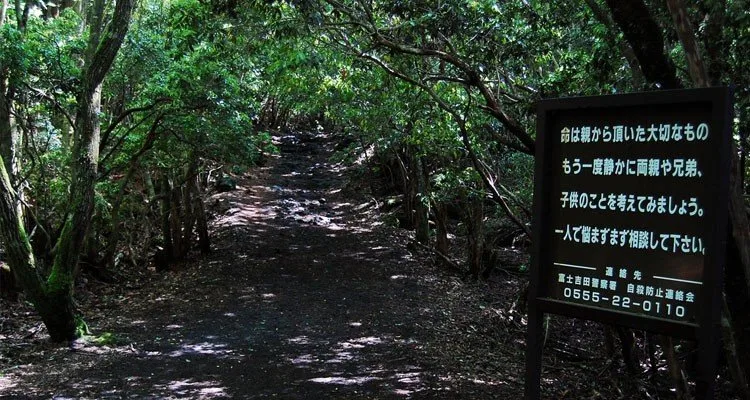
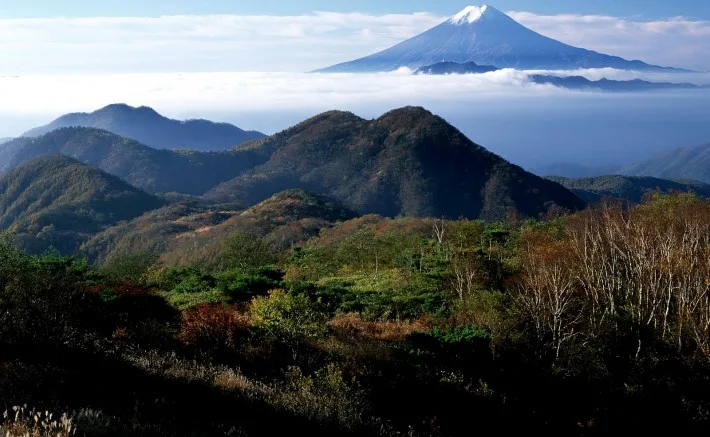
At the northwestern base of Mount Fuji lies a forest so dense that people call it the Sea of Trees. Aokigahara [青木ヶ原], or Jukai [樹海], grew over lava from Fuji’s great 864 eruption — and over decades it also earned a heavier nickname abroad: the “suicide forest.” That label is real history, but it is not the whole place.
Between the silence of the canopy, lava caves open to visitors, ribbons mark safe trails, and authorities keep trying new ways to prevent tragedy. What follows is the landscape, the folklore, the hard numbers that were once published, and what a careful visitor actually finds.
Contents 8
Where Aokigahara is and why it feels so quiet
Aokigahara covers roughly 30 square kilometers of hardened lava on the northwestern flank of Mount Fuji, in Yamanashi Prefecture. The forest floor is uneven volcanic rock; moss and roots knit over it. The porous lava absorbs sound, so wind and bird calls often feel distant even when the trail is busy.
That hush feeds the forest’s reputation. So does the density of the trees: leave the marked path and orientation gets hard quickly. Tourists often tie ribbons to trunks so they can find their way back — a practical habit that has nothing to do with the macabre stories that circulate online.
Compass myth, in plain terms: if you press a magnetic compass flat against iron-rich lava, the needle can wander. Held at normal height, it usually behaves. Getting lost here is more about thick vegetation and uneven ground than “the forest eating GPS.”
Suicide association: published figures and what changed
At least since the 1960s, Aokigahara has been linked with suicide in Japanese media and literature. Seichō Matsumoto’s novel Nami no Tō (Tower of Waves, 1960s) is often cited as having amplified that image, though associations with death and isolation are older in local lore.
Official tallies that were made public include grim peaks: in 2003, 105 bodies were found in the forest (above the previous record of 78 in 2002). In 2010, police recorded 54 confirmed suicides among more than 200 attempts. Local authorities later stopped releasing yearly counts, precisely to weaken the site’s fatal notoriety.
Claims that “more than 50 people die here every year” or that Aokigahara is always “number two in the world after the Golden Gate Bridge” recycle older journalism. They should not be treated as a live annual scoreboard. What remains true is simpler and sadder: the forest has been a high-profile place of despair, and officials treat prevention as ongoing work.
Trailheads carry signs in Japanese and English urging people in crisis to think of their families and to seek help. Volunteers and police have long conducted searches. In 2024, Yamanashi Prefecture also began trial drone patrols over Aokigahara — aircraft with cameras and infrared sensors — to support ground teams at night and locate people in distress under the canopy.
Mount Fuji itself remains a beloved destination for living visitors — climbers, photographers, school trips — and that contrast is part of the region’s difficult story: the same landscape can hold pilgrimage, tourism, and grief.
My visit to Aokigahara
At the end of 2023 we reached the forest by bus with a Fuji Pass from Fuji-shi. Buses are limited, so planning matters, but the day is doable without a private car if you accept the timetable.
What stood out was not a horror set: it was cool air under the trees, clear routes near the caves, and other travelers who stayed on the path. Respect for the place — and for people who may be struggling — fits better than hunting for “cursed” thrills.
What to do in Aokigahara as a visitor
The forest is not only its darkest reputation. Designated trails lead to natural monuments that school groups and families visit year-round:
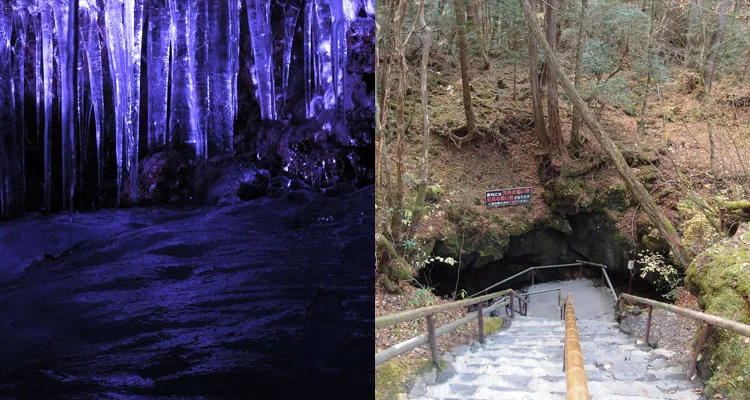
- Narusawa Ice Cave (Narusawa Hyōketsu) — a lava cave formed after the 864 eruption; ice can persist even in warmer months deep inside.
- Fugaku Wind Cave (Fugaku Fuketsu) — another lava tube nearby, once used as natural cold storage; the walk between caves is a popular short link.
- Surrounding Fuji Five Lakes scenery, autumn maples on safer routes, and lodging managed in Yamanashi Prefecture for ordinary nature trips.
There are many smaller lava cavities in the wider area; the big public caves are the ones with managed access. You will not find “over a thousand Buddhist temples” packed inside Aokigahara — that claim sometimes appears in recycled web copy and does not match how the forest is used today. Shrines and small sacred spots exist in the broader Mount Fuji culture; they are not a temple mall under the trees.
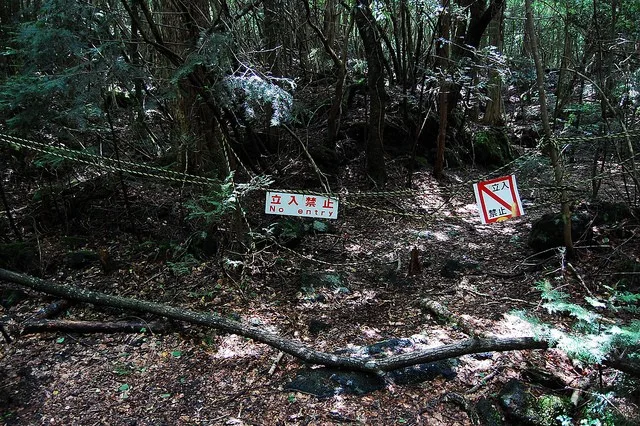
Stay on marked trails. Carry water, a charged phone, and a simple plan for exit. Treat personal items or memorials you might see with distance and dignity — this is not a place for trophy photos of distress.
Legends: yūrei, isolation, and stories of the past
Folklore paints Aokigahara as a haunt of yūrei — restless spirits bound by anger, grief, or unfinished business. Popular belief holds that a person who dies in deep hatred or sorrow may remain, unable to leave this world. Some tales also link the forest to older practices of abandonment in remote places; historians treat those associations carefully, as memory and legend often blur.
That fear of never returning mixes real navigation risk with ghost stories. Body-recovery workers in older accounts sometimes told of keeping a found body company overnight and playing janken (rock-paper-scissors) to decide who stays with the remains — a grim ritual story that underlines how heavy the work felt, whether or not every detail is documented the same way today.
Kōbō Daishi and spiritual journeys
One strand of legend ties the forest to Kōbō Daishi (Kūkai), the founder of Shingon Buddhism, meditating for long periods and drawing pilgrims who sought enlightenment. In some tellings, extreme devotion and ideas about rebirth twisted into stories of people ending their lives in the woods. Treat this as cultural narrative, not a verified chronology of “why suicides happen here.” Modern associations have far more to do with media, accessibility from the Tokyo region, and Japan’s broader mental-health challenges than with a single medieval saint.
Films and screen portrayals
Two widely discussed films use the forest as setting or inspiration:
The Suicide Forest (2009) — a horror piece about students shooting an amateur documentary among the trees and losing their way as the stories turn on them.
The Sea of Trees (2015) — a drama with Matthew McConaughey and Ken Watanabe: two men enter wishing to die and instead face a harsh journey of survival and reflection deep in the woods.
Screen Aokigahara is almost always gothic. Real Aokigahara, on a guided cave day, looks more like a volcanic woodland with rules, tickets, and other hikers — unless you go looking for the tragedy the signs are trying to stop.
If you are in crisis
If thoughts of self-harm are part of why this page showed up in your search, please step away from travel plans and contact local emergency services or a suicide prevention line in your country. In Japan, resources and hotlines change over time; start with official prefectural or national mental-health information rather than any “dark tourism” guide. The forest will still be there for nature — people in pain need help first.



Community
Comments
0 comments
There are no published comments in this language yet.
Send comment