

Japanese grammar is, in practice, simple. It is also almost the reverse of English, and that is what throws people off. The verb waits at the end. The pieces in the middle can slide. The sentence can still mean the same thing.
Plenty of explanations jump to particles and conjugations and skip the order of a longer sentence: who, when, where, what, and only then the action. That order is what starts to sound like Japanese instead of English lined up in a new alphabet.
Contents 11
Japanese SOV structure (subject + object + verb)
First we need to see how a Japanese sentence is built. Unlike English, the verb almost always ends the sentence. That pattern is called SOV.
SOV means most sentences follow the order subject + object + verb. Take this English line and flip it:
The children ate the apple.
子供はリンゴを食べた
kodomo wa ringo wo tabeta
- Subject: child (kodomo);
- Object: apple (ringo);
- Verb: ate (tabeta);
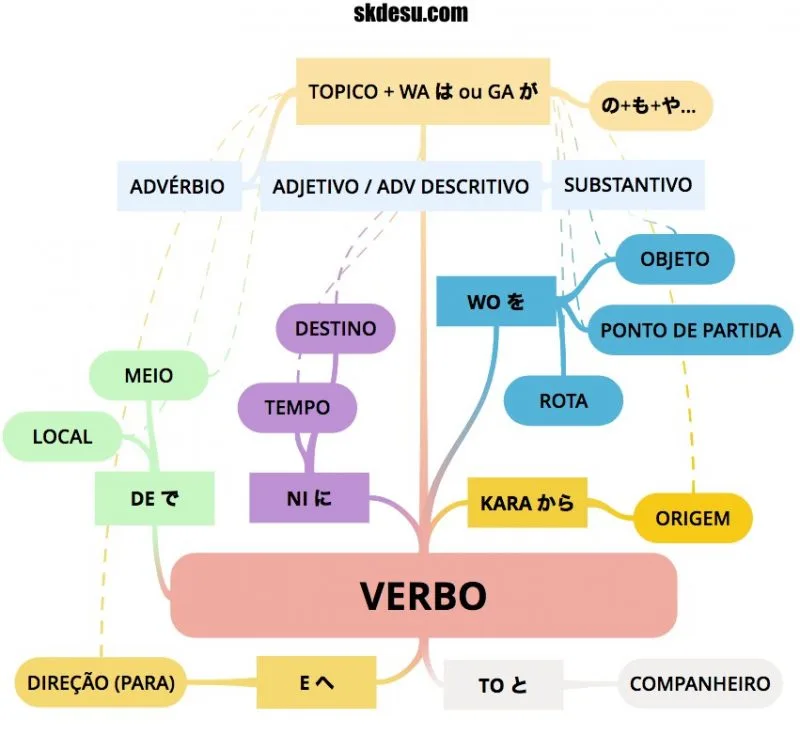
The apple sits before the past-tense verb. English would put ate in the middle; Japanese parks tabeta at the door and lets everyone else file through first. The image below sketches that skeleton:
Sentences with desu「です」
Now the sentences that seem to have no action verb, only です (desu). Some people treat desu as a verb; others refuse. I will stay neutral and treat it as the closer that lets a noun or adjective finish the thought.
| Kana | お名前は | ケビン | です | これは | 本 | です |
| Romaji | onamae wa | kebin | desu | kore wa | hon | desu |
| Literal | name | Kevin | is | this | book | is |
| Structure | noun | description | closer | pronoun | noun | closer |
| English | My name | is | Kevin | This is | a | book |
The same end-position habit holds when a real verb replaces desu.
How do I identify the subject, verb, and object?
It is easy to get lost and ask what counts as subject, object, or verb. This small map helps before the particles take over:
| Category | Definition | Examples |
| Noun | person, place, thing, or idea | Kirigaya, mountain, stick, linguistics |
| Adjective | describes a noun | red, happy, hot |
| Verb | an action or a state of being | eat, contemplate, live, be afraid |
| Determiner | articles and similar terms | a / an, the, this, that, some, all |
Japanese also has pronouns, adverbs, conjunctions, and a long list of particles. We will not unpack every class here. One distinction does matter: the topic marked by は is not always the same as the grammatical subject marked by が. If that pair is the part that still itches, there is a separate walk-through of は (wa) and が (ga).
The flexibility of Japanese sentences
Japanese is much more flexible than English. Anything to the left of the verb can often be rearranged without changing the basic meaning, even if one order still sounds more natural. How? The particles name each role, so the sentence does not depend on English-style word order to say who did what.
In English, moving the object usually breaks the sentence. In Japanese, the particles stay glued to their words. The preferred shape still starts with the topic and ends with the verb. Between those two sit time, place, companion, object, and the rest. There is a natural order that gives emphasis; there is not a single legal slot for every piece.
What do you mean there is no fixed order?
Take this English sentence: On Monday, Yamada saw Yumi at the train station.
The pieces are:
- Topic: Yamada
- Object: Yumi
- Time: Monday
- Place: train station
- Verb: saw
That same fact can be written in several Japanese orders:
- Yamada wa getsuyoubi ni Yumi wo eki de mimashita.
- 山田は月曜日に由美を駅で見ました。
- Yamada wa getsuyoubi ni eki de Yumi wo mimashita.
- 山田は月曜日に駅で由美を見ました。
- Yamada wa Yumi wo getsuyoubi ni eki de mimashita.
- 山田は由美を月曜日に駅で見ました。
- Getsuyoubi ni Yamada wa Yumi wo eki de mimashita.
- 月曜日に山田は由美を駅で見ました。
All four say that Yamada saw Yumi at the station on Monday. Time usually sits near the front, so the third option is the least comfortable. Time can also appear before the topic, as in the last line.
Making Japanese sentences more natural
A useful habit for longer sentences: newer or more important information tends to sit closer to the verb. That is the opposite of English, where we often name the action early and hang the details after it. I had lunch in the park on Monday becomes, in Japanese, something closer to I + Monday + park + lunch + ate.
- 私は月曜日に公園で昼ご飯を食べました。
- watashi wa getsuyoubi ni koen de hiru gohan wo tabemashita;
- I wa Monday ni park de lunch wo ate;
The person comes first, then the details usually run from the outside in until they hit the action: date → setting → object → verb. Remembering the common particle sequence は → に → で → を is a practical way to keep that shape.
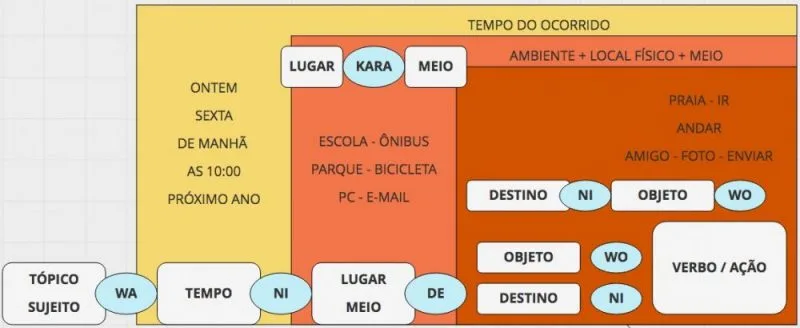
The image is a map of that preferred path. A movement sentence can look like this:
- Kevin + yesterday + school + bus + sea + go
- Yesterday Kevin took the bus from school to the sea;
- ケビンは昨日学校からバスで海に行きました。
- kebin wa kinou gakkou kara basu de umi ni ikimashita;
Notice 昨日 has no に. Relative time words such as 昨日, 今日, 明日, and 毎日 usually stand alone. Clock times and calendar points (3 o'clock, Monday, 2026) more often take に.
Going into details
These preferred patterns apply most cleanly to sentences with:
- an action in one place;
- movement from one place to another;
- movement of an object (give, send, put);
Other pieces can join the same sentence:
- companion (と);
- origin (から);
- start time (から);
- end time (まで);
- subject (が);
Getting the natural order into your mouth takes practice. The particles do the grammar; the preferred order does the music.
Sentences with two objects
Many verbs take more than one object; some take none. With one object you usually have a direct object. With two, the other is often an indirect object — the person or place that receives the thing.
| 先生は | 授業の後で | 生徒に | 成績を | 出した。 |
| The teacher | after class | to the students | grades | handed out |
| subject | adjunct | indirect object | direct object | verb |
Word order with the particle の
Once sentence order is clear, the next snag is the order inside a noun. How do you stack an adjective and say that something belongs to someone?
The particle の (no) is the usual glue. Possession runs the opposite way from English 's: ケビンの車 is Kevin's car. In a longer stack the modifiers still sit before the noun:
| Kana | 私の | 赤い | 日本の | 車 |
| Romaji | Watashi no | akai | nihon no | kuruma |
| Literally | my | red | Japan | car |
| English | my | red | Japanese | car |
English wants “my red Japanese car.” Japanese lines the pieces up in front of 車 and lets の and the adjective do the work. That whole block then moves as one piece if you rearrange the larger sentence.
Putting a longer sentence together
The same skeleton, now with time, place, and object in their preferred seats:
| Kana | ケビンさんは | 金曜日に | お店で | 本を | 買いました |
| Romaji | kebinsan wa | Kin'yōbi ni | o mise de | hon wo | kaimashita |
| Literally | Kevin | Friday | shop | book | bought |
| Structure | topic | time | place | object | verb |
| English | Kevin | bought | a book | at the shop | on Friday |
The topic still opens the line, marked by は. A specific time usually follows, marked by に. Broader time words such as “afternoon” or “night” often drop the particle. Place comes after time. で marks the place where the action happens; に more often marks a destination or a point you move toward. The object sits before the verb with を.
There is still no single cage. There is a preference: speak and write so the listener can land on the verb without having to rebuild the sentence in their head.
To turn the same idea into a question, Japanese usually keeps this order and adds か at the end: ケビンさんは金曜日にお店で本を買いましたか。 You do not invert the verb the way English does.
In summary — grammatical structures
We have not covered every pattern — word dropping, relative clauses, and the rest wait for other pages. The maps below are a starting kit for order, not a prison:
| 1 | subject | object | verb | |||
| 2 | object | subject | verb | |||
| 3 | topic | subject | object | verb | ||
| 4 | topic | time | companion | place | object | verb |
| 5 | topic | direction | location | verb | ||
| 6 | subject | time | place/tool | indirect object | direct object | verb |
| 7 | subject | time | place | existential verb | ||
| 8 | subject | time | origin | route | destination | motion verb |
| 9 | time | transport / companion | place | verb | ||
| 10 | time | person / place | noun | verb |
Do not forget the particles that usually ride with those pieces:
| topic | は |
| time | に (not after 昨日 / 今日 / 明日) |
| companion / person | と |
| place of action | で |
| object, route | を |
| possession | の |
| subject | は / が |
| origin | から |
| destination | に or へ |
| indirect object | に |
The tables are a map, not a cage. Particles do the heavy work. The preferred order is what makes the sentence sound like something a person would actually say.

Community
Comments
0 comments
There are no published comments in this language yet.
Send comment