

Today we will talk about a free Japanese course that has helped many learners get started with the language: Erin's Challenge (エリンが挑戦). This Japanese course is one of the most comprehensive free courses I have ever seen, and it is published directly by the Japan Foundation, a Japanese governmental institution dedicated to promoting Japanese language and culture worldwide. If you want to learn Japanese without buying a textbook on day one, you will find a well-structured learning environment built around short videos, manga-style episodes, grammar explanations and review exercises.
The course revolves around the character エリン (Erin), a student who comes to Japan from the United Kingdom to study. Across the lessons she meets friends such as 咲 (Saki) and 健太 (Kenta). The motto of the website is にほんごできます (nihongo dekimasu), which basically means "I can speak Japanese" or "I understand Japanese" — and that is exactly the promise the course delivers, step by step, over 25 lessons.
Contents 14
What is Erin's Challenge?
Erin's Challenge is an official learning portal run by the Japan Foundation (Kokusai Kōryū Kikin), the institution the Japanese government set up to promote Japanese language and culture internationally. The platform is mainly aimed at beginners and lower-intermediate learners, and blends traditional textbook methods with modern web-based formats. Unlike a pure vocabulary-drill app, it leans on short everyday dialogues, manga-style companion scenes and explanatory videos. The official domain erin.jpf.go.jp is reachable both in Japan and abroad, and you do not need an account to access most of the content — only saving your progress requires a free account.
For learners who already know hiragana and katakana, the platform is a near-perfect starting point; those still learning the kana can rely on the romaji option while they build up. Erin's Challenge is explicitly not designed as JLPT preparation (the Japanese Language Proficiency Test) — it gives you solid everyday Japanese, but does not replace a focused JLPT study plan.
How do the lessons work?
The site contains 25 different lessons, each building on the last. Each lesson is split into 7 themes (called temas or tópicos on the platform itself), so a single study block stays manageable. The same seven themes appear in the same order in every lesson, which makes orientation easy: once you know where the Basic Dialogue and the Exercises are, you will find them just as quickly in lesson 15 as in lesson 1.
The seven themes are Basic Dialogue, Manga, Exercises, Advanced Dialogue, Review Exercises, Important Phrases (with grammar explanations and a small mini-game), and finally Increasing Vocabulary. The repeating structure is especially useful for self-learners without a fixed class schedule — you simply follow the path the platform lays out, and each lesson gives you a complete cycle of listening, reading, writing, practising and review.
The 7 themes in detail
If you are opening the site for the first time, it helps to know what each theme does so that you do not lose the thread.
1. Basic Dialogue
The Basic Dialogue is the entry point of each lesson. You watch a short video of an everyday situation — Erin in a café, at school, out shopping — and follow the subtitles underneath. In the subtitles, you can choose to see the subtitles in Japanese (kana and kanji), hiragana, romaji, and Portuguese. It's really cool. Right after the video, the Script opens: you see the dialogue in writing and can hover over individual words for an instant translation.
2. Manga
Right after the Basic Dialogue comes the Manga: the same situation as a short comic episode with Erin, Saki and Kenta, picking up the everyday situations the dialogue only hinted at and making body language, tone and reactions visible. In the speech bubbles you will also find onomatopoeia (gitaigo and giongo), the sound-symbolic expressions that play a surprisingly large role in Japanese and often get short shrift in traditional classes. Reading the manga is genuinely fun, and you absorb vocabulary and pronunciation that rarely come together in textbook study.
3. Exercises
At the end of the Basic Dialogue block there are review exercises: questions about the dialogue you have just watched, sentence fragments to reorder, or matching answers to pick. The exercises are deliberately low-stakes — they repeat what you have just seen and do not jump ahead. If you get an answer wrong, you can usually correct it on the spot and understand in context why the other option would have been right.
4. Advanced Dialogue
The Advanced Dialogue follows the same structure as the Basic Dialogue, but is denser in language. Here you meet longer sentences, more polite forms and a wider vocabulary. The familiar tools stay available: subtitle selection, script with hover translation, audio and PDF download. There is intentionally no manga in this section — the platform leans more heavily on listening and reading comprehension. A lesson is therefore a clean loop: first you hear and read a simple scene, then a more complex one, and finally you work through both in the exercises.
5. Important Phrases
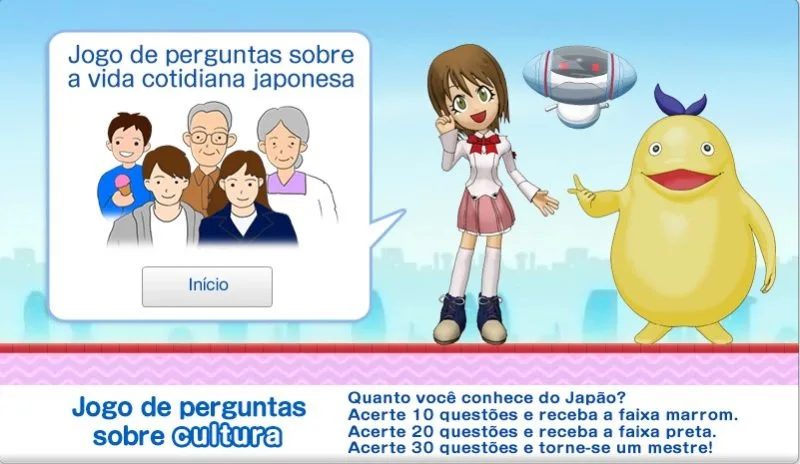
In the Important Phrases block, Erin is joined by ホ二ゴン (Honigon) — a small blue mascot figure — and the robot N21-J. Together they introduce a central grammatical structure and use it in short example sentences. The explanations are in Japanese, but you can switch on the subtitles you already know (Japanese, kana, romaji, and Portuguese). The sub-section Uses in different situations shows the same structure in slightly different contexts — at the office, with friends, on the phone — which is didactically valuable because it shows that a grammatical form rarely appears on its own in real life. If you like, you can add the example sentences to spaced-repetition apps such as Anki.
6. What is this? and Let's see
These two blocks move you from pure language to Japanese culture: food, festivals, everyday objects, geographic curiosities. First a photo or short scene appears and you pick from four options what it is. Then an explanatory video plays, with the usual subtitle options and the correct answer. These sections are especially helpful for learners who want to understand Japanese culture and daily life without wading through a non-fiction book.
7. Increasing Vocabulary
At the end of each lesson sits the Increasing Vocabulary block. Here you pick up new vocabulary tied to the lesson's topic, supported by images and example sentences. A small matching game follows — you connect the new words with the right images, an effective way to store vocabulary as picture–word pairs, not as abstract syllables. Combined with a small daily Japanese routine, this block is the engine of long-term retention.
Features: subtitle selection and downloads
Two features make Erin's Challenge especially useful for self-study.
Subtitle selection. In almost every video you can choose how the Japanese lines appear below the video: Japanese with kana and kanji, hiragana only, romaji, or English (or Portuguese) translation. If you are slowly working your way up to the original scripts, you can move away from the translation step by step without losing the thread.
Download content for later. Both the dialogue audio and the scripts — and many vocabulary lists — can be downloaded as audio files or PDFs. Save the dialogues on your phone and listen on the move — on the bus, at the gym, while cooking. If you already use Japanese podcasts and websites for beginners, these downloads are a natural complement for listening practice.
With a free account on erin.jpf.go.jp you can save your learning progress and pick up exactly where you left off. The platform also offers print-ready tables for hiragana and katakana, and a Japanese calendar as a PDF download — useful for practising dates or organising study time in a Japanese frame.
Who is the course for?
Erin's Challenge is built for beginners and lower-intermediate learners who are taking their first steps in Japanese or want to consolidate their foundations. If you can already read hiragana and katakana with confidence, you will get the most out of the platform. If you also understand the basics of kanji, you can follow many of the dialogues directly in the original. If you are starting Japanese from zero, it is worth working through the hiragana and katakana tables first.
The biggest strength of the course is the way it combines video, manga, grammar and review in a single free package. The dialogues are rooted in everyday life, the exercises are motivating, and the switch between different scripts lets you set your own pace. The limits are clear, though: the course does not teach kanji in any depth, and it largely follows the same method as traditional Japanese schools — just packaged in a more entertaining way. If your goal is real fluency, you will need to add other materials, for example a systematic kanji resource or language exchange with native speakers.
For learners living in Japan, there are also DVDs for the course with additional lessons that are not available online. They are sold in Japan through bookshops and official Japan Foundation distributors; the website erin.jpf.go.jp lists current pricing and contents.
Final thoughts
Erin's Challenge is a remarkably well-built free Japanese course, published by an official Japanese institution. For learners taking their first steps in the language who do not want to invest in a textbook straight away, the platform is a solid starting point. The combination of Basic Dialogue, Manga, Grammar and Vocabulary exercises covers the main building blocks of beginner-level Japanese, and the option to download audio files and PDFs makes fitting the course into everyday life surprisingly easy.
If you are willing to learn hiragana and katakana in advance, and if you go through the lessons consistently, Erin's Challenge gives you a tool that noticeably shortens the path into the language. It will not replace a teacher or a textbook, but it is a free, well-maintained and didactically thoughtful companion — exactly the kind of resource the Japanese-learning world has needed for a long time.





Community
Comments
0 comments
There are no published comments in this language yet.
Send comment