
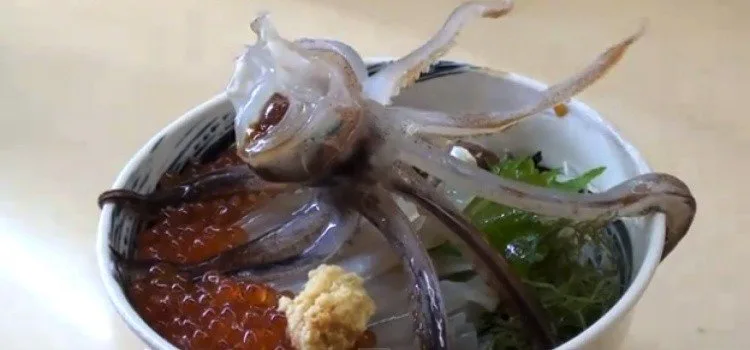
Every few years, a short clip from Japan does the rounds on social media and sets off a familiar argument: a small squid is laid over a bowl of rice, soy sauce is poured on top, and the tentacles start to twist as if the animal were still alive. The dish in that clip is Katsu Ika Odori-don (活いか踊り丼), a donburi from the port city of Hakodate in Hokkaido. It looks unsettling at first sight, but the "dance" is not a sign of life. It is a chemical reaction on muscle and nerve tissue that is already detached from a functioning brain, and the dish itself is a small, regional curiosity, not a symbol of how Japanese people eat.
Contents 5
What is Katsu Ika Odori-don?
Katsu Ika Odori-don (活いか踊り丼) is a donburi: a bowl of rice topped with a range of ingredients. In this case the base is rice, vegetables, fish roe (ikura) and other seasonal seafood, with a freshly prepared squid laid across the top. The Japanese word odori (踊り) simply means "dance", and the kanji 活 in 活いか points to the freshness of the seafood, not to the idea that the animal is still living. The "dancing" is a brief visual moment right after the soy sauce is poured, not a stage of the meal the diner is meant to eat.
The dish was created at the restaurant Ikkatei Tabiji in Hakodate, on the southern tip of Hokkaido. A serving costs around 2,000 yen, roughly 13 to 15 US dollars at recent exchange rates, on the higher side for a donburi, but not unusual in a Hokkaido port city where fresh squid and ikura are daily staples.
Why does the squid dance?
Is the squid still alive when it is served? No. Before the dish is plated, the head and the main organs are removed, which stops the brain from sending signals. What you see on the plate is a freshly butchered squid whose nerve cells and muscle fibres are still electrically active for a short while after the brain is gone.
The movement starts as soon as shōyu, Japanese soy sauce, is poured over the tentacles. Shōyu contains a high concentration of sodium chloride, ordinary salt. The sodium ions trigger the still-active nerve cells in the tentacles, which in turn make the muscle fibres contract. The energy for that contraction comes from adenosine triphosphate, or ATP, the molecule every animal uses to power muscle movement. Squid muscle is unusually rich in ATP, which is why the response is so visible and so quick.
The same basic effect can be seen in any kitchen. If you sprinkle salt on the leg of a frog that has just been separated from the body, the muscle twitches. Fresh cuts of meat, in any country, can still respond to salt or to heat for a short time after the animal has died. The "dance" in Katsu Ika Odori-don is the same kind of response, made dramatic by the size of the squid and by the fact that the diner is watching the bowl.
Video of the controversy
The clip that usually circulates online is short and tightly framed on the bowl. The longer cut, used by Japanese and international outlets when the story resurfaced around 2016, shows the squid being prepared in a more traditional style and then "dancing" after the head is removed. Both videos are worth watching to understand how much of the impression depends on camera angle and timing.
Cultural misunderstandings around the dish
Most of the anger the clip generates comes from a simple misread: a moving animal is treated as a living animal, and a living animal is treated as one that is being eaten. Neither assumption holds here. The squid is brain dead before it is served, the tentacle movement is a post-mortem chemical reaction, and the diner does not eat the squid while it is moving. After the brief "dance" the cook takes the bowl back, finishes the preparation and returns it for the meal.
It is also worth keeping the dish in proportion. Katsu Ika Odori-don is a single regional item on the menu of a single restaurant in Hakodate, not a daily staple, not a national symbol, and not something the average Japanese person has ever tried. Reducing all of Japanese cuisine to this one bowl is a category error that judges an entire food culture by a viral clip. Judging any country's cuisine by its most extreme dish is rarely fair, and it usually says more about the viewer than about the food.
Similar dishes: Ikizukuri, Odori ebi, Sannakji and Shirouo no Odorigui
A few related Japanese and East Asian dishes come up in the same conversation. Each is a different story from Katsu Ika Odori-don, where the squid is already dead, but they are worth knowing for context. For a closer look at the cultural side of one of the most common everyday Japanese ingredients, often bundled into the same "raw food" discussion, see our piece on why eating raw egg in Japan is not actually dangerous.
- Ikizukuri ("prepared while alive") is a sashimi-style presentation where the fish is filleted in front of the diner. The animal is, in most preparations, still technically alive when the slices are cut, although the practice is regulated, varies by region and is not part of the everyday diet.
- Odori ebi ("dancing shrimp") is a dish of live amaebi sweet shrimp served while they are still moving on the plate.
- Sannakji is the Korean cousin: live octopus cut into small pieces and served immediately, with the tentacles still moving on the plate and in the mouth. It is a Korean dish, not a Japanese one, and comes with real safety warnings around choking.
- Shirouo no Odorigui (シロウオの踊り食い, "live eating of ice goby") is a Japanese winter delicacy in which tiny transparent ice gobies are served in a bowl and eaten while still moving, often with raw egg.
For a wider regional context, our Hokkaido travel guide, covering Sapporo, Hakodate, Otaru and Asahikawa, lays out how seafood fits into the broader cuisine of the island, and our look at whether the Japanese actually eat dogs or insects addresses the same kind of generalisation that usually travels with the dancing squid clip.




Community
Comments
0 comments
There are no published comments in this language yet.
Send comment