
Outside the west exit of Shibuya Station in Tokyo, a small bronze dog draws a steady stream of people every day. Some leave a flower, others pose for a photo with the statue, and many simply agree to meet friends "at Hachiko" — the famous meeting point that owes its name to a real Akita. Hachiko (ハチ公) was the dog who returned to the same spot for nearly ten years, waiting for an owner who would never come back. His story is one of the most widely shared examples of loyalty between a person and an animal, in Japan and beyond.
This article follows Hachiko from a puppy in a Tokyo professor's household to the morning his owner failed to step off the train, and through the long years of waiting that followed. It also covers the University of Tokyo, where Professor Ueno taught, the bronze statue that became a national landmark, the two major film adaptations (1987 in Japan, 2009 in the United States), and the cultural footprint Hachiko still leaves in schoolbooks and pop culture. For more on the breed itself, see the guide to Akita Inu and Shiba Inu.

Contents 13
The story of Hachiko: an Akita between professor and train station
Hachiko was born in 1923 in Akita Prefecture, in the north of Japan's main island of Honshū. In 1924, he was given as a puppy to Professor Hidesaburō Ueno (上野英三郎), a respected agricultural scientist at the Imperial University of Tokyo — what is now the University of Tokyo. Ueno lived in a small house near Shibuya Station and gave the puppy the name Hachi (ハチ), to which the honorific kō (公) was added as a sign of affection. Over time the two halves blended in Japanese usage into the name the world now knows: Hachikō (ハチ公).
Ueno loved dogs, and Hachiko grew up as part of the household. A routine developed that the professor came to look forward to: every morning, when Ueno left for work in the Hongo district, Hachiko walked with him to Shibuya Station, said goodbye, and went back home. In the late afternoon, Hachiko would be back at the same spot to greet his owner as the train pulled in. Commuters and passers-by soon recognised the pair.
21 May 1925: the day everything changed
On 21 May 1925, Professor Ueno suffered a stroke during a faculty meeting at the university. He died that same day, at the age of 53. That evening, Hachiko was waiting at the usual place outside Shibuya Station — but his owner's train did not arrive, and Ueno did not walk through the ticket gates.
A widely told anecdote says that, on the day of the wake, Hachiko scratched at the door and howled until he was let in. Once inside, the story goes, he made his way to the room where Ueno's coffin had been laid out, lay down next to it, and spent the night at his master's side. Whether that scene happened exactly like this is hard to verify after so many decades, but what is certain is that Hachiko did not simply disappear after Ueno's death. He was first taken in by relatives of the professor, escaped more than once, ran back to the old house in Shibuya, and finally settled at the station. Realising that his owner was no longer going to come out of the building, he began to wait — every day, at the usual hour, for months, then for years.
Nine years at the station: the wait that moved Japan
What followed was nine years, nine months and fifteen days of waiting. Throughout that time, Hachiko — at first a strong-coated dog with pricked ears, later visibly worn down — appeared at the Shibuya ticket gates, scanned the faces of commuters for his owner, and lay down when the last evening train had come and gone. Relatives and new owners tried more than once to place him somewhere else. Hachiko always found his way back.
Hachiko in the media: Asahi Shimbun and national fame
In September 1932, Japan's major daily Asahi Shimbun ran an article about the strange Akita who had been waiting at Shibuya Station for a master who would never return. The piece caused a stir. Readers came to the station, brought food, took photographs, and wrote letters to the dog. Almost overnight, Hachiko became a national figure.
From that point on, his example was used in school lessons and parenting guides as a model of loyalty, gratitude and duty. To this day, Hachiko's story still appears in Japanese schoolbooks. The sudden fame, however, changed nothing about his routine: Hachiko kept doing exactly what he had always done, waiting at the same spot day after day. In 1929, he became seriously ill with mange, a skin disease caused by mites, and came close to death; veterinarians and animal lovers cared for him over several weeks until he recovered and returned to his place outside the station.
The end of a faithful life: 8 March 1935
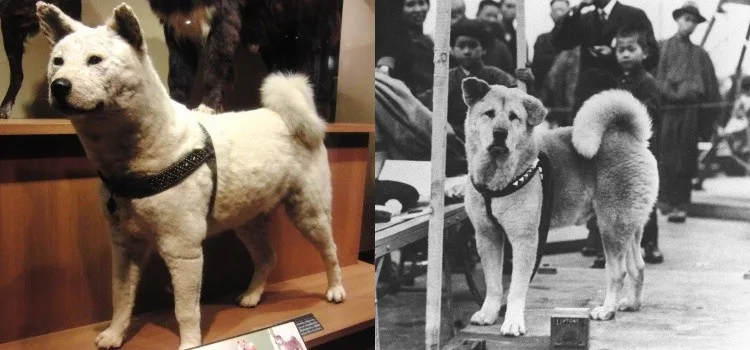
On the night of 8 March 1935, Hachiko was found dead on a street near Shibuya Station. He was about eleven years old. The exact cause of death is still not settled: cited possibilities include a stroke and heartworm (filarial) infection. An autopsy later found four heartworms in his body, as well as advanced mange — traces of years spent out in the cold, in the wind, and with irregular meals.
His death triggered a wave of mourning across Japan. Newspapers ran long obituaries, a large number of people attended his funeral, and a Buddhist ceremony was held in his honour. After his death, his fur was preserved and his body was taxidermied. Today he is on display at the National Museum of Nature and Science (国立科学博物館) in Tokyo's Ueno district — not far from the university where his owner once taught.
The bronze statue in Shibuya: a meeting point with history
While Hachiko was still alive — on 21 April 1934, almost a year before his death — a bronze statue was erected in his honour. It was placed right at the west exit of Shibuya Station, at the exact spot where Hachiko had been waiting every day. The statue was funded by donations that the Asahi Shimbun coverage had triggered. The sculptor, Teru Andō, had observed Hachiko at the station on several occasions to capture his posture and expression as faithfully as possible.
During the Second World War, the statue was melted down in 1944 for its metal. After the war, Andō collected funds for a replacement. The current statue was unveiled on 15 August 1948, in almost the same location. It stands on a small plinth and shows the dog in an alert, slightly forward-leaning pose, his gaze directed toward the station exit, as if he were still waiting. Today the statue is one of Tokyo's most famous meeting points: when Japanese people arrange to meet in Shibuya, they often simply say "at Hachi" (ハチの前).
Hachiko on screen: two well-known film adaptations
Hachiko's story has been adapted for the screen twice on a major scale. Both films follow the same basic outline but differ in tone, perspective and period.
Hachikō Monogatari (1987, Japan)
The Japanese feature film Hachikō Monogatari (ハチ公物語), released in 1987, was the first major theatrical adaptation. Directed by Seijirō Kōyama, it starred the well-known actor Tatsuya Nakadai as the professor; the dog was played by an elderly Akita male named "Chu". The film sticks closely to the real sequence of events and is still considered the most emotionally faithful version of the story.
Hachi: A Dog's Tale (2009, USA)
In 2009, an American adaptation titled Hachi: A Dog's Tale was released, directed by Lasse Hallström. Richard Gere took the lead role; the dog was played by three different Akitas, one for each stage of his life. The action was moved to a small town in Rhode Island, but the basic structure of the real story was kept. The film played a large part in making Hachiko's story known well beyond Japan's borders.
Hachiko and Greyfriars Bobby: loyalty across the centuries
In Europe, Hachiko's story is often compared to the legend of Greyfriars Bobby. In 19th-century Edinburgh, a Skye Terrier is said to have guarded his deceased master's grave in the Greyfriars Kirkyard for years. Both stories share the same motif: a dog who, after his owner's death, keeps returning to the last place they shared, and each has its own memorial at the site. There is no documented historical link between the two stories; they are parallel motifs from two very different cultures.
Hachiko today: a symbol in schoolbooks and pop culture
More than ninety years after his death, Hachiko is still very much present in Japan. In elementary-school textbooks, his story appears regularly under the theme of "loyalty". Manga artists have referenced him more than once; the name "Hachiko" shows up occasionally in anime series as a small tribute. The Akita breed has benefited from the myth, both in Japan and, since the 2000s, internationally: anyone who buys an Akita is, more often than not, eventually asked about the connection to Hachiko.
At the same time, it is worth looking at the story with some distance. The media cycle — from the 1932 newspaper article to the 1987 Japanese feature film to the 2009 American remake — turned one dog's life into a national narrative. Veterinarians and animal-welfare organisations today point out that the conditions in which Hachiko spent his last years are not a romantic example of how to keep a dog. The gesture itself — the daily wait — remains striking. The circumstances do not.
Practical tips: visiting Hachiko in Shibuya
If you are in Tokyo and want to see Hachiko, the best plan is to combine the visit with the rest of Shibuya. The statue sits right at the west exit of the station, about thirty seconds from the famous Shibuya Crossing.
- Getting there: Shibuya is a hub for the JR Yamanote Line, the Keio Inokashira Line, the Tokyo Metro Ginza, Hanzōmon and Fukutoshin lines, and the Tokyu lines. From most central neighbourhoods, the station is 10 to 25 minutes away.
- Best time of day: Early morning and late evening are the quietest. Around midday and early evening, the area around the statue and the crossing is at its busiest.
- Photo tip: The statue is small and sits in a busy square. A clean shot without passers-by is easiest very early in the morning or late at night.
- Nearby stops: From Shibuya, Harajuku (two Yamanote stops away), the Meiji Shrine and Yoyogi Park are easy to reach on foot or in a few minutes by train. The Shibuya Sky observation deck on top of the Scramble Square building, directly above the station, is a natural stop before or after paying your respects to Hachiko.
- Memorial day: Every year on 8 March, the anniversary of Hachiko's death, a short ceremony is held at Shibuya Station.
For more on Japanese dog breeds, see the article on Akita Inu and Shiba Inu. If you want to explore the area around the University of Tokyo, the guide to Tokyo's neighbourhoods is a useful starting point.
Conclusion: why Hachiko's story still moves people
At its core, Hachiko's story is a simple one: a dog waits for a person who is not coming back. What has made it so widely known is not a single heroic act but the sheer length of the wait — nine years, day after day, in the same place. Hachiko stands for a kind of loyalty that asks for nothing in return: no words, no contract, no reward. That may be exactly why the story still works: it reminds us that loyalty can be quiet, ordinary and easy to miss — and that it can still outlast the people who inspired it.




Community
Comments
0 comments
There are no published comments in this language yet.
Send comment