
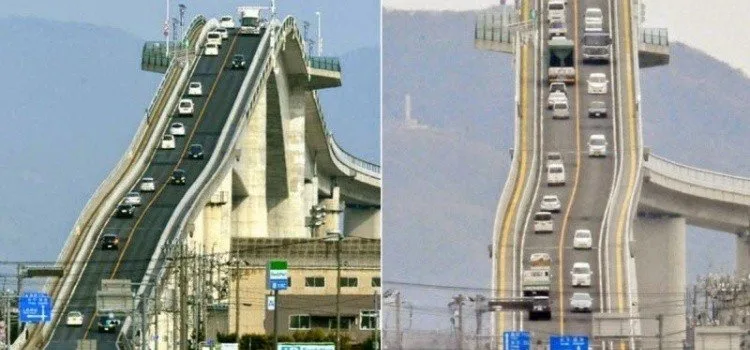
If you have scrolled through Instagram, TikTok or YouTube in recent years, you have probably seen the images: a bridge that seems to rise almost vertically into the sky, tiny cars teetering on the edge of a ramp that looks more like a roller coaster than a highway. The subject of those shots is the Eshima Ohashi Bridge (江島大橋), which connects the city of Matsue in Shimane Prefecture with Sakaiminato in Tottori Prefecture. Few structures in Japan have collected more myths, and few have been compared to a roller coaster as often as this one.
But how much truth is really in those viral images? How steep is the bridge in everyday driving, and why does it look so much more extreme in photos than it feels from behind the wheel? This article sorts out the facts, the myths and the practical side of things, with real numbers, background on the 2015 Daihatsu commercial, and tips for anyone who wants to drive across Lake Nakaumi themselves.
Contents 9
What is the Eshima Ohashi Bridge?
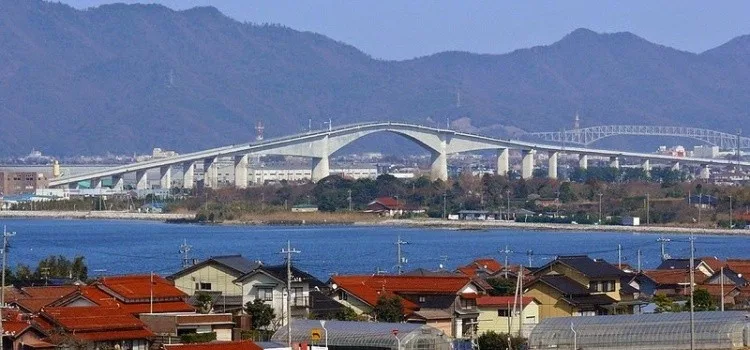
The Eshima Ohashi Bridge (Japanese 江島大橋, Eshima Ōhashi) is a road bridge that spans Lake Nakaumi. On the western end sits Matsue, the capital of Shimane Prefecture. On the eastern end it joins Sakaiminato, in Tottori Prefecture. If you know the region, you will also know that close to Tottori lie the famous sand dunes of Tottori, a popular stop on the same route.
The structure was built between 1997 and 2004 and replaced an older bridge that could no longer accommodate the growing ship traffic on Lake Nakaumi. Today the Eshima Ohashi Bridge is one of the busiest connections between Shimane and Tottori, since it shortens the driving time between the two prefectures considerably.
Technical data on the bridge
With a total length of about 1.7 kilometres and a clearance of roughly 44 metres above the water, the Eshima Ohashi Bridge is one of the larger reinforced concrete road bridges in Japan. Around 1.44 kilometres of the route run over the lake itself, and the rest is made up of the approach ramps. The roadway is about 11.3 metres wide, enough for two lanes in each direction plus a narrow shoulder.
Two numbers, however, are the real reason the bridge has such a reputation, and they cause a lot of confusion:
- On the Shimane side, the maximum longitudinal gradient is 6.1 percent.
- On the Tottori side, it sits at 5.1 percent.
A 6.1 percent slope means the road gains about 6.1 metres of height over every hundred metres. That is more than you find on many motorways, but it is nowhere near the vertical ramp the photos suggest. For a sense of scale: in the mountain ranges of central Europe, national roads regularly hit gradients between 8 and 12 percent, and alpine passes can sit at 15 to 20 percent or more. If you have ever driven a real mountain pass, you already know the Eshima Ohashi Bridge is, technically speaking, a moderate climb.
Why it looks so steep in photos
The reason the bridge went viral comes down to photography itself. Telephoto lenses compress distances, because they appear to bring the background closer to the foreground. When a road climbs gently over several hundred metres, the eye reads it as flat in a wide-angle shot. Through a telephoto lens, that same slope suddenly looks like a wall.
At Eshima Ohashi there is an extra twist: at the highest point the road runs without any visible curve, and the horizon is replaced by the open water of Lake Nakaumi. There is no visual reference for the eye to gauge the real distance. That effect gets stronger in shots taken early in the morning or late in the afternoon, when the sun sits low and casts long shadows that distort the roadway even further.
The 2015 Daihatsu commercial
The trigger for the bridge's worldwide fame was a commercial run by the Japanese car maker Daihatsu, aired in the summer of 2015. Daihatsu was promoting the Daihatsu Tanto at the time, and staged the car as if it had to tackle an almost vertical ramp. In the spot the car appears to drive along the edge of a cliff, before the camera reveals that the whole thing is actually the Eshima Ohashi Bridge, and the supposed stunt turns out to be an ordinary everyday drive.
The commercial was picked up internationally, shared by countless outlets outside Japan, and ended up being the first time millions of people ever saw the bridge, distorted by camera work, telephoto lenses and a deliberate game with perspective. If you dig into internet forums, travel threads or platforms like Reddit today, you still run into claims such as "the steepest bridge in the world" or "the most dangerous bridge in Japan". Neither holds up when you check it against the actual numbers.
The cycle and foot path next to the roadway
You will often hear that the bridge is extremely dangerous and off-limits to pedestrians. In fact, there is a separate cycle and foot path running parallel to the roadway, crossing the lake as well. That path is noticeably steeper than the road: a short ramp with roughly a 31 degree incline that bridges the height difference between the carriageway and the promenade. It is exactly that ramp that shows up in so many viral shots, and it is the source of most of the "roller coaster" feel.
For drivers, the bridge feels very different than it does for cyclists or walkers, who feel the climb in their own legs. If you are on a bike, plan for a short stretch where you will probably want to push the bike, especially if yours is not a lightweight road model. For walkers it is still worth the effort: the view over Lake Nakaumi and across the Shimane coastline is striking, especially early in the morning or in the hour before sunset.
What the bridge is like in real life
On the carriageway itself, you notice the slope far less than the photos suggest. The bridge meets modern safety standards, with solid guard rails, a comfortable lane width and a gently curved alignment that softens the feeling of climbing. The first time you drive up, you do get the impression of being pulled into the sky, but that is more about the missing reference points than about physics.
In everyday traffic, the bridge behaves like any other national road in Japan: lorries, compact cars and motorcycles share the lanes, trucks like the Daihatsu and other Japanese models cruise at normal highway speed, and most travellers describe the crossing as unspectacular. What does stand out, in the end, is not the slope but the wide view over the lake and the calm, well-kept road surface.
Is the bridge open today?
Yes. The Eshima Ohashi Bridge is a public national road, and you can drive, ride or cycle across it at any time. There is no toll. During typhoon season in late summer and autumn, however, weather-related closures can happen, as they do on many coastal roads in Japan. In heavy winter fog it is also worth checking conditions before you set off, since the bridge sits about 44 metres above the water and visibility can drop fast.
Because the structure also serves as the main access road to the port of Sakaiminato, heavy lorries and delivery trucks use it regularly, timed to the ferry and container traffic. Travellers with motorhomes or large rental cars should keep the narrower shoulder in mind, and watch for the stronger crosswinds that tend to show up on a stretch of road this exposed over open water.
How to get to the bridge
The easiest way to reach it is via Matsue. From Matsue Station the drive to the bridge takes about 30 minutes by car, heading towards Sakaiminato. If you are travelling by train, take the San'in Main Line to Sakaiminato Station, which is about 50 minutes from Matsue. From Sakaiminato Station it is another 15 minutes by taxi or rental bike to the bridgehead on the Tottori side.
For a day trip, the bridge pairs well with the sand dunes of Tottori and the port of Sakaiminato, where crab boats and ferries to the Oki Islands leave on a regular schedule. The historic centre of Matsue, with Matsue Castle and the Adachi Museum of Art, is also worth a stop on the same route.
Conclusion: is it worth a visit?
If you are thinking of travelling all the way to Shimane or Tottori just for the bridge, you can safely set the viral images aside. The Eshima Ohashi Bridge is an impressive structure with a moderate slope, a thoughtful alignment and a sweeping view over Lake Nakaumi. If the drive is already on your itinerary, on the way to the Tottori dunes, the port of Sakaiminato or Matsue, plan in a stop at the bridge, ideally in the late afternoon, when the light sits low over the water and the telephoto lens can deliver that classic souvenir shot. If you are coming only for the supposed adrenaline rush, you will find little of it on the carriageway itself. The real slope lives on the cycle and foot path at the edge of the road, and there, finally, it really is as steep as the photos make it look.



Community
Comments
0 comments
There are no published comments in this language yet.
Send comment