
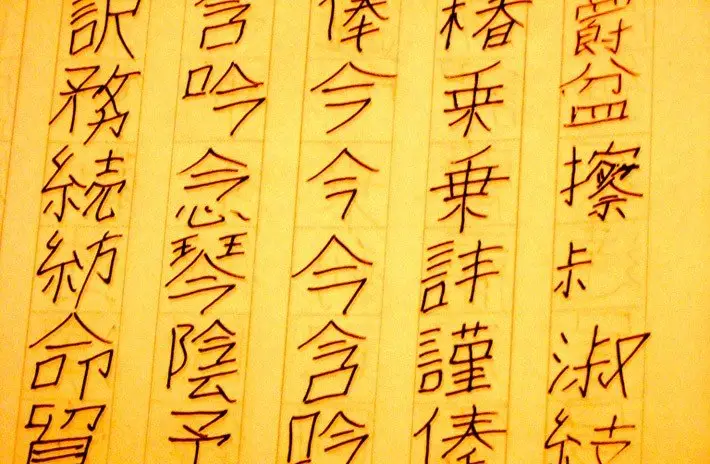
Japanese homonyms can be confusing at first because one sound may point to several meanings. In practice, learners solve that confusion the same way native speakers do: by watching the kanji, the surrounding words, and the situation in which the word appears.
Strictly speaking, many examples in Japanese are closer to homophones than true homonyms, because the pronunciation is shared while the kanji are different. Still, most learners search for “Japanese homonyms”, so this guide uses the common label while showing what really matters in study: how to tell those meanings apart without freezing mid-sentence.
Contents 7
Why Japanese has so many same-sounding words
Japanese works with a compact sound system, so many words end up sharing the same reading. Kanji helps separate those meanings in writing, while context does the heavy lifting in conversation. If you want a broader look at that relationship, it helps to read why Japanese words can carry many meanings and why kanji remains essential in Japanese.
That does not mean every identical-looking word is equally confusing. Some pairs are common in daily life, while others are rare literary or technical terms. For learners, the best approach is to start with words you will actually hear in class, anime, travel, and everyday conversation.
Common Japanese homonyms you will meet early
These are the kinds of examples that show up again and again because the words are frequent and the meanings are far apart.
| Reading | Kanji | Meaning | Typical clue |
|---|---|---|---|
| hashi | 箸 / 橋 / 端 | chopsticks / bridge / edge | eat, cross, cut, sit at the end |
| kami | 紙 / 髪 / 神 | paper / hair / god or spirit | write, cut, pray, shrine, hairstyle |
| ame | 雨 / 飴 | rain / candy | weather, falling, sweet, buy, eat |
| sake | 酒 / 鮭 | rice wine / salmon | drink, menu, grilled fish, dinner |
| kaeru | 帰る / 変える / 蛙 | return / change / frog | go home, switch something, animal context |
How context tells you which meaning is intended
Native speakers rarely stop to decode every ambiguity one by one. They listen to the whole sentence. With hashi, for example, the verb often gives the answer immediately. If someone says hashi de sushi o taberu, you are dealing with chopsticks. If the sentence is hashi o wataru, it is a bridge. If someone sits at the hashi of the table, the word means the edge or end.
The same thing happens with kami. Kami o kiru points to hair, kami ni kaku points to paper, and references to shrines, myths, or worship usually point to a god or spirit. This is why memorizing isolated dictionary glosses is less effective than learning a word inside short, natural phrases.
Examples that make the difference obvious
Here are a few quick contrasts that beginners can remember without turning the topic into a memorization trap:
- Hashi: 箸で食べる means “eat with chopsticks”, while 橋を渡る means “cross the bridge”.
- Ame: 雨が降っている means “it is raining”, while 飴を買った means “I bought candy”.
- Kami: 髪を切る means “cut hair”, while 紙に書く means “write on paper”.
- Sake: 酒を飲む means “drink sake”, while 鮭を焼く means “grill salmon”.
Some entries add another layer: words may look the same in kana or romaji but differ in pitch accent, which helps native listeners separate them even faster. Learners do not need to obsess over that on day one, but it is worth remembering once your listening becomes more precise.
How to study Japanese homonyms without getting lost
The most practical method is to learn each reading in a full phrase, not as a lonely flashcard. Pair the word with one verb, one common setting, and the kanji that usually appears with it. That turns an abstract list into something your brain can retrieve in seconds.
It also helps to group the examples by use. Food words such as sake are easier to remember together. Movement words such as kaeru become clearer when you place them in travel or daily routine sentences. If you enjoy breaking down how one form can branch into many senses, this article on why Japanese words have many meanings is a natural next step.
One more thing beginners should remember
Japanese homonyms are not a sign that the language is impossible. They are simply part of how Japanese packs meaning into a small set of sounds. Once you start reading more kanji and hearing words inside full sentences, the confusion drops quickly.
If you can already recognize the difference between hashi on a dining table and hashi over a river, you have understood the core idea. From there, every new example becomes less of a trap and more of a clue about how Japanese organizes meaning.






Community
Comments
0 comments
There are no published comments in this language yet.
Send comment