
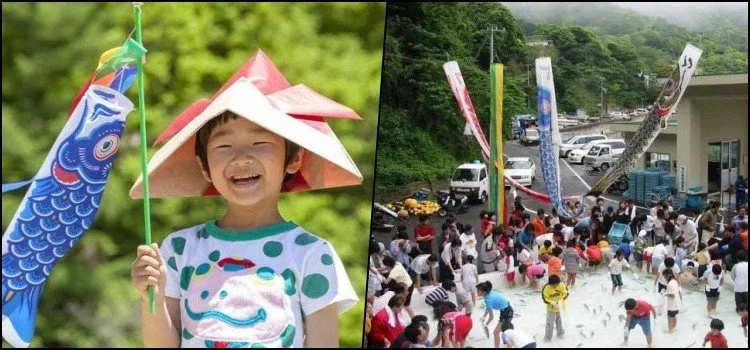
Walk through a Japanese neighborhood in early May and the sky is full of carp. Those cloth fish are not tourist decoration: they mark Kodomo no Hi (子供の日), the day the country actually stops for children. The twist is that Japan also keeps two other beloved dates for kids — and neither one is a public holiday.
Families still fly koinobori and set out miniature armor as if the day were still Boys' Day. The official name changed in 1948. The carp, the helmets, and the oak-leaf sweets did not.
Contents 7
Kodomo no Hi — Children's Day, May 5
Kodomo no Hi (子供の日) literally means Children's Day, and it falls on May 5 during Golden Week. It is the only one of these dates that closes schools and offices. On this day, carp streamers called koinobori are hung in gardens and on balconies to wish children strength and determination — the carp that swims upstream.
The largest black carp (magoi) is usually the father, the red higoi the mother, and a smaller carp is added for each child. Families also display gogatsu ningyō: samurai dolls, armor, and helmets. Folk heroes such as Kintarō, Momotarō, and the demon-queller Shōki appear in those displays, each one a separate wish that a child grow brave and protected. Iris leaves, shōbu, belong to the same set of symbols.
According to Article 2 of the Holiday Law, the goal is “to respect the personality of children, to seek their happiness, and to thank mothers.” The day was established as a national holiday on July 20, 1948, when the old Boys' Day was opened to every child.
It is still known as Tango no Sekku [端午の節句]. Children eat chimaki, rice cakes wrapped in bamboo leaves (more common in western Japan), and kashiwa mochi, sweets wrapped in oak leaves that stay on the tree until new ones grow. Another custom that rarely makes the postcards is shōbu-yu: a bath with iris leaves, thought to drive away harm. And on this day the carp song, Koinobori uta, still gets sung.
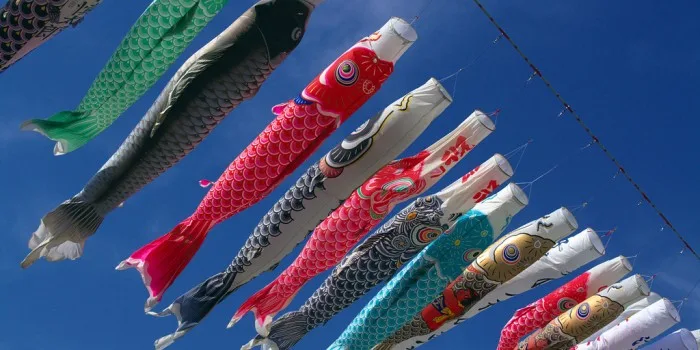
Song of the Carp — Koinobori uta
Yane yori takai koinobori.
Ōkii magoi wa otōsan.
Chiisai higoi wa kodomotachi.
Omoshiro-sō ni oyoideru.
Girls' Day — Hina Matsuri
Girls' Day falls on March 3 and is called Hina Matsuri [雛祭り], or Hina no Sekku. It is a festival, not a national holiday. The day is remembered for the peach blossoms that stand for a happy marriage and for wishes of health for girls. The older name, Momo no Sekku, still sits in the background: peach trees, purification, and a quiet hope that the year will be kind.
Hina Matsuri is traditionally marked by an exhibition of dolls, passed down from mother to daughter for generations. The dolls are arranged on a red-covered stand every year. A full set usually has 15 dolls dressed in imperial court attire from the Heian period (794–1185). According to Japanese belief, the dolls can take on misfortune — illness, bad luck, the things a family would rather send away from a daughter.
On Girls' Day it is common to drink shirozake, a cloudy sweet white sake. It does contain alcohol. Children are usually given amazake, a similar rice drink made without that kick. The traditional snack is hina-arare, colorful rice crackers; Kantō leans sweeter and puffed, Kansai toward round glutinous crackers. Other typical foods include hishimochi and sakuramochi, chirashizushi, and a clam soup called hamaguri ushio-jiru, whose matching shells stand for a couple that fits.
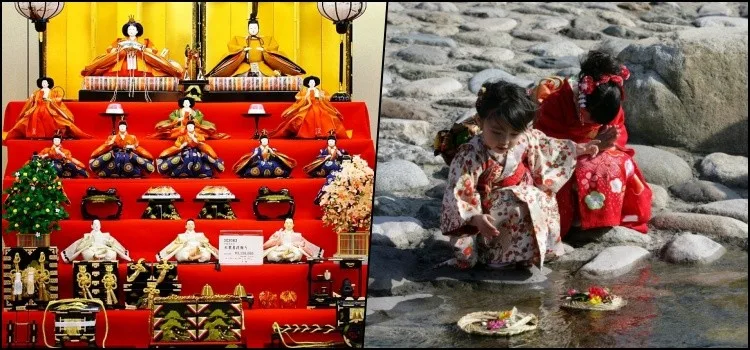
The girls' or doll festival also has its own song, Ureshii Hina Matsuri:
Ureshii Hina Matsuri — Lyrics
Akari wo tsukemashō bonbori ni
Ohana wo agemashō momo no hana
Gonin-bayashi no fue taiko
Kyō wa tanoshii Hinamatsuri
Odairi-sama to Ohina-sama
Futari narande sumashi-gao
Oyome ni irashita nēsama ni
Yoku nita kanjo no shiroi kao
Kin no byōbu ni utsuru hi wo
Kasukani yusuru haru no kaze
Sukoshi shirozake mesareta ka
Akai o-kao no udaijin
Kimono wo kikaete obi shimete
Kyō wa watashi mo hare-sugata
Haru no yayoi no kono yoki hi
Nani yori ureshii Hinamatsuri
Shichi-Go-San [753] — Children's Festival
The Shichi-Go-San [七五三] is a festival that takes place every November 15 in Japan. The name is written with the kanji for seven, five, and three, because parents take daughters aged three and seven and sons aged three and five to shrines to pray for health, growth, and a little luck that lasts. It is not a public holiday, so when the 15th lands on a weekday, families usually go on the nearest weekend — and many now spread visits across November.
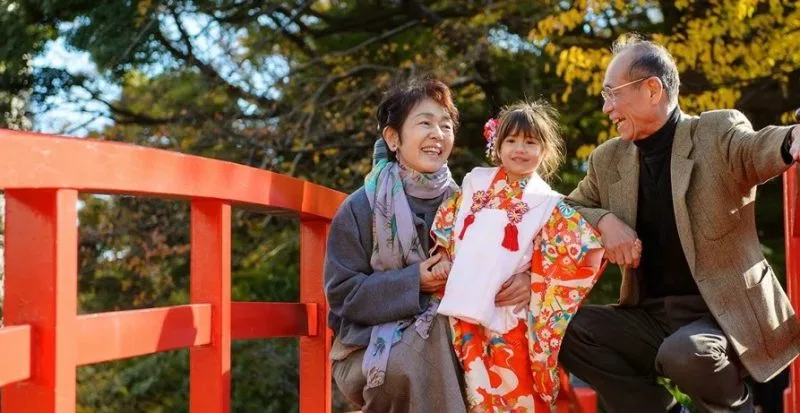
A second reason for going to the shrine is to ward off harm, though that wish is hardly limited to this date. During the festival, children usually dress in kimono or formal Western clothing, often for the first time, and receive amulets and their chitose ame (千歳飴), the “thousand-year candy.”
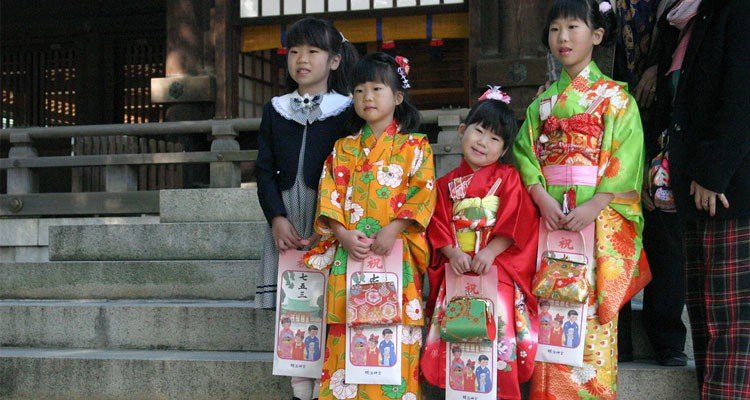
Chitose ame is a long, thin, red-and-white candy wrapped in an edible rice paper so thin it looks like plastic. It is associated with longevity and comes in a bag adorned with a crane and a turtle. There is a common belief that the candy carries a wish of a thousand years of happiness — a sweet exaggeration that families still enjoy saying out loud.
The ages seven, five, and three sit on two ideas at once. East Asian numerology treats odd numbers as lucky. And these three ages have long been treated as the sharp turns of childhood: hair grown in, first formal clothes, first real obi.
The history of Shichi-Go-San
The festival is said to have taken shape among nobles in the Heian period (794–1185), who marked the growth of their children on a lucky day in November. The fifteenth of the month became the usual date during the Kamakura period (1185–1333). Later tradition ties the fixed November 15 to rites the fifth Tokugawa shogun, Tsunayoshi, held for his son Tokumatsu.
From the Edo period (1603–1868) it spread as a popular festival. During the Meiji period (1868–1912) the custom loosened and reached commoner families more widely, including the shrine visit that people picture today.
Earlier, the day was treated more strictly. Children often had their hair kept shaved until about three, and only after the festival — kamioki, “hair-leaving” — could it grow. At three, girls would wear their first kimono, usually floral; at seven they would wear a proper obi for the first time. Boys would wear their first hakama at five.
By the Meiji era those rules had already softened. Even three-year-olds might appear in a full festive outfit, and the practice of shaving children's hair was set aside. The photographs stayed.
For all the beauty of the clothes, the reason Shichi-Go-San mattered is a little melancholy. Infant mortality was high, and the festival was a way for families to mark that a child had made it through the most fragile years. Japan is no longer haunted by that same fear; the tradition remained anyway, now more photo, candy, and gratitude than emergency prayer.
Sekai Kodomo no Hi — World Children's Day
The United Nations marked an international children's day on November 20, 1954, and left room for each country to keep its own date. Japan already had May 5 as Kodomo no Hi. The universal date is still worth remembering, especially if you grew up with a different Children's Day on the calendar and then landed in Tokyo in Golden Week, staring at carp that were never meant for your November.



Community
Comments
0 comments
There are no published comments in this language yet.
Send comment