
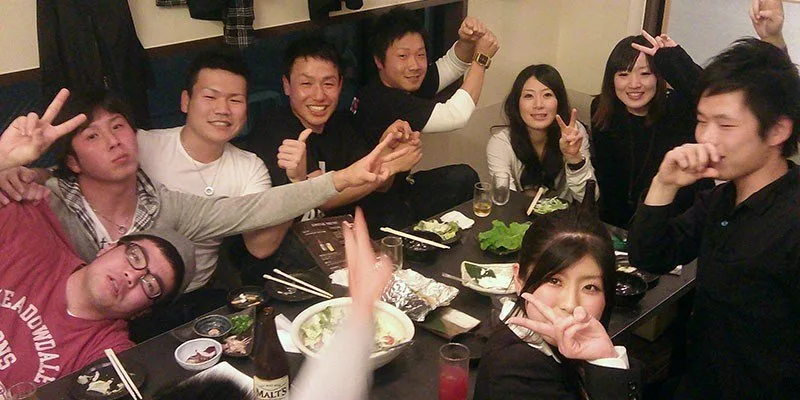
Few topics are repeated as stubbornly in the West as the supposedly bizarre eating habits of the Japanese. In forums, travel guides and social media posts, claims keep surfacing that Japanese people eat dogs, insects, rats or even human flesh. These stories have been part of the stock repertoire of Western clichés about Japan for decades. But how much truth is actually behind the myths, and where does the disinformation begin?
Japanese cuisine (和食, washoku) is considered one of the most balanced and respected in the world. UNESCO added it to the Representative List of the Intangible Cultural Heritage of Humanity in 2013. Precisely because washoku enjoys such a strong international reputation, the recurring rumors about supposedly disgusting foods find fertile ground. This article separates facts from prejudice and answers the question about dog meat, insects, rats and human flesh in Japan, calmly, without sensationalism and without passing sweeping judgment on other cultures.

Contents 15
Western myths about Japanese cuisine
Anyone who looks at how Japan is perceived in the West soon encounters a recurring pattern: foreign cuisines tend to be judged by whatever strikes the Western observer as most unusual. In Japan's case, since the 19th century, three points dominate: raw fish, exotic sea creatures and the alleged consumption of anything that moves. Travelers, early journalists and later tabloid media built a composite image from isolated observations that has little to do with the reality of Japanese food culture.
The most persistent prejudices can be summed up in four claims that keep coming back in Western media, forums and casual conversation: the Japanese eat dog meat, the Japanese eat insects such as grasshoppers and wasps as everyday snacks, the Japanese eat rats, and the Japanese are even said to eat human flesh. Each of these four claims deserves its own fact-based answer, and that is what this article delivers.
Do the Japanese eat dog meat?
The short answer: no. There is no tradition of dog meat consumption in Japan, and dogs are clearly classified as family members and pets in Japanese society.
Unlike some other Asian countries where the consumption of dog meat has been historically documented, in parts of China, Korea and Vietnam, the practice does not exist in Japan. Anyone living in or traveling through Japan sees every day that dogs are treated as everyday companions. In Tokyo neighborhoods such as Aoyama or Daikanyama, dogs wear coats in winter, are carried in bags through cafés, and there are more veterinary clinics, dog salons and pet hotels than in many large European cities. The emotional relationship between Japanese people and their dogs is culturally almost identical to that in the United States, the United Kingdom or Australia.
Legally, dog meat is not explicitly banned in Japan, but in practice consumption is essentially impossible. Regulations on dog breeding in Japan are strict, apartment ownership and pet registration are mandatory, and the cost of keeping a dog properly is high. According to estimates from the Japan Pet Food Association, around 8.4 million dogs lived in Japanese households as of 2023. In a society where pet ownership is this taken for granted, dog meat has no cultural place.
What remains is the confusion with other Asian countries. Dog meat is also contested and sharply declining in those countries: in South Korea, the Supreme Court ruled in 2024 that dog meat consumption is no longer to be treated as a cultural practice; in several Chinese cities it is actively being suppressed, and in Vietnam it has always been limited to certain rural areas. For decades the West has merged these regional practices into a single image that does not hold up, and that wrongly includes Japan.
Read also: Consumption of dog meat in Asia

Do the Japanese eat insects?
The short answer: yes, but rarely, regionally, and in very specific contexts. Insects are not an everyday snack in Japan but a traditional food with clearly defined regional roots.
The consumption of insects, known in technical language as entomophagy, has a long if narrow tradition in Japan. Three examples show how narrow the field really is.
Inago no tsukudani (蝗の佃煮): grasshoppers simmered in soy sauce, sugar and sake, considered a snack or rice accompaniment for centuries in the prefectures of Nagano, Gifu and Toyama. The dish has a slightly nutty taste and is occasionally sold in Tokyo's depachika (department store food halls) as a regional specialty rather than a mainstream snack.
Hachinoko (蜂の子): bee and wasp larvae, gathered mainly in the mountains of Nagano, Gifu and Fukushima and cooked in a thin soy sauce. Hachinoko is considered a delicacy and, like inago, is concentrated in rural regions.
Zaza-mushi (ざざむし): insect larvae from mountain streams, traditionally boiled in salted water and served in sake in the San'in region (Tottori and Shimane). Today the dish is a rarity you will mostly encounter among older residents of the area.
In the postwar period (1945–1950) insect eating briefly returned to rural areas as emergency food when the food supply collapsed. That historical context shows that insects in Japan were always survival food rather than luxury fare. Today, in a society with one of the highest per-capita incomes in the world, entomophagy barely plays a role. The United Nations recommended insects as a resource-efficient protein source in a widely discussed 2013 report; in Japan, startups such as TAKEO then brought insect snacks to market, but they have not yet reached mainstream consumers.
Unlike in Thailand, Cambodia or parts of Mexico, where fried grasshoppers, maggots and beetles at street stalls are part of everyday life, insect eating in Japan is not a street-level sight. If you want to try insects there, you actively look for a specialty restaurant in Tokyo, Kyoto or Osaka, try a tin of inago no tsukudani in a department store, or visit one of the few entomophagy bars that have opened since the 2010s.
Do the Japanese eat rats?
The short answer: no. There is no tradition of eating rats in Japan, neither historically nor today.
The myth that the Japanese eat rats is one of the most persistent Western fantasies about East Asia, and it has nothing to do with Japanese reality. Unlike in some parts of Southeast Asia, such as parts of Thailand, Myanmar or the Philippines, where wild rodents were hunted in times of famine, rats play no role in Japanese food culture. In the Edo period, when the urban population of Edo (modern Tokyo) grew to about a million people, rats were pests living in lumber yards, rice mills and sewers. Even then they were not food.
Today rats in Japan are seen exclusively as pests and as laboratory animals. The Japan Rat Control Association publishes annual statistics on pest control, not on food hygiene around rodents. The word nezumi (鼠) in the kitchen never refers to a dish: it means the animal, or, in architecture, a structural element (the nezumi-ita, a small ridge beam). If you still hear the myth, treat it with skepticism: in the vast majority of cases it comes from conflating Chinese, Vietnamese or Burmese practices that Western media flatten into a generic "typically Asian" claim.
Do the Japanese eat human flesh?
The short answer: absolutely not. There is no serious source documenting Japanese cannibalism as a widespread practice, neither in history nor in the present.
The myth of Japanese human flesh consumption is one of the darkest Western fantasies about Japan and belongs in the same category as the ancient rumors about "the barbarians" in the Roman Empire. The claim surfaced mainly in 19th century Western travel writing and referred to alleged atrocities by Japanese soldiers during the colonial wars, as well as a supposed samurai custom of eating enemies killed in battle. Both claims do not hold up historically. In the Japanese war history of the Sengoku period (1467–1615) there are occasional accounts that touch on ritual acts or extreme emergencies, but those are isolated cases, not a widespread practice.
What fed the rumors was Western wartime propaganda. During the Russo-Japanese War (1904/05), World War II and the Korean War, Japan was systematically demonized, and the slander of a "cannibalistic people" was part of that propaganda. Historians such as John Dower (Embracing Defeat, 1999) and Yuki Tanaka have shown how these depictions were intertwined with real Japanese atrocities and then sharpened for Western propaganda needs. If you read about "Japanese cannibalism" in a Western source, always check the time period and political context.
Legally and culturally, the consumption of human flesh is excluded in Japan by clear norms. The Japanese Penal Code (刑法, keihō) criminalizes desecration of corpses and graves. Respect for the dead is deeply rooted in Japanese culture: funeral rites, household altars (butsudan) and regular visits to the family grave are everyday practices. In a society where death is accompanied by such careful ritual, the idea of human flesh as food has no cultural place.
What else? Frogs, whales and the "dancing" squid
Beyond the four big myths, other claims about unusual foods in Japan keep circulating. Three of them deserve a brief clarification, because they keep causing confusion.
Frogs in Japan
Frog legs are a very rare food in Japan. There are isolated specialties such as kaeru no nikogori (frog and gelatin stew) in the mountains of Gifu prefecture, or frog meat in Nagano prefecture, but these are niche products for enthusiasts and not everyday fare. In most Japanese restaurants, from the izakaya to the sushi counter, you will look in vain for frog. If you want frog legs in Japan, your easiest bet is to head to France, Belgium or the United States, where the dish is far more common than in Japan.
Whales in Japan
Unlike the other myths, whaling in Japan has a real historical basis. In the coastal regions of Aomori, Iwate and Chiba, whale meat was an important source of protein for centuries, especially in the postwar period when the food supply collapsed. Commercial whaling has been permitted again since 2019, but whale meat consumption is now limited to a small fan base and remains culturally controversial.
The "dancing" squid: ikizukuri
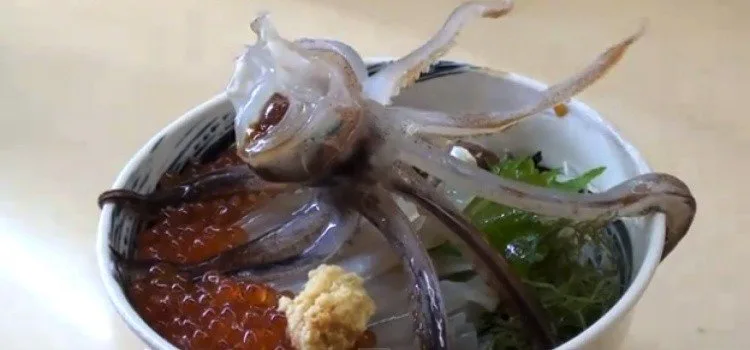
One of the best-known rumors concerns the dish ikizukuri (生き作り), in which a squid is served still twitching on the plate. Western accounts often claim the squid is eaten "alive." That is false: the head is severed before serving, and the body is dead. What the onlooker sees are muscle reflexes triggered by the sodium in the soy sauce. In Japan itself, ikizukuri is a specialty of a few restaurants and is not part of everyday cuisine.
Why these myths persist
The question of why prejudices about Japanese food culture have survived for decades has several answers, and none of them excuses the disinformation.
Confusion with other Asian countries
The most important reason is the conflation of different Asian countries. China, South Korea, Thailand, Vietnam, the Philippines and Indonesia each have very different food cultures. Western perception tends to flatten that variety into a single label: "Asia." When you read in a forum that "Asians eat dogs," the reference is usually dog meat from China or Korea, with Japan, which takes a completely different position on the question, quietly left out of the picture.
Propaganda and war reporting
The image of a "cannibalistic Japan" was spread by Western wartime propaganda, which deliberately built up enemy images during several 19th and 20th century conflicts. After 1945 those images stayed lodged in the Western collective memory, partly because they made for a visually effective enemy and were rarely corrected by more nuanced reporting.
Sensationalism and cultural blind spots
On the internet, disinformation runs on clicks. A headline like "Japanese people eat human flesh" attracts far more attention than a sober assessment. Platforms such as TikTok, YouTube and Reddit reward sensational content with reach, and the consequences show up in the comment sections: young users absorb the rumors because they have never read a fact-based rebuttal. There is also a Western blind spot at work: as far back as the 19th century, Western writers described Japan as a country caught between "exotic beauty" and "disturbing otherness." The uncomfortable side of that pairing is more visible in today's prejudices than the appealing one.
The real Japanese cuisine
What Japanese people actually eat is by now easy to see in major Western cities: sushi, ramen, udon, soba, tempura, donburi, yakitori, okonomiyaki and bento are everyday fare in London, New York and Sydney. Behind those staples lies a centuries-old food culture built on five basic principles, the so-called ichijū-sansai (一汁三菜, "one soup, three sides"):
Rice as the staple, served at virtually every Japanese meal. Soup, usually a clear misoshiru or a light suimono. Three side dishes of fish or meat, vegetables and pickled vegetables (tsukemono). Seasonal ingredients that mirror the rhythm of the Japanese year: sakura in spring, kabocha in autumn, hot nabe hotpots in winter. Freshness and quality, valued so highly in Japan that sushi master Jiro Ono, featured in the 2011 documentary of the same name, became an icon for an entire industry.
Japanese cuisine contains few dairy products and little red meat, and a lot of fish, soy, seaweed, fermented vegetables and green tea. Average life expectancy in Japan has been estimated by the WHO at around 84 years in recent years, one of the highest figures in the world. Diet is one factor, not the only one, but it is an important one.
Conclusion: dismantling myths, rediscovering flavor
The question "do the Japanese eat dogs or insects?" has a nuanced answer: dog meat is not eaten in Japan, insects are, but only regionally and rarely. Rats and human flesh are Western fantasies that have nothing to do with Japanese reality. Anyone who keeps spreading these myths contributes to the distortion of a cultural picture that is more nuanced than the clickbait suggests.
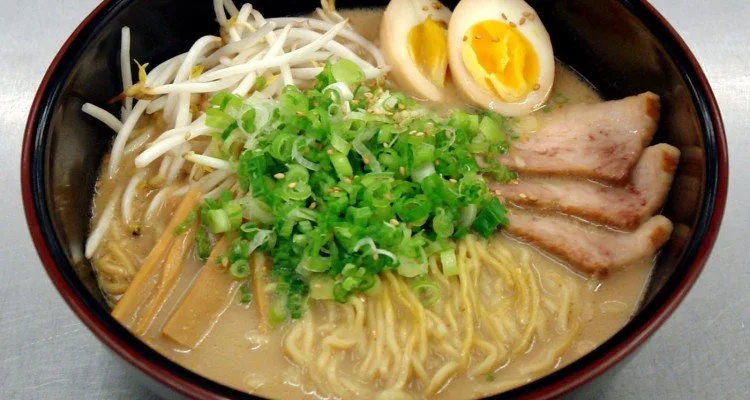
What remains is a food culture worth exploring without prejudice. Washoku is more than sushi and ramen: it is a centuries-old system of balanced eating, regional diversity and craft. The next time you sit down to a bowl of ramen in London, New York or Sydney, remember: it is cooked with care, not with a taste for sensation.





Community
Comments
0 comments
There are no published comments in this language yet.
Send comment