
April 1 is a regular working day in Japan. It is also the one day of the year when Japanese companies are expected to announce products and services that do not exist, using videos, dedicated websites and the hashtag #エイプリルフール. The custom is known as エイプリルフール (Eipuriru Fūru), or literally 四月馬鹿 (Shigatsu Baka).
Corporate April Fools' jokes divide the public. A 2025 survey by the research institute Shirabee asked 684 people between 10 and 60 years old whether they enjoy the company gags: 41.4% answered yes and 58.6% answered no. The numbers show the balance companies have to keep. A joke that everyone recognizes earns attention, while an announcement that sounds too real can be taken as false news.

Contents 4
What does Shigatsu Baka mean?
In modern Japanese, エイプリルフール is the everyday name for the date. 四月馬鹿 (Shigatsu Baka) is the literal translation, "April fool", and appears mostly in dictionaries. The custom arrived in Japan during the Taishō era (1912 to 1926) from Europe and the United States, and newspapers were already explaining it by the 1930s. April 1 is also the beginning of the fiscal and school year, a date when the public is already paying attention to new announcements.
On the internet, the date has developed into a culture of its own. Users collect the announcements, media outlets publish roundups of the most memorable ideas, and many posts carry the hashtag #エイプリルフール so readers know the claim is a joke.
Why Japanese companies love April 1
For a company, April 1 is cheap advertising. A fictional product page can travel through social networks in a day, and the largest campaigns now include videos and websites built for a single date. The culture grew through the 2010s, as more companies joined every year. Japanese television commercials already rely on humor and strange ideas, and the first of April gives that style a natural outlet.
Risks appear every few years. In 2019, Microsoft's chief marketing officer told employees to stop running April Fools' pranks, and many Japanese companies skipped their campaigns because the new era name Reiwa was announced on April 1. A recent example turned into a public apology. In 2025, the bento chain Hokka Hokka Tei posted that it would stop selling rice because of rising prices. The post carried the April Fools' hashtag, but readers found the topic too close to a real problem, and the company apologized the same evening, explaining that the message was meant to introduce a new line of noodle bento.
Famous April Fools' Day pranks in Japan
Some announcements are remembered years later. The examples below range from newspaper hoaxes to product gags from major companies.
Oil in Tokyo Bay (2003): The Tokyo Shimbun reported that a huge oil field had been found in Tokyo Bay, with reserves estimated at more than 110 billion barrels. The story belonged to the newspaper's April 1 tradition, which started in 2001.
Astro Boy robots for Iraq (2003): In the same year, the newspaper wrote that the government planned to send robots modeled on the 1960s character Astro Boy to help rebuild Iraq after the war.
Lottery tickets instead of pensions (2004): The Tokyo Shimbun returned with a front-page story saying the government was considering a lottery ticket inside each pension payment, so that cuts would arrive with a chance at a windfall.
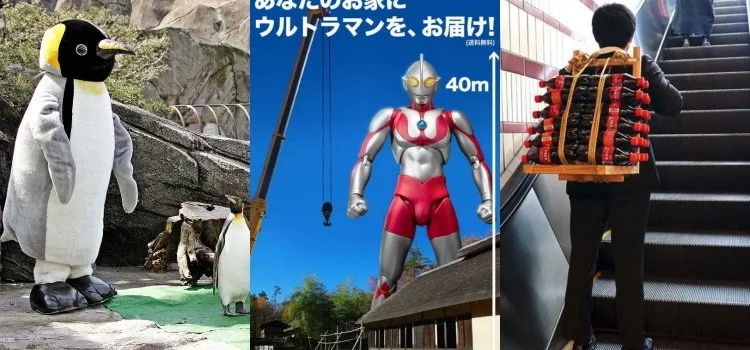
The giant penguin of Ueno Zoo (2005): Ueno Zoo announced a 165-centimeter, 80-kilogram "Lord" penguin. The animal was presented to the public on April 1 and turned out to be zoo director Teruyuki Komiya in a costume.
Pizza in a can (2013): Domino's Pizza Japan presented a canned pizza with a rolled-up slice inside, a parody of the canned bread sold in Japanese vending machines.
Audi A8 5.5 (2015): Audi Japan presented a special edition for the Japanese market with a rice cooker built into the rear console and igusa tatami mats for the seats. The model name reads as gohan, the Japanese word for cooked rice.
Ultraman at 40 meters (2015): Bandai opened reservations on the Premium Bandai site for an ULTRA-ACT Ultraman figure in real size: 40 meters tall and 78 million yen. The ULTRA-ACT line covers the company's collectible action figures, and the posing crane and the land came at the buyer's expense.
Coca-Cola business cards (2015): Coca-Cola Japan showed employees carrying bottles of Coca-Cola to meetings and handing them out as business cards.
Airbag for pedestrians (2015): Volvo Car Japan announced an airbag for pedestrians who look at their phones while walking.
PlayStation Flow (2015): Sony published a video for PlayStation Flow, a set of goggles, arm bands and a body dryer designed to let players control games underwater.
When the joke becomes a real product
Some ideas leave the internet and reach stores. Kameda Seika, the snack maker behind Happy Turn crackers, posted a fictional spicy version called Tsurataan on April 1, 2023. The name plays on tsurai, the Japanese word for painful, and the post received around 41,000 likes. Readers asked for the product, and in April 2024 the company put a real Tsurataan on convenience store shelves, replacing the usual happy powder with a "pain powder".
The April 1 tradition in Japan lives on that limit between joke and reality. An invented product can end up on store shelves, and a headline that gets too close to a real problem can end in a public apology. Both outcomes depend on how the audience reads the announcement.






Community
Comments
0 comments
There are no published comments in this language yet.
Send comment