
Japan is famous for its many festivals, which take place throughout the year. The most common matsuri are easy to follow for outside visitors: fireworks, shrine celebrations, cherry blossom gatherings and traditional dances. Yet alongside them there is a smaller set of festivals that may strike you as surprising on first contact. They are not bizarre for the sake of it. They tend to put everyday subjects — the body, fertility, health, the relationship between people and the natural world — into a ritual form that feels unfamiliar in the West.
If you give these festivals a little context, you quickly see how deeply rooted most of them are in Japanese religious and agricultural history. Many come from a Shinto background, some mix Shinto with Buddhist elements, and a few are offshoots of older regional animist traditions. The eight examples below are among the most discussed unusual matsuri in Japan — from Hokkaido to Okinawa, from the rice planting season to New Year's Eve. You will not be able to attend all of them in a single trip, but visiting one will teach you a great deal about how the country celebrates.
Contents 9
Hokkai Heso Matsuri — the navel festival in Furano
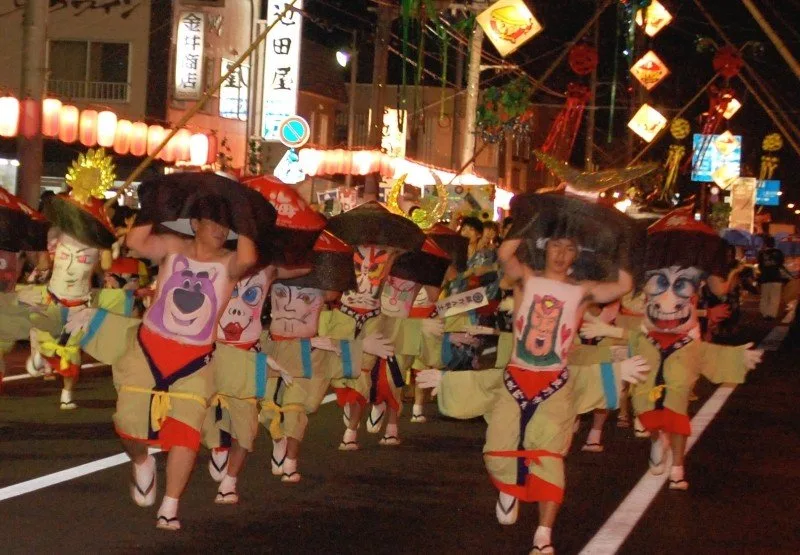
In the city of Furano, in the interior of Hokkaido, the Hokkai Heso Matsuri has been held on the last weekend of July (usually 28 and 29 July) every year since 1969. The name literally means navel festival, and the idea is simple. Furano sits close to the geographic center of Hokkaido, so the city presents itself as the navel of the island, and the festival grew from that local identity.
On those two days, around five thousand participants paint faces on their bellies and put on costumes that turn the painted belly into the head of a character. They then parade and dance through the streets, competing for prizes in front of a crowd that comes specifically to watch. It is light, family-friendly entertainment, and a good example of how a small regional city turned a local joke into one of the most photographed summer events in Hokkaido.
Kanamara Matsuri — the fertility festival in Kawasaki
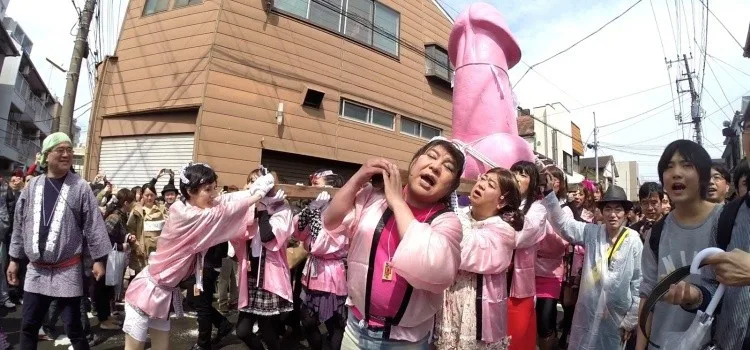
The Kanamara Matsuri, held on the first Sunday of April each year at and around the Kanayama Shrine in Kawasaki, is the festival most international readers will already have heard of. It is often described simply as the penis festival in English-language coverage, but the local framing is more straightforward: it is a Shinto fertility ritual, and it has been celebrated in this form since 1969, on the second Sunday of April before 2018.
Shinto priests carry a mikoshi — a portable shrine — topped with a phallus-shaped object made of metal or pink steel. Three main mikoshi are part of the procession, including the famous black Kanayago mikoshi, named after a legendary 17th-century blacksmith who is said to have placed a broken blade into her vagina to ease childbirth. For that reason, the festival was originally associated with sex workers, who came to pray for protection from sexually transmitted infections. Today, parts of the proceeds go to HIV prevention and awareness, a use that has been part of the festival's modern identity since 2018.
Visitors come for the photographs, the candy shaped like phalluses, and the unusually open atmosphere. Western reaction tends to be amused and slightly puzzled, and Japan does come across as strange and unusual at first sight, but the religious context is genuine. The shrine itself takes the ritual seriously, and the local community has supported it for decades.
Hitorizumo Matsuri — sumo for the rice harvest
On 5 May, Children's Day in Japan, the Hitorizumo Matsuri takes place at the Oyamazumi Shrine on Ōmishima Island, in the Seto Inland Sea off Ehime Prefecture. The name roughly translates as one-man sumo, and the idea is a match between a single sumo wrestler and an invisible opponent: the spirit of the rice crop.
A senior wrestler enters the ring and wrestles, in effect, against nothing. He throws, grapples and pushes an unseen foe for several minutes, then declares victory on behalf of the community. The ritual is meant to guarantee a good harvest for the year, since the wrestler has symbolically beaten every possible threat to the rice fields. It is a short, quiet event compared with the big city festivals, and watching it feels closer to attending a village ceremony than a tourist attraction.
Hadaka Matsuri — the naked festival at Saidai-ji
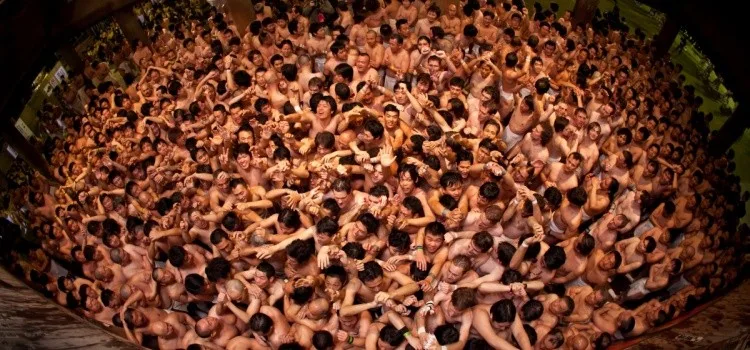
The most famous Hadaka Matsuri, or naked festival, takes place on the third Saturday of February at Saidai-ji, a Buddhist temple in Okayama. Around ten thousand men wear only a white fundoshi loincloth, gather in a tight space inside the temple precinct, and compete for wooden talismans called shingi, which are thrown into the crowd at a signal.
The point of the event is not the nudity itself. The ritual has two main meanings. First, the shingi are thought to bring good luck and a safe year to whoever catches one. Second, the half-naked exposure in freezing February weather is a form of purification: by enduring the cold and the chaos of the crowd, participants are thought to cleanse themselves before the new agricultural cycle begins. The morning ends with a plunge into cold water, and the whole ceremony is a striking mix of endurance, religion and adrenaline.
Nakizumo — the crying baby festival
The Nakizumo is a sumo-themed ritual in which the goal is to make a baby cry as loudly as possible. Around sixty babies are brought to a dohyō, the sumo ring, and a wrestler holds each child while gently rocking them. A referee shouts NAKE, NAKE!, meaning Cry, cry!, and if the babies still refuse to cry, masked volunteers step into the ring to startle them with growls and sudden movements.
The crying is read as a sign of healthy lungs, strong energy and a long life, which is why parents are happy to enter their children. The tradition has roots in folk medicine that go back roughly four hundred years, and several temples and shrines hold their own version. The most famous is held at Sensō-ji in Asakusa, Tokyo, where the modern event has run since 1991. Other well-known versions take place at Gokoku-ji and Hiyoshi Taisha, and the rules vary by region: in some places, the first baby to cry is the winner, while in others, the first to cry is considered the loser.
Pantu Festival — animist processions in Miyako, Okinawa
There are actually two related festivals under the Pantu name, both held on Miyako Island in Okinawa. The Pantu are supernatural beings that sit somewhere between gods and demons, and they walk through the streets in a procession led by priests, with the aim of driving out evil spirits for the year.
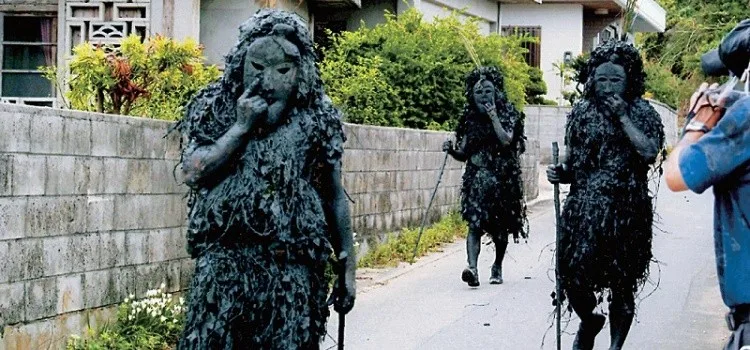
The festival in the Hirara–Shimajiri area, called Pantu Punaha, is the last of three celebrations held at different points in the year. Together, those three are known as Pantu Satupunaha. In one of the most striking moments, three men covered in mud and leaves walk through town carrying sticks in one hand and frightening masks in the other. Anyone who is touched or splashed by the Pantu is thought to receive a year of protection, and residents often invite the procession into their homes to be blessed. The festival shares clear cultural roots with similar rituals in Indonesia and Micronesia, which is a useful reminder that Okinawan culture is not simply a regional version of mainland Japan.
Namahage Matsuri — New Year's demons in Oga, Akita
The Namahage are masked demons who walk through the town of Oga on the Oga Peninsula in Akita Prefecture on New Year's Eve. They enter homes shouting, sometimes in groups, looking for lazy, greedy or disobedient children to scold. The idea is educational rather than frightening in the long run: parents invite the Namahage into the house, offer them mochi (rice cake) and sake, and ask in exchange for good health, a good harvest and well-behaved children for the coming year.
Behind the rough exterior, the ritual works as a seasonal warning. Children who misbehave during the year hear about the coming visit for weeks in advance, and the visit itself is theatrical rather than violent. The tradition was added to UNESCO's list of Intangible Cultural Heritage in 2018, alongside similar New Year rituals from across the region, and the Namahage are now one of the most recognized cultural icons of northern Japan.
Why these festivals exist
Even though the festivals above look very different on the surface, they share a few common roots. A first group, which includes the Kanamara Matsuri and the Hokkai Heso Matsuri, is tied to Shinto ideas about fertility, harvest and the body as something to be celebrated rather than hidden. A second group, led by the Hadaka Matsuri, mixes Buddhist and Shinto elements and centers on purification, luck and the marking of the agricultural calendar. A third group, which includes the Pantu and the Namahage, belongs to older regional animist traditions, where masked figures act as messengers between the human world and the spirit world.
For visitors, this is the most useful thing to keep in mind. These festivals are not staged for tourists. They are community events with serious religious and social meaning, and they have survived for centuries because they still work as seasonal anchors. The costumes, the shouting and the unusual elements are part of how a small community takes care of itself, marks a turning point in the year and reminds the next generation of who they are.
Final thoughts
Japan's festival calendar is large enough that, in almost any month of the year, you can find a matsuri that does something you have not seen anywhere else. Some of them will look strange, some of them will look funny, and a few will stay with you long after the trip ends. If you travel with a little patience and a willingness to learn the story behind the costume, you will leave with a much sharper sense of how this country thinks about ritual, the body and the turning of the seasons.
And if you do decide to take part in one of them, dress warmly, follow the instructions of the local organizers, and remember that you are a guest at someone else's celebration.


Community
Comments
0 comments
There are no published comments in this language yet.
Send comment