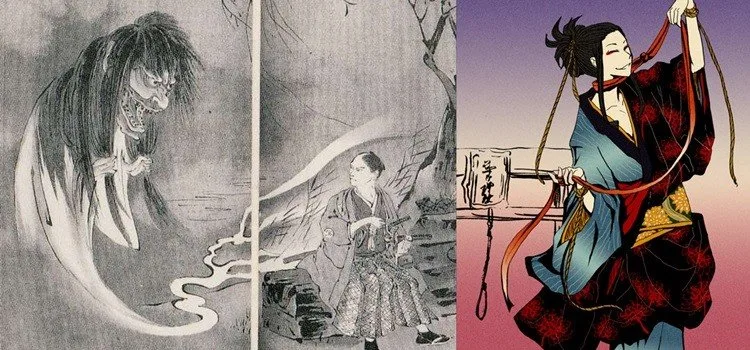
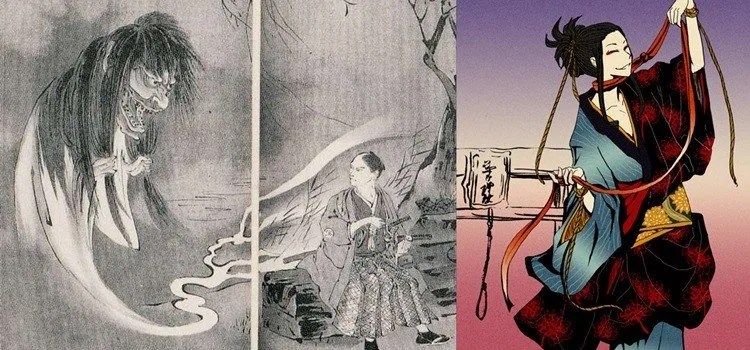
The Japanese folklore is filled with supernatural creatures known as youkai (妖怪), each with its own peculiarity. Among stories of animated objects and playful spirits, there are youkai that personify humanity’s deepest fears. One of these is Itsuki (縊鬼), a terrifying being that does not attack with physical violence but commands its victims to a tragic fate: suicide by hanging.
This legend, recorded during the Edo period, reveals not only the dark character of Itsuki but also the psychological and cultural impact it carries.
The recorded story of Itsuki
The first mention of Itsuki appears in a text from the Edo period, called Notes on the Reverse of Drafts (反故の裏書). This work documents curious and supernatural events, including the encounter of a government official with this fearsome youkai.
According to the account, the official summoned his subordinates for a meeting, but one of them arrived late and agitated. The man, with strange behavior, quickly announced: “I won’t be able to participate today. I left someone waiting!”
When asked who was waiting, he replied:
“I promised someone that I would hang myself.”
The official, suspicious, prevented the man from leaving and offered him alcohol to calm him down. During the conversation, he revealed that he had encountered a figure standing near the entrance gate, which ordered him to fulfill this macabre promise. Meanwhile, another piece of news reached the meeting: someone had hanged themselves exactly at the mentioned location, apparently fulfilling the fate that the subordinate had escaped.
This macabre event was attributed to Itsuki, a youkai whose main characteristic is to induce people to promise that they will commit suicide.
The psychological impact of Itsuki
What makes Itsuki so terrifying is the type of influence it exerts. Unlike other youkai that attack physically or play tricks, Itsuki explores the internal fears and psychological vulnerability of its victims. It does not need to force or manipulate directly; it just needs to make a suggestion and watch the tragic outcome.
This coercive power deeply affects Japanese cultural beliefs about honor, duty, and the weight of promises. In the context of the time, where a person’s word held great value, the impact of a youkai like Itsuki was even more disturbing.
Possible interpretation of the legend
Although there is no detailed physical description of Itsuki in historical records, it can be interpreted as a personification of fear and depression, themes that remain relevant in contemporary Japan. Suicide, especially ritualized, has always been a sensitive topic in Japanese culture, often associated with honor and despair.
Itsuki could symbolize the internal struggle against external forces that seem uncontrollable, an allegory of how the environment and circumstances can lead someone to a dangerous mental state.
Why is Itsuki so scary?
Among so many youkai, Itsuki stands out for touching on deeply human issues: the control of the mind and psychological vulnerability. Unlike physical creatures that can be confronted or avoided, Itsuki acts on the mental plane, where it is more difficult to defend oneself.
Invisibility of danger: without a physical description, Itsuki can be interpreted as an invisible entity, which amplifies its threatening nature.
Induction to the inevitable: the idea that its victims fulfill a fate that was “ordered” is particularly frightening, as it takes away any sense of control from them.
Connection to suicide: in Japan, suicide by hanging has cultural and historical resonances, making Itsuki’s power even more disturbing.
Itsuki in popular culture
Although Itsuki is not one of the most depicted youkai in popular culture, it carries elements that make it a strong candidate for horror stories. The concept of mental coercion and fatalism parallels various narratives, especially in anime and films that explore the darker side of Japanese folklore.
Itsuki is an example of how youkai are not just folkloric creatures but also reflections of the fears, values, and cultural issues of their time. Its story serves as a reminder of the importance of taking care of mental health and the impact that promises and external influences can have on people’s lives.
And you? Have you heard of other youkai as dark as Itsuki? Share your stories or reflections!
If you are a fan of Naruto, you certainly know that ramen is the protagonist’s favorite food. Naruto Uzumaki not only loves the dish but also has a favorite restaurant in Konoha: Ichiraku Ramen. What many do not know, however, is that this famous place is not just a product of Kishimoto Masashi’s imagination, but was inspired by a real shop! And the best part: it is possible to taste ramen similar to that in the anime at establishments related to Ichiraku.
In this article, we will explore the story behind Ichiraku Ramen, its relation to the anime, and where you can experience this unique adventure.
The Origin of Ichiraku Ramen
Ichiraku Ramen, so present in the anime and manga, was inspired by a real restaurant located in Fukuoka, Japan. Kishimoto Masashi, the creator of Naruto, revealed that he used to pass by this establishment during his student days and that it served as a model for the famous fictional restaurant.
The original Ichiraku, which was near the Fukuoka station, became a landmark for both Naruto fans and ramen lovers. It appeared in several episodes and chapters of the anime, even being featured on the cover of volume 16 of the manga. Unfortunately, the restaurant closed its doors in 2014, leaving many fans nostalgic.
Where to Find Ichiraku Today?
Although the original Ichiraku is no longer in operation, there is good news for Naruto fans and ramen enthusiasts. Other branches of the brand are still open in Fukuoka, allowing you to taste ramen as delicious as that in the anime.
Shime Branch
The most well-known branch today is in Shime, located near Fukuoka airport. This shop preserves the essence of the original Ichiraku and is a popular destination for fans who want to immerse themselves in the Naruto universe. There, you can order the pork ramen, Naruto’s favorite dish, and feel as if you are in Konoha.
Theme Parks
Usually in Naruto parks like on Awaji Island, you can find a perfect replica of the Ichiraku from the anime, with themed dishes that resemble Naruto’s ramen. We cannot say that the taste experience is authentic, but the atmosphere will be quite nostalgic.
Naruto’s Ramen: A Japanese Classic
The pork ramen, known as tonkotsu ramen, is a classic of Japanese cuisine. Originating from the Kyushu region, where Fukuoka is located, this type of ramen is characterized by a creamy and rich broth made from pork bones cooked for hours. The combination of handmade noodles, flavorful broth, and fresh ingredients makes the dish a true explosion of flavors.
Even if you are not a Naruto fan, Ichiraku Ramen is a great opportunity to experience an important part of modern Japanese culture. Tasting the character’s favorite dish is more than a culinary experience: it is a direct connection to one of the most iconic animes in the world.
Is Ichiraku Really the Best Ramen?
As someone who enjoys various ramens from Japan, at least the one from the theme park in Awaji, I personally did not like it compared to other ramens in Japan. Perhaps the original from Fukuoka is quite superior, as theme park foods usually aren’t that tasty.
In fact, there are hundreds of factors that can affect your ramen experience. The first time I went to Japan, I personally did not like the ramens I ate, but after the second time, I became addicted, especially to Tonkotsu.
Regardless of your taste experience, sitting in a restaurant that inspired such an iconic element of the Naruto anime is a privilege for fans of the series. It is a way to make real something that seemed to exist only in the universe of Konoha.
And you, have you ever imagined tasting Naruto’s ramen and feeling part of this amazing universe? How about planning your next trip to Japan and living this culinary adventure?
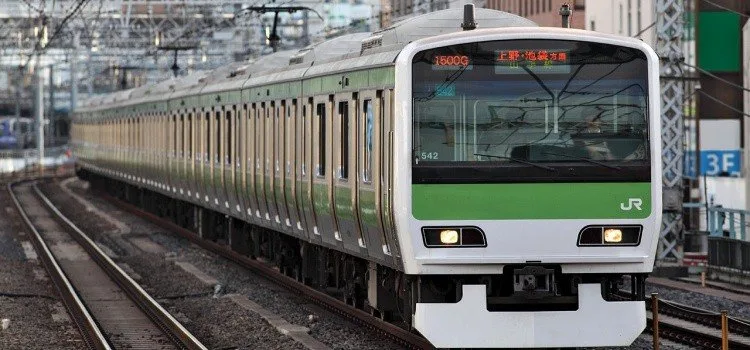
Traveling by train in Japan is a unique experience, marked by efficiency, organization, and the almost melodic atmosphere of the stations. The announcements are a fundamental part of this journey, offering clear and precise information. For those learning Japanese or just curious about the meaning of the announced phrases, diving into these dialogues can be as fascinating as it is useful. In this article, we will translate and explain some of the most common phrases you will hear on Japanese trains and at stations.
What do the announcements at the stations have to say?
When you board or disembark from a train in Japan, you are greeted by a series of announcements that serve both to guide and to ensure the safety of passengers. These announcements follow specific patterns, but there are variations depending on the railway company, the type of train, and even the station.
1. Arrival of trains at the station
まもなく、1番線に電車がまいります
Mamonaku, ichiban sen ni densha ga mairimasu
Translation: Soon, the train will arrive at platform 1.
10時30分発小田原行きがまいります
Jūji sanjūppun hatsu Odawara yuki ga mairimasu
Translation: The 10:30 train to Odawara is arriving.
電車が通過いたします。黄色い線の内側にお下がりください
Densha ga tsūka itashimasu. Kiiroi sen no uchigawa ni osagari kudasai
Translation: The train is passing. Please stand behind the yellow line.
2. Train Destination Announcements
Destination announcements are the most frequent. They indicate where the train is going and what the next station is. This information is extremely useful, especially for tourists and newcomers to the Japanese transportation system.
この電車はXXX行きです
Kono densha wa XXX iki/yuki desu
Translation: This train goes to XXX. Here, “XXX” is the name of the final station, such as Ueno, Shibuya, or Kyoto.
次は東京、東京です
Tsugi wa Tokyo, Tokyo desu
Translation: Next stop: Tokyo.
3. Transfer Announcements
Transfer announcements are essential in a railway system as interconnected as Japan’s. They inform about connections with other lines or services.
中央線、地下鉄銀座線、新幹線は、お乗り換えです
Chūōsen, chikatetsu Ginzasen, shinkansen wa o norikaedesu
Translation: For the Chuo Line, Ginza Subway, or Shinkansen, please transfer here.
JR線ご利用お客様はお乗り換えです
JR-sen go riyou okyakusama wa o norikaedesu
Translation: Dear customers using the JR line, please transfer here.
These announcements always mention the available lines and are often repeated in English for greater accessibility.
Safety First
The Japanese prioritize safety, and this is reflected in the announcements. They not only alert about precautions when boarding and disembarking but also reinforce the importance of respecting the limits on platforms.
1. Disembarking Announcements
お出口は右側です
O deguchi wa migi gawa desu
Translation: The exit is on the right side.
足元に、ご注意ください
Ashimoto ni, go chu-i kudasai
Translation: Watch your step.
2. Platform Precautions
列車に乗る際は、必ず黄色い線の内側にお待ちください
Ressha ni noru sai wa, kanarazu kiiroi sen no uchigawa ni omachi kudasai
Translation: When boarding the train, always wait behind the yellow line.
白線/黄色い線まで下がってお待ち下さい
Hakusen/Kiiroisen made sagatte omachi kudasai
Translation: Please wait behind the white/yellow line.
危ないですから、黄色い線の内側までお下がりください
Abunaidesukara, kiiroi sen no uchigawa made osagari kudasai
Translation: Because it is dangerous, please stay behind the yellow line.
ホームで走らないように、ご注意ください
Hōmu de hashiranai you ni, go chūi kudasai
Translation: Please do not run on the platform.
ベビーカーをご利用のお客様はご注意ください
Bebīkā wo riyou no okyakusama wa go chūi kudasai
Translation: Passengers with strollers, please be careful.
The Travel Experience in Japan
Traveling by train in Japan is an experience that combines efficiency and hospitality. The announcement system, besides being functional, reflects the attention to detail that the Japanese have with their services. If you want to delve into railway vocabulary or better understand the announcements, listening carefully is an excellent learning exercise.
Common phrases inside the trains
ドアが開きます。ご注意ください
Doa ga akimasu. Go chūi kudasai
Translation: The doors are opening. Please be careful.
ドアが閉まります,ご注意ください
Doa ga shimarimasu, go chūi kudasai
Translation: The doors are closing, please be careful.
今日もJRをご利用くださいまして、ありがとうございます
Kyou mo JR wo goriyou kudasaimashite, arigatou gozaimasu
Translation: Thank you very much for using JR today.
この列車をご利用いただき、誠にありがとうございます
Kono ressha wo go riyou itadaki, makoto ni arigatou gozaimasu
Translation: We sincerely thank you for using this train.
ご利用いただきまして、ありがとうございます
Go riyou itadakimashite, arigatou gozaimasu
Translation: Thank you for using our services.
Take Care of Your Belongings
Another important aspect is ensuring that passengers do not forget their belongings. The announcements are especially helpful for those traveling with luggage or shopping.
お忘れ物のないように、ご注意ください
O wasuremono no nai you ni, go chūi kudasai
Translation: Please make sure not to forget your belongings.
Conclusion
Understanding the announcements on trains and at stations in Japan not only enhances your travel experience but also provides an opportunity to immerse yourself in Japanese culture. The precision and care for passengers show how the little details make all the difference. The next time you are on a Japanese train, pay attention to the announcements – you might learn something new at every stop!
It’s not always easy to turn an anime into a dorama, but when done well, the adaptation can surpass the original work. Although many anime fans turn up their noses at live-action performances, there are cases where doramas have brought a freshness to the stories and given new meaning to the plots and characters. Below, we list some examples of doramas that, in my opinion, managed to be better than their animated versions. Check it out!
1. Death Note (2015)
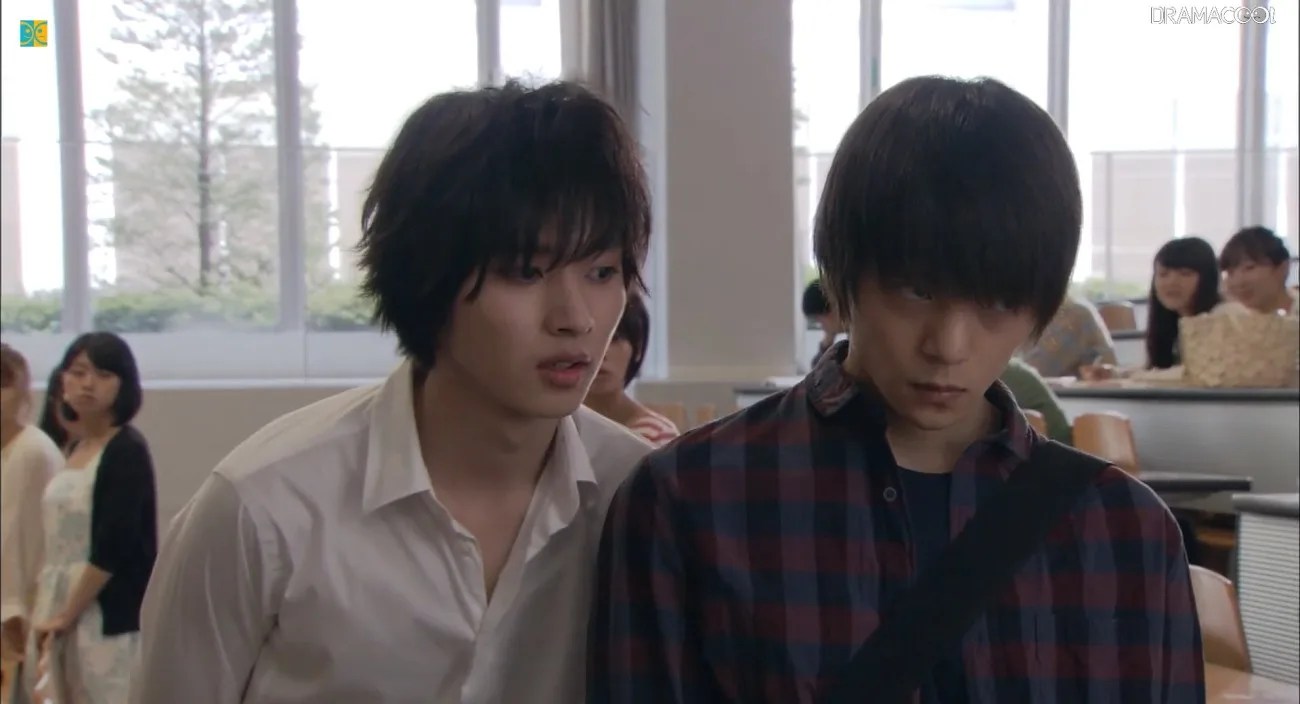
“What do you mean, Kevin? Death Note?” It’s true! Surpassing the anime that became a global phenomenon is an almost impossible task, but the 2015 dorama managed to do it. While the previous live-action films fell short, this 13-episode series managed to give a new shine to the plot.
The adaptation not only respected the original material but also brought important improvements. The visual of the characters was more faithful to the manga, such as Misa Amane’s hair. L’s participation was expanded, making the mental battle between him and Kira even more exciting. In addition, the soundtrack, performances, and small changes in the story elevated the dorama’s level.
If you are a fan of Death Note and haven’t watched it yet, I highly recommend it. L’s importance in solving the Kira case is one of the main reasons this adaptation stands out. The question remains: how would the anime be if it followed the dorama’s footsteps?
2. Nobunaga Concerto
This is another fascinating example of a dorama that surpassed its animated version. “Nobunaga Concerto” tells the story of a young man who travels back in time and ends up taking the place of the legendary Oda Nobunaga. While the 2011 anime faced criticism for excessive CGI and some character changes, the 2014 dorama brought a more emotional approach.
With 11 episodes and a film that complements the story, the dorama offers an engaging soundtrack and a more dramatic plot, with touches of romance. The actors’ performances brought the characters to life authentically, making the experience richer and more impactful. For those who enjoy stories that mix history and fiction, this adaptation is a sure choice.
3. Hana Yori Dango
When talking about doramas that surpassed their animated versions, it’s impossible not to mention Hana Yori Dango. Based on a successful manga, it already received an anime adaptation in 1996, but it was the dorama version that truly won the hearts of fans.
The story follows Makino Tsukushi, a girl from a humble background who studies at a school for the Japanese elite. There, she crosses paths with the F4, a group of four rich and influential boys. While the anime suffers from dated animation and some narrative limitations, the dorama stands out for its emotional intensity, chemistry between the actors, and unforgettable soundtrack.
Hana Yori Dango not only became a phenomenon in Japan but also generated adaptations in other countries, such as the Korean version Boys Over Flowers. For those who love stories of romance and overcoming challenges, this dorama is an indispensable classic.
4. GTO – Great Teacher Onizuka
The anime of 1 is one of the best comedies in the anime universe, telling the story of an ex-delinquent who becomes a teacher and helps his troubled students. However, its dorama adaptations brought a more serious and emotional perspective to the plot, highlighting human relationships and the challenges faced in the classroom.
The first dorama adaptation was released in 1998, with great success, followed by a new version in 2012. Both have their merits, but the 2012 version modernized the story and gained new fans. The choice depends on personal taste, but the emotional impact of the dorama is undeniable. Moreover, the more dramatic tone contrasts with the comedic focus of the anime, broadening the appeal of the work.
5. Rurouni Kenshin (Samurai X)
Although “1” is widely known for its excellent anime adaptation, the live-action adaptations – including doramas and films – managed to highlight elements that the anime did not explore deeply.
The realistic and perfectly choreographed action scenes, combined with an impressive fidelity to the manga, make the dorama and the live-action films unforgettable experiences. The performance of actor Takeru Satoh as Kenshin is widely acclaimed, bringing emotional depth to the character that is often lost in the anime.
Why Doramas Can Surpass Animes?
Although animes have their advantages, such as greater visual and narrative freedom, doramas manage to bring a more human connection to the stories. The performances, real settings, and soundtracks create a different atmosphere, allowing the audience to identify even more with the characters and their struggles.
Of course, Japanese performances can be a bit daunting for Westerners due to their stark difference from Western series, but today this stigma is diminishing, especially with the success of Korean Doramas on Streaming platforms.
These examples show that, when well adapted, doramas can not only do justice to the original material but also exceed expectations. And you, do you agree with this list? What other doramas do you think surpassed their animes?
The animes Yaoi, Shounen Ai and BL (Boys’ Love) have conquered a legion of fans around the world with their stories that go far beyond the romance between two boys. They explore themes such as coming of age, trauma, friendship, overcoming challenges, and, of course, love — whether it is sweet, intense, or troubled. If you are looking for titles to get emotional, fall in love, or binge-watch, you’ve come to the right place.
In this article, we gathered 50 of the best BL, Yaoi, and Shounen Ai animes ever released, mixing classics, fan favorites, and more recent works. The list is varied to please all tastes — from those who enjoy deep drama to those who prefer light comedies and “aegyo” moments that melt the heart.
And before anyone asks: yes, Yaoi has more explicit scenes, while Shounen Ai focuses on light and emotional romance. BL is an umbrella term, used both in Japan and internationally to describe any work centered on love between men.
What is the difference between yaoi, shounen ai, and BL?
Before we dive into the list, it’s worth understanding the differences between these genres — after all, they greatly influence the tone of the stories.
Yaoi: Focus on romantic and sexual relationships, usually with a heavier dramatic load and bolder scenes.
Shounen Ai: Softer relationships, without explicit sexual content, focused on emotional and affectionate development.
BL (Boys’ Love): Comprehensive term that includes both Yaoi and Shounen Ai, being more commonly used outside Japan.
The classification is sometimes fluid, and many titles transition between these categories.
In Japan, they usually use a single category for all animes, whether they have sexual relations or not. We will use the Western form, where shounen-ai is for light animes and yaoi is for heavy animes, with ecchi or even hentai.
Did you know that many women are passionate about this genre of animes? They are known as Fujoshi. Previously, we wrote an article explaining why women like Yaoi.
Crossdress Anime Characters
Perhaps you are looking for anime characters who dress as women; they are called Femboy or Trap. These young people who practice crossdress are not always homosexual.
How the Fujoshi React!
Boku no Pico – The Yaoi that everyone knows
This is that famous anime that friends recommend watching as a prank, but it actually became a huge success among animes of the yaoi, shounen ai, and BL genre. Remembering that this anime is indeed a Yaoi that fits into the Hentai genre.
Pico is an optimistic and extremely effeminate BOY who works at his grandfather’s café, Café Bebe, during the summer. Tamotsu is a white-collar worker looking for an escape from the routine and monotony of his daily life.
When they meet at the café, sparks of love and lust quickly bring the two together. Conventional notions of age, gender, and sexuality are broken as the pair seeks carnal gratification in each other’s company.
The Yaoi Anime Boku no Piko that catches everyone by surprise.
My opinion about Boku no Pico
To start off well, this anime, due to its plot, characters, and other things, became a joke for men, in a homophobic sense, and generated several bad taste jokes. But it also served to increase its fame, which for better or worse led a good number of people to watch and satisfy their curiosity; I confess I am one of those people.
Its opening, or opening in English, is widely used to “play” with people in the sense of making jokes. An extremely effeminate boy, working in a café that belongs to his grandfather. Just with this description, it is enough to realize that it wouldn’t be a normal and common anime.
And we have to focus on the “extremely effeminate” because this is not an exaggeration. Immoral? I don’t know if it goes that far, but it comes pretty close, that’s just my opinion. Well, there had to be a good reason for this anime to become a joke, in a genre that is full of things like this, just not as “blatantly” as this. My rating is 7!
Sekaiichi Hatsukoi – yaoi animes
Ritsu is a literary editor who wants to establish himself in the market without his father’s influence, and to achieve this, he is transferred to another publishing house. In this publishing house, he finds himself working as a rookie manga editor instead of an editor. There, Ritsu is introduced to the infamous editor-in-chief Masamune Takano, a persistent man who always seeks results.
The plot begins to unfold at this point, as Takano is actually Ritsu’s high school love. Now, with the two reunited after several years of separation, the restoration of their relationship is marked by Takano’s promise to make Ritsu say that he loves him again.
One of the classic yaoi animes Sekaiichi Hatsukoi
My opinion about Sekaiichi Hatsukoi
This yaoi anime also follows three other couples that are interlinked within the manga industry, with each one subject to the emergence of the first love. However, the focus is minimal. As you can see, this is mainly focused on the story that the first love is the best.
I agree, but there is also the story of summer romances that are fleeting, and especially teenage romances that often don’t work out and only leave us depressed and make us suffer when they end. I prefer a stronger and more lasting love that often requires maturity, but I liked this anime. It’s always good to see that not all loves are lost forever. My rating is 8!
Junjou romantica
Misaki Takahashi is a high school student preparing for university entrance exams. To reduce the stress of studying, he accepts help from his older brother’s best friend and famous author, Akihiko Usami. However, he discovers that Usami’s books are of a very vulgar genre, and that there may be something vulgar appearing within him as well.
In addition to this, the anime follows the story of two other couples loosely connected to the previous one. One of them is the very passionate but often complicated relationship between university professor Hiroki Kamijou and pediatrician Nowaki Kusama.
The third story shows how love can become obsessive when the wealthy eighteen-year-old Shinobu Takatsuki finally discovers something he cannot have so easily – the literature professor You Miyagi.
Junjou Romantica fits quite well among BL animes.
My opinion about Junjou Romantica
This is a feast for people who love love, love, and a little love for distraction. Yes, that thing that is so sweet it becomes sticky and hard to get rid of. All this in a good sense and without any bad intention behind the words.
There is an abundance of passion as these three couples try to achieve their goals in life while falling into temptation and anguish with their partners. Sharing experiences, feelings, sensations, and other things that make the plot hotter and more interesting.
Things like that and that are only not better because they are between men. Unfortunately, anime authors cannot or are afraid to create a story with protagonists of this type in genres like fantasy and drama. I can’t understand why this happens; there is no logic in them making such “cowardly” protagonists when they have a harem just for themselves. My rating for this yaoi anime is 8!
Koisuru boukun
Tetsuhiro Morinaga is in love with his senior Souichi Tatsumi. He even managed to confess his love. The problem is that Tatsumi is an aggressive, egocentric, and frank homophobe.
However, somehow Tetsuhiro managed to fall in love with Tatsumi, who is the kind of man who declares that all gay men should be swept off the face of the planet. But an unfortunate or fortunate accident with an aphrodisiac drug brings the two men physically together against Souichi’s will, and this experience has a transformative effect on both.
My opinion about Koisuru Boukun
With a synopsis like this, it’s hard to say that it doesn’t spark great curiosity to watch this anime. It doesn’t matter that it is a homosexual relationship; a plot like this will always arouse interest in people.
After all, it’s not every day that we see a yaoi anime where two characters with extremely different concepts are united by a work of fate. And to top it off, it’s not by the free will of both parties, as one of them wouldn’t accept this fact if they were fully conscious.
And it becomes even more interesting to think about what will happen after this incident, and I dare say that this is a case where palliative measures will not help; only extreme measures will resolve such an issue. My rating for this is 7!
Loveless – A shounen-ai with nekos
In this universe, people are born with cat ears and a tail, which disappear when they engage in sexual relations. For this reason, these additions are symbols of innocence and purity. Moreover, fights are conducted only in “fighting pairs” or couples. In these, one is known as the sacrifice and receives the damage, and the other is the fighter who, as the name suggests, is the one who attacks.
Ritsuka Aoyagi is a 12-year-old boy who, for some unknown reason, suffers from amnesia. His brother was recently killed, and as if his life wasn’t bad enough, on his first day at the new school, he meets a stranger named Agatsuma Soubi, who claims to have known his brother. Ritsuka thinks that Agatsuma and his brother were a fighting pair.
Together they try to find the truth behind his brother’s death and the organization known as “the seven moons,” which may be responsible for this. Meanwhile, it seems that these two are becoming closer than they should be.
Loveless a classic shounen ai with cat ears.
My opinion about Loveless
I don’t have much to comment on, since this resembles quite a bit with other genres that don’t necessarily have these homosexual relationships. Because it is a romance that has few peculiarities and has almost the same elements as an anime like taboo tattoo.
My rating for this yaoi anime is 7.
Gravitation – A yaoi about music
The protagonist, Shuichi, has always dreamed of following in the footsteps of his pop idol, Ryuichi Sakuma, and the band Nittle Grasper. Along with his best friend Hiro, Shuichi formed a band called Bad Luck and they managed to sign with a major record label.
Unfortunately, the studio deadlines are approaching, and Shuichi still hasn’t finished the lyrics to any of the songs. Stressed and uninspired, Hiro advises him to get a girlfriend.
Walking through the park late at night, Shuichi’s latest creations fly away and land at the feet of a stranger. Unfortunately, this mysterious stranger is the famous novelist Eiri Yuki, who completely crushes the young singer by saying he has “zero talent.” Shuichi becomes so upset that he manages to finish his song just to find and confront Yuki once again.
Gravitation is a classic yaoi music anime
My opinion about Gravitation
That typical anime where someone is humiliated by another person and decides to do everything to be recognized. I don’t see many animes with this issue, perhaps because it’s hard to work in a way that doesn’t make the plot boring and predictable. Because we already know that hating and loving are two sides of the same coin, and giving a shallow and superficial plot makes the anime tedious.
Yes, it’s a cliché, but this is not the kind of cliché that is malleable and looks good in any way. This is one of the animes that was recommended to me, but I haven’t heard any criticism about it, but I think I can’t generalize and make statements without watching.
Super Lovers
Upon hearing the news that his mother was on the brink of death, Haru Kaidou, the eldest son of the family, flies to Canada. The moment he arrives, he discovers that not only did his mother deceive him, but he must also take care of his adopted brother, Ren Kaidou, an antisocial boy who feels more comfortable with dogs than with people.
Haru initially struggles to reach Ren, but their relationship eventually develops. He makes a promise to Ren: they will live together in Japan after Haru graduates from high school.
However, due to an unfortunate accident, Haru loses all memories of the summer they spent together, including the promise he made. Five years later, hoping that Haru will fulfill his promise, Ren arrives in Tokyo; but for Haru, Ren is just a random boy claiming to be his brother.
My opinion about Super Lovers
I found this interesting because it is a typical cliché of animes, and here it was applied equally even though both are men. The parental relationship cliché is global and does not choose genders; that’s what I ended up discovering.
I have to admit that I will never see this cliché the same way again. I used to think that only heterosexual relationships would happen, but after this anime and the anime citrus, I became much more open to new experiences. It’s almost funny, but as the saying goes, man does not live by bread alone. Here’s a reference for the clever ones out there. My rating is 7!
Uragiri wa boku no namae wo shitteiru
Growing up as an orphan, Yuki Sakurai questions his reason for living and his ability to see the painful memory of a person simply by touching them. After receiving anonymous notes telling him to die, Yuki is unable to shake off the uncomfortable feeling that forms within him. Unbeknownst to him, he is being watched, both by people who want to harm him and by those who want to protect him.
On a foggy night, Yuki’s life is saved by a man with silver eyes and black hair — a man he has never met before but seems familiar to him. With the arrival of this mysterious stranger, Yuki’s forgotten past is awakened, and the purpose of his existence appears before him.
My opinion about Uragiri wa boku
This is another one that I don’t have much to comment on, both because I haven’t watched it and because it is a very widespread cliché that rarely brings us any surprises. But it might be interesting; we will only know by watching, and that’s why I’m recommending it.
And I am also recommending it because it is quite popular and has great ratings from people about it. Who knows if it’s not as good as Angel Beats (which I think is unlikely, given that Angel Beats is the number 1 anime in my opinion).
Hitorijime my hero
Masahiro Setagawa is a hopeless teenager who is often used by the neighborhood bullies as a messenger boy. However, his life changes drastically when he meets Kousuke Ooshiba, a man known as the “Bear Killer,” who takes down neighborhood gangs.
A year later, Masahiro and his former friend, Kensuke Ooshiba, attend high school, only to discover that Kousuke is their math teacher. As the three grow closer, Masahiro begins to see Kousuke as his “hero,” and Kousuke develops an urgent desire to protect Masahiro.
However, their normal lives change when Kensuke’s childhood friend, Asaya Hasekura, returns, seeing Kensuke as more than just a friend, to his surprise.
A Yaoi Comedy Anime?
My opinion about Hitorijime my hero
Just from the synopsis, it’s clear that there will be a very troubled love triangle. Jealousy, intrigue, occasional fights — all of this always happens when you have this type of relationship. I can say that it’s not the kind of cliché that brings the most popularity to a work, but it’s certainly always interesting to see how the characters develop the relationship while trying to outdo the other competing parties.
I haven’t watched this anime yet, but I don’t think I will take long to do so. However, until then, I can’t evaluate it better than I have now. And like the previous ones, this one has great reviews and has a good plot and a great studio.
Ling QI – A Chinese BL yaoi
Yang Jinghua, one of the protagonists, suffered an accident and the moment he woke up, he seemed 10 years younger. Yang Jinghua thought he had been reborn, and when he was about to embark on a path for a new beginning, a rich and handsome white-haired guy named Duanmu Xi appeared right in front of him.
He not only told Yang Jinghua that Yang Jinghua was already dead, but he even asked for an invitation: “Young man, do you want to sign a contract with me and stay with me for the rest of your life?”
My opinion about Ling Qi
This question was quite contradictory; after all, he was already dead, and dead means no more life. But to avoid being the contrarian who is always finding faults in things, I will overlook it and imagine that this “life” is the afterlife. I advise you to do the same. And yes, this is another one I haven’t watched yet.
As can be seen from the character names, this is a Chinese anime, but that doesn’t mean that the animation or the plot is bad. I mean, I can’t assert anything, but I won’t make the mistake of judging a book by its cover as I did with the grand anime King’s Avatar. What I can say for sure is that the dubbing will bother those who are not used to it, at least at first. And this one will also remain without a rating for now.
Umibe no Étranger
Shun Hashimoto is a young gay writer living on a small island, where he meets Mio Chibana, a high school student who has just lost his parents. The two begin to develop a friendship and eventually deeper feelings.
However, Mio suddenly leaves the island, leaving Shun behind with a broken heart. Three years later, Mio returns, determined to confront his feelings for Shun and discover if they have a future together.
My opinion about Umibe no Étranger
This anime captures the nuances of a developing romance sublimely, with a sensitive narrative and deep characters. The setting on a small island gives a unique touch to the story, making it even more engaging.
The contrast between the pain of loss and the hope for a new beginning is explored in a touching way. It is a work that is certainly worth watching, not only for its LGBTQ+ representation but for the beautiful love story that transcends barriers.
Given
Ritsu Onodera is a literature editor who decides to change jobs due to a misunderstanding at his previous workplace. He ends up working at Marukawa Shoten, in the shoujo manga division.
There, he meets his new boss, Masamune Takano, who is actually his first love from high school. While Ritsu tries to move on and forget the past, Takano is determined to win him back, reigniting feelings Ritsu thought were buried.
My opinion about Given
Given is an anime that not only addresses romance between men but also explores the passion for music. The connection between the main characters is intensified by their musical performances, creating exciting and memorable moments.
The way the anime deals with the pain of loss and the discovery of love is moving. It is a story that goes beyond romance, showing how music can be a means of healing and connection.
No. 6
No. 6 takes place in a utopian city where everything seems perfect. Shion is a privileged boy who meets Nezumi, a fugitive from the poorer areas of the city. By helping Nezumi, Shion ends up being banished from his privileged life and begins to uncover the dark truth behind the utopia.
Together, they face dangers and challenges, developing a deep friendship and a bond that defies all societal expectations.
My opinion about No. 6
No. 6 combines elements of science fiction with an exciting plot and captivating characters. The relationship between Shion and Nezumi is complex and full of nuances, evolving from a simple friendship to something deeper.
The contrast between Shion’s privileged life and the harsh reality faced by Nezumi adds an extra layer of tension and intrigue to the story. This anime is a perfect blend of action, mystery, and romance, making it an unforgettable experience for viewers.
Doukyuusei – The beginning of an unexpected love
Doukyuusei follows the life of Rihito Sajou and Hikaru Kusakabe, two schoolmates with completely different personalities. Rihito is an exemplary student, shy and reserved. Hikaru, on the other hand, is outgoing, a musician, and full of energy. Destiny crosses the paths of the two when Hikaru offers help to Sajou to prepare for a recital.
What starts as a simple relationship between classmates transforms into a friendship that soon takes on more intimate tones. The anime delicately portrays the fears and doubts of first love, as well as the challenges of youth, such as insecurity, acceptance, and the pressure of the future.
With smooth and artistic animation, the anime stands out for its poetic aesthetics and introspective atmosphere. It is a simple story, but one that deeply touches anyone who has experienced the intensity of adolescent feelings.
My opinion about Doukyuusei
Doukyuusei is like a visual love letter: there is no rush, nor exaggeration. The relationship between Sajou and Hikaru is built with such sincerity that it is impossible not to connect. Every gesture, every exchange of glances carries meaning.
The anime has a calm, almost meditative pace, and this may not please those who expect big twists. But for those seeking true emotion, it is a sensitive and memorable experience. The discreet soundtrack and the watercolored style complete the intimate atmosphere. A true gift for those who love stories of discovery and affection.
Ai no Kusabi – A forbidden love in dystopia
Ai no Kusabi takes place in a futuristic society divided by castes, where the elite dominates everything and the poorest have no rights. In this cruel world, Riki is a young man from the lower class who, after being captured, is delivered as a companion to Iason Mink, a cold and powerful elite member.
The relationship between the two begins marked by inequality, with Riki fighting against Iason’s domination. Over time, however, complex feelings arise between them. Love, desire, hatred, and submission intertwine in a narrative filled with emotional tension and social critique.
Despite being short, the anime is impactful and intense. Its bold approach, full of symbolism and critiques of the system, has made it one of the most cult titles in the Yaoi genre.
My opinion about Ai no Kusabi
Ai no Kusabi is not an easy anime. It requires attention, maturity, and an open mind to reflect on power relations, control, and freedom. The cyberpunk aesthetic gives it a unique charm, and the dialogues are loaded with subtext.
The relationship between Riki and Iason is anything but conventional. But it is precisely this complexity that captivates. The ending is tragic, like many striking stories, and leaves that bittersweet feeling that lingers for days. It is a work that divides opinions but is unlikely to be forgotten.
Complete List of Yaoi Animes
In the West, the term Shounen-ai categorizes stories that focus on the emotional aspects of relationships, while Yaoi categorizes more sexual aspects, with or without explicit content. The list of Yaoi animes below fits into the ecchi genre.
Below we will share Yaoi that are considered Hentai and focus on sexual relations:
Boku no Pico
Boku no Sexual Harassment
Enzai
Ginga Teikoku no Metsubou Gaiden: Aoki Ookami-tachi no Densetsu
Keiraku no Houteishiki Level-C
Natsuyasumi;
Otokonoko ♂ Delivery
Pico to Chico
Pico x CoCo x Chico
Sensitive Pornograph
Shounen Maid Kuuro-kun: Tenshi no Uta
Complete list of BL Shounen-Ai animes
Below we have a list of Yaoi animes that are not explicit or do not fit into the Hentai genre:
Given
2019
Doukyuusei
2016
Sekai-ichi Hatsukoi (series)
2014
Junjou Romantica 1,2,3
2008
Hybrid Child
2014
Hitorijime My Hero
2017
Hyperventilation
2017
Super Lovers 2
2017
Love Stage!!
2014
Super Lovers OVA
2017
Spiritpact: Bond of The Underworld
2018
Sekai-ichi Hatsukoi: World’s Greatest First Love – Proposal-hen
Japanese bathrooms, in addition to their advanced technology, are also known as a stage for scary urban legends. Ghostly figures inhabit these spaces and are part of Japan’s rich folklore. From goblins that clean dirt to vengeful spirits, these stories are passed down from generation to generation, perpetuating fear and curiosity. Let’s explore some of the most famous ghost legends of bathrooms in Japan.
Aka-name: The Licking Goblin
The Aka-name, which can be translated as “Dirt Licker,” is a peculiar creature from Japanese folklore. It is described as having a humanoid body, a grotesque face resembling that of a goblin, slimy hair, and a long, poisonous tongue. Its purpose? To feed on the dirt accumulated in dirty bathrooms.
Although the idea of a “supernatural cleaner” may seem convenient, the Aka-name is not entirely harmless. If someone is licked by its poisonous tongue, the result can be fatal. The legend serves as a chilling (and somewhat comical) reminder of the importance of keeping the bathroom clean.
Hanako: The Japanese “Bathroom Blonde”
The legend of Hanako is one of the most well-known in Japan, especially among students. It is said that the spirit of a girl from the time of the Second World War haunts the third stall of the bathroom on the third floor of schools. To summon her, simply knock three times on the door and ask, “Hanako, are you there?”. If she answers or appears, prepare for a supernatural encounter.
Although she is considered harmless in most stories, some darker versions claim that Hanako can pull her victim into the toilet, drowning them. This legend has similarities to the Brazilian “Bathroom Blonde,” showing how myths from different cultures can have intriguing parallels.
Although Hanako-san is the most famous, some versions of the legend state that if you mock her or show disrespect, she may summon a more dangerous spirit. This spirit, often described as male and aggressive, attacks those who provoke Hanako or try to confront her.
Aka Manto: The Red Cape
Among the bathroom ghosts, Aka Manto is one of the most terrifying. He appears wearing a red cape and a white mask, approaching his victims with a fatal question: “Would you like a red cape?” Answering “yes” means having your skin torn off and turned into a bloody cape. Meanwhile, the “no” can lead to other deadly consequences, depending on the version of the story.
The only safe way to escape Aka Manto is by politely refusing: “No, thank you.” This legend reflects the Japanese obsession with choices and consequences, turning something as simple as answering a question into a deadly dilemma.
Reiko Kashima: The Incomplete Spirit
Reiko Kashima is a tragic and vengeful figure. After being brutally attacked and left to die, she was run over by a train, resulting in the loss of her legs. Now, she haunts bathrooms, asking: “Where are my legs?”. Answering correctly — “At Meishin Express Village” — is essential to avoid a terrible fate.
This legend also has connections to Teke-Teke, another mutilated spirit, but one that is not limited to bathrooms. Reiko Kashima, however, represents human fragility in the face of violence, turning her story into a chilling warning about indifference and neglect.
This terrifying legend involves a seemingly harmless choice: red or blue? After realizing that they are out of toilet paper, a supernatural voice offers these options.
Choose red: You will have your throat cut or your skin torn off.
Choose blue: You will be strangled to death, turning your face blue-purple.
It is said that choosing any other color can imprison the spirit or even lead the victim to the underworld. To escape unscathed, some versions suggest responding “yellow,” which means a bath of urine, but guarantees survival.
Shiro-uneri: The Cleaning Rag Ghost
The Shiro-uneri is a minor spirit that inhabits dirty bathrooms. It is described as an old and filthy cleaning cloth that came to life after years of neglect. It is said to appear to torment those who leave the bathroom in poor condition, grotesquely rubbing against them. The story serves as a lesson to keep bathrooms clean.
Kanashibari no Toire: The Paralysis in the Bathroom
Some believe that certain bathrooms are cursed with the phenomenon of Kanashibari – sleep paralysis, but while the person is awake and vulnerable. Those who enter a cursed bathroom may feel stuck on the toilet, unable to move, while a malevolent presence whispers or appears in the mirror. This legend is often associated with ancient or abandoned places.
Other Minor Legends
Kurokami no Onna: The Woman with Black Hair
This legend tells of a woman with long black hair who appears in the mirrors of public bathrooms, especially in train stations. If you look directly at her, she may whisper disturbing secrets or ask for help to “find her child.” Ignoring the request or trying to leave without responding can result in curses or fatal accidents.
Hidaruma: The Fire Spirit
It is said that in some old bathrooms, especially in schools or temples, the Hidaruma, a fire spirit, can appear when candles are lit in the bathroom. He appears as a figure engulfed in flames and forces his victim to perform dangerous challenges. If they fail, he consumes their soul.
Zōri-baki no Rei: The Ghost of the Slippers
In traditional Japanese bathrooms, it is common to leave shoes outside and use specific slippers for the place. There is a legend that says if the slippers are placed haphazardly, a spirit known as Zōri-baki no Rei will appear to haunt the user. He is described as a hunched old man, with bright eyes and a sinister laugh, causing the person to lose their balance while walking or slip dangerously.
Benjo-gami: The Bathroom God
Although not exactly scary, some legends speak of a protective spirit called Benjo-gami. He is a supernatural figure associated with prosperity and health but can become vengeful if the bathroom is mistreated or neglected. The legend suggests that keeping the bathroom clean and honoring Benjo-gami brings good luck.
The Infinite Toilet Paper Trap
In some old schools or buildings, there is a legend that when trying to get toilet paper in a haunted bathroom, it never ends, rolling infinitely while a distant laugh echoes throughout the place. It is said that the only way to escape is to ignore the paper and leave without cleaning your hands or face.
These legends demonstrate how the Japanese manage to turn even the most common environments into sources of psychological terror. Bathrooms, with their privacy and vulnerability, become ideal settings for chilling folklore.
Train Melodies are small melodies that are played when a train is arriving or departing from a station. In Japan, there are various melodies played at each station; they serve to alert and wake the sleepy, as well as to bring a sense of relief from the departure and arrival of the train.
The melodies of train stations in Japan, known as “hassha merodii” (発車メロディー), play a significant role in the passenger experience, signaling departures and arrivals in a harmonious manner. These compositions not only assist in organizing the platforms but also reflect the local culture and history.
The Origin of Train Melodies
The first train melody was introduced in 1971 by the Keihan Electric Railway. Before that, stations used bells or simple jingles to alert passengers about the approaching trains. With the advancement of technology, especially in the 1980s, the melodies evolved into more elaborate compositions, including pieces of classical music and original themes.
The main objective of these melodies is twofold: to alert passengers without causing anxiety and to create a unique sound identity for each station. Instead of a shrill sound that rushes people, as occurs in many places around the world, Japan adopted a system that makes everyday life more pleasant.
Famous Station Melodies and Their Composers
Each station has its own melody or theme, often inspired by cultural or historical elements of the region. Here are some of the most iconic:
1. “Seseragi” – Yamanote Line
Composed by Minoru Mukaiya, one of the leading composers of train melodies, “Seseragi” is a classic that plays at several stations on the Yamanote Line. Mukaiya, who is also the keyboardist for the jazz band Casiopea, is known for his captivating compositions that evoke tranquility.
2. “It’s a Small World” – Maihama Station
Maihama Station, near the Tokyo Disneyland theme park, plays the famous Disney song, “It’s a Small World.” The choice creates a magical atmosphere for visitors, connecting the train experience to the magic of Disney.
3. Astro Boy Theme – Takadanobaba Station
At Takadanobaba Station, passengers are greeted with the opening theme of the classic anime 1, created by Osamu Tezuka. This choice is a tribute to the area’s historical connection with otaku culture.
3. “Kōjō no Tsuki” (The Moon over the Ruined Castle) – Bungotaketa Station
Composed in 1901 by Rentarō Taki, “Kōjō no Tsuki” is a classic Japanese piece played at Bungotaketa Station, in Ōita Prefecture. Taki spent part of his youth in the city of Taketa and wrote the piece inspired by the ruins of Oka Castle. The melody was adopted by the station in 1951, becoming one of the first to use music to signal departures.
5. Compositions by Minoru Mukaiya
Minoru Mukaiya, former keyboardist of the jazz fusion band Casiopea, is responsible for over 200 melodies in more than 110 stations in Japan. His passion for trains and music led to the creation of unique jingles that reflect the atmosphere of each station. For example, the melody of Ebisu Station is inspired by Yebisu beer commercials, connecting the music to the local history.
Do You Feel Nostalgia?
There are so many melodies that I get lost and don’t know which ones to mention. Some are classical music, but most are played in MIDI composed with 8-bit sounds. Reminiscent of the sounds of the Nintendo or even simpler. Some stations like Shin-Okubo and Ueno play a simple telephone sound. Watch the video below and follow all the melodies of the Yamanote line.
Have you ever wondered why Japanese women’s hair is straight and thick?
The texture and thickness of hair vary around the world, and these differences are not merely aesthetic: they have an evolutionary and scientific basis that reveals how our ancestors adapted to the environment. In the case of Japanese hair, its striking characteristic of being straight and thick is deeply related to biology and climate.
In this article, we will explore the reasons behind these particularities, analyzing historical, evolutionary, and scientific factors that explain why this characteristic is so common among Japanese and other Asian peoples.
The Influence of Climate on Hair Evolution
Humans evolved in different parts of the world, facing varied climates that shaped their physical characteristics over thousands of years. Hair, like skin, plays a fundamental role in regulating body temperature.
Cold regions and straight hair: In cold climate areas, such as much of Asia, populations needed to retain body heat. Straight and thick hair proved ideal for creating an efficient insulating layer. These strands cover the scalp uniformly, reducing heat loss.
Warm regions and curly hair: In warm climate areas, such as Africa, curly and wavy hair is more effective at dissipating heat. This structure allows for better ventilation of the scalp, helping to keep the body cool.
Darwin’s Theory of Evolution reminds us that characteristics that aid in survival tend to be passed on to future generations. Thus, the straight and thick hair of the Japanese is a clear example of evolutionary adaptation.
Structure and Composition of Japanese Hair
Asian hair, including Japanese hair, is notably different from other types of hair in its biological composition and physical structure:
Thickness: Asian hair strands are thicker due to a higher density of cells in the hair fiber. This density increases the strand’s resistance and contributes to its thermal insulation capability.
Keratin distribution: In Asian hair, keratin is evenly distributed, making the strands straighter and firmer. This also gives the hair its shiny and healthy appearance.
Uniform coverage of the scalp: Straight hair tends to cover the scalp more completely, minimizing direct exposure to cold. In comparison, curly hair allows for greater ventilation, being more suitable for warm climates.
These characteristics give Japanese hair its uniqueness, in addition to being an evolutionary mark of adaptation to the cold environment.
The Challenge of Baldness
Although Japanese hair is robust by nature, issues like baldness affect populations of all ethnicities. Hair loss is associated with genetic, hormonal, and environmental factors. Even with scientific advances, baldness remains a challenge for many people, both men and women.
Genetic factors: Genetic predisposition plays a central role in baldness. Studies indicate that genes related to hormonal sensitivity are the main culprits.
Emotional and cultural impacts: In some cultures, hair is seen as a symbol of youth and vitality, making baldness a significant issue for many people.
Future hopes: Science is continuously advancing in search of solutions for hair problems, including more effective and accessible treatments for baldness.
While evolution shapes us to adapt to the environment, issues like baldness remind us that not all human characteristics have simple answers.
Conclusion
Japanese hair, with its straight texture and unique thickness, is a fascinating testament to the evolutionary process. It reveals how populations adapted to cold climates, developing characteristics that aided in survival. At the same time, modern challenges, such as baldness, show that evolution is an ongoing process.
Understanding these particularities is not just a lesson in biology but also a way to appreciate the diversity that makes humanity so rich. If you enjoyed this article, share it with friends and explore more curiosities about the world on our page!
Tobita Shinchi, in Osaka, is considered the last great red-light district in Japan. But why “last”? Although there are other areas of adult entertainment in the country, such as Kabukicho (Tokyo) and Susukino (Sapporo), Tobita Shinchi maintains the classic structure of the old prostitution neighborhoods, with its narrow streets and open-front houses, where the workers are exposed at the entrance. This model, popular until the 1950s, has disappeared in almost all Japanese cities, making Tobita Shinchi a true historical remnant.
If you want to better understand how this district works, what the unwritten rules are, and how to navigate it without problems, this detailed guide brings everything you need to know.
History and Operation of Tobita Shinchi
Tobita Shinchi emerged in the early 20th century, replacing an old red-light district closed by the government. During the Taisho era (1912–1926), Japan began to relocate and regulate these areas, and Tobita became one of the main centers of this type of service in Osaka.
With the Prostitution Prohibition Law of 1958, the sale of sex became illegal. However, Tobita Shinchi found a loophole in the legislation: the establishments registered as “restaurants,” and, theoretically, customers pay only for private companionship, not for the sexual act itself. This legal model, known as “Fūzoku” (風俗, adult entertainment), is the same used by Soaplands and other types of houses of the genre in Japan.
Currently, Tobita Shinchi operates practically the same way it did 100 years ago, maintaining its traditional aesthetic and unique organizational structure.
How Does Tobita Shinchi Work?
Tobita Shinchi is not like the modern adult entertainment districts in Japan. Instead of discreet clubs and bars, it operates with small houses lined up on the streets, where the workers sit on display at the entrance. This style resembles the old Yūkaku (遊郭, pleasure districts) of the Edo period.
Here is a step-by-step guide on how the process works:
Payment is made before entry, and the houses operate with strict rules to maintain discretion.
Arrival at the District:
Upon entering the streets of Tobita Shinchi, you will see several houses with open fronts.
The women sit at the entrance, elegantly dressed, usually accompanied by an Okami (おかみ, older manager).
Selection and Negotiation:
You do not speak directly to the woman; the Okami handles all the negotiations.
The customer chooses the girl, and the manager informs the price and duration of the service.
Prices vary, but generally start around 10,000 to 30,000 yen for about 15 to 20 minutes.
Entry and Service:
If you accept the price, the customer is taken inside the house, where the service occurs.
Important Tips for Visitors
Although it is a relatively safe and organized place, Tobita Shinchi has specific rules and norms that must be followed. Here are some essential tips to avoid problems:
Photography is Prohibited
Taking photos in the district is strictly prohibited. There are reports of security confiscating phones from tourists trying to film or photograph.
Not All Customers Are Welcome
Many establishments refuse foreigners who do not speak fluent Japanese.
Some places also reject tourists to avoid problems with the police.
There are signs saying “日本人専用” (“Only for Japanese”), especially during peak hours.
Bring Cash
Most establishments only accept cash payment (yen).
Credit cards are not accepted.
Avoid Walking in Groups
It is best to walk alone or in small groups, as large groups attract attention and may be looked down upon.
Operating Hours
Tobita Shinchi mainly operates at night, but some houses open in the afternoon.
The busiest time is between 6 PM and 1 AM.
Useful Vocabulary in Tobita Shinchi
If you are visiting the district, it may be helpful to know some words and expressions used in the area:
Okami (おかみ) – The manager of the house, usually an older woman.
Fūzoku (風俗) – Generic term for the adult entertainment industry.
Yūkaku (遊郭) – Old pleasure districts from the Edo period.
Okyaku-san (お客さん) – Customer.
Osusume (おすすめ) – Recommendation (used when the Okami suggests a girl).
O-aisatsu (お挨拶) – Polite greeting upon entering an establishment.
The Future of Tobita Shinchi
Despite its resistance to time, Tobita Shinchi faces modern challenges. Increasing police scrutiny and changing habits of the Japanese are reducing the number of customers. Additionally, the aging population means fewer people are entering the industry, making the future of the district uncertain.
However, as long as it is in operation, Tobita Shinchi remains one of the last windows to a Japan that no longer exists elsewhere. Its nostalgic charm and traditional model make it a unique place for those who wish to experience a part of the living history of the country.
Soaplands are a type of establishment in Japan that offers bathing and massage services in a private environment, where an attendant assists the client in a personalized manner. Within this universe, the term GFE (Girlfriend Experience) refers to a differentiated approach, where the attendant seeks to provide an experience similar to that of a romantic date, with special attention to emotional involvement and an intimate atmosphere.
Although Soaplands are popular among Japanese people, they can be a bit difficult to access for foreigners, due to language barriers and certain restrictive policies of some establishments. However, for those interested in this type of experience, there are ways to find places that accept tourists and offer high-quality services.
What is a Soapland?
Soaplands emerged in Japan as a legal alternative to prostitution, which was officially banned in the country in 1958. To circumvent this restriction, these establishments were registered as “assisted bathing” locations, where the attendant helps the client wash and offers relaxing massages.
Over time, Soaplands have become one of the most sophisticated adult entertainment services in Japan, providing personalized experiences and differentiated services. Currently, these establishments are part of specific areas in Japanese cities, often hidden in discreet districts regulated by the local government.
What is GFE in a Soapland?
The acronym GFE stands for “Girlfriend Experience,” meaning an experience that simulates a romantic relationship. In the context of Soaplands, this goes beyond the simple bathing and massage service, bringing more engaging interactions, such as:
Affectionate and attentive conversations;
A climate of closeness and complicity;
Personalized treatment, as if the client were the attendant’s boyfriend.
Unlike more direct services, GFE in a Soapland aims to create a comfortable and immersive environment, where the client feels truly desired and cared for. This approach makes many people seek this type of experience, as it provides something more human and engaging than a simple professional service.
Types of Soapland in Japan
Although the general concept of Soaplands is the same, the services and experiences vary greatly among establishments. Below are the main categories of Soaplands in Japan:
1. Standard Soapland
This is the most common type of Soapland, where the client is welcomed by an attendant who assists them in bathing and provides body massages. Depending on the establishment, there may be a more personalized experience or a more objective service.
2. High-Class Soapland (Luxury Soapland)
Luxury Soaplands are known for offering premium service and sophisticated facilities. Establishments in this category often have an exquisite environment, with luxurious private suites, and the attendants are rigorously selected. Prices in these places tend to be higher due to the exclusivity of the services.
3. Gyaru Soapland
Gyaru Soaplands specialize in attendants who follow the “gyaru” style, characterized by tanned skin, bleached hair, and flashy makeup. This type of Soapland attracts clients looking for a bolder look and service with vibrant energy.
4. Mature Soapland
While most Soaplands focus on young attendants, Mature Soaplands specialize in older and more experienced women. This type of establishment attracts an audience that prefers a more mature and sophisticated service.
5. Idol Soapland
Inspired by Japanese pop culture, Idol Soaplands feature attendants who dress and act like Japanese idols, providing a service full of sweetness, admiration, and charisma. Some of these places offer schoolgirl outfits, cosplay, and even musical performances to entertain clients.
6. Foreign Soapland
Although many Soaplands are exclusive to Japanese clients, some specialize in serving foreigners. In these places, there are attendants who speak English or other languages, facilitating the experience for tourists.
7. Fetish Soapland
For those seeking something more specific, Fetish Soaplands offer experiences focused on fetishes and particular preferences. Depending on the location, the client can choose services with themed outfits, customized scenarios, or attendants with specific characteristics.
How to find a Soapland in Japan
Finding a Soapland in Japan can be a challenge, especially for foreigners. This is because many establishments have restrictive rules regarding the entry of tourists and require clients to speak Japanese. However, there are ways to find a place that accepts foreigners and offers good service:
To find a Soapland in Japan, a good strategy is to research in specialized forums, such as the International Sex Guide and the Tokyo Adult Guide, where visitors share recommendations and detailed experiences about different establishments.
Look for adult entertainment districts, you can also use the Japanese terms from this article on Google Maps. Many adult entertainment establishments are interconnected and can also point to Soaplands that accept foreigners.
Recommendations for Establishments
Although the experience varies depending on the location and the attendant, here are some recognized Soaplands in Japan:
Yoshiwara (Tokyo): Known for its long history, Yoshiwara is home to several renowned Soaplands. Establishments like “Club Atlantis” are popular among visitors.
Kawasaki (Kanagawa): Close to Tokyo, Kawasaki has an area dedicated to Soaplands, with options like “Paradise” and “Dream Stage.”
Susukino (Sapporo): This region is famous for its vibrant nightlife and offers various Soaplands, such as “Angelique” and “Club Royal.”
Prices and service time
Prices in a Soapland vary according to the type of establishment and the service time. In general, the average values are:
Standard Soaplands: ¥20,000 to ¥40,000 for 60 minutes
Luxury Soaplands: ¥50,000 to ¥100,000 for 60 minutes
High-Class Soaplands: ¥100,000 or more for 60 minutes
The service time can also be personalized, with options of 60, 90, 120 minutes or more, depending on the client’s budget.
Japanese Terms about Soaplands
ソープランド (Sōpurando) – “Soapland,” the official name of this type of establishment in Japan.
泡姫 (Awa-hime) – Literally “foam princess,” a term used to refer to the attendants of Soaplands.
吉原 (Yoshiwara) – The most famous district of Soaplands in Tokyo, with a long history linked to the culture of adult entertainment.
無料案内所 (Muryō Annai-sho) – “Free information center,” small shops scattered in entertainment districts where one can find information about different establishments, including Soaplands.
入会金 (Nyūkai-kin) – “Membership fee,” some Soaplands charge this additional fee for new clients.
本番 (Honban) – A delicate term related to the complete experience within Soaplands. Although prostitution is illegal in Japan, the way services are offered circumvents this restriction.
熟女ソープ (Jukujo Sōpu) – “Mature Soapland,” specializing in older and more experienced attendants.
ギャルソープ (Gyaru Sōpu) – “Gyaru Soapland,” focused on attendants who follow the gyaru style.
Final considerations
Soaplands are part of Japan’s adult entertainment culture, offering varied experiences for different audiences. If you wish to visit one of these establishments, it is important to be aware of the rules, research beforehand, and choose a place suitable to your preferences.
Although some places are restrictive to foreigners, there are options that accept tourists and provide more accessible service. For those seeking a unique experience in Japan, visiting a Soapland can be an interesting way to explore a less-explored side of local culture.
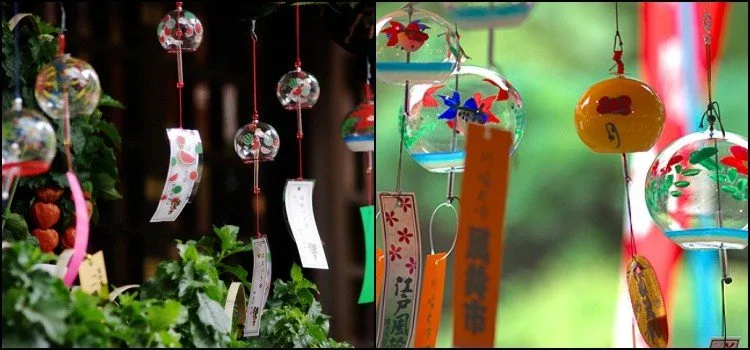
The Fūrin (風鈴), the charming Japanese wind chime, is an iconic symbol of summer in Japan. In addition to its aesthetic beauty, it carries deep cultural and spiritual meanings. Traditionally made of glass and iron, with a small piece of paper hanging inside, the Fūrin produces a soft sound when swayed by the wind, creating an atmosphere of tranquility and well-being. But, beyond the pleasant sound, it is also seen as a protective talisman, warding off evil spirits and negative energies.
Origin and Evolution of Fūrins
The origin of the Fūrin dates back to China, where similar bells were used to predict the weather based on the direction and intensity of the wind. These objects arrived in Japan through Buddhist monks, who used them in temples to ward off evil spirits. The belief that the sound of the bell could prevent bad events soon spread through Japanese communities.
In the 12th to 17th centuries, during periods of epidemics such as the plague, Fūrins gained even more importance. The Japanese believed that strong winds could spread diseases, and the bells were used as protection against these threats. However, at that time, only wealthy families, such as samurai and nobles, could acquire them, as they were made of bronze, an expensive material.
The popularization of the Fūrin occurred between the 18th and 19th centuries, when the glass manufacturing technique was introduced to Japan by the Dutch. Glass allowed for larger-scale production, making these bells accessible to a wider audience. Since then, they have been used not only as protection but also as a decorative item.
Tradition and Handcrafted Production
One of the most striking features of Fūrins is the internal painting, which enhances the durability of the colors and gives a unique touch to each piece. Even with modernization, many bells are still made handcrafted, keeping regional traditions alive.
Each area of Japan has its own styles and materials. Some regions use recycled glass, while others employ specific techniques to shape iron or other metals. This artisanal care reflects the Japanese respect for their traditions and aesthetics.
Today, Fūrins can be found in convenience stores and markets, with various models ranging from classic to contemporary. They continue to be a symbol of protection and also a charming reminder of Japan, appreciated by people all over the world.
Curiosities about Fūrins
Internal painting: The technique of painting inside protects the colors from wear caused by time and weather.
Symbol of protection: Even with the advancement of science, many still believe in the power of Fūrins to ward off negative energies.
Global popularity: Besides Japan, the bells have gained space as decoration in other countries, symbolizing peace and harmony.
Fūrins remain a link between the past and the present, a reminder of the value of traditions and the connection with nature. Whether to hear the soft sound that brings calm or to appreciate their artisanal beauty, these bells continue to enchant generations.
Bringing money to Japan or any other country can seem like a challenge for those preparing to travel. After all, there are various ways to transport funds, and each has its advantages and disadvantages. In this article, we will explore the available options to ensure you have money on hand during your stay abroad in a safe and economical way.
The choice of the right method will depend on factors such as fees, transaction limits, and convenience. We will discuss options such as currency exchange offices, debit cards, credit cards, and international transfer services, with practical tips based on real experiences.
Understanding the options for bringing money
Currency exchange offices: convenience or loss?
Exchanging money at currency exchange offices is one of the most traditional options, but it is not always the most advantageous. The fees applied often include high margins over the market value of the currency. Additionally, the availability of yen (or other foreign currencies) may be limited, especially in smaller cities.
When to use: If you want to bring an initial amount in cash for emergencies.
Be careful: Avoid exchanging money at the airport, where the fees are usually even higher.
An interesting alternative is to perform the conversion on online platforms that allow you to lock in more competitive rates. This way, you can withdraw the money at predetermined locations before your trip.
International debit cards: convenience at ATMs
International debit cards are an excellent alternative to avoid carrying large amounts of cash. In Japan, it is common to find ATMs in convenience stores, such as 7-Eleven, that allow direct withdrawals from your Brazilian bank account.
Advantages:
Lower fees (IOF and fixed withdrawal fee).
More flexible limits compared to prepaid cards.
Machines available in Portuguese, making operations easier.
Before traveling, make sure to activate the international feature of your card. Also, check the weekly withdrawal limit to avoid surprises.
real to yen – how much does it cost and where to exchange?
Credit and prepaid cards: flexibility with limits
Credit cards are useful for larger payments and can serve as a complement to cash or debit. However, the IOF and currency conversion fees can weigh on the budget. Prepaid cards offer spending control but require prior planning to load funds.
When to use:
For higher-value purchases.
As a backup in emergency situations.
For online payments in foreign currency.
Avoid relying solely on cards, as some establishments in Japan do not accept credit, especially in less touristy areas.
There are accounts focused on currency conversion that allow you to use a card for withdrawals and payments. Services like Wise or Nomad can be an economical way to convert money with low IOF fees.
Strategies to save when bringing money abroad
Combine different methods
For greater security and convenience, the ideal is to diversify the methods of transporting money: bring an initial amount in cash, have an enabled debit card, and a credit card for emergencies.
Plan your transactions
If you choose to use ATMs abroad, concentrate your withdrawals to reduce the impact of fixed fees per transaction. Additionally, consult your bank about international partnerships that may offer fee waivers or reductions.
Know the withdrawal and payment limits
Many banks limit the weekly or monthly amount for withdrawals and transactions abroad. Inquire about these limits before traveling and plan your budget accordingly.
Conclusion
Bringing money to Japan or another country requires careful planning to avoid unnecessary costs and ensure access to your resources during the trip. Currency exchange offices, debit and credit cards, and online transfer platforms are valid options, but each should be used strategically.
Choose the combination that best fits your traveler profile and remember to activate the international features of your cards. With the tips presented here, you will be prepared to enjoy your trip without financial worries.
The addresses in Japan follow a unique system that is different from what we are used to in the West. While many countries organize addresses in streets with sequential numbers, the Japanese use a method based on areas, blocks, and building numbers. This can be confusing for those who are not familiar, but it is extremely efficient within the Japanese logic.
Understanding how this system works is essential for anyone planning to visit or live in Japan. From the way cities are divided to the details of postal codes, each part of the address has a specific meaning. Let’s explore in detail how Japanese addresses are structured and how to find them more easily.
Structure of Japanese Addresses
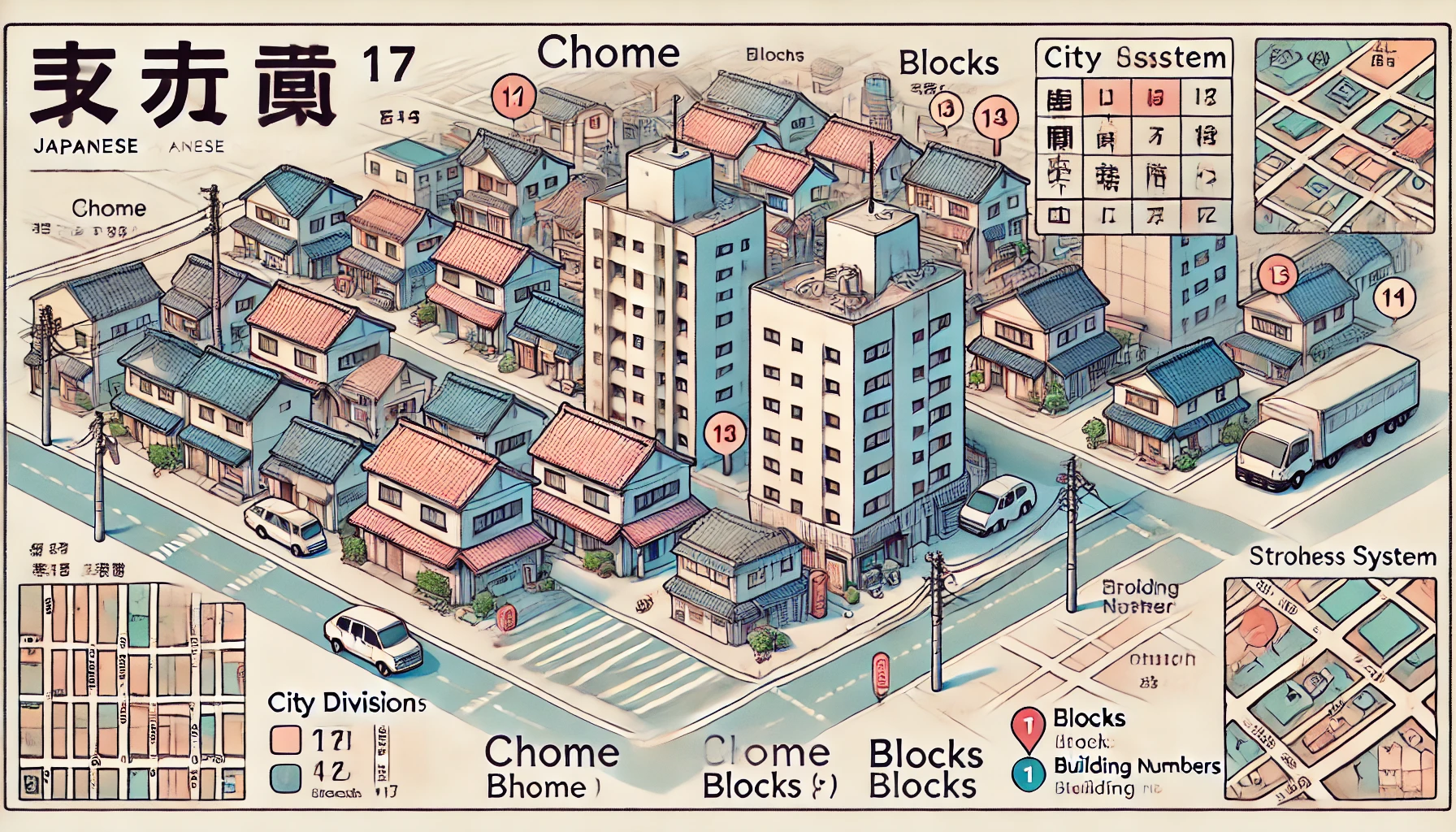
Addresses in Japan follow a hierarchy from the largest to the smallest, starting from the prefecture and ending with the building number. A typical Japanese address can be represented as follows:
Prefecture (都道府県) → City/District (市・区・町) → Area/Smaller District (丁目) → Block (番) → Building Number (号)
For example, a fictional address would be:
東京都新宿区西新宿2丁目8番1号
(Tokyo, Shinjuku Ward, Nishishinjuku 2-chome, Block 8, Building 1)
In contrast to Western addresses, where a street number indicates a sequence, buildings in Japan are numbered according to their order of construction within the block. This means that neighboring numbers may not be physically close.
Difference Between Cities and Smaller Areas
Large cities like Tokyo, Osaka, and Kyoto are divided into administrative districts called “ku” (区). Within these districts, there are subdivisions known as “chome” (丁目), which are smaller sectors within the district.
In rural areas, the system may vary a bit. Small towns and villages do not have the chome division but use village or district numbers.
How Do Japanese People Locate Addresses?
Although the system seems complicated, the Japanese have effective methods for finding locations. Instead of relying on street numbers, navigation in Japan is based on landmarks and maps.
Post offices and police stations: There are often detailed maps on the streets or in public places.
Tables at building entrances: Many buildings have signs indicating the companies or residents present there.
Navigation apps: Today, services like Google Maps have made it much easier to find addresses in Japan.
The Role of Postal Codes
Postal codes in Japan follow a seven-digit format (XXX-XXXX). Each code covers a specific area and can be very useful for finding places more accurately. In large cities, a single district may have several different postal codes.
Tips for Understanding and Using Addresses in Japan
If you are traveling to Japan or need to send mail, it is important to follow some tips to avoid confusion:
Learn the basic kanji: The address characters such as 区 (ku), 町 (cho), and 丁目 (chome) help identify the divisions of the address.
Use maps whenever possible: Do not rely solely on the numerical order, as buildings may be numbered randomly.
Ask for information: Japanese people are used to helping lost foreigners and usually point out nearby landmarks.
I hope this article helps you understand how addresses work in Japan!
IPTV, or Internet Protocol Television, is a way to transmit television content over the internet. This method has gained global popularity, offering access to live TV channels, movies, and on-demand series. In Japan, however, the use of IPTV faces a series of regulations and challenges. For those in the country who wish to use IPTV, it is essential to understand local laws, the risks involved, and the available options.
Is It Possible to Use IPTV from Another Country in Japan?
Yes, it is technically possible to use IPTV services from another country in Japan, as long as you have access to a stable internet connection and the necessary devices. However, there are restrictions and associated risks. Many IPTV services from other countries use international servers, which can cause performance issues due to connection latency.
Additionally, the content offered by some services may not be licensed for distribution in Japan. This can lead to legal issues, especially if the service does not comply with Japanese copyright laws. Using a VPN (Virtual Private Network) is common to bypass geographical restrictions, but this does not eliminate legal implications.
Does Japan Prohibit IPTV?
Japan does not prohibit the use of IPTV itself, but it has strict laws related to copyright infringement and piracy. These laws, outlined in the Copyright Act of Japan, can make it illegal to use IPTV services that offer pirated content. Japanese authorities have intensified their actions against the distribution and consumption of unlicensed content, imposing severe penalties on offenders.
Penalties and Fines
Penalties for those caught using or distributing pirated content include:
High Fines: Fines can reach up to 10 million yen (about 80 thousand dollars) for those who distribute or use illegal IPTV services.
Imprisonment: In more serious cases, such as redistributing pirated content, sentences can include up to 10 years in prison.
Criminal Record: Even without imprisonment, being convicted can result in a criminal record, affecting personal and professional life.
These measures are implemented to protect Japan’s entertainment industry, one of the largest and most important in the world.
Risks of Using IPTV in Japan
In addition to legal issues, using IPTV in Japan presents other significant risks:
Digital Security: Many unlicensed IPTV services may contain malware or vulnerabilities that expose your personal data to hackers.
Service Quality: Unofficial services often face interruptions, low image quality, and lack of technical support.
Government Tracking: Authorities may monitor networks and identify users accessing illegal content.
Yes, there are legal and reliable IPTV services in Japan. These services operate under licensing and are designed to cater to the local audience and expatriates. Some popular options include:
Hikari TV: One of the largest IPTV services in Japan, offering a wide range of local and international channels.
AbemaTV: A streaming platform that also acts as IPTV, with options for live and on-demand content.
SkyPerfecTV: Although better known for its satellite operation, it also offers licensed IPTV services.
These services comply with all Japanese regulations and ensure a safe and high-quality experience.
Tips for Those Who Want to Use IPTV in Japan
Choose Legal Services: Prefer licensed and approved options to avoid legal complications.
Avoid VPN for Piracy: While using a VPN to access legitimate services is acceptable, doing so to consume pirated content can lead to problems.
Check Quality and Licensing: Before subscribing to any IPTV service, ensure it has distribution rights for the offered content.
Conclusion
The use of IPTV in Japan is feasible but requires caution and knowledge of local laws. While legal services can provide a satisfactory experience, using illegal options can lead to serious consequences. If you are in Japan and wish to enjoy IPTV, always opt for licensed services, ensuring safe and risk-free entertainment.
Blox Fruits is an action and adventure game on Roblox that has won millions of players around the world. In it, participants explore mysterious islands, face challenging enemies, and seek special fruits that grant unique abilities. Reaching the maximum level in the game can be a time-consuming and demanding task, leading many to look for alternatives to speed up this process.
Abandoned Free Accounts for Blox Fruits
Below we will share a list of accounts that have been abandoned and that you can log in to play at the maximum level. Remember that some of these accounts may not work as they have been changed over time.
Login
Password
oleander91
kimberly7
Alexandralux
ale44555
GrinderPurfect
comiccatuk
Shunhope
rainbow98
BabyDoge
981201
Bigmind11
supercar1
Deelaw
spmoto90
Bingbang1783
megamax819
bonky
mingomic
Superf4st
javier719
DemonMellow
667q
LiveCheerup
qwerty5
CraziiDaily
daisyy
kuboxx
selffast-
Hamleen98
leamendez
Blox Robs
robin2004
KeepupLive
monkkk
roberwido
scarlett
LexDanceLuv
123123
Alexey122
maxwell3
GonzaPlay
gonzalo-
KissezNotas
junme1
DinoSaurr
bent7
diddlysquat
void204
Other Blox Fruits Accounts
See other Roblox accounts for the Blox Fruits game that you can try:
Users
Passwords
Robux
lunarEclipse
moondust22
600
emeraldKnight
gemstone99
750
oceanExplorer
seashell123
2000
darkKnight777
shadowblade
666
blazingPhoenix
inferno2024
987
thunderKing
lightning77
300
alphaWolf
packleader1
1400
goldenGoddess
aurora123
2200
spacePirate
asteroid22
1800
technoMage
circuit2024
333
timeTraveler
paradox123
5000
quantumGuru
wavefunction
15000
rainbowRider
skittles888
777
pixelProwler
bitbyte2024
888
gravityGamer
levitate123
1234
auroraBorealis
polar123
400
blitzkrieg
lightning911
911
codeCrusader
encrypt2024
200
lunarLander
moonwalk123
123
frostbite
icicle2024
1000
cyberPunk
cyberspace99
1500
phoenixFlame
firestorm123
2500
shadowNinja
vanish2024
6666
omegaOverlord
supreme123
7777
neonNinja
glowstick99
8888
galaxyGuardian
stargazer123
9999
pixelPirate
bytebuccaneer
1010
sunSurfer
solarflare22
12345
midnightMage
darkmagic99
5432
stormChaser
tempest2024
2222
starStriker
supernova123
3333
cometCrasher
meteorite99
4444
cyberSleuth
binarydetective
5555
technoTitan
motherboard123
6666
quantumQueen
entanglement99
7777
novaNoble
starburst2024
8888
astralAce
cosmos123
9999
Free Blox Fruits Account Generator
Below we have our artificial intelligence that will search for some Roblox accounts with Robux and high levels in Blox Fruits, most may not work as they may have already been used by someone else, but does it cost anything to try? The artificial intelligence searches the internet itself instead of generating random numbers like some questionable sites out there.
No account shared on this page is stolen, it may have been abandoned or shared by the owner on forums and other web pages. We do not encourage any type of crime! In fact, we abhor any practice of dishonesty.
Methods to Obtain Maximum Level Blox Fruits Accounts
Although it is tempting to look for free maximum level accounts, it is crucial to consider the security and ethics of these practices. Many accounts offered for free may be obtained in questionable ways or contain risks, such as the presence of malware. Additionally, using third-party accounts may violate Roblox’s terms of service, leading to penalties.
Buying Maximum Level Accounts
For those who wish to avoid the long leveling process, buying maximum level accounts is an option. Platforms like GGMAX offer Blox Fruits accounts with high levels and additional features. For example, it is possible to purchase accounts with all swords at 600 mastery, mastered fruits, and included game passes. However, it is essential to check the seller’s reputation and ensure that the transaction is secure.
Leveling Up Your Own Account
For players who prefer to develop their own skills, there are strategies to speed up the leveling process in Blox Fruits. Focusing on missions that offer more experience, using fruits that increase XP gain, and participating in special events are some of the recommended tactics. Additionally, tutorial videos can provide valuable tips on how to efficiently reach the maximum level.
Final Considerations
Before deciding between buying an account or leveling up on your own, it is important to weigh the pros and cons of each approach. While buying offers an immediate advantage, leveling up your own account provides a sense of achievement and learning. Regardless of the choice, always prioritize safety and be aware of the game’s policies to avoid potential penalties.
Drift animes are an excellent option for fans of speed, exciting races, and precise drifting scenes. Although this genre is not as extensive as other types of racing animes, some productions have marked an era by portraying in detail the culture of street racing and the mastery of the drift technique. Furthermore, when animes do not cover enough, some movies also capture this essence.
If you enjoy adrenaline, iconic cars, and engaging stories about talented drivers, this article will present the best drift animes and movies. From influential classics to more recent productions, here is everything you need to check out to feel the thrill of the tracks.
Origin of Drift as a Driving Technique
Drift as a automotive practice emerged in Japan in the 1970s, with drivers challenging the winding roads of the mountains (known as touge). One of the pioneers of this style was Kunimitsu Takahashi, a former MotoGP driver who applied controlled drifting techniques in car races. He realized that by sliding the car through corners, he could maintain higher speeds and gain an advantage over his opponents.
However, it was Keiichi Tsuchiya, nicknamed “Drift King”, who truly popularized drifting. Inspired by Takahashi’s techniques, Tsuchiya took drifting to a new level, showcasing his skill in videos and competitions. He helped transform drifting into a recognized sport, which later resulted in the creation of the D1 Grand Prix, the main professional drifting championship in Japan.
Over time, drifting became more than just a driving technique – it turned into a cultural phenomenon. Its popularity grew with Initial D, which introduced the art of drifting to a global audience. Additionally, films like The Fast and the Furious: Tokyo Drift helped solidify drifting as a symbol of street racing.
Initial D – The greatest drifting classic in animes
There is no way to talk about drift animes without mentioning Initial D. Created by Shuichi Shigeno, this anime was responsible for popularizing drift culture not only in Japan but around the world. The story follows Takumi Fujiwara, a young tofu delivery driver who, unknowingly, develops incredible skills while driving a Toyota AE86 through the mountainous roads of Akina.
Throughout the seasons, Takumi faces various drivers in intense drifting battles while honing his technique and discovering his true passion for racing. In addition to the engaging plot, Initial D stands out for:
Iconic soundtrack with Eurobeat songs, which became a hallmark of the genre.
Realistic representation of drifting, with real techniques and precise details about the cars.
Evolution of the protagonist, going from a disinterested beginner to a formidable driver.
If you are looking for an anime that defines drifting in the world of animes, Initial D is the perfect choice.
MF Ghost – The spiritual successor to Initial D
After the success of Initial D, Shuichi Shigeno launched MF Ghost, an anime and manga set in a future where electric motors dominate the market, but combustion engine racing is still popular. The story follows Kanata Livington, a young driver who returns to Japan to compete in the MFG, a highly competitive street racing championship.
Even though it is not exclusively focused on drifting, MF Ghost inherits many elements from Initial D, including:
Battles on mountain roads, where drifting is still an essential technique.
Presence of iconic cars, such as the Toyota GT86, maintaining the tradition of the previous series.
Appearance of old characters, creating a nostalgic connection for fans.
If you enjoyed Initial D, MF Ghost is a must-watch recommendation.
Wangan Midnight – Drift and high speed on the highways
Although Wangan Midnight is not exclusively about drifting, it deserves a place on the list. The anime focuses on high-speed racing on the expressways of Tokyo, where drivers challenge each other in electrifying battles. The protagonist, Akio Asakura, finds a cursed Nissan Fairlady Z (S30), known as “Devil Z,” and enters the world of illegal racing.
Drifting appears at certain moments in the anime, especially in tight corners, but the main focus is on extreme speed. Even so, if you love cars and adrenaline, Wangan Midnight is an excellent recommendation.
Éx-Driver – Technology against human skill
Unlike other racing animes, Éx-Driver takes place in a future where autonomous cars dominate the roads. However, when these machines malfunction and go out of control, only highly skilled human drivers can stop them.
The series follows a group of young drivers who use classic fuel-powered vehicles to face out-of-control cars in electrifying chases. Although the focus is not exclusively on drifting, many scenes include tight corners and precise slides, showing that even in a technological future, human skill still makes a difference.
If you enjoy action combined with technology and a touch of automotive nostalgia, Éx-Driver is a great choice.
Over Rev! – The realistic side of street racing
Over Rev! is a little-known anime and manga, but with a realistic approach to street racing and drifting. The story follows Ryoko Shino, a former athlete who discovers the world of motorsport by meeting a group of girls passionate about cars.
Unlike Initial D, which has a narrative more focused on exciting duels, Over Rev! focuses on the protagonist’s development and her journey to learn to drive with precision. Among the highlights of the anime are:
Well-detailed drifting scenes, respecting the physics of the cars.
Focus on female automotive culture, something rare in the genre.
Gradual evolution of the protagonist, making everything more engaging.
If you want an anime with a more technical touch and deeper character development, Over Rev! is an excellent option.
Future GPX Cyber Formula – Drift at high speed
Although Future GPX Cyber Formula is an anime focused on futuristic racing, it deserves attention for how it uses drifting at high speeds. The story follows Kazami Hayato, a young driver competing in a tournament of advanced cars equipped with artificial intelligence.
Even in a more technological setting, drifting techniques are explored, especially in dangerous corners and moments when drivers need to improvise to overtake their rivals. If you enjoy a futuristic touch mixed with intense motorsport, this anime is a great pick.
Conclusion
Drift animes may not be numerous, but the few that exist have profoundly impacted fans of racing and adrenaline. Initial D remains the ultimate reference, while MF Ghost and Wangan Midnight complement the experience with their own approaches. And when animes are not enough, movies ensure even more excitement for those who want to see cars sliding through corners with mastery.
If you love speed and the art of drifting, these recommendations are a must for your list!
Religious freedom in China is a complex and often debated topic. Officially, the Chinese Constitution guarantees freedom of belief, but in practice, the government imposes various restrictions on the exercise of religion. State supervision over religious practices and the repression of certain groups are aspects that raise concerns about the limits of this freedom in the country.
The Chinese Communist Party (CCP), which governs China, maintains strict control over religions, requiring that all religious activities be registered and supervised by the State. Some religions are officially recognized and regulated, while others face persecution, leading to international criticism and reports of human rights violations.
What the Chinese Constitution Says About Religious Freedom
The Constitution of China, in its Article 36, states that citizens have freedom of religious belief. However, this freedom comes with restrictions. The government prohibits any religious activity that “disturbs public order,” “harms national unity,” or involves “foreign influence.”
The five religions officially recognized by the State are:
Buddhism
Taoism
Islam
Protestant Christianity
Catholic Christianity
These religions must operate under specific state bodies, such as the Chinese Patriotic Catholic Association and the Three-Self Patriotic Movement for Protestants. The Vatican, for example, has no control over the Catholic Church in China, as the government appoints bishops.
Religious Freedom in China is a Joke
If you are not part of the 5 religions mentioned earlier, you do not have religious freedom in China. Let’s take Jehovah’s Witnesses as an example, a Christian religion based on the Bible. Since the organization is not among the 5 religions officially recognized by the State, its activities are considered illegal, and its members may be subject to surveillance, arrests, and repression.
Unlike countries where Jehovah’s Witnesses operate freely, in China they are seen as an illegal organization. The Chinese government represses their activities, just as it does with other unregistered religious movements, such as domestic Protestant churches and Falun Gong.
Although the Chinese Constitution mentions religious freedom, the Chinese Communist Party (CCP) requires that all religions operate under state supervision bodies, something that Jehovah’s Witnesses refuse, as their faith does not allow involvement with politics or other religious organizations.
How Do Unrecognized Religions Operate in China?
Due to the official prohibition, Jehovah’s Witnesses in China must practice their faith discreetly and clandestinely. Despite being people who encourage total obedience to the governmental laws of their country, they obey God before any authority (Acts 5:29).
Meetings occur secretly in small groups, usually in private homes, and door-to-door preaching, which is a hallmark of the religion, is done very discreetly to avoid reprisals.
Additionally, adherents take strict precautions to avoid detection by the authorities:
They do not use fixed locations for meetings, alternating gatherings between different residences.
They do not have temples or Kingdom Halls, as in other countries.
They avoid distributing printed publications and, when possible, share religious materials digitally in a discreet manner.
Digital surveillance is also a challenge. With the high level of monitoring in China, Jehovah’s Witnesses avoid religious discussions on apps like WeChat, as the government can track messages and identify participants.
Many members of the religion have been arrested for participating in religious meetings or for preaching. There are documented cases of Jehovah’s Witnesses being sentenced to years in prison simply for practicing their faith.
For example, in 2019, a Chinese court sentenced several believers to prison terms of up to three years on the charge of “using a religious organization to undermine the law.”
Many members face difficulties at work or school because of their faith. In some cases, families are pressured to renounce their Jehovah’s Witness relatives, and employers may be coerced into firing employees who belong to the group.
Shanghai China
Restrictions and State Control over Religion
Even the religions recognized by the State face restrictions. Churches and temples must follow guidelines from the Communist Party, and independent religious activities are prohibited. This has led to the closure of house churches, the destruction of Buddhist temples, and even the imprisonment of religious leaders.
Among the most persecuted religious groups are:
Uighur Muslims: Face intense surveillance, mass detentions, and re-education campaigns in Xinjiang.
Unregistered Christians: Underground churches are often closed, and their members persecuted.
Falun Gong: A banned spiritual movement that has been severely repressed since 1999.
Furthermore, there are reports of the destruction of religious symbols, such as crosses being removed from churches and the prohibition of public religious celebrations without authorization.
Religious Freedom in China from an International Perspective
Religious repression in China is the target of criticism from human rights organizations and foreign governments. The United States and the European Union frequently condemn the persecution of Uighurs and the repression of underground Christian churches.
Despite the restrictions, religiosity continues to grow in China, especially among Christians. It is estimated that the number of Christian believers will surpass the number of Communist Party members in the coming years, which may pose new challenges for the government.
Final Considerations
Although the Chinese Constitution mentions religious freedom, in practice, this freedom is severely limited by the State. Control over religions and the repression of certain groups show that the Chinese government views religion more as a political issue than as an individual right. The situation of religious freedom in China remains a delicate topic and the subject of international debates.
Many communist, authoritarian, or socialist countries like China, Russia, Eritrea, North Korea, Saudi Arabia, Turkmenistan, and the Emirates have severe restrictions against religions, often ignored by those who advocate for this style of government.
It is entirely understandable to prohibit laws that ban public disturbance. But be aware that religious freedom ends when you are threatened with imprisonment simply for gathering to pray or speak or for maintaining political neutrality because of your faith.
Effective communication in Korean requires a good understanding of how to say “yes” and “no” correctly. Unlike Portuguese, Korean has nuances that vary depending on the context and level of formality. Whether in casual or formal situations, knowing the right way to respond can make all the difference when interacting with natives.
In addition to the direct words for “yes” and “no,” the Korean language also uses specific sentence constructions and alternative expressions. Understanding these differences avoids misunderstandings and improves your fluency in the language. Let’s explore the correct ways to affirm and deny in Korean, from the most polite to the most informal.
The most common word for “yes” in Korean is 네 (ne), used in most situations. However, there are other variations that may be more appropriate depending on the context.
네 (ne) – Formal and polite
This is the most commonly used and neutral way to affirm something. It can be used in both simple responses and to show agreement during a conversation. Example:
A: 한국어 공부해요? (Hangugeo gongbuhaeyo? – Do you study Korean?)
B: 네, 공부해요. (Ne, gongbuhaeyo. – Yes, I study.)
예 (ye) – Very formal
Another polite way to say “yes” is 예 (ye), used mainly in more formal contexts, such as job interviews or when speaking with elders and superiors. Although it is not as common in everyday conversation, it is still useful to know.
응 (eung) / 어 (eo) – Informal
If you are speaking with friends or close people, you can use 응 (eung) (if you are a woman) or 어 (eo) (if you are a man). Both mean “yes,” but are extremely casual. Example:
A: 우리 영화 볼까? (Uri yeonghwa bolkka? – Shall we watch a movie?)
B: 응! 좋아! (Eung! Joha! – Yes! Good idea!)
맞아요 (majayo) – To confirm something
Another common way to agree in Korean is to use 맞아요 (majayo), which means “That’s right” or “Exactly.” It is useful when you want to affirm something in a more emphatic way.
How to say “No” in Korean
Saying “no” in Korean can be a bit more complicated, as there are several ways to deny something depending on the tone and formality of the conversation.
아니요 (aniyo) – Polite and formal
The most common and polite way to say “no” in Korean is 아니요 (aniyo). This word can be used in both formal and neutral situations. Example:
A: 이 책 읽었어요? (I chaek ilgeosseoyo? – Did you read this book?)
B: 아니요, 안 읽었어요. (Aniyo, an ilgeosseoyo. – No, I didn’t read.)
아니 (ani) – Informal
If you are speaking with friends or close people, you can simply say 아니 (ani). This form is more direct and casual. Example:
A: 너 배고파? (Neo baegopa? – Are you hungry?)
B: 아니, 괜찮아. (Ani, gwaenchana. – No, I’m fine.)
안 돼요 (an dwaeyo) – To prohibit something
If you want to say “no” in the sense of “cannot” or “not allowed,” use 안 돼요 (an dwaeyo). This expression is common in situations where you want to deny permission for something. Example:
A: 여기서 사진 찍어도 돼요? (Yeogiseo sajin jjigeodo dwaeyo? – Can I take pictures here?)
B: 안 돼요. (An dwaeyo. – You cannot.)
아니에요 (anieyo) – To deny something
When someone makes an incorrect assumption and you want to politely deny it, use 아니에요 (anieyo). This expression is used to clarify something without being rude. Example:
A: 이거 너 거야? (Igeo neo geoya? – Is this yours?)
B: 아니에요. (Anieyo. – No, it’s not.)
Now you know how to say “yes” and “no” correctly in Korean, taking into account the level of formality and context. Practicing these expressions in daily life will help make your communication more natural and effective!
Religious freedom in Japan is guaranteed by the Constitution and widely respected in society. Unlike countries where the government interferes in religious practices, Japan adopts a stance of separation between religion and state, allowing its citizens to practice any faith without restrictions.
Despite this freedom, religiosity in Japan has unique characteristics. Many people do not follow a single religion, but rather a combination of Shinto, Buddhist traditions, and even Western influences. Additionally, there are challenges, such as discrimination against new religions and the impact of controversial sects.
The government cannot grant privileges to any specific religion.
No religion can exercise political authority.
This means that Japan has no official religion and the state does not interfere in individual beliefs. Unlike the period before World War II, when state Shintoism was promoted as part of Japanese nationalism, today there is a clear separation between religion and government.
How Religions Operate in Japan?
Japan has significant religious diversity, with three major traditions standing out:
1. Shinto
Shinto is the native religion of Japan and is deeply linked to national culture. Although many people participate in Shinto rituals, such as visiting shrines and celebrating festivals, few consider themselves exclusive “followers” of Shinto.
2. Buddhism
Buddhism arrived in Japan in the 6th century and still has great influence, especially in funeral rituals. Most Japanese families maintain a Buddhist altar at home to honor their ancestors.
3. Christianity and Other Religions
Christianity represents a minority, with about 1% of the population identifying as Christian. Additionally, there are new religions, such as Soka Gakkai (a branch of Buddhism) and groups inspired by Shinto-Buddhist beliefs.
Japan vs. China – Religious Freedom
Japan and China are often confused as similar countries, but they are completely different. Although China claims to have freedom of belief, the situation is quite different from Japan, as only 5 religions are officially recognized and any others are illegal and prohibited.
To understand more about how this religious persecution and lack of freedom affects believers in China, read our article on: Is There Religious Freedom in China?
Despite the freedom guaranteed by law, some religions face difficulties in Japan:
1. Discrimination Against New Religions
New religious groups, such as Soka Gakkai and Seicho-No-Ie, are often viewed with suspicion by society. Some people believe that these groups are closed sects and avoid interacting with their members.
2. Sects and the Aum Shinrikyo Case
Religious freedom was questioned after the sarin gas attack on the Tokyo subway in 1995, carried out by the sect Aum Shinrikyo. Since then, the government has monitored religious groups considered extremist, and the population has become more skeptical of new religions.
3. Social Pressure
Although Japan is religiously free, there is social pressure to follow certain rituals, such as Shinto-style weddings and Buddhist ceremonies at funerals. People who completely reject religion may be seen as different.
Conclusion
Japan has full religious freedom, with laws that guarantee the separation between religion and state. However, there are social and historical challenges that affect how certain religions are viewed. Overall, Japan stands out as a country where diverse beliefs coexist peacefully, with a flexible and culturally integrated approach to religiosity.
Traveling to Japan as a vegetarian or vegan may seem like a challenge, but with good planning, it is possible to enjoy the incredible Japanese cuisine without giving up your dietary principles. Despite the frequent use of animal-derived ingredients, there is a variety of dishes and restaurants adapted for those who do not consume meat or animal products.
In this comprehensive guide, we will cover everything you need to know to have an unforgettable culinary experience in Japan, from naturally vegetarian dishes to essential tips to avoid unpleasant surprises.
The basis of Japanese cuisine includes rice, noodles, fresh and fermented vegetables, tofu, miso, and mushrooms, which may seem promising for vegetarians. However, many dishes that appear to be meat-free contain hidden animal-derived ingredients.
Animal-Derived Ingredients to Avoid
Even in dishes that seem vegetarian, it is common to find ingredients such as:
Dashi (fish broth) – widely used in soups, sauces, and even in rice.
Katsuobushi (dried fish flakes) – often used as a topping in dishes like okonomiyaki and takoyaki.
Conventional shoyu – some brands may contain traces of fish or be fermented with animal-derived ingredients.
Gelatin (ゼラチン – zerachin) – present in traditional sweets and desserts.
Pork lard – used for frying some types of noodles or dumplings.
Therefore, learning some key words in Japanese or using explanatory cards can be essential to avoid these ingredients.
Where to Eat: Best Options for Vegetarians and Vegans
Specialized Restaurants
The number of vegetarian and vegan restaurants has been growing in Japan, especially in major cities like Tokyo, Kyoto, and Osaka. Some highlights include:
Ain Soph (Tokyo, Kyoto) – a chain of 100% vegan restaurants offering sophisticated dishes like burgers and desserts.
T’s Tantan (Tokyo) – specializing in vegan ramen, located inside some train stations.
Saido (Tokyo) – voted one of the best vegan restaurants in the world, with dishes inspired by traditional Japanese cuisine.
Mumokuteki Café (Kyoto) – homemade Japanese food without meat, in a cozy environment.
In addition to specialized restaurants, many Buddhist temples offer shojin ryori meals, a traditional vegetarian cuisine.
How to Find Vegetarian Restaurants in Japan
If you are in a smaller city, it may be more difficult to find vegetarian options. Fortunately, there are apps and websites that help locate restaurants catering to special diets:
Google Maps – searching for “vegan restaurant” or “vegetarian restaurant” can yield good local options.
HappyCow – one of the most popular apps for finding vegan and vegetarian restaurants.
Vegewel – a Japanese platform that lists vegetarian restaurants and cafés by region.
Strategies for Finding Plant-Based Options
Specialized Restaurants
In major Japanese cities, the availability of vegetarian and vegan restaurants has increased. Establishments like Izakaya Masaka in Shibuya, specializing in vegan “fried chicken,” and Komaki Shokudo Kamakura Fushikian in Akihabara, which offers a modern version of the Buddhist cuisine shojin ryori, are examples of places where you can enjoy meals without animal-derived ingredients.
Using Apps and Online Communities
Tools like HappyCow and Vegewel are useful for locating vegetarian and vegan restaurants in various regions of Japan. Additionally, participating in online communities, such as Facebook groups dedicated to veganism in Japan, can provide updated recommendations and valuable tips.
Effective Communication
Due to language and cultural barriers, it is advisable to carry explanatory cards in Japanese detailing your dietary restrictions. This can facilitate communication in restaurants and ensure that your needs are understood and respected.
Safe Traditional Dishes for Vegetarians and Vegans
If you can’t find a specialized restaurant, you can still enjoy many traditional Japanese dishes. Here are some safe options:
Zaru Soba – buckwheat noodles served cold with sauce on the side. Just make sure the sauce does not contain fish dashi.
Vegetable tempura – battered and fried vegetables (ask if the oil is vegetable).
Umeboshi or kombu onigiri – rice balls filled with pickled plum or seaweed.
Yuba (tofu skin) – a sophisticated dish made from the top layer of heated soy milk.
Shojin Ryori – the vegetarian cuisine of Buddhist monks, found in temples and some restaurants.
Avoid Common Traps
Even dishes that seem safe may contain non-vegetarian ingredients. For example:
Miso soup – usually contains fish dashi. Ask for it without dashi (“ダシなし” – dashi nashi).
Tsukemono (Japanese pickles) – some are marinated with fish sauce.
Japanese curry – most ready-made sauces contain meat or meat broth.
Always ask or check the ingredients before consuming.
Practical Tips for Eating in Japan Without Worries
1. Use Explanatory Cards in Japanese
Due to language and cultural barriers, it is advisable to carry explanatory cards in Japanese detailing your dietary restrictions. This can facilitate communication in restaurants and ensure that your needs are understood and respected.
To facilitate communication, carry a card with phrases like: I am vegetarian. I do not eat meat, fish, seafood, dashi, or gelatin.
私はベジタリアンです。肉、魚、魚介類、ダシ、ゼラチンを食べません。
Watashi wa bejitarian desu. Niku, sakana, gyokairui, dashi, zerachin o tabemasen.
If you are vegan, add: I also do not eat eggs or dairy products.
"卵や乳製品も食べません。
Tamago ya nyūseihin mo tabemasen.
2. Supermarkets and Kombinis
If you are having trouble finding restaurants, kombinis (convenience stores) can be an alternative. Some safe options include:
Edamame – steamed soybeans.
Fresh fruits and salads – available in most markets.
If you are staying longer in Japan, consider renting an apartment or staying in a hostel with a kitchen. This way, you can cook your own meals with fresh ingredients bought at local markets.
Is it Possible to Be Vegetarian in Japan?
Although vegetarianism and veganism are still not widely practiced in Japan, it is entirely possible to enjoy Japanese cuisine without consuming meat or animal products. With planning, knowledge about ingredients, and good communication strategies, you can have an amazing and worry-free culinary trip.
Whether exploring Buddhist temples with traditional meals or discovering vegan restaurants in large cities, there are always options for those who want to enjoy Japan without giving up their diet.
Now that you know everything about how to eat well in Japan as a vegetarian or vegan, how about sharing this guide with your friends who also have dietary restrictions? Have a good trip and enjoy your meal!
To deepen your understanding of vegetarian and vegan options in Japan, check out the video below:
Who doesn’t like romance animes? Even the toughest men are enchanted by the incredible love stories told in animes. In this article, we will see a list of the most romantic animes of all time.
This is one of the most popular genres in the world of animes, which often portray reality and blow any cliché romance movie out of the water. In this list, I will include only the animes that are truly worth watching.
It is worth mentioning that most of the animes on this list can be watched on Crunchyroll, its official anime streaming platform, and you can watch them all for free.
Heartbreaking romantic animes
Many romantic animes make us cry a lot. The list of animes below can bring a tear to your eye:
1
An anime composed of 2 seasons shows the life of Tomoya and Nagisa. They begin to strengthen their relationship until they start a romantic life full of challenges. This is undoubtedly one of the best romance animes and one of the most beautiful of all time, with a great soundtrack that makes any grown man cry.
1
This anime tells the story of Tachibana Mei, who has never made friends or had a boyfriend. Until a boy named Kurosawa Yamato shows interest in her, and Mei’s depressing life begins to change. The anime is short, beautiful, light, and has 12 episodes, making it a great romance anime.
1
If you want to cry, watch this story that shows the depressing life of Arima Kousei, who lost the ability to play the piano. Until finally, a wonderful girl named Kaori appears in his life and changes everything. The anime is spectacular, has beautiful art, and 22 episodes.
1
This anime has a very adult atmosphere, telling the story of 2 girls named Nana who start living together. One of them is the vocalist of a band, while the other wants a normal romantic life. Many things happen, making it one of the most dramatic and emotional animes out there.
1
The tragic and famous love story told in animation in a slightly different way. However, the anime maintains the same drama and romance, making it a great option for those who appreciate this beautiful work of romantic anime.
1
This anime tells the story of a girl who ends up getting involved with a boy she considers conceited, as he has won over two-thirds of the girls. However, this boy hides a bitter past, which the protagonist will try to understand.
Below we will see a list of the funniest romantic comedies:
1
The romantic comedy revolves around the student council president and the vice president. Both are extremely intelligent, rich, and popular, and develop feelings for each other, but neither wants to admit it, as they believe that confessing their feelings would be a form of submitting to the other. Instead, they engage in a mental battle to make the other confess first, using elaborate tactics and psychological games.
1
This romantic comedy takes place in college where a boy named Banri is attracted to a girl named Kouko, who is a stalker. The big problem is that in the past he suffered an accident in which he lost his memory. A perfect anime with 24 episodes that keeps you hooked from start to finish.
1
Tells the story of Ryuuji, a cleanliness-obsessed guy with a scary look who is in love with a girl. He meets the friend of this girl named Taiga, a short tsundere who is in love with his friend, so the two team up to try to get closer to them. One of the most popular romance animes of all time.
1
A cute romantic comedy that tells the story of a giant guy who has never been loved, who meets a beautiful girl who falls in love with him. A perfect anime from start to finish, full of comedy and cute scenes. A very peculiar romantic anime!
Romance is present in 90% of comedy animes
1
A romantic comedy with action composed of 4 seasons of 12 episodes each. The anime tells the story of a Saito who is summoned by a girl named Louise from a magic school in another world. He ends up becoming her pet, and then a long love story begins.
1
The anime tells the story of a student council president who is poor and works in a Maid Café to support her household. Until the most popular boy in school falls in love with her and starts pursuing her, the big problem is that she hates boys.
1
This romantic comedy tells the story of a tall girl and a short boy who are always fighting and teasing each other. Until things start to change and a complicated romance happens between them. One of the most famous romantic comedies of all time. A classic romance!
1
This very funny anime tells the story of Tomo, an athletic and tough high school girl who is childhood friends with Junichirou, a boy she secretly has a crush on. As Tomo deals with her personality and the conflicts of appearing like a boy, she and Junichirou face various funny and embarrassing situations while trying to deal with their feelings for each other.
1
Nisekoi follows the story of Raku Ichijou, a high school student who is the son of a yakuza leader. When Raku meets Chitoge Kirisaki, a transfer girl who is the daughter of another gang leader, they are forced to pretend to be dating to avoid a war between the two gangs, even though Raku is already in love with another girl from his past.
The anime tells the story of Futaba, who likes a boy named Kou. As she tries to get closer to him, everything goes well until he disappears. When he reappears, everything happens again, but some dramatic problems arise.
1
This anime tells the story of Sawako, an innocent girl who ends up scaring her classmates because of her name and appearance, which resembles Sadako from The Ring. Until she meets and falls in love with a boy, but since both are slow, the romance is cute and slow, yet it is still considered one of the best shoujo romance animes of all time.
1
The name of the anime is literally “The Red-Haired Snow White,” and it tells the story of a girl who wants to become an herbalist, who meets a prince from a neighboring kingdom. The unfolding of the story is somewhat slow, but it is a very cute romance anime.
1
The anime follows the story of Kyoko Hori, an exemplary and popular student in school, and Izumi Miyamura, a boy with an alternative and discreet style, who hides his true personality behind baggy clothes and glasses. When Hori discovers that Miyamura has a totally different side, they begin to get closer and discover more about their real personalities, forming an unexpected friendship that eventually turns into a romance.
The list of romantic animes is really large. Unfortunately, it’s not good to put a giant list for you to read, but I want to make honorable mentions to the famous movie that was released this year Kimi no na wa and all the other movies by Makoto Shinkai that are about romance.
The movie Kimi no na wa tells the story of 2 young people from distant cities who begin to swap bodies, one of the best romance animes of all time, dominating the Japanese and global animation box office.
Several other action animes or comedies focus a bit on romance, such as Kokoro Connect, Sword Art Online, Nodame Cantabile, and many others that you cannot miss. To conclude the article, I would like to leave a brief list of more romance animes that I recommend researching and watching later, as well as an extra AMV.
ReLife – comedy, everyday life, romance;
Tsuki ga kirei – School romance anime;
Chobits – romantic comedy;
Plastic Memories – Romance, Drama that makes you cry;
Guilty Crown – Action with a beautiful romance;
Koi Kaze;
Hana Yori Dango;
Onegai Teacher;
Masamune-Kun no Revenge – Romantic Comedy;
Nisekoi – Romantic Comedy;
Bakuman;
Accel World. – Action;
Aldnoah.Zero. – Action;
Gekkan Shoujo Nozaki-kun – Romantic Comedy;
Re: Zero Kara Hajimeru Isekai Seikatsu – Action;
TOP 100 romance animes
To conclude, I will share a ranking of the 100 best romance animes according to a survey that had more than 700,000 votes. This TOP will only have the names of the animes as it is very large. It does not mean that the focus of the anime is romance; the ranking considers the best romances in animes of all time.
I hope you enjoyed our list of romance animes! Have you watched them all? You can suggest romance animes in the comments on the website!
Religious freedom in Korea varies drastically between the two nations of the peninsula: South Korea and North Korea. While the South guarantees total religious freedom and hosts diverse beliefs, the North imposes severe restrictions and even religious persecution. This contrast makes Korea one of the most extreme examples in the world regarding freedom of faith.
The South Korea is a democratic country that ensures religious freedom in its Constitution. Unlike its northern neighbor, the South Korean government does not interfere with individual beliefs and allows various religions to thrive.
1. Religious Diversity in South Korea
The country hosts several religions, notably:
Christianity – Approximately 28% of the population is Protestant and 11% is Catholic. Christianity has grown rapidly since the 20th century and today has a significant influence on South Korean politics and culture.
Buddhism – Although historically dominant, Buddhism represents about 15% of the population. Still, many Buddhist temples continue to be important cultural and religious centers.
Shamanism and Traditional Religions – Some ancient spiritual practices, such as Korean shamanism and Confucianism, are still followed, especially in family rituals and ancestral ceremonies.
Other Religions – Islam, Hinduism, and new Korean religions, such as the Unification Church and Cheondoism, are also present.
2. Separation of Religion and State
South Korea maintains a separation between religion and government, but religious leaders have political influence. Large evangelical churches, for example, actively participate in debates about social values and public policies.
3. Challenges and Controversies
Despite religious freedom, there are challenges:
Conflicts between religions – Some Christian groups criticize Buddhist and shamanistic practices, generating friction.
Mandatory military service – Jehovah’s Witnesses and other pacifists have faced imprisonment in the past for refusing to serve in the military. Today, there are alternatives, such as substitute community service.
Cults and Controversial Groups – Some new religions, such as Shincheonji, have been criticized for aggressive recruitment practices and lack of transparency.
The Lack of Religious Freedom in North Korea
In North Korea, religion is severely restricted. The North Korean government, under the regime of Kim Jong-un, promotes the cult of personality of the Kim family as a kind of state doctrine.
1. The Official Religion: Juche
The Juche ideology, based on nationalism and self-sufficiency, has replaced traditional religions. The population is taught to see North Korean leaders as divine figures, and any other belief is viewed as a threat to the regime.
2. Persecution of the Religious
Any independent religious activity can result in imprisonment, torture, or execution. Reports indicate that practicing Christians and Buddhists are sent to forced labor camps. Only government-controlled churches operate to give the impression of religious freedom, but they are merely a facade for state propaganda.
3. Religions in the Past and Present
Historically, Buddhism and Confucianism were important in North Korea, but today these traditions have virtually disappeared. Small groups of Christians practice their faith in secret, risking great dangers.
Conclusion
Religious freedom in South Korea is widely respected, allowing diverse beliefs to coexist. In contrast, in North Korea, religion is practically nonexistent due to state repression. This extreme contrast makes the Korean peninsula one of the most striking examples of the difference between democracy and dictatorship concerning freedom of faith.
The Japanese culture is full of symbolism, and numbers are no exception. Unlike the West, where numbers generally carry neutral meanings, in Japan, many of them have positive or negative connotations due to their pronunciation, cultural associations, and even Buddhist and Shinto influences. This symbolism influences everything from architecture to the daily lives of the Japanese.
Have you heard that certain numbers are avoided in hospitals and hotels in Japan? Or that some numerical combinations are used to express secret messages? In this article, we will explore the meaning of Japanese numbers, from the most feared to the most auspicious.
The number 1 (一 – Ichi) represents the beginning and uniqueness. It is the foundation of all other numbers and symbolizes new beginnings. In Japanese, “ichi” is used in various expressions that denote primacy or something unique. For example, “ichiban” means “the first” or “the best.” There are no records of negative connotations associated with the number 1 in Japanese culture.
Furthermore, the number 1 is often associated with the idea of unity and individuality. In religious contexts, it can represent the concept of a single god or supreme entity. In Buddhism, for example, the quest for enlightenment is an individual journey, reflecting the importance of “one” as a symbol of uniqueness and personal purpose.
The Number 2 in Japanese (二 – Ni)
The number 2 (二 – Ni) symbolizes duality and balance. It is common in contexts involving pairs, such as “futago” (twins) or “meoto” (couple). The pronunciation “ni” has no known negative associations in Japanese culture. On the contrary, pairs are often seen as symbols of harmony and cooperation.
In traditional Japanese architecture, many elements are designed in pairs to create symmetry and aesthetic balance. For example, the guardian lions “komainu” are usually placed in pairs at the entrance of Shinto shrines, representing protection and balance between opposing forces.
The Number 3 in Japanese (三 – San)
The number 3 (三 – San) is considered auspicious and is present in various cultural and religious traditions. In Shintoism, for example, “Sanshu no Jingi” refers to the three sacred treasures: the mirror, the sword, and the jewel, which symbolize virtues such as wisdom, courage, and benevolence.
Additionally, the number 3 appears in Japanese idiomatic expressions, such as “Mikka Bouzu,” which describes someone who gives up after three days, highlighting the importance of commitment and perseverance. The presence of the number 3 in various cultural aspects reinforces its position as a number of luck and balance.
The Number 4 in Japanese (四 – Shi/Yon)
The number 4 (四 – Shi/Yon) is often avoided due to its pronunciation “shi,” which is homophonic with the word “death” (死). This negative association leads many establishments, such as hospitals and hotels, to omit the fourth floor or room number 4 to avoid superstitions related to death.
To circumvent this negative connotation, the alternative pronunciation “yon” is widely used in everyday life. For example, when counting objects or indicating phone numbers, “yon” is preferred to avoid any unwanted association with death.
The Number 5 in Japanese (五 – Go)
The number 5 (五 – Go) has varied meanings in Japanese culture. It is associated with the five traditional elements: wood, fire, earth, metal, and water, which constitute the foundation of Eastern philosophy and represent different aspects of nature and life.
Additionally, the number 5 is significant in Japanese cuisine. The philosophy of “goshiki” emphasizes the incorporation of five colors (red, green, yellow, white, and black) in a meal, aiming to balance nutrients and provide a visually pleasing experience.
The Number 6 in Japanese (六 – Roku)
The number 6 (六 – Roku) does not have particularly positive or negative connotations in Japanese culture. It is considered a neutral number and is widely used in everyday contexts without significant superstitious associations.
However, in some esoteric practices, such as in esoteric Buddhism, the number 6 can represent the six realms of existence, reflecting different states of life and consciousness through which a soul may pass.
The Number 7 in Japanese (七 – Shichi/Nana)
The number 7 (七 – Shichi/Nana) is widely considered lucky in Japan. It is present in various cultural and religious traditions, such as the “Shichi-Go-San” festival, celebrated on November 15, which commemorates the healthy growth of children aged three, five, and seven years old.
Additionally, the number 7 is associated with the “Seven Gods of Fortune” (Shichifukujin), who are often celebrated during the New Year, symbolizing good luck and prosperity for the coming year.
The Number 8 in Japanese (八 – Hachi)
The number 8 (八 – Hachi) is considered auspicious due to its wide shape at the base, symbolizing growth and prosperity. This visual representation suggests continuous expansion, which is why many businesses and individuals prefer to incorporate the number 8 in addresses, phone numbers, and other aspects of daily life.
Additionally, the number 8 is often associated with sports events and competitions in Japan, symbolizing challenges and the pursuit of success. The popularity of the number 8 is also reflected in special dates and celebrations that occur on the eighth day of the month.
The Number 9 in Japanese (九 – Ku/Kyuu)
The number 9 (九 – Ku/Kyuu) is avoided in certain contexts due to the pronunciation “ku,” which sounds similar to the word “suffering” or “agony” (苦). This negative association leads some people to avoid using the number 9 in situations such as gifts or room designations.
To mitigate this connotation, the alternative pronunciation “kyuu” is often used. However, in formal contexts or situations where superstition is considered, the number 9 may be completely omitted or replaced to avoid unfavorable associations.
The Number 10 in Japanese (十 – Juu)
The number 10 (十 – Juu) symbolizes completeness and perfection, representing the culmination of a complete cycle. In Japan, the number 10 is often associated with rankings and ratings, indicating the highest level of achievement or quality.
Additionally, the number 10 has spiritual significance, representing the union of the material world with the spiritual. This duality is reflected in the writing of the kanji “十,” which consists of two intersecting lines, symbolizing the intersection between different dimensions or aspects of existence.
Other Japanese Numbers
The Japanese use numbers symbolically even to create coded messages. A famous example is the use of numerical combinations to express words or feelings, based on sound similarity.
39 (San-kyuu): Sounds like the pronunciation of “Thank you” in English, being used to express gratitude.
4649 (Yo-ro-shi-ku, 宜しく): Means “count on you” or “nice to meet you.”
520 (Go-ni-rei): Reminds of “goni-rei” (愛してる, Aishiteru), which means “I love you.”
This use of numbers is common in text messages and personalized vehicle plates. I hope this article has presented the meaning of Japanese numbers.
Mastering the Japanese language can open up various job and income opportunities, both in the digital and physical environments. With the rise of globalization and the growth of Japan’s influence in various fields, speaking Japanese has become a valuable and lucrative skill.
Whether working as a translator, teacher, freelancer, or directly with Japanese companies, there are many ways to monetize your knowledge. In this article, we will explore the best ways to make money speaking Japanese and how to start your professional journey.
1 – Work as a Japanese Translator or Interpreter
The field of translation and interpretation is one of the most lucrative for those who speak Japanese. Companies, publishers, entertainment producers, and even government agencies often need qualified translators to handle documents, contracts, subtitling, and business meetings.
Earnings vary depending on the specialization and level of experience of the professional. Technical and legal translations tend to have higher payments than simple translations. On average, freelance translators can earn between $0.10 and $0.40 per translated word, while simultaneous interpreters can charge between $300 and $1,000 per event day. In Japan, salaries for professional interpreters range from ¥250,000 to ¥600,000 per month, depending on demand and sector.
To enter this market, it is essential to have a good portfolio and practical experience. Many translators start their careers by doing smaller jobs, such as video subtitling or article translation, before moving on to more lucrative contracts. Websites like Upwork, Fiverr, and Gengo are great starting points to find clients.
2 – Teach Japanese Online or In-Person
The growing popularity of Japanese culture and interest in travel and work in Japan have increased the demand for Japanese teachers. Teaching can be an excellent source of income, especially for those who enjoy teaching and have a good command of the language.
Earnings vary depending on the teaching modality. Private teachers offering personalized lessons via video call typically charge between $15 and $50 per hour, while platforms like Italki and Preply pay commissions based on the teaching time provided. For those seeking a more stable income, there is the option to teach at language schools or create online courses, which can generate ongoing passive income.
Many teachers use social media to attract students and expand their client base. Creating educational content on YouTube, TikTok, or Instagram can help build authority and attract students interested in learning Japanese. Additionally, specializing in niches, such as business Japanese or for certifications like the JLPT, can further increase the chances of financial success.
3 – Work for Japanese Companies Remotely
With the expansion of remote work, more and more Japanese companies are looking for professionals fluent in the language to work in areas such as customer support, digital marketing, IT, and project management. This is an excellent opportunity for those who want to work for Japan without having to move to the country.
Technology and e-commerce companies often hire bilingual support to serve international clients. In the marketing sector, there is demand for professionals who can translate and adapt content for different audiences, manage social media, and optimize websites for SEO in Japanese.
Salaries for these positions vary widely. Customer service professionals earn between $1,500 and $3,000 per month, while specialized positions in IT and digital marketing can exceed $5,000 monthly. In Japan, programmers who speak Japanese fluently can earn ¥500,000 or more per month, depending on the company and experience.
To find these opportunities, it is worth exploring websites like GaijinPot, Daijob, and LinkedIn, as well as seeking networking groups and forums for professionals working with Japanese companies.
4 – Create Content about Japanese and Monetize
Creating digital content has become an excellent source of income for those who master Japanese. With the growth of video, blogs, and social media consumption, there are many ways to monetize knowledge of the language.
Creating a YouTube channel can be highly profitable, especially for those who teach Japanese in a didactic and engaging way. Monetization can come from ads, partnerships, and personal courses. Many content creators achieve monthly earnings exceeding $3,000 just from views and sponsorships.
Another option is to develop a blog about language learning, travel to Japan, or Japanese culture. With a well-optimized site, it is possible to generate revenue through affiliate programs and advertising. Platforms like Medium and Substack also allow monetizing paid articles for an interested audience.
For those who prefer social media, TikTok and Instagram are great ways to build an audience and sell digital products, such as e-books or personalized study plans. The most important thing is to maintain consistent production and find a specific niche to stand out.
5 – Work in Japan and Increase Earnings with Language Fluency
For those who wish to live in Japan, speaking Japanese opens doors to well-paying opportunities. Jobs that require fluency in the language typically pay more than those intended for foreigners without knowledge of the language.
Sectors such as IT, engineering, translation, and language teaching offer high salaries for qualified professionals. Interpreters and translators working in Japanese companies can earn ¥300,000 to ¥800,000 per month, depending on experience. IT and engineering professionals can exceed ¥1,000,000 monthly, especially in large corporations and startups.
Even in areas like tourism and hospitality, fluency in Japanese can secure better positions and above-average salaries. For those looking for jobs, official recruitment websites in Japan, as well as employment agencies specializing in foreigners, are the best ways to find opportunities that match your skills.
Conclusion
Knowing Japanese can be a significant differentiator for achieving high earnings and building a solid career. From remote jobs to opportunities in Japan, there are various ways to turn this skill into a stable and growing source of income.
The most important thing is to identify which path makes the most sense for your skills and interests. Whether as a translator, teacher, content creator, or technology professional, the market has space for those who master the language and know how to apply it strategically.
If you already speak Japanese, now is the time to explore these opportunities. And if you are still learning, keep investing in the language – fluency can become one of your greatest professional assets.