
Love triangles are one of the most reliable engines of romance anime: two people want the same person, one of them loses, and everyone learns something about themselves along the way. This list gathers more than fifty series and films built around that tension. Seven titles are introduced in detail first, followed by an ordered overview with format and year.

Contents 22
Golden Time: a triangle with memory loss
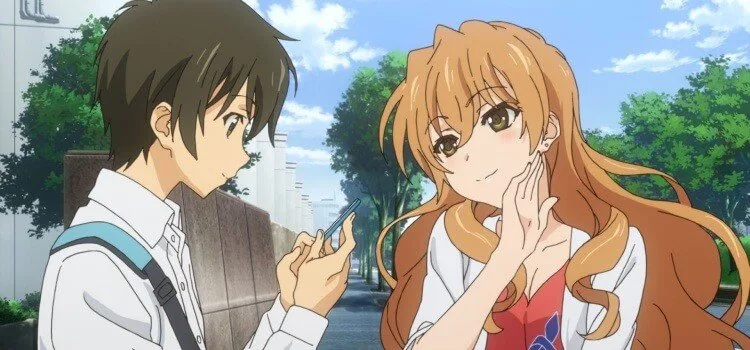
Tada Banri starts law school in Tokyo, but an accident has erased his memories. In the first episode he is already caught in a knot of feelings: he falls for Kouko, who appears as the girlfriend of a friend who no longer wants her. Once they get together, Linda shows up carrying a secret and feelings of her own. The series is set at university and deals with growing up, memory and responsibility; there is even a Brazil reference. Fans of Toradora will recognise the same author in a more serious key.
Sakurasou no Pet na Kanojo

Kanda Sorata lives in the Sakurasou dormitory, known as a home for difficult students. There he meets the strange artist Shiina Mashiro and helps her cope with everyday life. The triangle forms between Sorata, Mashiro and his childhood friend Nanami Aoyama. Along the way the series talks about the future, hard decisions and the feeling of not being good enough, while the other residents have their own romantic troubles, including Misaki chasing Jin, who shows no interest.
Kokoro Connect

A group of students goes through strange phenomena: they swap bodies, briefly turn into children, and their thoughts become audible. These events test their friendship and bring out feelings nobody wanted to say aloud. Between Himeko, Taichi and Iori a triangle grows that changes the group. The show mixes a supernatural premise with slice of life and talks seriously about trust and vulnerability.
White Album 2
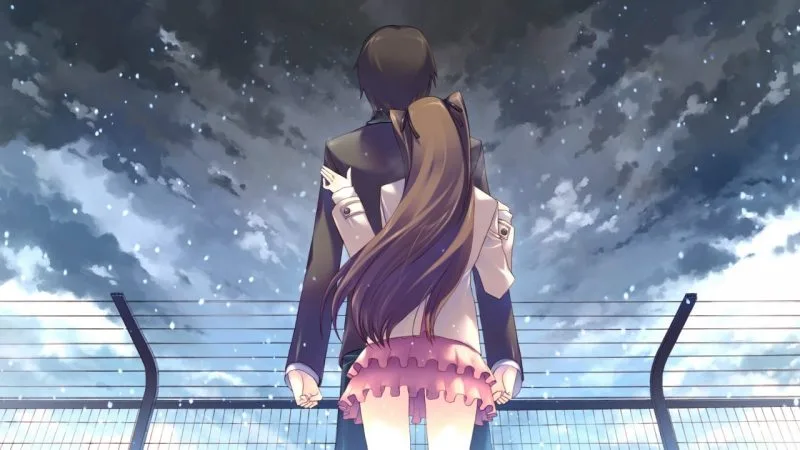
What begins as a music club anime turns into one of the bitterest stories in the genre. The protagonist has to choose between a singer and a wealthy pianist, and the story shows what happens when a decision is postponed for too long. The soundtrack carries the mood. Despite the number in the title, this is not a second season but a separate story with new characters, based on a visual novel.
Yahari Ore no Seishun: Oregairu

Hachiman Hikigaya is a loner with a sharp tongue, and his teacher sends him to the service club. There he meets Yukinoshita, an equally difficult classmate, and later Yui, who tries to bridge the gap. Across three seasons a triangle takes shape that avoids quick confessions and focuses on misunderstandings, compromises and the question of whether honesty has to hurt. The show works as comedy and social observation at once.
Nagi no Asukara: the heptagon
At the bottom of the sea lives a group of people separated from those on the surface, and some teenagers transfer to a school above. Racism, prejudice and the feeling of belonging nowhere run through the story. The romance is not a simple triangle but a chain of seven people in which almost everyone loves the wrong person, which makes it one of the most tangled relationship charts in anime.
Gotoubun no Hanayome: the quintuplets

Five sisters, one tutor and a childhood secret: the protagonist has to help the girls study, but they have little interest and very different personalities. The series mixes romance, comedy and a touch of ecchi, and it became far more popular than many expected. In the end the question is simple: which sister does he choose?
What makes a good love triangle
A triangle only works when all three people have goals of their own. Shows that invent a rival just so the hero can choose feel empty quickly; stronger stories give both sides something to lose. Tone matters too: comedies play with jealousy, dramas with guilt and sacrifice. The titles below cover both directions, from classics of the eighties to recent series.
Recurring character types
Almost every love triangle uses the same roles. There is the person who has stood beside the hero for years, often a childhood friend who never says what she feels. Then comes the newcomer who disrupts the routine and has the courage to speak first. The protagonist stands between them and usually realises too late that silence is also a decision. Good shows give all three people a life of their own; weak ones use the rival as an obstacle only.
Why the childhood friend so often loses
The childhood friend looks like the safe choice, and that is exactly why she loses so often. Narratively she is already part of daily life, while the new character promises change. Series that escape the cliché give her a storyline of her own or let her make a decision instead of waiting. Once you notice the pattern, you can tell quickly whether a story plays with it or simply copies it.
How to pick by mood
For comedy with sharp dialogue, try Oregairu and Gotoubun no Hanayome. For serious tones, look at White Album 2, Nagi no Asukara and Scum's Wish. Classics from the eighties and nineties such as Kimagure Orange Road and Maison Ikkoku show how the genre used to be told. If you prefer films, start with the Macross movies or Touch. The list below also works as a path: well-known titles first, older and more specific ones later.
What the years tell you
The oldest titles here come from the sixties, and most are from the 2000s and 2010s. In the eighties and nineties romance series often took place at school and used long arcs in which characters approached each other over dozens of episodes. Later, seasons got shorter and stories leaned on single turning points. Reading the years, then, also tells you what pace a series keeps.
Film, OVA or series?
A film tells a triangle in ninety minutes and has to focus on one conflict, which works well when the setup is clear. An OVA has more room but was often made as a companion to a series and expects prior knowledge. Television series can follow several characters across seasons, though they sometimes lose focus. For newcomers, complete runs of twelve to twenty-six episodes are usually the safest choice.
How to avoid spoilers
With love triangles the resolution is the whole point. If you want to know whether a show suits you, read reviews only up to the middle and stay away from comment sections. Information about tone, pacing and audience helps more than summaries of the ending. This page names no outcomes; the order of the list is not a judgement on the decisions.
Triangles that end differently
Not every story ends with a confession and a happy couple. Some let the characters move on apart, others show that a choice means sacrifice for everyone involved. Such endings are rarer in the genre but stay in memory longer because they refuse the expected payoff. If you like open or bitter conclusions, the list has several candidates, especially among the older titles.
How to tell if a series fits
If you want quick romance, choose comedy titles where the approach starts early. If you want drama with serious themes, look for shows where work, family or loss matter. And if you simply want many characters and relationships, the longer classics are the place to start. Checking the format and episode count usually saves more time than hunting for the perfect recommendation.
The role of music
In romance anime the soundtrack carries much of the mood. A piano piece can turn a scene, and a closing song can reveal more about the characters than a conversation. Shows built around music, such as White Album 2 or Anonymous Noise, use rehearsals and performances as places where feelings surface indirectly. On a second watch, the music often points to details that went unnoticed the first time.
From manga and light novels to anime
Many titles here began as manga, light novels or visual novels. The source shapes how much attention side characters receive: a long manga allows more relationships, a visual novel offers several routes. Adaptations that pick one route have to discard the others, which often frustrates fans of the alternatives. Knowing the source makes the choices of an adaptation easier to judge.
Where the genre stands today
Modern romance anime tends to favour short seasons and clear endings. Streaming has also made it easier to catch up with older titles, so classics from the eighties and nineties keep finding new viewers. The basic pattern remains stable: a decision is postponed until the characters are ready. Seen side by side, old and new titles show how little the drama has changed and how much pacing and visual language have.
Frequently asked questions
What is a love triangle in anime? Three characters whose romantic feelings overlap, so that at least one of them has to step back. Does a triangle always end in conflict? No, many shows resolve it through conversation and compromise. Is the order a ranking? The list keeps the order of the original selection and works as a guide, not a verdict. And if you want no spoilers, avoid summaries of the ending and look at tone, pacing and episode count instead.
More anime with love triangles
The order follows the original selection, from the better-known to the less popular title. Format and year appear in brackets.
- Fruits Basket 2nd Season (TV, 2020)
- Fruits Basket 1st Season (TV, 2019)
- Chihayafuru 3 (TV, 2019)
- Chihayafuru 2 (TV, 2013)
- Shouwa Genroku Rakugo Shinjuu (TV, 2016)
- Kids on the Slope (TV, 2012)
- Nana (TV, 2006)
- Chihayafuru (TV, 2011)
- Honey and Clover II (TV, 2006)
- School Rumble: 2nd Semester (TV, 2006)
- Macross Frontier (TV, 2007)
- Tsukigakirei (TV, 2017)
- A Lull in the Sea (TV, 2013)
- Macross Frontier Movie 2: Sayonara no Tsubasa (Movie, 2011)
- Blue Spring Ride (TV, 2014)
- ef - a tale of memories (TV, 2007)
- Kokoro Connect (TV, 2012)
- Super Dimensional Fortress Macross (TV, 1982)
- Bloom Into You (TV, 2018)
- School Rumble (TV, 2004)
- Maison Ikkoku (TV, 1986)
- Fruits Basket (TV, 2001)
- Golden Time (TV, 2013)
- Macross Frontier Movie 1: Itsuwari no Utahime (Movie, 2009)
- To Love Ru: Darkness 2nd OVA (OVA, 2016)
- To Love Ru: Darkness OVA (OVA, 2012)
- To Love Ru: Darkness 2nd (TV, 2015)
- To Love Ru: Darkness (TV, 2012)
- Super Dimensional Fortress Macross: Do You Remember Love (Movie, 1984)
- Aoi Bungaku Series (TV, 2009)
- Macross Plus Movie Edition (Movie, 1995)
- White Album 2 (TV, 2013)
- Honey and Clover (TV, 2005)
- Macross Plus (OVA, 1994)
- Kimagure Orange Road: I Want to Return to That Day (Movie, 1988)
- Touch (TV, 1985)
- New Kimagure Orange Road: Summer's Beginning (Movie, 1996)
- ORESUKI: Are you the only one who loves me? (TV, 2019)
- The Vision of Escaflowne (TV, 1996)
- Motto To Love Ru (TV, 2010)
- True Tears (TV, 2008)
- Scum's Wish (TV, 2017)
- To Love Ru OVA (OVA, 2009)
- Kimagure Orange Road (TV, 1987)
- Fushigi Yugi: The Mysterious Play (TV, 1995)
- Princess Nine (TV, 1998)
- Kimagure Orange Road OVA (OVA, 1989)
- Gokinjo Monogatari (TV, 1995)
- Rumbling Hearts (TV, 2003)
- Love Hina Again (OVA, 2002)
- To Love Ru: Multiplication - Mae kara Ushiro kara (OVA, 2017)
- Natsuyuki Rendezvous (TV, 2012)
- Sing "Yesterday" for Me (TV, 2020)
- Domestic Girlfriend (TV, 2019)
- Da Capo II Second Season (TV, 2008)
- Marmalade Boy (TV, 1994)
- Just Because! (TV, 2017)
- We Were There (TV, 2006)
- Urusei Yatsura Movie 3: Remember My Love (Movie, 1985)
- To Love Ru (TV, 2008)
- Anonymous Noise (TV, 2017)
- Macross Delta (TV, 2016)
- Video Girl AI (OVA, 1992)
- Aoki Densetsu Shoot! (TV, 1993)
- Please Twins (TV, 2003)
- Kirarin Revolution (TV, 2006)
- A Town Where You Live (2014) (OVA, 2014)
- Ceres, Celestial Legend (TV, 2000)
- Candy Boy (Web, 2008)
- I''s Pure (OVA, 2005)
- Peach Girl (TV, 2005)
- Gokinjo Monogatari Movie (Movie, 1996)
- Love and Lies (TV, 2017)
- No-Rin (TV, 2014)
- A Town Where You Live (TV, 2013)
- Canvas 2 ~Niji Iro no Sketch~ (TV, 2005)
- Kashimashi: Girl Meets Girl (TV, 2006)
- Tales of a Street Corner (Movie, 1962)
- Touch Movie 1: Sebangou no Nai Ace (Movie, 1986)
- Magical Angel Creamy Mami (TV, 1983)
- Attack No. 1 (TV, 1969)
- To Heart: Remember My Memories (TV, 2004)
- Love and Lies OVA (OVA, 2018)
- Slow Step (OVA, 1991)
- To Heart (TV, 1999)
- 801 T.T.S. Airbats (OVA, 1994)
- Mizuiro Jidai (TV, 1996)
- Hikari no Densetsu (TV, 1986)
- Natsu e no Tobira (Movie, 1981)
- If I See You in My Dreams (TV, 1998)
- I''s OVA (OVA, 2002)
- Psychic Academy (TV, 2002)
- School Days (TV, 2007)
- Sakura Diaries (OVA, 1997)
- Ai Shite Night (TV, 1983)
- Sequence (OVA, 1992)
- Love to Lie Angle (TV, 2018)
- Boku wa Kono Mama Kaeranai (OVA, 1994)
Final thoughts
Love triangles are not an end in themselves: they force characters to name their feelings and make a choice. If you like comedies with sharp dialogue, start with Oregairu; if you want drama, take White Album 2 or Nagi no Asukara. The list above offers enough material for several seasons, from classics to hidden gems.
More on anime: the best romance anime, Michiko to Hatchin and Brazil, slice of life, school clubs in Japan, visual novels and everyday Japan.


Community
Comments
0 comments
There are no published comments in this language yet.
Send comment