
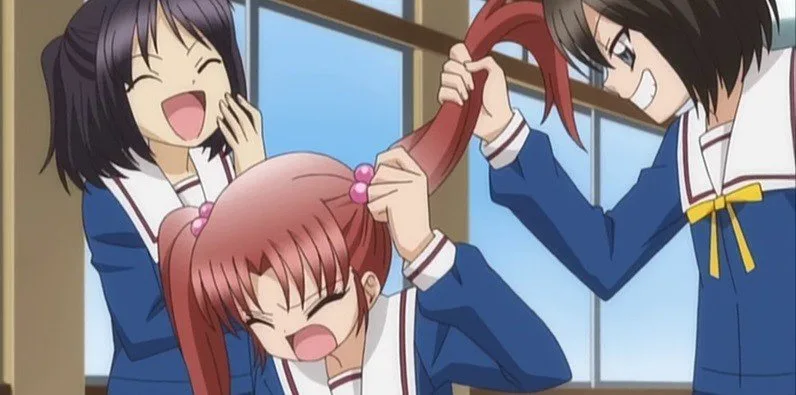
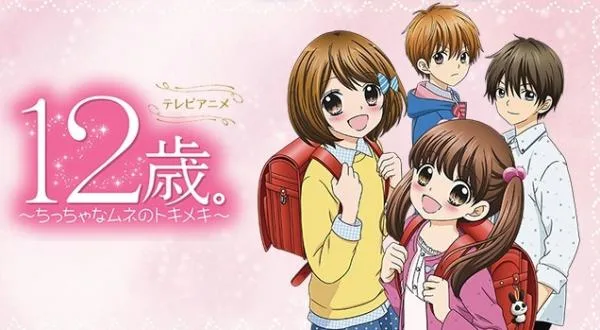
In this article, we recommend an anime that, on the surface, looks unassuming, but keeps turning up in lists tagged school, romance and comedy: 12-Sai: Chicchana Mune no Tokimeki (十二歳。ちっちゃな胸のときめき). It is a romantic comedy series whose characters sit in pre-adolescence and – spoiler up front – experience their first love in a very restrained, almost old-fashioned way. We place the series in context, explain why it works for an adult viewer without sliding into uncomfortable territory, and close with a few similar titles from the children's romance corner of the catalogue. If you have not come across the term "children's romance" before, in the Japanese context it refers to series that portray the first crushes and tentative relationships of middle- and upper-elementary-school children, told in a consistently age-appropriate way, often with a wink at adult viewers who remember their own school days all too well.
Contents 6
Synopsis and context
The story begins with Ayase Hanabi, who has just entered the sixth grade at a Japanese middle school. On her way to class she happens to see two of her teachers kissing – a detail that, in the world of Japanese school stories, is not exactly run-of-the-mill, and one that pushes her to think about feelings, affection, and the small taboos that come with growing up. From that opening scene, the narrative unfolds into a series about Japanese school anime, in which Hanabi, her friend Aoi, the shy Yumesuke, and the reserved Takao work through their first crushes, their small insecurities, and the inevitable pangs of jealousy that come with them.
The four characters form the emotional centre of the show. Hanabi is the curious narrator, always listening to herself, trying to make sense of the tangle of school life, family, and first feelings. Aoi is her extroverted counterweight, usually one step ahead and not above nudging Hanabi into awkward situations. Yumesuke is a quiet boy from the parallel class who admires Hanabi from a distance for a long stretch of the series, while Takao plays the supposed "rival" competing for the same attention. Put together, the four are a classic quartet of observer, catalyst, crush and troublemaker, the kind of Japanese school-life scaffolding you will find in many series of the genre.
At its core, the anime is a slice of life title that describes the school and family life of these children in considerable detail. The themes are the first hints of romance, group dynamics inside the classroom, the relationship with the teachers, and the question of what "growing up" actually means when you are twelve. If you have ever wondered how tightly the Japanese school day is bound up with ideas like class councils, club duty, and clean-up duty, this series offers a low-key take on it. What is striking is the way the anime keeps its distance from caricature: the children do not behave in a forcedly childish or artificially grown-up way, but read as young teenagers navigating a world full of small rules.
Why this anime is worth watching
Anyone who starts the series should be ready to settle in for a deliberately slow pace. Because the main characters are only twelve, every step forward happens at a crawl: simply holding hands is enough to make Hanabi and Yumesuke visibly blush, the first kiss is held off for several episodes, and confessions are staged at length and then postponed at the last moment. The restraint feels unusual at first, but it is the conscious signature of the show. It recalls the period of being twelve yourself, when every small thing carried enormous weight – an effect that often asks more of the adult viewer than of the children on screen.
Three points make the title appealing to adult anime fans looking for stories beyond the usual high-school romance:
- Character writing: Hanabi, Aoi, Yumesuke and Takao are written as distinct figures, with their own strengths, weaknesses and family backgrounds. That makes it easy to distribute your sympathies without the cast tipping into caricature. The quiet moments – a glance down the corridor, an unanswered message, an embarrassed smile – carry the story more than any grand gesture.
- Long-form growth: Watching both seasons, you can actually see the relationships mature. The characters do not simply "get older", they become visibly more self-assured, without the childlike uncertainty disappearing. That mix of continuity and change is one of the series' quiet strengths.
- Tonal balance: The anime works consistently with humour, everyday observation, and a gentle sharpness – including towards the characters you are not supposed to like. The unwanted rival "Cocoa-chan" is explicitly named in the source as a figure around whom the audience's sympathies are meant to rub the wrong way. The mix fits with the Japanese storytelling tradition of everyday series, in which conflicts rarely blow up dramatically and are worked through quietly instead.
What further sets the title apart from many modern school stories is its narrative structure. The first season stays largely with Hanabi's point of view, while individual episodes place Aoi, Yumesuke and Takao in the role of first-person narrator, widening the inside view. That gives the plot a welcome depth, without any single episode throwing the rest off its rhythm. Fans of anime that devote each episode to a different character will recognise a clean execution of the principle.
One drawback: the animation
An honest recommendation has to include an honest caveat. The animation is the series' most visible weakness. The first season came out in 2016, but visually it reads like a production from the early 2000s: backgrounds are short on detail, motion is sometimes stiff, and comparable titles from the same year show clearly more production budget. If you watch anime mainly for cinematic images, you will need a measure of patience in several places. If you prioritise story, dialogue and character work, the trade-off is easy to accept.
It is also worth mentioning that, after the first season, the series picked up a run of OVA recap episodes and then a second season. That makes it possible to catch up on the plot in compact form before starting the second season – a service not every older anime offers its fans. The OVA episodes retell the first season in slightly condensed form, which makes the return to the show easier if a long pause has slipped in between the seasons. The second season continues the story directly, deepens the relationship between Hanabi and Yumesuke, and introduces new supporting characters that bring fresh dynamic to the classroom.
Is it worth it?
After both seasons released to date, the verdict is positive. The anime is cute, funny, and explicitly innocent. It belongs to the kind of show you can dip into in the background without losing the thread, while still carrying enough substance to be entertaining and a touch nostalgic. The patience the slow pace asks for pays off once the relationships start gaining depth.
The clear recommendation goes to adult viewers who appreciate Japanese children's romance titles and are looking for a counterpoint to the usual high-school and adult romance anime. If you are already familiar with the school, slice of life and romance genres, you will find a low-key, well-told variant here that captures the feelings of the early teenage years without overstretching them in any direction. If, on the other hand, you are after fast-paced drama, supernatural elements, or extended fan-service scenes, other titles will serve you better – this one asks for the willingness to settle into a quieter register.
Similar animes with children's romance
Once you have discovered the genre label children's romance (often kodomo no romance in Japanese), the anime catalogue offers a number of comparable titles. The series below feature characters between ten and thirteen, cover first crushes, friendships, and everyday school problems, and stay family-friendly throughout. They make for a natural next step after 12-Sai, if the series leaves you wanting more:
- Gakuen Alice (ages 10+) – A group of children is admitted to a special school for the gifted after being separated from their old classes. The focus is friendship, small rivalries, and the question of what being a "genius" actually means in daily life. The series balances comedy with surprisingly serious moments, as the children work through homesickness, jealousy, and the pressure of expectations.
- Naisho no Tsubomi (ages 11+) – First-person narrator Tsubomi has to deal with several "secrets" at once: her mother is pregnant and does not want her to tell anyone, she has just had her first period, and new feelings are surfacing towards the boys in her class that she cannot yet place. A quiet, gentle story about growing up, told consistently from the perspective of an eleven-year-old girl, and treating puberty as a confusing but normal stage of life.
- Kamichama Karin (ages 13+) – Seventh-grader Karin Hanazono has lost her parents and her beloved cat in quick succession, moves in with her aunt, and discovers that a ring left by her mother can turn her into a goddess. A mix of comedy, mystery, and the first stirrings of romance, in which fantasy elements are used to make the characters' emotional growth visible.
- Cardcaptor Sakura (ages 10+) – A true classic: Sakura accidentally scatters a set of magical cards that threaten to upend the world, and in collecting them back she learns about responsibility, friendship, and her first love. One of the most influential magical-girl series ever made, and one that handles the "children's romance" angle with a lightness that still works decades later.
- Yumeiro Pâtissière (ages 14+) – At a sweets festival, middle-schooler Ichigo Amano meets the trainee patissier Henri Lucas, who encourages her to enrol at St. Marie Academy, a school that specialises in training future pâtissiers and pâtissières. A warmly told story about vocation, friendship, and first crushes, in which baking becomes the thread that ties the characters' personal growth together.
These five titles cover a wide spectrum, from fantasy through quiet everyday observation to classic magical-girl action. If you like 12-Sai: Chicchana Mune no Tokimeki, you will find at least one fitting next anime in the list. If you particularly enjoy the quiet pace, the best place to start is Naisho no Tsubomi; if you would rather mix fantasy with children's romance, Kamichama Karin or Cardcaptor Sakura will fit the bill.
Closing remark
12-Sai: Chicchana Mune no Tokimeki is not an anime aimed at the mainstream, and it is not a title that sells itself with big action set pieces. If you settle into its slow pace, the childlike directness of its characters, and its deliberately innocent tone, however, you get a small, carefully told story about the heartbeat of a first love. At a time when many school stories lean on dramatic love triangles and exaggerated conflicts, it is a relief to watch a series that puts the value of small gestures – a hand held for a second, a quick glance, an embarrassed silence – back at the centre. If you have so far avoided the genre label children's romance, this may be a quietly grown-up way into one of the more overlooked corners of the anime catalogue.


Community
Comments
0 comments
There are no published comments in this language yet.
Send comment