

If you are looking to learn Korean, there are plenty of resources you can use on your phone or computer. The best method depends on what you want to practice: Hangul, grammar, vocabulary, listening, or conversation.
Some apps offer a structured course, while others are better for short stories, videos, or speaking with other learners. You can combine a course with listening and conversation practice as your confidence grows.
Here are 15 Korean learning resources to help you find an approach that fits your routine:
Contents 16
1. Duolingo: The Classic for Beginners
Duolingo offers short, gamified Korean lessons that make it easy to build a daily habit. Its Korean course includes dedicated Hangul practice and exercises that introduce grammar and vocabulary. The core course is free, with optional paid plans.
Features and Benefits:
- Short, gamified lessons
- Hangul practice
- Grammar and vocabulary exercises

2. MeloLingua: Learn Korean with Short Stories
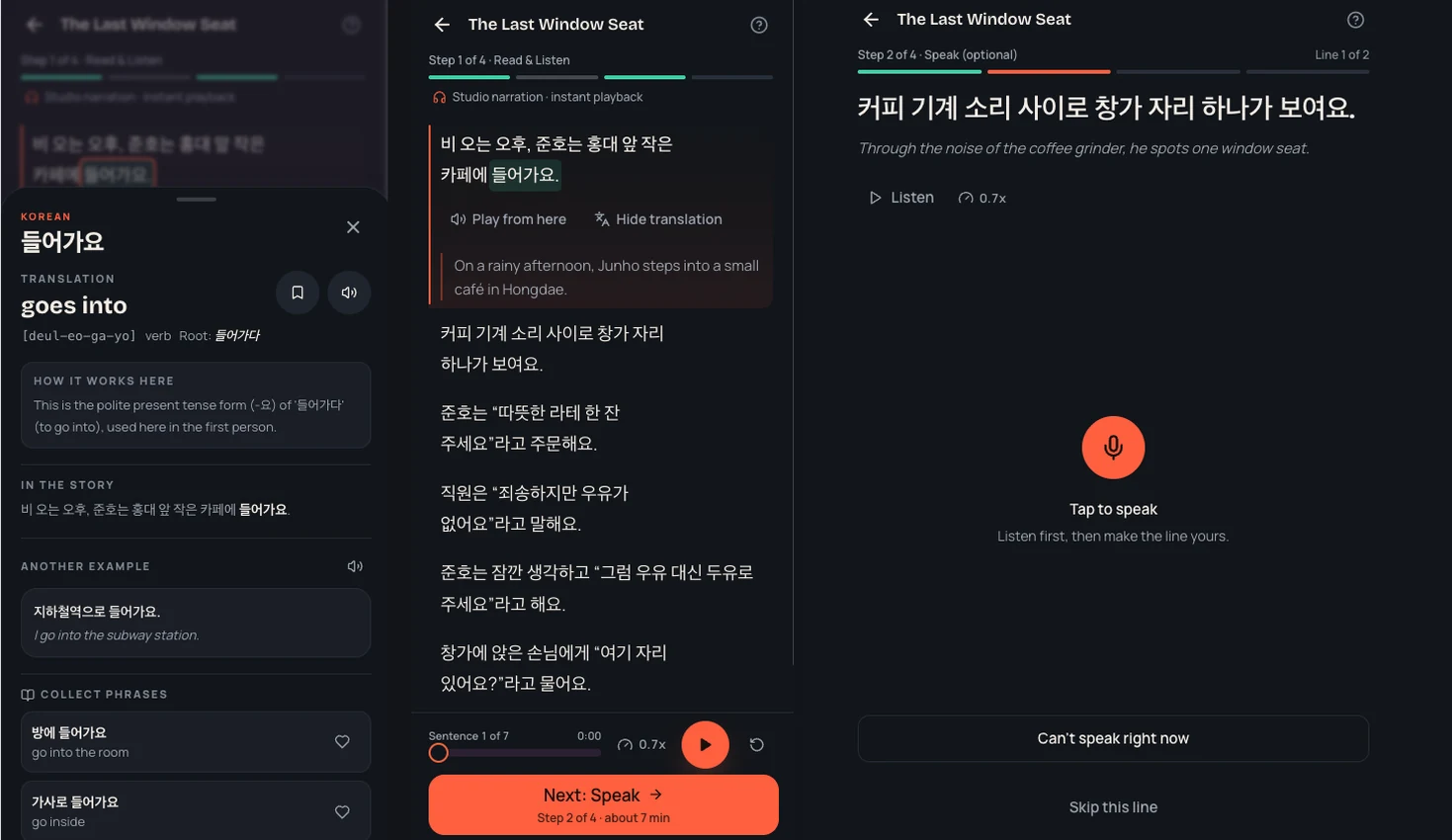
MeloLingua is a story-based language-learning app that teaches Korean through short graded stories with studio narration. Instead of disconnected drills, each session is one complete everyday scene: you read and listen, tap any word to see what it means in that exact sentence, repeat the lines aloud with pronunciation feedback, rebuild sentences, and answer comprehension questions, with spaced review afterwards so the vocabulary sticks.
For beginners, MeloLingua offers 10 free Korean stories to learn Korean with short stories at A1 and A2 level, with English support and a short Hangul starting path. It's a good fit for learners who find Duolingo too repetitive and want to understand real Korean sentences from day one. MeloLingua also covers 12 other languages, including Spanish, French and Italian, and has a free plan with no credit card needed.
Features and Benefits:
- Graded Korean stories (A1-A2) with audio narration
- Tap-to-translate words explained in context
- Speaking practice with pronunciation feedback
- Sentence building, comprehension quizzes and spaced review
3. LingoDeer: Focus on Grammar and Writing
LingoDeer teaches Korean through structured lessons and grammar explanations. You can study vocabulary, practice writing, and review what you have learned. Some introductory content is free, while full access requires a subscription.
Features and Benefits:
- Structured lessons
- Grammar notes
- Writing and review exercises
4. Memrise: Vocabulary and Listening
Memrise helps you learn Korean words and phrases through lessons based on your interests. It pairs vocabulary with videos of speakers using the language and offers conversation practice with an AI partner. Some features require a paid plan.
Features and Benefits:
- Vocabulary lessons
- Videos featuring Korean speakers
- AI conversation practice

5. Mondly: Short Interactive Lessons
Mondly offers Korean lessons built around everyday vocabulary and phrases. Its exercises combine listening, reading, and speaking practice; extra features and course access depend on the plan and device.
Features and Benefits:
- Short lessons
- Everyday vocabulary
- Listening and speaking exercises
6. Pimsleur: Practice by Listening
Pimsleur focuses on audio lessons that ask you to listen and respond aloud. This format is useful if you want to practice conversation during a commute or while walking, although you will need separate reading practice to become comfortable with Hangul.
Features and Benefits:
- Audio lessons
- Spoken responses
- Conversation-focused practice
7. Mango Languages: Conversation and Culture
Mango Languages teaches Korean with practical dialogues, pronunciation activities, and cultural notes. You may be able to access the service through a participating library, school, or other institution; check availability with your local provider.
Features and Benefits:
- Practical dialogues
- Pronunciation activities
- Cultural notes
8. Drops: Learning in Short Intervals
Drops focuses on vocabulary through short visual exercises. Its five-minute sessions are easy to fit into a routine, but you will want another resource for extended grammar and conversation practice.
Features and Benefits:
- Visual vocabulary exercises
- Short sessions
- Review practice
9. Eggbun: Korean with a Chatbot Tutor
Eggbun teaches Korean through chat-style lessons with Lanny, a chatbot tutor. The app combines vocabulary, reading, listening, and writing activities with cultural material. It is designed for self-study rather than live private lessons with a native speaker.
Features and Benefits:
- Chat-style lessons
- Vocabulary and writing practice
- Korean culture content
10. Udemy: Courses for Different Levels
Udemy offers Korean courses from individual instructors, so lesson quality, topics, and prices vary. Check the syllabus, instructor, reviews, and last update before buying. Courses can focus on Hangul, grammar, pronunciation, or other goals.
Features and Benefits:
- Courses from different instructors
- Beginner and advanced topics
- Self-paced video lessons
11. Lingopie: Learn with Videos
Lingopie uses videos with interactive subtitles to help learners connect spoken language with written words. It can be useful for listening practice alongside a structured course; check the current Korean catalog and plan before subscribing.
Features and Benefits:
- Video-based learning
- Interactive subtitles
- Vocabulary practice
12. Talk To Me In Korean: Lessons and Listening
Talk To Me In Korean offers a library of Korean lessons, courses, and listening materials. Its resources can help learners who want explanations and practice beyond a daily quiz. Check the available plans and course descriptions before choosing.
Features and Benefits:
- Korean lessons
- Listening materials
- Structured courses
13. KoreanClass101: Audio and Video Lessons
KoreanClass101 provides Korean audio and video lessons for different levels, with vocabulary and grammar resources. Its library is useful for learners who enjoy listening to explanations and dialogues. Some materials and features require a paid plan.
Features and Benefits:
- Audio and video lessons
- Vocabulary and grammar
- Lessons for different levels
14. GO! Billy Korean: Video Lessons and Books
GO! Billy Korean is a learning resource created by Korean teacher Billy Go. His website and videos cover Hangul, grammar, and conversation, and his books offer another way to study. It is a useful companion to an app, although it is primarily a collection of lessons and books rather than a standalone learning app.
Features and Benefits:
- Lessons from Billy Go
- Hangul and grammar videos
- Books and learning materials
15. HelloTalk: Language Exchange
HelloTalk connects language learners with speakers who want to practice each other’s languages. You can exchange text or voice messages and use the app’s correction and translation tools. It works best alongside a course when you want real conversations, and finding a suitable partner can take time.
Features and Benefits:
- Language exchange with Korean speakers
- Text and voice messages
- Correction and translation tools
Conclusion
Choose a resource that matches your current goal. A structured course can help with Hangul and grammar, while audio, videos, and language exchange give you more opportunities to hear and use Korean.
Remember:
- Learning a language takes time and dedication. Be patient with yourself and practice regularly.
- Combine the use of apps with other forms of learning, such as watching Korean dramas, listening to Korean music, and conversing with native speakers.
- Try a few formats and keep the ones that fit your routine and help you stay motivated.





Community
Comments
0 comments
There are no published comments in this language yet.
Send comment