
Karaage [から揚げ] is a Japanese frying technique that starts long before the oil: small pieces of food—most often chicken—are marinated, dusted with starch or flour, then deep-fried until the outside snaps and the inside stays juicy. You will also meet fish, other meats, and even tofu done the same way, but when someone in Japan says “karaage,” they almost always mean chicken.
That contrast is the whole point. Ordinary breaded chicken often leans on a thick crust and a dipping sauce. Karaage leans on the marinade—soy sauce, ginger, sake, sometimes garlic—so the flavor is already inside the meat when it hits the pan.
Contents 9
Why is karaage so delicious?
What separates karaage from everyday fried chicken is not mystery seasoning so much as sequence. The meat sits in a soy-based marinade, usually with ginger and sake (and often garlic), long enough for the salt and aromatics to settle in. Then comes a light coating of wheat flour, potato starch, cornstarch, or a mix of both—not a heavy batter that drowns the chicken.
Once fried in neutral oil, the shell turns crisp while the center stays tender. A half hour or more in the fridge with the marinade makes a clear difference; rushing that step is the fastest way to get something that only looks like karaage. On the plate, it is usually served plain with lemon, or with rice and shredded cabbage, the way izakaya kitchens and homemade bentos still do it.
What is the origin of karaage?
The name itself already tells a story. Written as 唐揚げ, kara points to “Tang” / Chinese-style frying; written as 空揚げ, it can be read as “empty” frying—coating without a thick wet batter. Japanese newspapers and cookbooks still disagree on the preferred kanji, which is why many people simply write からあげ in hiragana.
References to a frying style called karaage appear as early as the Genroku period at the end of the 17th century. Chicken karaage as a restaurant dish with the “Chinese-style” characters spread more clearly in the 1930s. After World War II, home cooks leaned harder on chicken because it was practical and relatively affordable, and the technique settled into everyday Japanese cooking.
Some local stories credit early popularity to places such as the Toyoken restaurant in Beppu, famous for its onsen tourism. Broader food history also points to Ōita Prefecture—especially the neighboring cities of Usa and Nakatsu—as a stronghold of chicken karaage culture. Nakatsu still hosts a large karaage festival, and shops advertising “Nakatsu karaage” turn up far beyond Kyushu.
Like gyoza and ramen, the technique sits in the wider family of Chinese-rooted methods adapted to Japanese taste. That does not make every plate identical: once the idea landed in Japan, regions rewrote the marinade, the cut, and the sauce around local habits.
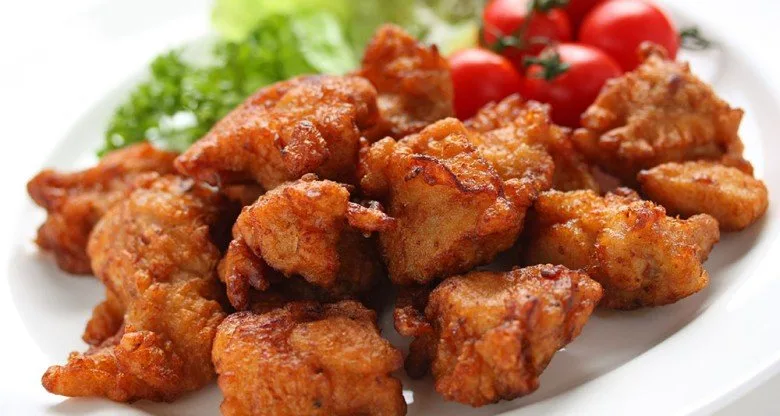
Tatsutaage [竜田揚げ] is closely related and often treated as a type of karaage, not a synonym for “Tang fry.” The name is tied to the Tatsuta River in Nara, famous for autumn leaves; the pale starch coat with soy-darkened edges is said to recall those floating colors. In kitchen practice, tatsutaage usually uses a soy-and-mirin style marinade and a coating that is mainly potato starch, often without garlic. Ordinary karaage may mix flour and starch and lean more freely on ginger and garlic. Menus blur the line all the time—if both names appear, read the description more than the dictionary.
Today you can find karaage at Lawson, FamilyMart, 7-Eleven, food stalls, izakaya counters, and home kitchens across Japan.
Different types of karaage
Karaage is a method more than a single recipe. Change the cut, the marinade, or the sauce and you still land inside the same family. Regional standards help when you want a specific mood on the plate:
Zangi — Hokkaido’s take, usually served with a spicy dipping sauce rather than lemon alone.
Tebasaki — Nagoya’s fried chicken wings, often finished with sesame and a sticky special sauce. Bone-in wings make the eating messier and more satisfying.
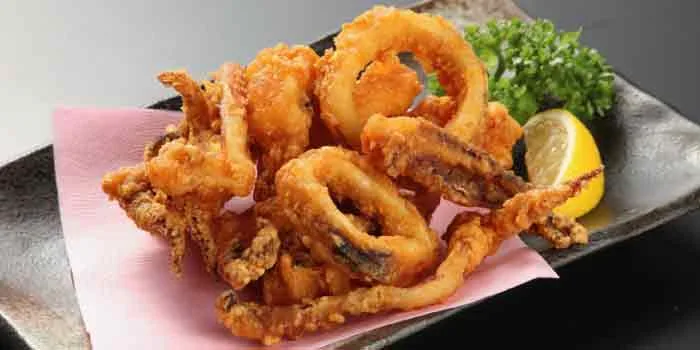
Toriten — From Ōita, coated in wheat flour and often served as a topping for udon rather than as a snack with cabbage.
Chicken nanban — Miyazaki Prefecture’s version: fried chicken soaked in sweet vinegar and finished with tartar sauce.
Gurukun no kara-age — Okinawa’s popular “banana fish” fried whole and served with lemon.
Dakgangjeong is not a Japanese regional karaage, but a Korean fried-chicken cousin that travelers often compare to it. The coating and glaze usually run sweeter and spicier, sometimes with a milk-based prep, and the sauce does more of the finishing work than a Japanese soy marinade alone. Worth knowing so you do not mislabel either dish when you order.
The famous konbini karaage
In many countries, fried snacks live in bakeries, food trucks, or fast-food counters. In Japan, the everyday grab-and-go version often sits in a convenience store—a konbini—next to breaded sausages and nikuman.
Konbini karaage usually comes on a skewer or in a small tray, priced roughly around 100 to 300 yen depending on size and brand. Flavors rotate: plain, spicy, garlic, cheese, limited-edition sauces. It is not always the same as a specialty shop plate, but it is the version that fits a late train, a desk lunch, or a night walk with a cold drink.
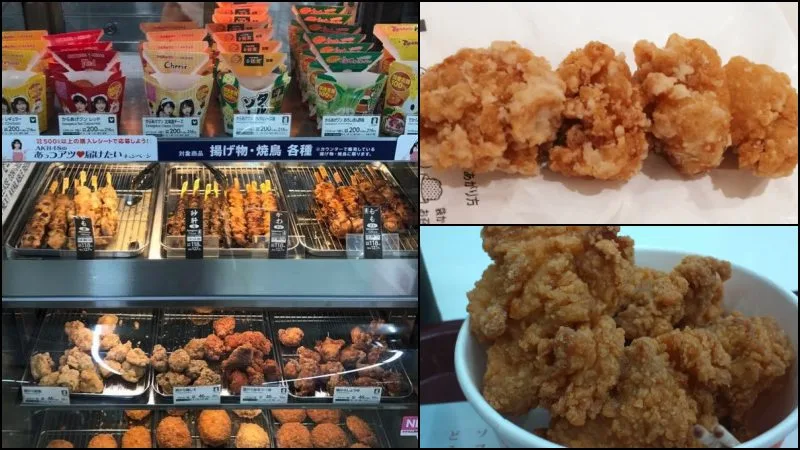
Some people insist on restaurant or homemade karaage only. I personally liked the konbini kind a lot and ate it almost every day alongside nikuman—the convenience version is its own genre, not a failed restaurant copy.
What is the difference between karaage and tempura?
In Japanese, foods fried with a coating sit under the broader idea of agemono [揚げ物]—fried things. That family includes eggplants, potatoes, asparagus, pumpkin, mushrooms, fish, shrimp, squid, and meats, each with its own batter or dredge.
Tempura is usually not marinated first; the light batter does the work, and you dip the finished piece in tentsuyu or salt. Karaage flips that logic: seasoning happens in the marinade, the coating stays relatively dry, and lemon or mayo is often enough at the table. The experience is completely different even when both are “Japanese fried food.”
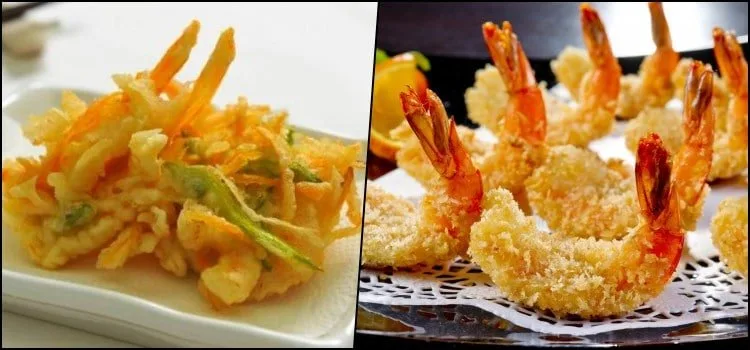
Tempura batter is thin and cooks fast. There is also kakiage, mixed vegetables fried together in tempura batter. Karaage’s starch shell, by contrast, is denser and built for bite-size chicken that already carries soy and ginger.
Karaage recipe
Karaage travels well outside Japan because the ingredient list is short and the method is forgiving. Once you control the marinade time and the oil temperature, the rest is practice. Here is a home version close to what many Japanese kitchens actually do—no thick American batter, no long wait for a restaurant deep-fryer.
Ingredients (about 2 servings)
- About 400–500 g boneless chicken thighs (skin-on if you can get it; other cuts and firm fish also work)
- 2 tablespoons potato starch or cornstarch (plus more if needed)
- 2 tablespoons wheat flour (or use only starch for a lighter shell)
- Neutral oil for deep-frying
- Lemon wedges, to serve (Kewpie mayonnaise optional)
Marinade
- 2 tablespoons soy sauce (shoyu)
- 1–2 tablespoons sake (or dry sherry if needed)
- 1 teaspoon sugar (optional, for balance)
- 1 grated garlic clove
- About 1 tablespoon grated ginger with juice
- Black pepper to taste
- A few drops of toasted sesame oil (optional)
Method
- Cut the chicken into even bite-size pieces so everything fries at the same pace.
- Mix the marinade ingredients, add the chicken, and massage until coated.
- Cover and refrigerate for about 30 minutes (up to an hour is fine; longer can over-salt).
- Heat oil to about 160–165°C (320–330°F). Dredge each piece lightly in flour, then starch, shaking off the excess.
- Fry in small batches for about 2–3 minutes until the color is pale gold. Drain on a rack.
- Raise the oil to about 180°C (350°F) and fry a second time for 30–60 seconds until deep golden and extra crisp.
- Serve hot with lemon. The double fry is optional on busy nights, but it is the step that keeps leftovers from going limp.
You can swap potato starch for cornstarch, skip garlic for a milder profile closer to some tatsutaage plates, or finish with shichimi togarashi. The core remains the same: marinate, coat lightly, fry hot, and let the crunch do the talking.

Community
Comments
0 comments
There are no published comments in this language yet.
Send comment